
 Posts
Posts


The
Problem Of Debt As We Reach Oil Limits
Gail
Tverberg
11
February, 2015
(This
is Part 3 of my series – A New Theory of Energy and the Economy.
These are links to Part
1 and Part
2.)
Many
readers have asked me to explain debt. They also wonder, “Why
can’t we just cancel debt and start over?”
if we are reaching oil limits, and these limits threaten to
destabilize the system. To answer these questions, I need to talk
about the subject of promises in general, not just what we would call
debt.
In
some sense, debt and other promises are what hold together our
networked economy. Debt
and other promises allow division of labor, because each person can
“pay” the others in the group for their labor with a promise of
some sort, rather than with an immediate payment in goods. The
existence of debt allows us to have many convenient forms of payment,
such as dollar bills, credit cards, and checks. Indirectly, the many
convenient forms of payment allow trade and even international trade.

Each
debt, and in fact each promise of any sort, involves two parties.
From the point of view of one party, the commitment is to
pay a certain amount (or
certain amount plus interest). From the point of view of the other
party, it
is a future benefit–an
amount available in a bank account, or a paycheck, or a commitment
from a government to pay unemployment benefits. The two parties are
in a sense bound together by these commitments, in a way similar to
the way atoms are bound together into molecules. We can’t get rid
of debt without getting rid of the benefits that debt
provides–something that is a huge problem.
There
has been much written about past debt bubbles and collapses. The
situation we are facing today is different. In the past, the world
economy was growing, even if a particular area was reaching limits,
such as too much population relative to agricultural land. Even if a
local area collapsed, the rest of the world could go on without them.
Now, the world economy is much more networked, so a collapse in one
area affects other areas as well. There is much more danger of a
widespread collapse.
Our
economy is built on economic growth. If the amount of goods and
services produced each year starts falling, then we have a huge
problem. Repaying loans becomes much more difficult.
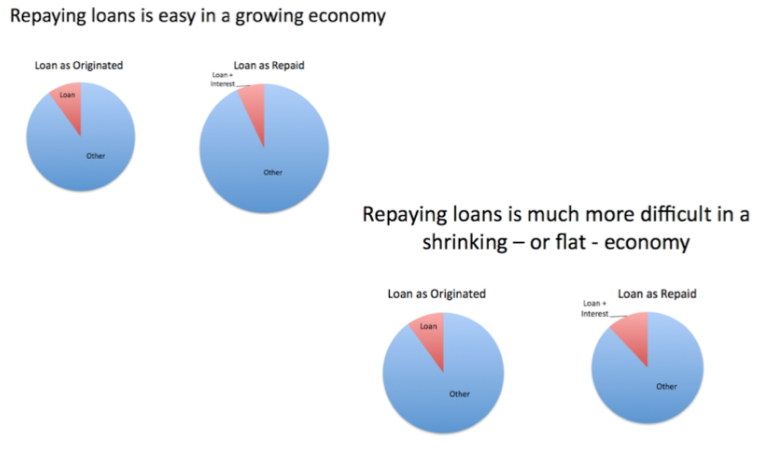
Figure
2. Repaying loans is easy in a growing economy, but much more
difficult in a shrinking economy.
In
fact, in an economic contraction, promises that aren’t debt, such
as promises to pay pensions and medical costs of the elderly as part
of our taxes, become harder to pay as well. The amount we have left
over for discretionary expenditures becomes much less. These
pressures tend to push an economy further toward contraction, and
make new promises even harder to repay.
The
Nature of Debt
In
a broad sense, debt is a promise of something of value in the future.
With this broad definition, it is clear that a $10 bill is a form of
debt, because it is a promise that at some point in the future you,
or the person you pass the $10 bill on to, will be able to exchange
the $10 bill for something of value. In a sense, even gold coins
are a promise of value in the future. This is not necessarily a
promise we can count on though. At times in the past, gold
coins have been confiscated.
Derivatives and other financial products have characteristics of debt
as well.
To
understand how important debt is, we need to think about an economy
without debt.Such
an economy might have a central market where everyone brings goods to
exchange. But even in such an economy, there will be a problem if
there is not a precise matching of needs. If I bring apples and you
bring potatoes, we could exchange with each other (“barter”). But
what if I don’t have a need for potatoes?
Then we might need to
bring a third person into the ring, so each of us can receive what we
want. Because barter is so cumbersome, barter
was never widely used for everyday transactions within communities.
An
approach that seemed to work better is one mentioned in David
Graeber’s book, Debt:
The First 5,000 Years.
With this system, a temple would operate a market. The operator of
the market would provide a “price” for each object, in terms of a
common unit, such as “bushels of wheat.” Each person could bring
goods to the market (and perhaps even services–I will work for a
day in your vineyard), and have them exchanged with others based on
value. No “money” was really needed because the operator would
take a clay tablet and on it make a calculation of the value in
“bushels of wheat” of what a person brought in goods, The
operator would also calculate the value in “bushels of wheat”
that the same person was receiving in return, and make certain that
the two matched.
Of
course, as soon as we start allowing “a day’s worth of labor ”
to be exchanged in this way, we get back to the problem of future
promises, and making certain that they really happen. Also, if we
allow a person to carry over a balance from one day to another–for
example, bringing in a large quantity of goods that cannot be sold in
one day–then we get into the area of future promises. Or if we
allow a farmer to buy seed on credit, with a promise to pay it back
when harvest comes in a few months, we again get into the area of
future promises. So even in this simple situation, we need to be able
to handle the issue of future promises.
Future
Promises Even Before Debt
Whenever
there is division of labor, there needs to be some agreement as to
how that division will take place–what are the responsibilities of
each participant. In the simplest case, we have hunters and
gatherers. If there is a decision that the men will do the hunting
and the women will do the gathering and care for children, then there
needs to be an agreement as to how the arrangement will work. The
usual approach seems to have been some sort of “gift
economy.”
In such an economy, everyone would share whatever they were able to
obtain with others, and would gain status by the amount they could
offer to share.
Instead
of a formal debt being involved, there was an understanding that if
people were to participate in the group, they had to follow the rules
that the particular culture dictated, including, very often, sharing
everything. People who didn’t follow the rules would be thrown out.
Because of the difficulty in living in such an environment alone,
such people would likely die. Thus, participants were in some sense
bound together by the customs that underlay gift economies.
At
some point, as more of an economy was built up, there would be a need
for one or more leaders, as well as some way of financially
supporting those leaders. Thus, there would need to be some sort of
taxation. While taxation to support the leader would not be
considered debt, it has many of the same characteristics as debt. It
is an ongoing payment obligation. The leader and the other members of
the group plan their lives as if this situation is going to continue.
In a way, the governmental services and the resulting taxation help
bind the economy together.
Benefits
of Debt
The
benefits of debt are truly great, including the following:
- Debt allows transactions to take place that are not precisely at the same time and place. I can order goods and have them delivered to my home. An employer can pay me for a month’s work with a check, rather than needing to give me food or some other barter item corresponding to each hour I work. There is no need to have billions of gold coins (or other agreed up metal currency) to facilitate each and every transaction, and to transport around. We can each have bank accounts. From the bank’s perspective, the amount in a bank account is a liability (debt) owed to the depositor.
- Additional debt gives additional purchasing power to individuals, governments or businesses. The additional funds available can be spent immediately. Very often, repayment (with interest) is spread over several years, making goods that would not be affordable, affordable. Thus debt raises “demand” for goods and also for the commodities used to create these goods.
- Because debt makes goods more affordable, additional debt tends to “pump up” the price of commodities. These higher prices make it worthwhile for businesses to extract more minerals (including fossil fuels) from the earth, and make it worthwhile to plant more acres of food. Debt, particularly cheap debt, makes building new factories and opening new mines more affordable for businesses.
- Debt allows a steep step-up in standard of living, such as that obtained by adding coal or oil to an economy. Debt allows goods to be purchased that will substantially change a person’s future, such as transit to a new country, or purchase of a college education, or purchase of a delivery vehicle that can be used to start a business. Without debt, it is unlikely that fossil fuels could ever have been extracted; consumers would never have been able to afford the goods provided by fossil fuels, and businesses would have had difficulty financing the many new factories required to make goods using these fuels.
- Adding debt is self-reinforcing. Suppose a considerable amount of debt is added for what is deemed a good purpose, such as extracting oil in North Dakota. Oil companies will use the debt they receive for many different purposes–including paying employees, paying royalties to land owners, and paying taxes to the state. Employees will buy new houses and cars, taking out loans in the process. North Dakota residents who receive royalty payments may decide to take out home improvement loans to fix up their homes, expecting that the royalties will continue. The state may fix its roads with its revenue, giving additional income (which may lead to more debt) to road workers. A grocery chain may decide to build a new store (borrowing money to do so), further pushing the chain along. What happens is that indirectly, the new oil company debt makes a lot of people at least temporarily wealthier. These temporarily wealthier individuals can then “qualify” for more in loans than would otherwise be the case, giving them more to spend, and allowing yet others to qualify for loans.
- Arrangements that are not debt, but more of the nature of contingent debt, make people feel more confident of the current system. There are insurance programs for pension programs and for bank accounts, up to a selected balance per account. These insurance programs generally don’t have very much money in them, relative to what they are insuring. But they make people feel good, especially if there is a government that might come in and take over, beyond the actual funding of the insurance program.
What
Goes Wrong with Debt and Other Financial Promises
1.
As mentioned at the beginning of the post, debt works very badly if
the economy is contracting.
It
becomes impossible to repay debt with interest, without reducing
discretionary income. Government programs, such as health care for
the elderly, become more expensive relative to current incomes as
well.
2.
Interest payments on debt tend to transfer wealth from the
poorer members of society to the richer members of society.
Economists
have tended to ignore debt, because it represents a more or less
balanced transaction between two individuals. The fact remains,
though, that the poorer members of society find themselves especially
in need of debt, and many pay very high interest rates. The ones
lending money tend to be richer. Because of this arrangement, over
time, interest payments tend to increase wealth disparities.
3.
All too often, the payment stream upon which debt depends proves
unsustainable.
In
the example given above, everyone thinks the North Dakota oil will
continue for a while, so takes out loans as if this is the case. If
it doesn’t, then this is an “Oops” situation.
In
the case of US student loans, many students are never able to get
jobs with high enough wages to pay back the loans they were given.
4.
Governments tend to put programs into place that are more
expensive than they really can afford, for the long term.
As
an economy gets wealthier (because of more fossil fuel use), there is
a tendency to add more programs. Representative government is used
instead of a monarch. Medical care and pensions for the elderly are
added, as are unemployment benefits, and more advanced levels of
schools.
Unfortunately,
it is hard to properly estimate what long-run cost of these programs
will be. Also, even if the programs were affordable with a high level
of fossil fuels, they almost certainly will not be affordable if
energy availability declines. It is virtually impossible to roll
programs back, even if they are not guaranteed, once people plan
their lives on the new programs.
Figure
3 shows a graph of US government spending (all levels) compared to
wages (including amounts paid to proprietors, including farmers). I
use this base, rather than GDP, because wages have not been keeping
up with GDP in recent years. The amounts shown include programs such
as Social Security and Medicare for the elderly, in addition to
spending on things such as schools, roads, and unemployment
insurance.
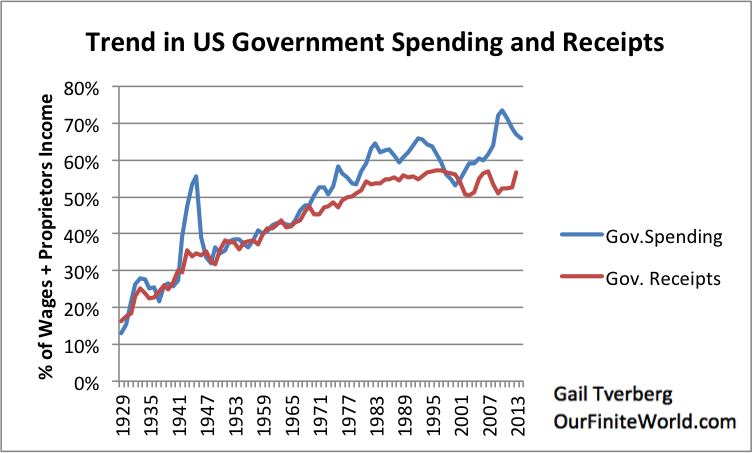
Figure
3. Comparison of US Government spending and receipts (all levels
combined) based on US Bureau of Economic Research Data.
Clearly,
government spending has been rising much faster than wages. I would
expect this to be true in many countries.
5.
There is no real tie between amounts of debt issued and what
will actually be produced in the future.
We
are told that money
is a store of value,
and that it transfers purchasing power from the present to the
future. In other words, we can count on balances in our bank
accounts, and in fact, in all of the paper securities that are
outstanding.
This
story is only true if the economy can continue to create an
increasing amount of goods and services forever. If, in fact, the
production of goods and services drops off dramatically (most likely
because prices cannot rise high enough to encourage enough extraction
of commodities), then we have a major problem.
In
any year, all we have available is the actual amount of resources
that can be pulled out of the ground, plus the actual amount of food
that can be grown.
Together, these amounts determine how many goods
and services are available. Money acts to distribute the goods that
are available. Presumably, the people who work at extraction and
production of these goods and services need to be paid first, or the
whole process will stop. This basically leaves the “leftovers” to
be shared among those who are now being supported by tax revenue and
by those who hold paper securities of some sort or other. It is hard
to see that anyone other than the workers producing the goods and
services will get very much, if we lose the use of fossil fuels.
Workers will become less efficient, and production will drop by too
much.
6.
Derivatives and other financial products expose the financial system
to significant risks.
Certain
large banks have found that they can earn considerable revenue by
selling derivatives and other financial products, allowing people or
businesses to essentially gamble on certain outcomes–such as the
price of oil falling below a certain price, or interest rates rising
very rapidly, or a certain company failing. As long as everything
goes well, there is not a huge problem. The concern now is that with
rapidly changing commodity prices, and rapidly changing levels of
currencies, companies may fail and there may be major payouts
triggered.
In
theory, some of these payments may be offsetting–money owed by one
client may offset money owed to another client. But even if this is
the case, these defaults can sometimes take years to settle. There
may also be issues with one of the parties’ ability to pay.
One
particular problem with many of the products is the use of
the Black-Scholes
Pricing Model.
This model is applicable when events are independent and normally
distributed. This is not the case, when we are approaching oil limits
and other limits of a finite world.
7.
Governments tend to be badly affected by a shrinking economy, so may
be of little assistance when we need them most.
As
noted previously, payments to governments act very much like debt. As
an economy shrinks, programs that seemed affordable in the past
become less affordable and badly need to be cut. Thus, governments
tend to have problems at the exactly same time that banks and other
lenders do.
Governments
of “advanced” countries now
have debt levels that are high by historical standards. If
there is another major financial crisis, the plan seems to be to
use Cyprus-like
bail-ins of
banks, instead of bailing out banks using government debt. In a
bail-in, bank deposits are exchanged for equity in the failing
bank. For
example,
in Cyprus, 37.5% of deposits in excess of 100,000 euros were
converted to Class A shares in the bank.
This
approach has a lot of difficulties. Businesses have a need for their
funds, for purposes such as paying employees and building new
factories. If their funds are taken in a bail-in, the ability of the
business to continue may be damaged. Individual consumers depend on
their bank balances as well. As noted above, deposit insurance is
theoretically available, but the actual amount of funds for this
purpose is very low relative to the amount potentially at risk. So we
get back to the issue of whether governments can and will be able to
bail out banks and other failing financial institutions.
If
wages are rising fast enough, wages by themselves might be used to
pump demand for commodities, and thus raise their prices. Our wages
are close to flat–median
wages have been falling in
the US. If wages aren’t rising sufficiently, increasing debt must
be used to raise demand. Debt is growing slowly in the household
sector, according to figures compiled by McKinsey
Global Institute.
Household debt has grown by only 2.8% per year between Q4 2007 and Q4
2014, compared to 8.5% per year in the period between Q4 2000 and Q4
2007.
Even
with business demand included, debt isn’t rising rapidly enough to
keep commodity prices up. This lack of sufficient growth in debt (and
lack of growth in demand apart from growing debt) seems to be a major
reason for the drop
in prices since 2011 in many commodity prices.
9.
Differing policies with respect to interest rates and quantitative
easing seem to have the possibility of tearing the world financial
system apart.
In
a networked economy, not moving too far from the status quo is a
definite advantage. If the US’s policies have the effect of raising
the value of the dollar, and the policies of other countries have the
tendency to lower their currencies, the net effect is to make debt
held in other countries but denominated in US dollars unpayable. It
also makes goods sold by American companies unaffordable.
The
economy, as it exists today, has been made possible by countries
working together. With sanctions against Iran and Russia, we are
already moving away from this situation. Low oil prices are now
putting the economies of oil exporters at risk. As countries try
different approaches on interest rates, this adds yet another force,
pulling economies apart.
10.
The economy begins to act very strangely when too much of current
income is locked up in debt and debt-like instruments.
Economic
models suggest that if oil prices drop, demand for oil will grow
robustly and supply will drop off quickly. If oil producers are
protected by futures contracts that lock in a high price, they may
not respond in the manner expected. In fact, if they are obligated to
make debt payments, they may continue drilling even when it may not
otherwise make financial sense to do so.
Likewise,
consumers are also affected by prior commitments. If much of
consumers’ income is tied up with condominium payments, auto
payments, and payment of taxes, they may not have much ability to
respond to lower oil prices. Instead of increasing discretionary
spending, consumers may pay off some of their debt with their
newfound income.
Conclusion
If
the current economic system crashes and it becomes necessary to
create a new one, the new system will have to deal with having an
ever-smaller amount of goods and services available for a fairly long
transition time. Because
of this, the new system will have to be very different from the
current one. Most promises will need to be of short
duration. Transfers among people living in a particular
area might still be facilitated by a financial system, but it would
be hard to have long-term or long-distance contracts. As a
result, the new economy will likely need to be much simpler than our
current economy. It is doubtful it could include fossil fuels.
Many
people ask why we can’t just cancel all debt, and start over again.
To do so would probably mean canceling all bank accounts as well.
Most of our current jobs would probably disappear. We would probably
be without grid electricity and without oil for cars. It would be
very difficult to start over from such a situation. We would truly
have to start over from scratch.
I
have not talked about a distinction between “borrowed funds” and
“accumulated equity”. Such a distinction is important in terms of
the rate of return investors expect, but it is not as important in a
crash situation. Similarly, the difference between stocks, bonds,
pension plans, and insurance contracts becomes less important as
well. If there are real problems, anything that is not physical ends
up in the general category of “paper wealth”.
We
cannot count on paper wealth (or for that matter, any wealth) for the
long term. Each
year, the amount of goods and services the economy can produce is
limited by how the economy is performing, given limits we are
reaching. If the quantity of these goods and services starts falling
rapidly, governments may fail in addition to our problems with debts
defaulting. Those
holding paper wealth can’t count on getting very much. Workers
producing whatever goods and services are actually being produced
will likely need to be paid first.


No comments:
Post a Comment
Note: only a member of this blog may post a comment.