Showing posts with label economy. Show all posts

Saturday, 6 March 2021

China's new Five Year Plan cuts growth and turns back on cutting emissions

China.. refrained from introducing a ban on building new coal-fired plants, and did not set a target for curbing coal power plants’ capacity for the next five years.

 China Cuts Growth Outlook, Increases Military Spend, Shrugged Off Climate Change In Latest 'Five-Year Plan'

Zero Hedge,

5 March, 2021


When it comes to official documents, China’s five-year plans (FYPs) are the mother of them all. Not only do FYPs encapsulate all major socioeconomic goals and priorities, they contain the basic assessment and strategy of how China aims to develop.  
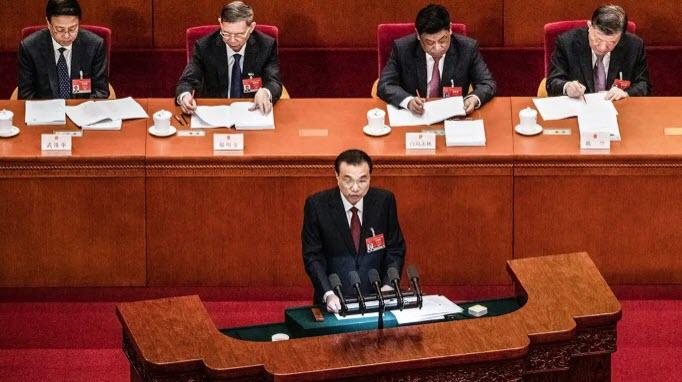
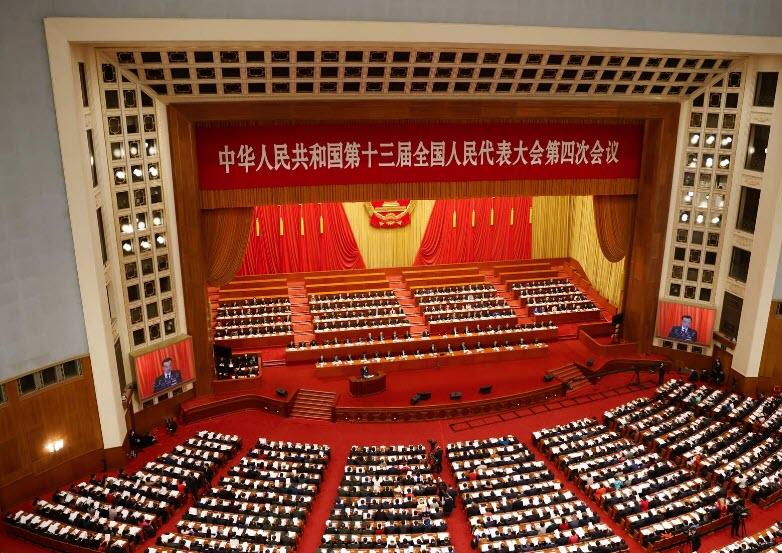
Premier Li Keqiang touted the achievements of the previous year as China overcame the coronavirus pandemic, and laid out ambitions to solidify the economic recovery, cut emissions, invest in innovation and improve a worsening demographic outlook.

"We will keep major economic indicators within an appropriate range, set annual targets for economic growth in light of actual conditions," Li told 2,900 delegates, including President Xi Jinping.

"Doing so will enable us to achieve higher-quality development that is more efficient, equitable, sustainable and secure."

The five-year plan is part of Xi's ambition to make China a high-income economy by 2025, paving the way to doubling the country's gross domestic product in 2035 from the 2020 base.

After the painful contraction (and immediate rebound) that China's economy saw last year. China grew by 2.3% last year, its weakest in 44 years, but was still the only major economy to expand as it largely vanquished the domestic spread of the novel coronavirus that first emerged in the country in late 2019.
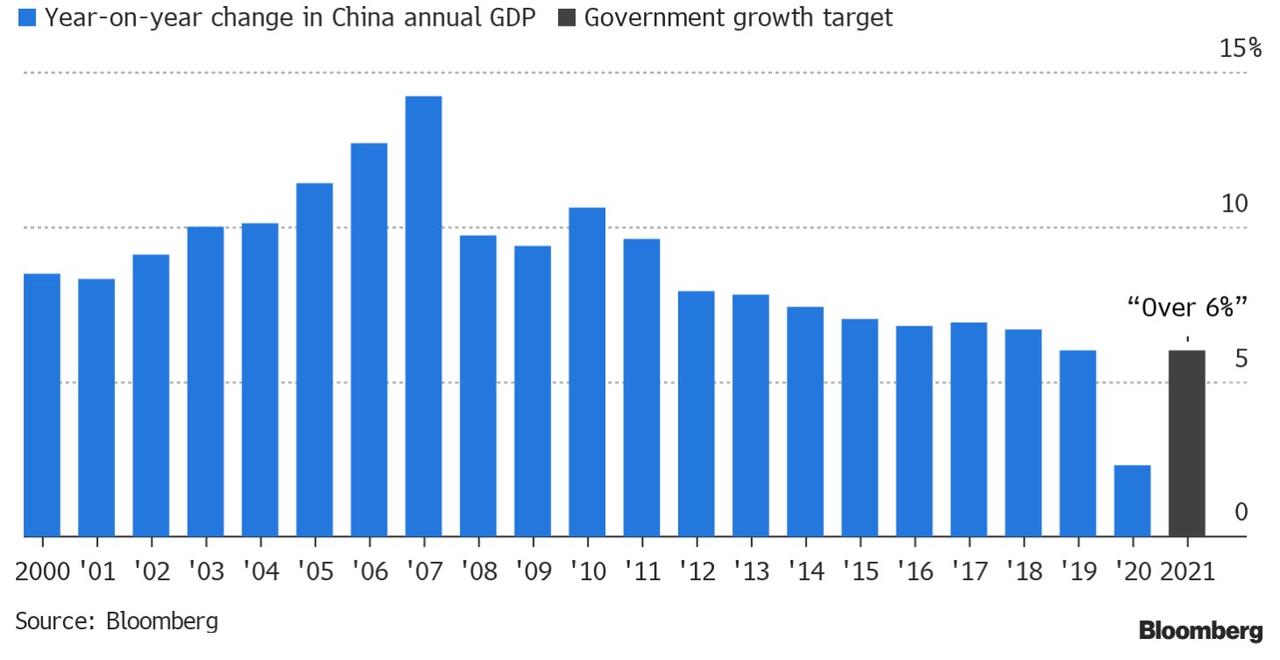
Li set a growth target of more than 6% this year for the world’s second-largest economy, seen to be easily achievable, defying expectations that China would refrain from setting a goal given global uncertainty caused by the pandemic. The growth target for the year is lower than the 8%-to-9% projected by some economists but Li argued that it is "well-aligned with the annual goals of subsequent years" under the five-year plan to "sustain healthy economic growth."
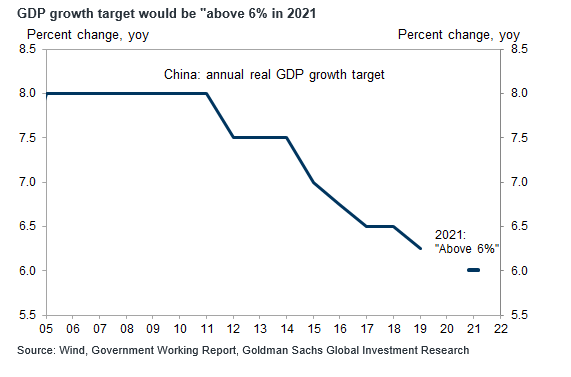
Chaoping Zhu, global market strategist at J.P. Morgan Asset Management, said the low economic expansion target reflects a shift from quantity to quality growth.

“This implies that more resources will be allocated to push forward long-term initiatives such as environment protection, fiscal consolidation and leverage reduction, so as to boost China’s long-term growth potential,” he said in a note.

The growth target lets China “devote full energy to promoting reform, innovation, and high-quality development,” Li said.

"Innovation remains at the heart's of China's modernization drive," Li said.
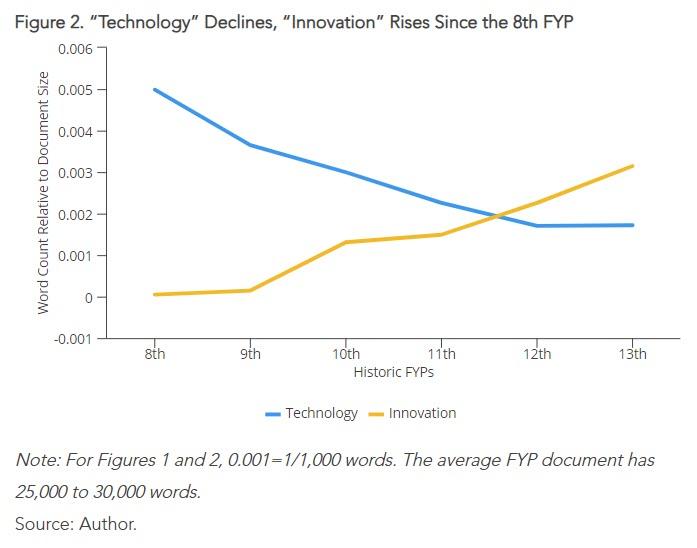
Nikkei Asia reports that Li also pledged to ensure that the country's industrial and supply chains are "more self-supporting" by upgrading infrastructure and supporting Chinese companies' capacity-building.

"The development of 5G networks and 1000M fiber optic networks will be stepped up and their application will be extended to more settings," he said.

The five-year plan also aims to increase R&D spending by at least 7 per cent each year through 2025, to reduce China’s reliance on US companies for semiconductors and other technologies.

Despite advocating "fiscal frugality," one exception is military spending, which will grow by 6.8% to 1.355 trillion yuan. It is slightly higher than 2020's 6.6%, reflecting the government's priority of modernizing its military.

Ni Lexiong, a military analyst, said that deteriorating ties with the US had created “drastic changes” in China’s external security concerns, making it impossible to cut military expenditure.

China pledged to lift employment, targeting more than 11 million new urban jobs, compared with last year’s goal of over 9 million.

In the absence of COVID-19 stimulus, businesses, especially small and medium enterprises will continue to enjoy tax holiday and tax cuts.

Additionally, much to the chagrin of the world's climate-change evangelists, China - the world's largest "polluter" - confirmed little other than that a plan to reach peak emissions by 2030 would be completed this year (and net-zero emissions by 2060).

“We will expedite the transition of China’s growth model to one of green development, and promote both high-quality economic growth and high-standard environmental protection,” Li said.

As The FT reports, the plan sent an “indecisive signal. We were hoping for more answers on climate issues, but what we got are more questions.”

China also refrained from introducing a ban on building new coal-fired plants, and did not set a target for curbing coal power plants’ capacity for the next five years.

On foreign policy, Li said the government is hopeful of a "mutually beneficial China-U. S. business relations," and reiterated an earlier proposal to join the Comprehensive and Progress Agreement for Trans-Pacific Partnership.
 

Finally, China moved to overhaul Hong Kong’s electoral system on Friday in a further blow to democracy in the city. As The FT reports, delegates will pass a contentious election law designed to reduce further the representation of Hong Kong democracy activists in the territory’s pro-Beijing legislature and other local bodies. Wang Chen, an NPC vice-chairman, said on Friday that Hong Kong's electoral system had “loopholes and deficiencies” that could allow “anti-China forces” to seize control in the city.

*  *  *

Here's Goldman's full breakdown of the 'Two Sessions' meeting:

Thursday, 17 September 2020

New Zealand is officially in recession

 These figures will be massaged; they always are. 
They are talking about recovery but how is that possible when people can't come ino or leave the country and our #1 earner, tourism, is completely shut down.

Yesterday, they were saying 16 %


'In the eye of the storm': 

Quarterly GDP falls a record 

12.2 percent, New Zealand 

officially in recession


17 Setermber, 2020

New Zealand Gross Domestic Product (GDP) fell by a record 12.2 percent in the June 2020 quarter compared to the March quarter, in what is the largest fall since official records began.

In an announcement on Thursday, Statistics New Zealand confirmed that GDP was negative for a second consecutive quarter. Between the March 2020 and the June 2020 quarters, it fell by 12.2 percent, from -1.6 percent in March. The annual percentage change was -2 percent. 


The result indicates the size of the economy has shrunk considerably and New Zealand is officially now in recession.

An official measure of economic activity, GDP provides a snapshot of the value added to the economy over a quarterly or annual period. It represents all finished goods and services made in New Zealand, including net exports (exports minus imports). 

Statistics New Zealand national accounts senior manager Paul Pascoe says the 12.2 percent fall in quarterly GDP is by far the largest on record in New Zealand. 

It’s a little hard to make direct long term comparisions because of the way statistics change over time. It’s much larger than anything we saw in the Global Financial Crisis," he said.

He said technically New Zealand is now in a recession.

This is a very sharp, very broad shock to economy. Obviously we start the September quarter in a very different situation."

Throughout the quarter, borders were closed to incoming travellers. Industries such as retail, accommodation, restaurants and transport were significantly impacted. For essential services, such as food and beverage manufacturers, falls were less. 

COVID-19 alert level 4 restrictions saw the majority of construction activity, and some manufacturing sub-industries, come to a halt. Construction fell by 25.8 percent and manufacturing by 13 percent. Household spending fell by 12.1 percent, including travel, restaurant and takeaway services.

To put the record fall in perspective, steps taken to contain COVID-19 across the world had also led to historically large drops. 

"New Zealand's result compares to falls of 7.0 percent in Australia, 11.5 percent in Canada, 7.9 percent in Japan, 20.4 percent in the United Kingdom, and 9.1 percent in the United States," Pascoe said.

June 2020 quarter GDP reflects economic activity through all four COVID-19 alert levels. It includes 27 days in COVID-19 alert level 4 lockdown, which saw all non-essential businesses close.

Prior to the announcement, leading economists picked a -12 percent to -13.5 percent change in GDP for the June quarter. 

"Regards the recession, we're in the eye of the storm," ANZ chief economist Sharon Zollner said.

But although the outbreak is expected to weigh on economic activity until halfway through 2022, economists say GDP has reached its lowest point this cycle.

"A third of economic activity simply wasn’t possible for a time: quarter two GDP should certainly mark the bottom," Zollner added.

Economist Cameron Bagrie said he expects an improvement in the September quarter. But the economy is moving in fits and starts. 

"The September quarter is going to show a pretty big bounce, but it's going to take a long time to get that level," he said.

The pre-election and fiscal update (PREFU) released by Treasury on Wednesday forecast a 16 percent contraction in GDP for the June 2020 quarter - a result that would "far exceed previous records."

It forecast net core Crown debt to reach $201 billion by 2024, which as a share of GDP is 55.3 percent. Unemployment would peak at 7.8 percent in the March 2022 quarter, it said.

Based on Statistics New Zealand GDP measures applied from 1987, the largest quarterly drop was in March 1991, when GDP fell 2.4 percent. Earlier figures using different methods showed a larger fall of 4.4 percent in the December 1977 quarter. 

Statistics New Zealand says as COVID-19 is unprecedented, the GDP results may be revised as more information comes to hand.


It’s results season for many of New Zealand’s biggest corporates, which find themselves awkwardly announcing large profits, with the wage subsidy helping them get there.

We’re now approaching six months since the dread of late March, when over the course of a few fearsome days New Zealand closed its borders, locked its population inside and issued a multi-billion-dollar wage subsidy as the country turned to face a profoundly uncertain future.

Looking back on that period, it’s sometimes hard to recall the scale of the unknowns – how bad it was forecast to get from both a health and economic perspective. As many as 14,000 deaths were feared, along with a cataclysmic drop in GDP of 15%. It was for this reason that the government turned on a torrent of Keynesian stimulus, a firehose of cash sent directly to businesses, on the proviso that they essentially hold their collective nerve – keep staff around, and trust the government that it would do the difficult work of ensuring the virus stayed out, so there was an economy left to operate in on the other side of lockdown.

The scale of the support still makes staggering, incomprehensible reading. I’ll write it out, so that the coy shorthand of “bn” can’t disguise its scale: $13,600,000,000 was paid out in wage subsidies and leave support to around 400,000 firms. Business commentator Josh Hitchcock gave us a breathtaking piece of context at the time: “In its first week, more money was paid out in wage subsidies than the entirety of the 25 years of the Treaty settlements programme.”


Friday, 11 May 2018

Ecological and economic collapse in New Zealand

It will be only apparent to those paying attention but New Zealand is collapsing environmentally, socially, financially and politically, not to mention socially.


Every day we read headlines like this. The detail with which these questions are dealt with are usually in inverse proportion to the importance of the crisis in question.

People who react emotionally to things,mostly on social media, but are incapable (or unwilling) to analyse why this might be the case just blame the government.

It is really only the symptoms of social collapse that get any public attention.

While the previous government with its socially-destructive policies of austerity took this breakdown to new, unseen levels. But there is nothing unique in this and the result probably end up being the same.

We cannot look solely to economic policies.


What we are seeing is a neo-liberal response to a very real problem to ongoing and progressive collapse as a result of economic crisis arising out of energy decline along with ecological degradation and accelerating climate change.

NZ glaciers shrank 30 percent in hot summer

The summer heatwave has massively affected New Zealand's glaciers, resulting in a 30 percent loss of ice.

fox glacier


Fox Glacier on the West Coast (file photo). Photo: 123RF

10 May, 2018

The meltback was observed by the annual Glacier Snowline Survey, a collaboration between NIWA and Victoria University.

Survey founder Trevor Chinn said it was one of the largest glacier meltbacks since he began the survey in 1977.

"A glacier is the best climate change indicator you can use," he said.

Whether these dramatic results could be directly attributed to climate change "is the $64,000 question", Niwa climate scientist Andrew Lorrey said.

Niwa said it was embarking on formal testing in collaboration with Victoria University and the University of Melbourne to see if a definitive correlation could be found.

"Can you actually get a natural event like this, or is it something where climate change has loaded the dice and it's pushed us over some sort of threshold?" Dr Lorrey said.

"Those are the questions we're looking to answer."

Just think of the next major disaster which may strike sooner than the people  in charge are willing to admit.

Natural Disaster Fund drops from $6 4b to $287m in 8 years


The Earthquake Commission's assets are now as low as $287 million, and will soon reach the $200m mark that triggers the Crown guarantee to top up the Natural Disaster Fund.

What is underpinning the New Zealand economy (apart from immigration)? Dairying

First north Canterbury farm confirmed to have mycoplasma bovis


9 May, 2018

Cattle disease mycoplasma bovis has been found on a mixed sheep and beef farm in north Canterbury.

It is the first time the disease has been found in this region after it was first detected on a south Canterbury farm in July last year.

The farm was identified through animal movements from other infected farms.
Ministry for Primary Industries (MPI) Mycoplasma bovis response incident controller Catherine Duthie says the discovery of new infected properties is not because the disease is spreading.

"All the infected farms we know about are in quarantine lockdown and no movements of risk goods, including animals, are allowed off them.

"Rather, the new finds are the result of our tracing uncovering historical movements of animals and then confirming the infection through testing.

These movements, in many cases, took place before we even knew mycoplasma bovis was in the country."

There are currently are 36 infected properties across the country in Southland, Otago, Canterbury, Hawkes' Bay and Manawatu.

In March, MPI announced more than 22,000 cattle will be culled in a effort to control the spread of the disease.

Mycoplasma bovis does not infect humans and is not a food safety risk.

However it can cause mastitis, pneumonia, arthritis and late-term abortions in cattle

It's that faulty Chinese steel again! We used to have our own steel industry

Faulty Chinese steel thought to be behind Britomart train derailment


11 May, 2018

Newshub understands the train derailment in Auckland's Britomart on Wednesday morning may have been caused by potentially faulty Chinese steel.
The derailment caused a huge mess, both for passengers on board at the time and with severe delays due to the clean-up affecting others.
KiwiRail chief operating officer Todd Moyer confirmed to Newshub there is Chinese steel in the Britomart tracks, along with other kinds of steel.
The company said it can't rule out Chinese steel being used at the point the train came off the tracks, but it needs to see what comes out of the investigation.
The union representing steel workers has long held fears about the quality of steel imported from China.
"For some time I've highlighted that I believe that there are quality issues, and there's no checks and balances with the quality of the steel that's coming into New Zealand," E tū union spokesperson Joe Gallagher told Newshub.
E tū is also concerned about the use of that steel on railway tracks.
"It's a major concern, I mean you know you're talking about people being transported, the general public being transported, on these railways," Mr Gallagher said.
"We're talking about shifting our freight. We've only just rebuilt Kaikōura. We can least afford to have another major derailment."
Chinese steel was also used in Te Matau ā Pohe bridge in Whangarei; the entire opening section is made with it.
Four years after it was opened, with much fanfare, the bridge had to undergo major maintenance and some of the Chinese steel was cut out.
The Whangarei District Council told Newshub some of the steel edge was cut off so the bridge can expand during summer.
A source familiar with the Britomart derailment told Newshub when trains derail it's often at the railroad switch point, but usually at the thinner blade end.
But they said in Britomart it was a crack at the opposite, thick end - something that is highly unusual.