“This
is the slowest corn planting in recorded history, besting the 1995
record of 50% planted for this week.”
The
unfolding collapse of the industrial food production in the US,
Argentina, Europe and Australia.
Similar
issues are unfolding in Mozambique where cyclone Idai has devestated
croplands and destroyed the city of Beira where I worked on a
development project in 1991. Most of these people were poverty
stricken before Idai blasted and then washed everything they had
away.
I
can honestly say this is one of my favourite interviews on Nature
Bats Last. The honesty and frankness of Nick Humphrey is
inspirational. I predict he will go on to be a world leader in
chronicling the unraveling of the biosphere.
“One
of the greatest shortcomings of the human race is our inability to
understand the exponential function” Albert
Bartlett.
It’s
critically important to understand the fact that we are in the
non-linear stage of the unraveling, change will happen with a
rapidity that will make previous predictions meaningless.
Dr
Michael Mannet
al’s “Hockey Stick Theory” writ large, even though he can no
longer envisage it.
If
we were coal miners we would be neck deep in dead canaries. Good luck
everyone, soon the living will envy the dead.
Parts
of Europe, the Middle East, North Africa and the United States of
America have seen extremely high May and June temperatures, with a
number of records broken. The heatwaves are unusually early and are
occurring as the Earth experiences another exceptionally warm year.
Average
global surface temperatures over land and sea were the second highest
on record for the first five months of 2017, according to analyses by
NOAA, NASA-Goddard Institute for Space Studies and the European
Centre for Medium Range Weather Forecasting Copernicus Climate Change
Service.
Only
2016 saw higher global temperatures due to a combination of a very
powerful El Niño event, which has a warming impact, and long-term
climate change caused by greenhouse gas emissions. So far in 2017
there has been no El Niño event.
Climate
change scenarios predict that heatwaves will become more intense,
more frequent and longer. It is also expected that the number of hot
days will continue to rise.
Europe
The
Deutscher Wetterdienst (DWD), which acts as WMO’s Regional Climate
Centre for Europe’s Node on Climate Monitoring, has issued a
Climate Watch Advisory valid until at least 25 June. It states that a
period with significantly above-normal temperatures and heat waves is
expected for most parts of western Mediterranean (from Portugal to
western Balkans).
National
meteorological and hydrological services are issuing regular
forecasts, heat-health advice, as well as information on air
quality, UV levels and wildfire risk.
The
heatwave originated as a result of very hot air moving up from the
Sahara to the Iberian Peninsula and parts of the Mediterranean.
Iberian
Peninsula
Fire
risk in Portugal, 20 June 2017Extremely high temperatures of around
40°C contributed to the severity of the disastrous wildfire in
Portugal which has claimed dozens of lives.
An
amber alert for heat – the second highest warning level –
continues to be in place in the area on 20 June.
The
Portuguese national meteorological service, IPMA, said that over the
weekend, when the fire broke out, more than one third of its weather
stations measured temperatures over 40°C. The meteorological service
said that for 20 June, 5 municipalities are at maximum fire risk and
58 at very high risk.
Spain:
Spring
2017 (from 1 March to 31 May 2017) has been extremely warm, with an
average temperature of 15.4 ° C, which is 1.7 ° C above the average
of this term (reference period 1981-2010). It has been the warmest
spring since 1965, having exceeded by 0.06 ° C the previous highest
value, which corresponded to the spring of 2011. It has therefore
been also the warmest spring since the beginning of the 21st century.
The
marked contrast observed between the maximum temperature anomalies,
which were on average 2.5 º C above the normal value of the term,
and those of the minimum temperatures, which were only 0.9 ºC higher
than the normal ones.
May
was extremely warm, with a temperature that surpassed the normal
value by 2.4 ° C. As of June, the average temperature is well above
normal values.
A
number of places broke temperature records for June for both maximum
daytime temperatures and minimum overnight ones.
These
include Granada airport, 41.5°C, Madrid Retiro 40.3°C and Madrid
airport 40.1°C on 17 June. The peak if the minimum temperatures was
on the 19th June, when Salamanca and Zamora had record overnight
temperatures of 22.1°C and 23.7°C.
AEMET
also reported extreme fire hazard for parts of the country on 20
June.
Heat
alerts for France, 20 June
France
Fifty
one departments in France have an amber alert for high temperatures
on 20 June, according to Meteo France. Temperatures for Monday
included 38°C for Bordeaux, 36°C forLimoges, 34°C for Mulhouse and
33°C for Paris, Toulouse, Brest and Lille, according to Meteo
France.
A
number of stations broke June records, including Cuers at 37.6°C and
Toulon 35.3°C. Records for minimum night-time temperatures were also
beaten (25.1°C in Montpellier, 25°C in Marseille) on Friday 16
June.
Meteo
France said that very high temperatures will continue until Friday 23
June, with temperatures between 32 °C and 38 °C in the afternoon,
or more than 10°C above the average for this time of year.
Other
parts of Europe
Many
other parts of Europe, including the United Kingdom, also witnessed
above average temperatures into the low to mid 30°s.
USA
Temperatures
in Phoenix, Ariz, 19 June 2017
Near
record to record heat has been reported in the desert southwest USA
and into California, with highs near 120°F (49°C) in places. More
than 29 million Californians were under an excessive heat warning or
advisory at the weekend. The US National Weather Service has warned
that dangerous heat will continue through at least Friday 23 June in
Nevada, Arizona, parts of California and Las Vegas.
Phoenix
recorded 118°C (47.8°C) on 19 June. In the 11,059 days since the
start of record keeping, 118°C heat has only been recorded 15 times.
A number of flights to Phoenix Sky Harbour International Airport were
reportedly cancelled because it was too hot to fly.
Death
Valley National Park, California, issued warnings to visitors to
expect high temperatures of 100°F to over 120°F (38°C to over
49°C). Death Valley holds the world record for the highest
temperature, 56.7°C recorded in 1913.
North
Africa, Middle East and Asia
The
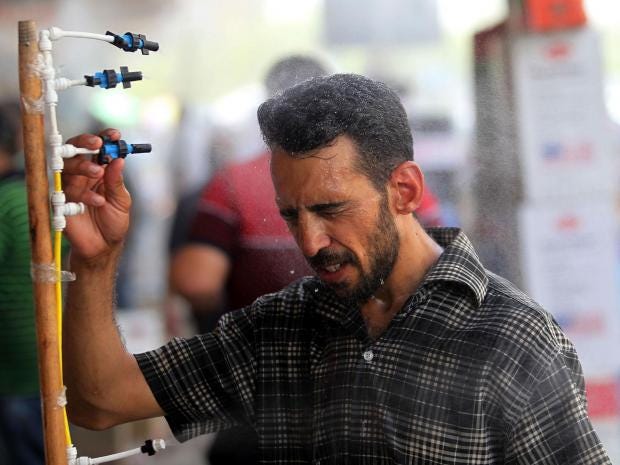
temperature in United Arab Emirates topped 50°C on 17 May, with
50.5°C in Mezaira.
In
the center of Iran's Kuzestan province in the south-east of the
country, neighboring Iraq, temperatures reached 50°C on 15 June.
The
heatwave in Morocco peaked on 17 May, when there was a new reported
record of 42.9°C Larach Station in northern Morocco.
The
high June temperatures follow above average temperatures in parts of
the world at the end of May. The town of Turbat in southwestern
Pakistan reported a temperature of 54°C. WMO will set up an
international committee of experts to verify the temperature and
assess whether it equals a reported 54°C temperature recorded in
Kuwait last July.
It’s
So Hot in Phoenix, Planes Can’t Takeoff
An intense heat wave is crippling the West this week, sending the mercury above 120°F in places like Phoenix. In a sign of just how hot things are getting, some airlines have had to cancel flights because of the heat.
American
Airlines said it cancelled 50 flights out of Phoenix Sky Harbor
aboard Bombardier CRJ aircraft on Tuesday because the planes can’t
operate above 118°F.
Heat
waves are intimately
tied to climate change as
rising background temperatures make them more intense and common. The
latest batch of heat will cook an area from northern California to
western Texas, a region home to some seven of the 10 fastest-warming
cities in
the country.
Temperature
records have already fallen across California and heat will build
throughout the week. Sacramento, San Jose, Palm Springs, Fresno and
Death Valley all set daily highs on Monday. But the hottest
temperatures aren’t even expected to arrive until Tuesday. They’ll
last through Thursday, and forecast highs mean the region could set
all-time records.
Phoenix,
Tucson and Las Vegas are forecast to be within striking distance of
all-time records. All eyes will be on Phoenix, which is ground zero
for the heat wave. Temperatures are forecast to climb to 120°F on
Tuesday, just 2°F shy of its all-time record. When it comes to
extreme heat, Arizona is one of the many states
at risk.
All-time
record hot or not, the extreme weather has the potential to be
life-threatening. The National Weather Service has issued an
excessive heat warning and its Phoenix office has said “heat of
this magnitude is rare, dangerous and very possibly deadly.”
Perhaps
it’s no surprise these cities could be in line to set records.
Phoenix is the second-fastest warming city in the U.S. over the past
50 years while Las Vegas comes in at third and Tucson at seventh.
Climate change is largely responsible for boosting those background
temperatures, increasing the odds of setting record highs like the
ones currently broiling the region. The heat
island effect only
compounds the risks of deadly heat in cities.
“Across
the world we're finding that we can link unusually warm weather
events to climate change,” Andrew King, a climate researcher at
Australia’s ARC Centre for Excellence, told
Climate Central in March following
February’s intensely mild weather. He added climate change is
almost certainly playing a role in almost all extreme heat events
“for most of the world.”
While
the heat wave this week in the West has not been specifically
attributed to climate change, it’s probably safe to say background
warming is playing a role and the impacts we’re seeing will only
become more pronounced in the future.
Take
the grounded flights, for example. They’re what one group of
scientists have dubbed a “hidden cost of climate change.” That’s
because higher temperatures generally translate to thinner air,
making it harder for airplanes to take off. The solution is either to
ground flights or bump people and packages to make planes lighter.
If
carbon pollution keeps going at its current rate, Phoenix could see
20 more days a year by 2100 where flights are restricted to a maximum
takeoff weight of 10,000 pounds. That’s currently a rare
occurrence. Other airports like LaGuardia in New York and Reagan
National in Washington, D.C. could see even more days with weight
restrictions.
But
canceled flights are a climate change inconvenience. There are far
more serious impacts that will put more lives at risk if carbon
pollution continues unchecked. Research published on Monday showed
that half the world’s population will face life-threatening
heat waves by
2100 unless carbon pollution is curbed.
The
summer average temperatures in Phoenix could be more
like Kuwait City by
the end of the century, making this currently rare heat routine.
A
Government heat alert - one tier below a level 4 national emergency -
has been sent to hospitals and emergency services across the country
A
heat health warning has been issued as the country continues to bake
in a mini-heatwave with temperatures set to climb even HIGHER and
fears people could die.
The
UK will be hotter than the Bahamas on 'Meltdown Monday', according to
the Met Office, as a week-long Spanish roast nudges record 35C highs.
And
as more hot air pushes north from France and Spain, an amber level 3
Government heat health warning - one tier below a level 4 national
emergency - has been issued.
The
'official' record was 56.7C on 10 July 1913 at Furnace Creek Ranch in
Death Valley, California, but many doubt that reading was accurate
If
you're feeling flustered by the mini-heathwave over parts of the UK
and Europe at the moment, then you'll want to avoid the Middle East
right now. On Thursday a blistering temperature of 54C (129.3F) was
recorded in Kuwait, firmly putting our hot spell into context. It is
the highest temperature ever recorded in the eastern hemisphere and
almost certainly the highest temperature ever recorded on earth.
A
weather station in Mitribah, a remote featureless area of north-west
Kuwait, took the temperature last week during an intense heatwave
that continues in parts of the Middle East. The mercury in
neighbouring Iraq on the same day soared to 53.9C (129F) in the
ancient city of Basra.
If
verified by the World Meteorological Organisation, they will almost
certainly be the two highest temperatures ever recorded on the
planet.
Until
now the official record for the highest temperature was 56.7C
(134.1F) on 10 July 1913 at Furnace Creek Ranch in Death Valley,
California. But many modern meteorologists are sceptical of the
record, arguing that the equipment used at the time was prone to
error and not as reliable as modern recording methods.
Drone
footage shows aftermath of deadly Portugal forest fire
Heat
Waves to Get Worse, Affect More People: Study
Think
global warming is bad now? It is going to get much worse, even if
governments act quickly, researchers predicted Monday.
According
to a new report, half the world’s population will swelter through a
month of killer-level heat every year by the year 2100 even if all
the world’s countries acted aggressively to reverse climate change
right now.
And
if things just stay the same, nearly three-quarters of the world will
endure weeks on end of potentially deadly heat waves, the
international team of researchers said.
“An
increasing threat to human life from excess heat now seems almost
inevitable, but will be greatly aggravated if greenhouse gases are
not considerably reduced,” the team, led by Camilo Mora of the
University of Hawaii, wrote in the journal Nature Climate Change.
There’s
no question that the average temperature of the planet is getting
warmer, and that human activity is speeding the process. The result
is extreme weather — hotter in some places, cooler in others, with
more severe storms, flooding and drought.
Mora’s
team looked at heat waves dating back to 1980, including one in
Chicago that killed 740 people in 1995, one in Paris that killed
4,870 people in 2003 and a 2010 heat wave in Moscow that killed
10,860.
How
deadly a heat wave gets varies from place to place, but it is a
function of temperature plus humidity, combined with how easy it is
for people to lower their body temperatures down with air
conditioning, shade, fans or other measures.
“Our
attitude towards the environment has been so reckless that we are
running out of good choices for the future.”
The
key temperature is 104 degrees. The human body is designed to
function at 98.6 degrees and once body temperature goes above 104
degrees, organ damage starts.
People’s
body heat can go to 104 when the heat index hits that level, and
that’s a combination of outside heat plus humidity. The higher the
humidity, the harder it is for the body to cool itself with
perspiration.
The
team looked at temperature trends and overlaid them with where people
live.
“We
found that by 2100, even under the most aggressive mitigation
scenario around 26.9 percent of the world’s land area will be
exposed to temperature and humidity conditions exceeding the deadly
threshold by more than 20 days per year, exposing around 47.6 percent
of the world’s human population to deadly climates,” they wrote.
“Our
attitude towards the environment has been so reckless that we are
running out of good choices for the future," Mora said in a
statement.
“For
heat waves, our options are now between bad or terrible. Many people
around the world are already paying the ultimate price of heatwaves,
and while models suggest that this is likely to continue to be bad,
it could be much worse if emissions are not considerably reduced.”
President
Donald Trump on June 1 pulled the U.S. out of the 2015 Paris climate
agreement, a voluntary global pact aimed at reducing human-made
emissions that help drive up temperature.
It
set a specific goal to keep the Earth from warming by more than 3.6
degrees Fahrenheit — or 2 degrees Celsius.
“Climate
change has put humanity on a dangerous path that will become
increasingly dangerous and difficult to reverse if greenhouse gas
emissions are not taken much more seriously. Thus, actions like
President’s Trump recent decision to withdraw from the Paris
agreement appear very reckless to me,” Mora said.
Heat
can kill people directly and indirectly.
Heat
can raise blood pressure and worsen cholesterol levels, leading to
heart disease deaths.
A
2015 study found that a rise in the average summer temperature of
just under 2 degrees F led to a 1 percent higher death rate in New
England.
Longer,
hotter summers can aid the spread of mosquitoes that carry diseases
such as malaria, dengue, Zika and yellow fever — and warmer winters
may fail to kill off populations of the insects.
The
U.S. is experiencing several scorchers this week.
The
rapid changes leading to this house being on the cliff edge are seen
as being caused by a marked speeding of erosion of the permafrost
shore by waves. Picture: Ivan Mizin/WWF Russia
The
stunning speed of the coastal erosion on Wiese Island in the northern
Kara Sea - shown here - is a graphic example of the impact of warming
temperatures in the Siberian Arctic. Ironically, the collapsing
building is a disused Soviet meteorological station that now stands
on the brink due to changes in the weather.
Our
main pictures shows it about to collapse into the frozen sea last
winter. It may already have done so this summer.
Seven
years ago it stood some 74 metres from the sea. When it was built in
1945, it was much further away.
Glaciologist
Dr Alexander Aleinikov compared the coastline on the island - also
called Vize Island - between 2009 and this year.
'The
shores of the Wiese Island were collapsing earlier too,' he said. 'It
is a natural process. However, if back in the 1950s polar experts
reported (a retreat of) about 1.5 metres per year, according to
satellite images taken from 2009 to 2016, the shore has stepped back
by 74 metres at this place.
'The
speed has increased significantly.'
Shoreline
on remote island retreats by 74 metres in seven years due to
increased wave power of unfrozen sea, and thawing
permafrost. Pictures: Ivan Mizin/WWF Russia, Aleksandr
Aleinikov/WWF Russia
Oksana
Lipka, coordinator of WWF's climate and energy programme, said: 'It
was earlier believed that the fastest pace of shore erosion in Russia
and the world was in the Novosibirsk Islands (between the Laptec and
East Siberian seas) that 'step back' by 5-to-15 metres a year,
sometimes by 20 metres after a strong storm.
'It
is likely that the pace of shore erosion is even higher (on Wiese
Island). We've got to conitue monitoring."
The
rapid changes leading to this house being on the cliff edge are seen
as being caused by a marked speeding of erosion of the permafrost
shore by waves.
Previously,
the sea was frozen for a much longer period during the year, so the
waves had limited power in battering the coast. The melting of
the sea ice means the coastal permafrost, weakened by warmer
temperatures, faces more forceful waves.
The
energy of wave impact directly depends on number of summer days when
there is so-called open water around the island - without ice.
Analysis
of Landsat satellite images over recent years shows the open water
period increased because of global warming.
For
example, a satellite image taken on 15 July 2016 shows there is
absolutely no ice in the water area around the island.
The
increase in temperature of the air and the sea's surface, along with
the reduction of ice and extension of the time the water is
'open' are the consequences 'of climate change in northern
latitudes', says WWF.
'Remarkably,
the temperature in the Arctic is rising twice as fast as anywhere on
the planet. This allows new opportunities for exploring the Arctic.'
Wiese
Island in the Kara Sea marked on the world map. Picture: The Siberian
Times
Dr
Ivan Mizin, senior expert at the WWF's Barents Sea office, said: 'Sea
islands that are altering both because of human influence and climate
change require careful attention of researchers.'
He
warned: 'Wiese Island needs protection first of all as a year-round
habitat of Polar bears, Atlantic walruses, and Ivory gulls. It
is located on the border of two seas and joins the population of
these rare species.
'We
need to understand if reduction of the size of the island will affect
these species and to what extent.
'To
do that, it is desirable to limit human impact to the already
existing Polar meteorological station and obtain reserve status (for
the island).'
With
an expected large increase in commercial shipping using the Northern
Sea Route between Asia and Europe - along the Russian coastline - he
said it was important to 'preserve the most precious natural
territories that will play an important role in maintaining
biological diversity of the Kara sea during its commercial
exploration'.
Icebreakers
on the Northern Sea Route. Picture: Slava Titov
The
desolate island, subject to severe storms, is part of Krasnoyarsk
region and is located in the Arctic Ocean at the northern end of the
Kara Sea, roughly midway between Franz Josef Land and Severnaya
Zemlya. In 1924, oceanographer Vladimir Wiese predicted the
island's existence before it was known as a fact.
He
studied a deviation in the drift of Georgy Brusilov's ill-fated
Russian ship Svyataya Anna which was trapped on the pack ice of the
Kara Sea.
The
island was discovered on 13 August 1930 by a Soviet expedition led by
Otto Schmidt aboard the Icebreaker Sedov.
Professor
Wiese, of the Soviet Arctic Institute, was on board the Sedov and set
foot on the island whose existence he had predicted.
NASA
Scientist Eric Rignot , "West Antarctica is going to melt no
matter what"
"Stopping
our carbon emissions is wishful thinking at this point...that’s not
holy shit. Its worse than that"
Clip from HBO VICE. NASA Scientist Eric Rignot , "West Antarctica is going to melt no matter what".I thank Professor Guy McPherson for bringing me the awareness of Abrupt Climate Change.Please check Guy McPherson his many videos on Youtube, or at my Facebook page, to see how much time we have left.You have a right to know.Ice sheets contain enormous quantities of frozen water. If the Greenland Ice Sheet melted, scientists estimate that sea level would rise about 6 meters (20 feet). If the Antarctic Ice Sheet melted, sea level would rise by about 60 meters (200 feet).Michael J. Sliwa and Guy McPherson will be doing a call-out show in a couple weeks, and we're asking your help. Specifically, we'll be calling out climate scientists and other public figures for their absurdity. Please put clips here and indicate where in the clip the scientist expressed unfounded hope (e.g., 10:12-11:35). Or submit a clip of somebody who contradicts him/herself regarding climate change. Some obvious names for you: Michael Mann, Naomi Klein, and Bill McKibben. But surely there are others. No clips longer than 3 minutes, please. Print media will work, too. THANKS, EVERYBODY.Please click below for more info.https://www.facebook.com/groups/592090680907692/829165957200162/?comment_id=829308253852599¬if_t=like
Posted by Marc Haneburght on Tuesday, 14 July 2015

 Posts
Posts