

This gives a first-hand look at what is happening on the Arizona-Mexico border in the first days of the Biden presidency
Subscribe to

 Posts
All Comments
Posts
All Comments
Showing posts with label Arizona. Show all posts
Showing posts with label Arizona. Show all posts
Monday, 8 February 2021


Friday, 22 February 2019
How drugs are really moved freom Mexico into Arizona - and it's not through official ports of entry
This
is my third attempt to get this article up which contradicts the
narrative that Trump's wall may be a solution to a “non-existant
problem”
Trump's
“solution” may be problematical to say the least but the problem
sure ain't “non-existant” and the powers-that-be don't want you
to know that especially if it comes from a Spanish language source.
I
got this posted successfully a couple of days ago after many
shennnagins but it has disappeared.
I
tell the story in the following video
By tunnel or by mule: how drugs are moved from Mexico into Arizona
The
Sinaloa Cartel controls 90% of the narcotics shipped through this
stretch of the US border

El Pais,
4 November, 2016
Sandra lives less than 10 minutes from Arizona but she cannot cross over to the US side because she does not have a visa. Her modest house with its unpainted walls sits atop a hill at the end of bumpy dirt road in Nogales, Sonora, a state in northern Mexico that is home to 234,000 people. The border wall that separates this Nogales from Nogales, Arizona – a town of some 20,000 people and a few stores where Mexicans with visas like to shop – runs next to her house. From the door of her home, Sandra can see the high fence, made of three-meter-high rusting metal pales, that divides the two countries and snakes across the hills toward the horizon.
4 November, 2016
Sandra lives less than 10 minutes from Arizona but she cannot cross over to the US side because she does not have a visa. Her modest house with its unpainted walls sits atop a hill at the end of bumpy dirt road in Nogales, Sonora, a state in northern Mexico that is home to 234,000 people. The border wall that separates this Nogales from Nogales, Arizona – a town of some 20,000 people and a few stores where Mexicans with visas like to shop – runs next to her house. From the door of her home, Sandra can see the high fence, made of three-meter-high rusting metal pales, that divides the two countries and snakes across the hills toward the horizon.
“They
found a drug tunnel in the pink house down there. Helicopters arrived
that day and closed down the streets,” says the 38-year-old who
lives in Buenos Aires, a shanty town outside Nogales whose strategic
location means US officials regularly search there for tunnels. The
gangs that control the underground routes patrol the area and there
are informants with binoculars and radios on every avenue, street
corner and alley, watching and reporting the movements of agents near
the entrances to the tunnels, where drugs and people are trafficked
into the United States.
The
cartels are continually finding new ways to smuggle drugs
“Sometimes,
when I’ve been outside washing clothes, I hear how they shout at
them in their language to get down from the wall. When I see someone
trying to climb over with a bag [of drugs] I go inside my house to
avoid problems,” she says.
Sandra
has lived in this slum for 15 years. Before the United States built
its wall of rusted metal bars, she says, there was a shorter fence
that locals would cut with pliers and slip through to go shopping “on
the other side.” Then the fence was replaced with metal sheeting,
until in 2007 the current barrier was put up.
“In
the 1990s, I used to cross through the hole, as we used to say. There
wasn’t all this technology,” Sandra says, pointing at security
cameras on the other side.
A
few meters down the road, a kindergarten decorated in bright colors
stands in sharp contrast to the wall. Vanessa Quijada, the director
of the school, says it is normal for young kids to see police
activity and men scuttling over the wall. “They know the wall
divides us, that it separates one country from the other,” she
says. The street where the school is located runs all the way through
downtown Nogales where men with backpacks filled with drugs climb up
the rectangular bars in front of the stores just a few steps away
from the checkpoint. “It’s a very common thing,” one shopkeeper
explains. “They climb up like Spider-Man and quickly jump over to
the other side.”
According
to municipal authorities, 40% of the population in Nogales, Sonora,
is transient. Hundreds of people who have been deported from the
United States stay in the town, sometimes indefinitely, most of them
picking up jobs in manufacturing, waiting for another opportunity to
enter the United States. Nogales was one of the first cities in
northern Mexico to attract maquiladoras, or US assembly plants.
Father Ricardo Reciado, who is involved in outreach work in troubled
communities, says hundreds of young men and women have joined the
drug trade as recruits. “They use primary and secondary school
students to move drugs, as well as little boys from the slums to
serve as informants,” he adds.
A
dangerous border
The
Arizona-Sonora border is one of the biggest entry points for drugs
into the United States, and the Tucson border patrol is one of the
busiest units, with eight stations covering most of Arizona, from New
Mexico to Yuma County. Its agents typically seize around half of the
marijuana that enters the country along the 350-kilometer border,
says Vicente Paco, the spokesman for the Tucson border patrol.
The
gangs operating here not only oversee the drugs trade, but also
control the gun and migration routes, Paco says. “Any person who
wants to enter the United States illegally has to join organized
crime. They have to pay the organizations and if they don’t have
money they are used as mules.”
One
of the most dangerous areas along the Arizona-Sonora border is the
Great Desert of Altar, a UNESCO World Heritage Site, where
temperatures can reach 50ºC. Its inhospitableness makes it
attractive to the drug traffickers, says the border patrol. A common
way to transport drugs is to send the mules in groups of up to 15 to
make the 15-day journey through the desert with 20 to 25 kilograms of
marijuana strapped to their backs.
The
gangs that control the tunnels use look-outs to spot border patrols
The
organized crime network is so large it uses people on both sides of
the border. Since 2014, more than 80 individuals have been arrested
in the hills for spying on law-enforcement agents working at the
border. “Before, a lookout who watched our police efforts would
enter the country as an illegal immigrant and the only thing we could
do was return him to his country,” one agent says. Now, if border
patrol finds a campsite on a hill with paramilitary equipment and
radios operating on secret frequencies, the state of Arizona will
charge the suspect. “They are the eyes of the criminal
organizations,” he adds.
A
recent US border patrol report said agents seized 1.5 million pounds
of marijuana and 4,294 pounds of cocaine in 2015, with Tucson alone
accounting for 48.6% of all seizures. Agent Paco says he has seen a
rise in the confiscation of methamphetamine, heroin and cocaine.
The
cartels are continually diversifying the ways they transport drugs.
Authorities have discovered 107 cross-border tunnels in Nogales
alone, while each day dozens of men carrying drug shipments climb
over the wall. “Nogales is also known as the tunnel capital. Since
Sonora is a mining state there is the kind of technology [needed] to
build this type of infrastructure,” Paco says. The border patrol
has also found catapults, staircases and loading ramps near the
border.
Meanwhile,
the Sinaloa Cartel has reinforced its presence in Arizona in order to
ramp up its shipments of marijuana and heroin, the Drug Enforcement
Administration (DEA) says. The organization once led by imprisoned
drug boss Joaquín El Chapo Guzmán, who is now fighting extradition
to the United States, poses the greatest threat to Arizona’s
communities, controlling an estimated 90% of drugs that cross the
border. The Sinaloa cartel also controls arms and money-laundering
routes.
Sunday, 25 June 2017
Unprecedented heat in Arizona
It's So Hot in Arizona, Meteorologists Need New Weather Map Colors
22
Jue, 2017
It's
so hot in
the American Southwest that meteorologists are using unusual colors
for their temperature maps.
As
reported by MLive's
Mark Torregrossa, with temperatures forecast to hit 120 degrees
Fahrenheit in the Phoenix area, the folks at weatherbell.com had
to use green for its Wednesday map because the other shades were
already used.
"I've
tweaked color banks on weather graphics for almost 30 years,"
Torregrossa wrote. "The trick is to get the colors to match the
temperatures, as we have come to expect them. So cold temperatures
are usually blue and purples, and hot temperatures are varying levels
of red."
"But
sometimes extreme weather can make a graphic color bank hard to
develop," he added.
Not
only that, Gizmodo pointed
out that the National Weather Service's weather map usually shows a
mix of green, yellow and orange this time of year. However, for its
Tuesday map for Phoenix, the agency had to use magenta to represent
"rare, dangerous, and very possibly deadly" heat.
We have very high Heat Risk levels this week – especially today. That means it’s well beyond the usual heat of Summer. Reschedule outdoor exercise for the coolest part of the day and choose a less strenuous routine. If you must work outdoors, drink at least 1-2 liters per hour, take frequent breaks in the shade, and finish up by midday. Even if you don’t work outdoors, take extra water with you wherever you go. If you have elderly family/friends/neighbors – especially those living alone - check on them to make sure they are well and the air conditioning is working. Taking precautions like these will prevent you or someone you know from joining people in the emergency room with heat related illness.

There
have been a slew of heat-related incidents around the area due to the
ongoing heatwave. Earlier this week, as temperatures hit 119 degrees
Fahrenheit around Phoenix, flights
were canceled for
safety reasons. Dogs have burned
their paws during
walks on 160-degree asphalt. A local news team even successfully
baked a frozen pizza outdoors during Tuesday's triple-digit scorcher.
One taste-tester remarked that the thawed pie "tastes like gas
station breadsticks."


We're now at 116 degrees, per @NWSPhoenix. The pizza is fully thawed but the cheese isn't really melting yet. Crust feels pretty soft.


Friday, 23 June 2017
The Heat Wave in SW United States
Heat Wave Across Southwest Turns Deadly

22
June, 2017
For
days, the Southwest has sweltered in temperatures well above 100
degrees in some areas, and the heat wave has taken its toll on
millions. Power grids have been stressed, flights have been grounded
and wildfires have grown rapidly. At least five people have died.
- A Texas man and his son reported missing were found dead Tuesday in Carlsbad Caverns National Park in New Mexico, where temperatures have surpassed 100 degrees, NBC News reports. Robert Stuart Pita, 57, and his son Bobby, 21, had been on a hiking trip since Wednesday of last week but had not been heard from since checking into their hotel. Authorities say the heat was likely a factor in the deaths.
- In San Jose, California, a 72-year-old man and an 87-year-old woman died Monday. Temperatures reached 94 degrees, and one of the victims was homeless and lived in a car, police told the Associated Press.
- A California man, identified by the Bakersfield Californian as Benjamin R. Greene, died while running a 5k in 107-degree heat at a Bakersfield park Tuesday night.
- Arizona Public Service Company, the largest electricity provider in Arizona, said temperatures near 120 degrees in Phoenix led customers to set a new peak usage record. Between 5 and 6 p.m. local time Tuesday evening, over 7,300 megawatts of energy were consumed. This breaks a record that stood for 11 years.
- Two firefighters in California had to be treated for heat-related injuries. In New Mexico, a brush fire destroyed sheds and cars. Two residents and a firefighter were sent to the hospital with minor injuries and smoke inhalation.
- South of Tucson, blazing temperatures helped fuel a wildfire that destroyed six structures. More than 100 homes in total were threatened by the inferno that started Tuesday.
- Heat was blamed for warping train tracks that caused a derailment near Earlimart, California. Nineteen cars derailed Tuesday, butnobody was injured, according to KMPH.com.
- In Las Cruces, New Mexico, officials temporarily opened several "cooling stations" for residents to get out of the heat and find relief.
- About 50 people received elastic booties for their pets at a Phoenix-area PetSmart to keep the animals' paws from burning on the pavement.
- In Central California, residents along the swollen Kings River were urged to evacuate as warm weather quickly melted some of the winter's massive snowpack.
- As far north as San Francisco, residents were advised to avoid strenuous activities in the heat, if possible, and don't leave kids or pets in vehicles.
Wednesday, 21 June 2017
Extreme heat in the Northern Hemisphere
High
temperatures and heatwaves take hold

20
June, 2017
Parts
of Europe, the Middle East, North Africa and the United States of
America have seen extremely high May and June temperatures, with a
number of records broken. The heatwaves are unusually early and are
occurring as the Earth experiences another exceptionally warm year.
Average
global surface temperatures over land and sea were the second highest
on record for the first five months of 2017, according to analyses by
NOAA, NASA-Goddard Institute for Space Studies and the European
Centre for Medium Range Weather Forecasting Copernicus Climate Change
Service.
Only
2016 saw higher global temperatures due to a combination of a very
powerful El Niño event, which has a warming impact, and long-term
climate change caused by greenhouse gas emissions. So far in 2017
there has been no El Niño event.
Climate
change scenarios predict that heatwaves will become more intense,
more frequent and longer. It is also expected that the number of hot
days will continue to rise.
Europe

The
Deutscher Wetterdienst (DWD), which acts as WMO’s Regional Climate
Centre for Europe’s Node on Climate Monitoring, has issued a
Climate Watch Advisory valid until at least 25 June. It states that a
period with significantly above-normal temperatures and heat waves is
expected for most parts of western Mediterranean (from Portugal to
western Balkans).
National
meteorological and hydrological services are issuing regular
forecasts, heat-health advice, as well as information on air
quality, UV levels and wildfire risk.
The
heatwave originated as a result of very hot air moving up from the
Sahara to the Iberian Peninsula and parts of the Mediterranean.
Iberian
Peninsula
Fire
risk in Portugal, 20 June 2017Extremely high temperatures of around
40°C contributed to the severity of the disastrous wildfire in
Portugal which has claimed dozens of lives.
An
amber alert for heat – the second highest warning level –
continues to be in place in the area on 20 June.
The
Portuguese national meteorological service, IPMA, said that over the
weekend, when the fire broke out, more than one third of its weather
stations measured temperatures over 40°C. The meteorological service
said that for 20 June, 5 municipalities are at maximum fire risk and
58 at very high risk.
Spain:
Spring
2017 (from 1 March to 31 May 2017) has been extremely warm, with an
average temperature of 15.4 ° C, which is 1.7 ° C above the average
of this term (reference period 1981-2010). It has been the warmest
spring since 1965, having exceeded by 0.06 ° C the previous highest
value, which corresponded to the spring of 2011. It has therefore
been also the warmest spring since the beginning of the 21st century.
The
marked contrast observed between the maximum temperature anomalies,
which were on average 2.5 º C above the normal value of the term,
and those of the minimum temperatures, which were only 0.9 ºC higher
than the normal ones.
May
was extremely warm, with a temperature that surpassed the normal
value by 2.4 ° C. As of June, the average temperature is well above
normal values.
A
number of places broke temperature records for June for both maximum
daytime temperatures and minimum overnight ones.
These
include Granada airport, 41.5°C, Madrid Retiro 40.3°C and Madrid
airport 40.1°C on 17 June. The peak if the minimum temperatures was
on the 19th June, when Salamanca and Zamora had record overnight
temperatures of 22.1°C and 23.7°C.
AEMET
also reported extreme fire hazard for parts of the country on 20
June.
Heat
alerts for France, 20 June
France
Fifty
one departments in France have an amber alert for high temperatures
on 20 June, according to Meteo France. Temperatures for Monday
included 38°C for Bordeaux, 36°C forLimoges, 34°C for Mulhouse and
33°C for Paris, Toulouse, Brest and Lille, according to Meteo
France.
A
number of stations broke June records, including Cuers at 37.6°C and
Toulon 35.3°C. Records for minimum night-time temperatures were also
beaten (25.1°C in Montpellier, 25°C in Marseille) on Friday 16
June.
Meteo
France said that very high temperatures will continue until Friday 23
June, with temperatures between 32 °C and 38 °C in the afternoon,
or more than 10°C above the average for this time of year.
Other
parts of Europe
Many
other parts of Europe, including the United Kingdom, also witnessed
above average temperatures into the low to mid 30°s.
USA

Temperatures
in Phoenix, Ariz, 19 June 2017
Near
record to record heat has been reported in the desert southwest USA
and into California, with highs near 120°F (49°C) in places. More
than 29 million Californians were under an excessive heat warning or
advisory at the weekend. The US National Weather Service has warned
that dangerous heat will continue through at least Friday 23 June in
Nevada, Arizona, parts of California and Las Vegas.
Phoenix
recorded 118°C (47.8°C) on 19 June. In the 11,059 days since the
start of record keeping, 118°C heat has only been recorded 15 times.
A number of flights to Phoenix Sky Harbour International Airport were
reportedly cancelled because it was too hot to fly.
Death
Valley National Park, California, issued warnings to visitors to
expect high temperatures of 100°F to over 120°F (38°C to over
49°C). Death Valley holds the world record for the highest
temperature, 56.7°C recorded in 1913.

North
Africa, Middle East and Asia
The
temperature in United Arab Emirates topped 50°C on 17 May, with
50.5°C in Mezaira.
In
the center of Iran's Kuzestan province in the south-east of the
country, neighboring Iraq, temperatures reached 50°C on 15 June.
The
heatwave in Morocco peaked on 17 May, when there was a new reported
record of 42.9°C Larach Station in northern Morocco.
The
high June temperatures follow above average temperatures in parts of
the world at the end of May. The town of Turbat in southwestern
Pakistan reported a temperature of 54°C. WMO will set up an
international committee of experts to verify the temperature and
assess whether it equals a reported 54°C temperature recorded in
Kuwait last July.
An intense heat wave is crippling the West this week, sending the mercury above 120°F in places like Phoenix. In a sign of just how hot things are getting, some airlines have had to cancel flights because of the heat.

20
June, 2017
American
Airlines said it cancelled 50 flights out of Phoenix Sky Harbor
aboard Bombardier CRJ aircraft on Tuesday because the planes can’t
operate above 118°F.
Heat
waves are intimately
tied to climate change as
rising background temperatures make them more intense and common. The
latest batch of heat will cook an area from northern California to
western Texas, a region home to some seven of the 10 fastest-warming
cities in
the country.

Temperature
records have already fallen across California and heat will build
throughout the week. Sacramento, San Jose, Palm Springs, Fresno and
Death Valley all set daily highs on Monday. But the hottest
temperatures aren’t even expected to arrive until Tuesday. They’ll
last through Thursday, and forecast highs mean the region could set
all-time records.
Phoenix,
Tucson and Las Vegas are forecast to be within striking distance of
all-time records. All eyes will be on Phoenix, which is ground zero
for the heat wave. Temperatures are forecast to climb to 120°F on
Tuesday, just 2°F shy of its all-time record. When it comes to
extreme heat, Arizona is one of the many states
at risk.
All-time
record hot or not, the extreme weather has the potential to be
life-threatening. The National Weather Service has issued an
excessive heat warning and its Phoenix office has said “heat of
this magnitude is rare, dangerous and very possibly deadly.”
Perhaps
it’s no surprise these cities could be in line to set records.
Phoenix is the second-fastest warming city in the U.S. over the past
50 years while Las Vegas comes in at third and Tucson at seventh.
Climate change is largely responsible for boosting those background
temperatures, increasing the odds of setting record highs like the
ones currently broiling the region. The heat
island effect only
compounds the risks of deadly heat in cities.
“Across
the world we're finding that we can link unusually warm weather
events to climate change,” Andrew King, a climate researcher at
Australia’s ARC Centre for Excellence, told
Climate Central in March following
February’s intensely mild weather. He added climate change is
almost certainly playing a role in almost all extreme heat events
“for most of the world.”
While
the heat wave this week in the West has not been specifically
attributed to climate change, it’s probably safe to say background
warming is playing a role and the impacts we’re seeing will only
become more pronounced in the future.
Take
the grounded flights, for example. They’re what one group of
scientists have dubbed a “hidden cost of climate change.” That’s
because higher temperatures generally translate to thinner air,
making it harder for airplanes to take off. The solution is either to
ground flights or bump people and packages to make planes lighter.
If
carbon pollution keeps going at its current rate, Phoenix could see
20 more days a year by 2100 where flights are restricted to a maximum
takeoff weight of 10,000 pounds. That’s currently a rare
occurrence. Other airports like LaGuardia in New York and Reagan
National in Washington, D.C. could see even more days with weight
restrictions.
But
canceled flights are a climate change inconvenience. There are far
more serious impacts that will put more lives at risk if carbon
pollution continues unchecked. Research published on Monday showed
that half the world’s population will face life-threatening
heat waves by
2100 unless carbon pollution is curbed.
The
summer average temperatures in Phoenix could be more
like Kuwait City by
the end of the century, making this currently rare heat routine.
A
Government heat alert - one tier below a level 4 national emergency -
has been sent to hospitals and emergency services across the country
A
heat health warning has been issued as the country continues to bake
in a mini-heatwave with temperatures set to climb even HIGHER and
fears people could die.
The
UK will be hotter than the Bahamas on 'Meltdown Monday', according to
the Met Office, as a week-long Spanish roast nudges record 35C highs.
And
as more hot air pushes north from France and Spain, an amber level 3
Government heat health warning - one tier below a level 4 national
emergency - has been issued.
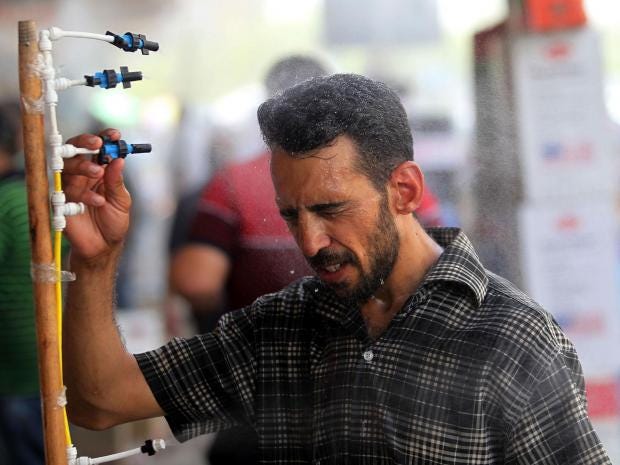
The
'official' record was 56.7C on 10 July 1913 at Furnace Creek Ranch in
Death Valley, California, but many doubt that reading was accurate
If
you're feeling flustered by the mini-heathwave over parts of the UK
and Europe at the moment, then you'll want to avoid the Middle East
right now. On Thursday a blistering temperature of 54C (129.3F) was
recorded in Kuwait, firmly putting our hot spell into context. It is
the highest temperature ever recorded in the eastern hemisphere and
almost certainly the highest temperature ever recorded on earth.
A
weather station in Mitribah, a remote featureless area of north-west
Kuwait, took the temperature last week during an intense heatwave
that continues in parts of the Middle East. The mercury in
neighbouring Iraq on the same day soared to 53.9C (129F) in the
ancient city of Basra.
If
verified by the World Meteorological Organisation, they will almost
certainly be the two highest temperatures ever recorded on the
planet.
Until
now the official record for the highest temperature was 56.7C
(134.1F) on 10 July 1913 at Furnace Creek Ranch in Death Valley,
California. But many modern meteorologists are sceptical of the
record, arguing that the equipment used at the time was prone to
error and not as reliable as modern recording methods.

Drone
footage shows aftermath of deadly Portugal forest fire
Heat
Waves to Get Worse, Affect More People: Study

NBC,
19
June, 2017
Think
global warming is bad now? It is going to get much worse, even if
governments act quickly, researchers predicted Monday.
According
to a new report, half the world’s population will swelter through a
month of killer-level heat every year by the year 2100 even if all
the world’s countries acted aggressively to reverse climate change
right now.
And
if things just stay the same, nearly three-quarters of the world will
endure weeks on end of potentially deadly heat waves, the
international team of researchers said.
“An
increasing threat to human life from excess heat now seems almost
inevitable, but will be greatly aggravated if greenhouse gases are
not considerably reduced,” the team, led by Camilo Mora of the
University of Hawaii, wrote in the journal Nature Climate Change.
There’s
no question that the average temperature of the planet is getting
warmer, and that human activity is speeding the process. The result
is extreme weather — hotter in some places, cooler in others, with
more severe storms, flooding and drought.
Mora’s
team looked at heat waves dating back to 1980, including one in
Chicago that killed 740 people in 1995, one in Paris that killed
4,870 people in 2003 and a 2010 heat wave in Moscow that killed
10,860.
How
deadly a heat wave gets varies from place to place, but it is a
function of temperature plus humidity, combined with how easy it is
for people to lower their body temperatures down with air
conditioning, shade, fans or other measures.
“Our
attitude towards the environment has been so reckless that we are
running out of good choices for the future.”
The
key temperature is 104 degrees. The human body is designed to
function at 98.6 degrees and once body temperature goes above 104
degrees, organ damage starts.
People’s
body heat can go to 104 when the heat index hits that level, and
that’s a combination of outside heat plus humidity. The higher the
humidity, the harder it is for the body to cool itself with
perspiration.
The
team looked at temperature trends and overlaid them with where people
live.
“We
found that by 2100, even under the most aggressive mitigation
scenario around 26.9 percent of the world’s land area will be
exposed to temperature and humidity conditions exceeding the deadly
threshold by more than 20 days per year, exposing around 47.6 percent
of the world’s human population to deadly climates,” they wrote.
“Our
attitude towards the environment has been so reckless that we are
running out of good choices for the future," Mora said in a
statement.
“For
heat waves, our options are now between bad or terrible. Many people
around the world are already paying the ultimate price of heatwaves,
and while models suggest that this is likely to continue to be bad,
it could be much worse if emissions are not considerably reduced.”
President
Donald Trump on June 1 pulled the U.S. out of the 2015 Paris climate
agreement, a voluntary global pact aimed at reducing human-made
emissions that help drive up temperature.
It
set a specific goal to keep the Earth from warming by more than 3.6
degrees Fahrenheit — or 2 degrees Celsius.
“Climate
change has put humanity on a dangerous path that will become
increasingly dangerous and difficult to reverse if greenhouse gas
emissions are not taken much more seriously. Thus, actions like
President’s Trump recent decision to withdraw from the Paris
agreement appear very reckless to me,” Mora said.
Heat
can kill people directly and indirectly.
Heat
can raise blood pressure and worsen cholesterol levels, leading to
heart disease deaths.
A
2015 study found that a rise in the average summer temperature of
just under 2 degrees F led to a 1 percent higher death rate in New
England.
Longer,
hotter summers can aid the spread of mosquitoes that carry diseases
such as malaria, dengue, Zika and yellow fever — and warmer winters
may fail to kill off populations of the insects.
The
U.S. is experiencing several scorchers this week.
Subscribe to:
Posts (Atom)