Extensive release of methane from sediments of the world’s largest continental shelf, the East Siberian Arctic Ocean (ESAO), is one of the few Earth system processes that can cause a net transfer of carbon from land/ocean to the atmosphere and thus amplify global warming on the timescale of this century. An important gap in our current knowledge concerns the contributions of different subsea pools to the observed methane releases. This knowledge is a prerequisite to robust predictions on how these releases will develop in the future. Triple-isotope–based fingerprinting of the origin of the highly elevated ESAO methane levels points to a limited contribution from shallow microbial sources and instead a dominating contribution from a deep thermogenic pool.
Abstract
The East Siberian Arctic Shelf holds large amounts of inundated carbon and methane (CH4). Holocene warming by overlying seawater, recently fortified by anthropogenic warming, has caused thawing of the underlying subsea permafrost. Despite extensive observations of elevated seawater CH4 in the past decades, relative contributions from different subsea compartments such as early diagenesis, subsea permafrost, methane hydrates, and underlying thermogenic/ free gas to these methane releases remain elusive. Dissolved methane concentrations observed in the Laptev Sea ranged from 3 to 1,500 nM (median 151 nM; oversaturation by ∼3,800%). Methane stable isotopic composition showed strong vertical and horizontal gradients with source signatures for two seepage areas of δ13C-CH4 = (−42.6 ± 0.5)/(−55.0 ± 0.5) ‰ and δD-CH4 = (−136.8 ± 8.0)/(−158.1 ± 5.5) ‰, suggesting a thermogenic/natural gas source. Increasingly enriched δ13C-CH4 and δD-CH4 at distance from the seeps indicated methane oxidation. The Δ14C-CH4 signal was strongly depleted (i.e., old) near the seeps (−993 ± 19/−1050 ± 89‰). Hence, all three isotope systems are consistent with methane release from an old, deep, and likely thermogenic pool to the outer Laptev Sea. This knowledge of what subsea sources are contributing to the observed methane release is a prerequisite to predictions on how these emissions will increase over coming decades and centuries.
This article is from a South African publication
The destruction of permafrost in the Laptev Sea provokes methane emissions
Scientists have identified the source of methane in the waters of the Laptev Sea: the concentration of the substance is associated with the destabilization of the permafrost at their bottom and the release of ancient gas reserves.
We carried out isotopic measurements, which clearly indicated that the concentration of methane in the waters of the Laptev Sea is increasing mainly as a result of the release of ancient reserves of this gas, hidden under the permafrost layer at the bottom of the ocean. This indicates the possible beginning of the disintegration of this soil layer and the existence of a large reservoir of gas, which can be abruptly ejected into the atmosphere.
Research text
The discovery of such emissions forced scientists to debate where these emissions come from and whether they are all related to the destabilization of ancient permafrost and clathrate deposits.
The authors of the work believe that the release of methane indicates a possible disintegration of the soil layer. There may be a volumetric gas reservoir under the permafrost. With the destruction of the soil layer, all the methane will be abruptly released into the atmosphere. Not so long ago, similar events took place at the bottom of the Barents Sea.
The group of researchers analyzed the isotopic ratios of carbon and three different forms of dissolved methane in the waters of the East Siberian Arctic shelf: they serve as indicators of conditions in the source of gas formation and subsequent diagenetic processes – the transformation of loose sediments into sedimentary rocks.
These measurements showed that, in all cases, the concentration of carbon-14 in methane molecules was close to zero in the vicinity of the alleged gas sources at the bottom of the Laptev Sea and gradually increased with distance from them.
Further research will lead to more accurate conclusions.
Just like last year these fires will come to life when the snow melts. So few are willing or able to face the Full Catastrophe. They have to ignore or deny one part of the equation, whichever "side" they are on.
I suppose that is something that is wired into the human psyche which is another reason why we are doomed.
Peat fires continue to burn at air temperature of -50C in northeastern Yakutia
Pillars of smoke filmed over the areas hit by last summer’s wildfires despite the current long spell of extremely cold weather.
Zombie fires in northeastern Yakutia, Russia's largest and coldest inhabited region. Picture: The Siberian Times
The latest sighting of winter - zombie - fires was recorded on 23 January by the village of Saydy in the Tomponsky district of Yakutia, some 400km north-east of the republic’s capital Yakutsk.
Local man Ivan Zakharov who filmed the fire at -50C told The Siberian Times: ‘It is burning near the area hit by last summer's wildfires.
'This area suffered extremely hot and dry weather. It must be either peat on fire here, or, as some hunters who noticed these fires suggest, possibly young coal (lignite).’
Winter fire by the village of Saydy in the Tomponsky district of Yakutia, some 400km north-east of the republic’s capital Yakutsk and, below, summer wildfires in the same area. Video, pictures: The Siberian Times
A much bigger burning area was filmed higher up north from Saydy by the village of Udarnik, also badly hit by wildfires last summer.
‘The fire is burning in the area close to the village of Udarnik. The summer fire didn’t stop.
'The filming was made in November, but as the local tell us, several fires are still active’, reported Tomponsky Vestnik newspaper that shared the video.
Last summer Republic of Yakutia, Russia’s largest and coldest region was hit by some of the worst wildfires in history, following the spell of extremely hot and dry weather.
Wildfires were raging all around its territory, with a massive blanket of smoke visible from space in the far north beside the Arctic Ocean.
Some were in the areas too remote to reach, but many got dangerously close to populated areas like the Arctic town of Chersky, a gateway to Pleistocene Park, an experimental scientific base aiming to show how the release of carbon can be slowed by restoring the flora to grassland as it was in the era of the extinct woolly mammoth.
‘We didn’t have wildfires reaching this far north to our area for many years’, said scientist Nikita Zimov, director of Pleistocene Park. ‘Last time it was this bad forty years ago in the 80s’.
This winter is the coldest in Yakutia since 2006, with air temperatures going as low as -59C during peak days, and record cold weather holding on for weeks all through December 2020, and January 2021.
Siberian peat fires have continued to burn after a year of record-setting wildfires in and around the Arctic Circle despite temperatures below minus 50 degrees Celsius, The Siberian Times reported Wednesday.
Footage showing smoke rising from the snow in January and November offers physical evidence of the “zombie fire” phenomenon, which describes summertime blazes that continue smoldering through the winter, eventually igniting new fires. European scientists have voiced concerns that “zombie” fires could be causing earlier-than-normal wildfires.
A local resident who filmed the peat fires last weekend said the area was located near the site of last summer’s wildfires, which took place amid “extremely hot and dry weather.”
“It must be either peat on fire here, or, as some hunters who noticed these fires suggest, possibly young coal [lignite],” The Siberian Times quoted the man, Ivan Zakharov, as saying.
Regional media that shared a video of the November peat fires said villagers report seeing still-active fires as late as the end of January, according to The Siberian Times.
“The summer fire didn’t stop,” the Tomponsky Vestnik newspaper said.
“We didn’t have wildfires reaching this far north to our area for many years,” scientist Nikita Zimov told The Siberian Times, recalling the previous surge in fires in the 1980s.
The republic of Sakha, Russia’s largest and coldest region, is in the midst of one of its coldest winters in years with mercury slipping below minus 59 C.
Scientists fear that, in addition to causing an early start to wildfire seasons, “zombie” fires could accelerate permafrost melt that triggers unpredictable damage and greenhouse gas emissions.
Russia, the world’s fourth-largest greenhouse gas emitter with an economy heavily dependent on oil and gas, is warming more than twice as fast as the rest of the world due to its vast Arctic territories.
Bubbling methane craters and super seeps - is this the worrying new face of the undersea Arctic?
Video and pictures from latest research mission show gas release in the Laptev and the East Siberian seas.
By Valeria Sukhova, Olga Gertcyk
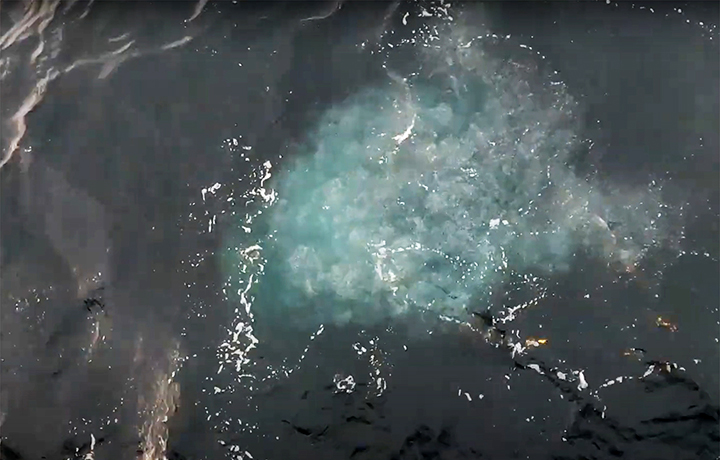
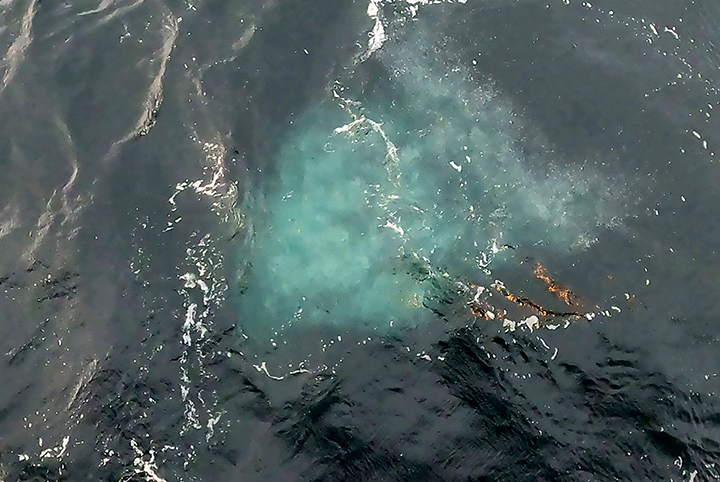
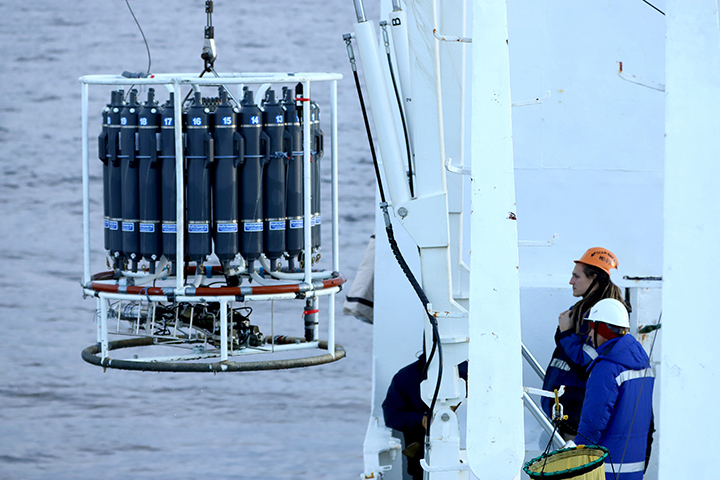
A team of 69 scientists from ten countries documented bubble clouds rising from a depth of around 300 metres (985ft) along a 150km (93 mile) undersea slope in the Laptev Sea, and confirmed high methane concentrations by hundreds of onboard chemical analysis. Picture: TPU
Scientists have shared the first results of a trip to the world’s largest deposit of subsea permafrost and shallow methane hydrates.
Fields of methane discharge continue to grow all along the East Siberian Arctic Ocean Shelf, with concentration of atmospheric methane above the fields reaching 16-32ppm (parts per million).
This is up to 15 times above the planetary average of 1.85ppm.
The preliminary results are from this year’s only international scientific expedition to the eastern Arctic.
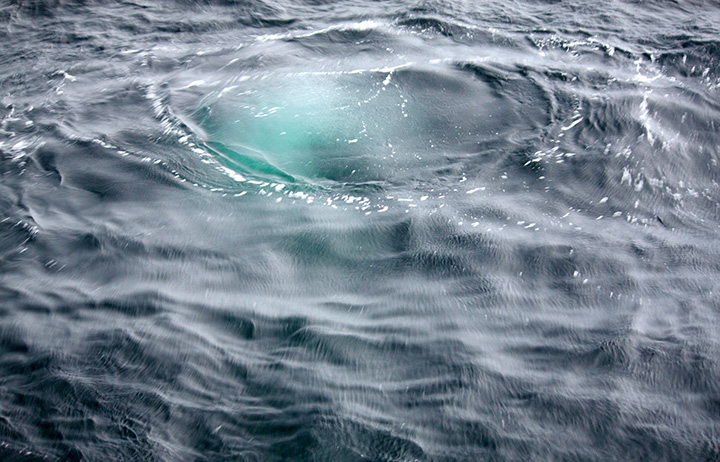
Methane bubbling in the Eastern Arctic, video from this autumn international expedition to the Laptev and to the East Siberian Sea
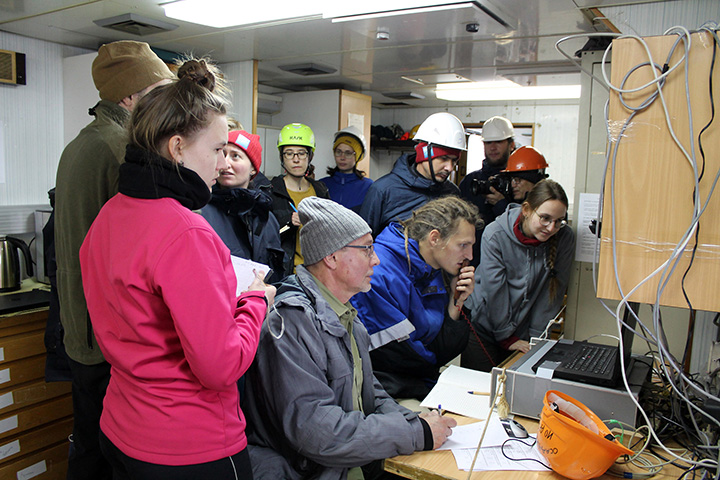
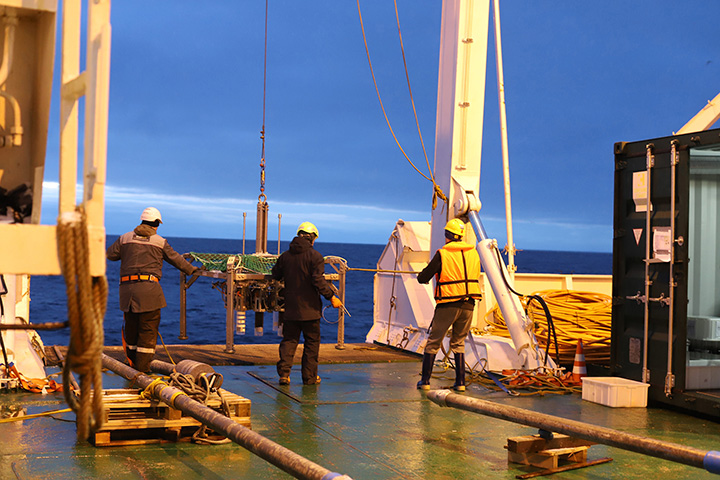
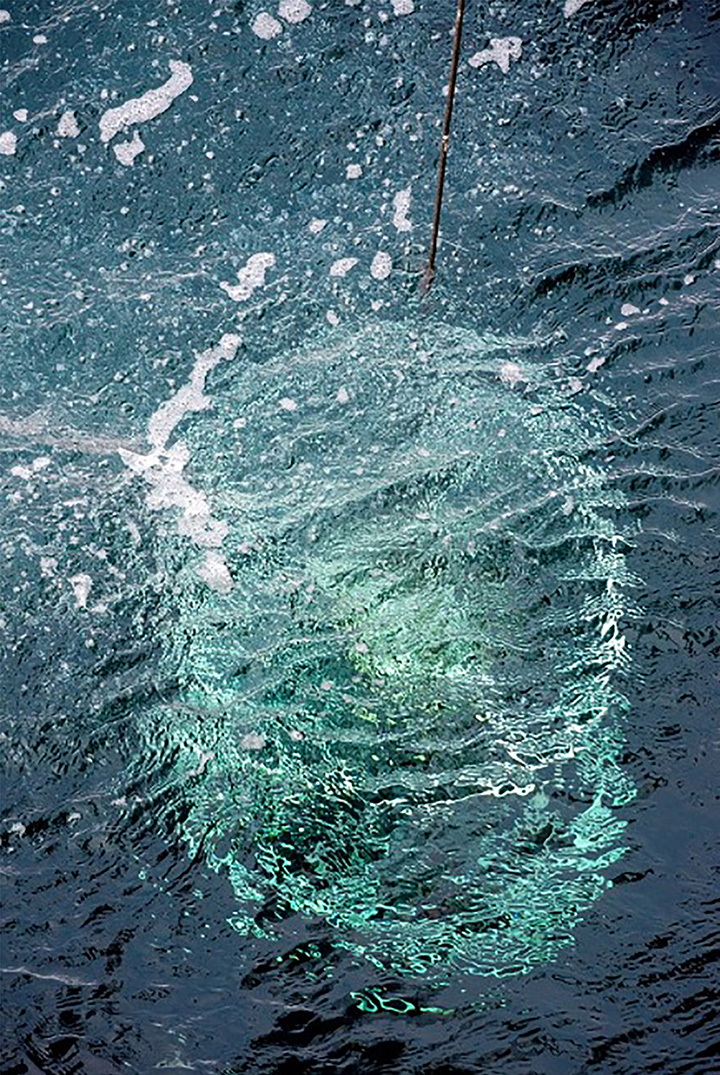
A team of 69 scientists from ten countries documented bubble clouds rising from a depth of around 300 metres (985ft) along a 150km (93 mile) undersea slope in the Laptev Sea, and confirmed high methane concentrations by hundreds of onboard chemical analysis.
A second discovery is pockmarks and craters sunk deep in shelf sediments of both the Laptev and East Siberian seas, actively venting bubbles and strong methane signals.
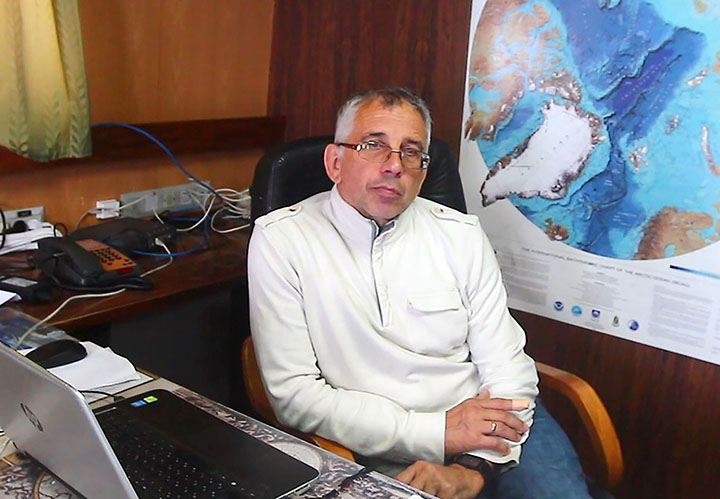
‘All previously discovered fields of methane discharge showed an increase to various degrees, now we need to figure out exactly how much they grew,’ said the head of the expedition Professor Igor Semiletov.
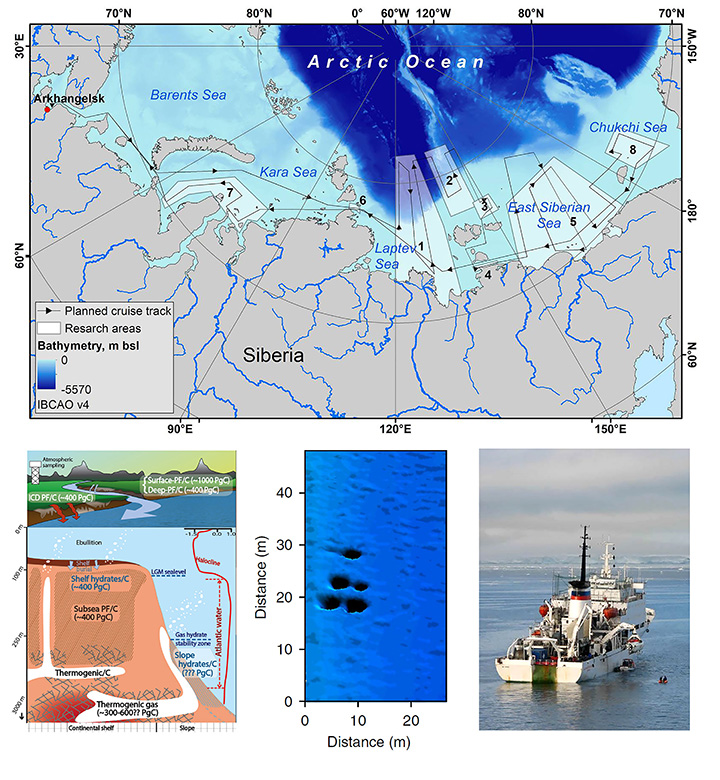
‘One of the new discoveries was a field of sea bottom craters in the shallow part of the Laptev Sea, some of them 30 metres (98 ft) in diameter.
‘They look like holes in the permafrost and, as our studies showed, they were formed by massive methane discharge.
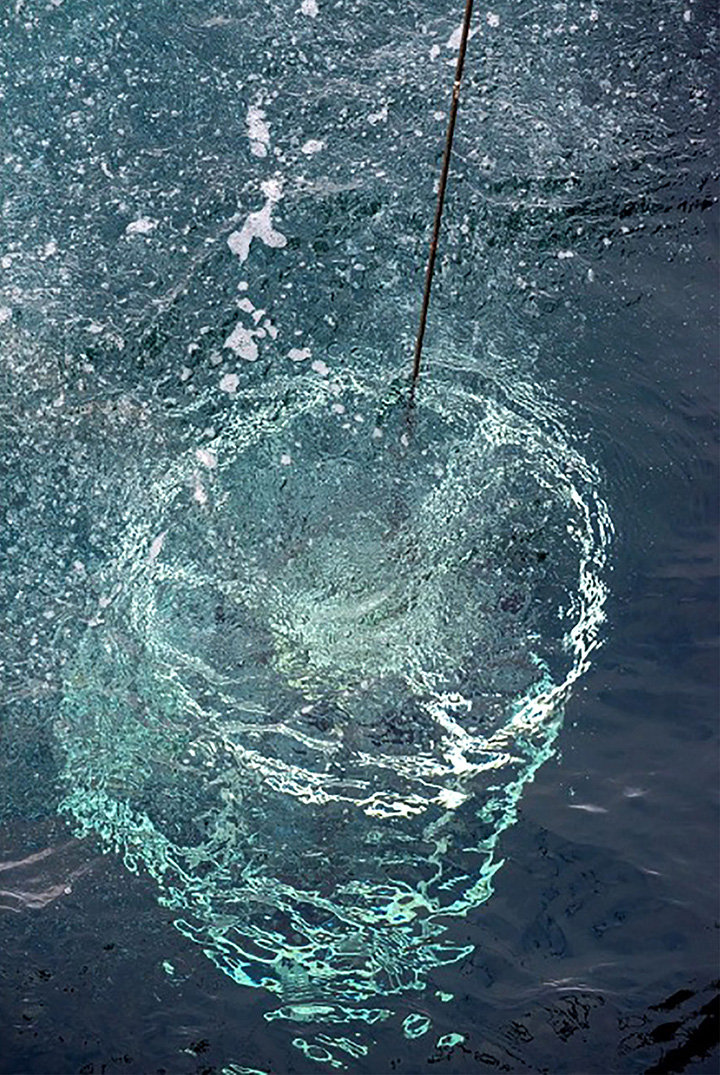
‘Also two more powerful seeps emitting methane through iceberg furrows were discovered in the East Siberian Sea.’
‘All previously discovered fields of methane discharge showed an increase to various degrees, now we need to figure out exactly how much they grew,’ said the head of the expedition Professor Igor Semiletov. Pictures: ISSS2020, TPU
The expedition mapped over 1,000 large seep fields (areas of massive methane discharge over 100 metres or 328 ft) and mega seep fields, each over 1,000 metres in linear dimension.
‘We believe these emissions at this stage have not yet any large impact on global atmospheric methane and climate, yet these huge carbon/GHG capacitors are clearly activated’, the expedition communication page said.
Six mega seeps were registered in both the Laptev and the East Siberian seas in what the scientists described as ‘the first comprehensive observation of active release from methane hydrates on the Siberian-Arctic slope system’.
‘All previously discovered fields of methane discharge showed an increase to various degrees, now we need to figure out exactly how much they grew,’ said the head of the expedition Professor Igor Semiletov (pictured). Pictures: ISSS2020, TPU
The expedition members spent 40 days on board the Akademik Keldysh research vessel, covering a distance of nearly 6,000 nautical miles.
For the first time the scientists managed to take samples of bottom sediments in a methane seep near the delta of River Lena, one of Siberia’s giant waterways.
Along with the Lena, the East Siberian Arctic Shelf is fed by other large Arctic rivers like the Khatanga, Indigirka and Kolyma, which deliver significant quantities of organic matter thus making it particularly vulnerable to climate warming and erosion.
A very rare item on Russian TV on abrupt climate change in Siberia
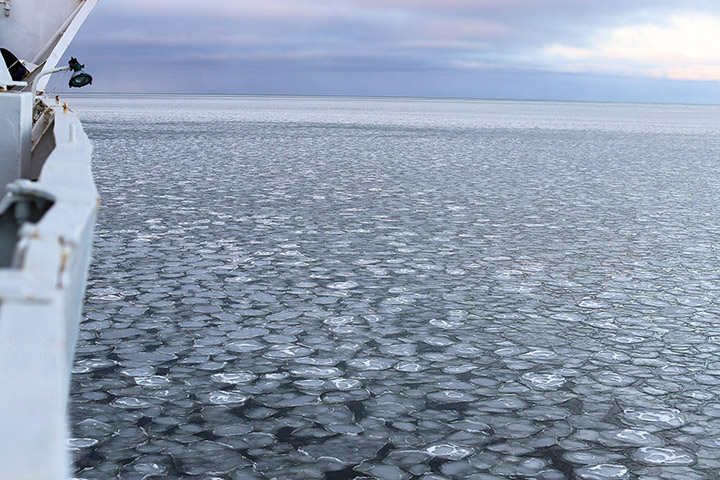
Bad News For Arctic: Russia's Laptev Sea, BIRTHPLACE OF ICE, Did Not Freeze For The First Time Ever!
For the first time since records began, the main nursery of Arctic sea ice in Siberia has yet to start freezing in late October.
October heat: this Arctic archipelago was 10 degrees warmer than normal
It was one of the warmest October months on record and the Russian archipelago of Severnaya Zemlya had the biggest temperature anomaly on the planet.
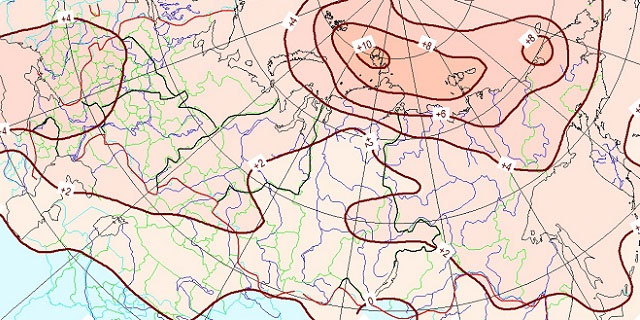
Temperature maps from Russian meteorology service Roshydromet show that the islands located north of the Siberian mainland were as much as ten degrees Celsius warmer than normal for the season.
Temperture deviations in October 2020. Map by Roshydromet
Judging from the data, it was the spot on earth with the biggest temperature deviation from normal.
Also other surrounding parts of the Arctic were extraordinary warm in October. Temperature maps show that practically the whole northern Kara Sea and Laptev Sea was six and eight degrees warmer then normal.
According to the meteorologists, this year had the second warmest October in the Arctic on record. Only 2016 was warmer, the service informs.
Also other parts of the globe saw October temperatures reach abnormal highs. The European parts of Russia experienced an absolute record, while the northernmost parts of Canada saw average temperatures reach six degrees above normal.
This is why (along with declining health and energy) I talk less about climate change than I used to and restricted myself to watching what is happening in the Arctic real time.
It all takes a lot of time and energy, which I don't have any more.
If you ignore the ridiculous talk-over with mantras about “reducing emissions” there is
See how Siberian landscapes are scarred by climate change
BBC
Scientists are warning that, across Siberia, vast swathes of ground - normally frozen all year round – are thawing – with potentially devastating consequences for the climate. As it thaws, the earth is believed to be releasing huge amounts of greenhouse gases, accentuating the problem of global warming. In the second of his reports from the remote Yakutia region, our Moscow correspondent looks at how thawing permafrost is affecting not just the climate, but the landscape and livelihoods in Siberia.
Drone footage shows extent of
Arctic ice loss
Reuters
Stunning drone footage shows the extent of ice loss in the Arctic where climate change has driven up temperatures.
Municipal Mayor Oleg Shabalin got a very direct and personal encounter with climate changes in the Arctic when he this week visited a coastal area near his home town of Gyda.
Across a 200 meter wide belt, the tundra had collapsed and vast masses of mud and melted permafrost slid into the nearby sea. As the town mayor was on site, melted ground continued to flow towards the shore.
Footage posted on Shabalin’s Instagram account show a slow flood of tundra land drifting towards the shores of the Gydan Bay.
In some places, the sinkhole is up to 20 meter deep. The dramatic sight was made on the northern coast of great peninsula Gydan, in the area between the settlements of Gyda and Yuribey, Shabalin says.
This is why I have parted company with Dmitry Orlov. He seems to be all for it.
The Arctic summer season is short and there is plenty of drilling, digging and construction works to be done before ice again covers these far northern waters. The Gulf of Ob has over the last years become centerpiece in the Russian oil industry’s drive towards the North.
This is where Gazprom and Novatek are building their future resources bases. It is an integrated key part of Russian Arctic policy and of crucial economic interest for the country.
Hydrocarbon reserves are enormous, big enough to fuel export markets for decades to come.
But stakes are high.
The extensive development of the area could have fatal consequences for marine life, and environmentalists now sound the alarm. They especially fear that ongoing dredging ultimately could eliminate rare local fish stocks

 Posts
Posts