Dr. Peter Wadhams speaks out. Arctic Sea Ice, Methane and more
Environmental Coffee House
Welcome Dr. Peter Wadhams who spoke to Jennifer Hynes and Sandy Schoelles on August 11, 2020. Peter is currently teaching in Italy, but we were fortunate enough to catch up with him for a candid discussion regarding the Scientists Warning articles and subsequent videos that painted Peter and his work with an "alarmist" brush.
With 50 years of Arctic Sea Ice Research to Peter's credit, he spoke to us about his reaction to the material as well as his extremely well researched views on the future of arctic ice and methane
This
is one of the best interviews I have heard in a long time.
In
this interview Peter Wadhams covers the denial (and consequential
censorship) by the mainstream scientific community for no better
reason that they think it can't be happening (and therefore it
isn't).
One
of the biggest problems I see right now is with certitude. All we
can say is that based on the knowledge we have this is the conclusion
we reach. There are many uncertainties in the science and all we can
do is to infer the outcome from the evidence we have.
Please
watch this very important interview with Dr. Peter Wadhams. He is
professor of Ocean Physics, and Head of the Polar Ocean Physics Group
in the Department of Applied Mathematics and Theoretical Physics,
University of Cambridge. Here he discusses the very real threat of
abrupt releases of methane from the East Siberian Arctic Shelf
(ESAS). He discusses what has been termed scientific reticence and
(in his words) a "lack of objectivity" among some in the
scientific community and those funding scientists' research, as well
as issues in the peer-review process (also discussed by Dr. Natalia
Shakhova who has conducted extensive Arctic methane research). There
is also the problem of observational science evidence being set aside
in favor of modeling which need the observations to correct them.
In
this interview, Dr. Wadhams stated that he's not certain there has
ever been a modeled study on the global effect of an abrupt methane
release. Last year, I did find a study (Obata & Shibata, 2012),
discussing the global effect and vegetation biomass damage from a
sudden 1000-fold increase in atmospheric methane concentration
specifically from methane
hydrates
(<1 ppm to 1000 ppm). It is from 2012, but it is really the best
paper I have found on the issue, particularly the use of an Earth
System Model to understand impacts. See the attachment below. Here is
the abstract:
Decadal-time-scale
responses of climate and the global carbon cycle to warming
associated with rapid increases in atmospheric methane from a massive
methane release from marine sedimentary methane hydrates are
investigated with a coupled climate–carbon cycle model. A 1000-fold
methane increase (from <1 to 1000 ppmv) causes surface air
temperatures to increase with a global warming of >6°C within 80
yr. The amount of carbon stored in the land biosphere decreases by
>25%. This is mostly due to a large decrease in tropical net
primary production during the first few years (~−40%), which is
caused by a decrease in photosynthesis and an increase in plant
maintenance respiration with the early warming of ~3°C, leading to
tropical forest dieback (>20%) and the largest decrease in
vegetation carbon of >50% (~80% of the decrease in global
vegetation carbon). The decrease in global land carbon is also partly
due to forest diebacks (mainly boreal forest dieback by heat stress)
at northern middle latitudes. In contrast, vegetation increases by
>50% at northern high latitudes because of the amelioration to
warm and wet conditions. Sensitivity experiments show that the
warming of >6°C consists mainly of >5°C by the 1000-fold
atmospheric methane and an additional increase of 1°C by the
atmospheric CO2 increase due to the land CO2 release and that the CO2
fertilization of land plants prevents further warming of 1°C by
limiting the atmospheric CO2 increase. The large decrease in land
biomass estimated in this study suggests a critical situation for the
land ecosystem or agricultural production, especially in the tropics.
Because global methane content of marine methane hydrates is
estimated at ~10 000 Gt, more intense warming leading to greater
damage to the land biomass than the authors’ experiment (~2000 Gt)
is possible in the future methane release event that would be caused
by the ongoing anthropogenic warming.
You
can learn more about the methane danger and permafrost melt HERE,
HERE,
HERE
, HERE
, and HERE.
My
thoughts -with these rapid changes underway, the likelihood is
high
that there will be sudden, irreversible and discontinuous change to
an unfamiliar climate state very quickly. This will be caused by
tipping points and such change will be on the order of years. This
has been noted in Dansgaard-Oeschger events (during ice
age/interglacial transitions), and during the Paleogene-Eocene
Thermal Maximum (PETM) 55 million years ago (which may have included
a huge spike in global temps within just a decade). I discuss more
about Earth System Nonlinearity HERE.
A
conversation with Peter Wadhams : Arctic Sea Ice Loss
Just
Have a Think
Peter
Wadhams is professor of Ocean Physics, and Head of the Polar Ocean
Physics Group in the Department of Applied Mathematics and
Theoretical Physics, University of Cambridge. His book, A Farewell to
Ice, outlines in exquisite detail the changes in the arctic over the
last four decades and the threats that these changes pose to our
climate. In this mini series he shares his thoughts about our current
situation and his prognosis for the future.
In
the North Pacific, the flow of warmer water is clearly visible (see
image above, bottom left circle). In the North Atlantic, huge amounts
of heat are moving into the Arctic Ocean (top right circle). At some
spots, heat that is traveling underneath the sea surface comes to the
surface (top left circle).
Most
warming caused by people's emissions goes into oceans, especially
into the top layer of oceans. Furthermore,
warmer air and warmer sea surfaces can cause winds to grow
dramatically stronger. As the Arctic is warming much faster than the
rest of the world, the narrowing difference between the temperatures
at the North Pole and the Equator is decreasing the speed at which
winds circumnavigate Earth; at the same time, the amount of heat that
is moving north can grow dramatically, both due to winds and sea
currents, and cyclones can further accelerate this.
The
danger is that an influx of warm salty water will reach the seafloor
and trigger methane eruptions.
The
situation is especially critical in many parts of the Arctic Ocean
where the water is very shallow. Some 75% of the East Siberian Arctic
Shelf (ESAS) is shallower than 50 m. The
danger here is huge, for at least five reasons:
•
shallow
waters can warm up very rapidly in case of an influx of warm
water;
• these
shallow seas are now covered by ice, so the heat cannot escape to the
atmosphere;
•
sea
ice is very thin, so the sea ice won't act as a buffer to absorb the
heat;
•
methane
rising through shallow waters will pass through the water column and
enter the atmosphere more quickly;
•
in
shallow waters, large abrupt releases will more quickly deplete the
oxygen in the water, making it harder for microbes to break down the
methane.
The
videos below further illustrate the dangerous situation in the
Arctic. The
video below is part of a talk between Dave
Borlaceand
Peter Wadhams
.
The
video below contains another part of this talk.
The
situation is dire and calls for comprehensive and effective action,
as described at the Climate
Plan, i.e. multiple lines of action implemented in parallel and
locally where possible. Links
This
year's devastating fires in California are a taste of things to come,
as insolent politicians continue to ignore and deny climate change as
the cause. Here Peter Wadhams and I discuss the unimaginable
stupidity that is allowing us to descend into a hell-on-earth.
The IPCC just
released its report Global Warming of 1.5ºC. Things aren't
looking good and instead of providing good advice and guidance, the
IPCC bends over backward in efforts to keep feeding the
addiction.
The Paris Agreement constitutes a joint commitment
by all nations of the world to keep the temperature rise below
1.5ºC. The IPCC should have honored this commitment by explaining
that the situation is dire and by pointing at action to be taken to
improve the situation.
Instead, the IPCC bends over backward
to make it look as if temperatures were lower than they really are,
in an effort to make it look as if there were carbon budgets
to be divided, and polluters should be allowed to keep polluting
until those budgets had run out. This is like saying that drug
junkies who cause damage and are deeply in debt, should be handed
over more OPM (other people's money, in this case the future
of all people and other species).
In reality, there is no
carbon budget to be divided, there is just a huge carbon
debt to be repaid. The urgency and imperative to act is such
that progress in one area cannot make up for delays elsewhere. The
best policies should be implemented immediately, and everywhere
across the world.
Use of terms such as trade-offs,
net-outcomes, off-sets, carbon budgets and
negative emissions is misguided and highly misleading.
Policies based on giving and trading in permits to pollute
are less effective than local feebates, i.e. polices that
impose fees on sales of polluting products and then use the
revenues to support rebates on the better alternatives sold
locally.
Here are twelve instances where the IPCC is
misleading:
Changing the
baseline set at the Paris Agreement While the Paris
Agreement is clear that pre-industrial is to be used as baseline,
the IPCC has instead chosen to use 1850-1900, a period when the
Industrial Revolution had long started. This compromises the entire
Paris Agreement and thus the integrity of us all. Temperatures may
well have been 0.3ºC higher in 1900 than in 1750, as depicted in
above image in the light blue block. Add up the warming elements
and it may well be that people have caused more than 2ºC of
warming already and that we're facing warming of more than 10ºC by
2026.
Misleading
calculations and wording The IPCC suggests that warming
caused by people is 1.0°C (±0.2°C), likely to reach 1.5°C
between 2030 and 2052. To reach these numbers, the IPCC used
misleading calculations in efforts to downplay how dangerous the
situation is, as discussed further below. As an example of
misleading wording, the IPCC says it has high confidence
that 1.5°C won't be reached until 2030 if warming
continues to increase at the current rate of 0.2°C per decade.
Sure, if warming was 1.0°C and if it was indeed
warming at 0.2°C per decade and if that warming would
continue at 0.2°C per decade, yes, then it would take 25
years for warming to reach 1.5°C. But the reality is that warming
is already far more than 1.0°C and that it is accelerating. That
makes it misleading to associate high confidence with the
suggestion that warming will not reach 1.5°C until 2030. The use
of a straight line (linear trend) is misleading in the first place,
since warming is accelerating. The use of a straight line is even
more misleading when such a straight line is then used to make
projections into the future and qualifications such as high
confidence are added.
Ignoring the
importance of peaks Daily and monthly peaks are obviously
higher than annual averages, and it's those high peaks that kill,
making it disrespectful toward past and future victims of extreme
weather events to average that away. NASA records show that, in
February 2016, it was on average 1.67ºC warmer than in 1900 (i.e.
a 30-year period centered around 1900), while the higher latitudes
North had anomalies up to 10.8ºC. On land, the average anomaly in
February 2016 was 2.26ºC. And this is before adding 0.3ºC for the
rise before 1900, and before further adjustments as discussed
below. Conservatively, the magenta block at the top of above image
shows a rise of 1.63ºC.
Cherry-picking
the baseline period For a baseline of a 30-year period
around the year 1900, the temperature rise to 2016/2017 was 1.22ºC,
NASA records show. When adding another 0.3ºC rise for the rise
before 1900, warming was well above 1.5ºC in 2016/2017. However,
the IPCC conveniently selects an 1850-1900 baseline, a period when
it was relatively warm, i.e. warmer than in 1750 and warmer
also than in 1900. It was warmer from 1850 to 1900 due to
increasing livestock numbers and forests clearing, while huge
amounts of wood were burned, all contributing to large emissions of
black carbon, brown carbon, methane, CO, etc., which caused
additional warming during this period. So, this period was
relatively warm. There was little impact yet of the sulfur aerosols
that started coming with burning fossil fuel from 1900. Choosing
this baseline period enabled the IPCC to beef up the
temperature for the baseline and then draw a linear trend from
1850-1900 that looks flatter.
Changing the
data The U.K. Met Office's HadCRUT dataset goes back to
1850. The IPCC used this dataset, but actually changed the data, by
averaging the data with datasets that showed a similar rise for the
years after 1900, but that showed higher warming for 1880-1900.
This enabled the IPCC to further beef up the average temperature
for the period 1850-1900 and then draw a linear trend from
1850-1900 that looks even flatter.
Cherry-picking
the type of data To further support its suggestions, the
IPCC uses water surface data for ocean temperature, but uses air
data for temperatures over land. When selecting datasets with more
consistency and using air temperatures globally, the temperature
rise is 0.1ºC higher.
Not using new
techniques to estimate values for missing data The IPCC
chooses not to use new techniques to estimate temperatures where
data are missing. Less data are available for the Arctic, and this
is precisely where temperatures have risen much faster than in the
rest of the world. When values for missing data are included, the
temperature rise is another 0.1ºC higher.
Leaving out
2016 The IPCC suggests there was a temperature rise of 0.2ºC
per decade in the years up to 2015, as if the high
temperatures in 2016 didn't occur. The IPCC then uses that 0.2ºC
rise to make projections into the future, conveniently skipping the
high temperatures in 2016. Failure to properly address acceleration
of future warming is further discussed in the point below.
Failure to
properly address dangerous developments The IPCC fails to
point out that carbon dioxide reaches a maximum in warming the
atmosphere some 10 years after emission, which means that the full
wrath of global warming due to the very high emissions of carbon
dioxide over the past decade is yet to come. While temperatures
could rise very rapidly over the coming decade, the IPCC keeps
talking about carbon budgets, without properly addressing tipping
points such as the decline of the snow and ice cover that will
result in huge albedo losses, jet stream changes, more and more
extreme weather events, and more. The IPCC fails to point out the
danger of destabilization of sediments containing methane in the
form of hydrates and free gas. Furthermore, the IPCC fails to
properly address the aerosol warming that will occur as sulfur
emissions decrease and other aerosols increase such as black
carbon, brown carbon, etc. The IPCC fails to mention the water
vapor feedback, i.e. the increase of water vapor in the atmosphere
that will occur as a result of these developments. Since water
vapor itself is a potent greenhouse gas, this will speed up the
temperature rise even further. These developments could lead to a
potential global temperature rise (from 1750) of more than 10ºC by
2026, as illustrated in the image at the top.
There is no
carbon budget left Instead of pointing at the dangers, as it
should have done, the IPCC makes it look as if there was a
remaining carbon budget that should be divided among polluters, as
if they should continue polluting the world. It should be obvious
that there is no such budget. Instead, there's only a huge and very
dangerous carbon debt. There is no room for trade-offs or
offsets, and terms such as negative emissions are
also inappropriate. All efforts should be made to cut emissions,
including ending current subsidies for fossil fuel and livestock,
while at the same time great effort should be taken to remove
carbon from the atmosphere and oceans. And even then, it's
questionable whether any humans will be able to survive the coming
decade, which will be critically dangerous for all species on
Earth.
Suggesting
polluting pathways The pathways suggested by the IPCC keep
fossil fuel in the picture for many years, while highlighting
non-solutions such as BEECS. The IPCC makes it look as if
coal-fired power plants could continue to operate, by burning more
biomass and capturing carbon. The IPCC makes it look as if
transport could continue to use internal combustion engines, by
burning more biofuel. Instead, clean & renewable energy has
many benefits, including that it's more economic, so air capture
powered by such facilities would make more sense than BEECS.
Furthermore, electric vehicles should be supported now, rather than
in the year 2050. It makes sense to stop fossil fuel subsidies, and
to support better diets, to plant more vegetation and to support
ways to add carbon and nutrients to soils and oceans, such as with
biochar and ground rocks. Many technologies have been proposed,
e.g. refrigerators and freezers are now made that do not use gases
for cooling. The IPCC should not have used pathways that are wrong
in the first place. Instead, the IPCC should have pointed at the
policies that can best facilitate the necessary transitions,
because the scientific evidence is overwhelming and it's the right
thing to do.
Not pointing
at the best and much-needed policy tools The IPCC report
fails to point out that imposing fees on polluting products is the
most effective policy instrument, the more so when the revenues are
used to support rebates on better alternatives supplied locally.
The situation is dire
and calls for comprehensive and effective action, as described at
the Climate
Plan.
Extended
EXCLUSIVE with Peter Wadhams on IPCC SR 1.5 Report
UPFSI
Here
is the extended version Peter Wadhams' views on the latest IPCC SR
1.5 Report. While the sense of urgency they transmit is much more
realistic, they are still underestimating. There is still
over-reliance on models that omit certain feedbacks. While they are
sincere in their work, we have to remember the pressures placed upon
them by the policy makers they are supposed to advise.
Peter
Wadhams - After 50 Trips to the Arctic and Antarctic. What are the
Conclusions?
The Real Truth About Health
The
Arctic may be free of ice for the first time in 10,000 years. Wadhams
shows how sea ice is the 'canary in the mine' of planetary climate
change. He describes how it forms and the vital role it plays in
reflecting solar heat back into space and providing an 'air
conditioning' system for the planet.
Prof.
Peter Wadhams is the UK’s most experienced sea ice scientist, with
48 years of research on sea ice and ocean processes in the Arctic and
the Antarctic. This has focused on expeditions and measurements in
the field, which has involved more than 50 expeditions to both polar
regions, working from ice camps, icebreakers, aircraft, and,
uniquely, Royal Navy submarines (6 submerged voyages to the North
Pole ). His research group in Cambridge has been the only UK group
with the capacity to carry out fieldwork on sea ice.
He
is Emeritus Professor of Ocean Physics and is the author of numerous
publications on dynamics and thermodynamics of sea ice, sea ice
thickness, waves in ice, icebergs, ocean convection and kindred
topics. The current main topics of research in the group are sea ice
properties, dynamics, and distributions in thickness and
concentration. He is also a pioneer in the use of AUVs (autonomous
underwater vehicles) under sea ice, using multibeam sonar to map
bottom features, work which he has also been done from UK nuclear
submarines.
He
began his research career at the Scott Polar Research Institute,
Cambridge University, where he rose to become Director. He moved to
DAMTP in 2001. He has also held visiting professorships in Tokyo
(National Institute of Polar Research), Monterey (US Naval
Postgraduate School), Seattle (University of Washington) and La Jolla
(Green Scholar at Scripps Institution of Oceanography).
He
was the coordinator of several European Union Arctic flagship
projects (ESOP, GreenICE, CONVECTION, and others) and is currently on
the Steering Committee of the EU ICE-ARC project as well as a major
US Office of Naval Research initiative in the Arctic. He served eight
years on the Scientific Committee of the European Environment Agency
and had served on panels of the National Academy of Sciences (USA).
In
1990 he received the Italgas Prize for Environmental Sciences, and he
has also been awarded the Polar Medal (UK) (1987) and the W.S. Bruce
Prize of the Royal Society of Edinburgh. As well as being Professor
at Cambridge he is an Associate Professor at the Laboratoire
d’Océanographie de Villefranche, run by Université Pierre et
Marie Curie, Paris, and is a Professor at the Università Politecnica
Delle Marche, Ancona. He is a Member of the Finnish Academy and is a
Fellow of the Royal Geographical Society.
His
most recent book, “A Farewell to Ice”, documents the ways in
which the retreat of sea ice in the Arctic generates feedbacks which
impact the entire global climate system, accelerating the rate of
warming, the rate of sea level rise, the emission of methane from the
offshore, and the occurrence of weather extremes affecting food
production. He contends that catastrophic consequences cannot be
avoided without making an all-out effort to develop ways of directly
capturing carbon dioxide out of the atmosphere.
Peter
Wadhams Interview: Climate Change and the Politics of Climate Change
Head
in the Box
Peter
Wadhams discusses "A Farewell to Ice," climate change, the
politics of climate change, the East Siberian Arctic Shelf, Blue
Water Event, Methane Bursts, Sea Ice Loss, Theresa May, Donald Trump,
etc.
Dr.
Wadhams talks about the heating from sea ice and snow melt equals 50%
of our CO2. Every 2 molecules of CO2 'we' produce, there is one CO2
equivalent amount of heating.
Arctic
Impacts On Weather And Food, Plus How Do We Mitigate The Effects?
The
Real Truth About Health
The
Arctic may be free of ice for the first time in 10,000 years. Wadhams
shows how sea ice is the 'canary in the mine' of planetary climate
change. He describes how it forms and the vital role it plays in
reflecting solar heat back into space and providing an 'air
conditioning' system for the planet.
Prof.
Peter Wadhams is the UK’s most experienced sea ice scientist, with
48 years of research on sea ice and ocean processes in the Arctic and
the Antarctic. This has focused on expeditions and measurements in
the field, which has involved more than 50 expeditions to both polar
regions, working from ice camps, icebreakers, aircraft, and,
uniquely, Royal Navy submarines (6 submerged voyages to the North
Pole ). His research group in Cambridge has been the only UK group
with the capacity to carry out fieldwork on sea ice.
The
strange world of media coverage of ABRUPT climate change
We live in a strange world where the British tabloid, the Daily Mail, notorious for its climate change denial can produce articles like the following that acknowledges climate change as the cause for all-time heat records. Not only that but they quote US meteorologist, Nick Humphrey and his recent (and ever-so-important article)
Meteorologist
Nick Humphrey has expressed concern over high temperatures in
Northern Siberia
The
Laptev Sea and Eastern Siberian Sea have received a 'true roasting'
melting ice covering the Arctic Ocean
This
ice serves as an insulator and stops the flow of thermal energy from
the water's into the atmosphere
Experts
fear this effect, known as Arctic Amplification, is causing extreme
weather patterns across the planet
Weakening
of the polar jet stream can lead to severe weather like the Beast
from the East that buffeted Britain
Nebraska-based
meteorologist Nick Humphrey, who runs the 'Ocean's Wrath' blog, said
the extreme spell of hot weather shown in the maps amounted to 'a
true roasting'.
'It
is absolutely incredible and really one of the most intense heat
events I've ever seen for so far north,' he said.
Humphrey
made the comments after analysing weather data from the University of
Maine's Climate Reanalyzer maps - and he believes the high
temperatures show no signs of subsiding.
The
maps show how cities across the Northern Hemisphere witnessed extreme
temperatures in the past week, with records breaking in North
America, Europe, the Middle East, and Western Asia.
Fascinating
maps have revealed the true scale of 'one of the most intense heat
events ever seen' on Earth.
Global
heatwave stretches across the majority of the Northern hemisphere
Montreal,
Motherwell, Glasgow and more are recording record-breaking highs
France
has issued weather alerts in 21 regions in the country
The
distribution of the heatwaves points to global warming as the
culprit
I have to contrast that with the Guardian, which has long been one of the best mainstream media sources on climate change research. It was, after all, the newspaper that published the article in 2008 by Oliver Tickell
We
need to get prepared for four
degrees of global warming,
Bob Watson told the Guardian last week. At first sight this looks
like wise counsel from the climate science adviser to Defra. But the
idea that we could adapt to a 4C
riseis
absurd and dangerous. Global
warmingon
this scale would be a catastrophe that would mean, in the immortal
words that Chief Seattle probably never spoke, "the end of
living and the beginning of survival" for humankind. Or perhaps
the beginning
of our extinction.
Theyseem to be firmly in the category of opinion that considers that extreme weather events have nothing to do with climate change. This is shown by the fact that,although they do generally give coverage to the latest scientific paper they give very, very little coverage to extreme weather events and seem to refuse to join the dots.
This is demonstrated by the fact that while the Washington Post and much of the world media has given a lot of coverage of the ongoing and unprecedented heatwave over much of the northern hemisphere and made the connection with climate change there has been no mention of it in the Guardian - not a bean!
A brief Google search found the gap.
The Guardian has never had a set editorial policy (as, for example, the Murdoch press) and does publish a wide range of opinions but for all that the gaps in its reporting is glaring.
Regrettably I have to report that the Washington Post these days does a much better job than the Guardian in reliably informing its readers.
There is no better illustration of "how the Mighty have fallen' than this piece by Dana Nucitelli who has such a pedigree that I had not heard of him before,in the Guardian on the 9th March.
Deniers
have conservative media outlets and control the Republican Party;
climate alarmists are largely ignored
Those
who debunk climate change misinformation often face a dilemma. We’re
flooded with such a constant deluge of climate myths, where should we
focus our efforts? Climate misinformation is propagated via
congressional climate hearings, conservative media outlets, denial
blogs, and even from some genuine climate alarmists.
Specifically,
there has recently been a
debate as
to whether Skeptical
Science–
a website with a database of climate myths and scientific debunkings,
to which I’m a primary contributor – would be more useful and
effective if it called out misinformation from ‘alarmists,’ and
if it eliminated or revised its Climate
Misinformers page.
One of the first names he singles out to "call out misinformation from ‘alarmists’ " is of course Guy McPherson:
That
being said, there are a few reasonably well-known individuals who
could be accurately described as climate alarmists. The most
prominent is Guy McPherson, who decided in 2002 that climate change
would likely drive humans to extinction by 2030. Sixteen years later,
we’re now more than halfway to 2030 and the global human population
has grown from 6.3 bn to 7.6 bn. It’s quite safe to say we won’t
go extinct in the next few decades.
He totally fails to present Guy's case accurately and misses out one or the cornerstones of Guy's case (well backed-up by citations from the scientific literature unlike most who rely on their own authority) - that is that rapid changes in global temperature mean that flora and fauna are unable to adapt to rapid changes in temperature. Simply put, without the ability to grow grains at scale we die.
No number of electric cars or solar panels is going to save is from that. I doubt if Mr. Nucitelli has even the faintest understanding of ecology or plant biology and I am unsure of his understanding of up-to-date climate science. Just how bad this article is is demonstrated by the fact that the only 'evidence' he cites is the notorious article by Scott K Johnston that always stands at the top of any Google search for 'Guy McPherson'
The most egregious attack is the one on Prof. Peter Wadhams:
As
another example, Peter Wadhams predicted in 2012 that the Arctic
would be ice-free in the summer by 2016. In fact, the summer of 2012
saw a dramatic decline in year-to-year Arctic sea ice extent (down to
3.6 million square km), which Wadhams believed would become the norm.
That hasn’t yet been the case – there were 4.7 million square km
of Arctic sea ice in the summer of 2016.
This is one of the most arrogant things I have read written by a non-entity with zero scientific pedigree on the one man who knows more about the Arctic ice than almost anyone on the planet.
Wadhams has been leading expeditions to the Arctic, studying the Arctic ice from submarines for at least 30 years. In the words of Wikipedia "Wadhams
has been the leader of 40 polar field expeditions"
Mr Nucitelli, having attacked Wadhams makes this concession, presumably to tell us who the real target of his attack piece is:
"It’s
worth noting that Wadhams gets most of the climate science right.
There is absolutely a long-term decline in Arctic sea ice, which is
in the midst of what many have described as a ‘death spiral.’ And
Arctic sea ice is thinning rapidly. The Arctic will eventually be
ice-free in the summer, but not within the next few years. According
to Met Office Chief Scientist Julia Slingo, 2025–2030 would be the
earliest date for an ice-free Arctic summer, and 2040–2060 is more
likely. Wadhams also believes that there may soon be a large methane
release from the Arctic, but a review of the relevant research
suggests this isn’t a near-term concern"
Apparently someone from the UK Met Office is a better authority than the expert on Arctic ice! Presumably because it comes with the stamp of official authority and political consensus (such as we see in this country with NIWA who seem to be mandated with never mentioning climate change,let alone the actual reality)
In the face of all the evidence he says:
"There
is no evidence that methane will run out of control and initiate any
sudden, catastrophic effects. There’s certainly no runaway
greenhouse. Instead, chronic methane releases will supplement the
primary role of CO2
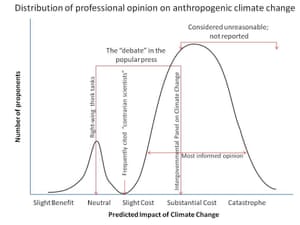
To give his article, devoid of anything other than his own opinion some scientific credibility he includes a graph into his article:
Like the ridiculous people from the Facebook site Global Warming Fact of Day (I do not know if they are still going) he sees to think it is all a matter of consensus rather than scientific evidence. These days we are all exhorted to run with the herd.
In contrast to The Guardian and other publications the Real News does some good work on climate change.

 Posts
Posts