Showing posts with label global warming. Show all posts

Wednesday, 25 August 2021

Ice is melting at 88 degrees North


All the Near Term Human Extinction death cult people will be getting ready to call a large party at this graph. "We're safe for another year!" Reality, which they never ever check tell us otherwise. Today was one of the days where the cloud has dissipated to a level where one can see what is really happening - and it is much as I said in my previous video. The ice is breaking up throughout much of the region north of 80 degrees North - in fact, as can be seen, it is breaking up up to

 88N.   

  This is what the Navy data shows

   
Here is Margo's last report from 2 days ago.

Wednesday, 21 July 2021

Report from the Arctic - 20 July, 2021

Here is Margo's full report from two days ago.


Here is my summary, following on one from a month ago


SEA ICE EXTENT

The experts refer exclusively to sea ice extent an so doing provide a false picture of the real situation


METHANE

There is a lot more methane being released than a few weeks ago but there is a suspicion that the algos are hiding the real situation (as discussed by Margo)


Margo has been monitoring global methane levels from what are now called Metop A and Metop B satellite. There has been a steady increase in levels so that already in mid-July levels are equivalent to about September last year.

SEA ICE THICKNESS

This is how it looks today
The same time in 2020


Here are the last 30 days


This is from a different data set


SEA ICE CONCENTRATION

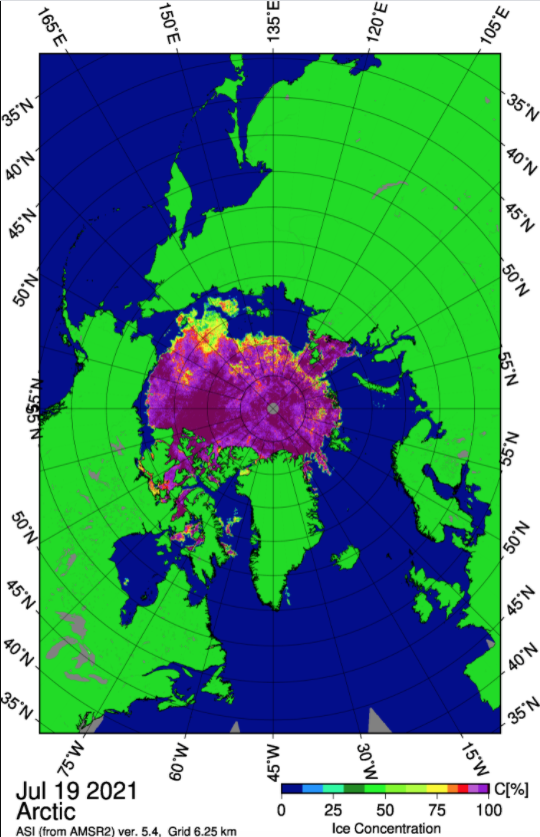
Here are two different data sets representing sea ice concentration


THE JETSTREAM

In short, a mess.


TEMPERATURES AT THE NORTH POLE


THE VIEW FROM SPACE

The ice has gone from the Northeast of Greenland that has been present in previous years.


This is how it looked last year


There is a lot of cloud right now but I can identify that ice is breaking up quite close to the North Pole 


Zooming in 


Friday, 5 March 2021

Scientific paper: The destruction of permafrost in the Laptev Sea provokes methane emissions

 I do not have the time to do this justice right now. But, in brief, it seems to confirm what we already know from observations.


Scientific paper discusses 

extensive release of methane 

from the East Siberian Arctic 

Ocean


This is the paper, just published.


Significance

Extensive release of methane from sediments of the world’s largest continental shelf, the East Siberian Arctic Ocean (ESAO), is one of the few Earth system processes that can cause a net transfer of carbon from land/ocean to the atmosphere and thus amplify global warming on the timescale of this century. An important gap in our current knowledge concerns the contributions of different subsea pools to the observed methane releases. This knowledge is a prerequisite to robust predictions on how these releases will develop in the future. Triple-isotope–based fingerprinting of the origin of the highly elevated ESAO methane levels points to a limited contribution from shallow microbial sources and instead a dominating contribution from a deep thermogenic pool.

Abstract

The East Siberian Arctic Shelf holds large amounts of inundated carbon and methane (CH4). Holocene warming by overlying seawater, recently fortified by anthropogenic warming, has caused thawing of the underlying subsea permafrost. Despite extensive observations of elevated seawater CH4 in the past decades, relative contributions from different subsea compartments such as early diagenesis, subsea permafrost, methane hydrates, and underlying thermogenic/ free gas to these methane releases remain elusive. Dissolved methane concentrations observed in the Laptev Sea ranged from 3 to 1,500 nM (median 151 nM; oversaturation by ∼3,800%). Methane stable isotopic composition showed strong vertical and horizontal gradients with source signatures for two seepage areas of δ13C-CH4 = (−42.6 ± 0.5)/(−55.0 ± 0.5) ‰ and δD-CH4 = (−136.8 ± 8.0)/(−158.1 ± 5.5) ‰, suggesting a thermogenic/natural gas source. Increasingly enriched δ13C-CH4 and δD-CH4 at distance from the seeps indicated methane oxidation. The Δ14C-CH4 signal was strongly depleted (i.e., old) near the seeps (−993 ± 19/−1050 ± 89‰). Hence, all three isotope systems are consistent with methane release from an old, deep, and likely thermogenic pool to the outer Laptev Sea. This knowledge of what subsea sources are contributing to the observed methane release is a prerequisite to predictions on how these emissions will increase over coming decades and centuries.

This article is from a South African publication

The destruction of permafrost in the Laptev Sea provokes methane emissions

In My City,

2 March, 2021

Scientists have identified the source of methane in the waters of the Laptev Sea: the concentration of the substance is associated with the destabilization of the permafrost at their bottom and the release of ancient gas reserves.

We carried out isotopic measurements, which clearly indicated that the concentration of methane in the waters of the Laptev Sea is increasing mainly as a result of the release of ancient reserves of this gas, hidden under the permafrost layer at the bottom of the ocean. This indicates the possible beginning of the disintegration of this soil layer and the existence of a large reservoir of gas, which can be abruptly ejected into the atmosphere.

Research text

The discovery of such emissions forced scientists to debate where these emissions come from and whether they are all related to the destabilization of ancient permafrost and clathrate deposits.

The authors of the work believe that the release of methane indicates a possible disintegration of the soil layer. There may be a volumetric gas reservoir under the permafrost. With the destruction of the soil layer, all the methane will be abruptly released into the atmosphere. Not so long ago, similar events took place at the bottom of the Barents Sea.

The group of researchers analyzed the isotopic ratios of carbon and three different forms of dissolved methane in the waters of the East Siberian Arctic shelf: they serve as indicators of conditions in the source of gas formation and subsequent diagenetic processes – the transformation of loose sediments into sedimentary rocks.

These measurements showed that, in all cases, the concentration of carbon-14 in methane molecules was close to zero in the vicinity of the alleged gas sources at the bottom of the Laptev Sea and gradually increased with distance from them.

Further research will lead to more accurate conclusions.


Monday, 1 March 2021

Looking at Antarctica - sea ice report from Margo - 28 February, 2021

 Looking at the Calving of the Brunt Ice Shelf, Methane, Sea Ice & Climate with Margo (Feb. 28, 2021)


Margo reviews methane data from CAMS & NOAA for Saturday, 2/27/21. She also shows the current state of the Arctic and Antarctic sea ice and looks at Climate Reanalyzer and recent earthquakes. Margo shares an article on the recent calving of the Brunt Ice Shelf and shows it on NASA Worldview.


Daily Mail,

1 March, 2021


A large iceberg the size of Bedfordshire has broken away from the Antarctic, scientists have revealed.

The separation, which took place near Britain's Halley research station, saw the iceberg measuring 1,270 square kilometres break off from the Brunt Ice Shelf in a process called 'calving', the British Antarctic Survey (BAS) said.  

It comes almost a decade after scientists first detected vast cracks had formed in the shelf which is located in the Weddell Sea section of Antarctica.

The BAS, which has been operating the research station since 2017, said the first indication that a calving event was imminent came in November 2020 when a major crack - called the North Rift – carved its way through the ice. 


In January, the rift pushed northeast at up to 1 km per day and eventually an iceberg was formed when the crack widened in the morning of February 26 and split from the rest of the floating ice shelf. 

The movement has been relayed back to the research station's headquarters in Cambridge and scientists will be inspecting satellite imagery when it becomes available. 

According to NASA, the crack in the Brunt Ice Shelf was stable for nearly 35 years before it recently began accelerating.

While it is not the largest iceberg to split off from the Antarctic, it is the biggest chunk the Brunt Ice Shelf has lost since observations began more than 100 years ago in 1915.


Britain's Halley VI Research Station, which monitors the state of the vast floating ice shelf daily, said their team had been preparing for the calving 'for years'.

BAS director Jane Francis said: 'Our teams at BAS have been prepared for the calving of an iceberg from Brunt Ice Shelf for years. 

'We monitor the ice shelf daily using an automated network of high-precision GPS instruments that surround the station, these measure how the ice shelf is deforming and moving. We also use satellite images from ESA, NASA and the German satellite TerraSAR-X. 

A crack called the North Rift formed on the Brunt Ice Shelf in Antarctica before the iceberg formed

A crack called the North Rift formed on the Brunt Ice Shelf in Antarctica before the iceberg formed


Naive for sure, but a sign that with some people with little understanding of science the truth might be percolating through.

This is from the conspiracy (and almost 100% climate change denial site, Godlike Productions)


BREAKING NEWS: The opening scene from the movie “Day After Tomorrow” is playing out in real life as we speak!!!!!
Here’s the opening scene of the movie. It’s a doomy movie where a bunch of people die. 
This is the opening scene, and the start of epic doom unleashing upon the world.


Now here’s real life with the iceberg breaking off. Epic doom will follow 
just like the movie. .


They always have to show us beforehand before they pull the real events. It’s some sort of karma
 code for them.


Saturday, 27 February 2021

Germany sees an increase of 41.9 degrees temperature in one week.

 Unseasonable European Warmth Smashes All-Time February Temperature Records


Gizmodo,

16 February  2021

Winter has receded in Europe this week. Temperature records are falling as unseasonably warm weather sweeps across the continent delivering an early spring thaw, even while neighboring Russia is simultaneously going through a deep freeze.

The shocking weather pattern began to creep across the continent earlier this week, but has reached a fever pitch on Thursday as some countries’ all-time February high temperature records tumble. It was particularly balmy in Sweden on Thursday. An area in the country’s southeast recorded a high of 62.6 degrees Fahrenheit (17 degrees Celsius), the highest temperature in Sweden ever recorded in February. Though not the hottest temperature recorded in Europe, it’s jarring to see the mercury climb that high for a country synonymous with cold weather.

Poland also set an all-time record as did Lichtenstein, Croatia, Slovenia, and Slovakia, speaking to the widespread nature of the heat wave. Of those countries, Croatia saw the highest overall temperature, clocking in at nearly 80 degrees Fahrenheit (26.4 degrees Celsius). Fourteen monthly records for regions in the Czech Republic were also broken earlier this week. All told, temperatures are averaging anywhere from 20 to 30 degrees (11 to 16.7 degrees Celsius) above normal for this time of year.

The nice weather comes on the heels of an aggressive cold snap, sending residents yo-yoing from deep winter to spring in some areas over the course of a week. Germany recorded its biggest-ever boomerang from cold to warm temperatures, logging a low of minus-10.8 degrees Fahrenheit (minus-23.8 degrees Celsius( in the city of Goëttingen on Feb. 14 to a high of 64.6 degrees Fahrenheit (18.1 degrees Celsius) just seven days later. The previous record spike had been set in 1880. In addition to the heat over Europe right now, freakishly warm air is also parked in the Arctic near the North Pole as well as Greenland.

The warm temperatures are a little too familiar. In 2019, a heat wave swept the continent and delivered record-shattering temperatures in February of that year. The winter heat wave foretold a deadly hot summer, where around 2,500 people died due to excess heat. Researchers found the 2019 heat was at least 10 times more likely due to climate change, an increasingly common finding.

It’s not all balmy sunshiny weather this week, though. Temperature maps show an abrupt shift from warm to cold temperatures roughly dividing east and west portions of the continent. In Russia, temperatures plummeted 25 degrees Fahrenheit (13.9 degrees Celsius) below average in some regions.

The reason for the sharp divide between the two regions is a sharp snap in the jet stream, a fast-flowing river of air that travels from west to east. While it can wiggle here and there, every now in then the oscillations can become more extreme, trapping warm air from the tropics in one region and cold Arctic air in another. That’s exactly what’s happening over Europe and Russia respectively right now. Some research has linked extreme waves in the jet stream to increased Arctic warming, which is weakening the temperature gradient between the poles and tropics that normally holds the jet stream more taut. Outbreaks of more extreme temperatures are liable to become more common as a result, in addition to the impacts of other natural climate shifts that can sometimes align such as the Arctic Oscillation.

This week’s European warm wave should cool off a bit as we head into the weekend as a coming front helps break up the high pressure currently camped over the continent.

Germany has seen its its biggest temperature swing since records began - with an increase of 41.9 degrees in one week.

Climate researchers at the German Weather Service (DWD) on Tuesday said the country had never before experienced a swing like the one that occurred at the weather station in the central German city of Goettingen.

A low of minus 23.8 degrees Celsius was recorded there on February 14. Seven days later, on February 21, the high was 18.1 degrees Celsius,

https://thewest.com.au/news/environment/germany-sees-record-temperature-swings-ng-s-2050779


..One idea centers on the pattern of cold air above the Arctic Circle. This pattern, known as the polar vortex, is an area of cold, low-pressure air that swirls in the stratosphere above Earth's North and South poles. When it's strong, the polar vortex spins in a regular pattern, with the jet stream serving as a barrier that keeps cold air contained in the north.


But warm weather can disrupt this system. When temperatures rise, the jet stream weakens and becomes wobbly, sometimes allowing cold air to shoot out across the planet. What may be contributing to disruptions in the polar vortex is a phenomenon called Arctic amplification, which describes how the Arctic has warmed by more than twice the global average in recent decades.

https://bigthink.com/surprising-science/texas-snowstorm-arctic

There is more to. this than meets the eye.

Thursday, 25 February 2021

Wednesday, 24 February 2021

The Breach of the Arctic Vortex and the Effects of Ice Meltwater on the Oceans

 Snowstorms, the Breach of the Arctic Vortex and the Effects of Ice Meltwater on the Oceans

By Dr. Andrew Glikson


Global Research,

23 February, 2021


All Global Research articles can be read in 27 languages by activating the “Translate Website” drop down menu on the top banner of our home page (Desktop version).

***

Warnings by leading climate scientists regarding the high sensitivity of the atmosphere in response to abrupt compositional changes, such as near-doubling of greenhouse gas concentrations, are now manifest: According to Wallace Broecker, (the “father” of climate science) “The paleoclimate record shouts out to us that, far from being self-stabilizing, the Earth’s climate system is an ornery beast which overreacts to even small nudges, and humans have already given the climate a substantial nudge”. As stated by James Zachos, “The Paleocene hot spell should serve as a reminder of the unpredictable nature of climate”.

As snowstorms the Beast from the East (2018) and Storm Darcy (2021) sweep the northern continents, reaching Britain and as far south as Texas and Greece, those who still question the reality and consequences of global climate change, including in governments, may rejoice as if they have a new argument to question global warming.

However, as indicated by the science, these fronts result from a weakened circum-Arctic jet stream boundary due to decreased temperature polarity between the Arctic Circle and high latitude zones in Europe, Russia and North America. The reduced contrast allows migration of masses of cold Arctic air southward and of tropical air northward across the weakened jet stream boundary, indicating a fundamental shift in the global climate pattern (Figure 1).
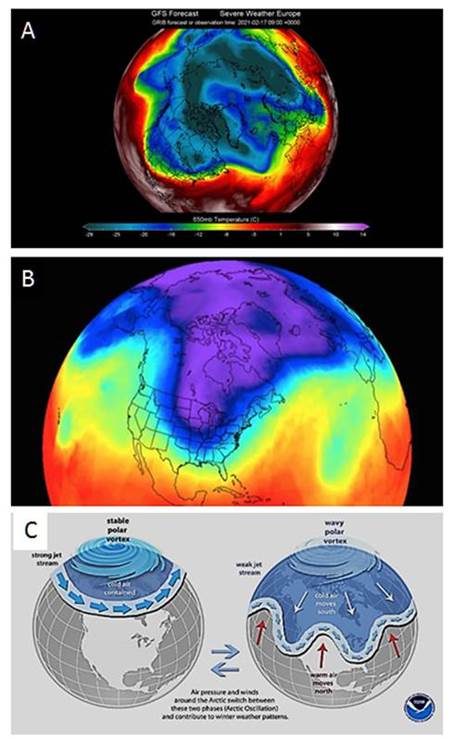
Figure 1. (A and B) Extensions from the Arctic polar zone into North America and Eutope; (C) weakening of the Arctic jet stream boundary (NOAA)

The weakening of the Arctic boundary is a part of the overall shift of climate zones toward the poles in both hemispheres, documented in detail in Europe (Figure 2). Transient cooling pauses are projected as a result of the flow of cold ice meltwater from Greenland and Antarctica into the oceans, leading to stadial cooling intervals.
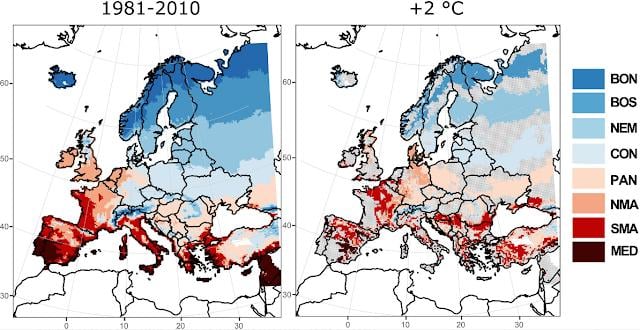
Figure 2. Migration of climate zones in Europe during 1981-2010 and under +2°C. Faint pink areas represent advanced warming. (A, left) Agro‐climate zonation of Europe based on growing season length (GSL) and active temperature sum (ATS) obtained as an ensemble median from five different climate model simulations during the baseline period (1981–2010). (B, right) Ensemble median spatial patterns of agro-climate zones migration under 2°C global surface warming according to model RCP8.5. Gray areas represent regions where no change with respect to the baseline period is simulated.

A combination of ice sheet melting and the flow of melt water into the oceans on the one hand, and ongoing warming of tropical continental zones on the other hand, are likely to lead to the following:

  • Storminess due to collisions of cold and warm air masses;
  • As the ice sheets continue to melt, the cold meltwater enhances lower temperatures at shallow ocean levels, as modelled by Hansen et al. (2016) and Bonselaer et al (2018) (Figure 3A), as contrasted with warming at deeper ocean levels over large parts of the oceans. This transiently counterbalances the effects of global warming over the continents arising from the greenhouse effect;
  • The above processes herald chaotic climate effects, in particular along continental margins and island chains.
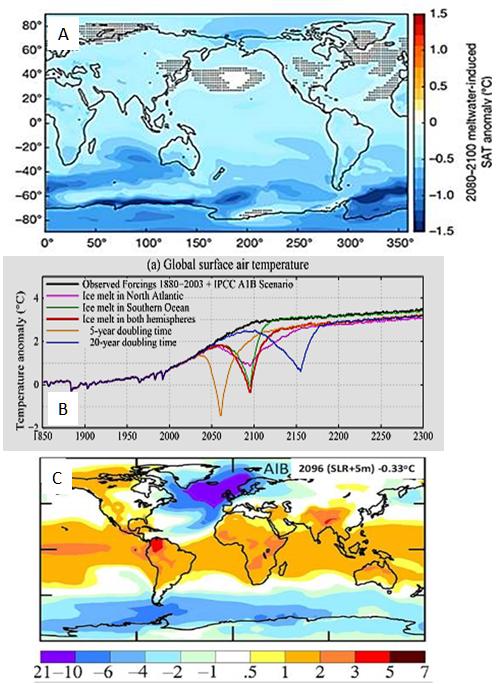
Figure 3. A. 2080–2100 meltwater-induced sea-air temperature anomalies relative to the standard RCP8.5 ensemble (Bronselaer et al., 2018), indicating marked cooling of parts of the southern oceans. Hatching indicates where the anomalies are not significant at the 95% level; B. Negative temperature anomalies through the 21st-22nd centuries signifying stadial cooling intervals (Hansen et al., 2016); C. A model of Global warming for 2096, where cold ice melt water occupies large parts of the North Atlantic and circum-Antarctica, raises sea level by about 5 meters and decreases global temperature by -0.33°C (Hansen et al., 2016).

The extreme rate at which the global warming and the shift of climate zones are taking place virtually within a period less than one generation-long, faster than major past warming events such as at the Paleocene-Eocene boundary 56 million years ago, renders the term “climate change” hardly appropriate, since what we are looking at is a sudden and abrupt event.

According to Giger (2021)

“Tipping points could fundamentally disrupt the planet and produce abrupt change in the climate. A mass methane release could put us on an irreversible path to full land-ice melt, causing sea levels to rise by up to 30 meters. We must take immediate action to reduce global warming and build resilience with these tipping points in mind.”

Computer modelling does not always capture the sensitivity, complexity and feedbacks of the atmosphere-ocean-land system as observed from paleoclimate studies. Many models portray gradual or linear responses of the atmosphere to compositional variations, overlooking self-amplifying effects and transient reversals associated with melting of the ice sheets and cooling of the oceans by the flow of ice melt.

According to Bonselaer et al. (2018)

“The climate metrics that we consider lead to substantially different future climate projections when accounting for the effects of meltwater from the Antarctic Ice Sheet. These differences have consequences for climate policy and should be taken into account in future IPCC reports, given recent observational evidence of increasing mass loss from Antarctica” and “However, the effect on climate is not included (by the IPCC) and will not be in the upcoming CMIP6 experimental design. Similarly, the effects of meltwater from the Greenland Ice Sheet have so far not been considered, and could lead to further changes in simulated future climate”. Depending on future warming the effect of Antarctic ice meltwater may extend further, possibly becoming global.

By contrast to ocean cooling, further to NASA’s reported mean land-ocean temperature rise of +1.18°C in March 2020 above pre-industrial temperatures, relative to the 1951-1980 baseline, large parts of the continents, including central Asia, west Africa eastern South America and Australia are warming toward mean temperatures of +2°C and higher. The contrast between cooling of extensive ocean regions and warming of the continental tropics is likely to lead to extreme storminess, in particular along continent-ocean interfaces.

The late 20th century to early 21st century global greenhouse gas levels and regional warming rates have reached a large factor to an order of magnitude faster than warming events of past geological and mass extinction events, with major implications for the nature and speed of extreme weather events.

For these reasons the term “climate change” for the current extreme warming, which is reaching +1.5°C over the continents and more than +3°C over the Arctic over a period shorter than one century, no longer applies.

The world is looking at an extremely rapid shift in the climatic conditions that have allowed civilization to emerge.

*

Note to readers: please click the share buttons above or below. Forward this article to your email lists. Crosspost on your blog site, internet forums. etc.

Dr Andrew Glikson is an Earth and Paleo-climate scientist, Canberra, Australia.

Featured image is from Barbara Nimri Aziz