Showing posts with label oil leak. Show all posts

Sunday, 26 July 2015

Siberian oil spill

I discovered this in my search

New oil spill in Siberia

Mysterious 'lakes of black oily liquid' found near Nizhnevartovsk.

16 July 2015

'Oil layer covers the entire visible surface of the water within a radius of 10-15 metres.' Picture: N1

The discovery by a local resident was highlighted by local NI channel. 
Reporter Konstantin Scherbina, at the scene, said:  'In the middle of the oily lake is sticking a valve. 
'Oil layer covers the entire visible surface of the water within a radius of 10-15 metres. 
'Along the way, right on the surface lies a pipe, presumably the pipeline. 
'The oil spills extend approximately 100-150 metres from the valve along the road in both directions.'
Oil spill in Nizhnevartovsk

Oil spill in Nizhnevartovsk

Oil spill in Nizhnevartovsk
'The oil spills extend approximately 100-150 metres from the valve along the road in both directions.' Pictures here and below: N1

Some 200 metres away is another spill - 'the size of a small football field'.
The reporter ignited a piece of paper dipped in the oil, to show on camera how it burned.
It was unclear which oil company owned the 'rusty' pipeline, or what had happened to cause the seepage. 
The leak follows another spill close to  Nefteyugansk, a city of 123,000, when oil seeped into floodwater from the Ob River. 
Oil spill in Nizhnevartovsk

Oil spill in Nizhnevartovsk

Oil spill in Nizhnevartovsk

Oil spill in Nizhnevartovsk


Friday, 5 December 2014

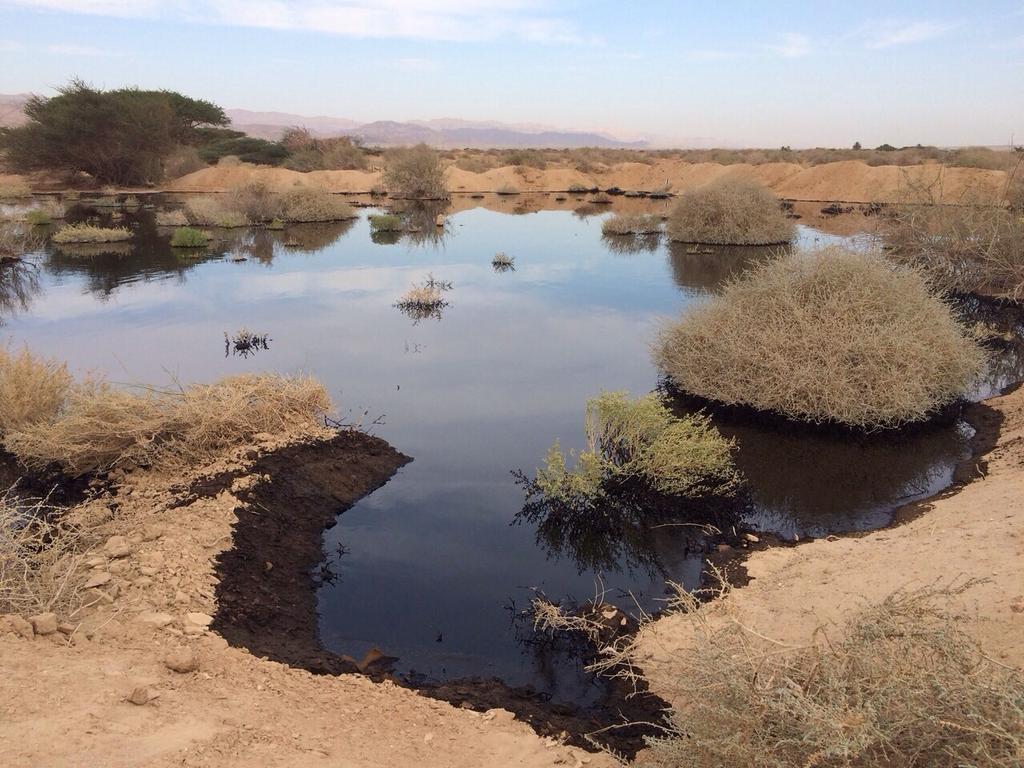
Oil spill in Israel

Millions of liters’ of oil spilled in Israel, flooding nature reserve


Crude oil streams through the desert in south Israel, near the village of Beer Ora, north of Eilat December 4, 2014.(Reuters / Yehuda Ben Itach)

RT,

4 December, 2014

A pipeline breach near the Israel-Jordan border has flooded a nature reserve in what authorities call one of Israel’s worst environmental disasters, causing large amounts of potentially poisonous gas to be released near Aqaba, raising health concerns.

The Eilat-Ashkelon crude oil pipeline near the Evrona reserve in the south of Israel accidentally ruptured Wednesday night spewing a river of oil across the desert. Israeli environment officials predict that the clean-up effort could take years

View image on Twitter
Israeli nature reserve hit with oil spill http://cir.ca/news/israel-nature-reserve-oil-spill 

The full scope of the incident is still not clear to us, but it is certainly a matter of millions of liters of crude oil, which is dangerous both to animals and to the nature reserve itself," Environment Ministry representative Guy Samet was quoted as saying in Globes, as Israeli financial news daily.
Samet has said that an estimated 4.3 mile-oil stream is flowing through the reserve, which is home to a large gazelle population and the world’s northernmost doum palms, a rare type of branching palm tree.

View image on Twitter
Oil spill on Israel-Jordan border "1 of worst" environmental disasters in region's history pic.twitter.com/gSG6PbKL2L but barely makes the news.

"This is one of the State of Israel's gravest pollution events," Samet told Israel Radio on Thursday.

A spokesman for the Eilat Asheklon Pipeline Company (EAPC), Ronen Moshe, said that the spill occurred in a new section of the pipeline. The breach occurred during prep work for the construction of an international airport in Timna, in southern Israel, according to Haaretz. The reasons for the spill are being investigated. 

There are dozens of people in the field taking care of the aftermath,” Moshe said Wednesday night, adding that the spill had not affected supply.

EAPC workers were joined by Israeli firefighters and rescue forces who worked to contain the spill, stopping the oil short of the Jordanian border. Route 90, the main road to Eilat, was temporarily closed pending emergency work. The team was reportedly able to curtail the oil flow after several hours

Crude oil streams through the desert in south Israel, near the village of Beer Ora, north of Eilat, December 4, 2014. (Reuters / Yehuda Ben Itach)


Though the Jordanian side of the border remained unscathed, Jordanian officials have said that over eighty Aqaba residents have sought medical treatment for respiratory problems following the release of large amounts of hydrogen sulfide into the air, according to Haaretz. However, officials said that the residents’ health problems were not serious.

The 153-mile pipeline which links Asheklon, a southern port city, to the Mediterranean coast, was opened in the 1960s to facilitate transport of Iranian oil to Europe, but has primarily been used to move oil within Israel since the deterioration of Israeli-Iranian relations after the 1979 Iranian Revolution.

Thursday, 1 May 2014

'Compromised oil pipeline' in Alaskan tundra

BP pipeline sprays ‘oily mist’ over 33 acres of Alaskan tundra


RT,
30 April, 2014
Alaska state officials confirmed Wednesday that an oily mist sprung from a compromised oil pipeline and sprayed into the wind without stopping for at least two hours, covering 33 acres of the frozen snow field in the oil well's vicinity.
The discovery was at the BP-owned Prudhoe oil field on Alaska’s North Slope, the northernmost region of the state where a number of profitable oil fields sit beneath the tundra. The Alaska Department of Environmental Conservation (DEC) revealed that BP officials found the mist during a routine inspection on Monday.
Initial reports said that 27 acres had been covered, although that figure was updated later on Wednesday. The cause is still under investigation, according to the Associated Press, but officials know that the mist was made up of a mixture of gas, crude oil, and water. They also reported that while the noxious mist was distributed over such a wide area by 30 mph winds, no wildlife was impacted.
BP spokeswoman Dawn Patience said the company is “still assessing repairs” and will soon know what, if any, long-term effects the spill could have.
The Prudhoe Bay region, like elsewhere in the North Slope, is home to a great number of migratory birds and caribou, as well as other animals, such as a massive porcupine herd. Clean-up efforts are expected to be complete before birds pass through the region again in the coming weeks.
The company was at fault in at least two oil spills in the same region since 2006. That year, an estimated 267,000 gallons of oil seeped through a quarter-inch sized hole in a corroded BP pipeline. That accident went unnoticed for five days, until an oil worker smelled the aroma of crude when driving through the area, according to Think Progress.
The company spent $500 million on upgrading 16 miles of pipeline that transported oil into a processing facility dubbed Gathering Center 2.
Instead of acting as a warning to the company, though, the 2006 spill only served as a preview for a 2009 spill that sent approximately 14,000 gallons from a pipeline into the tundra and wetlands of Prudhoe Bay.
The 2009 spill vividly demonstrates that BP has not adequately addressed the management and environmental compliance problems that have plagued it for many years,” US government lawyers said in a court filing that sought to levy steep fines onto BP, as quoted by Bloomberg.
This rupture was the result of a predictable and preventable freezing of produced water within the pipeline that caused the pipe to over-pressurize and burst. Eerily similar to the 2006 spill, BP ignored alarms that warned of the pipe’s eventual rupture and leak.”
Officials made the most recent finding less than a week after a report from the US National Research Council (NRC) announced that regulators are not prepared to effectively respond to an Arctic oil spill. The 198-page assessment authored by scientists at the request of the American Petroleum Institute and the Coast Guard found that while more research still needs to be done, the current situation is bleak.
The lack of infrastructure in the Arctic would be a significant liability in the event of a large oil spill,” the report stated, as quoted by the Associated Press. “It is unlikely that responders could quickly react to an oil spill unless there were improved port and air access, stronger supply chains and increased capacity to handle equipment, supplies and personnel.”
Most of the information regulators have gathered on how to respond to oil spills comes from warmer areas, such as the Gulf of Mexico – the site of another massive BP oil spill in April 2010. Yet the drilling areas far to the north remain largely isolated from the resources in the Gulf, with the Chukchi and Beaufort Seas located more than 1,000 miles from the nearest deep water port.
As such, the NRC recommended the US quickly institute “a comprehensive, collaborative, long-term Arctic oil spill research and development program.”

Wednesday, 19 February 2014

Oil and gas disasters


U.S. under attack: 7 oil/gas disasters in 
4 days


15 February, 2014


Seven fossil fuel disasters within four days this week terrorized hundreds of Americans. Bright glowingfireballs brightening night skies scarier than bombs;blown up homes while others rocked to their foundations; evacuations; injured, feared dead workersderailed train leaking chemicals, and a toxic coal slurry covering at least six miles of waterway emptying into a major river, and a gas pipeline blowout preventer failure have left people running for their lives and countryside looking like a war zone.

Corporate-government's intense human rights abuses against citizenry regarding health and safety escalated in oil- and gas-cursed states this week.

Hiland Partners Pipeline Explosion, North Dakota

Monday evening, Feb. 10, a Hiland Partners LP gas pipeline exploded, causing a large fire south of Tioga in northwestern North Dakota.

The blast was so bright, it lit the night sky like the sun, according to Tioga Mayor Nathan Germundson, also a firefighter who responded.

As crews began responding, they saw a large glow south of town, so they knew it was a big blaze.

Hiland was ‘blowing’ hydrates, ice-like solids formed from a mixture of water and gas that can block pipeline flow, out of the pipeline, according to Kris Roberts of the North Dakota Department of Health Environmental Health Section.

Hiland Partners said the fire on the property it operates was extinguished and no third-party property was damaged. The cause of the fire is unknown and remains under investigation.

The pipeline was above ground at the point of ignition, Roberts said. It started in the “slug catcher,” a large diameter pipe with a hatch that allows workers to remove equipment used in a pipeline cleaning and inspecting process called pigging.

Navy Dumps 2,000 Gallons Oily Contaminated Waste Water, Puget Sound

The Navy dumped thousands of gallons of oil contaminated waste-water into Puget Sound, blaming it on a failed pump.

Tom Danaher, spokesman for Naval Base Kitsap-Bangor, said the Navy was using a pumping system on one of its piers to remove oily bilge water from a ship late Monday. An electrical ground prevented the pump from automatically shutting off when a 4,000 holding tank was filled. Because the operation was unattended, it took 20-30 minutes before naval staff realized that oil-contaminated waste-water was pouring into the sound, Danaher said in an interview Wednesday.

So the pumps did not get the signal that the tank was full. The tank overflowed,” he said. “When the people on the pier saw the overflow, we stopped all pumping and started our clean up.”

The cleanup expanded Wednesday with deployment of surveyors walking the beaches around Hood Canal where the spill occurred, Danaher said.

Initially, the Navy indicated 150-200 gallons had spilled. Since then, only after shown photos of the oil mess, the unified spill command – including the Navy, U.S. Coast Guard and Washington Department of Ecology – agreed the amount leaked was nearly 2,000 gallons.

Chevron fracking well explosion sets blaze, injuring one, one feared dead: Penn.-West Virginia Border Town

Tuesday, Feb. 11, the worst fear fossil fuel workers imagine occurred when a Chevron fracking well exploded near the Pennsylvania-West Virginia border. It injured one worker, likely killed another, and continues to spew a massive amount of chemicals into the air for at least 15 miles that four days later, is still impacted, despite what the corporation and some officials say.

This is not your standard well fire. It’s bigger,” officials report.

The explosion rocked residents’ houses and set a huge blaze seen for miles, still alight and so hot, responders have been unable to get near it.

I can see the gas well fire in Bobtown from my house… like 10 miles away,” tweeted Jesse Vihlidal ‏@JesseVihlidal, adding hashtags, “#scary” and ” #gasland.”

Wednesday, as far as Morgantown, West Virginia 14 miles south, the smog from the north as winds blew south, was so heavy, many were absent from work, some attributing the absenteeism to the spreading volatile gas plume — that officials say is not hazardous to humans.

No emergency provisions were on site. The wild well was so unique and huge, Chevron has Houston-based company Wild Well Control to attempt to halt the massive gas fire, larger than most other such fires.

We’re being told … the site itself, that fire, will not be contained and we will not have access to that property for at least a few days,” Trooper Stefani Plume said Tuesday.

Wild Well specialists say, however, they will cap the well. Officials have voiced concern about plugging the well, fearing gas pressure below might migrate to other areas and cause further serious damage. Residents also remain fearful.

Location of well pads….school yards? right next to homes? Any gas well can go wrong-why do they need companies like Wild Well Control if it is perfectly safe?” asks Victoria Switzer in a comment Thursday. “Are folks being told the real danger or risk of gas wells in their yards? Is signing a gas lease a waiver. I am still waiting for the gas industry to be honest and share the list of inherent risks associated with gas extraction, production and transportation.

Other than this site, I have seen very little coverage of this event but I have sure seen a lot of glossy ads on tv showing the wonders of natural gas.”

Patriot Coal Co. slurry line ruptured, sent black toxic crud 6 miles into river: West Virginia

Also Tuesday, Feb. 11, near the same time that Chevron’s frack well exploded in Bobtown near West Virginia’s border, 150 miles south, a Patriot Coal company slurry line at southern West Virginia’s Kanawha Eagle Prep Plant ruptured and spilled a highly toxic byproduct from the coal mining and preparation process into a creek feeding the Kanawha River, blackening a 6-mile stretch down one waterway.

Over 100,000 gallons of slurry spilled. West Virginia state officials are monitoring potential impacts on public health and the local water supply, along with Freedom Industries’ chemical leak that continues to prevent safe water for 300,000 residents.

Officials initially dismissed this event as not significant. Now, however, West Virginia Department of Environmental Protection (DEP) officials say it is ”significant” and are comparing it to Freedom Industries’ coal chemical spill into the Elk River.

Coal slurry contains substances more toxic than Crude MCHM or polyethylene glycol already contaminating over nine counties from the Freedom Industries event over a month ago.

Coal slurry contains heavy metals, like iron, manganese, aluminum and selenium.

Gas oipeline explodes: Kentucky

Wednesday Feb 13, a gas pipeline 20-30 feet underground, exploded in Kentucky just after 2:00 A.M. CST, sending two people to hospital, forcing evacuation of 20 homes, leaving a 60-foot crater, and two homes totally destroyed. The violent explosion rocked homes to their foundations.

All the sudden, the house shook and everything lit up like daylight, so we ran to the window and looked out and all we saw was this big ball of fire,” said military veteran Bill Kingdollar, who lives about a quarter mile from the blast site. “It looked like a warzone. I’ve never seen anything like that.

I’ve told you I spent 20 years in the military and I’ve never seen a fireball or anything like that,” he said. “It was the craziest thing I’ve ever seen. Everything shook. The ground shook. The windows shook. Everything was shaking including me because you don’t know what’s going on.“

This disaster occurred in Adair County, near Highway 76 in Knifley south of Louisville. The gas pipeline transports natural gas from the Gulf of Mexico to New York.

The first call came in at about 1:04 A.M. CST when residents heard and felt rumbling under their feet, said Adair County Emergency Management Agency director Greg Thomas. Then came the explosion and a ball of fire, he said.
Three homes, two barns, and six vehicles caught fire after the blast, he said. Two of homes were completely destroyed.

There is now a crater 60 feet deep and it blew rocks out, and I don’t mean pebbles … big rocks,” and a 20- to 30-foot section of pipe was thrown over 300 feet.

After the explosion, 20 homes were evacuated. By 1:30 p.m. all fires had been extinguished and the evacuation order lifted allowing residents to return to their homes, he said.

Columbia Gulf Transmission detected a drop in gas pressure in the pipe at the time of the explosion. Officials determined the pipe ruptured.

Nustar’s Norfolk Southern Train derails, crashes, spews 7,000 gallons crude plus propane near homes: Pennsylvania

Thursday, Feb. 13, 21 fossil fuel cars in NuStar’s Norfolk Southern train derailed, crashed in Pennsylvania, spewing 7,000 gallons of carcinogenic crude oil only two miles from dozens of homes.

I heard a strange noise, a hollow, screeching sound,” said Ray Cochran, who watched the train derail from his home on a hill above the tracks. “I looked out the window and saw three or four tankers turn over and one of them ran into the building.”

The 120-car Norfolk train carrying heavy Canadian crude oil derailed near Vandergrift, company officials confirmed Thursday.

In the cars that jumped track, 19 were carrying crude oil and two were carrying propane.

We do have a lot of homes in close proximity. It could’ve been very tragic,” said Dan Stevens, a local public safety spokesman Thursday. “If it would’ve happened in a borough, we could’ve had a totally different situation.”

The train crashed into a track-side building owned by MSI Corporation that makes metal products. MSI refrained from comment.

This was the second fossil fuel oil train derailment in less than a month in Pennsylvania. A train hauling crude on a CSX Corp railroad jumped the tracks and nearly toppled over a bridge in Philadelphia on Jan. 20.

Whiting Oil and Gas company frac well in North Dakota blew out, sending workers running for their lives

Also on Thursday, Feb. 13, a Whiting Oil and Gas company frac well in North Dakota blew out of contro, sending 15 workers running for their lives in fear of an explosion. A blow out preventer failed. Around 10,000 gallons of poisonous fluid has been leaking from the wild well per hour.

The hydraulic fracturing (fracking) well blowout occurred when a blow out preventer (BOP) failed south of Watford City, about seven miles north of the Theodore Roosevelt National Park North Unit in North Dakota according to the Department of Mineral Resources Director Lynn Helms.

The fifteen workers who ran from the well left their pickups at the site called McKenzie County Sheriff’s Office, said McKenzie County Emergency Manager Jerry Samuelson. He directed a school bus in the area to pick up the workers.

When that thing blows, you just never know,” Samuelson said. “There’s a possibility of explosion.”

The BOP seal leaked and caused the accident, according to Denver, Colorado-based Whting Oil and Gas company spokersperson Jack Ekstrom.

It’s still a tad dangerous up there,” Kris Roberts, with the health department’s Division of Water Quality said mid-day Friday.

Bob Wisness, who lives about a mile from the well, said he saw what looked like a green vapor after the incident. He received a message from Whiting that a blowout occurred. Although Wisness didn’t feel he was in danger, he started texting friends who live near the site but were out of town, he said.

There are well sites that are closer to people’s homes. I’m glad it’s not me. Other people have good reason to worry about it,” Wisness said.

While no immediate injuries were reported, the initial release sprayed oil and water on to snow that is on top of the ice-covered Cherry Creek, according to Helms.

To the best of our knowledge, nothing has gotten into the water,” Helms said.
Whiting Oil and Gas claimed about 50 barrels of flowback water were released but contained on site within a berm.

Fracking had been completed at the well and the fluid released was a poisoned water-based solution that flows back to the surface. As much as one million gallons of water is used per well. The well continued releasing about 200 barrels of poisoned fluid per hour, about 10,000 gallons per hour. The company says the fluid was directed to tanks and contained on site, according to Ekstrom.

Crews from Wild Well Control were brought in to assist with the out-of-control well. Helms said the cause of the accident will be closely examined because blowouts carry serious health and safety risks. (Author’s emphasis.)
In 2012, a worker died when hit by pickup during the chaos after a blowout in Williams County, North Dakota.

190,000 residents without power in freezing conditions: North Carolina

Meanwhile, this week, on Nov. 13, dependent on “safe and efficient fossil fuels,” thousands of North Carolinians had no electricity in a winter storm that dropped snow, sleet and freezing rain.

Overall, customer outages have totaled over 500,000. It took some 3,400 Duke Energy crews working to restore power Thursday in the Carolinas.

Some of our service territory took a hard blow from the storm,” said Jeff Corbett, senior vice president of Duke Energy’s Carolinas Delivery Operations. “We are concentrating our efforts on assessing damage and working to restore power in these hard-hit areas.

Not one of the above events would have happened had the nation been proactive in the field of renewable energy.

Sources: NPR, Post Gazette, WLKY, Bizmark Tribune with special thanks to reader, RetiredPatriot, Before It’s News,

Monday, 17 February 2014

Oil well in North Dakota out of control

I am posting this verbatim from Facebook

Oil well in North Dakota out of control, leaking


Blowout occurred late Thursday. Reuters report from Friday 4:22 PM said (well) "was leaking between 50 and 70 barrels per day of fracking fluid that contains chemicals, water and sand, a company spokesman said."

-snip

Local news report from Friday 6:01 PM says: "an oil spill near Watford City that's spewing 200 barrels of oil an hour."..."Lynn Helms with the Department of Mineral Resources says the bottom piece of a 3 part "blow out preventer" broke."

"Right now, he thinks the cold weather may have caused the piece to break."

Cold weather? in Fucking North Dakota? Shocking. Who are the clowns running this shit?

So, if the company says 50-70 barrels of fracking fluid per day, and local news and DMR rep says 200 barrels of oil per hour, what is the real amount and material being spilled? 50-70 barrels of 'fracking fluid' is a bit different than 4,800 barrels of crude oil.


Picture is representative of an oil well blowout, as it appears the authorities do not allow the public / press within miles of an oil well accident in ND.


Thursday, 13 February 2014

Leaks and spills - pollution

Leaks and spills everywhere:

"Officials are responding to a spill of oily bilge water in Washington’s Puget Sound. The spill occurred at Naval Base Kitsap-Bangor and has spread 10 miles north to Hood Canal.

State agencies estimate that up to 2,000 gallons spilled Monday when a ship was pumping out oily discharge at the naval facility. The pier-side transfer system failed and overflowed.

Initially the Navy estimated that 150 gallons spilled, but by Tuesday other agencies were disputing that amount.

The Washington Department of Ecology has conducted fly-overs and said that the sheen has spread as far as the Hood Canal Bridge, 10 miles north of the base."

--Mike Ruppert

Greene County shale well continues burning
Smoke rises on Tuesday above the flames at the site of the gas fire at the Chevron well near Bobtown, Greene County.


11 February , 2014

A spark or an error on the job results in a potentially deadly well fire that burns out of control, causing even more danger to the experts who have to be flown in to contain the blaze.

That's the situation in Dunkard, Greene County, after something caused a Marcellus Shale gas well owned by Chevron to catch fire just before 7 a.m. Tuesday, leaving one employee with a minor injury and another worker missing and feared dead.

More than 12 hours after an explosion that "sounded like a jet engine going 5 feet above your house," as one neighbor put it, the fire, fueled by the well's gas, continued to shoot flames and smoke into the air, causing a hissing sound that could be heard a quarter-mile away.

The heat from the blaze -- which caused a tanker truck on site that was full of propane gas to explode -- was so intense that first responders from local fire departments had to pull back rather than risk injury.

"They essentially retreated to let the fire burn," said John Poister, spokesman for the Pennsylvania Department of Environmental Protection, which had three people on site investigating.

State police said they were told it could take days to contain the fire.

"We're being told ... the site itself, that fire, will not be contained and we will not have access to that property for at least a few days," Trooper Stefani Plume said at a news conference Tuesday.

Experts on well fires like this were flown in Tuesday from Houston.

Patti Green, a spokeswoman for Wild Well Control, the company Chevron called in to try to contain the blaze, said it would not be unusual for a response team to let a fire burn before making an attempt to knock it down.

The question that remained unanswered Tuesday was what caused the explosion.

Though the fire was initially thought to be a "blowout" in which there was loss of control at the well head during drilling that resulted in a release of natural gas, Mr. Poister said he has been told that it was not a drilling-related accident.

Instead, he said, the well had long since been drilled and crews were on site early Tuesday morning putting in pipe that would connect the well to Chevron's gas-gathering network -- the final stage before the well goes into production.

DEP records show that Chevron's Lanco 7H well was drilled in March 2012 -- as were two other wells on the same well pad -- and had not yet begun to produce gas.

DEP's online records also show the state had not issued any violations against Chevron for any problems related to the drilling of the three wells on the well pad.

In December, Chevron was given one violation for an incident related to the well site -- for failure to comply with the terms and conditions of the state's site permit -- but no details of that violation were immediately available.

Chevron said the explosion occurred at about 6:45 a.m. Tuesday.

John Kuis, 57, of nearby Dilliner said he heard his dog Riley start growling early in the morning, seconds before he felt rumbling.

"Then the house just sort of shook and there was a big loud bang," he said.

Mr. Kuis, who lives less than a half-mile from the well, said he saw smoke and flames out of his window and at first thought his neighbor's home had blown up.

A contractor working for Chevron had 20 employees on site at the time of the explosion. Beyond the worker who was injured and the one who is missing, the other 18 workers were accounted for by 8:48 a.m., according to Rep. Pam Snyder, D-Greene.

Chevron employees came to the scene after the explosion and immediately decided to call in the experts at Wild Well Control, and police created a half-mile perimeter around the site.

No schools, homes or businesses are inside the state police perimeter, and state officials don't believe the burning natural gas is toxic, Mr. Poister said, and the fire appeared to be contained to the well pad.

Wild Well Control has an office in Southpointe, Washington County, and "prepositioned" equipment to help with well control incidents at an office in Clearfield.

But local offices are not typically staffed with advanced well-control specialists -- which Wild Well calls its "first response teams" -- who would handle a well fire or other well control incident.


Up To 2,000 Gallons Of Oily Water Spilled In Hood Canal


11 February, 2014

Officials are responding to a spill of oily bilge water in Washington’s Puget Sound. The spill occurred at Naval Base Kitsap-Bangor and has spread 10 miles north to Hood Canal.

State agencies estimate that up to 2,000 gallons spilled Monday when a ship was pumping out oily discharge at the naval facility. The pier-side transfer system failed and overflowed.

Initially the Navy estimated that 150 gallons spilled, but by Tuesday other agencies were disputing that amount.

The Washington Department of Ecology has conducted fly-overs and said that the sheen has spread as far as the Hood Canal Bridge, 10 miles north of the base.

The Navy did not immediately respond to requests for an interview.

There were no documented impacts to wildlife as of Tuesday afternoon, but the Department of Health advised against harvesting shellfish from the affected area.


'Significant' slurry spill blackens Kanawha creek
100,000 gallons escapes Patriot Coal facility


11 February, 2014

CHARLESTON, W.Va. -- More than 100,000 gallons of coal slurry poured into an eastern Kanawha County stream Tuesday in what officials were calling a "significant spill" from a Patriot Coal processing facility.

Emergency officials and environmental inspectors said roughly six miles of Fields Creek had been blackened and that a smaller amount of the slurry made it into the Kanawha River near Chesapeake.

"This has had significant, adverse environmental impact to Fields Creek and an unknown amount of impact to the Kanawha River," said Secretary Randy Huffman of the state Department of Environmental Protection. "This is a big deal, this is a significant slurry spill."

"When this much coal slurry goes into the stream, it wipes the stream out."

Earlier in the day, Jimmy Gianato, director of the Division of Homeland Security and Emergency Management, said he didn't have a lot of details on the incident but was under the impression it wasn't that serious.

"I don't think there's really anything to it," Gianato said. "It turned out to be much of nothing."
The spill occurred at Patriot Coal's Kanawha Eagle operation.

The spill was caused by a malfunction of a valve inside the slurry line, carrying material from the preparation plant to a separate disposal site, not to an impoundment, according to DEP officials.

The valve broke sometime between 2:30 and 5:30 early Tuesday morning, Huffman said at a news conference Tuesday evening. Patriot Coal did not call the DEP to alert them of the leak until 7:40 Tuesday morning, Huffman said. Companies are required to immediately report any spills to the DEP.

There was an alarm system in place to alert facility operators of the broken valve, but the alarm failed, so pumps continued to send the toxic slurry through the system. There was a secondary containment wall around the valve, but with the pumps continuing to send slurry to the broken valve, it was soon overwhelmed and the slurry overflowed the wall and made its way to the creek.

Huffman said they did not know why the alarm system failed.

"Had the alarms gone off and warned the operator that the pipe was leaking, the shutdown could have been done in time for the secondary containment to contain the material that leaked," Huffman said. "This was a mechanical failure, we're not making any excuses for anybody."

The company turned off the pumps at 5:30, more than two hours before anyone called the DEP, but Huffman said he's not sure if they turned off the pumps because they knew about the spill or for another reason.

Patriot Coal released a statement on the spill Tuesday evening.

"Mine personnel provided notification to the West Virginia Department of Environmental Protection and all pumping related to the slurry line was promptly discontinued and the discharge ceased. Containment activity began immediately at the site and is continuing in Fields Creek and is our top priority," Janine Orf, a Patriot spokeswoman wrote.

For most of the day, the DEP was operating under the assumption that MCHM, the chemical that contaminated the drinking water of 300,000 West Virginians last month, was included in the spilled slurry. Huffman said that they learned late in the day that the facility had stopped using MCHM just a few weeks ago, so a different coal-cleaning chemical was involved.

Huffman said that the new chemical was polypropylene glycol, although he also referred to it as polyethylene glycol. He said that that chemical is such a small part of the slurry that they don't believe it, specifically, will have an impact.

Huffman said they had been testing for MCHM, but will now have to change their testing protocols.

Residents near the spill had complained of MCHM's telltale licorice odor, but Huffman said that the odor was from a tank of MCHM that the company was moving off site.

Oddly, in Patriot's statement the company mentioned testing for MCHM in Fields Creek.

"Recent testing initiated by the Kanawha Eagle mining complex confirmed that the level of MCHM is far below the 1 part per million screening level set by the Centers for Disease Control and in most instances was non-detectable," Orf wrote. "We will continue to work with the Department of Environmental Protection regarding the containment and cleanup activities."

Huffman said that they are using booms, vacuum trucks and settling ponds to try to contain the spill.

Coal slurry contains a variety of substances that are likely more toxic than Crude MCHM or polyethylene glycol. It contains heavy metals, like iron, manganese, aluminum and selenium.

By calculating the rate of the pump and the time it ran, DEP officials estimate a maximum of 108,000 gallons of slurry spilled into Fields Creek. They do not know how much made it into the Kanawha, but Huffman said the slurry was visible in the river for about a half-mile before it began to dissipate.

There are no water intakes directly downstream from where the spill took place.

Laura Jordan, a spokeswoman for West Virginia American Water, issued a statement to reassure the public the slurry spill would not impact the company's regional drinking water plant in Charleston -- which is located about a mile upstream from where the Elk River empties into the Kanawha.

"We have been in contact with the West Virginia Bureau for Public Health, which concurs that they do not anticipate any impact to our plant on the Elk River," Jordan said.

This is at least the third slurry incident since 2010 at the Kanawha Eagle cite. In late November, black water was discharged into South Hollow Stream, and ended up in Fields Creek. The company was fined $663.

In October of 2010, there was a slurry line break that discharged into Spicelick and Joes Creek, impacting about 3 miles of stream. The company was fined $22,400.

On Tuesday, Huffman said fines alone were not enough of a deterrent to prevent spills.

"A some point companies will just pay. We have to do more than that, we can't just send them a bill and say you have to pay this to continue operating, there have to be fundamental changes made at a facility that's had multiple incidents," Huffman said. "Maybe there needs to be a top down review of all their processes. Maybe there's a cultural change within that company that needs to take place that has more of an emphasis on safety, environmental controls, things like that."

He mentioned increasing the size of secondary containment and requiring alarms to be certified as possible steps to be taken.

Coalfield citizens have for years complained about blackwater spills and worried about the dangers of coal-slurry impoundments and the potential consequences of injecting coal slurry underground.

A little more than four years ago, the U.S. Office of Surface Mining Reclamation and Enforcement issued a report cautioning the DEP was not taking strong enough enforcement actions to cut down on blackwater spills from mining operations.

"The team found that existing policies and procedures are not effective in reducing or preventing blackwater spills," said the OSM report, issued in October 2009.

DEP officials rejected the OSM's suggestion the DEP re-examine its rules and policies on blackwater spills, arguing the incidents were on the decline.

"The violation rate for blackwater spills is going down," Tom Clarke, then the DEP's mining director, said at the time. "The figures show it's a declining problem."

After a series of blackwater spills from 2001 to 2003, OSM had launched a review of how well the DEP was policing such incidents.

Among other things, the 2009 OSM report found it hard, using DEP inspection reports and databases, to definitively quantify the number of blackwater spills. When spills occur, state inspectors cite companies for violating different regulations, and inspection narratives don't always explain clearly what happened, OSM said.

The lack of clear data may lead some operators to face less-serious enforcement action than they should and may hurt the DEP's ability to cite companies for a "pattern of violation," which can lead to operations being shut down and operators being blocked from receiving new permits.

OSM investigators also found that other strategies -- including settlement agreements with mine operators and federal criminal prosecution -- don't always work in stopping future blackwater spills.

"It appears that the consequences for violating the law, even when the violations are intentional, willful and blatant, are not significant enough to be a deterrent," the OSM report said.


This Is What It Looks Like When 100,000 Gallons Of Coal Waste Spill Into A West Virginia Stream


12 February, 2014

A pipe break at a Patriot Coal preparation site spewed more than 100,000 gallons of coal slurry into a waterway near Charleston, WV on Tuesday.

When this much coal slurry goes into the stream, it wipes the stream out,” said Randy Huffman, Secretary of the Department of Environmental Protection.
Tuesday’s spill did not occur near a drinking water intake, an area of particular concern for nearby residents as the safety of their water supply remains a concern more than one month after a massive chemical spill contaminated the water for 300,000 West Virginians. Coal slurry contains a range of toxic substances, including chemicals used to wash the coal and heavy metals, like iron, manganese, aluminum and selenium.

Here are some images from the spill:

coal slurry spill
CREDIT: Foo Conner/@iwasaround

coal slurry spill
CREDIT: Foo Conner/@iwasaround

coal slurry spill
coal slurry spill

CREDIT: Foo Conner/@iwasaround


coal slurry spill