Showing posts with label derailment. Show all posts

Wednesday, 7 February 2018

A FOURTH train event involving Amtrak

This is the FOURTH incident in so many weeks. One obvious explanation is broken-down infrastructure in a counry that spends most of its money on wars. However, I find it difficult to accept such an “innocent” answer in the case of a train full of Republican congressment colliding with a dump truck.

Amtrak train breaks apart at 125 mph
A high-speed Amtrak train bound for Penn Station broke apart as it was cruising through Maryland on Tuesday, sources told The Post.


6 February, 2018

The 2150 Acela was traveling from Washington, DC, to the Big Apple when the incident happened at about 6:30 a.m. The train was traveling at about 125 mph, according to the source.

Someone could have been walking through the train when that happened and fell to their death,” said the source.
Amtrak officials confirmed the incident and said there were 52 passengers aboard at the time.
A photo shows the connector between two coupled trains broken and separated. Only the air hoses remained connected between the two cars, which both had passengers in them, said the source.
There was a lot of sparking and smoking at the head of the train and a lot of bouncing around,” the source said.
A rescue train pulled up next to the crippled Acela and took the passengers to Philadelphia, where they then got on other trains to continue on to New York City.
There were no injuries, said Amtrak officials, who added that they are investigating the incident.
We are currently investigating the cause of the car separation, inspecting every Acela trainset, and taking any necessary actions to prevent a reoccurrence,” said Amtrak spokesman Jason Abrams.
The incident happened just two days after an Amtrak train traveling through South Carolina slammed into the back of a freight train, killing two workers. And last week, an Amtrak train carrying several members of Congress slammed into a garbage truck in Virginia.

Asking questions after the event


Tuesday, 26 December 2017

Authorities were running a disaster drill at time and location of Amtrak derailement

I have been working happily on the internet UNTIL THE VERY MOMENT I tried opening the link associated with this and tried working with it.

Got there in the end though.

Total Confirmation the State Gov’t Derailed the Amtrak


20 December, 2017

BUSTED BUSTED BUSTED. I tried to post this at 1 PM today but my bandwidth ran out. HERE IT IS.

Three separate news anchors reported that the state and city were on scene ready to respond instantly to the train wreck because they were running an enormous disaster drill at the exact time and location of the Amtrack derailing.
This confirms 100 percent that I was completely right when I said the train was going 30 and was knocked off the tracks on purpose. It might have been going less but was absolutely not going faster. The bottom line is that this train went off the tracks AS PLANNED by saboteurs who were operating via the shadow state at the state level. The following video proves it.

In this video (which is served by this web site and not Youtube because it is sure to get censored) three different news anchors, two of them who are on scene, talk about “how lucky they were” that an emergency preparedness drill was happening at the train crash site right at the exact same time the train went off the tracks (obviously to make the drill as realistic as possible I guess).

SEE THIS, and you can right click and save this video. I suggest you do.

Source: 

to get to Jim Stone’s secure website, enter the following URL into your search engine: 82.221.129.208 and scroll down to the story you wish to read. Under the video there for the Amtrak false flag story is more on the Israeli plane and the recent event at the Atlanta airport.


I saved and uploaded the video so it doesn’t disappear.  ~ BP


Sunday, 28 December 2014

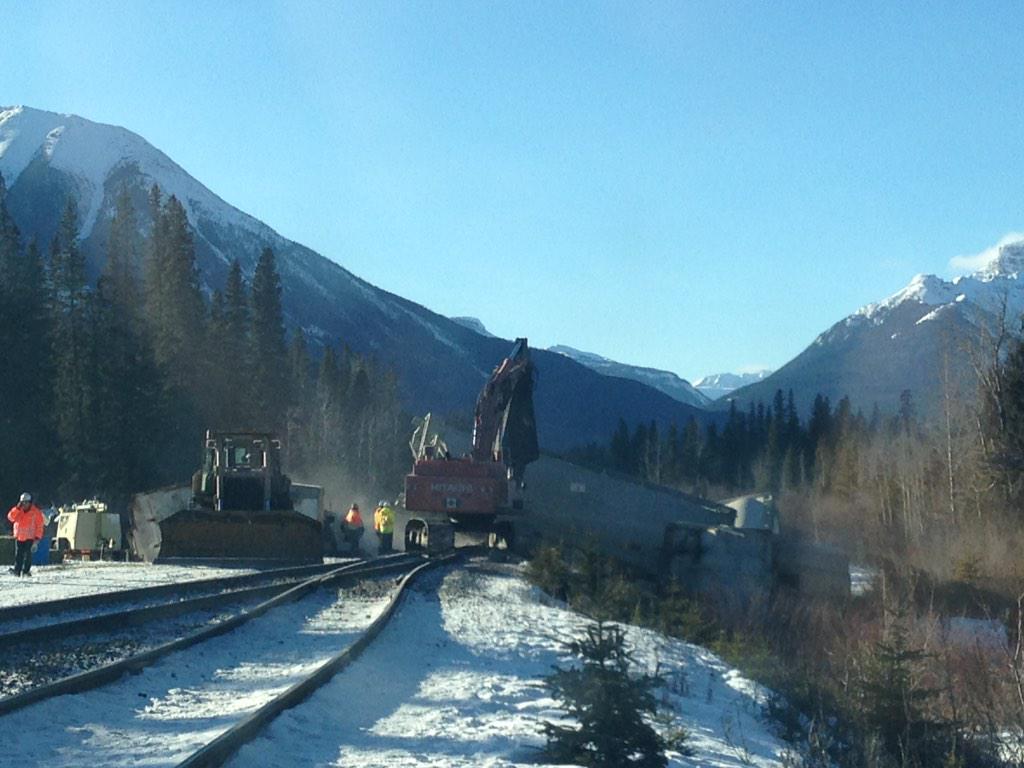
Canada: Toxic spill after derailment in Banff National Park

Crews rush to contain spill after CP derailment in Banff park sends train cars into creek

27 December, 2014

Crews were scrambling on Friday to clean up the scene of the latest train derailment that spilled ash and grain into a Banff creek and caused the water to become cloudy just upstream from the Bow River.

The derailment on Canadian Pacific’s main line through Banff National Park has reignited concerns about railway safety and the speeds at which trains travel through sensitive habitats.

The spilled ash and grain each pose their own potential problems for wildlife, one that could lower acidity levels for aquatic life, another that could attract bears to unsafe territory.

Parks Canada doesn’t expect any long-term impacts on the local environment, though its officials planned to continue monitoring water quality.

Fifteen Canadian Pacific cars loaded with lentils and fly ash — a component of cement and a byproduct of coal-fired plants — fell off the tracks on a bridge crossing over 40 Mile Creek near Banff townsite at 2 a.m. Friday.

Seven rail cars fell into the creek spilling some of their contents, which turned the water into a murky colour, though it doesn’t appear to be affecting the Bow River, which is about 200 metres downstream.

The bridge is a wreck,” said John Cottreau, a spokesman for the Transportation Safety Board, which is investigating the crash.

Alberta Environment, which has dispatched crews to the scene to help make sure the site is properly cleaned, said its greatest concern is the fly ash, which can create sedimentation problems and decrease acidity levels.

The impact that the spill will have on fish in 40 Mile Creek will depend on the amount of ash that was spilled, which has not yet been determined, 
spokeswoman Katrina Bluetchen said.

This is still an evolving situation.”

Crews planned to install a temporary dam on the creek to prevent the ash and grains from flowing into the nearby river, said Dave McDonough, of Parks Canada.

Government officials are monitoring water quality downstream of the derailment, including the Bow River, to check for changes in acidity levels, among other indicators. So far, pH levels are normal, McDonough said.

Canadian Pacific said 22 to 27 trains travel through the affected area in a 24 hour period, sometimes carrying petroleum products and other dangerous materials, but that the frequency of these shipments changes over time.

Authorities from several agencies were at the scene to aid in the cleanup and investigation into the cause, which will also uncover the speed at which the train was travelling.

Ahead of these reports, an Alberta conservationist suggested it may be time to insist that train speeds through the national park and other sensitive habitats be “seriously reduced.”

Perhaps a slower speed would not stop the derailments, but it would certainly change the nature of them,” said Colleen Campbell, of the Bow Valley Naturalists.
It’s like a slow-speed crash between cars (which) does a lot less damage to vehicles and people compared to a high-speed crash.”

Spilled grain is often a concern in forested areas because it can attract bears to areas that are not safe, but the vast majority of bears are hibernating, which means “it’s not a major concern,” McDonough said.

But Campbell, who was involved in a study on the impact of grain spillage on wildlife, said it can be difficult to remove every seed and crumb.

It’s OK now; the bears technically should all be asleep … but if it’s not all cleaned up, and it’s almost impossible, then it does ultimately become an attractant,” she said.

There is also a concern that fly ash, when airborne, can be a respiratory irritant. As cleanup at the site continues, officials are working to ensure the material is moist to prevent any hazards to crews and spectators, McDonough said.

We’re certainly on top of it (the derailment), and we’re actively working with CP and the Town of Banff to mitigate any potential impacts,” he said.

We will be monitoring it longer term as well. But we don’t anticipate any long-term effects to the environment from there.”

View image on Twitter
Passing by a casual train derailment in Banff

The Transportation Safety Board said its crews were gathering information to determine whether they need to launch an in-depth investigation.

CP Rail reported its crews had been dispatched to the scene to evaluate the incident and consult with Parks Canada “on all environmental matters.”

CP’s emergency protocols were immediately enacted and all safety precautions and measures are being taken as our crews respond to the situation with local officials,” the company said in a statement.

Work is underway to clean up the mess of rail cars and spilled materials, but there was no word on how long it would take.

The company said it had some re-routing options in place, but that it was also working to remove the rail cars and prepare the site for the installation of a temporary bridge.

We’re working with Parks Canada and people on the scene to assess the situation and get things cleaned up and operational again,” said Jeremy Berry, a spokesman for the railway.

Train derailment in @BanffNP - 15 cars carrying grain & cement. Crews on scene. No safety issues, no injuries, no dangerous goods

TSB deploys a team to the site of a derailment involving a CP freight train near Banff, AB
http://
ow.ly/GrIHR

It follows a long series of derailments, including the deadly Lac-Megantic crash, that TSB chair Wendy Tadros says have led to a “heightened fear over rail safety.”

There has been an erosion of public trust, and Canadians require reassurance that action is being taken, that risks are being properly identified and mitigated, and that future movements will be safe,” Tadros wrote in a newspaper op-ed in October.


Thursday, 1 May 2014

Derailment in Virginia

Train Derails In Lynchburg, Massive Fire Erupts, "Flames Stories High"


30 April, 2014


In what can only be explained as a massive oil pipeline derailment, because trains are obviously so much safer when transporting flammable commodities, moments ago another train derailed in Lynchburg, Virginia with numerous railcars falling in the river, and a massive fire erupting with flames that are "storeys high" according to ABC13. And moments ago it was also announced that the train belongs to CSX and the burning product is, expectedly, crude oil.


Additionally, it appears that the CBTX on the side of the train cars indicates they are associated with CIT Croup/Capital Finance.'


Click on the image below for the Live webcast:

Some more photos from the scene of the accident:

A train in the lower basin has derailed and caught fire.

"RT @ABC13News A train in the lower basin has derailed and caught fire." scary stuff in downtown Lynchburg. stay safe pic.twitter.com/eNdGb5F33F


Train derailment. Photo: Jean Bowman.

Train derailment in downtown Lynchburg. Photo: Brian M oore


CSX CEO Michael Ward spoke with FOX Business Network’s (FBN) Liz Claman about CSX’s train car derailment in Lynchburg Virginia. Ward said, “we are deploying all of our resources for three primary purposes; one to support the local emergency responders, and secondly to protect the community and the citizen injury, and finally to protect the environment.” Ward went on to say, “we are actively engaged with the emergency responders” and that “We’re setting up a community response center at this point and we’ve deployed both external and internal environmental experts to the scene.”

On the CSX train car derailment:


"As you noted it just happened a little over an hour ago, so there is not a lot of detail. What we do know is a unit hall train and it was headed to Yorktown, Virginia derailed in Lynchburg at least one car is on fire as the report we have. What I can tell you is we are deploying all of our resources for three primary purposes; one to support the local emergency responders, and secondly to protect the community and the citizen injury, and finally to protect the environment.So we are actively engaged with the emergency responders. We’re setting up a community response center at this point and we’ve deployed both external and internal environmental experts to the scene.”

 On railroad regulations:


 "We as an industry, we as a company, are in favor of tougher tank car standards. To be honest and forth right with you. We don’t own the cars, they are either owned by customers or leasing companies. But we do think there are some improvements that can be made.”


Listen to what Paul Beckwith has to say about derailments and climate chaos.

Wonky weather wacking infrastructure

A rant on how traintracks and pipelines and roads and buildings are being crushed under the onslaught of abrupt climate change.


Wednesday, 19 February 2014

Oil and gas disasters


U.S. under attack: 7 oil/gas disasters in 
4 days


15 February, 2014


Seven fossil fuel disasters within four days this week terrorized hundreds of Americans. Bright glowingfireballs brightening night skies scarier than bombs;blown up homes while others rocked to their foundations; evacuations; injured, feared dead workersderailed train leaking chemicals, and a toxic coal slurry covering at least six miles of waterway emptying into a major river, and a gas pipeline blowout preventer failure have left people running for their lives and countryside looking like a war zone.

Corporate-government's intense human rights abuses against citizenry regarding health and safety escalated in oil- and gas-cursed states this week.

Hiland Partners Pipeline Explosion, North Dakota

Monday evening, Feb. 10, a Hiland Partners LP gas pipeline exploded, causing a large fire south of Tioga in northwestern North Dakota.

The blast was so bright, it lit the night sky like the sun, according to Tioga Mayor Nathan Germundson, also a firefighter who responded.

As crews began responding, they saw a large glow south of town, so they knew it was a big blaze.

Hiland was ‘blowing’ hydrates, ice-like solids formed from a mixture of water and gas that can block pipeline flow, out of the pipeline, according to Kris Roberts of the North Dakota Department of Health Environmental Health Section.

Hiland Partners said the fire on the property it operates was extinguished and no third-party property was damaged. The cause of the fire is unknown and remains under investigation.

The pipeline was above ground at the point of ignition, Roberts said. It started in the “slug catcher,” a large diameter pipe with a hatch that allows workers to remove equipment used in a pipeline cleaning and inspecting process called pigging.

Navy Dumps 2,000 Gallons Oily Contaminated Waste Water, Puget Sound

The Navy dumped thousands of gallons of oil contaminated waste-water into Puget Sound, blaming it on a failed pump.

Tom Danaher, spokesman for Naval Base Kitsap-Bangor, said the Navy was using a pumping system on one of its piers to remove oily bilge water from a ship late Monday. An electrical ground prevented the pump from automatically shutting off when a 4,000 holding tank was filled. Because the operation was unattended, it took 20-30 minutes before naval staff realized that oil-contaminated waste-water was pouring into the sound, Danaher said in an interview Wednesday.

So the pumps did not get the signal that the tank was full. The tank overflowed,” he said. “When the people on the pier saw the overflow, we stopped all pumping and started our clean up.”

The cleanup expanded Wednesday with deployment of surveyors walking the beaches around Hood Canal where the spill occurred, Danaher said.

Initially, the Navy indicated 150-200 gallons had spilled. Since then, only after shown photos of the oil mess, the unified spill command – including the Navy, U.S. Coast Guard and Washington Department of Ecology – agreed the amount leaked was nearly 2,000 gallons.

Chevron fracking well explosion sets blaze, injuring one, one feared dead: Penn.-West Virginia Border Town

Tuesday, Feb. 11, the worst fear fossil fuel workers imagine occurred when a Chevron fracking well exploded near the Pennsylvania-West Virginia border. It injured one worker, likely killed another, and continues to spew a massive amount of chemicals into the air for at least 15 miles that four days later, is still impacted, despite what the corporation and some officials say.

This is not your standard well fire. It’s bigger,” officials report.

The explosion rocked residents’ houses and set a huge blaze seen for miles, still alight and so hot, responders have been unable to get near it.

I can see the gas well fire in Bobtown from my house… like 10 miles away,” tweeted Jesse Vihlidal ‏@JesseVihlidal, adding hashtags, “#scary” and ” #gasland.”

Wednesday, as far as Morgantown, West Virginia 14 miles south, the smog from the north as winds blew south, was so heavy, many were absent from work, some attributing the absenteeism to the spreading volatile gas plume — that officials say is not hazardous to humans.

No emergency provisions were on site. The wild well was so unique and huge, Chevron has Houston-based company Wild Well Control to attempt to halt the massive gas fire, larger than most other such fires.

We’re being told … the site itself, that fire, will not be contained and we will not have access to that property for at least a few days,” Trooper Stefani Plume said Tuesday.

Wild Well specialists say, however, they will cap the well. Officials have voiced concern about plugging the well, fearing gas pressure below might migrate to other areas and cause further serious damage. Residents also remain fearful.

Location of well pads….school yards? right next to homes? Any gas well can go wrong-why do they need companies like Wild Well Control if it is perfectly safe?” asks Victoria Switzer in a comment Thursday. “Are folks being told the real danger or risk of gas wells in their yards? Is signing a gas lease a waiver. I am still waiting for the gas industry to be honest and share the list of inherent risks associated with gas extraction, production and transportation.

Other than this site, I have seen very little coverage of this event but I have sure seen a lot of glossy ads on tv showing the wonders of natural gas.”

Patriot Coal Co. slurry line ruptured, sent black toxic crud 6 miles into river: West Virginia

Also Tuesday, Feb. 11, near the same time that Chevron’s frack well exploded in Bobtown near West Virginia’s border, 150 miles south, a Patriot Coal company slurry line at southern West Virginia’s Kanawha Eagle Prep Plant ruptured and spilled a highly toxic byproduct from the coal mining and preparation process into a creek feeding the Kanawha River, blackening a 6-mile stretch down one waterway.

Over 100,000 gallons of slurry spilled. West Virginia state officials are monitoring potential impacts on public health and the local water supply, along with Freedom Industries’ chemical leak that continues to prevent safe water for 300,000 residents.

Officials initially dismissed this event as not significant. Now, however, West Virginia Department of Environmental Protection (DEP) officials say it is ”significant” and are comparing it to Freedom Industries’ coal chemical spill into the Elk River.

Coal slurry contains substances more toxic than Crude MCHM or polyethylene glycol already contaminating over nine counties from the Freedom Industries event over a month ago.

Coal slurry contains heavy metals, like iron, manganese, aluminum and selenium.

Gas oipeline explodes: Kentucky

Wednesday Feb 13, a gas pipeline 20-30 feet underground, exploded in Kentucky just after 2:00 A.M. CST, sending two people to hospital, forcing evacuation of 20 homes, leaving a 60-foot crater, and two homes totally destroyed. The violent explosion rocked homes to their foundations.

All the sudden, the house shook and everything lit up like daylight, so we ran to the window and looked out and all we saw was this big ball of fire,” said military veteran Bill Kingdollar, who lives about a quarter mile from the blast site. “It looked like a warzone. I’ve never seen anything like that.

I’ve told you I spent 20 years in the military and I’ve never seen a fireball or anything like that,” he said. “It was the craziest thing I’ve ever seen. Everything shook. The ground shook. The windows shook. Everything was shaking including me because you don’t know what’s going on.“

This disaster occurred in Adair County, near Highway 76 in Knifley south of Louisville. The gas pipeline transports natural gas from the Gulf of Mexico to New York.

The first call came in at about 1:04 A.M. CST when residents heard and felt rumbling under their feet, said Adair County Emergency Management Agency director Greg Thomas. Then came the explosion and a ball of fire, he said.
Three homes, two barns, and six vehicles caught fire after the blast, he said. Two of homes were completely destroyed.

There is now a crater 60 feet deep and it blew rocks out, and I don’t mean pebbles … big rocks,” and a 20- to 30-foot section of pipe was thrown over 300 feet.

After the explosion, 20 homes were evacuated. By 1:30 p.m. all fires had been extinguished and the evacuation order lifted allowing residents to return to their homes, he said.

Columbia Gulf Transmission detected a drop in gas pressure in the pipe at the time of the explosion. Officials determined the pipe ruptured.

Nustar’s Norfolk Southern Train derails, crashes, spews 7,000 gallons crude plus propane near homes: Pennsylvania

Thursday, Feb. 13, 21 fossil fuel cars in NuStar’s Norfolk Southern train derailed, crashed in Pennsylvania, spewing 7,000 gallons of carcinogenic crude oil only two miles from dozens of homes.

I heard a strange noise, a hollow, screeching sound,” said Ray Cochran, who watched the train derail from his home on a hill above the tracks. “I looked out the window and saw three or four tankers turn over and one of them ran into the building.”

The 120-car Norfolk train carrying heavy Canadian crude oil derailed near Vandergrift, company officials confirmed Thursday.

In the cars that jumped track, 19 were carrying crude oil and two were carrying propane.

We do have a lot of homes in close proximity. It could’ve been very tragic,” said Dan Stevens, a local public safety spokesman Thursday. “If it would’ve happened in a borough, we could’ve had a totally different situation.”

The train crashed into a track-side building owned by MSI Corporation that makes metal products. MSI refrained from comment.

This was the second fossil fuel oil train derailment in less than a month in Pennsylvania. A train hauling crude on a CSX Corp railroad jumped the tracks and nearly toppled over a bridge in Philadelphia on Jan. 20.

Whiting Oil and Gas company frac well in North Dakota blew out, sending workers running for their lives

Also on Thursday, Feb. 13, a Whiting Oil and Gas company frac well in North Dakota blew out of contro, sending 15 workers running for their lives in fear of an explosion. A blow out preventer failed. Around 10,000 gallons of poisonous fluid has been leaking from the wild well per hour.

The hydraulic fracturing (fracking) well blowout occurred when a blow out preventer (BOP) failed south of Watford City, about seven miles north of the Theodore Roosevelt National Park North Unit in North Dakota according to the Department of Mineral Resources Director Lynn Helms.

The fifteen workers who ran from the well left their pickups at the site called McKenzie County Sheriff’s Office, said McKenzie County Emergency Manager Jerry Samuelson. He directed a school bus in the area to pick up the workers.

When that thing blows, you just never know,” Samuelson said. “There’s a possibility of explosion.”

The BOP seal leaked and caused the accident, according to Denver, Colorado-based Whting Oil and Gas company spokersperson Jack Ekstrom.

It’s still a tad dangerous up there,” Kris Roberts, with the health department’s Division of Water Quality said mid-day Friday.

Bob Wisness, who lives about a mile from the well, said he saw what looked like a green vapor after the incident. He received a message from Whiting that a blowout occurred. Although Wisness didn’t feel he was in danger, he started texting friends who live near the site but were out of town, he said.

There are well sites that are closer to people’s homes. I’m glad it’s not me. Other people have good reason to worry about it,” Wisness said.

While no immediate injuries were reported, the initial release sprayed oil and water on to snow that is on top of the ice-covered Cherry Creek, according to Helms.

To the best of our knowledge, nothing has gotten into the water,” Helms said.
Whiting Oil and Gas claimed about 50 barrels of flowback water were released but contained on site within a berm.

Fracking had been completed at the well and the fluid released was a poisoned water-based solution that flows back to the surface. As much as one million gallons of water is used per well. The well continued releasing about 200 barrels of poisoned fluid per hour, about 10,000 gallons per hour. The company says the fluid was directed to tanks and contained on site, according to Ekstrom.

Crews from Wild Well Control were brought in to assist with the out-of-control well. Helms said the cause of the accident will be closely examined because blowouts carry serious health and safety risks. (Author’s emphasis.)
In 2012, a worker died when hit by pickup during the chaos after a blowout in Williams County, North Dakota.

190,000 residents without power in freezing conditions: North Carolina

Meanwhile, this week, on Nov. 13, dependent on “safe and efficient fossil fuels,” thousands of North Carolinians had no electricity in a winter storm that dropped snow, sleet and freezing rain.

Overall, customer outages have totaled over 500,000. It took some 3,400 Duke Energy crews working to restore power Thursday in the Carolinas.

Some of our service territory took a hard blow from the storm,” said Jeff Corbett, senior vice president of Duke Energy’s Carolinas Delivery Operations. “We are concentrating our efforts on assessing damage and working to restore power in these hard-hit areas.

Not one of the above events would have happened had the nation been proactive in the field of renewable energy.

Sources: NPR, Post Gazette, WLKY, Bizmark Tribune with special thanks to reader, RetiredPatriot, Before It’s News,