Showing posts with label pollution. Show all posts

Friday, 5 June 2020

State of emergency in Norilsk after 20,000 tons of diesel leaks into Arctic river system

It has taken several days for this to make it into western MSM.


Vladimir Putin has announced a state of emergency in the region around the Arctic city of Norilsk after a massive fuel leak left two rivers with a bloody red tinge.

At least 21,000 tonnes of diesel is understood to have leaked from a local power plant on Friday. Initial reports suggested a car had crashed into one of the plant’s storage towers, but it transpired the tower first decompressed and then ruptured, resulting in a fire and further spillage. Remarkably, news of the accident took several days to reach the authorities.

Over two increasingly desperate days, officials in the power plant tried to deal with the problem themselves. By the time things were eventually referred higher up the chain, and Mr Putin was informed, over 100,000 sq metres of land had been affected.

https://www.independent.co.uk/news/world/europe/putin-russia-fuel-leak-arctic-river-state-of-emergency-a9547586.html?fbclid=IwAR251YEiO2w-y5YauUZLejjkl23_leIbHY_Fwd7Xx-adePj5ZYW6aM6VQfQ#gsc.tab=0

Here is an article from the Siberian Times

State of emergency in Norilsk after 20,000 tons of diesel leaks into Arctic river system

Fear that thawing permafrost caused damage to storage tank.
By Svetlana Skarbo


02 June 2020


The exact reason of the leak is yet to be established, but a statement from Norilsk Nickel company, which operates the site suggests it could have been caused - worryingly - by collapsing permafrost. Picture of a 'river of fuel' from social media 

A state of emergency was introduced in Norilsk, Russia’s nickel capital, after 
almost 20,000 tons of diesel burst out of a reserve fuel tank at the TPP-3 
industrial site. 

The fuel was stored there to ensure continuous supply to the power plant in case 
of an interruption in gas supplies.

The leak was on 29 May in the Kayerkan district of Norilsk, and the pictures show its dramatic impact. 

The exact reason of the leak is yet to be established, but a statement from Norilsk Nickel company, which operates the site suggests it could have been caused - worryingly - by collapsing permafrost. 

‘Due to sudden subsidence of supports which served for more than 30 years 
without problems, the diesel fuel storage tank was damaged, resulting in a fuel 
leak’, said a statement from Norilsk Nickel, the world's largest producer of 
palladium and Russia’s leading nickel mining and smelting company.

A car driving outside the storage depot caught fire due to contact with leaked fuel, prompting initial reports about the vehicle had crashed into it, causing a fire and 
leak. 

State of emergency in Norilsk after 20,000 tons of diesel leaks into Arctic river system

State of emergency in Norilsk after 20,000 tons of diesel leaks into Arctic river system

State of emergency in Norilsk after 20,000 tons of diesel leaks into Arctic river system

State of emergency in Norilsk after 20,000 tons of diesel leaks into Arctic river system
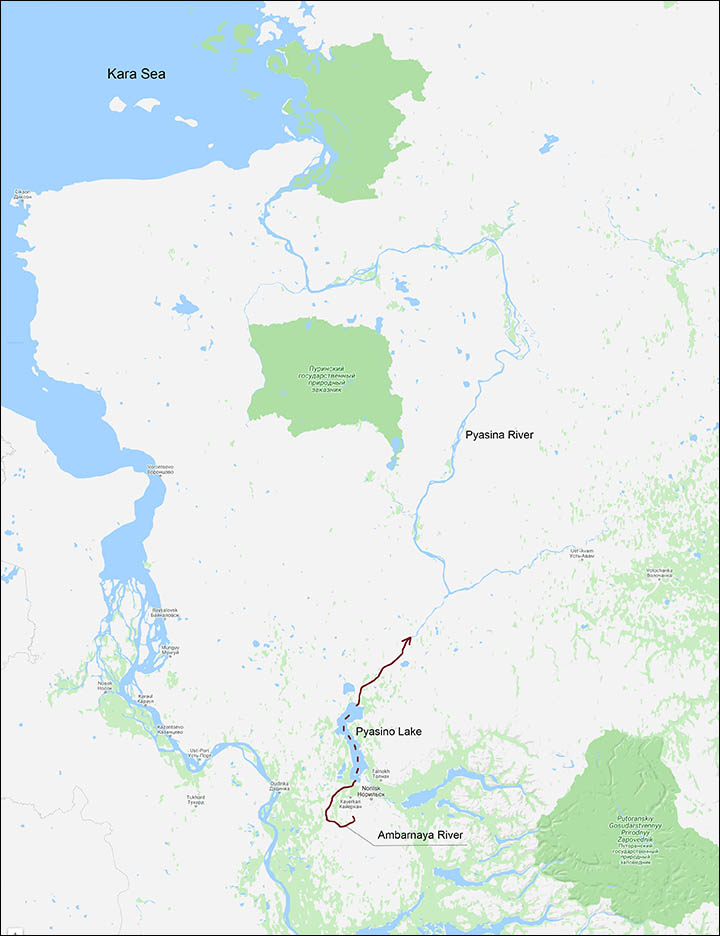
60km long Ambarnaya River flows into Lake Pyasino; the Pyasina River outflows this lake into the Kara Sea, part of the Arctic Ocean. Pictures: social media, The Siberian Times

Marine rescuers from Murmansk were flown into Norilsk to help mitigate consequences of the ecological catastrophe.

Diesel leaked into the 60km long Ambarnaya River which flows into Lake 
Pyasino.

The Pyasina River outflows this lake into the Kara Sea, part of the Arctic Ocean.
State of emergency in Norilsk after 20,000 tons of diesel leaks into Arctic river 
system. Video from a local residents shows the extent of pollution as he dips a 
piece of newspaper into a mixture of river water and fuel, and sets it on fire. 

Pictures: Norilsk Nickel, Svetlana Radionova


State of emergency in Norilsk after 20,000 tons of diesel leaks into Arctic river system

State of emergency in Norilsk after 20,000 tons of diesel leaks into Arctic river system

State of emergency in Norilsk after 20,000 tons of diesel leaks into Arctic river system

State of emergency in Norilsk after 20,000 tons of diesel leaks into Arctic river system

State of emergency in Norilsk after 20,000 tons of diesel leaks into Arctic river system

Meanwhile, In Australia...


https://www.abc.net.au/news/2020-06-04/tahmoor-mine-polluting-nepean-and-bargo-rivers/12315440?fbclid=IwAR1ElJcv2QA7JFJseOkKy043013sLGxor3h2p9Gqd2HAgIeXnDi5mmGVjYg

And elsewhere in Siberia.


https://siberiantimes.com/other/others/features/hurricane-force-winds-destroy-homes-welcome-to-new-normal-for-siberia-say-scientists/

Tuesday, 19 November 2019

Friday, 16 August 2019

The plastics from the sky

Microplastic drifting down with the snow

Microplastic drifting down with the snow


Phys.org
14 August,2019


Over the past several years, microplastic particles have repeatedly been detected in seawater, drinking water, and even in animals. But these minute particles are also transported by the atmosphere and subsequently washed out of the air, especially by snow—and even in such remote regions as the Arctic and the Alps. This was demonstrated in a study conducted by experts at the Alfred Wegener Institute and a Swiss colleague, recently published in the journal Science Advances.
The fact that the oceans are full of plastic litter has by now become common knowledge: Year after year, several million tonnes of  find their way into rivers, coastal waters, and even the Arctic deep sea. Thanks to the motion of waves, and even more to UV radiation from the sun, the litter is gradually broken down into smaller and smaller fragments—referred to as microplastic. This microplastic can be found in marine sediment, in seawater, and in marine organisms that inadvertently ingest it. In comparison, there has been little research to date on whether, and if so, to what extent, microplastic particles are transported by the atmosphere. Only a handful of works are available, e.g. from researchers who were able to confirm the particles' presence in the Pyrenees and near major urban centers in France and China.
A team of experts from the Alfred Wegener Institute, Helmholtz center for Polar and Marine Research (AWI) has now found that microplastic particles can apparently be transported over tremendous distances by the atmosphere and are later washed out of the air by precipitation, particularly snow. As the team led by Dr. Melanie Bergmann and Dr. Gunnar Gerdts report in the journal Science Advances, the analyses they conducted on  from Helgo-land, Bavaria, Bremen, the Swiss Alps and the Arctic confirm that the snow at all sites contained high concentrations of microplastic—even in remote reaches of the Arctic, on the is-land Svalbard, and in snow on drifting ice floes. "It's readily apparent that the majority of the microplastic in the snow comes from the air," says Melanie Bergmann. Her hypothesis is supported by past research conducted on grains of pollen, in which experts confirmed that pollen from the middle latitudes is transported by the air to the Arctic. These grains are roughly the same size as the ; similarly, dust from the Sahara can cover distances of 3,500 km or more, reaching the northeast Atlantic.
Microplastic drifting down with the snow
Scientists from the Alfred Wegener Institute analyse the content of microsplastics in the samples. Credit: Alfred-Wegener-Institut / Melanie Bergmann
The AWI researchers found the highest concentration in samples gathered near a rural road in Bavaria—154,000 particles per litre. Even the snow in the Arctic contained up to 14,400 particles per liter. The types of plastic found also varied greatly between sampling sites: in the Arctic, the researchers chiefly found nitrile rubber, acrylates and paint, which are used in a host of applications. Given its resistance to various types of fuel and broad temperature range, nitrile rubber is often used in gaskets and hoses. Paints containing plastic are used in several different areas, e.g. to coat the surfaces of buildings, ships, cars and offshore oil rigs. Near the rural road in Bavaria, the samples especially contained various types of rubber, which is used in countless applications, such as automotive tires.
One intriguing aspect of the AWI study: the microplastic concentrations found are considerably higher than those in studies conducted by other researchers, e.g. on dust deposits. According to Gunnar Gerdts, this could be due to one of two reasons: "First of all, snow is extremely efficient when it comes to washing microplastic out of the atmosphere. Secondly, it could be due to the  we used, which allowed us to detect even the smallest particles—down to a size of only 11 micrometers." Gerdts and his colleagues melt the snow and pour the meltwater through a filter; the residue trapped in the filter is then examined with an infrared microscope. Depending on the type of plastic, different wavelengths of the infrared light are absorbed and reflected; in this way, an optical fingerprint can be used to determine what type of plastic they've found.
Microplastic drifting down with the snow
Fresh snow is filled with a chrome steel towel to lockable galss containers. Later the samples are analysed for microplastic concentrations in the lab. The whole sampling takes place without the use of any plastics to prevent the samples from contamination. Credit: Alfred-Wegener-Institut / Jürg Trachsel, WSL-Institut für Schnee- und Lawinenforschung SLF
Whereas other experts sort out microplastic from their samples by hand under the micro-scope, which can easily cause some particles to be overlooked, Gerdts uses his infrared microscope to test all of the residue, ensuring that he and his team hardly miss a thing. "We've automated and standardized the technique so as to rule out the errors that can creep in when manual analysis is used." As such, it's hardly surprising that the analyses conducted at the AWI yielded especially high particle concentrations.
In light of the meteorological realities, the AWI experts are convinced that a major portion of the microplastic in Europe, and even more so in the Arctic, comes from the atmosphere and . According to Melanie Bergmann: "This additional transport route could also explain the high amounts of microplastic that we've found in the Arctic sea ice and the deep sea in previous studies."
**Microplastic drifting down with the snow
Scientists from the Alfred Wegener Institute use the board helicopter from the icebreaking research vessel Polarstern to collect snow samples. Even in the Arctic the snow is polluted with microplastics. Credit: Mine Tekman, Alfred-Wegener-Institut
Lastly, there's another key question that motivates her work. "To date there are virtually no studies investigating the extent to which human beings are subject to microplastic contamination." In addition, most research has focused on how animals or human beings absorb microplastic from what they eat. As Bergmann explains: "But once we've determined that large quantities of  can also be transported by the air, it naturally raises the question as to whether and how much plastic we're inhaling. Older findings from medical research offer promising points of departure for work in this direction." Yet another aspect that warrants a closer look in the future.
Researchers measure a record concentration of microplastic in Arctic sea ice

More information: M. Bergmann el al., "White and wonderful? Microplastics prevail in snow from the Alps to the Arctic," Science Advances (2019). DOI: 10.1126/sciadv.aax1157 , https://advances.sciencemag.org/content/5/8/eaax1157
Journal information: Science Advances 

Wednesday, 8 May 2019

Sulphur dioxide emissions in Siberia: a sign of the coming extinction?


This is an illustration that CO2 may not be the ONLY player in abrupt heating on the planet and the rush to mass extinction.


Noril'sk, the most polluted city on the planet, large emissions of sulphur dioxide and the Permian mass extinction


I am most grateful to Dave (Nostrodoomus) and Margo who have done stellar work on picking up and researching something that has seemingly not been picked up by anyone else


Here is the video made yesterday by Dave that goes into this. It is also discussed by Margo in her May 4 video which I have posted at the bottom of the article.


What they picked up was very, very large emissions of sulphur dioxide in Western Siberia.

Sulphur dioxide is usually associated with earthquakes and volcanoes and is therefore usually associated with areas (such as currently, Mexico) where there is such activity.

It is highly irregular to have such levels of sulphur dioxide where there is no such activity.


According to my research sulphur dioxide (SO2) is an INDIRECT greenhouse gas "because it contributes to aerosol formation which can either warm (through absorption of solar radiation on dark particles) or cool (from forming cloud droplets and reflecting radiation) the atmosphere."
http://naei.beis.gov.uk/overview/ghg-overview


High SO2 emissions last week

The following demonstrates the high levels of emissions.

500 hPa (5,500 meters altitude)

Friday, 3 May - 7 May , 2019 Sulphur dioxide - total column


These emission levels are right at the top of the scale
Total column


Surface


Friday, 3 - 7 May, 2019 Sulphur dioxide - total column

Noril'sk, the most polluted city in the world

Davie and Margo managed to narrow down the source of the SO2 to the area shown in the map.  You can see Novaya Zemlya and the Yamal Peninsula, which we are familiar with to the west.

What is here is the city of Noril'sk, a mining center since the 1920's and site of one of Stalin's concentration camp centers.
The following confirms that sulphur dioxide emissions are associated with the mining of nickel in Noril'sk.


https://www.nornickel.com/news-and-media/press-releases-and-news/dangerous-sulfur-dioxide-levels-at-kola-nickel-plant-are-dropping-cheering-environmentalists/


This photo (from Google Earth) shows the city of Norilsk and its environs


And some very polluted ponds with a proliferation of thermokarst lakes, formed by melting permafrost

Zooming in....

Here is some articles which discusses the city:


The city’s origins lie in the end of 1920, when it was decided to build a metallurgic complex for extraction of the rich resources of the region. The city was built by Soviet Gulag prisoners and became the the center of a Gulag prisoner camp in 1935 which reached its highest peak of (mostly political) prisoners in 1951, having as many as 75.000 estimated prisoners. Later in the 1950s these same prisoners were abused in the plan of Joseph Stalin to connect the city to the South-East of the Soviet-Union and ultimately to Moscow itself with a railroad. The project was never finished, as the arctic climate proved to be a large burden, but at the cost of thousands of prisoners. For this reason the city is only accessible through air or the infamous Russian road system.

Norilsk is currently a so called ‘closed city’ since 2001, as it is for strategic reasons closed to foreigners. It is believed that these reasons are the huge mineral reserves and mining operations and the IBM-missile depots which are situated in the vicinity of the city. The closed city is a follow up of the ‘secret city’ concept which existed during Soviet times. These were cities which were not on any map, roadsign or listed as a destination for public transport. These cities were mainly cities which were regarded ‘Atomgrads’, cities with nuclear research activities or weapon depots. Currently access to these former closed cities is only possible with an invitation and a long application procedure.

Here is a documentary made by a team that managed to get into the area.


The Siberian Traps and the Permian extinction


(Many thanks to Rosemary Hill)

The Siberian Traps that geographically coincide with the area we are discussing have been associated with "the Great Dying" 252 million years ago.


Figure Caption: Western Siberia showing the location of the main outcrops of the Siberian Traps on the Siberian craton The approximate extent of the craton is indicated in blue. Extensive subcrops of basalt occur beneath the West Siberian Basin, but are not shown on this map.

According to one theory the extinction was associated with the release of sulphur dioxide (SO2), carbon dioxide (CO2) and presumably methane (CH4) 


About 252 million years ago, the world came very close to ending when the vast majority of species on the planet winked out of existence in an event known euphemistically as "The Great Dying." Somehow, very violently, the period known to scientists as the Permian ended and the Triassic began, ushered in by a bang.

Recently, scientists have argued that the bang in question was the violent release of lava over a huge stretch of Russian land known as the Siberian Traps during a flood basalt eruption—a class of eruption which pours out 200 billion gallons of molten rock, at a bare minimum.

"We're looking for something catastrophic," Michael Rampino, a geologist at New York University, told Newsweek, noting that whatever caused the extinction seems to have happened quickly. The Siberian Traps, which is the largest stretch of land on the planet that can host flood basalt eruptions, certainly fit that description. But although scientists had established that they erupted at just about the time of the Permian extinction, they hadn't found a fingerprint of the eruption in rock around the world.


https://www.le.ac.uk/gl/ads/SiberianTraps/PDF%20Files/The%20Siberian%20Traps%20and%20the%20End-Permian%20mass.pdf?fbclid=IwAR1trqcU4zIBWB6MPLHnwb7kyqt3vXQfOAEB1QACwwFK5MtvPp_faZBppZk

What is giving rise to such high emissions?

Whilst sulphur dioxide emissions are definitely associated with pollution from the mining of nickel these emissions that Dave and Margo have observed are far too extensive for this to be more than a partial explanation.

It is simply much too large.

Also of interest, the emissions are intermittent just as methane emissions are.
One very reasonable hypothesis is that there have been geological changes which is leading to magma coming to the surface much as it did in the Permian extinction.

Clearly, this is something that has to be watched. 

Here is Margo's report on this: