This map shows the current position of oil tankers, mostly filled with oil. They are “stranded” around the world because there is no way to unload, since onshore warehouses are full, pipelines are full, and without flow, due to the low demand for oil. Although oil is now worth zero, keeping it in this condition costs about $ 30,000 a day per vessel. There is no one who buys oil if airplanes do not fly, if vehicles do not travel in cities.
Never in contemporary history has there been such a drastic reduction in the consumption of fossil fuels. The oil is standing on the surface of the oceans (in the tanks of the ships), in the deposits that are on land and in the pipelines. There is no clearer index to understand the magnitude of the paralysis and the problems that modern capitalism faces, since the ballast of the dollar is this, stopped, floating in the oceans.
The day after President Vladimir Putin told Russians that the next few weeks will be "decisive" in the battle with coronavirus, the country has posted a new daily record rise in infections, with 2,774 new cases discovered.
Over two-thirds (1,949) were found in Moscow and its surrounding region, with others dotted around the country. The national total now stands at 21,102.
Worryingly, the remote northern Komi Republic is Russia's fourth most affected region overall. The resource-rich territory recorded 97 fresh Covid-19 cases on Tuesday, bringing its tally to 305, with three dead.
Twenty-two new deaths have been announced, 18 of them in the Moscow area, the youngest a 29-year-old girl who had Down Syndrome. The nationwide toll is 170, with 119 of the deceased from the capital and its environs. Saint Petersburg has recorded four fatal cases.
On Monday, during a meeting with officials, via video link, Putin said Russia's situation was "changing every day and unfortunately not for the better." He warned of the need to prepare for "complex and extraordinary" circumstances as infections spread.
"We have a lot of problems," the President said. "We don't have anything special to brag about, and we certainly must not relax." Putin added that he was prepared to call in the military to help stretched medical services, if needed. Meanwhile, Tatiana Golikova, the deputy prime minister in charge of handling the national coronavirus response, said it was “unpleasant” to see the daily figures rise.
Russia’s coronavirus outbreak is deteriorating and its new cases are getting more severe, President Vladimir Putin warned Monday as the country reported its highest day-to-day spike in infections to date.
Russia has reported 18,328 overall coronavirus cases and 148 total deaths, making it the world’s 15th most-affected country as of Monday.
“We see that the situation is changing almost daily and, unfortunately, not for the better,” Putin said at a video conference with health officials.
“The number of people who are getting sick is increasing, with more cases of severe illness,” he told three federal officials and Moscow Mayor Sergei Sobyanin, who is overseeing Russia’s coronavirus task force.
MOSCOW (Bloomberg) --Vladimir Putin’s deal with OPEC to cut oil output and boost prices three years ago was a triumph for the Russian leader, bolstering his clout on the global stage. But now he’s had to make stinging concessions after U.S. President Donald Trump stepped in to end a price war.
Amid relief in Moscow at the unprecedented deal with Saudi Arabia and other major producers to slash oil output, the accord marks a painful setback for Russia, said two people close to the Kremlin.
Putin had catapulted Russia into a dominant role in global energy politics and drove a wedge between the U.S. and its Saudi ally, as the two marshaled producers to limit supplies. But it’s now clear he overplayed his hand when he refused to meet Saudi demands to double output cuts just five weeks ago. OPEC’s biggest producer cranked up output in a price war that crashed the market just as the spread of coronavirus demolished demand.
With markets collapsing, Putin agreed to cut more than 2.5 million barrels a day of crude from the 11 million of combined crude and condensate Russia pumps each day, more than four times the reduction that he turned down in early March and more than what Saudi Arabia is obliged to cut from its output level last month. Meanwhile, hopes that the U.S. would formally commit to its own curbs have evaporated, even as Trump takes credit for bringing about the new deal.
The ill-fated decision to face off against Saudi Arabia in early March was “a strategic mistake and now we’re paying the price, a much higher price than we could have paid,” said Andrey Kortunov, director of the Kremlin-founded Russian International Affairs Council. “This looks like a victory for the U.S., and Russia ends up a bigger loser than Saudi Arabia.”
If the cuts are achieved, Russia’s output for the next two months will drop to the annual average last seen in 2003, according to Bloomberg calculations based on data from the Russian Energy Ministry and BP Plc’s Statistical Review. Russia agreed to continue smaller cuts until May 2022, though it did manage to hold onto one concession by keeping condensate, a light fuel of which it is a major producer, out of the quotas.
But Russia completely failed to anticipate the devastating impact of the coronavirus pandemic on the world economy when it walked away from the agreement with the Organization of Petroleum Exporting Countries and other big producers known as OPEC+, said a senior Russian official. Holding that alliance together would have prevented the collapse in prices to an almost two-decade low that followed. Now, the Kremlin has had to negotiate a new arrangement under highly unfavorable terms, he said.
The decision to compromise over the cuts to crude output is painful for Putin’s political image, but it’s essential as a step toward overcoming the crisis, said another person close to the Kremlin. The final agreement, which foresees a gradual lifting of the supply restrictions starting from July, was coordinated with all major Russian oil companies and had Putin’s personal stamp of approval. Even symbolic U.S. participation is seen as an important milestone.
Putin’s spokesman, Dmitry Peskov, defended the new deal Friday. “There are no losers, there are only winners,” he told reporters on a conference call. The main state TV news program hailed the pact as an “unconditional success” on Sunday.
Economic Pain. But the deal marks a reversal in Putin’s push to restore Russia’s global influence, especially in the Middle East, where he’s become a key player with interventions in places like Libya and Syria. Just how big a setback it is will be determined by whether the new deal is enough to reverse the market rout and limit the economic pain for the Kremlin.
While Russian officials had put on a brave face in recent weeks as oil prices plunged, dragging the ruble sharply lower and forcing the central bank to sell dollars to steady the market, the Kremlin had become alarmed at the potential economic damage.
“Russia was seriously concerned about the Urals drop, in early April the price fell to almost $10 per barrel,” said Dmitry Marinchenko, senior director at Fitch Ratings, referring to Russia’s main export blend. “It’s difficult to imagine how the Russian budget would cope with a situation when the oil industry doesn’t bring any revenues at all.”
Lukoil PJSC’s billionaire shareholder Leonid Fedun likened the deal to the “humiliating and difficult” pact the Bolsheviks signed in 1918 to end Russia’s participation in World War I. Still, he told the RBC news group the pact will save the country’s oil industry from a production collapse of as much as 50% if low prices forced a “blanket” shuttering of wells.
Role Reversal. Moscow’s climbdown marks a dramatic role reversal. Due to climate and geography, Saudi Arabia can turn the taps on and off much more easily than Russia and, until now, Russia had dawdled on cuts, avoiding full compliance while Saudi Arabia bore the brunt of the output curbs to maintain market stability.
To meet the new conditions, Russian producers may have to go beyond cutting flows from their existing high-cost, fully taxed fields and review plans for new projects, said Darya Kozlova, head of oil and gas regulation at Moscow-based Vygon Consulting. That could have implications for years to come.
Russia may also have to provide cheaper supplies to traditional buyers in Europe to woo them back after Saudi Arabia offered deep discounts during their five-week standoff.
“This is Russia’s biggest defeat since the start of the 2000s,” said Dmitry Perevalov, an independent oil trader and former industry executive. “We’ve lost our markets and it won’t be easy to get them back.”
Russia’s deepening economic crisis is on the verge of spilling into some of the most remittance-dependent economies in the world.
Migrant workers from the former-Soviet Union send $13 billion home each year from Russia, where they are allowed to work visa-free. But now that money is starting to dry up due to lockdowns in Moscow and St. Petersburg that have halted construction projects and sapped demand for taxis.
Total remittances from Russia could drop by more than 30%-40% this year, according to Eldar Vakhitov, an emerging-market analyst at M&G Investments in London. The central bank says the self-isolation measure could knock 1.5%-2% off economic growth in 2020 but a worst-case scenario being discussed by the Russian government last month put the potential drop at 5%-10%.
A lack of aid for Moscow’s small and medium businesses hit by the coronavirus lockdown will lead to mass starvation and widespread protests, opposition lawmakers have reportedly warned Mayor Sergei Sobyanin.
“Failure to take [support] measures in the coming months may lead to mass starvation,” the Communist Party — the Moscow City Duma’s second-largest faction — told Sobyanin in a letter, the Kommersant business daily reported Monday.
“In the event of spontaneous unsanctioned protests attended by several thousand residents, all responsibility will fall on Moscow’s executive authority,” party leader Nikolai Zubrilin reportedly warned Sobyanin.
Over the weekend, Moscow officials closed the central outpatient clinic for the Mitino District, where local residents now fear a new outbreak of coronavirus. Outpatient Clinic № 180 is now being decontaminated from top to bottom and the facility’s chief physician was placed on a ventilator on Saturday. Staff will be allowed to return to work only after mass testing. This is the first time Moscow has had to close an entire clinic because of the coronavirus epidemic. Elsewhere in the city, admission and hospitalization at the Blokhin Oncology Center are still suspended because of concerns about COVID-19’s spread.
The uncertainty of the future of Brexit has left the United Kingdom’s economy in stagnation as business investment falters on the eve of the nation’s December general election. While Boris Johnson tries to rally voters to instill their confidence in him to usher in a new era of economic prosperity and growth in Britain by way of leaving the European Union at any cost, the economy is, in fact, doing just the opposite. This is just one of the great ironies of Brexit, the separatist movement that just can’t seem to cut the cord.
“British business investment has fallen 1.1 percent since the June 2016 Brexit referendum, and analysts warn that it could cause long-term damage to the economy,” according to reporting from Al Jazeera this week.
For the sake of comparison, “over the same period, business investment in the other Group of Seven (G7) big industrialised economies has risen 10 percent, with the United States posting an increase of 13 percent.”
That being said, low confidence in investment sectors and a general air of risk aversion is certainly not limited to Great Britain. The Al Jazeera report continues, “the International Monetary Fund says China-US trade tensions are hurting investment globally. But Brexit uncertainty threatens to turn the UK problem into a crisis.” The crisis is already beginning, as weak investment patterns have already make the UK’s economy too at risk for inflation for the central bank to be able to stimulate it by cutting interest rates, according to a representative from the Bank of England.
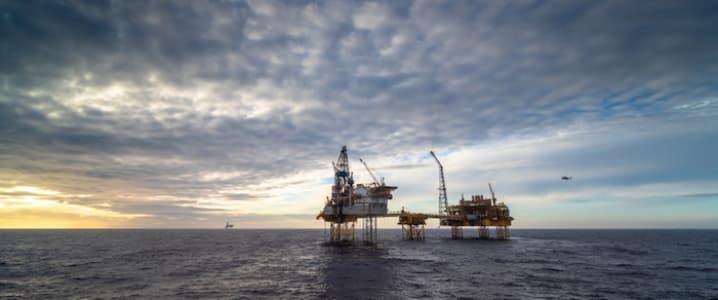
All of this will have major implications for the oil industry in the UK’s North Sea, from the obvious impacts of economic slowdown on the domestic energy sector to the added uncertainty of Scotland potentially splitting off from the UK to stay in the European Union.
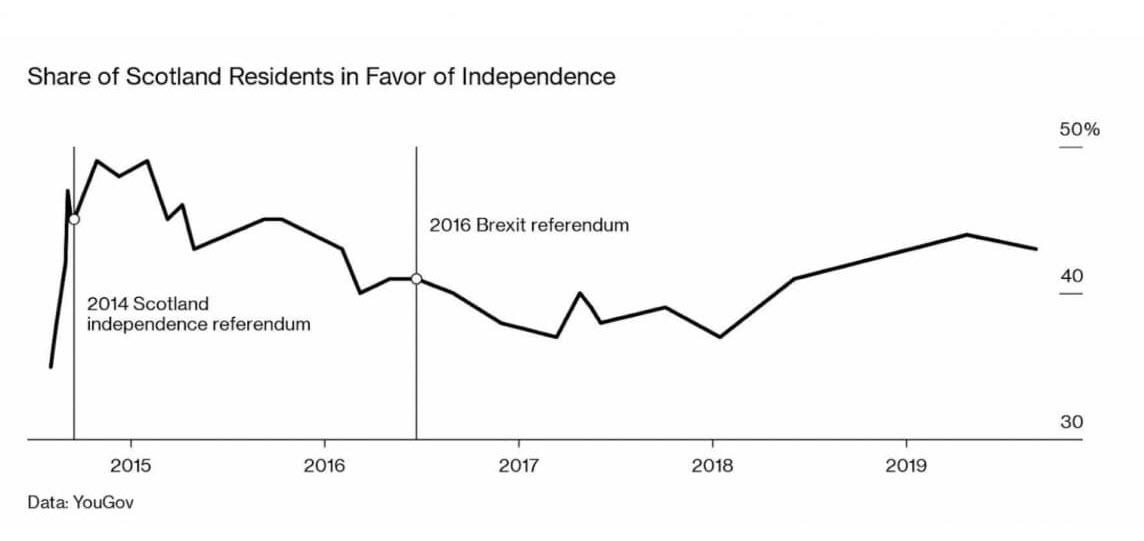
Back in 2014, Scotland voted (by a thin margin) to stay in the UK but the issue has since been complicated by Brexit back-and-forth. In the original Brexit vote way back in 2016, every single voting district in Scotland voted to stay in the EU. Now, the Scottish National Party is “gunning to retake districts it lost in 2017’s snap election by calling for another independence referendum” according to reporting by Bloomberg Businessweek, in an article that proclaims “The End of the United Kingdom May Be Nearing.” What’s more, hardline Brexiteers and Johnson supporters have made it clear that the loss of Scotland (and/or Northern Ireland) is a price they are more than willing to pay for secession from the European Union.
(Click to enlarge)
If Scotland does decide to break away from the UK definitively, it would make major waves in the North Sea drilling industry (pun most definitely intended). In the extremely possible scenario of an independent Scotland, if operating costs or ease become compromised or complicated, it is likely that many North Sea oil producers would very soon opt to take their business elsewhere. Back when this concern first surfaced in 2016, CEO of oil and gas company Petroplan Andrew Speers told CNBC that “Many of the operators and service companies [in the North Sea] with Scottish operations are global by nature and the most important thing is Scotland remains an easy and profitable place to do business.”
At the same time, however, there were some experts that speculated that the opposite could be true, and that an economic slowdown could ultimately be a boon for UK oil producers thanks to a deflated pound sterling. “For those in the U.K. and those producing oil in the U.K. North Sea, the weaker U.K. currency will reduce costs because operating costs are paid in pounds but the product (oil) is sold in U.S. dollars,” IHS Energy director Spencer Welch told CNBC. These concerns and hopes are still as valid now as they were in 2016, as Brexit still hangs in the bureaucratic balance.
In August of 2018 OilPrice published a report titled “What Would A Hard Brexit Mean For British Oil?“ when “deal or no deal?” was the biggest question in the Brexit bulletin. The answer to this question, in a nutshell, was (and is) that “the taxes on international trade that will be brought in swiftly by a “no-deal” Brexit will be a huge blow to the region’s oilfield services exporters in particular, as well as to industrial exports in Scotland and the rest of the UK to a slightly lesser degree. In particular, the subsea technology located in the UK’s north east region would be highly impacted. [...] There’s also a danger of too much demand for skilled workers, as the right of EU workers to practice their trades in the UK is only preserved until 2020.”
Now, a year later, the situation is even murkier than a year ago, as whether Brexit will happen at all being called into question in light of the impending general election. As Al Jazeera summed it up, “what's more, the opposition Labour Party has raised the prospect of more uncertainty. If it wins on December 12, it would try to strike a new exit deal and hold another referendum, throwing the Brexit question up in the air yet again.”
Ultimately, the story of Brexit is that the more things change, the more they stay the same. Despite all the bluster and upheaval, the ousting of Theresa May and the raucous rise of Boris Johnson, the yes-deal, no-deal, and forced deal proposals--Brexit remains in much the same place as it was in 2016, when the referendum was first passed, and so too does North Sea oil. When everything is uncertain, however, it’s not exactly business as usual. It’s business with nagging uncertainty and an air of doubt, both of which are ultimately fatal for economic growth.
What ‘s more, with the complexity of modern transnational supply chains, nothing is simple and absolutely nothing is isolated. This has led to hesitant investment in a great number of UK industries including North Sea oil, since, as the UK’s Press and Journal puts it, “with Brexit looming, the North Sea supply chain is only as good as its weakest link.” The article goes on to say that “key factors such as licensing and taxation of oil and gas exploration, development and production activities are already UK government responsibilities, while the legal and regulatory regime under the Petroleum Act 1998 is generally regarded as satisfactory. [...] While expectations for this year are optimistic, the added complication of Brexit could impede recovery. As a consequence of the downturn the market is now oversupplied, except in a few specialised areas.”
As long as Brexit drama continues, uncertainty and a lack of trust in the British economy will continue to fester, continuing the cycle of economic downturn and inflation in the UK. This means that North Sea investors, one of the UK’s more important economic sectors, undoubtedly see the writing on the wall and are already looking for foreign failsafes if they haven’t secured them already.
This is hot through the wires Oil Explodes 20% Higher, Biggest Jump On Record
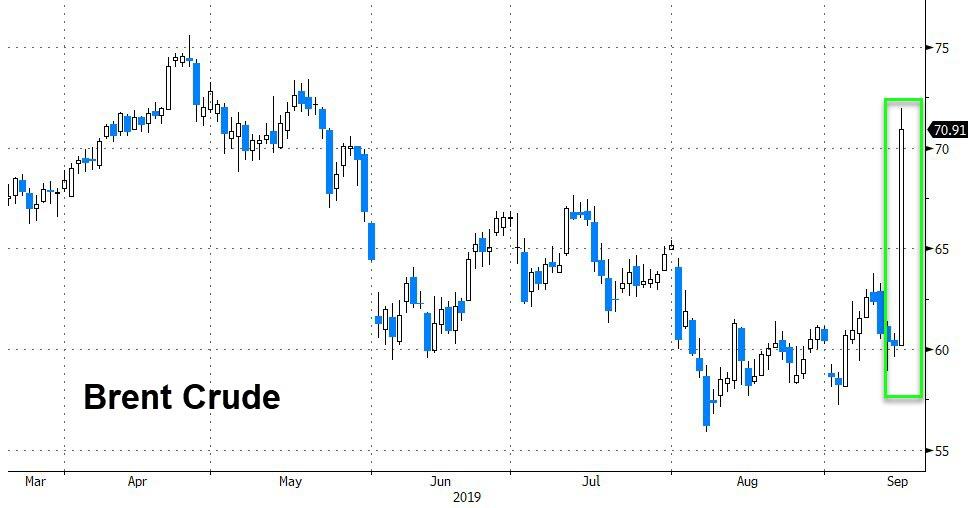
Brent crude surged the most on record after a drone strike on a Saudi Arabian oil facility removed about 5% of global supplies.
The benchmark oil futures jumped as much as $11.73 a barrel to $71.95 as the market opened Monday in Asia, the biggest jump in dollar-terms since futures started trading in 1988. State energy producer Saudi Aramco lost about 5.7 million barrels per day of output on Saturday after 10 unmanned aerial vehicles struck the world’s biggest crude-processing facility in Abqaiq and the kingdom’s second-biggest oil field in Khurais.
US
President Donald Trump has said he green-lighted the release of oil
from the US strategic reserves and ordered to streamline pipelines’
approvals to keep the oil market “well-supplied” in wake of the
attacks on Saudi Aramco.
The
drone strikes on Saudi Arabia’s largest Abqaiq oil processing plant
and another oil facility have cut the state-run oil giant’s daily
production in half, sending Saudi stocks into a nosedive and sparking
fears that oil prices can rise to triple-digits.
In
a series of tweets on Sunday, Trump said that the US would draw from
its oil reserves “if
needed, in a to-be-determined amount sufficient to keep the markets
well supplied,”adding
that he “also
informed all appropriate agencies to expedite approvals of the oil
pipelines currently in the permitting process in Texas and various
other States.”
Based on the attack on Saudi Arabia, which may have an impact on oil prices, I have authorized the release of oil from the Strategic Petroleum Reserve, if needed, in a to-be-determined amount....
Based on the attack on Saudi Arabia, which may have an impact on oil prices, I have authorized the release of oil from the Strategic Petroleum Reserve, if needed, in a to-be-determined amount....
....sufficient to keep the markets well-supplied. I have also informed all appropriate agencies to expedite approvals of the oil pipelines currently in the permitting process in Texas and various other States.
In
a run-up to the Trump’s announcement, the US Energy Secretary Rick
Perry confirmed that Washington “stands ready” to deploy its own
reserves to “offset any disruption to oil markets as a result of
this act of aggression.”
The
drone attacks that triggered major blazes at two Saudi oil refineries
in the early hours of Saturday were claimed by Houthi rebels, that
previously admitted to staging attacks on the Saudi territory,
including on the kingdom’s airports, in retaliation to the
Saudi-led coalition bombing camping in Yemen on behalf of the ousted
President Abdrabbuh Mansur Hadi, that has led to mass civilian
casualties.
Washington,
however, pinned the blame squarely on Tehran, alleging that the
attack was too sophisticated to be carried out by the rebels, with a
senior US official telling Reuters that US intelligence pinpointed
the launch area in the direction of Iraq and Iran.
Tehran
has rebuffed the allegations, describing them as "maximum lies"
and saying it stands ready to defend itself in case of a war.
The
US Strategic Petroleum Reserve is the world’s largest cache of
emergency crude, located underground in Louisiana and Texas, and
totaling some 630 million barrel.
With
traders in a state of near-frenzy, with a subset of fintwit
scrambling (and failing) to calculate what the limit move in oil
would be (hint: there is none for Brent), moments ago brent reopened
for trading in the aftermath of Saturday's attack on the "world's
most important oil processing plant", and exploded some 20%
higher, to a high of $71.95 from the Friday $60.22 close, its biggest
jump since futures started trading in 1988.
Source: Bloomberg
Source:
Bloomberg
As
Bloomberg notes, "for oil markets, it’s the single worst
sudden disruption ever, surpassing the loss of Kuwaiti and Iraqi
petroleum supply in August 1990, when Saddam Hussein invaded his
neighbor. It also exceeds the loss of Iranian oil output in 1979
during the Islamic Revolution, according to data from the U.S.
Department of Energy."
Furthermore,
in light of news that the Saudi
outage could last for months,
this could be just the start. As a reminder, according to Morningstar
research director, Sandy Fielden, “Brent could go to $80 tomorrow,
while WTI could go to $75... But that would depend on Aramco’s
48-hour update. The supply problem won’t be clear right away since
the Saudis can still deliver from inventory."
Of
course, should Aramco confirm that the outage - which has taken some
5.7mmb/d in Saudi output after 10 drones struck the world’s biggest
crude-processing facility in Abqaiq and the kingdom’s
second-biggest oil field in Khurais - will last for weeks, expect the
crude juggernaut to continue until the price hits $80, and keeps
moving higher.
Finally,
here is the price summary from Goldman commodity strategist Damien
Courvalin, who earlier today laid out four possible shutdown
scenarios, and the price oil could hit for each:
A
very short outage –
a week for example – would likely drive long-dated prices higher
to reflect a growing risk premium, although short of what occurred
last fall given a debottlenecked Permian shale basin, a weaker
growth outlook and prospects of strong non-OPEC production growth in
2020. Such
a price impact could likely be of $3-5/bbl.
An
outage at current levels of two to six weeks would,
in addition to this move in long-dated prices, see a steepening of
the Brent forward curve (2-mo vs. 3-year forward) of $2 to $9/bbl
respectively. All in, the
expected price move would be between $5 and $14/bbl, commensurate to
the length of the outage (a
six month outage of 1 mb/d would be similar to a six week one at
current levels).
Should
the current level of outage be announced to last for more than six
weeks, we
expect Brent prices to quickly
rally above $75/bbl, a level at which we believe an SPR release
would likely be implemented, large
enough to balance such a deficit for several months and cap prices
at such levels.
An
extreme net outage of a 4 mb/d for more than three months would
likely bring prices
above $75/bbl to
trigger both large shale supply and demand responses.
What
are the broader implications from this move? According to Ole Hansen,
head of commodities strategy at Saxo Bank A/S in Copenhagen, "the
global economy can ill afford higher oil prices at a time of economic
slowdown." But Peter Boockvar's hot take may be the best one.
Yet
while the inflationary impact from this surge will be transitory at
best, it will be interesting to watch the Fed cut rates with stocks
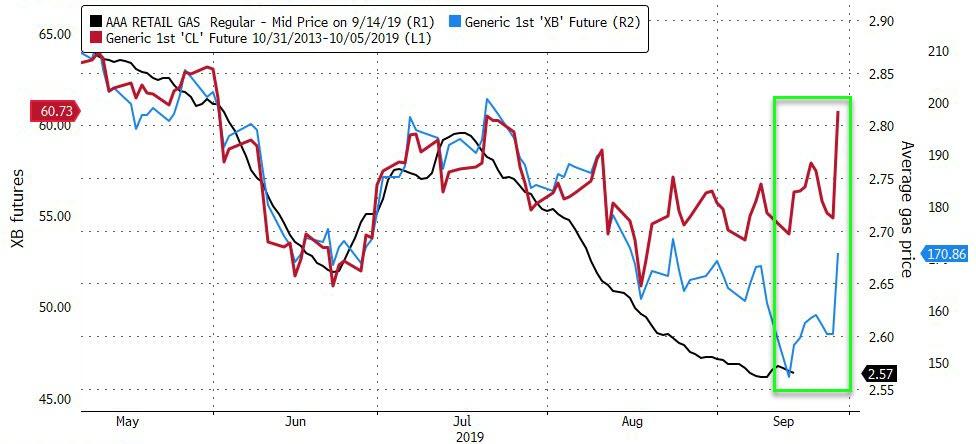
at all time highs, and with gasoline prices set for their biggest
surge in decades.
Source:
Bloomberg
Safe
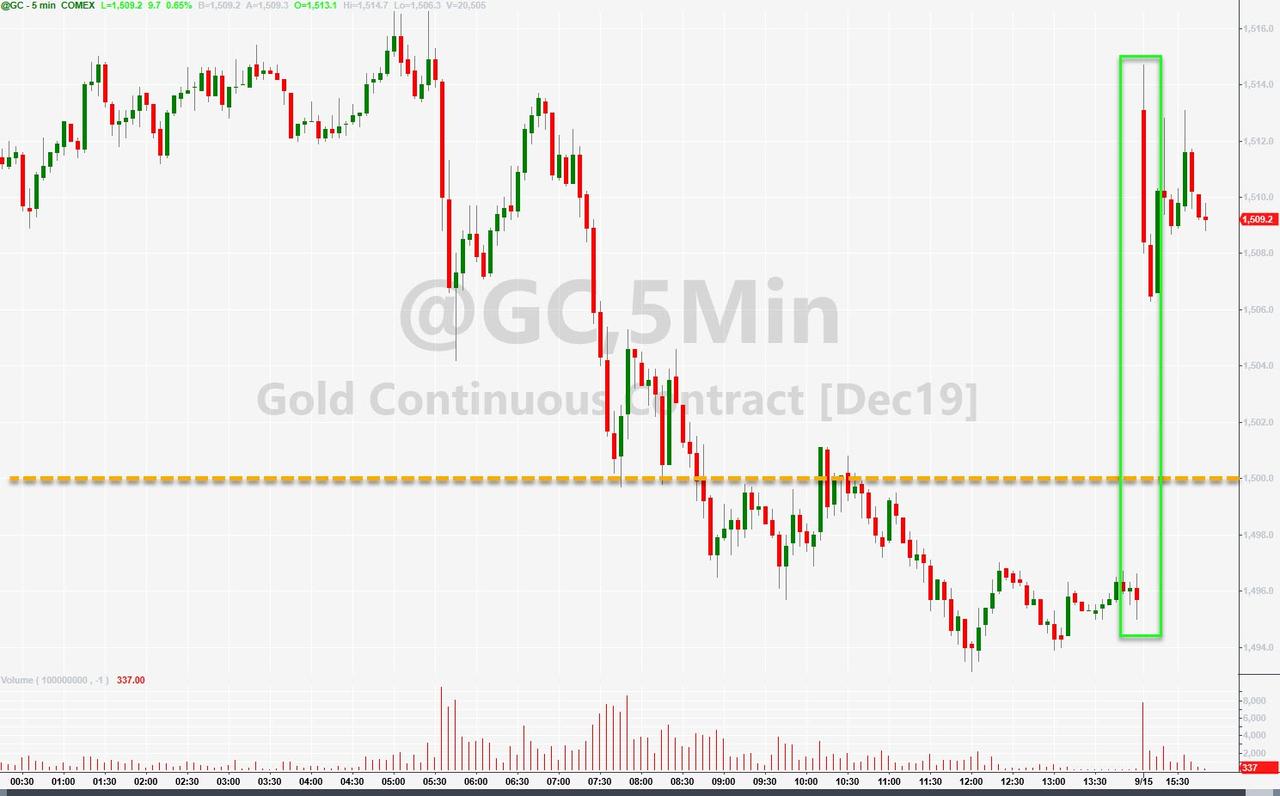
havens are also bid with gold futures back above $1500.
The
good news: at least Trump will redirect his anger away from the Fed
and toward slow, lazy, incompetent Saudi engineers, if only for the
time being.
As
bankers discussed Saudi Aramco’s initial public offering at the
Ritz Carlton hotel in Dubai last week, a drone attack was being
planned to hit the heart of its operations over the weekend. It
caused Saudi Arabia to halve its oil output and may cut the valuation
of Aramco’s milestone deal.
The
giant oil producer has accelerated preparations for a share sale that
could happen as soon as November in Riyadh. Dozens of bankers from
Citigroup Inc. to JPMorgan Chase & Co. met last week to work on
the deal, with analyst presentations initially scheduled for next
week, people familiar with the matter have said.

 Posts
Posts