Showing posts with label United States. Show all posts

Thursday, 6 October 2022

Rand Scenario, Jan 2022: How US Can Destroy Germany - Involve It In War wth Russia


Weaken Germany to strengthen US: Alleged leaked RAND doc outlines plan to destroy Europe as 'political competitor'

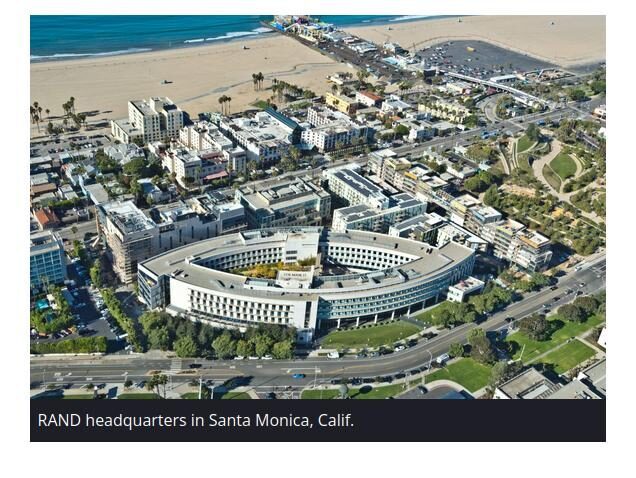
RAND corporation offices
Either this leak is a brilliant piece of technothriller fiction - or it shows that collapse we are experiencing was Made in the U.S.A.

"How can we destabilize Europe?"

"How can we destroy Germany and make life hard for Russia at the same time?"

"How can we seize total control over all people, everywhere?"

Total conspiracy theory questions. Right?

Well, to be sure, what you are about to read may be such good technothriller writing that Tom Clancy would have a run for his money. However, this reportedly comes from none less than the RAND Corporation, which is a real and well-known think tank in California that makes it its business to think about how to do things. All kinds of things.

A few days ago a leaked document from RAND started to appear in the news cycle, even making it to Russia Today. It was a small piece but it did get international attention from RT's estimated 700 million English-speaking viewers. However, the scope of the story was not delved into very deeply, and understandably so, because it is an alleged leak and one without confirmation, and by the standards of truly good journalism, sources really do need to be verified.

However, having viewed the entire document, it seems necessary to bring its full text to your attention for reading and consideration. We have a link to it here:

And, yes, this is on Yandex, Russia's Google in essence. Take that as you will. However, the writing is very polished for the most part and it appears to be serious.

Here, though, I want to insert a few notes that make me distrust this document's authenticity, for your consideration:
  1. There are occasional missing articles, in a manner consistent with the errors Russians make when they write in English. These errors are arguable within the context of professional language, but they still exist in places that surprise me. I am an English grammar-nazi, so I see this stuff easily, especially since I live and work in Russia. Examples include, "This gap will be primarily filled with dollar and yuan." (American English would render this as, "This gap will be primarily filled by dollars and yuan" or "by the dollar and the yuan.")
  2. The title "Vulnerabilities in German and EU economy" should be rendered "Vulnerabilities in German and EU economies" or "Vulnerabilities in the German and EU economies" - the missing article and incorrect use of plural references gives me a moment of pause. At the very least, this would not pass my eyes as an editor!! If this is really from Rand, they need some help in their editing department. I am available...
  3. Reference to the Russian president as simply "Putin" - perhaps this is internal language for an internal document, but the reference is unprofessional and banal. It should be "President Putin" at least, in my view. By contrast, the two German leaders named are given both first and last names.
  4. Near the end of the document, which supposedly comes from Rand Corporation in California, there are the words, "neutralised" and "labour", which are spelled in the manner consistent with UK English, AND which is the common denominator for the English language as it is professionally used in Russia and Europe. Why do these words appear this way in a California-based company?
  5. The word "crossgovernmental" should be rendered as "cross-governmental."
  6. Also, the document presumes knowledge of "THE military conflict in Ukraine" a month before it actually begins. This is troubling, and it has two explanations: Either it is a fake, cleverly written AFTER the military operations began but made incorrectly to appear as before it, with the definite article THE being the giveaway that this was written in full knowledge of the war, which already exists. That is Possibility Number One. Possibility Number Two is that the military conflict in Ukraine itself was planned by RAND and is addressed in other documents besides this one. Similar "we already know about this" style references appear elsewhere in this document, as well.
There are probably more errors, but these all jumped out at me. Signs of a hoax or signs of something else? We leave it up to you, Dear Reader, to decide.

We only have the Executive Summary, but it is interesting to note the destinations for it. Here is the key for the alphabet soup that we see:

rand
WHCS: The White House Chief of Staff

ANSA: Assisstant to the President for National Security Affairs

Dept. of State is obvious enough...

CIA: Central Intelligence Agency

NSA: National Security Agency

DNC: Democrat National Committee

Note that the RNC is not included in this destination list. Just keep that in mind.

What follows is the full text of the document's Executive Summary itself, but please look at the files to see the boilerplate introduction and the original documentation yourself:

-----

Executive Summary: Weakening Germany, strengthening the U.S

The present state of the U.S. economy does not suggest that it can function without financial and material support from external sources. The quantitative easing policy, which the Fed has resorted to regularly in recent years, as well as the uncontrolled issue of cash during the 2020 and 2021 Covid lockdowns, have led to a sharp increase in the external debt and an increase in the dollar supply.

The continuing deterioration of the economic situation is highly likely to lead to a loss in the position of the Democratic Party in Congress and the Senate in the forthcoming elections to be held in November 2022. The impeachment of the President cannot be ruled out under these circumstances, which must be avoided at all costs.

There is an urgent need for resources to flow into the national economy, especially the banking system. Only European countries bound by EU and NATO commitments will be able to provide them without significant military and political costs for us.

The major obstacle to it is growing independence of Germany. Although it still is a country with limited sovereignty, for decades it has been consistently moving toward lifting these limitations and becoming a fully independent state. This movement is slow and cautious, but steady. Extrapolation shows that the ultimate goal can be reached only in several decades. However, if social and economic problems in the United States escalate, the pace could accelerate significantly.

An additional factor contributing to Germany's economic independence is Brexit. With the withdrawal of the UK from the EU structures, we have lost a meaningful opportunity to influence the negotiation of crossgovernmental decisions.

It is fear of our negative response which by and large determines the relatively slow speed of those changes. If one day we abandon Europe, there will be a good chance for Germany and France to get to a full political consensus. Then, Italy and other Old Europe countries - primarily the former ECSC members - may join it on certain conditions. Britain, which is currently outside the European Union, will not be able to resist the pressure of the Franco-German duo alone. If implemented, this scenario will eventually turn Europe into not only an economic, but also a political competitor to the United States.

Besides, if the U.S. is for a certain period is engulfed by domestic problems, the Old Europe will be able to more effectively resist the influence of the U.S.-oriented Eastern European countries.

Vulnerabilities in German and EU Economy

An increase in the flow of resources from Europe to U.S. can be expected if Germany begins to experience a controlled economic crisis. The pace of economic development in the EU depends almost without alternative on the state of the German economy. It is Germany that bears the brunt of the expenditure directed towards the poorer EU members.

The current German economic model is based on two pillars. These are unlimited access to cheap Russian energy resources and to cheap French electric power, thanks to the operation of nuclear power plants. The importance of the first factor is considerably higher. Halting Russian supplies can well create a systemic crisis that would be devastating for the German economy and, indirectly, for the entire European Union.

The French energy sector could also soon begin to experience heavy problems. The predictable stop of Russian-controlled nuclear fuel supplies, combined with the unstable situation in the Sahel region, would make French energy sector critically dependent on Australian and Canadian fuel. In connection with the establishment of AUKUS, it creates new opportunities to exercise pressure. However this issue is beyond the scope of the present report.

A Controlled Crisis

Due to coalition constraints, the German leadership is not in full control of the situation in the country. Thanks to our precise actions, it has been possible to block the commissioning of the Nord Stream 2 pipeline, despite the opposition of lobbyists from the steel and chemical industries. However, the dramatic deterioration of the living standards may encourage the leadership to reconsider its policy and return to the idea of European sovereignty and strategic autonomy.

The only feasible way to guarantee Germany's rejection of Russian energy supplies is to involve both sides in the military conflict in Ukraine. Our further actions in this country will inevitably lead to a military response from Russia. Russians will obviously not be able to leave unanswered the massive Ukrainian army pressure on the unrecognized Donbas republics. That would make possible to declare Russia an aggressor and apply to it the entire package of sanctions prepared beforehand.

Putin may in turn decide to impose limited counter-sanctions - primarily on Russian energy supplies to Europe. Thus, the damage to the EU countries will be quite comparable to the one to the Russians, and in some countries - primarily in Germany - it will be higher.

The prerequisite for Germany to fall into this trap is the leading role of green parties and ideology in Europe. The German Greens are a strongly dogmatic, if not zealous, movement, which makes it quite easy to make them ignore economic arguments. In this respect, the German Greens somewhat exceed their counterparts in the rest of Europe. Personal features and the lack of professionalism of their leaders - primarily Annalena Baerbock and Robert Habeck - permit to presume that it is next to impossible for them to admit their own mistakes in a timely manner.

Thus, it will be enough to quickly form the media image of Putin's aggressive war to turn the Greens into ardent and hardline supporters of sanctions, a 'party of war'. It will enable the sanctions regime to be introduced without any obstacles. The lack of professionalism of the current leaders will not allow a setback in the future, even when the negative impact of the chosen policy becomes obvious enough. The partners in the German governing coalition will simply have to follow their allies - at least until the load of economic problems outweighs the fear of provoking a government crisis.

However, even when the SPD and the FDP are ready to go against the Greens, the possibility for the next government to return relations with Russia to normal soon enough will be noticeably limited. Germany's involvement in large supplies of weapons and military equipment to the Ukrainian army will inevitably generate a strong mistrust in Russia, which will make the negotiation process quite lengthy.

If war crimes and Russian aggression against Ukraine are confirmed, the German political leadership will not be able to overcome its EU partners' veto on assistance to Ukraine and reinforced sanctions packages. This will ensure a sufficiently long gap in cooperation between Germany and Russia, which will make large German economic operators uncompetitive.

Expected Consequences

A reduction in Russian energy supplies - ideally, a complete halt of such supplies - would lead to disastrous outcomes for German industry. The need to divert significant amounts of Russian gas for winter heating of residential and public facilities will further exacerbate the shortages. Lockdowns in industrial enterprises will cause shortages of components and spare parts for manufacturing, a breakdown of logistic chains, and, eventually, a domino effect. A complete standstill at the largest in the chemical, metallurgical, and machine-building, plants is likely, while they have virtually no spare capacity to reduce energy consumption. It could lead to the shutting down of continuous-cycle enterprises, which would mean their destruction.

The cumulative losses of the German economy can be estimated only approximately. Even if the restriction of Russian supplies is limited to 2022, its consequences will last for several years, and the total losses could reach 200-300 billion euros. Not only will it deliver a devastating blow to the German economy, but the entire EU economy will inevitably collapse. We are talking not about a decline in economy growth pace, but about a sustained recession and a decline in GDP only in material production by 3-4% per year for the next 5-6 years. Such a fall will inevitably cause panic in the financial markets and may bring them to a collapse.

The euro will inevitably, and most likely irreversibly, fall below the dollar. A sharp fall of euro will consequently cause its global sale. It will become a toxic currency, and all countries in the world will rapidly reduce its share in their forex reserves. This gap will be primarily filled with dollar and yuan.

Another inevitable consequence of a prolonged economic recession will be a sharp drop in living standards and rising unemployment (up to 200,000-400,000 in Germany alone), which will entail the exodus of skilled labour and well-educated young people. There are literally no other destinations for such migration other than the United States today. A somewhat smaller, but also quite significant flow of migrants can be expected from other EU countries.

The scenario under consideration will thus serve to strengthen the national financial condition both indirectly and most directly. In the short term, it will reverse the trend of the looming economic recession and, in addition, consolidate American society by distracting it from immediate economic concerns. This, in turn, will reduce electoral risks.

In the medium term (4-5 years), the cumulative benefits of capital flight, re-oriented logistical flows and reduced competition in major industries may amount to USD 7-9 trillion.

Unfortunately, China is also expected to benefit over the medium term from this emerging scenario. At the same time, Europe's deep political dependence on the U.S. allows us to effectively neutralise possible attempts by individual European states to draw closer to China.

-----

So, there it is. What do you think?

The team at Redacted.inc have a great report on this:


Certainly the occurrences in the world since February 24 of this year are a pretty close match to what is specified in this document, dated only a month earlier. The successful management of propaganda in the US and in the West overall has got governments in supposedly liberal democracies now treating Russians - actual regular Russian citizens in a manner that would have done old Adolf proud. With statements from new popular attractive party wannabe fascists like Finland's prime minister Sanna Marin saying things like "Visiting Europe is a privilege, not a right" and "It is time to end tourism from Russia now" coming from Estonian PM Kaja Kallas.

Both women, incidentally. Feminists? Probably.

The US economy is definitely self-destructing, thanks to Imposter Biden and his puppeteers. It does seem that President Putin is outmaneuvering the PLAN, but he appears to have been caught up in it at least from early points. We have yet to see what Russia does after the recent "counteroffensive" by the Ukrainians in the area around Kharkov. The silence from Moscow on this speaks volumes, and while speculation about it goes in all directions (Just read Western papers!), it also says this: "We are not worried. We will decide the next moves and when we are ready to act, we will."

This is a very confident stance, and Russia has gotten it right so many times in this conflict that it seems safe to assume this is the stance and not "oh, my God what do we do now!?"

Here in Moscow there is no sense of panic, and Moscow is far more liberal than many Russian cities, so there are more people here that would tend to look askance at the government than in other places. Some of them have spoken out, but very few, and there is no sense of "you better not say what you think" in place. (This points to the need to write about how one handles dissent in time of war - something the United States has long forgotten, but that is for another time.)

Something is coming, for sure. However, the premise shown by the "RAND letter" if true, is outrageous and stunning. It shows that the United States is the architect behind all of this, and that the whole war, perhaps even COVID, the economic gyrations - all of these are the machinations of some very powerful people who wish to preserve, consolidate and strengthen that power.

It makes even more sense in light of dozens of FBI raids on Trump supporters, which started to happen at an accelerated pace following the Imposter's "Red Speech."

OF COURSE the Rand Corporation have denied it!

Fake RAND Report on 'Weakening Germany'

FOR RELEASE

Wednesday
September 14, 2022

A supposedly leaked RAND report about a bizarre U.S. conspiracy to “weaken Germany” is fake.

Genuine RAND research, analysis, and commentary on the war in Ukraine may be found at this page.

Given the potential origins of this fake document, we encourage you to explore this resource on the “firehose of falsehood” approach to propaganda and RAND's extensive research on “Truth Decay,” a phenomenon driven in part by the spread of disinformation.

The documents are stored on Yandex


Friday, 12 March 2021

U.S. Aircraft Carrier Deploys In Mediterranean

 U.S. Aircraft Carrier Deploys In Mediterranean As Damascus Prepares To Push On The Northwest


South Front

The USS Dwight D. Eisenhower aircraft carrier and its Carrier Strike Group have entered the Mediterranean Sea.

This makes it, currently, the closest aircraft carrier to the Middle East. It has been quite a while since the US hasn’t had one of its super warships deployed in or near the Persian Gulf.

Starting in the spring of 2019, the U.S. Navy has been publicly ordered to keep a near-constant presence in the region, as if this were something new.

US Secretary of Defense Lloyd Austin announced that a global posture review is taking place, and it would be reconsidered whether a carrier was even needed in the region. Still, the Mediterranean Sea is quite nearby, and the removal of the Carrier Strike Group (CSG) from the Persian Gulf was a political move.

It’s Lloyd Austin’s dream to have a CSG in every hotspot in the world, but resources don’t allow for that.

Still, the US has the amphibious warship USS Makin Island (LHD-8) in the Persian Gulf with a detachment of F-35B fighter jets, so it still has a hefty presence. Further, it is without a doubt possible for the USS Dwight D. Eisenhower and its CSG to operate without issue in the Middle East, be it Syria, Iraq or elsewhere, from its current place of deployment.

In Syria itself, as the primary US competitor, alongside Iran, Russian forces are preparing to set up a permanent military base near the city of Palmyra in the Badia Desert. This is not yet confirmed, but according to satellite photos it has a helipad as a runway.

This base is likely planned to support the Syrian Arab Army (SAA) further in their push against both ISIS and Turkish proxies.

On March 9th, the SAA carried out heavy shelling on the positions of Turkish proxies in the village of Jabal Al-Zawiya, in southern Idlib.

Separately, Pro-Turkey opposition factions reportedly thwarted an attempt by the SAA to advance on the Qalaat front in the northern countryside of Latakia. Attacks are frequently repelled in Twitter posts, but nowhere else, demonstrating that the propaganda wing of the Turkish proxies is quite active.

In the days leading up to this, the SAA has been preparing for a large push in the province of Aleppo.

This is likely an attempt to form a uniform front, which can exert equal pressure along the frontline and thin the enemy’s forces to provide opportunity for a breach.

Turkey and its proxies are sure to offer heavy resistance to any advance by the SAA, but so far it appears that this may not be enough.


U.S. Bases in Deir Ezor, Syria, Being Sighted-in for launch of Rockets and Heavy Missiles by Iranian-Backed Militia's

Hal Turner,

11 March, 2021


Militias inside Syria are moving "very many" rockets and what is being described as heavy missiles into positions with striking range of US Troops in Deir Ezor, Syria.   The Rockets and missiles are "clearly being aimed directly at US Bases" across the river.

This is raw intel from the field inside Syria.   It is being published here, now, because the nature of the intel is such that these things are taking place out in the open and they can be USED with little or no notice.

Raw Intel VERBATUM:

There has been movement of large Rockets and Missiles at Al-Mayadin in Deir Ez Zor, Syria, with the Rockets and Missiles being pointed towards United States Military Positions in SDF-Held Deir Ez Zor, with a State of Maximum Alertness at Al-Mayadin and Al-Bukamal.

The American bases in Deir ez Zor are much less protected than the Iraqi ones. They are vulnerable yet have practically been untouched except for one or two occasions. There’s a much higher likelihood of inflicting casualties here if an attack takes place. Response would be big."

I have been told directly by someone in a position to know, "If the Iranian militias fire at our bases, it will immediately trigger a very heavy response by US military forces against "both the militias inside Syria and against their state-sponsor, Iran."

The latter portion of the statement is the key ". . . and against their state-sponsor, Iran."  

The scalable map below shows the area in which this is taking place:


Watch closely folks.  It seems the actual match to a major, MAJOR, conflict is about to be lit and thrown.


Watch closely folks.  It seems the actual match to a major, MAJOR, conflict is about to be lit and thrown

Thursday, 11 March 2021

Kremlin ‘alarmed’ by reports US considering cyberattack against Russia, as official government websites suddenly taken offline

Yesterday, Tru News reported on the following.

Today on TruNews, we discuss the Biden administration’s pledge to attack Vladimir Putin for inspiring the Chinese to attack America’s critical infrastructure.

We also detail the upcoming and secretive high-level meeting in Anchorage, Alaska between China’s top diplomats and Obama’s deep state puppets.

Rick Wiles, Doc Burkhart, Edward Szall. Airdate 03/09/2021

Watch the broadcast HERE


Today, Hal Turner is reporting the following.

This is urgent and serious but I have no energy to look further right now.

How do you think the Russians are going to react 

Massive Cyber-Attack Hits Russia; U.S.A. Suspected

Hal Turner,

10 March, 2021


Russia has announced it is being hit with what they call a "massive" cyber-attack.  

The websites of the http://Kremlin.ru, Roskomnadzor, and the Russian government, have gone down following the announcement.

It comes after reports the US was preparing a retaliation cyber attack against Russia. White House officials told the New York Times that the first major move is expected over the next three weeks and that the Government was planning a ‘series of clandestine actions across Russian networks’.

Sources said the actions would be less evident to outsiders but would send a clear signal to President Vladimir V. Putin and his officials. They added that cyber attacks could be combined with more economic sanctions. President Joe Biden is also expected to sign an executive order to strengthen government networks to crack down on the escalating cyberconflict.

Russia’s state communications watchdog Roskomnadzor said on Wednesday it was restricting the use of Twitter by slowing down its speed.

Official web sites of the Russian President, Duma, Federation Council, others, are paralyzed.

Is this execution of the threat recently issued via the New York Times?

But the Times talked about something that would be invisible to outsiders.

Major development anyway.


This is the NY Times article


https://www.nytimes.com/2021/03/07/us/politics/microsoft-solarwinds-hack-russia-china.html


Russian officials have demanded Washington categorically rule out acts of cyberterrorism against the country, after Western media reported the US was mulling digital “retaliation” for a colossal hacker attack it blames on Moscow.

On Sunday, The New York Times claimed that President Joe Biden’s government was considering tough new actions over the SolarWinds scandal, which came to light last year. American state networks were penetrated by hackers as part of that breach, which the US blames on Russia.

Despite official denials from the Kremlin, the White House is reportedly planning a fiery response. “The first major move is expected over the next three weeks,” officials told the Times, “with a series of clandestine actions across Russian networks that are intended to be evident to President Vladimir Putin and his intelligence services and military but not to the wider world.”

On Tuesday, Putin’s spokesman, Dmitry Peskov, said that “the fact that the newspaper doesn’t rule out that the American state could be involved in cybercrime, is definitely of great concern to us.”

Peskov added that "the Russian state has never had anything to do with the cybercrimes and cyberterrorism it is being accused of."

On Wednesday, a number of commenters and journalists speculated that US hackers had begun a campaign against the country, after a series of official websites were taken offline. The homepages of the Kremlin, the national parliament and the country’s media regulator were all hit by the outage.

However, Rostelecom, the agency responsible for maintaining internet access in the country, said that the problem was actually down to a technical error. “There was a malfunction of equipment,” it announced. “The problem is localized.” The sites appeared to function normally shortly afterwards.

Earlier on Wednesday, Russia’s media regulator announced it had begun slowing down the speed of US social media giant Twitter for users in the country. Roskomnadzor announced that this was because the company “does not remove content that incites minors to commit suicide, contains child pornography or information about the use of drugs.”


Meanwhile...


Twitter users in Russia are about to find it takes longer to share their thoughts online, as authorities start slowing the service's connection speeds amid a row over illegal content hosted by the US-based social media giant.

Communications regulator Roskomnadzor issued a statement on Wednesday morning announcing the decision, which it says is because Twitter “does not remove content that incites minors to commit suicide, contains child pornography or information about the use of drugs.”

The watchdog claims it has sent more than 28,000 requests for posts, links and publications to be deleted or blocked on the platform. However, at present, “3,168 pieces of content containing prohibited information… remain not deleted.” These reportedly include more than 2,500 calls for children to kill themselves and 450 involving child pornography.


In my opinion, you'd have to be some sort of sick liberal to disagree with him.


Wednesday, 10 March 2021

Mahia on East Coast New Zealand is being used as a Launchpad by the US Military

Are the Greens returning to their roots?

Greens Say Rocket Lab Launch Breaches National Security


Wednesday, 10 March 2021, 11:54 am

Scoop,

10 March, 2021

The Green party supports the open letter to the Government about Rocket Lab threats to New Zealand’s security, sovereignty and national interests.

“I want to stand in support of Mahia locals and peace advocates for speaking up about Mahia being used as a Launchpad by the US Military”, says Green Party spokesperson for Security and Intelligence Teanau Tuiono.

“We support the call to suspend the granting of licences for space-launch activities on behalf of US military agencies and to reverse the Gunsmoke-J permit which is scheduled to be part of the next Rocket Lab launch.

“Gunsmoke-J belongs to the US Army’s Space and Missile Defence Command (SMDC) and is designed to improve US missile targeting capabilities during combat.

“The Government has a moral responsibility to make sure technologies sent into orbit by New Zealand companies from New Zealand soil do not assist other countries' armies to wage war.

“The launch of a satellite that enables weapons of war to more precisely target people does not comply with the principle for authorising New Zealand space activity, approved by Cabinet in 2019. It states ‘space activities should be conducted in a way that does not jeopardise human safety (including the safety of people in space).’

“We should only support launches that have peaceful purposes enabling the weaponisation of space will only make us a US military target.” 


The Green Party says an upcoming Rocket Lab launch in New Zealand breaches national security and threatens the country's sovereignty and national interests.

Rocket Lab, which is United States-owned but based in New Zealand, is due to launch its next mission in mid-March at Māhia Peninsula. The mission will carry and deploy satellites for a range of commercial and government customers, including the US Army's Space and Missile Defense Command (SMDC).

The 'They Go Up So Fast' mission will carry the SMDC's Gunsmoke-J payload, which is described by Rocket Lab as "an experimental" satellite that "will test technologies that support development of new capabilities for the US Army".

Teanau Tuiono, the Green Party's spokesperson for security and intelligence, says he stands in support of Māhia locals and peace advocates who have spoken up about the town being used as "a launchpad by the US military".

"We support the call to suspend the granting of licences for space-launch activities on behalf of US military agencies and to reverse the Gunsmoke-J permit which is scheduled to be part of the next Rocket Lab launch," he says.

Tuiono says Gunsmoke-J is designed to improve US missile targeting capabilities during combat.

"The Government has a moral responsibility to make sure technologies sent into orbit by New Zealand companies from New Zealand soil do not assist other countries' armies to wage war," he says.

"The launch of a satellite that enables weapons of war to more precisely target people does not comply with the principle for authorising New Zealand space activity, approved by Cabinet in 2019. It states 'space activities should be conducted in a way that does not jeopardise human safety (including the safety of people in space)'."

He believes launches should only be supported if they have "peaceful purposes" and that "enabling the weaponisation of space" will make New Zealand a US military target.

Tuiono questioned Stuart Nash, the Minister for Economic and Regional Development, about the launch of the Gunsmoke-J payload during Parliament's Oral Questions last month. Nash said he received advice from the New Zealand Space Agency, which sits within the Ministry of Business, Innovation and Employment, who confirmed they assessed the application for launching the Gunsmoke-J satellite against a number of criteria in the Outer Space and High-altitude Activities Act.

"The assessment process is supported by multiple Government agencies that contribute to the regulation of space-related activities," Nash said.

"The New Zealand Space Agency processes each application on a case-by-case basis to ensure that the requirements of the Act are met."

He said this includes that:

  • the payload will be operated safely and meet New Zealand's requirements on orbital debris mitigation
  • the proposed operation of the payload is consistent with New Zealand's international obligations
  • its operations do not pose a risk to national security
  • its operations are not contrary to New Zealand's national interest.

Nash said he is unaware of the specific military capabilities of the SMDC satellite.

"The applicant in this case provided all the information that was deemed required by our space agency to make a recommendation to me," he said.

"The New Zealand Space Agency assessed the application and provided me with advice that, in fact, this satellite did not pose a risk to national security and the operations were not contrary to New Zealand's national interest."

Nash said he does believe that the Government has a moral responsibility to make sure technologies sent into orbit by New Zealand companies from New Zealand soil don't assist other countries' armies to wage war.

"What I will say is that when Cabinet analysed the process for signing off on satellite launches, we analysed this process very, very carefully before we signed off the relevant legislation," he said.

"And one thing I will say is we take our international obligations very seriously, which is why I say that the space agency assessed that this satellite did not pose a risk to national security, nor were the operations contrary to New Zealand's national interests."

a close up of smoke© Provided by Newshub

In a statement, Nash says he would not approve any payload if, when assessed, it was found it would contribute to a nuclear weapons programme.

"This is consistent with our domestic and international legal obligations, as well as our proud and firm history of being nuclear-free," he says.

"Each payload permit application is also assessed for consistency with New Zealand's international obligations, including those covering nuclear non-proliferation."

Newshub has contacted the New Zealand Space Agency to respond to the Green Party's statement.

Morgan Bailey, Rocket Lab's head of communications, reiterates Nash's earlier statements that all applications for a payload permit are subject to assessments against a number of criteria in the Outer Space and High-altitude Activities Act.

She says no payload will be approved for launch if it does any one of the following:

  • contributes to nuclear weapons programmes or capabilities
  • has the intended end use of harming, interfering with, or destroying other spacecraft, or systems on Earth
  • has the intended end use of supporting or enabling specific defence, security or intelligence operations that are contrary to government policy
  • has the intended end use likely to cause serious or irreversible harm to the environment.

"The payload in question was assessed against these criteria and approved for launch. To date, all payloads launched from New Zealand have met these stringent requirements and received payload permits," Bailey says.

https://www.msn.com/en-nz/news/national/upcoming-rocket-lab-launch-carrying-us-army-satellite-breaches-nz-s-national-security-greens/ar-BB1eqiu5?pfr=1

This is all there is from Pravda-on-the-South Seas and possibly all there has ever been.

In keeping with the former organ of the Communist Party of the Soviet Union this is the entire text from the state propaganda outlet, RNZ


The mission, called Another One Leaves the Crust, was scheduled for lift-off last night from the Mahia Peninsula but was delayed so the organisation could review sensor data.

It will send a single communication micro satellite in to a lower-earth orbit for a German based company.

The organisation's Head of Communication Morgan Bailey says they have a window until 25 January to launch the mission.

It will be the company's 18th mission, a dedicated mission for European space technology company OHB group.

Rocket Lab chief executive Peter Beck said the launch was taking place at a quick pace, within six months of signing the contract.

"By flying as a dedicated mission on Electron, OHB and their mission partners have control over launch timing, orbit, integration schedule, and other mission parameters."

Rocket Lab also aims to launch a mission to the Moon in support of Nasa's CAPSTONE program this year.

https://www.rnz.co.nz/news/national/434668/rocket-lab-reschedules-launch-to-wednesday

More spin from the Spinoff


Update: On 22 February The Spinoff reported that the Minister has now approved the Gunsmoke-J satellite for launch. 


The minister responsible for New Zealand’s space regime has yet to sign off on a controversial US military satellite, which Rocket Lab announced yesterday it would launch from New Zealand next month.


The experimental Gunsmoke-J payload, which belongs to the US Army’s Space and Missile Defence Command (SMDC), is designed to improve US military targeting capabilities, as The Spinoff reported yesterday.


All satellites launched from New Zealand must be signed off by the economic development minister who is currently Stuart Nash. But as yet, Nash has not received an application for the controversial satellite, even though officials have been assessing it for at least three months. 


By November last year, an application for the Gunsmoke-J was already under “active review” by NZ Space Agency staff. And in January this year, the agency again told The Spinoff the payload was “still under active review by officials and ministers”. 


But the most important of those ministers has yet to receive an application, he told The Spinoff. 


I have not received a permit application for the payload referenced in Rocket Lab’s announcement today. Once I receive the application I will make a judgement on whether to grant or deny the permit, based on advice from officials,” Nash said yesterday. 


Nash declined a request for an interview on the subject, and would not say whether he has been consulted on the application or has concerns about its payload.


Under principles agreed by Cabinet late in 2019, approval will be denied to payloads that contribute to nuclear weapons programmes or support military operations ”contrary to government policy”.


Given the satellite is yet to be approved, The Spinoff asked the Space Agency whether it had coordinated with Rocket Lab around the timing of the announcement. Agency head Dr Peter Crabtree said: “An application is in train.” 


Rocket Lab declined to say whether the announcement was agreed with the Space Agency, but said the agency had been advised of the announcement in advance. 


It’s common for missions and payloads to be announced prior to payload permitting, as that process is often completed closer to the opening of a launch window,” Rocket Lab head of communications Morgan Bailey said. 


Rocket Lab aims to provide as much notice and information as possible about upcoming missions in advance, which means often payloads are still undergoing permitting processes.” 

The timing of sensitive launch announcements has previously been a cause of tension between Rocket Lab and the Space Agency. 


In January last year, Rocket Lab privately condemned the agency’s decision to announce a mission for US spy agency the National Reconnaissance Office only 10 days before the launch was scheduled.

https://thespinoff.co.nz/business/11-02-2021/stuart-nash-on-nz-launch-of-us-military-satellite-i-have-not-received-an-application/

FINALLY, this seems to be getting some belated attention - from RNZ.

From a shaky start-up to the rise of Elon Musk's SpaceX


RNZ

Now for the inside story of the origins of leading-edge rocket company. SpaceX is headed by business magnate Elon Musk, who designs, manufactures and launches advanced rockets and spacecraft.

Elon Musk is the CEO of Tesla Motors, and he has a background in industrial designing and engineering.

Space editor at Ars Technica, Eric Berger is a journalist, specialising in covering astronomy, ventures into space and NASA policy, He is also a certified meteorologist, and the author of the new book Liftoff, which is about the rise of SpaceX.