Showing posts with label dolphins. Show all posts

Saturday, 26 December 2015

World-class Hypocrisy

New Zealand opens marine reserve for oil exploration and seismic testing

ZME Science,
22 December, 2015


In a world class display of hypocrisy, after opening up the world’s largest marine sanctuary and vowing to reduce fossil fuel subsidies, the New Zealand government has opened up a marine reserve of the world’s rarest dolphin for oil exploration – most significantly, seismic surveys.


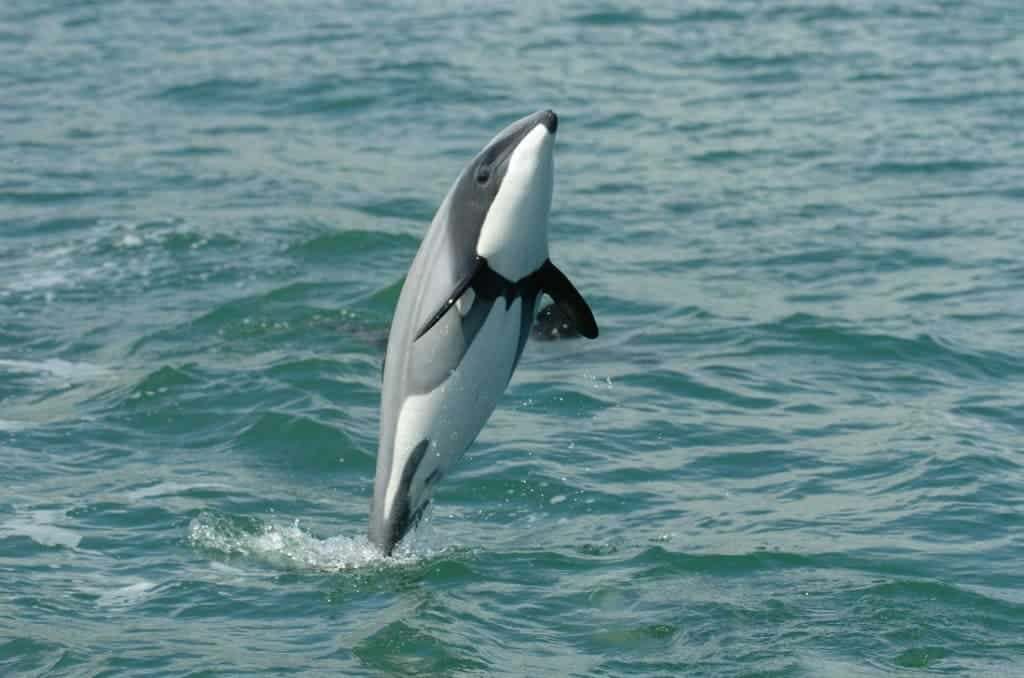
Maui’s dolphin or popoto is the world’s rarest and smallest known subspecies of эolphin.


The Maui dolphin is the world’s rarest, with under 60 individuals remaining in the wild – all in the waters around New Zealand. The area that was opened for exploration overlaps 3000 square kilometres into the sanctuary, including some large areas of the Tarnaki coast in the north island. However, the government doesn’t appear to be too worried.

I think primarily once you go from exploration right through to production, you’re not jeopardising the wildlife,” says Minister of Energy and Resources Mr Bridges.

Of course, that’s not even remotely true. Even if it never gets to the extraction, just exploration can be very dangerous for marine wildlife. Seismic prospection lies at the very core of exploration; what happens is that specially equipped vessels carry one or more cables containing a series of hydrophones at constant intervals. These hydrophones record the acoustic waves coming from one or several sources, which are almost always airguns. The main problem is that marine seismic surveys have a high risk of disturbing, damaging or even killing marine wildlife, especially cetaceans as dolphins and whales which rely on sound to communicate with one another (and even to navigate).

It has been shown that several species of whales purposefully avoid their regular migratory and breeding grounds where seismic surveys are carried, despite claims coming from oil companies and fossil fuel associations. However, as it often happens, the importance of protecting wildlife fades in comparison to those black, oily dollars.
There has been petroleum exploration in that area for a long period of time,” says Mr Bridges. “I think it’s about achieving a balance.”


Wednesday, 27 May 2015

New Zealand's Maui dolphins

The answer, in short, is no while we have a government that places oil exploration head of conservation and basically couldn't give a shit. 

Also, take into consideration abrupt climate change, warm oceans, acidification and loss of phytoplankton and the prospects look bleak.


Maui dolphin numbers hit all time low


16 May, 2015

A new warning has sounded for the world's smallest dolphin, with a researcher now reporting there are less than 50 Maui's dolphins left.

Dr Barbara Maas of the NABU International Nature Conservation Foundation and Otago University's Professor Liz Slooten are presenting new research during discussions with 200 leading cetacean scientists at the International Whaling Commission's Scientific Committee in San Diego.

Research by Dr Maas reports the numbers of the critically-endangered Maui's dolphin, endemic to our waters, have sunk to an all-time low of between 43 and 47 individuals, and just 10 to 12 adult female Maui's dolphins.

She warned that unless the level of fisheries protection was increased significantly, the critically-endangered dolphins could become extinct in just 15 years.

The subspecies of Hector's dolphins, found in shallow coastal waters up to depths of 100 metres off the North Island's west coast, have become a symbol for environmentalists challenging gill netting and trawling by commercial fishers, and Government oil and gas exploration block offers in habitat areas.

Earlier this year, Auckland councillors voted to oppose oil exploration in a sanctuary home to the dolphin, but stopped short of following Christchurch City Council and opposing any exploration, while a survey suggested Kiwis would be happy to pay for greater protection for the dolphins.

Population numbers - which environmentalists have generally put at 55 and the Department of Conservation has estimated at between 48 and 69 - had dropped 97 per cent as a result of fishing since the 1970s, NABU International Nature Conservation Foundation said in a statement.

The group stated the numbers had dropped from 111 in 2004 to 59 in 2010/11, and claimed the absence of man-made deaths, such as dying in fishing nets, would set the dolphins back on the road to recovery and allow numbers to grow to 500 individuals in 87 years.

Because Maui's dolphins could only cope with one human-induced death every 10-20 years, immediate conservation measures are urgently required, NABU said.

There has been debate around figures surrounding the dolphin's population and its extinction deadline.

Last year, a Ministry for Primary Industries spokesperson told the Herald that while there was no debate numbers were at a "very low level", the Government had not seen any analysis or evidence that supported research suggesting existing protection measures would lead to the Maui dolphin's functinal extinction within the next two decades.

Dr Maas said the new figures were an "unmistakable wake-up call", arguing New Zealand had to stop placing the interests of the fishing industry above biodiversity conservation.

Presently, the Government has in place a range of set net, trawling and drift net restrictions throughout the dolphins' habitat, while there are also restrictions on seabed mining and acoustic seismic survey work within the boundaries of the West Coast North Island Marine Mammal Sanctuary, which was extended in 2013 to include more of the Maui dolphin's range in the Taranaki area.

The Government was also reviewing a threat management plan already in place for the dolphins, with the programme to be informed by a marine research and advisory group of scientific and stakeholder experts.


See video HERE

Can we pull Maui’s dolphins from the brink of extinction?
Conservationists and scientists are urging greater protections for Maui’s dolphins, a small, rare species found off the coast of New Zealand.

By Jessica Mendoza


The smallest and rarest marine dolphin in the world could be extinct within 15 years if protection is not stepped up, new research suggests.

25 May, 2015

The world’s smallest and rarest dolphin species is on the verge of extinction.
New research suggests that the population of Maui’s dolphin, native to the waters off New Zealand's North Island, has fallen to an all-time low of fewer than 50 individuals, with only 10 to 12 breeding females left. Scientists and conservationists are once again urging the New Zealand government to expand measures to prevent dolphins from dying in fishing nets – the main reason the population has declined by 97 percent since the 1970s, according to the German conservation group NABU.

"It's a wake-up call, it's shocking," says Dr. Barbara Maas, NABU's head of endangered species conservation. The new figures, she adds, are a result of what she says is the New Zealand government's inadequate management response to what scientific research has for years been urging it to do.

New Zealand has to abandon its current stance, which places the interests of the fishing industry above biodiversity conservation, and finally protect the dolphins’ habitat from harmful fishing nets, seismic airgun blasts, and oil and gas extraction,” Dr. Maas told the BBC.

Otherwise, the dolphin’s extinction would be “a matter of when, not if,” she told the British news service.

Maui’s dolphin, scientific nameCephalorhynchus hectori maui, is a subspecies of Hector’s dolphin and is found in coastal waters up to a depth of 100 meters on the west side of New Zealand’s North Island. Solidly built, with a sloping snout and a rounded, or “mickey mouse shaped,” dorsal fin, the dolphin is the smallest in the world, measuring about 4 to 5 feet in length and weighing a little over 100 pounds as an adult, according to the WWF.

Females have a low reproductive rate, breeding just fast enough to replace those dolphins that die naturally — which explains why the species is struggling to recover from human-induced deaths, the WWF noted. In 2013, the species was listed as critically endangered by the International Union for Conservation of Nature (IUCN). Today, Maas estimates there are 43 to 47 individuals, a distinct drop from 59 dolphins in 2010. 

If allowed to become extinct, she says, Maui's dolphin would mean the loss of an important predator in the local ecosystem, which would affect the rest of the food chain.

Maui's dolphins ... are building blocks of biodiversity," Maas says. "They are not ornaments that are just there and can be removed.” 

Maui’s dolphin faces a number of risks, including pollution, tourist activity, and seismic testing, conservationists have said. The last has been heavily debated by marine mammal advocates and oil and gas companies, who employ seismic surveys to determine whether oil and gas reservoirs exist beneath the ocean floor.
Groups such as the Petroleum Exploration and Production Association of New Zealand have said that their methods are tested and regulated, and do little, if any, harm to the environment. Conservationists, on the other hand,have argued that seismic testing causes temporary or permanent hearing loss in dolphins, which in turn leads to stranding or death.

But the biggest problem Maui’s dolphin faces are trawl fishing and gillnetting, both popular commercial and recreational enterprises in New Zealand. These activities employ large, fine nets to trap fish – nets responsible for more than 95 percent of Maui’s dolphin mortalities, according to a 2012 study by a panel of experts appointed by the New Zealand government.

It’s a very fine nylon mesh, and the dolphins can’t detect this net, so they get tangled in it and drown,” Milena Palka, a marine advocate for WWF New Zealand, told the New Zealand Herald.

In response to the Maui’s dolphin crisis, the New Zealand government in 2007 developed the Hector's and Maui dolphin threat management plan, which sought to restrict the movement of commercial and tourist vessels and to establish sanctuaries in the species’ natural habitat. The plan would bolster New Zealand’s 1978 Marine Mammals Protection Act, which gave the country’s Department of Conservation the mandate to protect and administer marine mammals and their sanctuaries.

Critics, however, have said that the government’s efforts are inadequate.
In her latest study, to be presented at the International Whaling Commission (IWC) Scientific Committee meeting in San Diego this week, Maas wrote that New Zealand had promised to increase conservation efforts in response to last year's IWC recommendations. The committee had urged the government to expand protected waters, ban trawl fishing and gillnetting throughout the species’ habitat, and commit to specific timelines and targets with regards to the dolphin’s conservation.

The committee reiterates its extreme concern about the continued decline of such a small population as the human-induced death of even one dolphin would increase the extinction risk for this subspecies,” according to the IWC. 

But the dolphins' continued decline reveals a lack of political will on the part of the New Zealand government, and represents the problem that conservation as an issue faces on a global scale, Maas says. It says much about humans as a species if, in a country like New Zealand, we can't save as charismatic an animal as the dolphin even after decades of research telling us what to do, she adds.

She compares the survival of the world's ecosystems to the block game Jenga: “We pull out one, we pull out another ... eventually, we crash.”

The deadline for the dolphins’ extinction has been debated, but NABU, the German conservation group, has said that if the status quo is maintained, the species could be gone by 2031. If concrete steps are taken, however, and human-caused deaths are cut to zero, the dolphins’ numbers could be up to 500 individuals within about 90 years.

They are not doomed to extinction,” Dr. Maas told the BBC in 2013. “Genetic variability is still high [and] they can bounce back, but saving them is a race against time.”

Maui's Dolphins on '60 Minutes'


Friday, 17 April 2015

#TheGreatUnravelling - 04/16/2015

Just In: Emergency closure of fishery along entire West Coast
Almost no babies surviving since 2011 
― “Catastrophic crash… Population decimated… Crisis… Collapse so severe”
― “Latest in series of alarming die-offs… mass reproductive failures… strange diseases”
Official: “A lot of weird things out there”


16 April, 2015


NY Times, Apr 15, 2015 (emphasis added): [Regulators] approved an emergency closure of commercial sardine fishing off Oregon, Washington and California… Earlier this week, the council shut down the next sardine season… [R]evised estimates of sardine populations… found the fish were declining in numbers faster than earlier believed… [Stocks are] much lower than estimated last year… The reasons are not well-understood.

Pacific Fishery Management Council meeting, April 13, 2015: Ben Enticknap, Oceana senior scientist (1:08:00 in) — “We’ve seen a significant change in recruitment [Recruitment: The number of new young fish that enter a population]. There’s been practically no recruitment in recent years, and this was not expected.”

Undercurrent News, Apr 14, 2015: [A]ccording to the report on the emergency action from the PFMC… “the total stock biomass of Pacific sardine is declining as a result of poor recruitment“… [A California Wetfish Producers Association official said] “little recruitment was observed in 2011-2014.”

Oregonian, Apr 13, 2015: Pacific coast sardines are facing a population collapse so severe[fishing] will be shut down… [The] downward spiral in spite of favorable water conditions has ocean-watchers worried there’s more to this collapse than cyclical population trends. “There are a lot of weird things happening out there, and we’re not quite sure why they aren’t responding the way they should,” said Kevin Hill, a NOAA Fisheries biologist… Fishery managers are adding it to a list of baffling circumstances off the West Coast… NOAA surveys indicate very few juvenile fish made it through their first year. “The population isn’t replacing itself,” Hill said.

SFist, Apr 14, 2015: [T]he population appears decimated… As the Council writes, “temperatures in the Southern California Bight have risen in the past two years, but we haven’t seen an increase in young sardines”… Sardines typically spawn in warmer waters, with cold water decreasing their numbers.

SF Chronicle, Apr 14, 2015: Sardine population collapses… [There's] evidence stocks are going through the same kind of collapse [seen in the 1950s]… The sardine population along the West Coast has collapsed… Causes of crisis — A lack of spawning… was blamed for the decline… Severedownturn… things recently took a turn for the worse… because of a lack of spawning due to poor ocean conditions in 2014… The collapse this year isthe latest in a series of alarming die-offs, sicknesses and population declines in the ocean ecosystem along the West Coast. Anchovies… have also declined [due to] a lack of zooplankton… Record numbers of starving sea lions… Brown pelicans, too, have suffered from mass reproductive failures and are turning up sick and dead… Strange diseases have also been proliferating in the sea…

Monterey Herald, Apr 13, 2015: For the first time in 30 years [sardine fishing] will be banned.

KPCC, Apr 1, 2015: The first time that sardine fishing has been banned since federal management of the fishery began… Many are worried a… catastrophic crash is happening.


Thousands of dead fish found 
floating on lake in China

Image

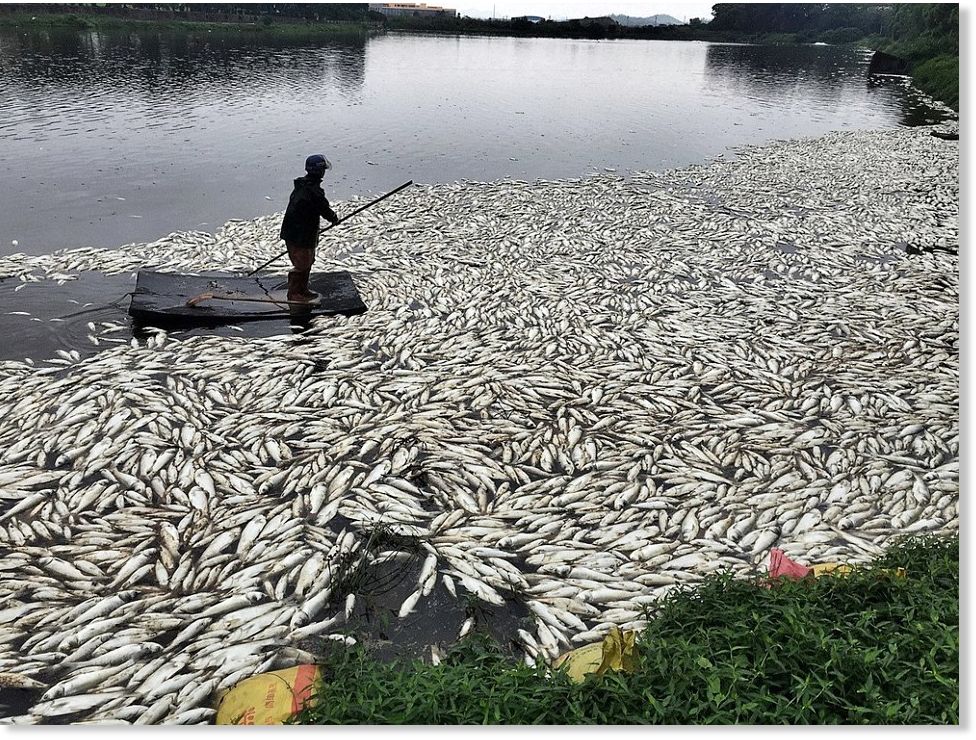
Thousands of fish, weighing 100 tonnes, have been found dead at a lake in Huizhou City in southern China's Guangdong Province

13 April, 2015

Thousands of animals have died overnight at a commercial fish farm in southern China's Guangdong Province after the lake became polluted.

More than 100 tonnes of dead fish were found floating in the water near Huizhou City on Friday morning by devastated farmer Mr Zhang.

Workers had rushed to clear the lake, using plastic baskets and nets to scoop them out, creating a huge mountain of rotting fish on the shore.

Others were sent to spread 2.5 tons of edible salt to try and restore the chemical imbalance of the lake which had become contaminated with ammonia, reported 
The People's Daily Online.

It may save the few remaining live fish but Mr Zhang, who founded the business in 1996, admitted he was not optimistic. 

Image

A mountain of rotting fish: A team of people have been working to clear the dead fish from the water by piling them up on the nearby shore

The shock death of thousands of fish means he could be facing financial ruin.

The farmer stands to lose over 1 million RMB (£110,000) in potential sales, and claimed he would need at least a decade to recover.

'It's the first time that my fish farming has had such a problem since I started in 1996. I'll need another ten years to make up for this loss,' said Mr Zhang.

'It has taken me years to build the fish numbers up and my one source of income has vanished almost overnight.'

Mr Zhang claims the source of the ammonia may have been fertilizer being used at a nearby farm.


Later Day Manner Falls In 
Thailand, As Fish Rain Over 
Streets

14 April, 2015

Later Day manner has fallen on Thailand.  In Thailand Fishes Gets Litters All Over the Streets After Rainfall with many people expressing surprise.

a2cca787
Indeed, passersby have been held in awe as hundreds of fishes had flown to the banks of seashore and on the road.

Reports have it that most of fishes were found dead.

Whilst some people tried to save the fishes, others stood watching in amazement.
It is on record that rainy season in Thailand varies from region to region.

Its rainy season can be classified as May/June to October and the river fishing season in Khao Sok National Park is influenced by the monsoon winds from both the Indian and Pacific Ocean.
31fe4690
a2cca787

From last year - 
Video: Villagers stunned as 
hundreds of fish fall out the 
sky over Sri Lanka


8 April, 2014


They found a total of 50kg worth of dead and alive fish, which is a valued commodity on the island and is believed to be fine to eat

A stunned community in west Sri Lanka were delighted when they were hit by a downpour of raining FISH.

A village in Chilaw reported that a storm had left behind scores of fish lying on roads, grass and roofs after they heard heavy thuds across the district.

The fish, which are fine to be eaten, fell during treacherous weather after scientists believe they were lifted out of the river during strong winds before plummeting back down to the ground.

Scientists said this happens when swirling whirlwinds over relatively shallow water become waterspouts, sucking in almost anything in the water including fish, eels and frogs.

But this isn't the first time the country has been plagued with mysterious bouts of rain - back in 2012, south Sri Lanka encountered a rainfall of prawns when a similar event occured.


A Sperm Whale Washes Ashore in the Bay Area
The dead behemoth that appeared south of San Francisco is "emaciated."
Image Jeff Chiu/AP

16 April, 2015

The Bay Area suffered a massive bummer this week, when the carcass of a nearly 50-foot sperm whale was spied on a beach just south of San Francisco.
The behemoth is still at Mori Point in Pacifica, for anybody who wants to touch it like the guy above. Experts from Sausalito's Marine Mammal Center are cutting it apart for a necropsy and removal, and though cause of death has yet to be established, it looks "emaciated," reports the Associated Press. Here's more:
The animal, which was first spotted Tuesday, is one of 17 dead sperm whales to beach along the North Coast of California during the 40 years that the center has been handling such cases, a spokeswoman said....
In 2008, a 51-foot adult male sperm whale was found washed ashore in Point Reyes, north of San Francisco. Scientists who performed a necropsy found more than 450 pounds of trash in his stomach, which caused his death. The trash was used to create an art exhibit at the center's headquarters to teach visitors about the importance of keeping trash from oceans.
In January, a rare pygmy sperm whale died after beaching itself in Point Reyes. Investigators said it had likely gotten sick and was too weak to swim.
  

Dead Dolphins In Fukushima Stranding Found With White Radiated Lungs


15 April, 2014

Japanese scientists are saying they have never seen anything like what they discovered after autopsying a massive group of dolphins that ended up dead after being discovered stranded on a beach near the site of the 2011 Fukushima disaster.

Their lungs were white, which, according to scientists is an indication of loss of blood flow to the organs which is an indication of radiation poisoning.

The translated article comes from EneNews:

Google Translate: Ibaraki Prefecture… for a large amount of dolphin which was launched on the shore… the National Science Museum… investigated… researchers rushed from national museums and university laboratory, about 30 people were the anatomy of the 17 animals in the field. [According to Yuko Tajima] who led the investigation… “the lungs of most of the 17… was pure white ischemic state, visceral signs of overall clean and disease and infections were observed”… Lungs white state, that has never seen before.

Systran: The National Science Museum… investigated circumstance and cause etc concerning the mass dolphin which is launched to the seashore of Ibaraki prefecture… the researchers ran from the museum and the university laboratory… approximately 30 people dissected 17… [Yuko Tajima] of the National Science Museum which directed investigation research worker [said] “the most lung 17 was state with true white, but as for the internal organs being clean”… The lung true white as for state, says… have not seen.

Fukushima Diary, Apr 12, 2015: According to National Science Museum, most of the inspected 17 dolphins had their lungs in ischaemia state… The chief of the researching team stated “Most of the lungs looked entirely white”… internal organs were generally clean without any symptoms of disease or infection, but most of the lungs were in ischaemia state. She said “I have never seen such a state”.
Fukushima
Wikipedia: Ischemia is a vascular disease involving an interruption in the arterial blood supply to a tissue, organ, or extremity that, if untreated, can lead to tissue death.

Many reports have been published on the links between ischemia and radiation exposure:

It has been shown that the ionizing radiation in small doses under certain conditions can be considered as one of starting mechanisms of… IHD [ischemic heart disease].” -Source

“Radiation risks on non-cancer effects has been revealed in the [Chernobyl] liquidators… Recently, the statistically significant dose risk of ischemic heart disease… was published.” -Source

“Incidence of and mortality from ischemic heart disease (IHD) have been studied in a cohort of 12210 workers [at] Mayak nuclear facility… there was statistically significant increasing trend in IHD incidence with total external gamma dose.” -Source

“Numerous studies have been published concerning non cancer diseases in liquidators… Risk of ischemic heart disease… seems increased.” -Source


“In 1990 the International Chernobyl Project has been carried out under the aegis of the IAEA… It is known that the international experts who had taken part in the International Chernobyl Project were aware of the report by the Minster of the Ministry of Health Care of Belarus delivered at an informal meeting arranged by the IAEA… The Belorussian Minister reported about… the worsening of the general health state of the affected population… “Among adults in 1988 there was a two- to fourfold increase, in comparison with preceding years, in the number of persons suffering from… ischemic heart diseases” -Source

“In a study on a Russian cohort of 61,000 Chernobyl emergency workers… a statistically significant risk of ischemic heart disease was observed.” -Source
How do you feel about the findings of the autopsies of the Fukushima Dolphin standing?


Dwindling bird populations in Fukushima
Even as radioactivity diminishes near the site of the 2011 nuclear disaster, negative effects on birds strengthen

UNIVERSITY OF SOUTH CAROLINA

15 April, 2015


This is the time of year when birds come out and really spread their wings, but since a disastrous day just before spring's arrival four years ago, Japan's Fukushima province has not been friendly to the feathered. And as several recent papers from University of South Carolina biologist Tim Mousseau and colleagues show, the avian situation there is just getting worse.

Since a few months after the March 11, 2011, earthquake, tsunami and subsequent nuclear catastrophe at Japan's Fukushima-Daiichi nuclear power plant, Mousseau and several co-workers have undertaken a series of bird censuses in contaminated areas. They recently published a paper in the Journal of Ornithology showing results from the first three years of the effort for 57 bird species.

Many populations were found to have diminished in number as a result of the accident, with several species suffering dramatic declines. One hard-hit species was the barn swallow, Hirundo rustica, which suffered large population losses in a dose-dependent manner according to individually measured levels of radiation exposure.

The researchers looked more closely with the barn swallow, trying to isolate the mechanism causing the population decrease with their first two years of data. But as Mousseau, his postdoctoral associate Andrea Bonisoli-Alquati and colleagues reported in a separate recently published study in the journal Scientific Reports, their tests of peripheral erythrocytes in individual barn swallow nestlings failed to show genetic damage as a result of direct-dose radiation effects. Nevertheless, the more detailed study showed a dose-response decrease in both numbers and fraction of juveniles.

"We were working with a relatively small range of background exposures in this study because we weren't able to get into the 'hottest' areas that first summer after the disaster, and we were only able to get to some 'medium-hot' areas the following summer," Mousseau says. "So we had relatively little statistical power to detect those kinds of relationships, especially when you combine that with the fact that there are so few barn swallows left. We know that there were hundreds in a given area before the disaster, and just a couple of years later we're only able to find a few dozen left. The declines have been really dramatic."

Another place in the world that might provide insight into what's now happening in Fukushima is Chernobyl, the scene in 1986 of a devastating release of radioactive materials in Ukraine. Mousseau, as director of the Chernobyl + Fukushima Research Initiative since it was founded in 2000 at Carolina, is uniquely qualified to draw comparisons, having been a leader over the past two decades in establishing a large body of research on the effects of radioactivity on animals living in the wild.

In a separate paper in the Journal of Ornithology, Mousseau and his longtime collaborator Anders Moller of the CNRS (France) discuss how the response of bird species differed between Fukushima and Chernobyl. One contrast between the effects of radiation in the two locales was striking: Migratory birds appear to fare worse in the mutagenic landscape of Chernobyl than year-round residents, whereas the opposite is true in Fukushima.

"It suggests to us that what we're seeing in Fukushima right now is primarily through the direct result of exposure to radiation that's generating a toxic effect -- because the residents are getting a bigger dose by being there longer, they're more affected," Mousseau says. "Whereas in Chernobyl, many generations later, the migrants are more affected, and one possibility is that this reflects differences in mutation accumulation.

"The DNA repair capabilities of migratory species are impaired at least for a short period of time following migration. After they've been flapping their wings, generating oxidative stress as a consequence of exercise, their antioxidant levels -- vitamin E, carotenoids, for example -- are much lower than normal, so the radiation hits them harder than the resident species that don't have that acute depletion effect."

What might be most disheartening to the researchers involved, and bird-lovers in general, is how the situation is progressing in Fukushima. Despite the decline in background radiation in the area over these past four years, the deleterious effects of the accident on birds are actually increasing.

"The relationship between radiation and numbers started off negative the first summer, but the strength of the relationship has actually increased each year," Mousseau says. "So now we see this really striking drop-off in numbers of birds as well as numbers of species of birds. So both the biodiversity and the abundance are showing dramatic impacts in these areas with higher radiation levels, even as the levels are declining."


Oregon Beaches Blanketed by Slimy Purple 'Jellyfish'


Millions of valella vallela - also known as 'purple sails' - have washed up on Oregon's shores in huge numbers. Neely Chalmers of KGW reports