Showing posts with label whales. Show all posts

Tuesday, 10 July 2018

Orcas are starving in the Pacific Northwest


I suspect there are as many lies and omissions in this as there is truth. One cause – radiation from Fukushima – is taboo.

Orcas of the Pacific Northwest Are Starving and Disappearing


9 July, 2018

SEATTLE — For the last three years, not one calf has been born to the dwindling pods of black-and-white killer whales spouting geysers of mist off the coast in the Pacific Northwest.

Normally four or five calves would be born each year among this fairly unique urban population of whales — pods named J, K and L. But most recently, the number of orcas here has dwindled to just 75, a 30-year-low in what seems to be an inexorable, perplexing decline.

Listed as endangered since 2005, the orcas are essentially starving, as their primary prey, the Chinook, or king salmon, are dying off. Just last month, another one of the Southern Resident killer whales — one nicknamed “Crewser” that hadn’t been seen since last November — was presumed dead by the Center for Whale Research.

In March, Gov. Jay Inslee issued an executive order directing state agencies to do more to protect the whales, and in May he convened the Southern Resident Orca Task Force, a group of state, tribal, provincial and federal officials, to devise ways to stem the loss of the beloved regional creature. “I believe we have orcas in our soul in this state,” he said. At another point, he wrote of the whales and Chinook salmon that “the impacts of letting these two species disappear would be felt for generations.”

SEATTLE — For the last three years, not one calf has been born to the dwindling pods of black-and-white killer whales spouting geysers of mist off the coast in the Pacific Northwest.

Normally four or five calves would be born each year among this fairly unique urban population of whales — pods named J, K and L. But most recently, the number of orcas here has dwindled to just 75, a 30-year-low in what seems to be an inexorable, perplexing decline.

Listed as endangered since 2005, the orcas are essentially starving, as their primary prey, the Chinook, or king salmon, are dying off. Just last month, another one of the Southern Resident killer whales — one nicknamed “Crewser” that hadn’t been seen since last November — was presumed dead by the Center for Whale Research.

In March, Gov. Jay Inslee issued an executive order directing state agencies to do more to protect the whales, and in May he convened the Southern Resident Orca Task Force, a group of state, tribal, provincial and federal officials, to devise ways to stem the loss of the beloved regional creature. “I believe we have orcas in our soul in this state,” he said. At another point, he wrote of the whales and Chinook salmon that “the impacts of letting these two species disappear would be felt for generations.”

Much is still unknown about the plight of these orcas, but biologists and conservation managers have zeroed in on several main factors — and they are all connected.

The biggest contributing factor may be the disappearance of big king salmon — fish more than 40 inches long. “They are Chinook salmon specialists,” said Brad Hanson, team leader for recovery efforts for the Northwest Fisheries Science Center here, part of NOAA. “If they could, they would eat Chinook salmon 24/7.” Orcas gobble 30 a day. Hunting enough smaller prey requires a lot more energy.

The underwater world in the region is also getting noisier, especially an area between the San Juan Islands and Vancouver Island called Haro Strait. It is one of the orcas’ favorite foraging grounds in the summer.

It’s also essentially a big rock ditch where sound bounces off. When you add in commercial vessel traffic going to Vancouver, recreational boaters and whale watching operations, it’s a pretty noisy place,” Mr. Hanson said.

Researchers are studying noise there now. They believe the cacophony of ship traffic interferes with echolocation and makes it harder for the whales to locate their prey and to communicate prey location among themselves. It can also cause hearing loss.

In recent years, officials have expanded the distance which vessels, including whale watching boats and kayaks, must keep from the whales. And there is a voluntary no-go zone near the San Juan Islands.

Just the presence of boats can cause the whales to spend less time feeding,” said Lynne Barre, of NOAA Fisheries, recovery coordinator for the orcas. “And it’s harder to communicate. They have to call longer and louder when boats are nearby.”

Another factor is the pollution in Puget Sound. Whales that live off the coast of Seattle, Tacoma and other cities are effectively urban whales buffeted by municipal and industrial waste, and the occasional spillage from wastewater treatment plants into the ocean. Killer whales carry some of the highest levels of pollution of any marine animal.

Of most concern are the lingering effects of chemicals and pesticides, including the now banned DDT, as well as PCBs and PPDE, widely used in flame retardants and found through the world. The pollutants accumulate in salmon as they feed, and when the whales eat salmon they also ingest PCBs at even higher levels.

It’s very lipophilic, which means it stays in the fat, and the females transfer a huge proportion of the contaminant burden to their offspring,” Dr. Hanson said. “About 85 percent gets transferred to calves through lactation.”

And while much of the pollution is from the region’s industrial past, Boeing disclosed this spring that over the past five years it had discharged highly toxic PCBs into the Duwamish River, which flows into Puget Sound, thousands of times over the legal limit.

These toxins suppress the whales’ immune systems, making them more susceptible to disease. They can also impede reproduction. That may be why tests show a high number of females who have become pregnant have failed to calve.

However, the decline of the whales can’t be pegged, experts say, to contaminants alone. A separate population of transient whales near here eat mammals that eat fish, and so consume concentrate contaminants at even higher levels — many times as high as the resident pods. Yet they are thriving, which has left scientists scratching their heads. Global populations are robust as well.

One possible scenario is that the dearth of salmon coupled with the interference of engine noise, which can affect their immune system, too, deprives the orcas of a sufficient diet. Their bodies then draw on fat reserves, which are laced with chemicals that suppress their immune system and reduce fecundity.

But experts aren’t sure what is raising their mortality rate. Often, when whales die, their carcasses sink or wash up onto remote beaches and are hard to find and test.

In recent years, researchers have been focusing on anthroponeses, diseases that humans may be passing to wildlife. Scientists have sailed out among the pods with a petri dish at the end of a 25-foot long pole to pass through the mist that whales exhale and see what they carry in their lungs. They found a range of pathogens that could be from humans, including antibiotic resistant bacteria and staphylococcus, which can cause pneumonia.

It doesn’t mean they are sick, we don’t have evidence for that,” said Linda D. Rhodes, a research biologist expert in marine microbes and toxins and part of the study. “It means they are being exposed. Whether or not the whales get sick is a product of how much of it is present in the environment and how well is the whale able to defend itself.”

There is deep concern that a fatal human or animal disease has, or will, cross the species barrier and find its way into these immuno-compromised killer whales. “I’ve had dreams about it at night,” said Joseph K. Gaydos, a veterinarian with the SeaDoc Society in Eastsound, Washington in the San Juan Islands, who studies the southern residents. “Disease smolders in the environment but can break out. If there were a highly virulent virus to come through here it would take out a large part of the population and totally stop recovery efforts.”

Disease threats are myriad. A young killer whale died from a fungal infection last year. Toxoplasmosis is a disease spread by parasites in the feces of cats. It is one of the top threats to the Hawaiian monk seal, killing eight of the remaining 1,400 since 2001. It’s not known, though, to affect whales.

Canine distemper from dogs is also a concern. It’s a morbillivirus, which is an RNA rather than a DNA virus. Some 1,500 dolphins were killed by a single outbreak of morbilliviruses on the East Coast several years ago.

RNA viruses can mutate rapidly and cross species lines,” Dr. Gaydos said.

Steps are being planned to help the whales persevere. More Chinook salmon are being reared in hatcheries as whale food, but that is far from a certain fix.

In the end trying to maintain a population of whales in the shadow of one of the fastest growing cities in the country may not be possible.

It’s an ecosystem-wide problem,” Dr. Hanson said. “Things are out of whack and we have to get them back to where we can sustain killer whales. And the clock is ticking.”

Losing the charismatic, intelligent animals with the distinctive black-and-white “paint job” and permanent smile would be a blow to the area.

There would be a great sense of loss,” Dr. Rhodes said. “They are such a part of our identity here. It would be a real sense of failure.”


Monday, 6 February 2017

Die-offs in the Pacific

TV Reporter: “Woah! Dead whales!” Record high number of deaths in Hawaii 

  • Carcasses scattered throughout islands” in Pacific
  • Sick and starving animals a ‘mystery’ to experts
  • Possible health effects” from Fukushima radiation off coast (VIDEO)

ENENews,
5 February, 2017


KGMB, Jan 17, 2017 (emphasis added): Wildlife officials investigate record number of humpback whale deaths… Six humpback whale carcasses have washed up onto Hawaii shores since November. That’s double the number typically found in a season, which runs from November to May… The previous record for the number of whale carcasses found in Hawaii waters was in 2013, when five dead whales were found. Biologists aren’t sure what’s behind the increase in deaths. “It is higher than usual. It’s almost double this early in the season for what we’d get in a whole season,” said [NOAA's] David Schofield… Since November, whale carcasses have been scattered throughout the main Hawaiian islands… Biologists are investigating to see if the whales starved or if there’s a problem with the ocean’s health… officials will be meeting with partners inAlaska and Washington D.C. to investigate further.
KGMB reporter Mahealani Richardson, Jan 17, 2017:Woah! Dead whales! Wildlife officials are investigating a mystery over a record number of humpback whale deaths
Other recent whale deaths in Hawaii
KHON, Nov 22, 2016: Beached melon-headed whale euthanized on Maui… “The body condition was significantly compromised…” said marine mammal response specialist Aliza Milette-Winfree… a necropsy will be done to determine what made it sick.
KHON, Oct 23, 2016: Necropsy results are in for a pregnant dwarf sperm whale found dead on Maui’s Makena shoreline… this is very unusual because these whales normally live in deep waters… samples have been sent to the mainland to see if the whale also had any diseases… [NOAA] reported that a witness saw two small whales stranded in Makena…
AP, Aug 26, 2016: Hawaii humpback whale experts are reporting the sighting of a sickly humpback whale off Maui. [NOAA's] Malia Chow said Friday the animal is emaciated and covered in whale lice… She says the animal’s poor condition is a mystery.
Hakai Magazine, May 25, 2016: No-Show Pacific Ocean Humpbacks Stump Scientists… Whaleresearchers from around the Pacific are reporting that far fewer whales showed up in their usual wintering grounds…  [NOAA's Ed Lyman] says he started noticing changes in December 2015… [He] was getting calls from tour boat operators asking where the whales were. “Something happened this year,” agrees Jim Darling, a researcher with the nonprofit Whale Trust Maui. “It almost seemed as if the females didn’t bother to show up”… the density of cows and calves was especially low… Darling also reported hearing from colleagues in the Philippines and Japan of similarly low whale numbers… Also striking was the low number of calves… Puerto Vallarta, Mexico, also saw fewer whales than normal says Oscar Frey, an oceanographer… he observed “the least number of mothers with babies that I have ever seen.”
How about in 2017?
The Garden Island, Jan 30, 2017: Annual whale count… [Jean Souza, HINMS Kauai programs coordinator] said the Kauai sites… saw an average of four whale viewings within a 15-minute time count period… down from the six sightings of the 2016 count.
Dr. Ken Buesseler, Woods Hole Oceanographic Institution, Jan 7, 2017: “We know there can be health effects from exposure to any amount of radiation… the highest level we’ve seen north of Hawaii is 10 Becquerels per cubic meterSwimming through that for eight hours a day for an entire year could have possible health effects, but that additional dose is one thousand times smaller than a single dental X-ray.”


Sunday, 16 August 2015

Death in the Pacific


Whales Are Dying Off North America’s West Coast — And it Could Signal Trouble Deep in the Ocean


15 August, 2015

In only one week, the corpses of four humpback whales have been found along Canada's west coast, fueling questions of whether their deaths are connected to a recent uptick of whale and other marine animal deaths in Alaskan waters. So far scientists don't know what's causing the deaths, but some believe they could be connected to warmer than average ocean temperatures that have caused unusual and potentially poisonous algae blooms.

The carcasses of 23 large whales, including endangered humpback and fin whales, were found in the western Gulf of Alaska last month, according to researchers at the University of Alaska Fairbanks. Of those, 18 are believed to be linked to a single event, although there is no direct cause known at this time. The deaths are believed to have occurred in late May or early June, based on the decomposition of the mammals. An unusual number of walrus and seabird carcasses have also been found near the dead fin whales, the Washington Post reported, though it's unclear whether the deaths are connected.

One of the humpbacks found along the northern British Columbia coast reportedly haddeep gashes on its tail, leading the people who found it to question whether it died from being entangled, although it has also been suggested that the injuries may have been older and unrelated. A First Nations group found it floating offshore, and towed it to land so it could be examined.

It will be a couple weeks before the necropsies of that humpback and another also found in BC waters are done. No cause of death has been determined for either at this time. The other two dead whales have been spotted floating off the west coast of Vancouver Island.

Dead humpback found this week, off northern BC coast, near Klemtu. Photo by Philip Charles.  

Researchers are analyzing the bodies of whales found in Alaskan waters, too, and some don't think they'll ever know for sure what happened. It's normal for scientists to see one dead fin whale every two years, the Washington Post states, meaning this year's fin whale die off is a big deal.

"The cause is still a mystery," Briana Witteveen, research assistant professor at the University of Alaska Fairbanks, told VICE News in an email.

As one marine ecosystem researcher tells VICE News, the whales found bobbing in the water or washed up on the shores could potentially have been killed by an algae bloom connected to warmer than normal ocean temperatures.

"We have very unusual things happening," explained Tom Okey, a University of Victoria expert who researches the effects of climate change on marine ecosystems in the Pacific. "We have this big algae bloom, and some of those algae are toxic, and especially when the whole system is out of whack like that, you can have the toxic ones become very abundant. And so it is feasible, it is reasonable that there could be a link."

Kate Wynne, a marine mammal specialist for the University of Alaska Sea Grant Program, told The Weather Channel that environmental toxins were her "leading hypothesis", too. 

Ocean surface temperatures in the North Pacific are well above average, with sea surface temperatures as high as 5.4 degrees Fahrenheit, or 3 degrees Celsius, warmer than normal. And the Gulf of Alaska is currently home to a warmer-than-usual water zone known as the "warm blob." Higher than normal sea surface temperatures can lead to toxic algae blooms.

The larger than usual algae bloom that has been identified in the Pacific could be poisoning other animals, including sea lions. 


Baleen whales, meanwhile, feed low on the food chain, Okey said. They eat phytoplankton, also known as microalgae, which can become toxic to the organisms that eat them.

And the whale deaths could signal something even worse beneath the ocean's surface.

"Carcasses of whales are easy to see and easy to find," Okey said, "but other species that may have succumbed to toxins or some other disturbance either sink or are more difficult to see, so there might be massive, potentially massive, ecological changes that are happening in the Northeast Pacific."

Okey did not hesitate to draw a possible connection between the variable ocean temperature changes and long-term climate change.

"This could be a glimpse into the kinds of changes and the things that could happen with climate change," he told VICE News. "We know that there is a longer term trend of climate change, and these events here are very short term variability. It's climate variability and oceanographic variability. We also know that there are longer term trends with climate change, which will emerge out of the noise as we move forward in time. But some of these massive changes that are happening give us insight into what the future might look like for the Gulf of Alaska and the whole Northeast Pacific."

Gashes on dead humpback's tail. Photo by Philip Charles. 

Once severely endangered, the humpback whale population has recovered somewhat since their hunting was banned in the 1960s, leading some groups to question whether they should be removed from the endangered species list, where they first appeared in 1970.

In April, the NOAA suggested classifying humpbacks differently and breaking them into 14 groups based on where they reside. Following petitions arguing the humpback populations in Alaska and Hawaii have recovered, the NOAA proposed removing 10 of the 14 groups from the endangered species list, Scientific American reported.

The Canadian government removed the humpback from the threatened species list last year because of its significant population increase. In the mid-1960s there were about 1,500 humpbacks in the North Pacific, but the latest estimates put the current population between 18,000 and 20,000.

Fin whales are the second largest mammal on earth, smaller only than the blue whale.According to the NOAA, there are no reliable population estimates of fin whales. Commercial hunting of fin whales ended by 1987, except off the coast of Greenland, the NOAA said.

In April, about 20 dead sei whales washed onto the beach of a remote part of southern Chile. 

A fin whale lies dead on Kodiak Island, in Alaska, in a June photo by Bree Witteveen, University of Alaska Fairbanks.  


Friday, 17 April 2015

#TheGreatUnravelling - 04/16/2015

Just In: Emergency closure of fishery along entire West Coast
Almost no babies surviving since 2011 
― “Catastrophic crash… Population decimated… Crisis… Collapse so severe”
― “Latest in series of alarming die-offs… mass reproductive failures… strange diseases”
Official: “A lot of weird things out there”


16 April, 2015


NY Times, Apr 15, 2015 (emphasis added): [Regulators] approved an emergency closure of commercial sardine fishing off Oregon, Washington and California… Earlier this week, the council shut down the next sardine season… [R]evised estimates of sardine populations… found the fish were declining in numbers faster than earlier believed… [Stocks are] much lower than estimated last year… The reasons are not well-understood.

Pacific Fishery Management Council meeting, April 13, 2015: Ben Enticknap, Oceana senior scientist (1:08:00 in) — “We’ve seen a significant change in recruitment [Recruitment: The number of new young fish that enter a population]. There’s been practically no recruitment in recent years, and this was not expected.”

Undercurrent News, Apr 14, 2015: [A]ccording to the report on the emergency action from the PFMC… “the total stock biomass of Pacific sardine is declining as a result of poor recruitment“… [A California Wetfish Producers Association official said] “little recruitment was observed in 2011-2014.”

Oregonian, Apr 13, 2015: Pacific coast sardines are facing a population collapse so severe[fishing] will be shut down… [The] downward spiral in spite of favorable water conditions has ocean-watchers worried there’s more to this collapse than cyclical population trends. “There are a lot of weird things happening out there, and we’re not quite sure why they aren’t responding the way they should,” said Kevin Hill, a NOAA Fisheries biologist… Fishery managers are adding it to a list of baffling circumstances off the West Coast… NOAA surveys indicate very few juvenile fish made it through their first year. “The population isn’t replacing itself,” Hill said.

SFist, Apr 14, 2015: [T]he population appears decimated… As the Council writes, “temperatures in the Southern California Bight have risen in the past two years, but we haven’t seen an increase in young sardines”… Sardines typically spawn in warmer waters, with cold water decreasing their numbers.

SF Chronicle, Apr 14, 2015: Sardine population collapses… [There's] evidence stocks are going through the same kind of collapse [seen in the 1950s]… The sardine population along the West Coast has collapsed… Causes of crisis — A lack of spawning… was blamed for the decline… Severedownturn… things recently took a turn for the worse… because of a lack of spawning due to poor ocean conditions in 2014… The collapse this year isthe latest in a series of alarming die-offs, sicknesses and population declines in the ocean ecosystem along the West Coast. Anchovies… have also declined [due to] a lack of zooplankton… Record numbers of starving sea lions… Brown pelicans, too, have suffered from mass reproductive failures and are turning up sick and dead… Strange diseases have also been proliferating in the sea…

Monterey Herald, Apr 13, 2015: For the first time in 30 years [sardine fishing] will be banned.

KPCC, Apr 1, 2015: The first time that sardine fishing has been banned since federal management of the fishery began… Many are worried a… catastrophic crash is happening.


Thousands of dead fish found 
floating on lake in China

Image

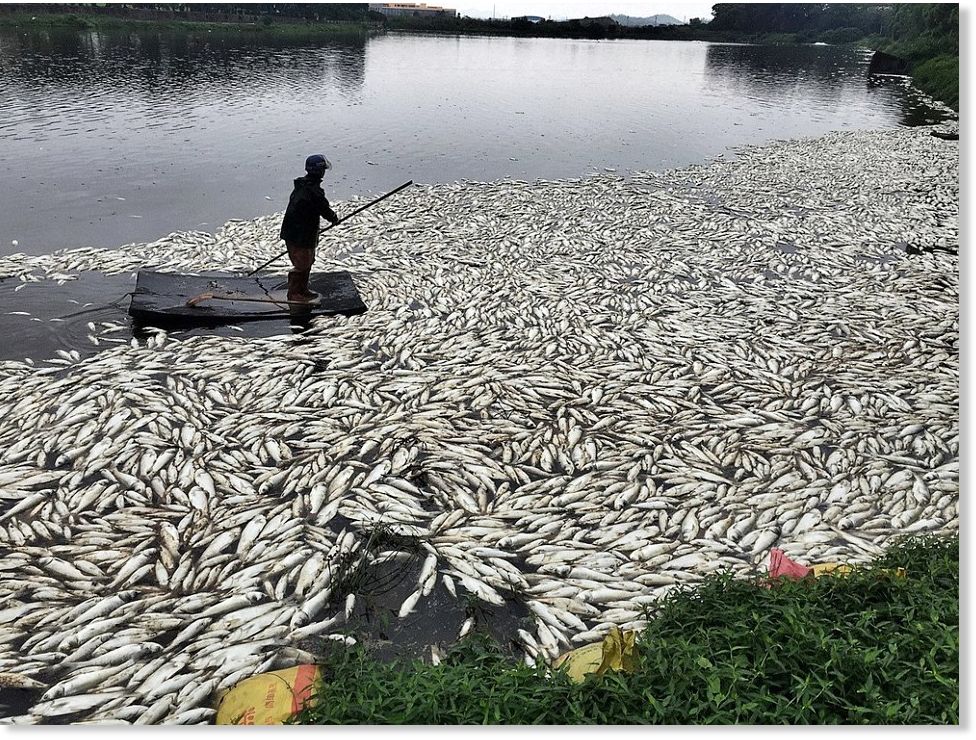
Thousands of fish, weighing 100 tonnes, have been found dead at a lake in Huizhou City in southern China's Guangdong Province

13 April, 2015

Thousands of animals have died overnight at a commercial fish farm in southern China's Guangdong Province after the lake became polluted.

More than 100 tonnes of dead fish were found floating in the water near Huizhou City on Friday morning by devastated farmer Mr Zhang.

Workers had rushed to clear the lake, using plastic baskets and nets to scoop them out, creating a huge mountain of rotting fish on the shore.

Others were sent to spread 2.5 tons of edible salt to try and restore the chemical imbalance of the lake which had become contaminated with ammonia, reported 
The People's Daily Online.

It may save the few remaining live fish but Mr Zhang, who founded the business in 1996, admitted he was not optimistic. 

Image

A mountain of rotting fish: A team of people have been working to clear the dead fish from the water by piling them up on the nearby shore

The shock death of thousands of fish means he could be facing financial ruin.

The farmer stands to lose over 1 million RMB (£110,000) in potential sales, and claimed he would need at least a decade to recover.

'It's the first time that my fish farming has had such a problem since I started in 1996. I'll need another ten years to make up for this loss,' said Mr Zhang.

'It has taken me years to build the fish numbers up and my one source of income has vanished almost overnight.'

Mr Zhang claims the source of the ammonia may have been fertilizer being used at a nearby farm.


Later Day Manner Falls In 
Thailand, As Fish Rain Over 
Streets

14 April, 2015

Later Day manner has fallen on Thailand.  In Thailand Fishes Gets Litters All Over the Streets After Rainfall with many people expressing surprise.

a2cca787
Indeed, passersby have been held in awe as hundreds of fishes had flown to the banks of seashore and on the road.

Reports have it that most of fishes were found dead.

Whilst some people tried to save the fishes, others stood watching in amazement.
It is on record that rainy season in Thailand varies from region to region.

Its rainy season can be classified as May/June to October and the river fishing season in Khao Sok National Park is influenced by the monsoon winds from both the Indian and Pacific Ocean.
31fe4690
a2cca787

From last year - 
Video: Villagers stunned as 
hundreds of fish fall out the 
sky over Sri Lanka


8 April, 2014


They found a total of 50kg worth of dead and alive fish, which is a valued commodity on the island and is believed to be fine to eat

A stunned community in west Sri Lanka were delighted when they were hit by a downpour of raining FISH.

A village in Chilaw reported that a storm had left behind scores of fish lying on roads, grass and roofs after they heard heavy thuds across the district.

The fish, which are fine to be eaten, fell during treacherous weather after scientists believe they were lifted out of the river during strong winds before plummeting back down to the ground.

Scientists said this happens when swirling whirlwinds over relatively shallow water become waterspouts, sucking in almost anything in the water including fish, eels and frogs.

But this isn't the first time the country has been plagued with mysterious bouts of rain - back in 2012, south Sri Lanka encountered a rainfall of prawns when a similar event occured.


A Sperm Whale Washes Ashore in the Bay Area
The dead behemoth that appeared south of San Francisco is "emaciated."
Image Jeff Chiu/AP

16 April, 2015

The Bay Area suffered a massive bummer this week, when the carcass of a nearly 50-foot sperm whale was spied on a beach just south of San Francisco.
The behemoth is still at Mori Point in Pacifica, for anybody who wants to touch it like the guy above. Experts from Sausalito's Marine Mammal Center are cutting it apart for a necropsy and removal, and though cause of death has yet to be established, it looks "emaciated," reports the Associated Press. Here's more:
The animal, which was first spotted Tuesday, is one of 17 dead sperm whales to beach along the North Coast of California during the 40 years that the center has been handling such cases, a spokeswoman said....
In 2008, a 51-foot adult male sperm whale was found washed ashore in Point Reyes, north of San Francisco. Scientists who performed a necropsy found more than 450 pounds of trash in his stomach, which caused his death. The trash was used to create an art exhibit at the center's headquarters to teach visitors about the importance of keeping trash from oceans.
In January, a rare pygmy sperm whale died after beaching itself in Point Reyes. Investigators said it had likely gotten sick and was too weak to swim.
  

Dead Dolphins In Fukushima Stranding Found With White Radiated Lungs


15 April, 2014

Japanese scientists are saying they have never seen anything like what they discovered after autopsying a massive group of dolphins that ended up dead after being discovered stranded on a beach near the site of the 2011 Fukushima disaster.

Their lungs were white, which, according to scientists is an indication of loss of blood flow to the organs which is an indication of radiation poisoning.

The translated article comes from EneNews:

Google Translate: Ibaraki Prefecture… for a large amount of dolphin which was launched on the shore… the National Science Museum… investigated… researchers rushed from national museums and university laboratory, about 30 people were the anatomy of the 17 animals in the field. [According to Yuko Tajima] who led the investigation… “the lungs of most of the 17… was pure white ischemic state, visceral signs of overall clean and disease and infections were observed”… Lungs white state, that has never seen before.

Systran: The National Science Museum… investigated circumstance and cause etc concerning the mass dolphin which is launched to the seashore of Ibaraki prefecture… the researchers ran from the museum and the university laboratory… approximately 30 people dissected 17… [Yuko Tajima] of the National Science Museum which directed investigation research worker [said] “the most lung 17 was state with true white, but as for the internal organs being clean”… The lung true white as for state, says… have not seen.

Fukushima Diary, Apr 12, 2015: According to National Science Museum, most of the inspected 17 dolphins had their lungs in ischaemia state… The chief of the researching team stated “Most of the lungs looked entirely white”… internal organs were generally clean without any symptoms of disease or infection, but most of the lungs were in ischaemia state. She said “I have never seen such a state”.
Fukushima
Wikipedia: Ischemia is a vascular disease involving an interruption in the arterial blood supply to a tissue, organ, or extremity that, if untreated, can lead to tissue death.

Many reports have been published on the links between ischemia and radiation exposure:

It has been shown that the ionizing radiation in small doses under certain conditions can be considered as one of starting mechanisms of… IHD [ischemic heart disease].” -Source

“Radiation risks on non-cancer effects has been revealed in the [Chernobyl] liquidators… Recently, the statistically significant dose risk of ischemic heart disease… was published.” -Source

“Incidence of and mortality from ischemic heart disease (IHD) have been studied in a cohort of 12210 workers [at] Mayak nuclear facility… there was statistically significant increasing trend in IHD incidence with total external gamma dose.” -Source

“Numerous studies have been published concerning non cancer diseases in liquidators… Risk of ischemic heart disease… seems increased.” -Source


“In 1990 the International Chernobyl Project has been carried out under the aegis of the IAEA… It is known that the international experts who had taken part in the International Chernobyl Project were aware of the report by the Minster of the Ministry of Health Care of Belarus delivered at an informal meeting arranged by the IAEA… The Belorussian Minister reported about… the worsening of the general health state of the affected population… “Among adults in 1988 there was a two- to fourfold increase, in comparison with preceding years, in the number of persons suffering from… ischemic heart diseases” -Source

“In a study on a Russian cohort of 61,000 Chernobyl emergency workers… a statistically significant risk of ischemic heart disease was observed.” -Source
How do you feel about the findings of the autopsies of the Fukushima Dolphin standing?


Dwindling bird populations in Fukushima
Even as radioactivity diminishes near the site of the 2011 nuclear disaster, negative effects on birds strengthen

UNIVERSITY OF SOUTH CAROLINA

15 April, 2015


This is the time of year when birds come out and really spread their wings, but since a disastrous day just before spring's arrival four years ago, Japan's Fukushima province has not been friendly to the feathered. And as several recent papers from University of South Carolina biologist Tim Mousseau and colleagues show, the avian situation there is just getting worse.

Since a few months after the March 11, 2011, earthquake, tsunami and subsequent nuclear catastrophe at Japan's Fukushima-Daiichi nuclear power plant, Mousseau and several co-workers have undertaken a series of bird censuses in contaminated areas. They recently published a paper in the Journal of Ornithology showing results from the first three years of the effort for 57 bird species.

Many populations were found to have diminished in number as a result of the accident, with several species suffering dramatic declines. One hard-hit species was the barn swallow, Hirundo rustica, which suffered large population losses in a dose-dependent manner according to individually measured levels of radiation exposure.

The researchers looked more closely with the barn swallow, trying to isolate the mechanism causing the population decrease with their first two years of data. But as Mousseau, his postdoctoral associate Andrea Bonisoli-Alquati and colleagues reported in a separate recently published study in the journal Scientific Reports, their tests of peripheral erythrocytes in individual barn swallow nestlings failed to show genetic damage as a result of direct-dose radiation effects. Nevertheless, the more detailed study showed a dose-response decrease in both numbers and fraction of juveniles.

"We were working with a relatively small range of background exposures in this study because we weren't able to get into the 'hottest' areas that first summer after the disaster, and we were only able to get to some 'medium-hot' areas the following summer," Mousseau says. "So we had relatively little statistical power to detect those kinds of relationships, especially when you combine that with the fact that there are so few barn swallows left. We know that there were hundreds in a given area before the disaster, and just a couple of years later we're only able to find a few dozen left. The declines have been really dramatic."

Another place in the world that might provide insight into what's now happening in Fukushima is Chernobyl, the scene in 1986 of a devastating release of radioactive materials in Ukraine. Mousseau, as director of the Chernobyl + Fukushima Research Initiative since it was founded in 2000 at Carolina, is uniquely qualified to draw comparisons, having been a leader over the past two decades in establishing a large body of research on the effects of radioactivity on animals living in the wild.

In a separate paper in the Journal of Ornithology, Mousseau and his longtime collaborator Anders Moller of the CNRS (France) discuss how the response of bird species differed between Fukushima and Chernobyl. One contrast between the effects of radiation in the two locales was striking: Migratory birds appear to fare worse in the mutagenic landscape of Chernobyl than year-round residents, whereas the opposite is true in Fukushima.

"It suggests to us that what we're seeing in Fukushima right now is primarily through the direct result of exposure to radiation that's generating a toxic effect -- because the residents are getting a bigger dose by being there longer, they're more affected," Mousseau says. "Whereas in Chernobyl, many generations later, the migrants are more affected, and one possibility is that this reflects differences in mutation accumulation.

"The DNA repair capabilities of migratory species are impaired at least for a short period of time following migration. After they've been flapping their wings, generating oxidative stress as a consequence of exercise, their antioxidant levels -- vitamin E, carotenoids, for example -- are much lower than normal, so the radiation hits them harder than the resident species that don't have that acute depletion effect."

What might be most disheartening to the researchers involved, and bird-lovers in general, is how the situation is progressing in Fukushima. Despite the decline in background radiation in the area over these past four years, the deleterious effects of the accident on birds are actually increasing.

"The relationship between radiation and numbers started off negative the first summer, but the strength of the relationship has actually increased each year," Mousseau says. "So now we see this really striking drop-off in numbers of birds as well as numbers of species of birds. So both the biodiversity and the abundance are showing dramatic impacts in these areas with higher radiation levels, even as the levels are declining."


Oregon Beaches Blanketed by Slimy Purple 'Jellyfish'


Millions of valella vallela - also known as 'purple sails' - have washed up on Oregon's shores in huge numbers. Neely Chalmers of KGW reports