Showing posts with label James Renwick. Show all posts

Saturday, 28 December 2019

James Renwick takes a guess on a blob to the east of New Zealand


Note: This is from foreign media.

Scientists are "puzzled" once again and the scientist at Victoria University who I think will give any explanation  to justify his "easy-does-it" approach to climate change thinks it is due to "more sun"and "less wind".

“It’s just a patch of water that’s had a lot of sunny skies and not much wind”.

These people take a description and call it a "cause"

No wind???

Our part of the world is still one of the windiest on the planet.

***
I have been reporting on a hot blob in the Tasman Sea for the last 3 years. During that period it never went away and only dissipated over the last year.


I was observing and reporting on this LONG BEFORE the authorities who only mentioned it when it was too obvious to be ignored while always reporting in a way that understated the phenomenon (I am talking of NZ's NIWA, the equivalent of NOAA.


Lots of sun?


Hot blob: vast patch of warm 

water off New Zealand coast 

puzzles scientists

Area of water in the Pacific Ocean off NZ is 6C hotter than normal, possibly due to a lack of wind in the region
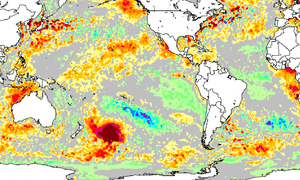
The hot blob off the NZ coast, seen here as a patch of dark red east of New Zealand
27 December, 2019


A spike in water temperature of up to 6C above average across a massive patch of ocean east of New Zealand is likely to have been caused by an “anti-cyclone” weather system, a leading scientist says.

Appearing on heat maps as a deep red blob, the patch spans at least a million square kilometres – an area nearly 1.5 times the size of Texas, or four times larger than New Zealand – in the Pacific Ocean.

James Renwick, the head of geography, environment and earth sciences at Victoria University in Wellington, said the scale of the temperature spike near the sparsely populated Chatham Islands archipelago was remarkable, and had been building for weeks.

It’s the biggest patch of above average warming on the planet right now. Normally the temperatures there are about 15C, at the moment they are about 20C,” he said.


Renwick said the blob could be linked to rising atmospheric greenhouse gas emissions, as a result of climate change, but he expected it was overwhelmingly due to natural variability – a strong high pressure system and a lack of wind.

It’s not uncommon to see patches of warmer water off New Zealand but this magnitude of four, five, up to six degrees is pretty unusual,” Renwick said.

It’s probably a very thin layer of ocean that has warmed up and there hasn’t been any wind to cool it for several weeks.”

Anti-cyclones form when a mass of air cools, contracts and becomes more dense, increasing the weight of the atmosphere and the surface air pressure.

Renwick said a surge in ocean heat over a short period could be difficult for local marine life if it penetrated far beyond the surface. Ocean temperatures are less prone to sharp changes than those on land due to the amount of energy required to warm an area of water.


He said scientists would study the spike in coming weeks to gain more insight into its cause and local impact. It followed a marine heatwave two summers ago that propelled New Zealand’s hottest summer on record, more than 3C above average, and led to tropical fish from Australia being found along the country’s coast.

(Ed.This was NOT a one-off blob that came and went as described here but was here for at least 2 years and has only dissipated in the last few months)

Across the globe, the World Meteorological Organisation says the last decade has almost certainly been the hottest on record for land and oceans. Seas have also grown more acidic as they have absorbed carbon dioxide from the atmosphere.

Temperatures for the years 2010 to 2019 were about 1.1C above the average for the pre-industrial period. The preliminary findings of the WMO’s annual state of the global climate report released earlier this month found this year was likely to be the second or third warmest since records began.


https://www.news.com.au/technology/environment/weird-hot-blob-appears-near-new-zealand/news-story/e5c53fe3eeb0796a86328b064731eb29

From NZ media - this IN FULL from Pravda NZ Inc (AKA RNZ)


Marine heatwave pushes temperatures 5C above normal

RNZ,
28 December, 2019


A marine heatwave measuring almost one million square kilometres has been detected off the east coast of New Zealand.

The heatwave has pushed the ocean temperature up by about 5C above the normal temperature of 15C.

The large blob was identified by thermal imaging from the US National Oceanic and Atmospheric Administration.

Victoria University Professor of Physical Geography James Renwick said the heatwave was likely to be caused by warm northerly winds and extended periods of sunshine.

Dr Renwick said, while heatwaves were not unusual, they were happening more often due to the global warming.

He also said marine life was likely to be affected.

Last summer, a marine heatwave around New Zealand waters led to hot, stuffy air temperatures across much of the country, and scientists observed sub-tropical fish swimming far further south.

This time round, it doesn't appear the ocean heat will have much impact on land temperatures, as the currents are moving towards South America.


From not quite a year ago. The only cause of concern seems to be about fish life because it was a "one-off" affair as it was the year before that, and the year before that as it is this year.


The Tasman Sea warmed on average by 3.7C above normal to reach 20.6C, with fish normally found in the tropics straying further south than they are supposed to.


University of Otago physical oceanographer Dr Robert Smith said while this may be good for recreational fishers, it pointed to the disruption of ecosystems that could be devastating to some species.


Wednesday, 30 January 2019

Top NZ scientists on the effects of the heatwave

If I had to unpack this I'd summarise it thus: "this heatwave is damaging, far beyond anything we might have imagined but don't worry – it will get a little hotter in the next 80 years.


James Renwick was the one who attacked Guy McPherson and said polar ice melt in the  Arctic was in a different part of the world (so presumably, according to him, doesn't matter)

What the heatwave is actually doing to New Zealand

30 January, 2019 


As the Australian heatwave spills across the Tasman pushing up temperatures in New Zealand, we take a look at the conditions that caused a similar event last year and the impacts it had.

Last summer's heatwave gave New Zealand its warmest summer and the warmest January on record.
It covered an area of four million square kilometres (comparable to the Indian subcontinent), including the land, the eastern Tasman Sea and the Pacific east of New Zealand to the Chatham Islands.
In our research, we looked at what happened and why, and found that the heatwave affected many sectors, leading to early grape harvests and killing farmed fish in parts of the country.

Drivers of warmer than average conditions


We used a combination of land and ocean temperature observations, large-scale analyses of the atmospheric circulation, and ocean modelling to understand the drivers of the 2017/18 summer heatwave.
It was memorable for a number of extreme events and statistics.
The average air temperature was 2.2degC above the 1981-2010 normal of 16.7degC, and it was the warmest summer ever recorded in more than 150 years.
The number of extreme warm days and warm nights was also the highest recorded, going back several decades.
The peak month was January 2018, 3.2degC above normal and the warmest month recorded in observations as far back as 1867.
Ocean surface temperatures were similarly extreme, with a marine heatwave that lasted about five months, at 2.0degC above normal at its peak.

The warming was mostly the result of very settled conditions over the country, especially to the east, bringing light winds, plenty of sun, and warm air from the subtropics.
Such conditions in summer are associated with the positive phase of a polar ring of climate variability known as the Southern Annular Mode (SAM), which brings high pressures (anticyclones) to New Zealand and parts of other southern hemisphere countries in the mid-latitudes, including southern Australia and Tasmania, southern Chile and Argentina.

The SAM was strongly positive throughout last summer, especially in January, and weak La Niña conditions were prevalent in the tropics.

The light winds in the New Zealand region allowed the ocean surface to warm rapidly, without the usual turbulent mixing to transport the heat away.
The warmest waters in the Tasman Sea formed an unusually thin layer near the surface.

Impacts and repercussions


New Zealand was affected by more than its normal share of ex-tropical cyclones, notably Fehi and Gita.

They brought strong winds, storm surges and heavy rainfalls that caused flooding as they passed through.

The warm ocean waters around New Zealand would have helped maintain the intensity of the storms and supply moisture to drive the heavy downpours.
The warm conditions caused massive ice loss in South Island glaciers, estimated to be the largest annual loss of glacier ice in nearly 60 years of records for the Southern Alps.
Satellite data from end-of-summer snowline measurements at the Tasman Glacier suggest that the Southern Alps lost 9 percent of glacier ice during last summer alone.
Warm air temperatures had a marked effect on managed and natural ecosystems. The Marlborough grape harvest was unusually early in 2018, two to three weeks ahead of the normal maturation time. Marine ecosystems were significantly disrupted.

Coastal kelp forests struggled to grow in the warm sea. In southern New Zealand, the temperature threshold was breached three times, resulting in substantial losses of kelp canopies.

For the first time, Atlantic salmon had to be imported as farmed fish died in salmon farms in the Marlborough Sounds.

Commercial fishers reported that snapper was spawning approximately six weeks early off the South Island coast, and Queensland groper was reported in northern New Zealand, 3000km out of range.

Past and future


The summer of 2017/18 shared some characteristics with another hot summer, way back in 1934/35. That season was so warm that it prompted a special report by the New Zealand Meteorological Service.
Conditions were similar: persistent high-pressure systems in the New Zealand region, positive SAM conditions, light winds over and around New Zealand, warm ocean surface and air temperatures.
While those two summers shared some natural variations in the local climate, the recent summer was warmer for two reasons.
First, climate in the region is now more than half a degree warmer now than in the 1930s.
Second, the SAM has been trending towards its positive phase over the last few decades, making settled conditions over New Zealand more frequent now than in the 1930s.

That trend is mostly related to the ozone hole that occurs in spring and early summer, cooling the polar atmosphere and driving the strongest winds farther south towards Antarctica, leaving lighter winds and higher pressures over New Zealand.

Looking to the future, we can compare the conditions experienced in 2017/18 with what climate models predict for the future.
We estimate that the extreme warm conditions of New Zealand's last summer would be typical summer conditions by the end of the century, for an emissions scenario associated with a couple of degrees of global warming above pre-industrial temperatures.
If emissions keep increasing as they have done in recent years, last summer will seem cool by the standards of 2100.The Conversation
A discussion with Guy McPherson on James Renwick


Jim Salinger interviewed

Monday, 6 August 2018

Being fed a false narrative

LIES, LIES AND STATISTICS


I am sitting here at what should be the coldest time of the year in my shirtsleeves. 

It was 17 degrees at 9.30 and the thermometer on the picnic table said 20C.

Yet this tells me it is 13C, a warmish winter day.

The overnight minimum was 11 degrees, not 9 degrees.
***
The following interview may well be Radio NZ's response to a letter of complaint Kevin Hester and I sent (along with 6 other signaturies) to Radio NZ.

These are the comments from Kevin Hester on the following interview. I might be a tad more polite but it is true!James Renwick is an abrupt climate change denier and an out right liar.


James Renwick is an abrupt climate change denier and an out right liar.

He bare faced lied about where we are going and where we are at.

Pitchforks await lying bastards like Renwick.

****

Stopping rising temperatures is possible - climate scientist


And, as we watch the Arctic sea ice melt before our eyes the  computer modellers have brought their projections forward to 2050!


A study published Monday said if the world warms 7.2 degrees this century, the Arctic will likely have a three-month, ice-free period each summer by 2050. (sic) It would be a worst-case scenario never seen in recorded human history.

By the end of the century, the ice-free summer could jump to five months a year, the study said.

Thursday, 18 January 2018

James Renwick predicts the end of civilisation "as worst scenario"

I’m not going to knock James Renwick too much but after his ad hominem attack on Guy McPherson when he was here I’m not going to let him off the hook.

Just suppose the following preposterous scenario was true and humanity was not moving in the wrong direction and we did not have a Trump regime but a Hillary one that did not (even more preposterous) play mere lip service to climate change instead of acting in the interests of the New World Order.

What if the rain forests weren’t turning into sources of carbon instead of being a sink?

Maybe we could keep warming withing some “acceptable” bounds?

Of course not!


But James Renwick is “30 percent optimistic”. Wonderful what conclusions you can come to when you ingore most of what is really going on along with the exponential function.

The Big Read: Climate change – the best and worst for NZ


15 January, 2018


New Zealand's destiny is inextricably tied to that of its celebrated environment. But our blue and green backyard is now under unprecedented pressure from a wave of pests and human activity, ranging from development and pollution to climate change and tourism. In the second part of our week-long series, 50 Questions About the Environment, Victoria University climate scientist Professor James Renwick discusses the threats we face from a warming planet.

Guidance tells us we can expect several degrees of warming this century and between 30cm and a metre of sea level rise. What are the best and worst case scenarios and what will determine whether these play out?

The best-case scenario is that we have only another 0.5C of warming and another 50cm of sea level rise, through this century and into the next.

This much more change would still mean big disruptions for coastal communities everywhere and a greater risk of problems for global food supplies.

This scenario would require global emissions of greenhouse gases (GHG) to peak in the next year or two and for emissions to get to zero globally around 2050.

The worst-case scenario is that we have 4C of warming this century, with nearly as much again over the following century.

That would be accompanied by perhaps 1.5m of sea level rise this century, and about 70m more over the following 1000 years.

That much warming would melt all the ice on the planet.

Such a future would mean massive disruption to societies everywhere, billions of people displaced, and possibly billions of deaths through famine and war.

The end of civilisation as we know it, in other words