Tuesday, 31 July 2018

Trump ready to meet Rouhani


Trump says he’s ready to meet Iran’s Rouhani ‘any time’ & with ‘no preconditions’
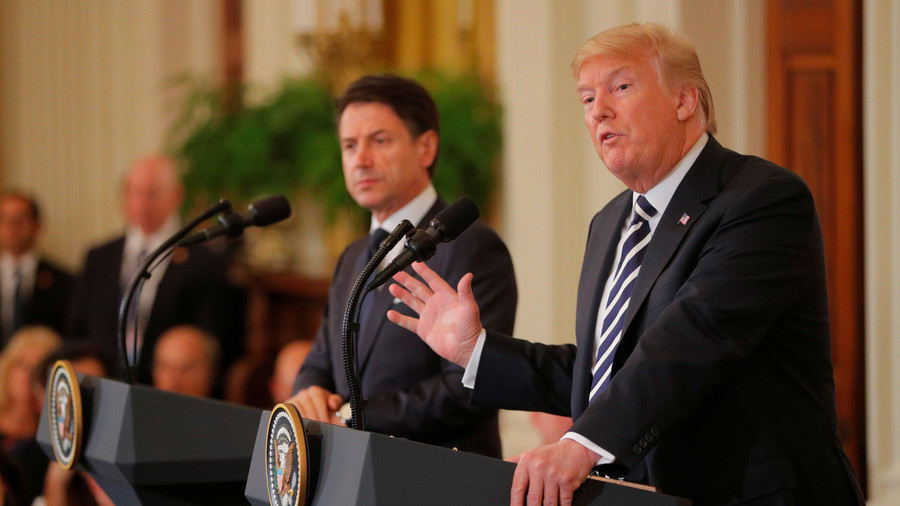

Trump says he’s ready to meet Iran’s Rouhani ‘any time’ & with ‘no preconditions’

RT,
30 July, 2018

US President Donald Trump has said that he is willing to meet with his Iranian counterpart, Hassan Rouhani with no preconditions. “Anytime they want,” he told reporters, “if they want to meet, I’ll meet.”

Trump made his comments while speaking to reporters after a White House meeting with Italian Prime Minister Giuseppe Conti on Monday. “I would certainly meet with Iran, if they were ready to meet,” he said.

A self-described negotiating genius, Trump added that he would “meet with anybody.”

While Trump and his cabinet have taken a hardline approach to Iran, Trump has threatened foreign adversaries with war before, and then softened his tone and welcomed them to the negotiating table, as was the case with North Korean Leader Kim Jong-un.

Trump pulled the United States out of the Joint Comprehensive Plan of Action (JCPOA), or Iran deal this year – which offered Iran sanctions relief in exchange for halting nuclear expansion – but hinted on Monday that he would be open to negotiating a new agreement with Tehran “If we could work something out that’s meaningful, not the waste of paper like the other deal was.”

In the meantime, the US looks set to continue its pressure campaign of sanctions and threats against the Islamic Republic. Last week, Trump threatened Rouhani with “CONSEQUENCES THE LIKES OF WHICH FEW THROUGHOUT HISTORY HAVE EVER SUFFERED BEFORE,” in a bizarre all-caps warning via Twitter.

Trump was responding to an earlier statement from Rouhani who urged Washington to refrain from provoking Iran unless it wants “the mother of all wars” to break out.

The Americans must understand well that peace with Iran is the mother of all peace, and war with Iran is the mother of all wars,” Rouhani stated, adding that “it would only lead to regret."

As speculation mounted over the possibility of war with Iran in the near future, Defense Secretary James Mattis assured reporters that the US has no policy in place for regime change in Iran, and called speculation that the US was about to launch an attack “fiction.”

With renewed US sanctions imminent, Iran’s currency hit a record low of 100,000 rials to the dollar on Sunday, losing half its value in four months.


HIgh-level discussions over the fate of Julian Assange


Julian Assange's Fate Is Being Decided At The Moment


30 July, 2018

Ecuador is holding high level discussions with Britain over the fate of Julian Assange, who has been living in the Ecuadorian embassy in London since 2012 after being granted political asylum, according to comments made by President Lenin Moreno to Spain's El Pais daily newspaper. 

"The issue of Mr. Assange is being treated with the British government and I understand that we have already established contact with Mr. Assange's lawyers so we can find a way out."

Not true, says Assange's Attorney Carlos Poveda in a Sunday LaJournada article retweeted by the official WikiLeaks Twitter account. 
The defense of Julian Assange is concerned about the contradictions of the government of Ecuador, which claims to be seeking a solution to the asylum of the founder of Wikileaks through dialogue, with all parties, but refuses to meet with their lawyers, said Carlos Poveda, one of the activist's lawyers. -LaJournada (translated)

"We have followed very closely the statements of President Lenin Moreno both in the United Kingdom and Spain," said Poveda. "And I must warn that even the legal team that presides (the former judge of the Spanish Supreme Court) Baltasar Garzón requested a hearing to meet in London or Madrid, but they told him that Moreno's schedule was full during the whole tour."
In other words - Moreno is talking out of both sides of his mouth while feigning a new found concern for Assange's fate (after referring to the WikiLeaks founder as a "hacker", "an inherited problem" and a "stone in the shoe").
We know how (Moreno) addresses the issue , said Poveda, who said that the president's statements leave us confused.
In relation to the recent declarations of the Ecuadorian agent chief executive, of which his government is in "permanent" communication with London and with the legal team of Assange, Poveda maintained that that does not happen.
 -LaJournada (translated)

According to Poveda, Assange's legal team is still awaiting a response from two letters sent from Madrid weeks ago requesting that Ecuador "explain the situation." 
Assange has been holed up in the embassy since 2012. Though Sweden long ago dropped its request that Assange be extradicted, he is still struggling with legal issues in the UK: Earlier this year, a UK court declined to reverse his arrest warrant for violating his bail terms when he initially took refuge at the embassy. Wikileaks has released thousands of diplomatic cables belonging to the US, and US officials, including Attorney General Jeff Sessions, have said Assange's arrest is a "priority."

In March, Ecuador cut Assange off from the outside world - blocking his internet and phone communications over violating a promise not to interfere with other countries' affairs. 
Assange particularly drew the ire of Ecuador by angering the Spanish government with his support for separatist leaders in Spain's Catalonia region who sought to secede last year. -France24

Moreno told El Pais that the "ideal" solution would be for Assange to endure some sort of UK penalty for violating his parole, before he is extradited to a country "where there is no danger." 

Two weeks ago, reports surfaced in the UK media that high level talks were happening between UK and Ecuadorian officials to try and remove Assange from the embassy.
Foreign Office Minister Sir Alan Duncan is said to be spearheading the diplomatic effort. Sources close to Assange said he himself was not aware of the talks - supporting his attorney's claim that they've been kept in the dark, while Assange believes that America has been putting "significant pressure" on Ecuador, including threatening to block an IMF loan, if he continues to stay at the embassy. 

Furthermore, as we pointed out weeks ago, the United States imported a record amount of crude from Ecuador (a massive unprecedented surge all of a sudden), which begs the question...was there a payoff?


What flavour of canned air do you want?


Buyers of canned fresh NZ air will be able to choose their 'flavour'
Phillip Duval of Breathe Ezy NZ is hoping citizens in polluted cities will be up for a puff of new air mixes.

25 June, 2018


A Christchurch company that helped pioneer sales of canned fresh South Island air to China is introducing new "flavours" as it makes a push into the Indian market, and goes after sales closer to home.

Breathe Ezy is close to releasing canned air infused with calming herbs, such as lavender, to help users relax and sleep, and another "flavoured" air to clear the throat and lungs.

Company director Phillip Duval said the new mixes could sell locally as well, unlike the straight fresh air which they mostly marketed in China.

The cans will cost slightly more than the recommended retail price of NZ$20 for 7.2 litres or air, or 130 deep breaths, although Asian retailers often add a significant mark up.


India's air pollution problems and its rapidly growing middle class made it an attractive market and Breathe Ezy was planning a new air with a slightly increased oxygen level to cater for demand from "oxygen bars" in cities like Delhi, Duval said.

Canada was their main competition for air sales in China, but they also made limited exports to South Korea and Japan.

Breathe Ezy has a number of air collection points because Duval said some Chinese clients specified which part of the country they wanted their air from so GPS coordinates of the collection site were printed on the label.

"Rather than being in one place and saying 'take it or leave it,' we have accommodated their request."

Since hitting the shelves just over two years ago Breathe Ezy has expanded into supplying other New Zealand companies wanting to export air, and about a third of its canning was now done on contract for other brands.

"You have to grab opportunities as you see them and you don't turn your back on business in a small country like New Zealand, so we prefer to roll out the welcome mat," said Duval.

A weather forecast for Europe


Early August to bring dangerous heat wave to western Europe
It is not out of the question for temperatures to reach  
49 C (120 F) in southwestern Spain and parts of southern Portugal”

Map of Europe showing the heat wave for the week of 30 July 2018. Graphic: AccuWeather

30 July, 2018


By Kristina Pydynowski
30 July 2018

(AccuWeather) – Dangerous heat is expected to expand across and have a firm grip on western Europe for the first several days of August.

While the core of the heat will be focused on the area around Germany on Tuesday, temperatures will be on the rise elsewhere across western Europe Wednesday into Friday.

Highs on Friday are anticipated to range from 31 C (88 F) in London and Berlin to 35 C (95 F) in Paris and 40 C (104 F) in Madrid and approaching 43 C (110 F) in Seville, Spain.

Temperatures will continue to soar 6-12 degrees Celsius (10-24 degrees Fahrenheit) above normal in most of these cities through at least the weekend.

"It is not out of the question for temperatures to reach 49 C (120 F) in southwestern Spain and parts of southern Portugal Friday into Sunday," AccuWeather Meteorologist Tyler Roys said.

The impending heat wave is expected to be the most intense and longest for the Iberian Peninsula so far this summer. Temperatures in Madrid have only reached 38 C (100 F) once so far this summer. Such temperatures are anticipated daily from Wednesday through next Tuesday.

"In southwestern France, temperatures can climb to 43 C (110 F) in a few communities this weekend," according to Roys. [more]

Early August to bring dangerous heat wave to western Europe


An unprecedented two-month drought the hottest temperatures on record the UK now has the wettest day ever and it's going to get worse

Photo Getty Images
30 July,2018

After an unprecedented two month drought with the hottest temperatures on record, parts of the UK has now witnessed it's wettest day ever and today is set to be even worse as the Met Office has warned that this will only get worse today, with gale-force winds and heavy rain.

Parts of the UK experienced their "wettest ever day," with Aldergrove in Northern Ireland hit by 98.8mm - which is more than a month's worth of rainfall.

The UK is braced for more than 36 hours of torrential downpour, according to the Met Office which has issued several weather warnings over rainfall and gale-force winds.

Intense flooding and gale-force winds are expected in places causing travel chaos around the country.

According to The Daily Express, Saturday marked the first day since 23 June that nowhere in the UK had temperatures above 25C.

Yesterday's highest temperature, 24C, was found in Cavendish in Suffolk and Weybourne in Norfolk.

This points to a dramatic 10-degree drop from Thursday, the hottest day of the year so far.

However, the Met Office is warning the heatwave will be back by midweek.


Hot weather in northern 

Europe and inside the Arctic 

circle during the weekend 

(again)


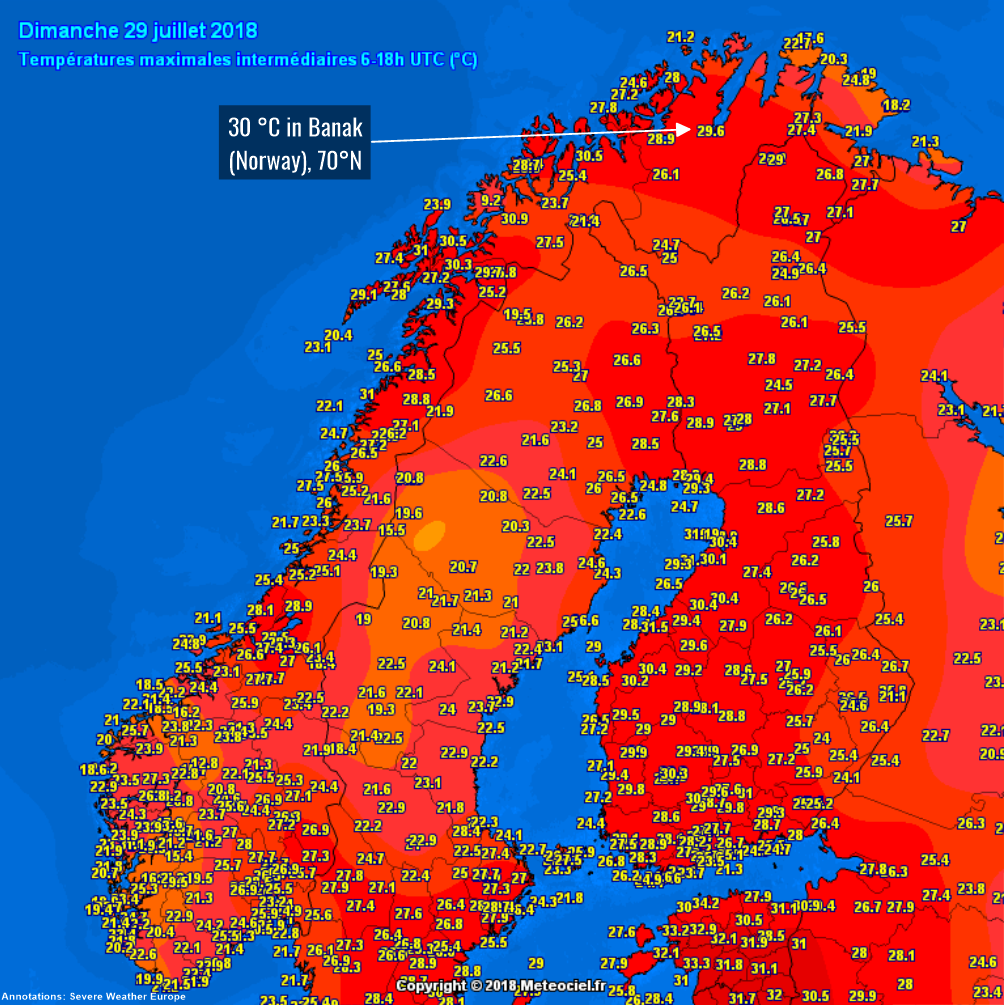
Temperatures again soared above 30 °C across parts of north Europe this weekend. Foehn winds warmed the fjords of western Norway up to 33 °C and up to 30 °C far north at 70°N, within the Arctic circle.
 Maximum temperatures across north Europe on Saturday, July 28, 2018. Map: meteociel.fr

Severe Weather.eu
30 July, 2018


On Saturday the coast of western Norway hit up to 33 °C as Foehn winds warmed the fjords. Banak, Norway at 70 °N pushed to 31 °C.
Temperatures again pushed to 30 °N as far north as Banak, Norway on Sunday. Daytime highs in the upper 20s and even above 30 °C were recorded across much of north Europe.
Sunday_N_Europe

Maximum temperatures across north Europe on Sunday, July 29, 2018. Map: meteociel.fr
Another sign of very warm days across the north are the lowest night time temperatures. Some very high values were recorded. In some stations, so-called “tropical nights” were observed – the lowest temperature did not drop below the 20 °C threshold. Here are this morning’s lows across Norway:
    21.5 °C Skibotn 2 (Norway)
    21.3 °C Skrova Fyr (Norway)
    21.2 °C Hasvik-Sluskfjellet (Norway)
    21.0 °C Alta Lufthavn (Norway)
    20.7 °C Straumsnes (Norway)
    20.6 °C Bo I Vesteralen (Norway)
    20.6 °C Tromso (Norway)
    20.2 °C Leknes (Norway)
    20.2 °C Nordstraum I Kvaenangen (Norway)
    20.2 °C Svolvaer / Helle (Norway)
    20.0 °C Harstad (Norway)
tmin
Tromso, Norway hit a night time minimum of 20.8 °C, the highest since the beginning of measurements in 1920.
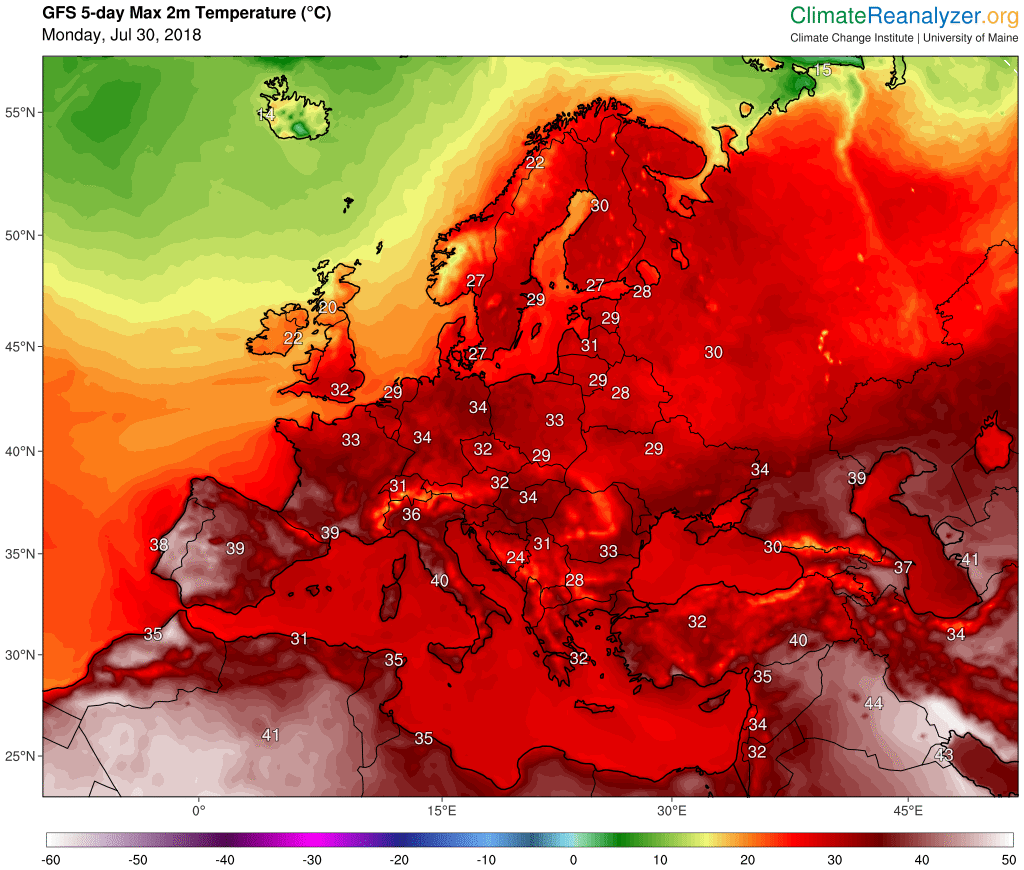
No respite for the region, as 5-day GFS model guidance indicates temperatures in the upper 20s and lower 30s, with temperature anomaly up to 10 °C above average.

gfs_euro-lc_t2max_5-day

gfs_euro-lc_t2anom_5-day

5-day GFS maximum temperature and temperature anomaly model guidance. Maps: Climatereanalyzer.org

A half-pie recognition of reality


A shocking and brave concluson – LOL! We pay academics to say this?

Heatwave was triggered by climate change, according to new research


30 July, 2018

The unprecedented temperatures seen over Summer 2018 are a sign of things to come—and a direct result of climate change, according to new Oxford University research.

In the newly published report, researchers from the Environmental Change Institute (ECI) at the School of Geography and Environment, Oxford University, who worked in collaboration with the World Weather Attribution network (WWA), reveal that climate change more than doubled the likelihood of the European heatwave, which could come to be known as regular summer temperatures.

Dr. Friederike Otto, Deputy Director of the ECI at the University of Oxford, said: "What was once regarded as unusually warm weather will become commonplace – in some cases, it already has."

The research compares current temperatures with historical records at seven weather stations in northern Europe – two in Finland, one each in Denmark, the Irish Republic, the Netherlands, Norway and Sweden.

These stations were selected because current temperature data could be accessed in real time, and they possess digitised records extending back to the early 1900s. The scientists also used computer models to assess the impact of man-made climate change.

For each year in the historical record, the team looked at the hottest consecutive three-day period. For 2018, it was the hottest three days of the year so far – either observed or in the
short-term forecast.

The findings show that the planet is definitely heating up, and for some of the weather stations, current temperatures are unprecedented in the historical record.

"We found that for the weather station in the far north, in the Arctic Circle, the current heat wave is just extraordinary – unprecedented in the historical record," said Dr. Geert Jan van Oldenborgh, Senior Researcher at the Royal Netherlands Meteorological Institute (KNMI).

"And while that is a striking finding, it's hard for us to quantify the increase in likelihood accurately because summer temperatures vary a lot from year to year, making it impossible to estimate the trend from the observations. The same is true for the other three northern stations.

"But for the three stations further south – in the Netherlands, Denmark and Ireland – the historical record does allow us to make a calculation, and it shows that climate change has generally increased the odds of the current heatwave more than two-fold."

The findings show that for the three stations further south – in the Netherlands, Denmark and Ireland climate change has more than doubled the likelihood of the current heatwave. Of these three stations, the one showing the lowest increase in likelihood due to anthropogenic climate change is Dublin, with a factor of 1.2-3.3 and a best estimate of 2. For Copenhagen the odds have increased by a factor 2.4-12, with a best estimate of 5; and for De Bild (Netherlands), 1.6-16, best estimate 3.3. For the four stations further north, observations and models indicate an increase in likelihood, but it has much harder to quantify.

The team stress that the report is based on preliminary analysis, and since it being published before the end of the Summer 2018 heatwave, the definition of the period as an 'extreme event' is based on forecast temperatures – rather than actual quantitative results. These more robust measures can only be collated after the summer has ended. However, the team say the potential environmental and social implications of the findings are undeniable and that action should be taken sooner rather than later.

Dr. Otto explains: 'this is something that society can and should prepare for – but equally there is no doubt that we can and should constrain the increasing likelihood of all kinds of extreme weather events by restricting greenhouse gas emissions as sharply as possible."

The WWA team plans to publish these results formally in a scientific journal. This will form part of a more in-depth analysis of this extraordinary summer; the team will also assess whether climate change played a role in the prolonged high pressure seen in northern Europe since May, and if so, to what extent.

Previous published studies by the group have shown that climate change increased the chances of the heavy rainfall experienced in northern England in the 2015-16 winter and in Houston due to hurricane Harvey, and that climate change has not changed the likelihood of the 2014 Sao Paolo drought.


Nick Humphrey, Meteorologist on Environmental Coffee House

Past the tipping point? Abrupt Climate Change Discussion with Nick Humphrey, Meteorologist


Tonight we are talking about all the weather events that are assaulting the earth, including humans and animals. Then we will take a walk into the science of “deep adaptation “, and what we all can do.

That synthesis leads to a conclusion there will be a near term collapse in society with serious ramifications for the lives of readers. The paper reviews some of the reasons why collapse- denial may exist, in particular, in the professions of sustainability research and practice, therefore leading to these arguments having been absent from these fields until now.” Dr. Bendell

"Basically the "deep adaptation" is more psychological... Dr. Bendell concludes there is no way to prevent collapse and possible extinction. It's no longer in our direct control because of processes set off by humans. It's something I'm really trying to emphasize with people because a lot of these climate researchers are not doing that. Probably because of their employers even if they wanted to share it." 

---Nicholas Humphrey

Guy McPherson is right


NO euphemisms: it's extinction. Guy McPherson is right, not the Party of Plastic Jesus
Emotional discussion about climate change and the party of plastic Jesus.


The United States seems ready to give up on Afghanistan


U.S. Negotiates Retreat From Afghanistan


30 July, 2018


The United States seems ready to give up on Afghanistan.

After the World Trade Center came down the U.S. accused al-Qaeda, parts of which were hosted in Afghanistan. The Taliban government offered the U.S. to extradite al-Qaeda chief Osama Bin Laden to an Islamic country to be judged under Islamic law. The U.S. rejected that and decided instead to destroy the Afghan government.

Taliban units, supported by Pakistani officers, were at that time still fighting against the Northern Alliance which held onto a few areas in the north of the country. Under threats from the U.S. Pakistan, which sees Afghanistan as its natural depth hinterland, was pressed into service. In exchange for its cooperation with the U.S. operation it was allowed to extradite its forces and main figures of the Taliban.

U.S. special forces were dropped into north Afghanistan. They came with huge amounts of cash and the ability to call in B-52 bombers. Together with the Northern Alliance they move towards Kabul bombing any place where some feeble resistance came from. The Taliban forces dissolved. Many resettled in Pakistan. Al-Qaeda also vanished.

A conference with Afghan notables was held in Germany's once capital Bonn. The Afghans wanted to reestablish the former Kingdom but were pressed into accepting a western style democracy. Fed with large amounts of western money the norther warlords, all well known mass-murderers, and various greedy exiles were appointed as a government. To them it was all about money. There was little capability and interest to govern.
All these U.S. mistakes made in the early days are still haunting the country.
 
For a few years the Taliban went quiet. But continued U.S. operations, which included random bombing of weddings, torture and abduction of assumed al-Qaeda followers, alienated the people. Pakistan feared that it would be suffocated between a permanently U.S. occupied Afghanistan and a hostile India. Four years after being ousted the Taliban were reactivated and found regrown local support.

Busy with fighting an insurgency in Iraq the U.S. reacted slowly. It then surged troops into Afghanistan, pulled back, surged again and is now again pulling back. The U.S. military aptly demonstrated its excellent logistic capabilities and its amazing cultural incompetence. The longer it fought the more Afghan people stood up against it. The immense amount of money spent to 'rebuild' Afghanistan went to U.S. contractors and Afghan warlords but had little effect on the ground. Now half the country is back under Taliban control while the other half is more or less contested.

Before his election campaign Donald Trump spoke out against the war on Afghanistan. During his campaign he was more cautious pointing to the danger of a nuclear Pakistan as a reason for staying in Afghanistan. But Pakistan is where the U.S. supply line is coming through and there are no reasonable alternatives. Staying in Afghanistan to confront Pakistan while depending on Pakistan for logistics does not make sense.

Early this year the U.S. stopped all aid to Pakistan. Even the old Pakistani government was already talking about blocking the logistic line. The incoming prime minister Imran Khan has campaigned for years against the U.S. war on Afghanistan. He very much prefers an alliance with China over any U.S. rapprochement. The U.S. hope is that Pakistan will have to ask the IMF for another bailout and thus come back under Washington's control. But it is more likely that Imran Khan will ask China for financial help.

Under pressure from the military Trump had agreed to raise the force in Afghanistan to some 15,000 troops. But these were way to few to hold more than some urban areas. Eighty percent of the Afghan people live in the countryside. Afghan troops and police forces are incapable or unwilling to fight their Taliban brethren. It was obvious that this mini-surge would fail:

By most objective measures, President Donald Trump’s year-old strategy for ending the war in Afghanistan has produced few positive results.

Afghanistan’s beleaguered soldiers have failed to recapture significant new ground from the Taliban. Civilian deaths have hit historic highs. The Afghan military is struggling to build a reliable air force and expand the number of elite fighters. Efforts to cripple lucrative insurgent drug smuggling operations have fallen short of expectations. And U.S. intelligence officials say the president’s strategy has halted Taliban gains but not reversed their momentum, according to people familiar with the latest assessments.

To blame Pakistan for its support for some Taliban is convenient, but makes little sense. In a recent talk John Sopko, the U.S. Inspector General for Afghanistan Reconstruction (SIGAR), made a crucial point:

We keep referring to Pakistan as being the key problem. But the problem also was that the Afghan government at times was viewed very negatively by their local people and what you really need is to insert a government that the people support, a government that is not predatory, a government that is not a bunch of lawless warlords,” observed Sopko.

He went on to say that the U.S. policy of pouring in billions of dollars in these unstable environments contributed to the problem of creating more warlords and powerful people who took the law into their own hands.
In essence, the government we introduced, particularly some of the Afghan local police forces, which were nothing other than warlord militias with some uniforms on, were just as bad as the terrorists before them,” said Sopko ...

This was the problem from the very beginning. The U.S. bribed itself into Afghanistan. It spent tons of money but did not gain real support. It bombed and shot aimlessly at 'Taliban' that were more often than not just the local population. It incompetently fought 17 one-year-long wars instead of a consistently planned and sustained political, economic and military campaign.

After a year of another useless surge the Trump administration decided to pull back from most active operations and to bet on negotiations with the Taliban:

The shift to prioritize initial American talks with the Taliban over what has proved a futile “Afghan-led, Afghan-owned” process stems from a realization by both Afghan and American officials that President Trump’s new Afghanistan strategy is not making a fundamental difference in rolling back Taliban gains.

While no date for any talks has been set, and the effort could still be derailed, the willingness of the United States to pursue direct talks is an indication of the sense of urgency in the administration to break the stalemate in Afghanistan.
...

Afghan officials and political leaders said direct American talks with the Taliban would probably then grow into negotiations that would include the Taliban, the Afghan government, the United States and Pakistan.

In February the Taliban declared their position in a public Letter of the Islamic Emirate to the American people (pdf). The five pages letter offered talks but only towards one aim:

Afghans have continued to burn for the last four decades in the fire of imposed wars. They are longing for peace and a just system but they will never tire from their just cause of defending their creed, country and nation against the invading forces of your war­mongering government because they have rendered all the previous and present historic sacrifices to safeguard their religious values and national sovereignty. If they make a deal on their sovereignty now, it would be unforgettable infidelity with their proud history and ancestors.

Last weeks talks between the Taliban and U.S. diplomats took place in Doha, Qatar. Remarkably the Afghan government was excluded. Despite the rousing tone of the Reuters report below the positions that were exchanged do not point to a successful conclusion:

According to one Taliban official, who said he was part of a four-member delegation, there were “very positive signals” from the meeting, which he said was conducted in a “friendly atmosphere” in a Doha hotel.

You can’t call it peace talks,” he said. “These are a series of meetings for initiating formal and purposeful talks. We agreed to meet again soon and resolve the Afghan conflict through dialogue.”
...
The two sides had discussed proposals to 
allow the Taliban free movement in two provinces where they would not be attacked, an idea that President Ashraf Ghani has already rejected. They also discussed Taliban participation in the Afghan government.
The only demand they made was to allow their military bases in Afghanistan,” said the Taliban official. 

... 
“We have held three meetings with the U.S. and we reached a conclusion to continue talks for meaningful negotiations,” said a second Taliban official.
...
“However, our delegation made it clear to them that peace can only be restored to Afghanistan when all foreign forces are withdrawn,” he said.

This does not sound promising:
  • In a first step the Taliban want to officially rule parts of the country and use it as a safe haven. The Afghan government naturally rejects that.
  • Participation of the Taliban in the Afghan government is an idea of the Afghan president Ghani. It is doubtful that this could be successfully arranged. Norther Alliance elements in the Afghan government, like the 'chief executive' Abdullah Abdullah, are unlikely to ever agree to it. The Taliban also have no interest to be 'part of the government' and to then get blamed for its failures. Their February letter makes clear that they want to be the government.
  • The U.S. wants bases in Afghanistan. The Taliban, and Pakistan behind them, reject that and will continue to do so.

It is difficult to see how especially the last mutually exclusive positions can ever be reconciled.

The Taliban are ready to accept a peaceful retreat of the U.S. forces. That is their only offer. They may agree to keep foreign Islamist fighters out of their country. The U.S. has no choice but to accept. It is currently retreating to the cities and large bases. The outlying areas will fall to the Taliban. Sooner or later the U.S. supply lines will be cut. Its bases will come under fire.

There is no staying in Afghanistan. A retreat is the only issue the U.S. can negotiate about. It is not a question of "if" but of "when".

The Soviet war in Afghanistan took nine years. The time was used to build up a halfway competent government and army that managed to hold off the insurgents for three more years after the Soviet withdrawal. The government only fell when the Soviets cut the money line. The seventeen year long U.S. occupation did not even succeed in that. The Afghan army is corrupt and its leaders are incompetent. The U.S. supplied it with expensive and complicate equipment that does not fit Afghan needs. As soon as the U.S. withdraws the whole south, the east and Kabul will immediately fall back into Taliban hands. Only the north may take a bit longer. They will probably ask China to help them in developing their country.

The erratic empire failed in another of its crazy endeavors. That will not hinder it to look for a new ones. The immense increase of the U.S. military budget, which includes 15,000 more troops, points to a new large war. Which country will be its next target?