Showing posts with label yuan. Show all posts

Thursday, 28 November 2019

Trump Signs Bill Backing Hong Kong Protesters


Futures Tumble After Trump 
Signs Bill Backing Hong 
Kong Protesters, Defying China

27 November, 2019

Less than an hour after Trump once again paraded with yet another all-time high in the S&P...

... and on day 510 of the trade war, it appears the president was confident enough that a collapse in trade talks won't drag stocks too far lower, and moments after futures reopened at 6pm, the White House said that Trump had signed the Hong Kong bill backing pro-democracy protesters, defying China and making sure that every trader's Thanksgiving holiday was just ruined.
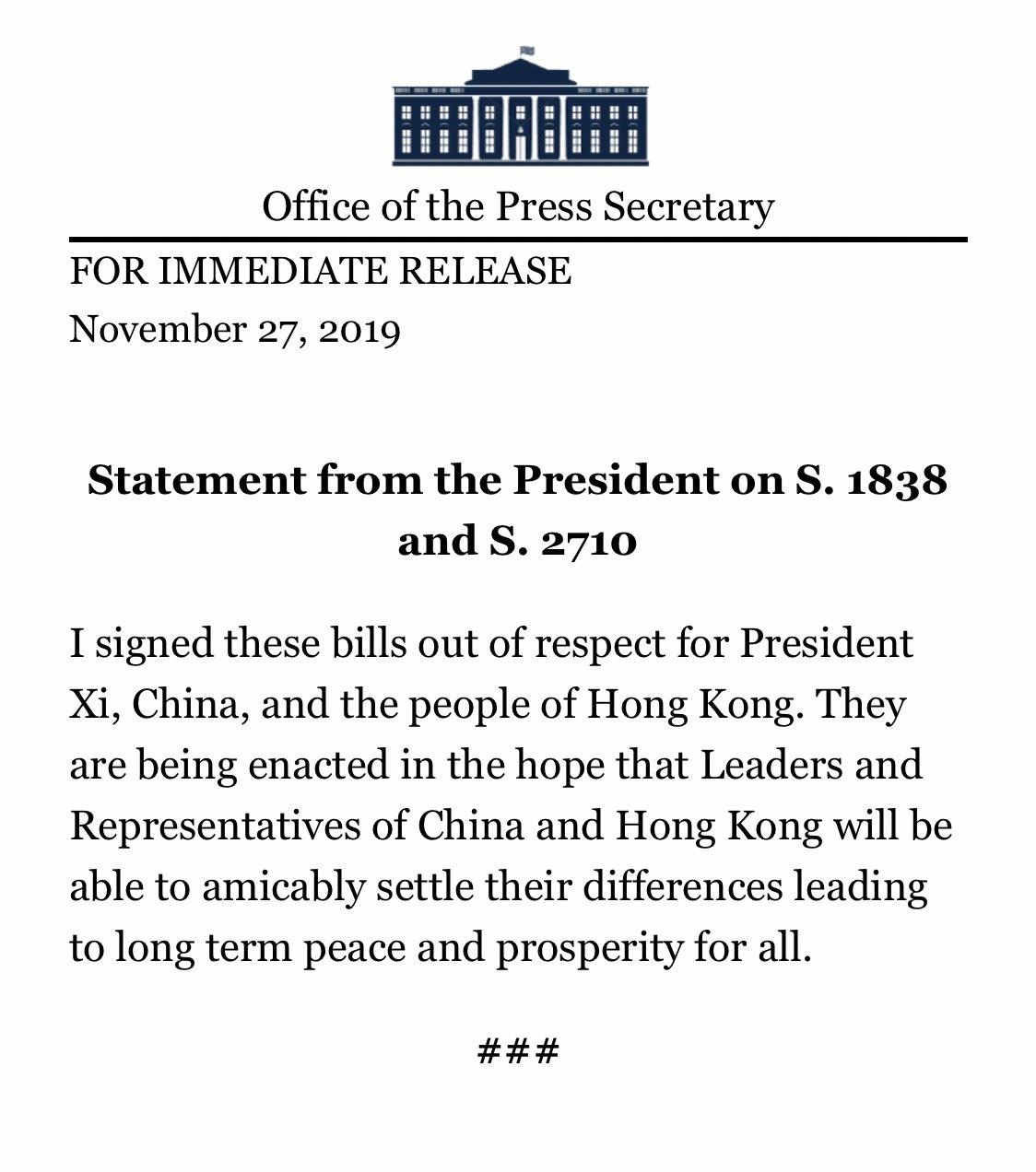
In a late Wednesday statement from the White House, Trump said that:
I signed these bills out of respect for President Xi, China, and the people of Hong Kong. They are being enacted in the hope that Leaders and Representatives of China and Hong Kong will be able to amicably settle their differences leading to long term peace and prosperity for all.
Needless to say, no differences will be "settled amicably" and now China will have no choice but to retaliate, aggressively straining relations with the US, and further complicating Trump's effort to wind down his nearly two-year old trade war with Beijing.
Trump’s signing of the bill comes during a period of unprecedented unrest in Hong Kong, where anti-government protests sparked by a now-shelved extradition bill proposal have ballooned into broader calls for democratic reform and police accountability.
“The Hong Kong Human Rights and Democracy Act reaffirms and amends the United States-Hong Kong Policy Act of 1992, specifies United States policy towards Hong Kong and directs assessment of the political developments in Hong Kong,” the White House said in a statement. "Certain provisions of the act would interfere with the exercise of the president's constitutional authority to state the foreign policy of the United States."
The legislation, S. 1838, which was passed virtually unanimously in both chambers, requires annual reviews of Hong Kong’s special trade status under American law and will allow Washington to suspend said status in case the city does not retain a sufficient degree of autonomy under the “one country, two systems” framework. The bill also sanctions any officials deemed responsible for human rights abuses or undermining the city’s autonomy.
The House cleared the bill 417-1 on Nov. 20 after the Senate passed it without opposition, veto-proof majorities that left Trump with little choice but to acquiesce, or else suffer bruising fallout from his own party. the GOP.
Trump also signed into law the PROTECT Hong Kong act, which will prohibit the sale of US-made munitions such as tear gas and rubber bullets to the city’s authorities.
While many members of Congress in both parties have voiced strong support for protesters demanding more autonomy for the city, Trump had stayed largely silent, even as the demonstrations have been met by rising police violence.
Until now.
The bill’s author, Senator Marco Rubio of Florida, said that with the legislation’s enactment, the US now had “new and meaningful tools to deter further influence and interference from Beijing into Hong Kong’s internal affairs.”
In accordance with the law, the Commerce Department will have 180 days to produce a report examining whether the Chinese government has tried use Hong Kong’s special trading status to import advanced “dual use” technologies in violation of US export control laws. Dual use technologies are those that can have commercial and military applications.
One other less discussed but notable provision of the Hong Kong Human Rights Act targets media outlets affiliated with China’s government. The new law directs the US secretary of state to “clearly inform the government of the People’s Republic of China that the use of media outlets to spread disinformation or to intimidate and threaten its perceived enemies in Hong Kong or in other countries is unacceptable."
The state department should take any such activity “into consideration when granting visas for travel and work in the United States to journalists from the People’s Republic of China who are affiliated with any such media organizations”, the law says.
* * *
In the days leading up to Trump's signature, China’s foreign ministry had urged Trump to prevent the legislation from becoming law, warning the Americans not to underestimate China’s determination to defend its “sovereignty, security and development interests.”

"If the U.S. insists on going down this wrong path, China will take strong countermeasures," said China's foreign ministry spokesman Geng Shuang at a briefing Thursday in Beijing. On Monday, China's Vice Foreign Minister Zheng Zeguang summoned the U.S. ambassador, Terry Branstad to express “strong opposition” to what the country’s government considers American interference in the protests, including the legislation, according to statement.
The new U.S. law comes just as Washington and Beijing showed signs of working toward “phase-one” of deal to ease the trade war. Trump would like the agreement finished in order to ease economic uncertainty for his re-election campaign in 2020, and has floated the possibility of signing the deal in a farm state as an acknowledgment of the constituency that’s borne the brunt of retaliatory Chinese tariffs.
Last week China's Vice Premier and chief trade negotiator Liu He said before a speech at the Bloomberg New Economy Forum in Beijing, that he was “cautiously optimistic” about reaching the phase one accord. He will now have no choice but to amend his statement.
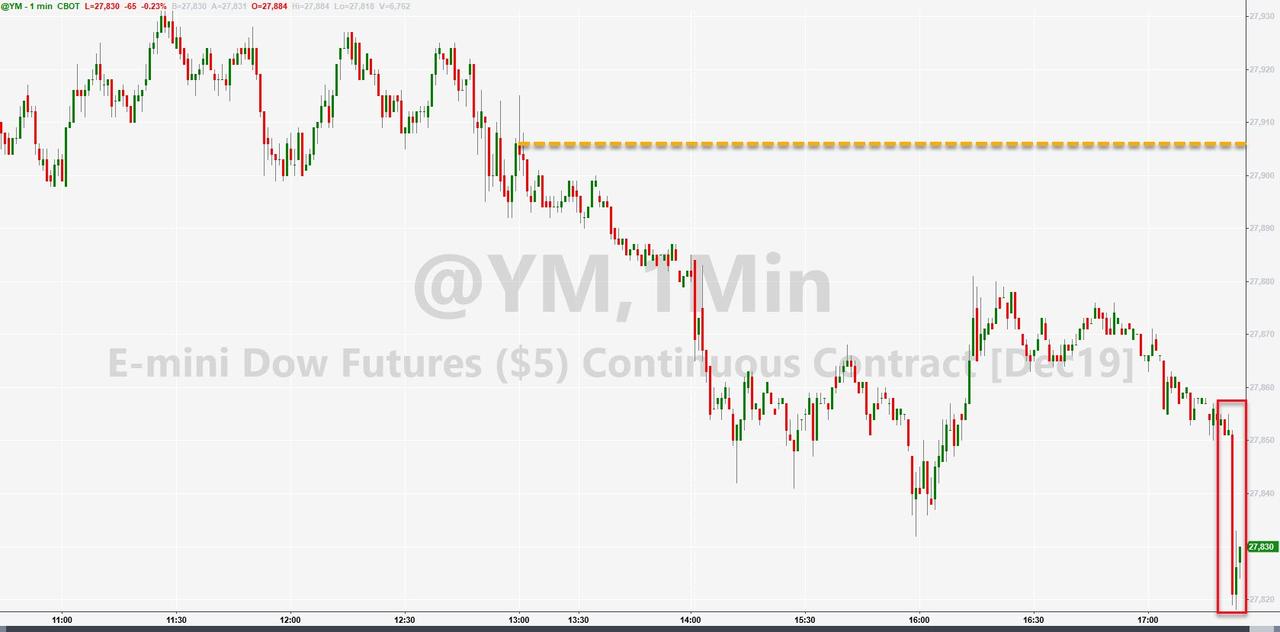
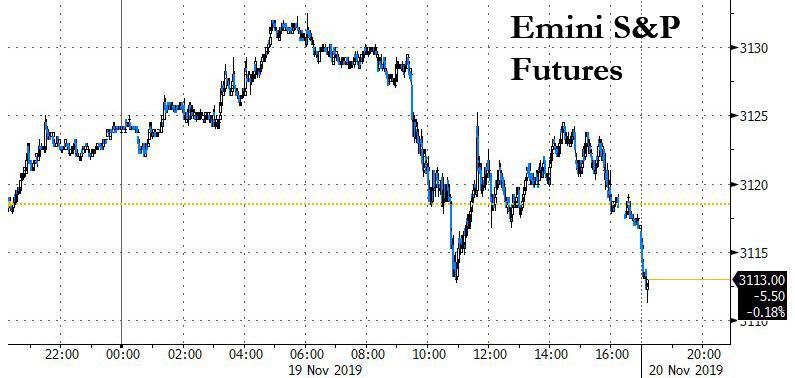
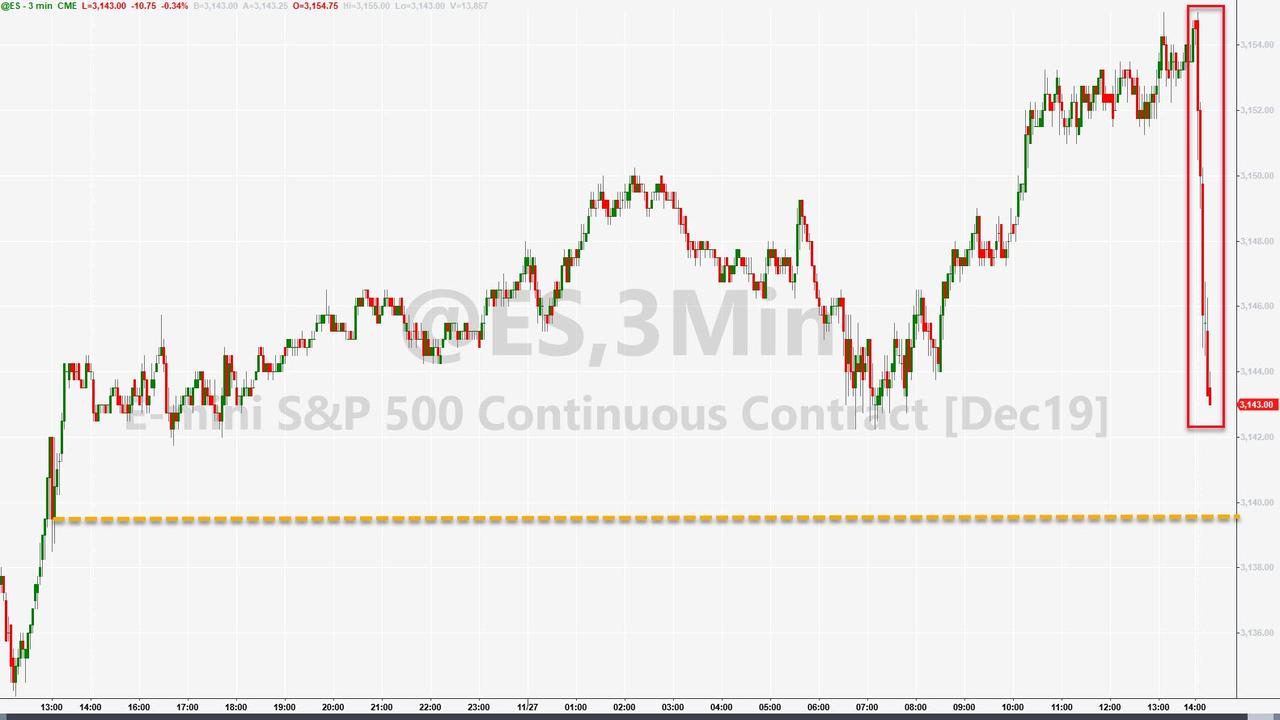
In anticipation of a stern Chinese rebuke, US equity futures tumbled, wiping out most of the previous day's gains...
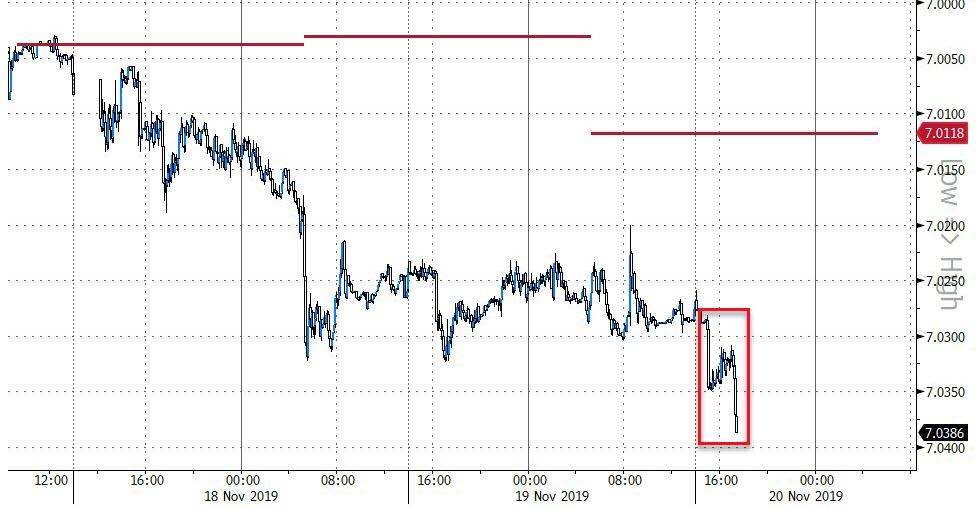
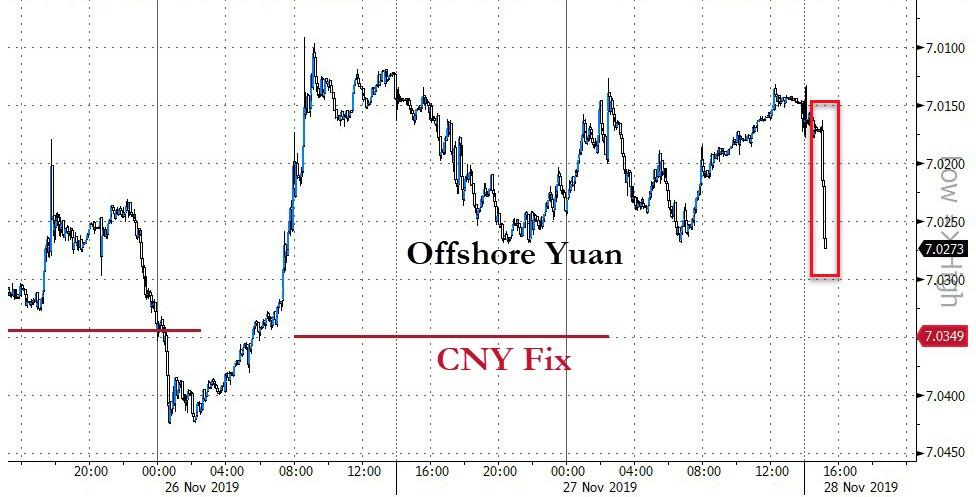
... while the yuan slumped over 100 pips in kneejerk response.
Still, the generally modest pullback - the S&P was around 2,940 when Trump announced the Phase 1 deal on Oct 11 - suggests that despite Trump's signature, markets expect a Chinese deal to still come through. That may be an aggressive and overly "hopeful" assumption, especially now that China now longer has a carte blanche to do whatever it wants in Hong Kong, especially in the aftermath of this weekend's landslide victory for the pro-Democracy camp which won in 17 of the city’s 18 districts.
“Following last weekend’s historic elections in Hong Kong that included record turnout, this new law could not be more timely in showing strong US support for Hongkongers’ long-cherished freedoms,” said Rubio

Wednesday, 20 November 2019

China Threatens Retaliation against the USA


China Threatens Retaliation 
After Senate Passes Bill 
Supporting Hong Kong 
Protests; Stocks, Yuan 
Tumble
US House passes bill to support Hong Kong protests, China ...
Zero Hedge,
19 November, 2019

Update (2020ET): As expected, Chinese (and implicitly Hong Kong) officials are extremely unhappy at Washington's interjection in their domestic policies by passing the bill supporting the protesters.
On November 19th, the US Senate passed the "Hong Kong Bill of Rights on Human Rights and Democracy." The bill disregards the facts, confuses right and wrong, violates the axioms, plays with double standards, openly intervenes in Hong Kong affairs, interferes in China's internal affairs, and seriously violates the basic norms of international law and international relations. The Chinese side strongly condemns and resolutely opposes this.
  In the past five months, the persistent violent criminal acts in Hong Kong have seriously jeopardized the safety of the public's life and property, seriously trampled on the rule of law and social order, seriously undermined Hong Kong's prosperity and stability, and seriously challenged the bottom line of the "one country, two systems" principle. At present, what Hong Kong faces is not the so-called human rights and democracy issues, but the issue of ending the storms, maintaining the rule of law and restoring order as soon as possible. The Chinese central government will continue to firmly support the Hong Kong SAR Government in its administration of the law, firmly support the Hong Kong police in law enforcement, and firmly support the Hong Kong Judiciary in punishing violent criminals in accordance with the law, protecting the lives and property of Hong Kong residents and maintaining Hong Kong's prosperity and stability.
  Since the return of Hong Kong to the motherland, the practice of "one country, two systems" has achieved universally recognized success. Hong Kong residents enjoy unprecedented democratic rights and fully exercise various freedoms in accordance with the law. The relevant bills of the US Congress completely ignore the objective facts and completely ignore the well-being of Hong Kong residents. For the ulterior political purpose, the Hong Kong violent elements are smashed, bullying and attacking innocent citizens, forcibly occupying the campus and besieging young students. Organized attacks on the police and other criminal acts are striving for the pursuit of "human rights" and "democracy". The purpose is to support the extremist forces and violent elements in the anti-China chaos and to undermine Hong Kong's prosperity and stability so that they can borrow Hong Kong. The problem hinders the sinister plot of China's development. This bad behavior of the United States not only harms China’s interests, but also undermines the important interests of the United States itself in Hong Kong. Any attempt by the US to intervene in China's internal affairs and hinder China's development will not succeed. In the end, it will only be a waste of effort.
  I want to stress once again that Hong Kong is China's Hong Kong and Hong Kong affairs are purely China's internal affairs. We are telling the US to recognize the situation and take the plunge. We will immediately take measures to prevent the case from becoming a law. We will immediately stop interfering in Hong Kong affairs and interfering in China's internal affairs so as not to ignite the fire and suffer from self-sufficiency.
If the US side is willing to go its own way, China will surely take effective measures to resolutely counteract and firmly safeguard national sovereignty, security, and development interests.
US futures immediately pushed lower on this statement...


And Yuan is extending losses...
Source: Bloomberg
*  *  *
In a widely anticipated move, just after 6pm ET on Tuesday, the Senate unanimously passed a bipartisan bill, S.1838,  showing support for pro-democracy protesters in Hong Kong by requiring an annual review of whether the city is sufficiently autonomous from Beijing to justify its special trading status. In doing so, the Senate has delivered a warning to China against a violent suppression of the demonstrations, a stark contrast to President Donald Trump’s near-silence on the issue, the result of a behind the scenes agreement whereby China would allow the S&P to rise indefinitely as long as Trump kept his mouth shut.
As we reported last week, the vote marks the most aggressively diplomatic challenge to the government in Beijing just as the US and China seek to close the "Phase 1" of their agreement to end their trade war. The Senate measure would require annual reviews of Hong Kong’s special status under U.S. law to assess the extent to which China has chipped away the city’s autonomy; in light of recent events, Hong Kong would not pass. It's unclear what would happen next.
As Bloomberg notes, the House unanimously passed a similar bill last month, but slight differences mean both chambers still have to pass the same version before sending it to the president.
”The United States has treated commerce and trade with Hong Kong differently than it has commercial and trade activity with the mainland of China,” said Republican Senator Marco Rubio of Florida, the bill’s lead sponsor. "But what’s happened over the last few years is the steady effort on the part of Chinese authorities to erode that autonomy and those freedoms", he added on the Senate floor.
The Senate bill passed by unanimous consent, which means there was no roll call vote because no senators objected to it. Rubio said on Twitter before the vote Tuesday that the bill, S. 1838, will “head over to the U.S. House & then hopefully swiftly to the President.”
That is one option: The House could simply take up the Senate bill. The other option would be to reconcile the differences between the two versions and have both chambers vote on the compromise bill. New Jersey Representative Chris Smith, the lead Republican sponsor of the House bill, said he expects the House Foreign Affairs and Senate Foreign Relations Committees to go for the latter option to work out the slight differences. He said the resulting compromise could be included in a defense bill slated for a vote later this year.
* * *
The legislation comes at a difficult time for Trump as his administration is trying to complete the first phase of a long-awaited trade deal with China. Earlier on Tuesday, Vice President Mike Pence said that it would be difficult for the U.S. to sign a trade agreement with China if the demonstrations in Hong Kong are met with violence.
“The president’s made it clear it’ll be very hard for us to do a deal with China if there’s any violence or if that matter is not treated properly and humanely,” Pence said in an interview with Indianapolis-based radio host Tony Katz.
Another prominent Republican, Senate Majority Leader Mitch McConnell urged Trump to personally voice support for the protesters on Monday, which Trump has refused to do.
“We have to get it passed and we have to get it passed quickly,” Smith said. The legislation tells protesters that “Congress has their back, that we are fully supportive of democracy and rule of law in Hong Kong.”
"It tells Xi Jinping that there’s a price,” Smith said of China’s president. “There’s one provision after another that says, ‘we’re not kidding.’" The bill would also sanction Chinese officials deemed responsible for undermining Hong Kong’s autonomy.
The bit question now is how will China react: the Chinese Foreign Ministry has repeatedly warned that there would be “strong countermeasures” for passing such legislation. That could complicate the delicate negotiations between the world’s two largest economies to get the trade deal over the finish line.
"What was already complicated just got more complicated, and the bill’s passage adds to the growing list of political reasons why Xi and Trump are unlikely to find a compromise," said Jude Blanchette, a China expert at the Center for Strategic and International Studies. “While Xi has more control over the domestic political environment in China, he’s not immune from the bad optics of negotiating with a government that he claims is tampering with his own political system.”


* * *
It remains unclear whether Trump will veto the bill, opening himself up to accusations he has been in bed with Beijing all along. So far Trump has not indicated whether he would sign the legislation if it gets to his desk.
Another complication: the timeline for completing the trade agreement could collide with this legislation landing on Trump’s desk. A congressional aide told Bloomberg the Senate measure was drafted with help from Treasury and State Department officials, but a senior administration official on Monday cautioned that Trump’s seal of approval is the only one that matters.
Because the Hong Kong bill passed both the House and the Senate without a single lawmaker objecting, there would probably be enough support to override a presidential veto.
"Today’s vote sends a clear message that the United States will continue to stand with the people of Hong Kong as they battle Beijing’s imperialism,” said Republican Senator Josh Hawley of Missouri. “The Chinese Communist Party’s quest for power across the region is a direct threat to America’s security and prosperity."
S&P futures dipped modestly on the news of the bill's unanimous passage...
... although that isn't saying much for a market that is so hypnotized by the Fed's "NOT QE" that it barely if ever responds to any actual news.


https://www.zerohedge.com/commodities/chinas-annual-aluminium-consumption-decline-first-time-30-years

Tuesday, 6 August 2019

China is now a "currency manipulator"


For The First Time In 25 Years, US Treasury Just Designated China A Currency Manipulator


5 August, 2019

Following the plunge in the yuan overnight, The U.S. Treasury Department on Monday designated China as currency manipulator, a historic move that no White House had exercised since the Clinton administration.
“Secretary Mnuchin, under the auspices of President Trump, has today determined that China is a Currency Manipulator,” the Treasury Department said in a release.
“As a result of this determination, Secretary Mnuchin will engage with the International Monetary Fund to eliminate the unfair competitive advantage created by China’s latest actions.” "
"This pattern of actions is also a violation of China’s G20 commitments to refrain from competitive devaluation."
Washington hasn’t labeled a major trade partner a currency manipulator since 1994.
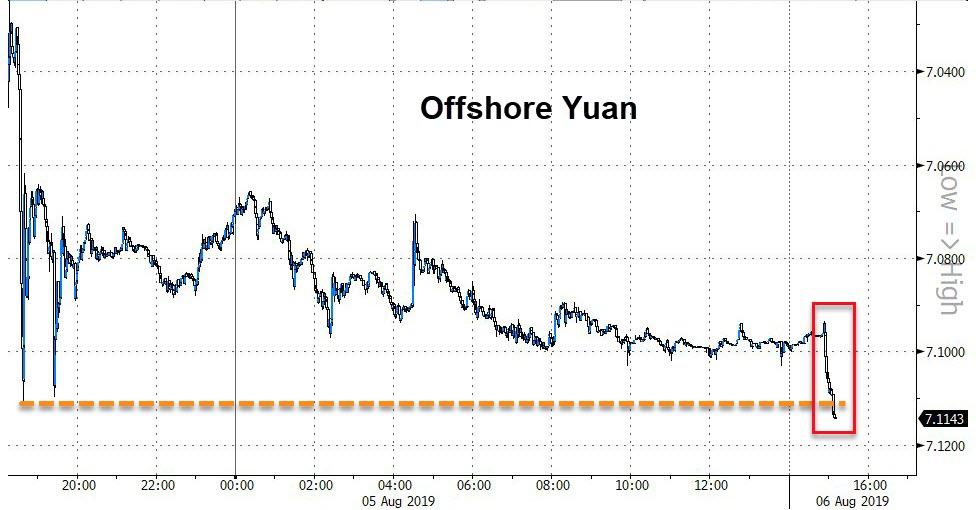
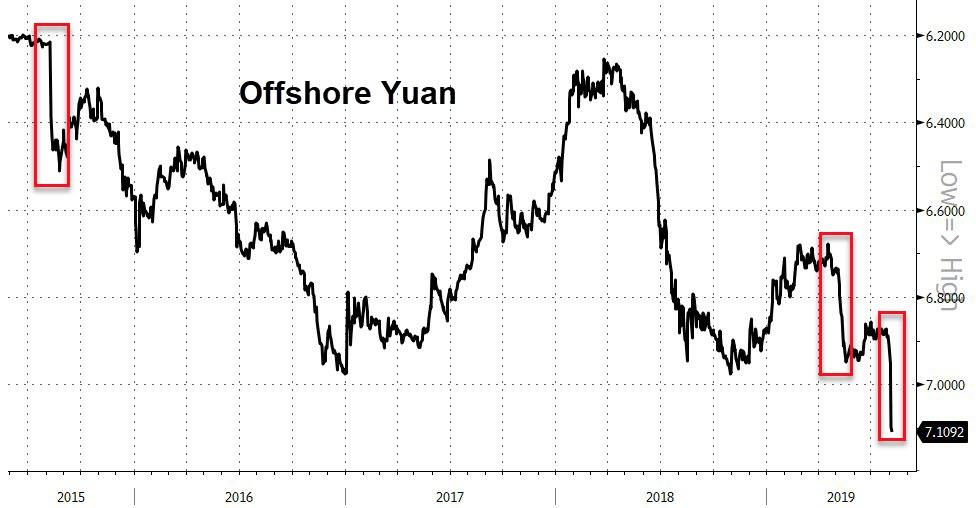
The Offshore Yuan tumbled to a new record low on the headline...


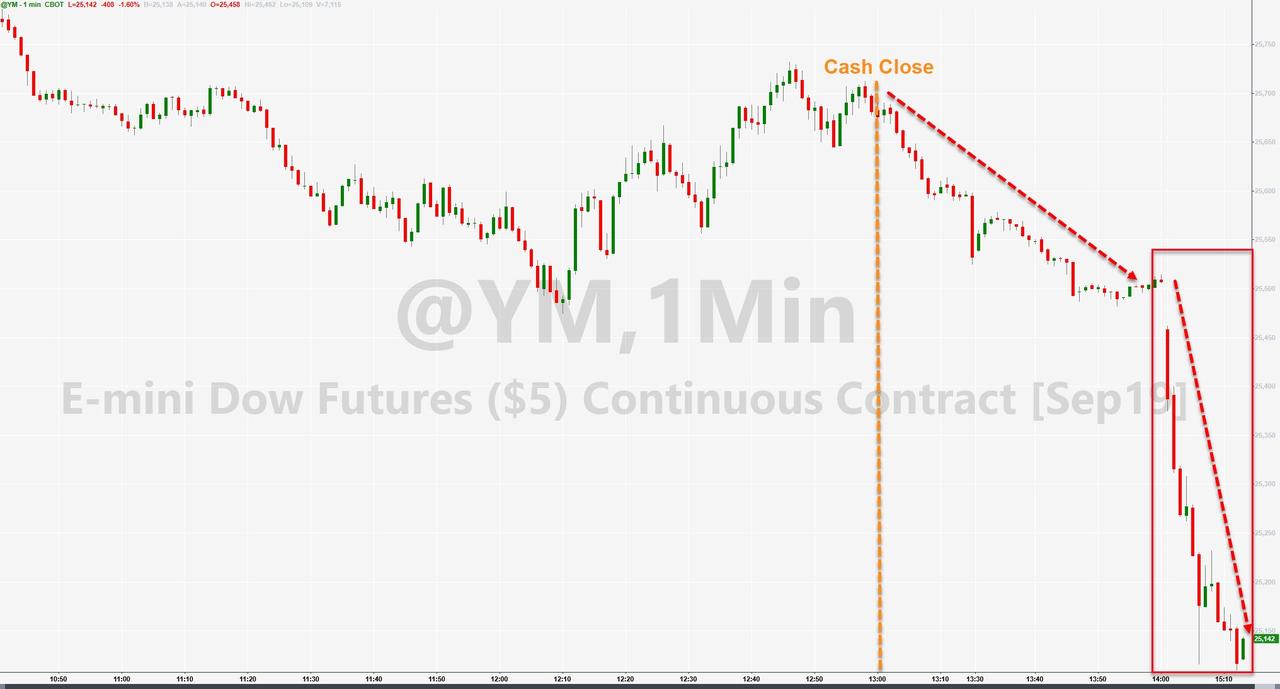
USDJPY is also diving as are US equity futures (Dow futures are down 350 from their close, down 500 from the cash close)...
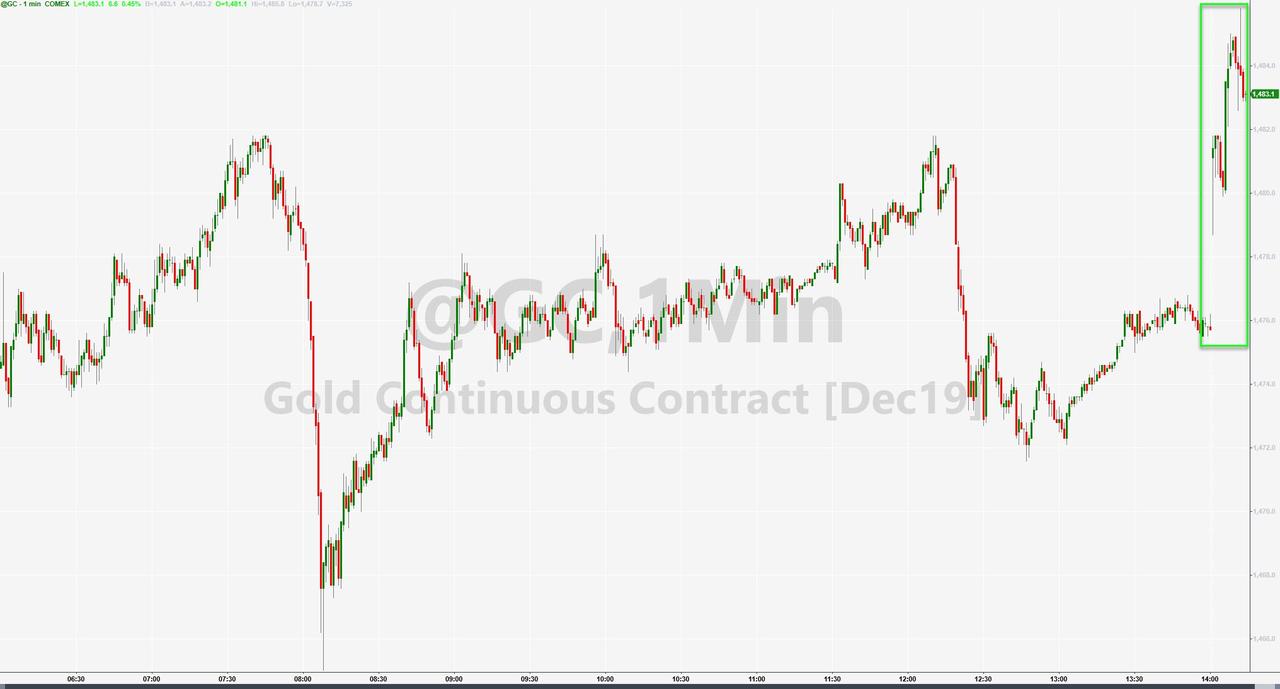
And gold is spiking above $1485...


*  *  *

Full Treasury Statement

The Omnibus and Competitiveness Act of 1988 requires the Secretary of the Treasury to analyze the exchange rate policies of other countries. Under Section 3004 of the Act, the Secretary must "consider whether countries manipulate the rate of exchange between their currency and the United States dollar for purposes of preventing effective balance of payments adjustment or gaining unfair competitive advantage in international trade.”
Secretary Mnuchin, under the auspices of President Trump, has today determined that China is a Currency Manipulator.
As a result of this determination, Secretary Mnuchin will engage with the International Monetary Fund to eliminate the unfair competitive advantage created by China’s latest actions.
As noted in the most recent Report to Congress on the Macroeconomic and Foreign Exchange Policies of Major Trading Partners of the United States (“FX Report”), China has a long history of facilitating an undervalued currency through protracted, large-scale intervention in the foreign exchange market. In recent days, China has taken concrete steps to devalue its currency, while maintaining substantial foreign exchange reserves despite active use of such tools in the past. The context of these actions and the implausibility of China’s market stability rationale confirm that the purpose of China’s currency devaluation is to gain unfair competitive advantage in international trade.
The Chinese authorities have acknowledged that they have ample control over the RMB exchange rate. In a statement today, the People’s Bank of China (PBOC) noted that it “has accumulated rich experience and policy tools, and will continue to innovate and enrich the control toolbox, and take necessary and targeted measures against the positive feedback behavior that may occur in the foreign exchange market.” This is an open acknowledgement by the PBOC that it has extensive experience manipulating its currency and remains prepared to do so on an ongoing basis.
This pattern of actions is also a violation of China’s G20 commitments to refrain from competitive devaluation.  As highlighted in the FX Report, Treasury places significant importance on China adhering to its G-20 commitments to refrain from engaging in competitive devaluation and to not target China’s exchange rate for competitive purposes. Treasury continues to urge China to enhance the transparency of China’s exchange rate and reserve management operations and goals.
This is very odd since just a few a weeks ago, The US Treasury Report chose not to label China a currency manipulator as it only triggered one of the criteria.
When China was manipulating its currency stronger for years, not a peep.

One day - just one day - it lets it drop (to a fair value) and all hell breaks loose.

This is what the Treasury said about China's FX policy then:
Treasury continues to urge China to take the necessary steps to avoid a persistently weak currency. China needs to aggressively address market-distorting forces, including subsidies and state-owned enterprises, enhance social safety nets to support greater household consumption growth, and rebalance the economy away from investment. Improved economic fundamentals and structural policy settings would underpin a stronger RMB over time and help to reduce China’s trade surplus with the United States.
The report also said that "Treasury continues to have significant concerns about China’s currency practices, particularly in light of the misalignment and undervaluation of the RMB relative to the dollar. China should make a concerted effort to enhance transparency of its exchange rate and reserve management."
Despite not accusing China of manipulting the yuan, the report warned that "notwithstanding that China does not trigger all three criteria under the 2015 legislation, Treasury will continue its enhanced bilateral engagement with China regarding exchange rate issues, given that the RMB has fallen against the dollar by 8 percent over the last year in the context of an extremely large and widening bilateral trade surplusTreasury continues to urge China to take the necessary steps to avoid a persistently weak currency." 
The punchline - the US was quite clear in its demands to Beijing:
China needs to aggressively address market-distorting forces, including subsidies and state-owned enterprises, enhance social safety nets to support greater household consumption growth, and rebalance the economy away from investment. Improved economic fundamentals and structural policy settings would underpin a stronger RMB over time and help to reduce China’s trade surplus with the United States.
Well that is all over now.