Showing posts with label trade war. Show all posts

Friday, 4 December 2020

China puppet, director and professor at the Australia-China Relations Institute, disses Australia

 I don't find that much to agree with the Australian government but it seems to me that Mr. Laurenceson has just committed treason.

Of course, if China. puppet, Joe Biden ever gets into the White House Australia will be thrown under the bus by lunchtime.


"Australia Is On Its Own": China Will Keep 200% Tariffs On Aussie Wines For 4-6 Months


Zero Hedge,

3 December, 2020


"As China piles on the trade pressure, the reality of Australia’s economic place in the world has been laid bare: it is on its own," begins a scathing op-ed by James Laurenceson, director and professor at the Australia-China Relations Institute (UTS) at the University of Technology, Sydney.

He underscores that Australian government leaders need to come clean on the fact that in its worsening trade and diplomatic spat with China there will not be a cavalry of "like-minded democracies" on the way or even so much as on the horizon.

This hard reality is why many Twitter users observed and remarked on how awkward and embarrassing the below quip from the US National Security Council was...

The above had been the immediate reaction to China's slapping import taxes of up to 212.1% on Australian wines late last week, which took effect last Saturday and has made Aussie wines basically unsellable in China.

And as of a week later, Aussies woke up to news that the pain for its exports (China is of course Australia's top export destination) is only set to continue - it's looking to stretch for up to half a year or more.

"China will keep temporary anti-dumping duties on wine imports from Australia for up to four months, but could extend them to nine months in special circumstances, the commerce ministry said on Thursday," Reuters reports Thursday.

"The ministry will set final anti-dumping measures on Australian wine according to law, its spokesman, Gao Feng, told an online news conference, but without elaborating on the special circumstances."
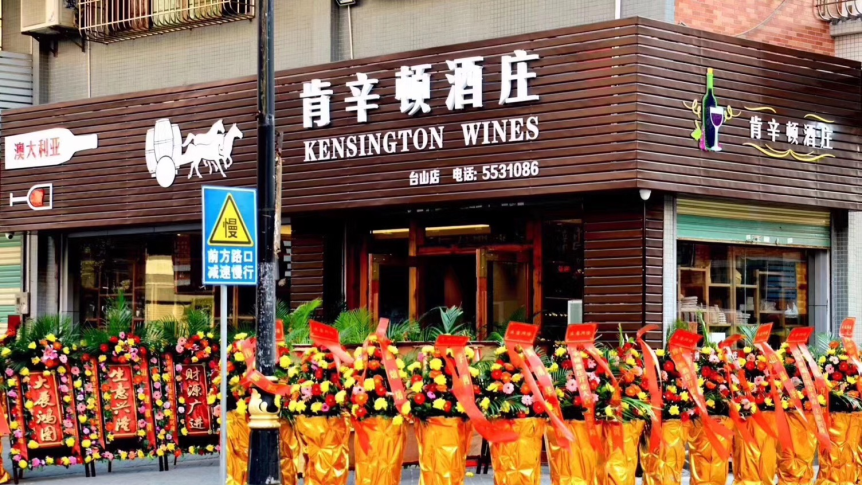
Via ABC: Kensington Wine is grown in the Goulburn Valley and mainly exported to China, where its considered a premium product.

This also as since last month other major commodities have been held up at ports or blocked altogether.

Again, there's no friendly democratic cavalry coming around to intervene and bring pressure on Australia's behalf, instead just empty rhetoric, as Laurenceson continues in South China Morning Post:

But when five of the 70 Australian meat processors able to sell beef to China had their access revoked earlier this year, self-serving rhetorical support was all Pompeo could muster, commending the Scott Morrison government for "standing up for democratic values and the rule of law despite intense, continued, coercive pressure from the Chinese Communist Party".

Beijing of course knows this and has so far remained unblinking and unwavering as it appears to hold all the cards.

The obedient and more pliant citizenry under the CCP will also have to forgo its 'Australian luxuries' for a time, and is no doubt perfectly capable of doing so. 

Tuesday, 1 December 2020

The rapidly declining relations between Australia and China

 China Trolls Australia With "Repugnant" Doctored Image, Refuses To Apologize


Zero Hedge,

30 November, 2020


The developing China-Australia trade row which initially sprang out of Australia's joining other countries in criticizing Beijing's handling of the coronavirus crisis has just taken a bizarre and sinister turn.

It started early Monday when China’s foreign ministry spokesman Zhao Lijian posted a disturbing image to Twitter depicting an Aussie soldier about to slit the throat of a child in Afghanistan. The grinning soldier is depicted holding a bloody knife to the distressed child, who is seen holding a lamb, which is a symbol of innocence. 


Australian leaders and media were quick to point out it is a doctored or "fake" image and demanded that Lijian remove it immediately, and that Twitter take action over the account. 

"It is utterly outrageous and cannot be justified on any basis," Australian Prime Minister Scott Morrison said. "The Chinese government should be utterly ashamed of this post. It diminishes them in the world’s eyes."

Morrison and others demanded a formal apology out of China over the "repugnant" image and tweet. But China's foreign ministry refused calls to apologize, instead doubling down on its charge that Australia appears less ashamed over its egregious war crimes in Afghanistan and more concerned over public embarrassment based on a tweet.

It comes after earlier this month Australia was rocked by scandal when a detailed investigation known as the Brereton War Crimes report revealed that Aussie special forces were implicated in up to 39 or more "unlawful killings" of Afghan civilians and prisoners. At least 13 Australian soldiers are facing criminal charges after horrific details emerged that they were killing random civilians essentially for sport, in something they called "blooding" - or initiating a special forces new join into war by orchestrating their first kill and then covering it up.

Here's how China responded to the demands for an apology:

"It is the Australian government who should feel ashamed for their soldiers killing innocent Afghan civilians," said Hua Chunying, China’s foreign ministry spokeswoman, when asked about Morrison’s comments.

The image posted by her colleague shows people’s "indignation," said Hua, speaking at a regular news conference in Beijing on Monday. Whether it will be taken down is a matter between Twitter and the Australian government, she said.

It is indeed clear that the tweet was meant to highlight the shocking history of well-documented war crimes by Australia in central Asia, and is the latest in Canberra being forced to play on the defensive with China, after major commodities exports earlier this month were blocked and/or were hit with huge tariffs by China.

Zhao had written on Twitter alongside the image: "Shocked by murder of Afghan civilians & prisoners by Australian soldiers. We strongly condemn such acts, & call for holding them accountable."

As of late in the day Monday (local time), the tweet is still up and has not been blocked or taken down by Twitter.


https://www.scmp.com/news/china/diplomacy/article/3112002/australian-researcher-hits-back-chinese-tabloid-over-xinjiang

Chinese propaganda


Chinese Foreign Ministry spokesperson Zhao Lijian on Monday posted on Twitter a cartoon circulating on Chinese social media platforms condemning Australian troops' murder of 39 innocent Afghans. Australian Prime Minister Scott Morrison was very angry about it, accused Zhao of offending his country, and demanded an apology from China. 

I was really shocked and disgusted. How could this Australian PM be so ridiculously arrogant to pick on Chinese FM spokesperson's condemnation against the murder of innocent people? Is the murder fake news? Shouldn't that illustrator have made the cartoon? Didn't the Chinese FM spokesperson have the right to repost that cartoon to censure Australian troops' murder of innocent Afghan civilians? 

The Australian government's many moves have made Australia more and more like a rural-urban continuum in Western civilization, where rogues and outlaws run wild. Whenever the leader of the West is up to something bad, it just needs to come to this place and hire some hatchet men. Afghanistan is so far away from Australia geographically, but Australian soldiers have killed as many as 39 innocent people there. 

Morrison should kneel down on the ground, slap himself in the face, and kowtow to apologize to Afghans - all these should be done in a live telecast. No matter what harsh words people use on them for the murder, the Australian government should have accepted it. How dare they talk back and say they are offended!

The Morrison administration is the political hatchet man hired by the US akin to a mafia. There is no remedy in Western culture that could save them. They should be sent to the temples in Thailand, Myanmar or China's Zhoushan, get their hair shaved and chant scriptures, and be taught not to kill people first thing first. They should recite The Analects and be taught that one should not impose on others what he himself does not desire. Such an education of Eastern civilization is expected to heal their evil minds and murderous mentality.

Australian troops and fleets should leave Asia and the coastal waters of the Asian continent. More precisely, they should run as far as they can. The Morrison administration is making Australia provocative and wanting a spanking.  

The author is editor-in-chief of the Global Times. opinion@globaltimes.com.cn

https://www.globaltimes.cn/content/1208525.shtml


The editor of China’s state-run English language newspaper, Hu Xijin, has posted an incendiary piece calling Prime Minister Scott Morrison “ridiculously arrogant” and saying he should “slap himself in the face” on live television.

The searing editorial comes after Chinese Foreign Ministry spokesman Zhao Lijian posted a doctored image on Twitter showing an Australian soldier holding a knife to the throat of a young child holding a lamb.

“Don’t be afraid, we are coming to bring you peace,” the caption reads.

The image references the Brereton report that alleged elite Australian soldiers had carried out war crimes including the killings of 39 Afghans in a series of incidents that are being referred for special investigation and potential prosecution.

Prime Minister Scott Morrison reacted swiftly and unequivocally to the image being shared on social media, calling it “truly repugnant”, calling for an apology from the Chinese government and asking the social media giant to take it down.

“It is deeply offensive to every Australian, every Australian who has served in that uniform, every Australian who serves in that uniform today, everyone who has pulled on that uniform and served with Australians overseas from whatever nation, that they have done that. It is utterly outrageous and it cannot be justified on any basis whatsoever,” he said in a virtual press conference on Monday.

“The Chinese Government should be totally ashamed of this post. It diminishes them in the world’s eyes.”

https://www.news.com.au/finance/work/leaders/global-times-editorial-calls-prime-minister-scott-morrison-arrogant-for-demanding-apology-over-image/news-story/e30f4ac67170aa845e4dfef5ffefc514


https://www.news.com.au/national/politics/deeply-disturbing-shocking-australian-war-crime-allegations/news-story/7f51b6f0bb000f2e90248948451b5b32


Australia's winemakers are scrambling to find new buyers around the world after China imposed hefty tariffs on the industry, effectively cutting it off from its most important export market.

Beijing's decision last week to impose tariffs of up to 212% on Australian wine imports has endangered business with mainland China, according to Tony Battaglene, CEO of Australian Grape and Wine, a national association.
Battaglene works with around 800 wine producers in Australia who have "built their businesses" around exporting to China and are now left with no backup plan, he added.
    "We were surprised, we were shocked," Battaglene told CNN Business. "Having the extent of these interim tariffs, I mean essentially they will close the market to Australian bottled wine, to premium wine, in China. There's no way that we can compete at those levels."
    China's Commerce Ministry announced Friday that its decision was made after finding preliminary evidence of dumping. Australian officials have bitterly protested the move, saying that China has been unable to provide proof.
    The wine war is taking place against the backdrop of a wider deterioration in relations. Australia has upset China this year by calling for an investigation into the origins of the coronavirus pandemic. Beijing later targeted Canberra over trade, namely by suspending some imports of beef and slapping heavy tariffs on barley.
    The tariffs on wine, which took effect on Saturday, have forced businesses to scramble. After the announcement, some container ships that were en route to mainland China had to turn back to Australia, according to Battaglene.
    "Orders are being canceled, orders are being suspended," he said. "No one's willing to ... take extra import duties just to get it through customs. Essentially the market will be closed to us."
    On Monday, Australia's leading winemaker, Treasury Wine Estates (TSRYF) (TWE), announced a contingency plan. It said it would start redirecting its shipments away from China to other markets, such as the United States, Europe and other Asian countries, after finding out its products would be slapped with tariffs of 169.3%.
    Some of the wine TWE is considering reallocating had already arrived at a port in Shanghai, according to CEO Tim Ford. "We will reassess [what to do with] that product," he said on an analyst call Monday.
    "We are extremely disappointed to find our business, our partners' businesses and the Australian wine industry in this position," Ford added. "Our attention's very clearly on building our business outside of China over the next period of time."
    The plan wasn't enough to reassure investors. TWE shares closed down 6.9% in Sydney on Monday, following an 11.3% drop on Friday, when the tariffs were announced.

    China is by far the biggest importer of Australian wine, according to Wine Australia, a trade organization backed by the country's government. In the most recent financial year, which ended this September, mainland China alone made up 39% of Australia's total wine exports by value, the group said.
    Going forward, more "Australian winemakers will now be forced to consider alternative markets for export sales," Australian Grape and Wine said in a statement.
      On Monday, Ford called on the Australian government to help businesses find a solution.
      "Left unresolved, there will be a significant impact," he said. "Things may change, and we'll deal with that as they change, but we're sort of dealing with the cards that we know at the moment, without a strategy of hope if you like. Because a strategy of hope is not a very smart strategy."

      https://edition.cnn.com/2020/11/30/business/australia-china-wine-tariffs-intl-hnk/index.html

      Tuesday, 3 November 2020

      China expected to BAN $400 million wheat imports from China

      Nothing in the Australian media yet.


      Exclusive | China-Australia 

      relations: ban on US$400 

      million Australian wheat 

      imports looms

      • Wheat exports from Australia are expected to join a list that already contains barley, sugar, red wine, timber, coal, lobster, copper ore and copper concentrates

      • The escalation in tensions between China and Australia started after Canberra pushed for an international inquiry into the origins of the coronavirus in April


      SCMP,

      2 November, 2020


      China is expected to ban imports of Australian wheat, putting a A$560 million (US$394 million) trade in doubt, with the grain the latest to join a list of new blocks on Australian products, according to industry sources.

      From Friday, barley, sugar, red wine, timber, coal, lobster, copper ore and copper concentrates from Australia, are expected to be barred from China even if the goods have been paid for and have arrived at ports. The ban on wheat is likely to follow, although a date has not yet been set, sources said.

      It is understood that Beijing will communicate the bans to all Chinese state-owned and private traders by Tuesday. Traders who have already been notified said no formal document was issued nor were reasons provided.

      The bans, though, came with a warning that Australian shipments would also be turned away if traders tried to circumvent the restrictions by re-routing shipments via a third party country, sources added, with Chinese authorities set to pay particular attention to certificates of origin.

      Chinese importers have been told to obey these rules strictly and suspend all orders for commercial reasons

      “Chinese importers have been told to obey these rules strictly and suspend all orders for commercial reasons,” said a trade source in China familiar with the impending ban, who wished to remain anonymous due to the sensitivity of the issue.

      “Shipments arriving at the port before Friday will be released, but those arriving after will stay at port. It does not matter if it is already in the bonded area.”

      Chinese importers which have shipments of the first seven banned goods arriving after Friday have been told that they will have to bear the expense of any uncleared goods.

      Alongside the new bans that were communicated verbally to some traders on Monday, on Friday, China also suspended imports from grain exporter Emerald Grain and ceased imports of Australian timber from Queensland due to the discovery of pests and other contamination.

      This follows earlier rounds of Chinese trade actions, including anti-dumping duties on Australian barley, beef export suspensions and a new anti-dumping investigation into cheap Australian wine.

      The escalation in tensions between China and Australia – that has shown no signs of abating after seven months – started after Canberra pushed for an international inquiry into the origins of the coronavirus in April, without consulting Beijing.

      Australian wheat exports to China had already faced a threat in September when China customs said it would increase checks and carry out tests on shipments following the first suspension of barley imports from Australia’s largest grain exporter, CBH Group, due to the discovery of pests.

      Barley is Australia’s biggest grain export to China, with Australia’s trade to China worth an average of around A$1.2 billion (US$843 million) a year.

      Wheat exports to China are lower, with the value of Australian wheat exports to China having fluctuated in the past three years. It fell from around A$290 million in 2017-18 to A$32 million in 2018-19, but according to the Australian Bureau of Statistics, exports in the year to June rose to over A$560 million.

      The ban on wheat would not have come as a surprise to some importers and analysts in China who have been on alert in recent months given China’s frantic buying of wheat and other grains, including corn.

      Despite not being a big wheat importer, China has been accelerating its purchases with stockpiling against shortages the likely driver, analysts S&P Global Platts said in October.

      China has already bought large amounts of wheat from France, Canada and Australia this year, while its wheat commitments with the United States are also near a four-year high, S&P Global Platts added.

      China has also been buying from Lithuania, while Russia and Kazakhstan are potential new suppliers, according to the China National Grain and Oils Information Centre.

      China is expected to continue buying grains at a faster-than-expected pace in the coming months as the country looks to meet its internal demand and ensure stable domestic reserves

      The move to buy more wheat also coincided with its commitment to ramp up its US agriculture purchases as part of the phase one trade deal agreed between Beijing and Washington in January, according to Bloomberg.

      China has projected it will raise its annual wheat purchases to 6 million tonnes from June, up from 4 million tonnes a year earlier, and to its highest import level since 2013-14.

      “China is expected to continue buying grains at a faster-than-expected pace in the coming months as the country looks to meet its internal demand and ensure stable domestic reserves amid a backdrop of uncertain market factors like food supply scare and trade tensions,” S&P Global Platts said.

      While the rapid levels of purchases have a lot to do with China’s moves to mitigate against shortages, this also sets up wheat as a potential target for a ban given its large stockpile, one analyst said. The same criteria could also be applied to China’s copper imports.


      Thursday, 28 November 2019

      Trump Signs Bill Backing Hong Kong Protesters


      Futures Tumble After Trump 
      Signs Bill Backing Hong 
      Kong Protesters, Defying China

      27 November, 2019

      Less than an hour after Trump once again paraded with yet another all-time high in the S&P...

      ... and on day 510 of the trade war, it appears the president was confident enough that a collapse in trade talks won't drag stocks too far lower, and moments after futures reopened at 6pm, the White House said that Trump had signed the Hong Kong bill backing pro-democracy protesters, defying China and making sure that every trader's Thanksgiving holiday was just ruined.
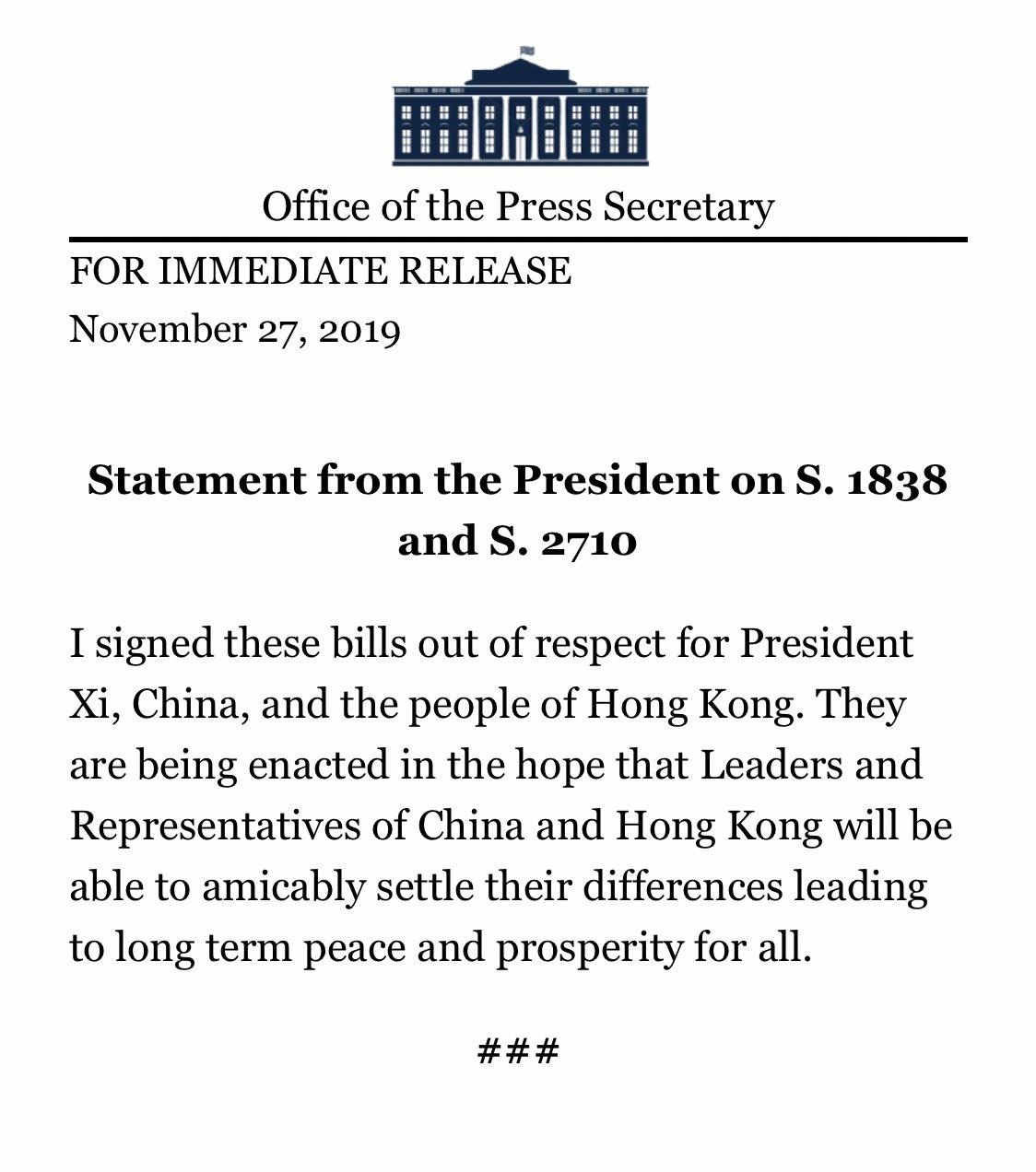
      In a late Wednesday statement from the White House, Trump said that:
      I signed these bills out of respect for President Xi, China, and the people of Hong Kong. They are being enacted in the hope that Leaders and Representatives of China and Hong Kong will be able to amicably settle their differences leading to long term peace and prosperity for all.
      Needless to say, no differences will be "settled amicably" and now China will have no choice but to retaliate, aggressively straining relations with the US, and further complicating Trump's effort to wind down his nearly two-year old trade war with Beijing.
      Trump’s signing of the bill comes during a period of unprecedented unrest in Hong Kong, where anti-government protests sparked by a now-shelved extradition bill proposal have ballooned into broader calls for democratic reform and police accountability.
      “The Hong Kong Human Rights and Democracy Act reaffirms and amends the United States-Hong Kong Policy Act of 1992, specifies United States policy towards Hong Kong and directs assessment of the political developments in Hong Kong,” the White House said in a statement. "Certain provisions of the act would interfere with the exercise of the president's constitutional authority to state the foreign policy of the United States."
      The legislation, S. 1838, which was passed virtually unanimously in both chambers, requires annual reviews of Hong Kong’s special trade status under American law and will allow Washington to suspend said status in case the city does not retain a sufficient degree of autonomy under the “one country, two systems” framework. The bill also sanctions any officials deemed responsible for human rights abuses or undermining the city’s autonomy.
      The House cleared the bill 417-1 on Nov. 20 after the Senate passed it without opposition, veto-proof majorities that left Trump with little choice but to acquiesce, or else suffer bruising fallout from his own party. the GOP.
      Trump also signed into law the PROTECT Hong Kong act, which will prohibit the sale of US-made munitions such as tear gas and rubber bullets to the city’s authorities.
      While many members of Congress in both parties have voiced strong support for protesters demanding more autonomy for the city, Trump had stayed largely silent, even as the demonstrations have been met by rising police violence.
      Until now.
      The bill’s author, Senator Marco Rubio of Florida, said that with the legislation’s enactment, the US now had “new and meaningful tools to deter further influence and interference from Beijing into Hong Kong’s internal affairs.”
      In accordance with the law, the Commerce Department will have 180 days to produce a report examining whether the Chinese government has tried use Hong Kong’s special trading status to import advanced “dual use” technologies in violation of US export control laws. Dual use technologies are those that can have commercial and military applications.
      One other less discussed but notable provision of the Hong Kong Human Rights Act targets media outlets affiliated with China’s government. The new law directs the US secretary of state to “clearly inform the government of the People’s Republic of China that the use of media outlets to spread disinformation or to intimidate and threaten its perceived enemies in Hong Kong or in other countries is unacceptable."
      The state department should take any such activity “into consideration when granting visas for travel and work in the United States to journalists from the People’s Republic of China who are affiliated with any such media organizations”, the law says.
      * * *
      In the days leading up to Trump's signature, China’s foreign ministry had urged Trump to prevent the legislation from becoming law, warning the Americans not to underestimate China’s determination to defend its “sovereignty, security and development interests.”

      "If the U.S. insists on going down this wrong path, China will take strong countermeasures," said China's foreign ministry spokesman Geng Shuang at a briefing Thursday in Beijing. On Monday, China's Vice Foreign Minister Zheng Zeguang summoned the U.S. ambassador, Terry Branstad to express “strong opposition” to what the country’s government considers American interference in the protests, including the legislation, according to statement.
      The new U.S. law comes just as Washington and Beijing showed signs of working toward “phase-one” of deal to ease the trade war. Trump would like the agreement finished in order to ease economic uncertainty for his re-election campaign in 2020, and has floated the possibility of signing the deal in a farm state as an acknowledgment of the constituency that’s borne the brunt of retaliatory Chinese tariffs.
      Last week China's Vice Premier and chief trade negotiator Liu He said before a speech at the Bloomberg New Economy Forum in Beijing, that he was “cautiously optimistic” about reaching the phase one accord. He will now have no choice but to amend his statement.
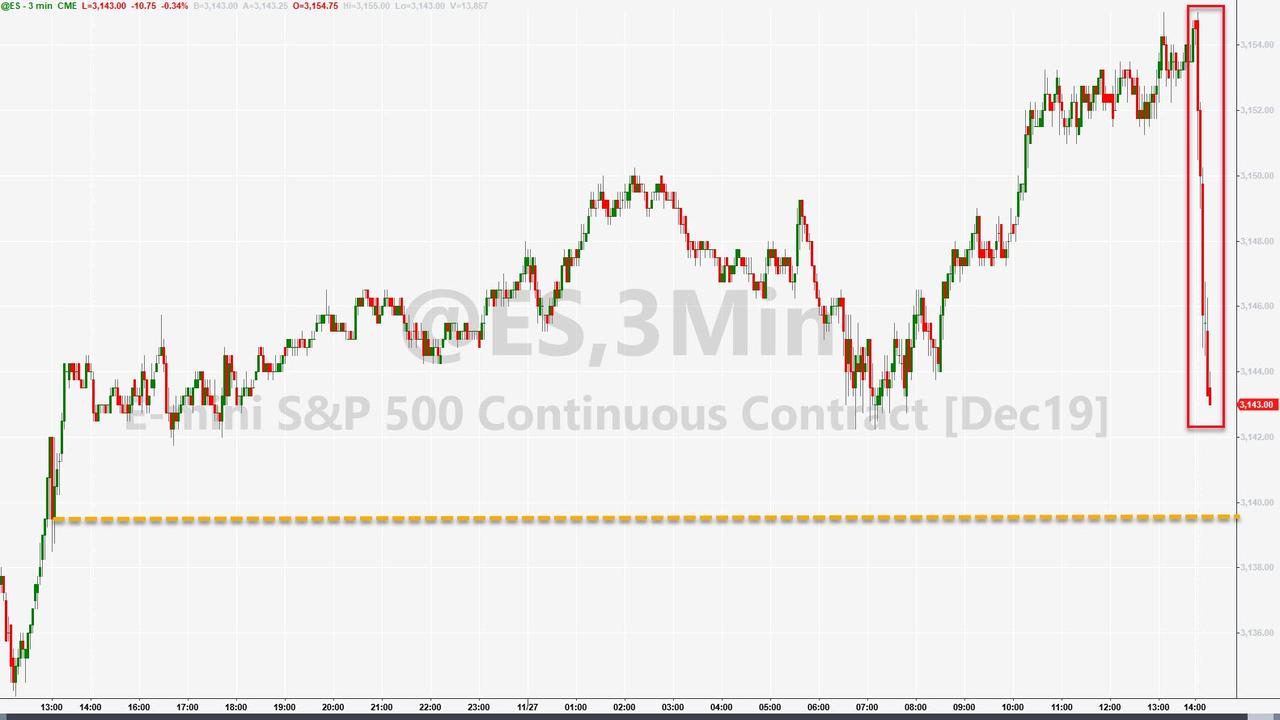
      In anticipation of a stern Chinese rebuke, US equity futures tumbled, wiping out most of the previous day's gains...
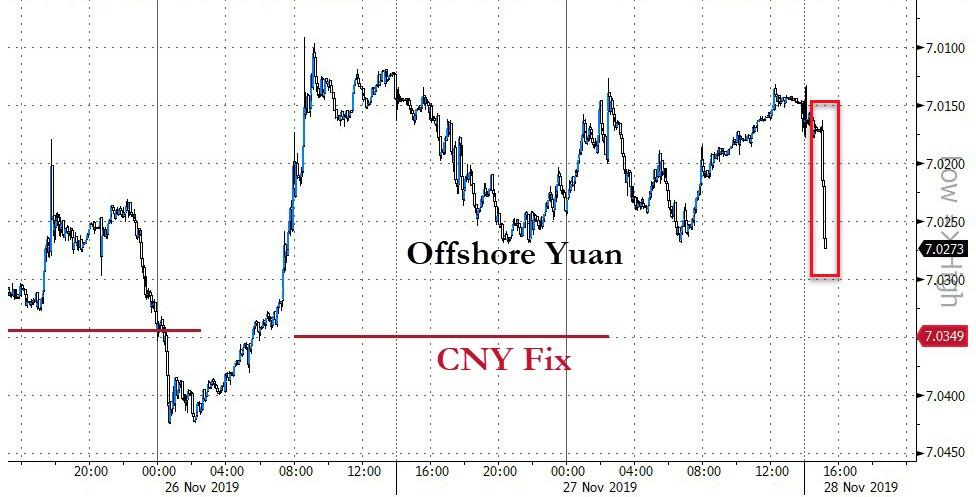
      ... while the yuan slumped over 100 pips in kneejerk response.
      Still, the generally modest pullback - the S&P was around 2,940 when Trump announced the Phase 1 deal on Oct 11 - suggests that despite Trump's signature, markets expect a Chinese deal to still come through. That may be an aggressive and overly "hopeful" assumption, especially now that China now longer has a carte blanche to do whatever it wants in Hong Kong, especially in the aftermath of this weekend's landslide victory for the pro-Democracy camp which won in 17 of the city’s 18 districts.
      “Following last weekend’s historic elections in Hong Kong that included record turnout, this new law could not be more timely in showing strong US support for Hongkongers’ long-cherished freedoms,” said Rubio