Showing posts with label geology. Show all posts

Tuesday, 14 November 2017

NASA DISCOVERS MANTLE PLUME ALMOST AS HOT AS YELLOWSTONE SUPERVOLCANO THAT'S MELTING ANTARCTICA FROM BELOW

'This is crazy': Antarctic supervolcano melting ice sheet from within


'This is crazy': Antarctic supervolcano melting ice sheet from within

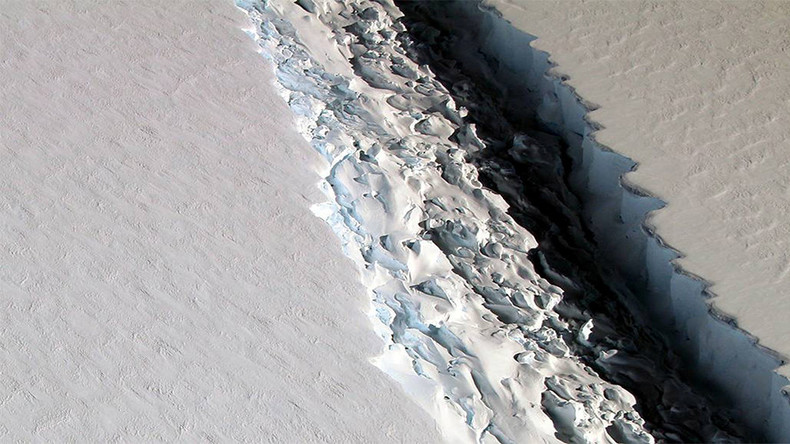
Oblique view of massive rift in Antarctic Peninsula's Larsen C ice shelf on Nov 10, 2016. Courtesy John Sonntag/NASA/Handout / Reuters

RT,
9 November, 2017

Scientists at NASA’s Jet Propulsion Laboratory (JPL) have found new evidence to support a theory that the breakup of Antarctic ice may be caused in part by a massive geothermal heat source, with output close to the scale of Yellowstone National Park.

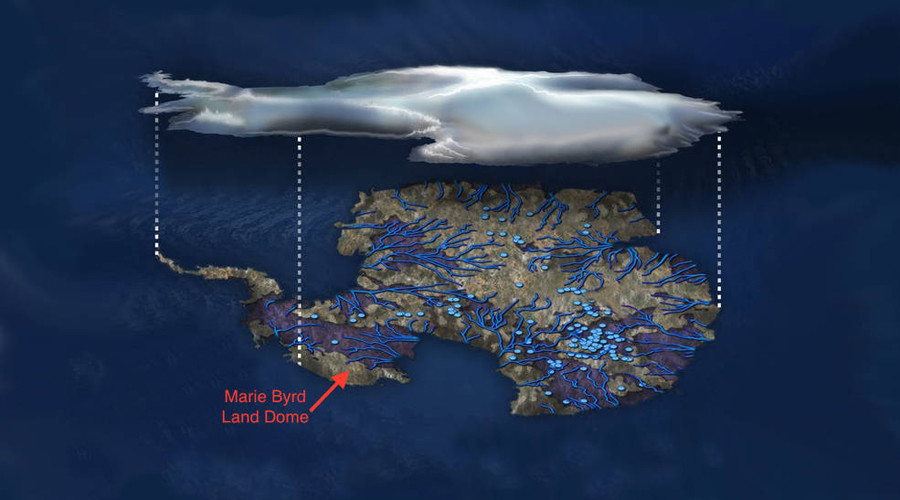
A geothermal heat source called a mantle plume – a hot stream of subterranean molten rock that rises through the Earth's crust – may explain the breathing effect visible on Antarctica's Marie Byrd Land and elsewhere along the massive ice sheet.

While the mantle plume is not a new discovery, the recent research indicates it may explain why the ice sheet collapsed in a previous era of rapid climate change 11,000 years ago and why the sheet is breaking up so quickly now.

"I thought it was crazy. I didn't see how we could have that amount of heat and still have ice on top of it," said Hélène Seroussi of NASA's Jet Propulsion Laboratory in Pasadena, California.


Seroussi and Erik Ivins of JPL used the Ice Sheet System Model (ISSM), a mathematical depiction of the physics of ice sheets developed by scientists at JPL and the University of California, Irvine. Seroussi then tweaked the ISSM to hunt for natural heat sources as well as meltwater deposits.

This warm water lubricates the ice sheet from below, allowing glaciers to slide off into the sea. Studying meltwater in western Antarctica may allow scientists to estimate how much ice will be lost in future.

© Zina Deretsky / NSF / NASA

The Antarctic's underwater systems of lakes and rivers fill and drain rapidly which can force surface ice to rise or fall by as much as 6 meters (20ft). The average thickness of the ice is  2.6km (1.6 miles) but can reach 4.7km in parts of the sheet. This motion allows scientists to better understand the underground topography and better estimate concentrations of water sources beneath the surface.

The JPL scientists corroborated their work with readings from NASA's IceSat satellite and airborne Operation IceBridge campaign which observe variations in the altitude of the Antarctic ice sheet's surface. The team found that the geothermal heat emitted by the Antarctic mantle plume is up to 150 milliwatts per square meter. For comparison, over the entirety of Yellowstone National Park the underground heat measures an average of 200 milliwatts per square meter.

Scientists to study 120,000yo ecosystem uncovered after 1tn-ton iceberg break (PHOTOS)
During their initial work, Seroussi and Ivins created simulations using higher heat flows than 150 milliwatts per square meter, which did not align with their space-based readings, except for one area: The Ross Sea.

Their calculations showed that, in certain sections of the sea, a heat flow of at least 150-180 milliwatts was required to create sufficient meltwater flows that matched with observations. They now believe the mantle plume is responsible for these higher-than-average readings.


The Marie Byrd Land mantle plume formed 50 to 110 million years ago, predating the Western Antarctic ice sheet. The mantle plume theory was initially proposed 30 years ago but other, competing theories suggested the sheer weight of the ice sheets causes melting deep below the surface.


Tuesday, 15 November 2016

Fears of even bigger tremors after 7.5 quake

My apologies. I find myself unable to cover normal geopolitical events.

New Zealand’s latest earthquake could trigger a mega-quake

By Alice Klein


14 November, 2016

New Zealand is continuing to shake after being hit by a magnitude 7.5 earthquake, and there are fears the underground stress could set off even bigger tremors nearby.

We currently calculate a 12 per cent probability of a magnitude 7 or larger earthquake within the next day, and 32 per cent within the next 30 days,” says John Ristau at GNS Science, New Zealand’s geoscience research and consultancy firm. “An earthquake like this can increase the risk of a major earthquake nearby, although it can also decrease stress on a nearby fault and lessen the risk.”

The latest earthquake struck 90 kilometres north-east of Christchurch in the South Island on Monday just after midnight local time, killing two people and tearing up buildings and roads in the rural area.

The quake triggered a tsunami warning that was later cancelled. Waves measuring 2.5 metres hit the coast soon afterwards, but further, larger waves of up to 5 metres that were feared didn’t happen.

Preliminary data show the earthquake occurred on a previously unknown fault near the interface of the Australian and Pacific tectonic plates. The South Island was thrust up over the Pacific plate with some sideways slip.

Stress change

The stress change could trigger a powerful earthquake at the interface between the Australian and Pacific plates, known as the Alpine Fault, says Kevin McCue at Central Queensland University. The giant Alpine Fault borders the South Island and splays into many faults through the North Island, he says.

If the 600-kilometre fault ruptures, it will produce one of the biggest earthquakes in New Zealand since European settlement, says GNS Science. It last ruptured in 1717.

However, Ristau believes Monday’s earthquake is probably too far away from the Alpine Fault to have a direct effect. Nevertheless, it could set off the closer Hope Fault, which branches off the Alpine Fault, he says.

The region has already experienced more than 300 aftershocks, half of which have been magnitude 4 or greater. The strongest aftershock recorded so far was magnitude 6.3.

New Zealand sits on the seismically active “Ring of Fire” around the Pacific Ocean, where about 90 per cent of the world’s earthquakes occur.

A magnitude 6.3 earthquake struck 10 kilometres from Christchurch’s central business district in 2011, killing 185 people and injuring thousands more.


Tuesday, 18 August 2015

The heat underneath Antarctica

High Heat Measured under Antarctica Could Support Substantial Life
Nearly a kilometer below the ice scientists have found a Yellowstone-like geothermal glow that could create life-rich subglacial lakes—and lubricate Antarctic ice loss

By Douglas Fox


10 July, 2015


Temperatures on the West Antarctic Ice Sheet can plummet below –50 degrees Celsius in winter. But under the ice scientists have found intense geothermal heat seeping up from Earth’s interior. The heat production that they measured is nearly four times the global average—“higher than 99 percent of all the measurements made on continents around the world,” says Andrew Fisher, a hydrogeologist at the University of California, Santa Cruz, who worked on the project. This excessive heat could melt up to 35 cubic kilometers of water off the bottom of the West Antarctic Ice sheet each year, according to results reported July 10 in Science Advances.

This meltwater could help create a vast, hidden habitat for aquatic life under the ice—a region that some scientists call the largest swamp on Earth. It could also influence the mechanics of the ice sheet by creating lubricated areas, which guide the flow paths and speeds of major glaciers that carry ice to the ocean. “We think that water is the knob that controls whether ice moves fast or slow,” says Slawek Tulaczyk, a glaciologist at U.C. Santa Cruz. Scientists like him need to understand that process if they are to predict just how much ice Antarctica will spill into the ocean as temperatures rise.

Researchers had already measured geothermal heat production at more than 34,000 sites around the world. But for decades, they could only make educated guesses about how much heat was seeping up under Antarctica’s ice—an area almost twice the size of Australia that had never been directly explored. That changed in January 2013 when a team co-led by Tulaczyk ventured deep into Antarctica and bored a hole through 800 meters of ice.

Tulaczyk’s team was drilling into a body of water called Subglacial Lake Whillans, which is sealed under the ice in West Antarctica—the part of the continent that sits directly south of the Pacific Ocean, between the lowermost tips of New Zealand and South America. The team hoped to see what kind of life might inhabit the lake. Their experiment also created the perfect opportunity for jabbing a giant thermometer into its bed—a metal spear, three meters long, accurate to one one-thousandth of a degree C. Fisher had spent two years building and testing the device. The critical moment came on January 31, 2013. The entire endeavor hung from a thread—or rather, a hastily knotted rope.

Geothermal night-light

I accompanied Tulaczyk and a dozen other researchers to the remote drill site that year. It sat on a monotonous plain of snow and ice 600 kilometers from the South Pole. Tulaczyk blinked in the brilliant sunlight as he crawled out of his tent around 1:00 A.M. that morning. He quickly received bad news: The massive winch that he needed to lower the probe half a mile into the lake had broken down. The probe weighed 550 kilograms, more than a full-grown horse—a hefty mass that would help drive it into the subglacial mud. But now Tulaczyk and his PhD student, Kenneth Mankoff, spent eight frantic hours disassembling and redesigning it to cut its weight in half so that a smaller winch could handle it.

This slimmed-down version of the thermometer had one major drawback: It now had no ring of any sort that would allow them to clamp it onto the end of the winch’s cable. In fact, it consisted of nothing more than a slender metal pole. 

They improvised by simply knotting a rope around its smooth shaft—a workaround that seemed destined to fail. “It either works or it doesn’t—it’s a one-time thing,” Tulaczyk told me during a brief break that morning. He worried that the rope would pull off the metal probe when they tried to lift it back up—leaving it jammed for eternity in the viscous mud almost a kilometer below.

And so people were understandably relieved when it was hoisted from the borehole several hours later. The chocolatey mud coating its lower half revealed that it had stabbed more than a meter into the lake bed—just enough to measure the heat flow.

The results published on July 10 show that heat energy is seeping out of the planet at a rate of 285 milliwatts per square meter. That’s a tiny amount of energy—equal to the heat dissipated by a small LED night light. But it’s two or three times the amount of geothermal heat that scientists had previously estimated for West Antarctica. In fact, it’s similar to measurements taken in volcanically active areas, such as Yellowstone in Wyoming and Mount Lassen in California. This higher heat measurement, if multiplied across all of West Antarctica, could liberate an extra 10 to 20 cubic kilometers of meltwater under the ice sheet each year—effectively doubling the amount produced.

Slick and slide

This is one measurement,” Fisher cautions—the heat flux probably varies from place to place. But that raises some fascinating possibilities: The area where they measured geothermal heat contains half a dozen subglacial lakes, with water flowing from one to another through shifting, braided subglacial rivers. Those lakes might owe their existence to a local geothermal hotspot, which supplies them with water, Fisher says. Hotspots might also account for many of the other 60-plus lakes thought to reside under the ice in West Antarctica.
SEE ALSO:

Those lakes are of great interest due to the aquatic life that they might harbor. Water taken from Lake Whillans (where Tulaczyk, Mankoff and Fisher measured heat flow in 2013) was found to hold 130,000 living cells per milliliter (just over half a million per teaspoon)—a surprising amount, similar to some parts of the open ocean.

West Antarctica probably exudes more heat than the higher-elevation eastern part of the continent, Tulaczyk says. Unlike its eastern counterpart, West Antarctica forms a broad, low saddle; its subglacial bed slopes hundreds, even thousands of meters below sea level. This topography was formed by a broad tectonic rift, he adds, “similar in many ways to the Basin and Range [Province] in Nevada and eastern California.” Gradual stretching has thinned Earth’s crust in this region, allowing hot rocks and magma to bulge up from below.

Much of the ice in Antarctica’s interior creeps only a few meters per year—but a handful of major ice streams, up to 100 kilometers across, flow hundreds or even thousands of meters per year—massive conveyor belts that carry hundreds of cubic kilometers of ice out of the interior yearly and dump it into the ocean. Tulaczyk and others believe that local hotspots influence the flow paths and speeds of these ice streams.

In 2014 scientists reported that one major West Antarctic ice stream, called Thwaites Glacier, sits atop several local hotspots (inferred using ice-penetrating radar and computer modeling). These could melt water and lubricate the glacier, says Duncan Young, a glaciologist with the University of Texas at Austin who was part of that study. The hotspots sit beneath several critical spots in the glacier’s inland tributaries, potentially increasing the supply of ice that is poured into the main trunk of the glacier—and eventually, the ocean, where it contributes to sea level rise. Thwaites Glacier is of particular interest because it is already accelerating and thinning in response to rising temperatures.

Much remains to be learned about the vast landscape hidden beneath the West Antarctic Ice Sheet but one possibility is becoming increasingly clear. Aerial surveys using ice-penetrating radar show numerous isolated high spots in the subglacial topography. These often correspond with strong magnetic anomalies—a marker of iron-rich lava rocks. “There have been at least three subglacial volcanoes identified under the ice sheet now,” Young says—“and we have suspicions of a bunch more”—perhaps hundreds. Dozens of these suspected volcanoes possess unusually squat profiles, suggesting that they actually erupted and grew while buried under the crushing weight of the ice sheet. At least one subglacial volcano is thought to be active right now—a submerged peak named Mount Casertz.

The upper surface of the ice sheet dips 50 meters as it flows over the buried crest of this volcano. Maintaining that low spot year after year is no small thing, because the crushing mass of the surrounding ice sheet should ooze inward and fill even a shallow depression. Calculations suggest that Mount Casertz exudes 700 million watts of geothermal heat—roughly equal to the energy produced by a medium-size nuclear power plant. It maintains the topographic depression above it by melting 70 million tons of water off the bottom of the ice sheet each year.
It’s entirely possible that Casertz or another of these hidden volcanoes could erupt in the future. No one believes that even a catastrophic eruption would rip apart the ice sheet—it’s simply too massive. But the meltwater that it produces could still cause a large glacier like Thwaites to speed up in a way that’s never been seen before.

Young and his colleagues in Texas continue to analyze radar and magnetic data, hoping to assemble a clearer picture of volcanoes under the West Antarctic Ice Sheet. “We haven’t looked everywhere,” Young says. “Our resolution of the topography [under the ice] is basically early 20th century, maybe 19th century, of what we had of North America.”


Tuesday, 19 May 2015

NZ ticking down to a "megathrust" earthquake.

Lets go down, deep sea drill it, frack it, unlock the methane hydrates and see what happens?

Megaquake could hit central New Zealand
To watch video GO HERE

The study area was salt marsh flats on the edge of Big Lagoon near Blenheim

26 November, 2014

Scientists finally have proof that central New Zealand could be ticking down to a highly damaging "megathrust" earthquake.

Earlier research has suggested the seabed between the Wairarapa and Marlborough is capable of generating magnitude 7-plus quakes.

Now researchers have found solid geological evidence that an area off the coast of Wairarapa and fringing Cook Strait causes "megathrust" quakes and tsunami similar to, but probably smaller than, the devastating magnitude 9.0 March 2011 event in Japan.

The study area was salt marsh flats on the edge of Big Lagoon near Blenheim

The work, out Tuesday morning, highlights the active threat the southern Hikurangi margin - where the Pacific Plate is being dragged down below the Australian Plate - poses to life and livelihood from Hawke's Bay south to the Wairarapa, Wellington and Marlborough.

The Alpine Fault, which extends further south from that plate boundary, is also a hazardous feature that will generate a magnitude 8 quake when it ruptures, possibly some time in the next 50 to 100 years.

To look for evidence of past earthquakes on the margin, the researchers performed a painstaking examination of the geologic layers contained within a salt marsh at Big Lagoon in the southeastern Wairau River valley on South Island.


The scientists, from GNS Science, the University of Texas and Geomarine Research, have calculated that in the past 1000 years two subduction quakes of at least magnitude 7 occurred – one between about 880 to 800 years ago and the other between 520 and 470 years ago.

"This is the first evidence that the southern Hikurangi margin ruptures in large (7-7.9) to great (8+) earthquakes, and the relatively short time interval between the two events has significant implications for seismic hazard in New Zealand," they said in Tuesday's Bulletin of the Seismological Society of America.

A map showing the area when the Australian and Pacific tectonic plates collide. Researchers warn a 'megaquake' of magnitude 8 or more could occur in this area.


They cited an earlier paper that said for a magnitude 8.9 Hikurangi subduction quake, losses in the Wellington region alone were estimated to be about $13 billion, with about 3550 deaths and 7000 injuries.

Their findings would allow better modelling of the impacts and help communities prepare to cope with such an event, they said.

The Hikurangi margin, which runs from east of East Cape to offshore of the Marlborough coast, is one of the few subduction zones around the Pacific that has not generated a "great", above magnitude 8, quake in historic times.

Jamie Howarth, William Ries and Delia Strong, of GNS Science, using a piston corer to recover sediment cores from salt marsh at Big Lagoon, Blenheim, to determine the dates of the last megathrust earthquake off the Wairarapa coast.

Jamie Howarth, William Ries and Delia Strong, of GNS Science, using a piston corer to recover sediment cores from salt marsh at Big Lagoon, Blenheim, to determine the dates of the last megathrust earthquake off the Wairarapa coast.
Kate Clark, GNS Science
Jamie Howarth, William Ries and Delia Strong, of GNS Science, using a piston corer to recover sediment cores from salt marsh at Big Lagoon, Blenheim, to determine the dates of the last megathrust earthquake off the Wairarapa coast.

Data shows that in the southern Hikurangi margin the Australian and Pacific plates are locked and accumulating strain where they meet, about 25km beneath Wellington and Blenheim.

Previous research suggests this locked patch between Cook Strait and Cape Turnagain could generate a quake of between 8.5 and 8.7 magnitude.

In their search for subduction-quake evidence, the researchers used a salt marsh on the edge of Big Lagoon near Blenheim to recover sediment that could be aged by radiocarbon dating.

They collected 48 sediment cores, from 0.5m to 2.2m deep. Analysis and dating of the buried soils in the cores showed there had been two occasions of sudden subsidence of the lagoon in the past 1000 years, indicative of two large quakes.

The older event was accompanied by a tsunami at least 3.3m high that swept more than 360m inland.

There was no evidence of a tsunami hitting Big Lagoon in the more recent quake, although there were tsunami deposits around Cook Strait, at Abel Tasman and on Kapiti Island about the same time as that event, researchers said.

Lead researcher Dr Kate Clark, of GNS Science, said the findings did not greatly change the actual level of risk to people in central New Zealand.

The National Seismic Hazard Model used a recurrence interval of 550 to 1000 years for a magnitude 8.1-8.4 quake but the researchers had found an actual interval of about 350 years between the two quakes.


Sunday, 25 January 2015

Lakes in Greenland Completely Drain in Just Weeks

Every day, (this article from two days ago), we learn new, alarming details about our melting ice caps. " The researchers noticed that two lakes in the region have disappeared. " Obviously the melt water has gone somewhere, presumably into the adjacent ocean raising sea levels.

" A lake disappearing though, is a bizarre occurrence that Cornell University, Michael Bevis, Ohio Eminent Scholar in Geodynamics and professor of earth sciences at Ohio State, who co-authored the paper, call a “milestone” for Greenland’s ice loss. "

Milestone after milestone, unprecedented, " Changes everything we know", the list goes on. The only constant is that there is a never ending litany of bad news on the ice caps. More and more technology is coming on stream and our understanding of our predicament becomes more clear every day and that is that we are rapidly losing the ice caps,the thermostat of the planet is irretrievably broken and the only precedent I can see is the Permian extinction which was dominated by the release of methane as will be the 6th great extinction which we are witnessing today.
---Kevin Hester

Researchers Made A Discovery That Changes Everything We Know About Greenland’s Melting Ice


23 January, 2015

A group of researchers at The Ohio State University made a startling discovery while creating a high-resolution map of Greenland’s ice sheet. The researchers noticed that two lakes in the region have disappeared. The findings on each lake were published separately. The research on the first lake studied was published the open-access journal The Cryosphere. The findings related to the second lake were later published in the journal Nature.

A map of a portion of southwest Greenland. The star marks the location of a drained subsurface lake discovered by Ian Howat of The Ohio State University and his team. Image by Ian Howat, courtesy of The Ohio State University.
Lakes that contain billions of gallons of water form underneath Greenland’s ice sheet. Their existence has been known of and well documented for a long time. A lake disappearing though, is a bizarre occurrence that Cornell University, Michael Bevis, Ohio Eminent Scholar in Geodynamics and professor of earth sciences at Ohio State, who co-authored the paper, call a “milestone” for Greenland’s ice loss.

The researchers believe there is a growing body of evidence that the ice sheet has melted so much that the melt water it creates is flowing into the ice sheet’s “natural plumbing system” which causes “blowouts” to occur, leading to the lakes draining out. One of the lakes that experienced has disappeared has left a mile-wide crater underneath the ice sheet – it only took a few weeks for the lake to completely disappear, with an estimated 6.7 billion gallons of water. For comparison, that amount of water is equivalent to the reservoirs that the 1.9 million people in Columbus, Ohio use for water.

In April 2014, researchers flew over a site in southwest Greenland to find that a sub-glacial lake had drained away. This photo shows the crater left behind, as well as a deep crack in the ice. Photo by Stephen Price, Los Alamos National Lab, courtesy of The Ohio State University.

The other lake studied has shown even more alarming behavior. The lake appears to be draining and re-filling. The lake has already emptied and re-filled twice by melt water. Each time the lake drained it brought with it “latent heat” that further weakens the surrounding ice.

Professor Bevis says:

It’s pretty telling that these two lakes were discovered back to back,” he said. “We can actually see the meltwater pour down into these holes. We can actually watch these lakes drain out and fill up again in real time. With melting like that, even the deep interior of the ice sheet is going to change.”

The invading melt water is causing tunnels to appear further and further inland. Ian Howet, associate professor of earth sciences at Ohio State, who led the research team, said:

Some independent work says that the drainage system has recently expanded to about 50 kilometers inland of the ice edge, which is exactly where this lake is.”

Howet views the drainage as “catastrophic”. He says that we need to continue mapping what lies beneath the ice sheet. Commenting on the possibility this could just be a “really weird” lake  bed he says:

Until we get a good map of the bed topography where this lake was, we have no idea whatsoever how many lakes could be out there. There may be something really weird in the bed in this particular spot that caused water to accumulate. But, if all you need is a bumpy surface a bit inland from the coast, then there could be thousands of little lakes.”

The melting of the ice at the northern and southern regions of the Earth has long been the most compelling and easily digestible proof to the public that the Earth is experiencing a rapid change in the climate. As researchers begin to learn more about how climate change is changing those regions, we are beginning to see that the changes that are taking place are creating more complex chaos than we previously imagined.

Featured Image credit: Image by Ian Howat, courtesy of The Ohio State University.


Monday, 10 November 2014

New Zealand's vanishing snow

I'm no geographer -  (I'm an historian) -  but I can see a more short-term problem. 

What if there are several winters like the one just past where there was a lack of snow due to warming conditions. 

What will this do to Canterbury's snow-fed rivers? What is the implication for agricuture, irrigation etc.?
---

This article was republished in the Herald from an Australian newspaper.

This simply isn't being talked about. Mostly we are talking about anecdotes. Most people don't notice, except for an handful of snowboarders or odd people that look up and the laps and notice there is no snow and relate that to past experience.  Most people just take it for granted or enjoy the manufactured snow on the ski slopes.


NZ: Southern Alps snow, ice vanishing
Retreating glaciers and uncovered rocks evidence of swift change in climate with implications for sea level.


30 July, 2014

A third of the permanent snow and ice on the Southern Alps has vanished in less than four decades, according to an analysis of aerial surveys.

In an article published on Australian website The Conversation, three Kiwi researchers describe the story of the alps' disappearing ice as very dramatic.
The analysis, by climate scientist Dr Jim Salinger, Otago University Professor Emeritus Blair Fitzharris and glaciologist Dr Trevor Chinn, follows on from a paper published by Dr Chinn last year documenting the retreat of our postcard glaciers.

Partly using aerial surveys by the National Institute of Water and Atmospheric Research, the three authors have calculated the alps' ice volume has shrunk by 18.4cu km or 34 per cent - and those ice losses have been accelerating rapidly in the past 15 years.
When compared with rapid glacier retreats in many parts of the world, the loss raised serious questions about future sea level rise and coastal climate impacts, they said.
In 1977, Dr Chinn began taking aerial photographs to measure the annual end-of-summer snowline for 50 index glaciers throughout the Southern Alps, which are still taken by Niwa.
He and his colleagues have now used Niwa results to calculate the annual glacier mass balance, and to quantify the volume changes of small to medium glaciers in the alps.
These glaciers responded quickly to annual variability of weather and climate, and were in balance with the current climate.
But this wasn't so for the 12 largest glaciers, among them the Tasman and Godley, which had a thick layer of insulating rocks on top of the ice lower down the glaciers' trunk.
"Their response to new snow at the top is subdued, and may take many decades to respond," the authors wrote. "Up until the 1970s, their surfaces lowered like sinking lids maintaining their original areas. Thereafter, glacial lakes have formed and they have undergone rapid retreat and ice loss."
To make the calculations, they used the snowline survey data along with earlier topographic maps and a GPS survey of the ice levels of the largest glaciers to calculate total ice-volume changes for the Southern Alps up until this year.
Over that time, they said, the ice volume had fallen by 34 per cent, or from 54.5cu km to 36.1cu km in water equivalents.
Of that reduction, 40 per cent was from the 12 largest glaciers, and 60 per cent was from the small to medium-sized glaciers.
Veteran mountain guide Shaun Norman described their calculations as astonishing but unsurprising.
An injury in 2000 had kept him off the high alps since then, but even before, the changes had been visible, he told the Herald. "One could see that less snow dumps in quite a few years meant pieces of rock which you knew were always covered suddenly were staying clear for 12 months of the year, and getting bigger."
The World Glacier Monitoring Service estimated the 1890s extent of ice volume in the Southern Alps was 170cu km, compared with 36.1cu km now - a change the authors said was evidence of the local effects of global warming.
Based on regional warming projections of 1.5C to 2.5C, it has been projected by glaciologists Valentina Radic and Regine Hock that just7 to 12cu km of ice would remain on the alps by the end of this century.

Kiwi glaciers do it their way


Research suggests that ancient New Zealand glaciers were out of tune with their Northern Hemisphere counterparts when they grew and subsided thousands of years ago.
The study, published this week in the US journal PNAS (Proceedings of the National Academy of Sciences), goes against an alternative view that our glaciers followed the same patterns as those in the opposite hemisphere between 30,000 and 20,000 years ago, when ice sheets were at their most recent maximum extension.
The study, led by Professor Henrik Rother of the University of Greifswald in Germany, analysed a record of glacier debris in the Southern Alps' Rangitata Valley from between 28,000 and 16,000 years ago.
According to the study, the records of glacier movement preserved in "exceptional detail" showed New Zealand glaciers peaked earlier and retreated more slowly than Northern Hemisphere glaciers, and were only partially influenced by northern climate patterns.
Victoria University researcher Associate Professor Andrew Mackintosh said while the new findings were compelling, whether our glaciers followed their northern counterparts remained an open question.
"One argument suggests that during the last deglaciation, there was a rapid retreat of New Zealand glaciers that was more or less synchronised with those in the Northern Hemisphere, and there's good evidence for that from a numbers of sites here," he said.
"Then there's the alternative that the ice stuck around for a bit longer, which this study is reinforcing. It's hard to know which one will stand the test of time."

 Read the full article HERE


Missing from New Zealand's Ski Slopes This Season? Snow!
The Remarkables ski area near Queenstown — one of few New Zealand ski areas that has been making snow the warmest start to winter ever recorded. Scientists said New Zealand’s glaciers and ice are melting at alarming rates due to climate change. (AP Photo/Richard Savoie)


6 August, 2014

Winter has rolled into its third month in New Zealand, and Nick Jarman says he’s going stir crazy as he stares out at the driving rain on the small ski area he manages in the Southern Alps.

The Craigieburn Valley Ski Area is one of several areas that haven’t opened for a single day this season, and some fear there may not be enough snow to open at all this year — something Jarman says has never happened during his 30 years carving turns on the mountain’s slopes.

Ski operators throughout New Zealand are feeling the effects of the country’s warmest start to the Southern Hemisphere winter since record-keeping began in 1909. And while one bad season doesn’t prove a trend, it comes at a time when scientists say the country’s snow pack and glaciers are melting at an alarming rate due to climate change.

The country’s largest ski areas have managed to open only because they’ve invested in equipment to make their own snow, which they’ve been doing this year in unprecedented quantities. For now, at least, that’s helped protect the nation’s reputation as a winter play land, one that each year attracts more than 60,000 skiers and snowboarders from Australia alone from June to August when it is winter south of the equator.

At Queenstown’s Coronet Peak, 200 snow guns have been blazing day and night whenever the temperature dips a little below freezing. Those guns have turned enough water to fill 100 Olympic-size swimming pools into a white blanket that’s remained on the main trails even on days when some skiers have taken to wearing t-shirts.

But New Zealand also has a tradition of small ski areas that rely entirely on natural snow, and many are facing steep financial losses this year. Typically, the areas are run as nonprofits. They are kept open not only by tourist dollars but also from the work of enthusiastic volunteers. Operators of these areas say they can’t afford to invest hundreds of thousands of dollars in snow-making equipment.

Jarman says Craigieburn employs about 10 staff but can only pay them once the area opens. He says it’s not just the ski areas that are suffering, but also the local ski rental stores, the gas stations, even the bakeries. He says he’s been refunding money to tourists who have booked ski and accommodation packages, and the season is putting a strain on Craigieburn’s finances.

"It’s going to be hard, really hard. We don’t have the extra money to spend on maintenance," he says. "We’re not living on caviar and salmon."

It’s a similar story at Mount Cheeseman Ski Area, which employs about 20 staff when there is snow, but which also hasn’t been able to open. Mountain manager Cam Lill says some of his staff, who come from abroad, are taking the opportunity to tour the country while others are earning money doing odd jobs