Showing posts with label cliamte change. Show all posts

Monday, 20 August 2018

Looking back at the 2012 ice melt in context

 What we are currently observing in the Arctic has reminded me of this article from Robertscribbler from the 2013 melt season.

The photo is still on my Facebook page.

North Pole Melting: Ice Camera 2 Swims as Camera 1 Gets its Feet Wet


Camera 2 in deep water at North Pole.
Camera 2 in deep water at North Pole. Image sourc: APL


25 July, 2015


This summer has seen a great number of extraordinary events resulting from human caused climate change. These include massive heat dome high pressure systems setting off record droughts, fires and heat waves, Arctic temperatures rocketing into the 80s and 90sEurope and Canada suffering some of their worst flooding events in history and a crazy US weather system moving backwards against the prevailing weather pattern for more than 3,000 miles. Add to these record events a substantial melting of ice in the Arctic’s most central regions, and you end up with rather strong proofs that our greenhouse gas emissions have permanently altered the word’s weather.

From late May to early July, a persistent Arctic cylone (PAC 2013) first fractured ice near the North Pole, then consistently widened and melted the gap it created. Now a large triangle of very thin ice extends from the North Pole south and eastward toward the Laptev Sea. The section of meter or less thickness keeps widening even as gaps continue opening in the ice and melt ponds form over many of the remaining flows.
Further north and on toward the western side of the North Pole, two cameras supplied by the Applied Physics Lab and funded through a National Science Foundation grant are performing their own daily recording if this major melt event. The melting, which from the satellite, appears to have turned the sea ice near the North Pole into swiss cheese has had a marked effect on visible surface conditions as well.
Sea Ice swiss cheese
Sea ice swiss chees as seen through the clouds near the North Pole. Image source: NASA/Lance Modis

Of the two ice cameras, #2 so far has seen the most action.  On about July 13th, melt puddles began to form in the region of Camera #2. By earlier this week, the camera was deep in a growing pool of ice melt. By today, the water had deepened further covering all the markers surrounding both the camera and its related sensor buoy. Water now appears to be about 3 feet deep and the pond just keeps growing and growing (you can read more about the saga of Ice Camera #2 here).

But now, Ice Camera #1 appears to be about to suffer the same fate. Over the past couple of days, melt ponds have now also been forming in the vicinity of Camera #1. You can see this new set of melt puddles here:
Puddles North Pole Camera 1
Puddles form near North Pole Camera 1. Image source: APL

Note the melt puddle snaking its way behind the wind vane visible in the camera’s field of view and on toward Camera #1 itself. If conditions at this camera are similar to those near Camera #2, then we can expect Carema #1 to be swimming in about ten days time.
With temperatures remaining above freezing for much of the Central Arctic, melt conditions have tended to dominate. Now, most of the remaining ice is rather weak, with a thickness of about 2 meters or less. And with so much of this thin ice in areas near the North Pole, a possibility exists that much of this region will melt out over the next 6 weeks or so.
As for the Ice Cams? It appears that #1 may soon join #2 in the drink.
 The following is from Wikipedia
Melt ponds are pools of open water that form on sea ice in the warmer months of spring and summer. The ponds are also found on glacial ice and ice shelves. Ponds of melted water can also develop under the ice.

Melt ponds are usually darker than the surrounding ice, and their distribution and size is highly variable. They absorb solar radiation rather than reflecting it as ice does and, thereby, have a significant influence on Earth's radiation balance. This differential, which had not been scientifically investigated until recently, has a large effect on the rate of ice melting and the extent of ice cover.[1]

Melt ponds can melt through to the ocean's surface.[2] Seawater entering the pond increases the melt rate because the salty water of the ocean is warmer than the fresh water of the pond. The increase in salinity also depresses the water's freezing point.

Water from melt ponds over land surface can run into crevasses or moulins – tubes leading under ice sheets or glaciers – turning into meltwater. The water may reach the underlying rock. The effect is an increase in the rate of ice flow to the oceans, as the fluid behaves like a lubricant in the basal sliding of glaciers.[3]

Effects of melt ponds[edit]

See also: Glacial motion
The effects of melt ponds are diverse (this subsection refers to melt ponds on ice sheets and ice shelves). Research by Ted Scambos, of the National Snow and Ice Data Center, has supported the melt water fracturing theory that suggests the melting process associated with melt ponds has a substantial effect on ice shelf disintegration[4] Seasonal melt ponded and penetrating under glaciers shows seasonal acceleration and deceleration of ice flows affecting whole icesheets.[5] Accumulated changes by ponding on ice sheets appear in the earthquake record of Greenland and other glaciers:[6] "Quakes ranged from six to 15 per year from 1993 to 2002, then jumped to 20 in 2003, 23 in 2004, and 32 in the first 10 months of 2005."[7] Ponding in the extreme is lakes and lakes in association with glaciers are examined in the particular case of the Missoula Floods.

Given what we are observing I have my doubts that what we are observing in the Arctic are meltpools.  
The ice seems too unstable and thin to support them.
But that is only my considered opinion   


Wednesday, 28 February 2018

Michael C Mann on climate change

My coverage would not be complete without this inteview of the liar Michael Mann by the dreadful Kim Hill on Radio NZ

Quite how you can be "fighting for facts" when you're lying is beyond me.

Michael Mann: "fighting for facts"


Radio NZ

Michael Mann, the distinguished professor of atmospheric science at Pennsylvania State University, is famous for his 'hockey stick curve' showing sharply increasing global temperatures since 1900.

Listen to the interview HERE

He was also involved in the 2009 ‘climategate’ scandal - the unauthorised release of more than 1000 emails from the climatic research unit at the University of East Anglia, many of them private correspondence to and from Mann, which critics said proved dissenting voices on climate change were being silenced.

Prof Mann has been the target of threats and there have been about a dozen investigations of his work, which have exonerated him every time.
Michael Mann


The author of several books, his most recent is The Madhouse Effect, which features cartoons by Pulitzer Prize-winning political cartoonist Tom Toles.

It portrays the "intellectual pretzels" into which denialists must twist logic to explain away clear evidence that man-made activity has changed our climate.
Climate change “contrarians”, Mann says, like to portray themselves as sceptics but are anything but.

 “Scientists are the real sceptics. You question a new result, something that’s unusual. We apply scrutiny to all sides of the problem - that’s different from simply rejecting mainstream science based on flimsy arguments that don’t hold up to the slightest bit of scrutiny.

When you present anti-science to a journal and it gets sent out to leading scientists, of course they’re going to say ‘this is junk, this doesn’t even pass the smell test’.

Too many contrarians or climate change deniers present themselves as sceptics but they’re not, Mann says. A sceptic is equal-sided, questioning their findings, at least as much as people's.

True scepticism, he says, is ‘the self-correcting machinery of science.”

That global warming caused by burning fossil fuels is incontrovertible, he says.

There is as widespread and solid a consensus on that as there is on the theory of gravity and yet you don’t see when a new exoplanet is discovered many light years away, you don’t interview a space physicist along with a member of the flat earth society.”

Mann says he has had no choice but to become increasingly political.
Trump administration officials have asked the Centres for Disease Control and Prevention to avoid phrases such as “evidence-based”.

To them that is a politically-loaded term. We’re now in an environment where simply advocating for a fact-based discourse is portrayed as political.”

Despite the current political climate in the US he remains cautiously optimistic.
I definitely think we can rise to this challenge. It’s become a more uphill challenge.”

The Paris [climate change agreement was a good start but the job is far from done, he says. And even with 1 degree of warming “dangerous climate change has already arrived.” Which is why he’s fighting for primacy of facts.

You fight back, in my view, because the stakes are too great. This isn’t about us, it isn’t just about the scientific community this is really a debate over whether or not were going to allow science to inform this discussion about potentially the greatest threat we face as a civilisation."

Tuesday, 27 February 2018

Large area of open water north of Greenland IN THE WINTER DARK


I feel so disheartened and sick at heart I am unable to post anything.


Not only do we have to deal with the reality of rapid changes on the planet that no one seems to care a share about and everyone lies about but we have an evil,dystopian world of lies, crisis actors and.... I can't find the words.


Quite frankly I feel suicidal.

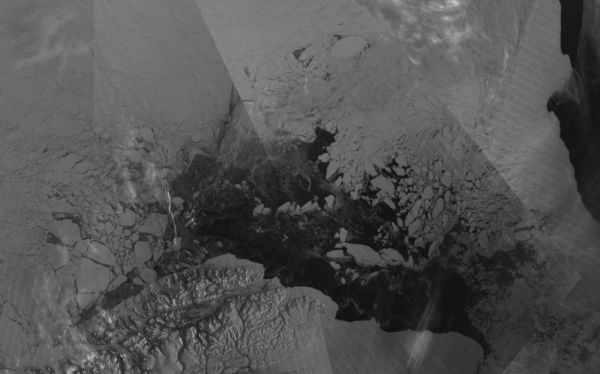
A Large Area of Open Water Forms in the Melting Sea Ice North of Greenland During February

26 January, 2018

In concert with an unprecedented polar warming event, it now appears that the Atlantic side of the Arctic Ocean is seeing some severe sea ice loses.

Warm winds blowing at up to gale force intensity from the south have assaulted the ice with high waves and above-freezing temperatures for about four days now. The ice edge north of Svalbard is being rapidly beaten back. Perhaps more disturbing, is the fact that the ice pack to the north of Greenland has also now withdrawn — opening up a huge polynya.
(Massive hole in the sea ice expands north of Greenland on February 26th. Image source: NASA.)

Looking at the N. Greenland area, we find a fractured, thinning mess along a region of sea ice that should be meters thick and growing thicker at this time in February. Such a state would be remarkable during summer time, but is much more-so in what should be the dark chill of winter polar night.
To be clear, as Neven notes in his most recent Sea Ice Blog, it’s not simply wind blowing the ice around here. It’s melt due to temperatures rising between 40 and 60 F above average over a large region of the Arctic. A region that yesterday saw a 33-34 F above freezing temperature at the North Pole.

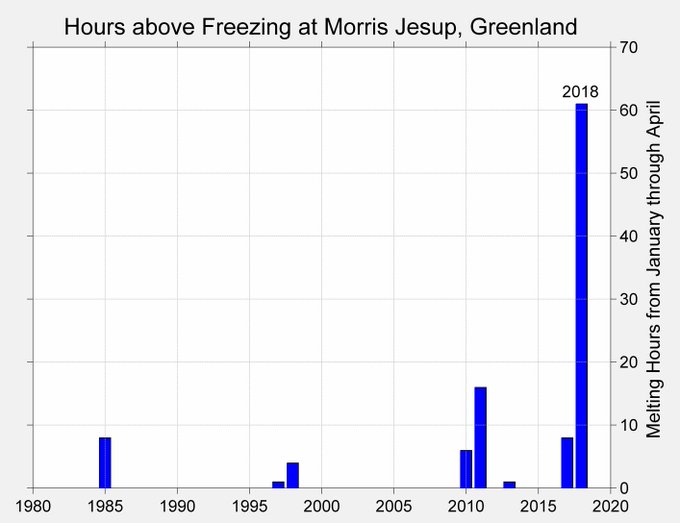
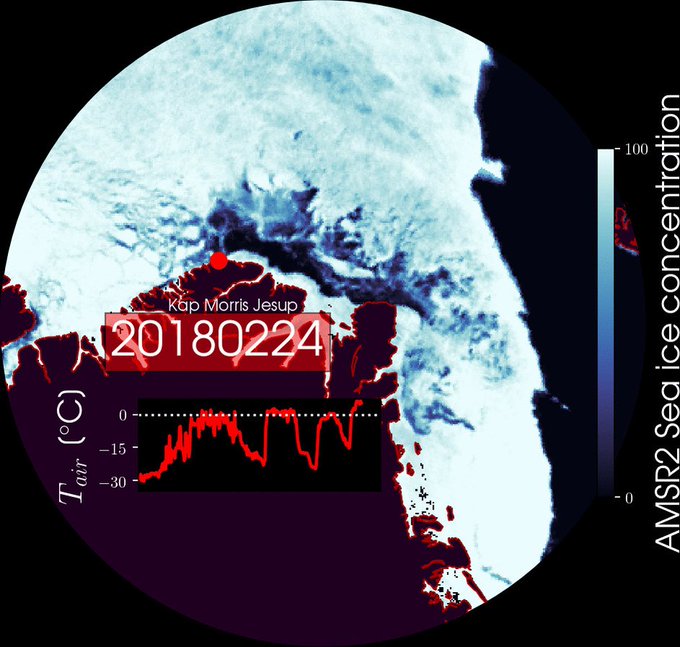
An updated time series for Cape Morris Jesup, Northern Greenland using DMI's hourly values.

The last 10 days have seen a series of swings near and above freezing. pic.twitter.com/v87fzaWLNP
In 2018, there have already been 61 hours above freezing at Cape Morris Jesup, Greenland.

The previous record was 16 hours before the end of April in 2011. pic.twitter.com/BCgcxAtKng


View image on Twitter

Closer to the massive expanse of water opening up in the ice, Cape Morris Jesup, the furthest north point in Greenland, has now experienced 61 melting hours during winter in 2018. This is comparable to 2011, which set the previous record for winter and early spring melt at 16 hours for the Morris Jesup location. This weekend, the typically frigid point on Greenland’s north coast saw a 43 degree Fahrenheit high in the 24-hour-long darkness (no sunlight or insolation) and at a time when usual daily peak readings hit a frosty -20 F.

The underside of sea ice melts at around -2 F, due to the salt content in the water. But surface portions of the ice still need above freezing temps to result in melt and ponding. Since this region of the Arctic tends to remain near or well below freezing year-round, the present temperatures are enabling unprecedented winter damage to the ice and the environments it supports.


There is open water north of where the thickest sea ice of the used to be. It is not refreezing quickly because air temperatures are above zero confirmed by @dmidk's weather station . Wacky weather continues with scary strength and persistence.

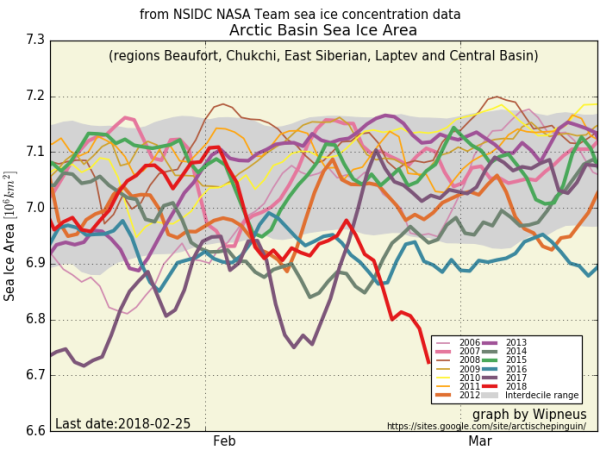
Overall, Arctic sea ice extent is now at record low levels for this time of year. According to JAXA, hitting 13.64 million square kilometers today — or nearly 2 million square kilometers below 1980s averages.


These record daily and seasonal lows are occurring following a major loss of ice in the Bering Sea and in concert with the rapid sea ice setbacks we are presently seeing on the Atlantic side.

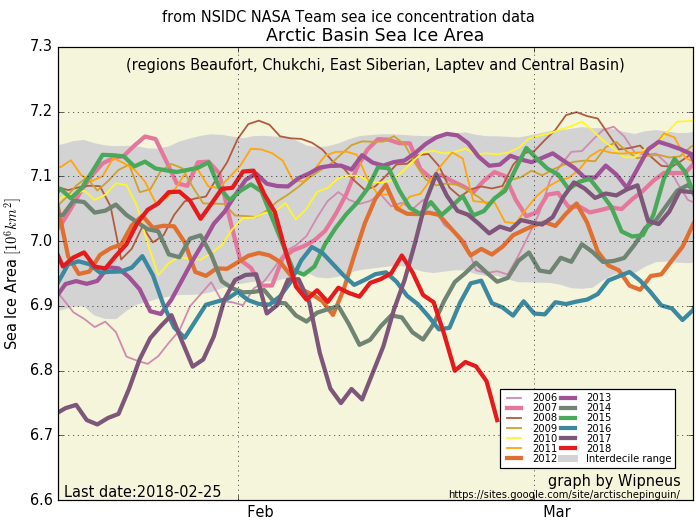
It is possible, given the present trend, that the Arctic will experience back-to-back years of record low seasonal ice during winter. 2016-2017 saw a crash in winter sea ice and we are presently even below the record low extents seen at that time
(Arctic Basin sea ice is at record lows and trending lower. Image source: The Arctic Sea Ice Blog. Graph by Wipneus.)
Only a month and a half of typical freeze season remains. But ten day forecasts indicated that Arctic mean temperatures might return closer to normal ranges (0 to 1 C above average as opposed the 3-6 C above average) and could allow for some recovery to the substantially reduced winter ice pack.

Overall, though, the tale so far has been one of highly unusual melt and warming. One that highlights the serious and worsening impacts of human-caused warming and related polar amplification.
(UPDATES TO FOLLOW)