Showing posts with label Siberai. Show all posts

Thursday, 10 August 2017

Wildfires rage in Greenland and Siberai )and in the Pacific North-West)

Fire in the Land of Ice: Massive Wildfires Rage Over Greenland and Siberia

14 August, 2017

Like never before, regions we typically associate with cold and ice are being over-run by wildfires. It’s a situation brought on by human-caused climate change. For our continued burning of fossil fuels is causing the Arctic to warm twice as fast as the rest of the globe. Under this oppressive influx of heat, the permafrost is thawing. And the fragile plants, frozen lands, and soils dependent on much cooler conditions simply cannot cope. Increasingly, and on greater and greater scales, they are burning.
(Large Greenland fire captured by NASA’s Earth Observatory on August 7th.)
This past week, an outlandish wildfire ignited about 100 miles southwest of Ilulissat near the western coast of Greenland. The fire, visible by satellite, cast a long smoke plume even as it exploded into fierce intensity. The odd blaze subsequently generated a rash of expert chatter among Arctic observers on twitter even as news sources like NPR scrambled for contextual information.

Due to typically very low fire incidence, Greenland lacks a national forest fire information center. However, widespread satellite reports and news based observation provide a pretty clear context for this odd event. According to news reports from NPR, the fire itself is a complex of multiple blazes — the largest of which has expanded to 3,000 acres. It’s a massive forest fire. And it’s exceptionally odd seeing such a blaze light up in typically-frozen Greenland.

(Time lapse of massive Greenland wildfire provided by Meteos.)
The fire ignited as temperatures rose to near 70 degrees (F) across the region. A range that is well above average for this Arctic zone. And brisk, down-sloping winds likely helped to speed the fire’s initial rapid expansion.

Fires do occur at times in Greenland. But they are usually rare and small. This year’s fires, on the other hand, have been exceptional. Preliminary satellite observation indicates that as much as 8 times the typical number of active fires have ignited so far in Greenland during 2017. And there is every indication that this particular fire complex is the largest ever recorded on an island that is mostly blanketed by thousands of feet of ice.

(Analysis of active wildfire pixels in Greenland satellite analysis indicates a substantially increased rate of burning in 2017.)
The fire itself is burning through peatlands — which contain deep, carbon-rich soils. In many regions, thawed permafrost ultimately becomes peat. In addition, peat itself is very sensitive to climate change related warming. For as exceptional heat dries the peat, it becomes a deep, dense fuel for fires. When the fires ultimately come, they can eat far into the peat soils — burning 3 feet or more beneath the ground.

Though not as bad as fossil fuel burning for the climate system, peat fires do provide a troubling amplifying feedback to human-caused climate change if they become widespread and if large permafrost zones thaw into peat and subsequently burn. One researcher noted to the New York Times last year that: “It’s carbon that has accumulated over several thousands of years. If it were to be released, the global CO2 concentration would be much higher.”

 
(Fires burning near the melting Greenland Ice Sheet are likely in a recently thawed permafrost zone. Permafrost contains a massive carbon store that if released will further exacerbate human-caused warming. Wildfires are one mechanism promoting that release. And as Arctic lands thaw and warm, more large fires are popping up across the Arctic. Image source: NASA Worldview.)
Jessica L. McCarty, an Assistant Professor of Geography at Miami University provides further context regarding the massive Greenland fires:
They are likely occurring in areas of degraded permafrost, which are predicted to have high thaw rates between now and 2050 with some evidence of current melt near Sisimiut. Fires in the High Northern Latitudes release significant CO2, CH4, N20, and black carbon. A fire this close to the Greenland Ice Shelf is likely to deposit additional black carbon on the ice, further speeding up the melt.”

Siberian Wildfires Now Extremely Intense

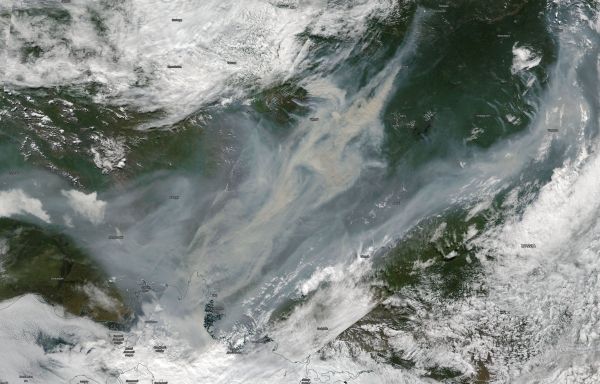
In many places throughout the Arctic, rapidly warmed and dried peatlands, forests and previously frozen permafrost zones are also burning. In Siberia the inky smoke plumes from massive fires today stretch for nearly 2,000 miles. Numerous fire complexes that dwarf the odd Greenland blaze are plainly visible in the satellite picture.
(The smoke plume in this image would blanket most of Greenland. Massive wildfires belch giant plumes of inky smoke over Siberia and the Arctic Ocean on August 9th. For reference, bottom edge of frame is 1,200 miles. Image source: NASA Worldview.)

The fires come with extreme heat along a high pressure ridge zone stretching from Lake Baikal all the way to the shores of the Arctic Ocean. Today, temperatures in this Arctic and near Arctic region are ranging from 80 to 90 degrees Fahrenheit or as much as 35 degrees (F) above average.
With so much Arctic warming and thawing now ongoing, massive fires have become a frequent occurrence during summertime in Siberia recently. And this year, Russia has resorted to cloud seeding in an apparently fruitless attempt to suppress the enormous blazes.
Most of today’s fires are burning in Yakutia — which contains one of the largest global stores of permafrost carbon in the world. During recent years, permafrost has more and more rapidly thawed through this zone — providing a larger and larger store of peat-like fuels for the kinds of fires we are seeing today.
Links:

Hat tip to Andy in San Diego
Hat tip to Vic
Hat tip to Greg


Tuesday, 19 July 2016

Huge wildfires in Siberia

Scores of City-Sized Siberian Wildfires Spew 2,500 Mile-Long Plume of Smoke Over Northern Hemisphere


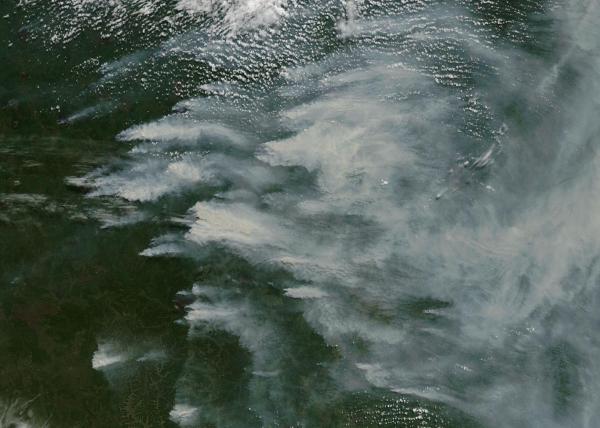
Today’s satellite pass by NASA’s LANCE MODIS array tells a dire story that practically no one in the global mainstream media is talking about. Northern and Central Siberia is burning. Scores of massive fires, some the size of cities and small states, are throwing off a great pall of smoke 2,500 miles long.

18 July, 2016

The vast boreal forests are lighting off like climate-change-enhanced natural fireworks. The tundra and permafrost lands — some of them frozen for hundreds of thousands to millions of years — are thawing and igniting. But for all of the loudly roaring fires, most of the major media reporting agencies have thus far produced only deafening silence.
Country-Sized Swath of Siberia is Covered With Wildfires

Massive Siberian Wildfires
(Large sections of Russia, Eastern Europe, and Scandinavia are blanketed by smoke from massive Siberian wildfires in today’s LANCE MODIS satellite shot.)

Imagine an enormous rectangle. At its northwestern end is the Yamal Peninsula and the shores of the Arctic Ocean. At its southeastern end is Lake Baikal, nearly 2,000 miles away. The vast expanse between is littered with fires. Some of these fires are relatively small. But others are vast, sporting firefronts 20-25 miles wide and revealing individual burn scars that, according to unconfirmed satellite analysis, appear to cover as much as 400 square miles of land.
And it’s not just a case of a smattering of these fires burning across the broad region. Rather, these massive fires are burning in multiple clusters, some of which would easily cover a region the size of the US state of South Carolina. The below image is a 300-by-220-mile box showing a section of North Central Arctic Siberia between north latitudes 58.5 and 66.2. Note that a significant portion of the land area in this satellite capture is covered by very large fires.
South Carolina Sized Siberian Region covered in smoke and flame
(Extensive swath of fires burn over North Central Siberia. Image shows a 300-by-220-mile area. Image source: LANCE MODIS.)

These very large fires are vigorously burning in a contiguous permafrost zone of Siberia. During recent years, as human fossil-fuel burning has continued to warm the Earth, such fires have become more and more common. Burning not only forest, the fires have also consumed duff, peat, and, increasingly, recently thawed sections of the permafrost. Though these fires are now in the process of activating a very large northern carbon store, and though such an event represents a dangerous amplifying feedback to human-forced warming, their occurrence and extent has been greatly underreported by the Russian government.

Fires Burning Near Yamal, Frozen Methane Deposits, Fossil Fuel Production Infrastructure

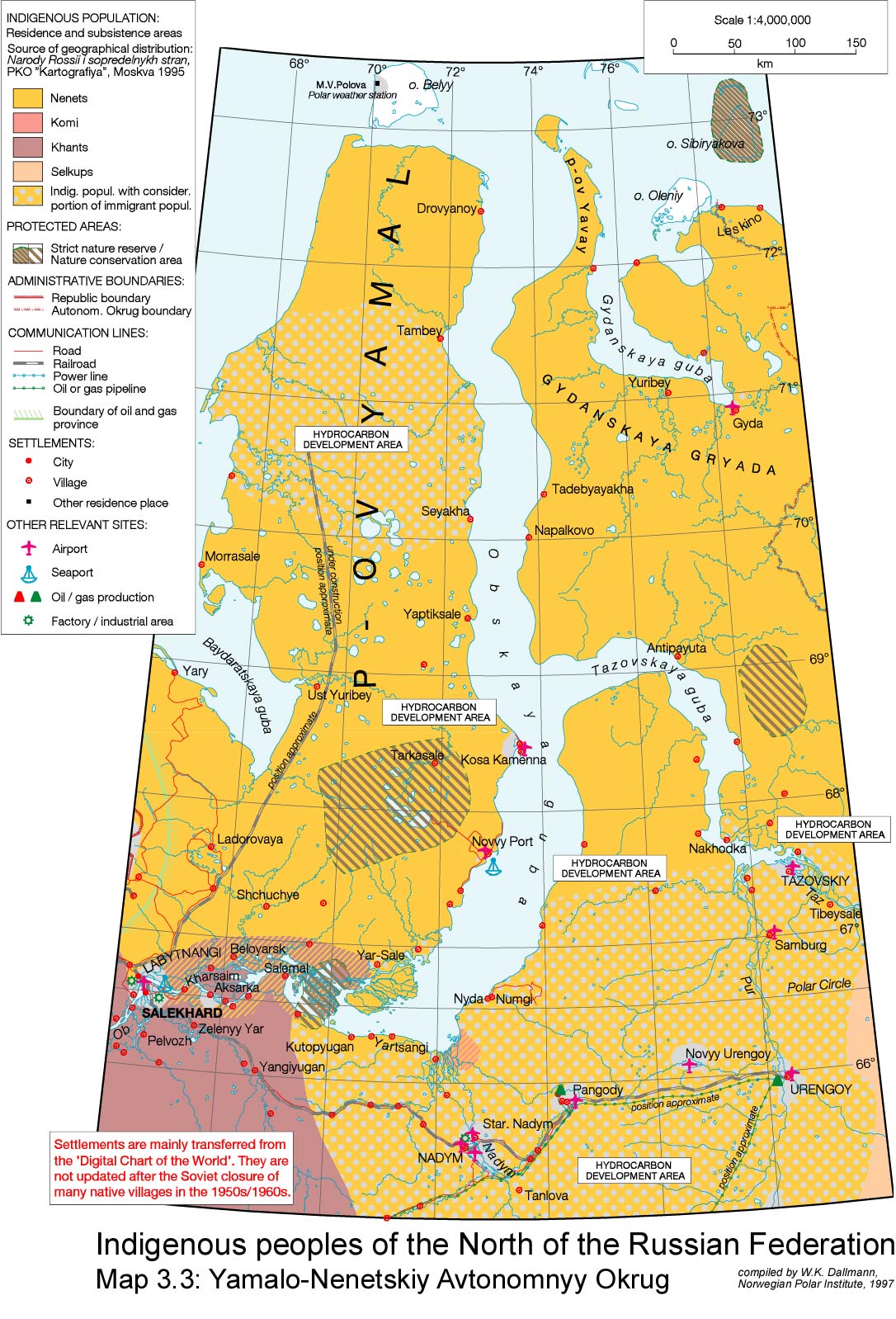
Further north, even the typically hard-frozen tundra regions are burning. Near the town of Nuya, along Obskaya Bay just east of Yamal, Russia and located in the fossil fuel development zone between north latitudes 66 and 67.3, enormous fires are raging. Like the recent Fort McMurray fire, these blazes appear to be burning near fossil fuel infrastructure and development zones.
Fires near Nuya Russia
(Large fires on the shores of Obskaya Bay in Northwestern Russia on July 18, 2016. Image source: LANCE MODIS.)

The Yamal region was also the location of the recent, and controversial, methane blowholes. The region sits over large gas deposits, some of which are in the form of clathrate. And some of the previously stable frozen deposits appear to be facing an increasing release pressure due to thawing, the invasion of warm liquid water into the subterranean environment, and, at the near-surface region, lightning strikes (which were previously unheard of in this zone) and wildfire pressure.

Up to 40-F-Above-Average Temperatures Blanket the Northern Fire Zone
Today, a good number of these fires burn north of the farthest northern extent of the Siberian tree line in 77 to 86 degrees F (25 to 30 C) temperatures. For some regions, these temperatures are 30 to 40 degrees F (17 to 22 C) above average. At the northwestern end of the vast, fire-marred range that now covers a land area larger than most countries, temperatures near the Arctic Ocean shore at 70.9° N, 81.4° E are 86 degrees F (30 C) — about 40 degrees F (22 C) above average. Not far away, the wildfires in the above image burn.
86 Degrees Near Arctic Ocean
(Extreme heat in the range of 30 to 40 degrees F above average temperatures [17 to 22 C] near Arctic Ocean shores greatly increases Arctic wildfire risk. Such extreme heat is related to human-forced climate change. As the Arctic warms at a rate two to three times faster than the rest of the globe, such fire-hazard and related potential for worsening amplifying feedbacks is also likely to increase. Image source: Earth Nullschool.)

Despite increasing prevalence and extent, Siberian wildfires have continued to be underreported during recent years, despite the fact that out of all major Arctic permafrost and boreal forest regions — Alaska, Canada, and Siberia — Siberia has shown the visibly greatest increase in wildfire frequency and extent. This is likely due, in part, to a now-documented underreporting of wildfire extent by the Russian government.

Links

Hat tip to Colorado Bob
Hat tip to DT Lange
Hat tip to Jim Benison


Saturday, 8 August 2015

Methane readings in the Arctic

Observations about methane readings


Seemorerocks


On 25 May I posted an alert of extra high methane readings above Barrow, Alaska 


On the basis of developing news of rapidly melting ice in the Arctic and especially in the ocean above Siberia, which is ice-free and with water that is above freezing (which raises the spectre of a rapid increase in the release of methane) I decided to check exactly what I could find out.

I decided to check the one source that I know about from May - that is readings from NOAA from their station at Barrrow AL (I do not know how to find direct readings for northern Siberia)


I put in the values as earlier suggested by Sam Carana (under 'time series')

methane
in-situ data

When I opted for data from this year, I got the following whereby data stoped in February


However, when I broadened the search to a multi-year one I got a chart that extends into this year.

What I observe from this is that the line of the mean readings seems to reflect the patterns of previous years, but that peak readings are much higher (more than 2000ppb). 

The individual dots reflect spikes in readings (including the one of 2845 ppb in May)
 
The latest data presented by Sam Carana in Arctic News reflects a similar situation with average readings remaining much the same,but with higher daily peak readings.

If you are a methane 'sceptic' you would want to look at the average readings but the preponderance of daily peak readings must be highly significant.

It is the trend of readings (prepared by Sam Carana) of methane readings for the two weeks from July 19 to August 4 that give reason to be worried.


With the situation with the data from the NOAA website does indicate that perhaps, at best NOAA are messing up, or, at worst, removing data they don't like.

While we are using about this I wonder what this news from today is about.

A problem with the F17 DMSP Satellite

August 7, 2015

On August 5, 2015, a problem arose with the F17 DMSP satellite that provides data to generate the daily maps and time series in the NSIDC Sea Ice Index and Arctic Sea Ice News and Analysis, as well as the Greenland Today daily melt extent. This has led to spurious values of sea ice for both the Arctic and Antarctic, and unreliable melt data for Greenland for this date. NSIDC is in the process of removing the spurious data, and will be closely monitoring the incoming F17 data stream.


In the meantime I am watching the whole situation in the Arctic with great trepediation and l'll be watching it closely in the coming weeks.

Wednesday, 6 May 2015

Reports on global warming from Siberia

New warning about climate change linked to peat bogs

Expert says deadly gas released from melting permafrost region will lead to 'awful' consequences for global warming.


By Vera Salnitskaya

Thaw of the frozen bogs, which take up as much as 80 per cent of the landmass of western Siberia, will release billions of tonnes of methane. Picture: Sergey Kirpotin

5 May, 2015


A leading Siberian scientist has delivered another stark warning about climate change and said melting peat bogs could speed up the process.

Professor Sergey Kirpotin, director of the BioClimLand Centre of Excellence for Climate Change Research in Tomsk, said he has concerns over the 'awful' consequences in Russia’s sub-Arctic region.

He said that a thaw of the frozen bogs, which take up as much as 80 per cent of the landmass of western Siberia, will release billions of tonnes of methane – a greenhouse gas more potent than carbon dioxide – into the atmosphere. That, he concluded, will greatly speed up the effects of global warming around the world with potentially devastating consequences.

Sergey Kirpotin
Prof Kirpotin, 51, first made the discovery about the threat 10 years ago when it was found the permafrost melting for the first time since being formed at the end of the Ice Age. Picture: Vera Salnitskaya

'Bogs are extremely important for humanity,' explained Prof Kirpotin. 'Over thousands of years bogs have been absorbing carbon dioxide from the atmosphere and storing it at peat deposits. Carbon is a basic component of greenhouse gases. This way, bogs function as a sort of natural freezer as they don’t let the carbon build up in the atmosphere.

'However, the permafrost in northern areas of western Siberia has started melting. As the permafrost thaws, it creates new lakes and old ones get bigger. This way, all the organics trapped in permafrost started decomposing rather quickly. Obviously, a lot of greenhouse gases, such as carbon dioxide and methane, are released into the atmosphere. Methane is a greenhouse gas 30 times more potent than carbon dioxide.'

He added: 'There is a so-called methane threat in the north of the bog. On top of that, the ice shelf is also thawing releasing methane hydrates and something really awful is happening.'

Probes with methane


Sergey Kirpotin and Rinat
Probes with methane. Sergey Kirpotin(left) and Rinat Manasypov holding the probes of snow, taken on Vasyugan Mire this winter. Pictures: Vera Salnitskaya

Various experts have been examining Siberia’s bog land, and its changing conditions, for decades. The bogs covering western Siberia spread out to a total of 7.5million hectares and give the region a unique eco-system. Within this region, the Vasyugan Mire bog is the largest anywhere in the world.

At more than 53,000km sq in size – making it bigger than Switzerland – Vasyugan Mire is 10,000-years-old and is famous around the world for its rare flora and fauna. Under ice and snow for much of the year, recently tourism officials launched a bid to attract wildlife lovers and environmentalists to the area.

The BioClimLand centre was established a year ago and mainly focuses on climate studies, with a special laboratory for biochemical and remote environment monitoring.

Prof Kirpotin, 51, first made the discovery about the threat 10 years ago when it was found the permafrost melting for the first time since being formed at the end of the Ice Age.

Vasyugan Mire


Vasyugan Mire


Vasyugan Mire


Vasyugan Mire


Vasyugan Mire
'Bogs are extremely important for humanity. Over thousands of years bogs have been absorbing carbon dioxide from the atmosphere and storing it at peat deposits.' Pictures: Sergey Kirpotin

He warned at the time that it could be an 'ecological landslide that is probably irreversible'. Now it seems the situation is more advanced than first thought. He said: 'The Arctic regions are more subject to climate change. There are so-called hot spots in the Arctic and northern western Siberia is one of them.

'That’s happening for a few reasons. Scandinavia is warmed by the Gulfstream so the changes there are not as rapid. Canada and Alaska have shorter meridional lengths. Siberia is the largest Arctic territory in the world, besides, there is a vast climate change [from continental] to extreme continental as you move from the west to the east. This way the changes in western Siberia are more extreme and dramatic than elsewhere in the world.'

The new warning comes just weeks after another Russian expert said the Arctic could be completely ice-free within just 40 years.

Nobel Peace Prize winner Professor Oleg Anisimov said there is now evidence that temperatures are rising four times faster in the frozen region than the rest of the planet.

It would mean open water at the top of the world by 2050, with nothing more than a few floating icebergs where the North Pole was once located


Will the Arctic be ice-free in 40 years? Expert claims temperatures in polar regions are rising four times faster than the rest of the planet
  • Professor Oleg Anisimov said Arctic temperatures are rising fast

  • This means that there will be open water in the polar region by the 2050s
  • Forecasts that the region's temperature will rise by 7°C within a century
  • Melting permafrost is already causing damage

25 February, 2015

The Arctic could be completely free of ice in just 40 years as a result of global warming, one of the world's leading climate change experts has warned.

Nobel Peace Prize winner Professor Oleg Anisimov said there is evidence that temperatures are rising four times faster in the frozen region than the rest of the planet.

This means that there will only be open water in the polar region by the 2050s, with nothing more than a few floating icebergs at the North Pole, according to the Russian academic.

Alarming: The Arctic could be completely free of ice in just 40 years as a result of global warming, one of the world's leading climate change experts has warned. This map shows rates of erosion on the Arctic coast, with the fastest rates marked in red

Alarming: The Arctic could be completely free of ice in just 40 years as a result of global warming, one of the world's leading climate change experts has warned. This map shows rates of erosion on the Arctic coast, with the fastest rates marked in red

Professor Anisimov, from the State Hydrological Institute in St Petersburg, gave his stark warning during a lecture in the Sakha Republic - the coldest part of Russia.

He forecasts that the region will see temperature rises of up to 7°C within a century.

For several reasons, the Arctic climate change is more intense and faster than in other regions. There is a reduction in snow and ice cover, which has a protective function,’ he said.

On average over the last year, the minimum area of sea ice has decreased from 5.4 to 5.3 million square kilometres [two million square miles]. Over the past 10 years, the reduction of sea ice in the Arctic was by 13.7 per cent.

Shocking pictures from Siberia (one is pictured) show the collapse of buildings due to melting permafrost. According to environmentalists, as the snow and ice melts, the ability of the Arctic region to reflect heat back into space is reduced and the rate of global warming is accelerated once more

Shocking pictures from Siberia (one is pictured) show the collapse of buildings due to melting permafrost. According to environmentalists, as the snow and ice melts, the ability of the Arctic region to reflect heat back into space is reduced and the rate of global warming is accelerated once more

Nobel Peace Prize winner Professor Oleg Anisimov (pictured) said there is evidence that temperatures are rising four times faster in the frozen region than the rest of the planet

Nobel Peace Prize winner Professor Oleg Anisimov (pictured) said there is evidence that temperatures are rising four times faster in the frozen region than the rest of the planet

By the middle of the century it may be that the Arctic Ocean will be completely ice free.’

Environmentalists and climate change scientists have long known about the potential disaster in the Arctic as a result of rising global temperatures. 

The Yakutia region is experiencing climate change at a rapid rate and a 1884 map (pictured) shows Arctic islands that have already vanished

The sea ice is already at the lowest ever level recorded, with the WWF warning that a rise of just 2°C would be enough to melt the remaining floes.

As well as rising sea waters, climate change could threaten delicate ecosystems and marine life.

According to environmentalists, as the snow and ice melts, the ability of the Arctic region to reflect heat back into space is reduced and the rate of global warming is accelerated once more.

This could spark increasing numbers of forest fires and unpredictable storms and, at worst, bring a halt to the Gulf Stream which warms Europe.
The Sakha Republic, also known as Yakutia, is experiencing climate change at a quicker rate than other parts of the world, The Siberian Times reported.

A map of the region from 1884 is already radically different to today's, with Arctic islands having vanished under rising sea waters.

Professor Anisimov predicts overall increases of about 7°C by next century in Russia's frozen north.

Shocking pictures from Siberia highlighted by the academic show the collapse of buildings due to melting permafrost.

In 2007, as part of an Inter-governmental Panel on Climate Change, he was awarded the Nobel Peace Prize for research on the impact of global warming, and is considered one of the world's most eminent experts on the subject.

He said: ‘If the global temperature got warmer by 0.85°C in 100 years, in Yakutia the winter temperature will have increased by 3.5°C.

Professor Anisimov said: ‘If the global temperature got warmer by 0.85°C in 100 years, in Yakutia the winter temperature will have increased by 3.5°C.' This picture shows s house destroyed by melting ice on Yenisey - the largest river system flowing to the Arctic Ocean

Professor Anisimov said: ‘If the global temperature got warmer by 0.85°C in 100 years, in Yakutia the winter temperature will have increased by 3.5°C.' This picture shows s house destroyed by melting ice on Yenisey - the largest river system flowing to the Arctic Ocean

As well as erosion (areas of which are marked on this map), climate change has been blamed for the series of unexplained craters appearing throughout Russia

As well as erosion (areas of which are marked on this map), climate change has been blamed for the series of unexplained craters appearing throughout Russia

That is, global warming here is four times faster. According to our forecasts, the temperature in the north will increase by six to seven degrees by the 2100s.’
Other scientists have already speculated that global warming could be partly responsible for the series of unexplained craters appearing throughout Russia.

They believe warming air is melting thick permafrost, leading to the accumulation and release of volatile ‘fire ice’ gases which then explode to create the giant craters.

Almost two thirds of the Russian land mass lies within a permafrost zone and there are concerns that any melting of this could cause potential problems for infrastructure, such as buildings in cities and pipelines.

Projected changes in the permafrost seriously threaten the Russian economy, primarily due to the increased risk of damage to the infrastructure of the Far North,’ Professor Anisimov said.

The US-based Natural Resources Defence Council said it is vital to pay attention to environmental changes at the top of the world.

The Arctic is global warming’s canary in the coal mine.

Most scientists view what is happening now in the Arctic as a harbinger of things to come,’ the council said.

...GLOBAL WARMING MAY BE THE CAUSE OF ENORMOUS HOLES IN RUSSIA


Four new mysterious giant craters have appeared in the Siberian permafrost in northern Russia, sparking fears that global warming may be causing gas to erupt from underground.

Scientists spotted the new holes, along with dozens of other smaller ones, in the same area as three other enormous craters that were spotted on the Yamal Peninsula last year.

The craters are thought to be caused by eruptions of methane gas from the permafrost as rising rising temperatures causes the frozen soil to melt.

It has sparked fears that the craters could become more common as climate change continues to warm and led to warnings that the area is facing a looming natural Ð½disaster.

Unexplained: The first of the new craters discovered, named B1 (pictured above), shows signs of an huge eruption of gas. Four new mysterious giant craters have appeared in the Siberian permafrost in northern Russia, sparking fears that global warming may be causing gas to erupt from underground

Unexplained: The first of the new craters discovered, named B1 (pictured above), shows signs of an huge eruption of gas. Four new mysterious giant craters have appeared in the Siberian permafrost in northern Russia, sparking fears that global warming may be causing gas to erupt from underground

One of new craters, surrounded by at least 20 smaller holes, is just six miles from a major gas production plant.

Experts have predicted there could be up to 30 more are waiting to be discovered.

Scientists, however, are still largely baffled by the exact processes causing the craters.

Professor Vasily Bogoyavlensky, deputy director of the Moscow-based Oil and Gas Research Institute, part of the Russian Academy of Sciences, has called for 'urgent' investigation of the new phenomenon amid safety feÑ‹rs.

Until now, the existence of only three Siberian craters had been established when great caverns in the frozen landscape were spotted by passing helicopter pilots.
'We know now of seven craters in the Arctic area,' Professor Bogoyavlensky told The Siberian Times.

'Five are directly on the Yamal peninsula, one in Yamal Autonomous district, and one is on the north of the Krasnoyarsk region, near the Taimyr peninsula.
'We have exact locations for only four of them. The other three were spotted by reindeer herders.

'But I am sure that there are more craters on Yamal, we just need to search for them. I would compare this with mushrooms.

'When you find one mushroom, be sure there are few more around. I suppose there could be 20 to 30 craters more.'

Two of the newly-discovered large craters - also known as funnels to scientists - have turned into lakes, revealed Professor Bogoyavlensky.

'It is important not to scare people, but this is a very serious problem. We must research this phenomenon urgently to prevent possible disasters.

'We cannot rule out new gas emissions in the Arctic and in some cases they can ignite.'


Yakutsk

Yenisey

Permafrost destruction
The collapse of the corner of the building in the center of Yakutsk in 1999, pictured by Mikhail Grigoriev. The building of a military unit, located in the lower reaches of the Yenisei River, badly damaged by thawing of permafrost and collapsed due to the melting of permafrost section of the building in Chersky settlement pictured by Vladimir Romanovskiy/University of Alaska Fairbanks