Showing posts with label Phillipines. Show all posts

Tuesday, 30 May 2017

Another US regime-change agenda in the Philippines?

Is the CIA using ISIS in Marawi to topple Philippine President Rodrigo Duterte?


26 May, 2017

The Deep State is attacking the Philippines and they are using ISIS to do the deed. The goal is destabilize the Duterte’s rule in the Philippines. Why? Because after meeting with President Trump, Duterte promptly returned home, prosecuted 3,000 online child sex traffickers. He later found that the Deep State has positioned ISIS to destabilize the Philippines with the goal of regime change. ISIS is actually an occupying terrorist inside the Philippines.”[1]


The Philippine pivot away from the USA and toward Russia and China will not be tolerated under any circumstances by Deep State.  The critical geostrategic location of the Philippines within the Asian side of the Pacific Rim is much to important for the Anglo-American Axis to lose.

With this understanding, the MSM article posted below can be interpreted as a status report on the CIA-coordinated hostilities being conducted on the southern island of Mindanao. This very same strategy was utilized by the C.I.A. in Chechnya in an attempt to preoccupy Russia on their southern border with purposefully engineered ‘Islamic’ militarism.  In the instant case, the city of Marawi is being used to stage state-sponsored terrorism (predominantly the U.S. government) as a launch-pad to conquer the rest of Mindanao.  The very same strategy was used in Syria whereby ISIS and Al-Nusra were used by the C.I.A. to take over the outlying cities.

The battle-hardened jihadis, who are often transported from other war zones throughout the world, are not really Muslims; rather, they are trained as professional terrorists in the ‘madrassas’ in Pakistan which are funded by Saudi Arabia.  The Salafis of Wahhabism, which originated in Saudi Arabia as a violent splinter group of an ultra-fundamentalist Sunni sect, fanatically fight for ‘jihad’ for whoever pays them the most. This is why there are so many Wahhabi terrorist groups involved in the Syrian War; the mercenaries are always switching their allegiances to the highest paymaster.

Just like the fake civil war in Syria, these Wahhabi fighters have been flown in, shipped in and bussed into the Philippines to man a U.S.-manufactured insurgency.  In this way the C.I.A. will attempt to overthrow Duterte, just as they are trying to militarily remove Syrian President Bashar al-Assad.

Source

N.B. The following BBC report, like all “fake news” published by the Mainstream Media (MSM), ought to be read as an informal intelligence briefing.  The C.I.A., MI6, DGSE, GID, and the MOSSAD frequently use various MSM outlets to disseminate crucial info to their agents on the ground and militants on the battlefield alike.

Marawi fighting: Foreign fighters ‘among militants’ in Philippine city


BBC

Foreign fighters are among Islamist militants killed in a southern Philippine city over the past days, officials say.

Six jihadists, including Indonesian and Malaysian citizens, were killed as the army continued its operation to drive the rebels out of the city of Marawi.
Attack helicopters and special forces have been deployed in the offensive.
It is a rare admission by the authorities that local jihadists are working with international groups.

Marawi is a mainly Muslim city in Lanao del Sur province on the southern island of Mindanao. The province is a stronghold for the Maute group, which has pledged allegiance to so-called Islamic State (IS).

What is happening in Marawi?


Fighting erupted after a failed army raid to capture a top militant leader. At least 11 soldiers and 31 militants have been killed, a military spokesman said.
Philippine President Rodrigo Duterte imposed martial law in Mindanao on Tuesday in response to the violence
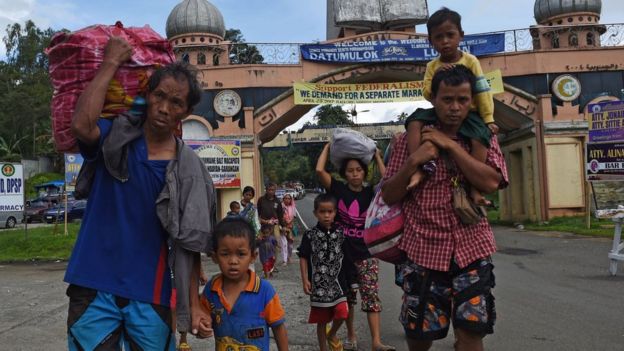
A family carrying their belongings flee from Marawi on the southern island of Mindanao

Martial law allows the use of the military to enforce order and the detention of people without charge for long periods.

What’s the IS link?


Manila’s solicitor-general said that what used to be domestic rebels have now subscribed to the ideology of IS.

What is happening in Mindanao is no longer a rebellion of Filipino citizens. It has transmogrified into an invasion by foreign fighters,” Jose Calida told a news conference.
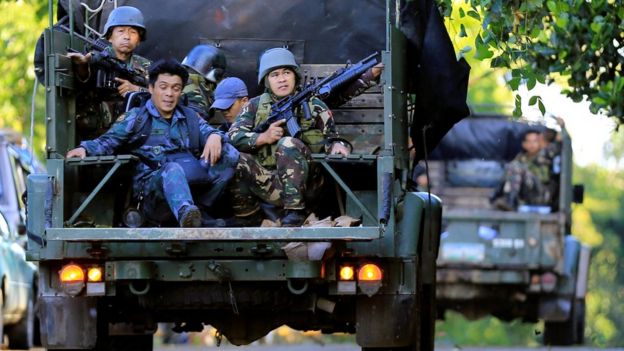
Government soldiers on military vehicles patrol after a continued assault on fighters from the Maute group who have taken over large parts of Marawi cityREUTERS – Marawi has seen intense fighting over the past days

They want to make Mindanao part of the caliphate.”
The government had always downplayed the numbers of foreigners amongst the local fighters, Sidney Jones, director of the Institute for Policy Analysis of Conflict in Jakarta told the BBC.
And it’s crucial that the government acknowledges that there is a serious IS problem in the Philippines,” she says, explaining that a much better co-ordination between local and national authorities was needed to deal with the situation.
class="image-and-copyright-container" style="border: 0px; font-family: inherit; font-size: 20px; font-style: inherit; font-weight: inherit; margin: 0px; outline: 0px; padding: 0px; vertical-align: baseline;"

The admission confirms what observers see as moves by IS targeting the majority Muslim southern Philippines to establish a stronghold in South East Asia.
It is clear that the number of men from both Indonesia and Malaysia who have travelled to Mindanao has increased over the past year,” Ms Jones explains.

Saturday, 25 January 2014

Climate change in the Philippines

The Neverending Deluge: Pacific Heat + Fixed Jet Stream Parks Anomalous January Cyclone Lingling Over Philippines For Two Weeks


24 January, 2014


The vulnerable island chain that is the Philippines already sits on the firing line of tropical storm devastation. During a typical year, about 20 tropical cyclones roar ashore, wrecking all sorts of havoc. In a typical year, this amazing parade of such cyclones begins in June.
But now it appears that weather in the Philippines, which was already rather extreme, has gotten much worse. For so far, this island nation has been treated to a tropical storm season that hasn’t ended for at least 20 months. The storm season didn’t end in 2013, when January 1rst saw the formation of that year’s first tropical cyclone. And the season didn’t end with the winter of 2014 when the devastating rainmaker that was Tropical Storm Lingling formed on January 10th.

(Lingling Track. Image source: Commons)
Lingling developed to the east of the Philippines over a pool of abnormally hot and deep warm water. Temperature anomalies for this region ranged up to 2.5 C above average. Perhaps more importantly and more ominously, the depth of this abnormally warm water extended far below the surface.
In a Deepening Pool of Hot Water
Such strange and anomalous conditions are expected under a regime of intensifying human-caused warming. In the hottest regions of the ocean, evaporation is expected to intensify as warmth increases. Eventually, the surface water becomes saltier as it becomes hotter, causing it to sink. This mechanism transfers heat deeper and deeper into the world’s tropical oceans. This process is the start of a dangerous ocean turnover. One related to hypoxia, ocean current changes, and stratification. And it appears that just such a perilous heat transfer is beginning in a region of the Pacific east of the Philippines.
We won’t go too far into detail about the initial signs of tropical ocean warming and turnover or its other hazards and implications here. However, suffice it to say that a deepening hot water pool in this region of the world appears to, at this time, be having a profound impact on storm formation and strength. Namely, it has spawned the almost constant progression of storms mentioned above. A hurricane season without end for two years. It is also the mechanism that, according to NOAA fueled the extraordinarily powerful Typhoon Haiyan, one of the strongest storms on record, which devastated the Philippines in November of 2013.
Now the same zone has spawned the epic rainmaker that is Lingling to again harry the Philippines just two months later.
The Storm that Wouldn’t End Forces More Than a Million to Flee
Lingling formed over this anomalously deep, hot water then marched in through the southern reaches of the Philippines where it has been dumping copious amounts of rain over the islands ever since. You can note the almost zero movement of the cyclone from January 11 to January 23 in the MODIS image sequence below:


(Lingling January 11, 16 and 23. Image source: Lance-Modis)
By January 22nd, over the course of 11 days of near-biblical flooding, the storm had inundated some parts of the Philippines with an astonishing 52 inches of rainfall, more than the amount New York receives in an entire year. By today, the never-ending deluge had resulted in 1.14 million evacuated, 63 missing, and over 54 lost lives. Numerous bridges and dams were also destroyed by the flooding, along with hundreds of homes. This, just two months after the strongest tropical cyclone ever to make landfall struck the northern part of this vulnerable island chain.
And with the anomalous January formation of a devastatingly persistent Lingling, there is simply no respite.
Jet Stream Lag, Stalled Fronts, and Hot, Deep Water
Lingling’s persistence over the Philippines for so long can be attributed to numerous factors. First, the storm was caught up in a stalled frontal boundary whose tail end had snagged over the Philippines for about 15 days running. The front itself was caught up in a Jet Stream trough shoved south by a disrupted and collapsing polar vortex (one that currently appears to be in the process of getting ripped in half). So Lingling became indirectly linked with polar amplification related events further north.
The stalled frontal boundary and related Jet Stream lag also resulted in Lingling remaining parked over hot Pacific waters of great depth. Normally, the cyclonic action of the storm would pump cooler, deeper waters to the surface and result in the storm’s weakening. Unfortunately, the deeper waters were also quite warm, so Lingling maintained enough strength to continue dumping epic amounts of rain over the Philippines for two weeks straight.
(Lingling, lower left, entangled in frontal system stretching all the way across the western Pacific on January 20, 2014. Front entanglement in a fixed Jet Stream pattern and related stalled frontal boundary helped result in Lingling’s 2 week persistence. Image source: Lance-Modis.)
This combination of conditions: hot, deep water, exceedingly early tropical storm formation (such that there is essentially no end to the Pacific cyclone season) and a lagging, persistent Jet Stream pattern resulting in an entirely abnormal storm event are unlikely to have occurred without the added weather forcing of human caused warming.
Unfortunately, the Philippines, at least for this year as in 2013, are likely to expect storm formation and impact to continue on throughout the year. Water conditions are certainly warm enough. So we will likely see the current 20 month storm season continue for another 11. A shift in winds, blowing the warmer waters east with an El Nino might bring some brief respite. But with human caused climate change pushing temperatures ever higher, we are likely to see the waters continue to warm, eventually over-riding such variability. In the end, the Philippines is indeed likely to see a never ending storm season.
Links:

Wednesday, 15 January 2014

More floods in the Phillippines


Deadly floods hit Philippines

The Philippines government says 22 people have been killed and nearly 200,000 evacuated as floods and landslides hit a southern region still recovering from a deadly typhoon in December 2012.


Radio NZ,

15 January, 2014


The flooded region is still recovering from a typhoon in 2012.The flooded region is still recovering from a typhoon in 2012.
Photo: AFP
Torrential rain struck the eastern side of Mindanao island at the weekend, unleashing fresh misery for survivors of Typhoon Bopha, civil defence officials said on Tuesday.

Local civil defence operations officer Franz Irag told AFP many of the victims had not managed to rebuild following the cyclone and were staying in temporary shelters when they were hit by fresh flooding.

The bad weather also forced more than 194,000 people to flee their homes, officials said. The rain had started abating on Monday and some of those who took refuge in government-run shelters were returning to their homes.

The Mindanao floods occurred amid an international rehabilitation effort for areas destroyed by Super Typhoon Haiyan in November last year.

Haiyan left at least 7986 people dead or missing across the central Philippines, according to a running government tally. Bodies are still being recovered from under the rubble.

An average of 20 typhoons and storms kill hundreds of people across the Philippines every year, but the last three years have been exceptional terms of the ferocity of some disasters.

Bopha left 1900 dead or missing on Mindanao by government count. Tropical Storm Washi also unleashed floods that killed 1080 people in December 2011.