Showing posts with label regime change. Show all posts

Tuesday, 3 November 2020

George Soros's Plan B if Trump wins the election

 George Soros's Plan B If Biden Loses


Town Hall

1 November, 2020


Editor's Note: This column is co-authored by John Aman

Billionaire George Soros is spending big—$70 million at last report—to evict Donald Trump from the White House. The radical philanthropist vilifies Trump as nothing more than “an impostor and a con man and a would-be dictator.” He considers America’s 45th president a "danger to the world" who would like to establish a “mafia state” here at home.

Which is why Soros is determined to oust the president and push the "Big Guy"—aka Joe Biden—over the finish line in first place on Nov. 3. But what if Biden loses? Well, don't expect Soros to give up and go home. 

George Soros has a plan B, and it's already underway, insists Richard Poe, co-author with David Horowitz of The Shadow Party, an in-depth examination of Soros’ far-reaching influence. “George Soros is trying to steal the election," Poe told D. James Kennedy Ministries, which produced the new, nationally aired documentary, Radical Billionaire: George Soros and the Scheme to Remake America. Poe claims Soros "has a whole crack team of experts, the top experts in the world.... And they are absolutely trying to steal this election."

Soros is committed to Trump’s removal. He assured elites at Davos in 2018 that Trump is a "purely temporary phenomenon that will disappear in 2020, or even sooner.” That's not an idle boast. Soros has an established record of driving leaders from power. Horowitz and Poe assert that “Soros’ Open Society Foundations have facilitated coups and rebellions in many countries, always ostensibly in the interests of ‘democratization.’”

Soros crowed in 2001 that his Open Society Foundations network has achieved "significant successes" in Slovakia, Croatia, and Yugoslavia where "civil society was mobilized to overturn ... overcome, rather, an oppressive regime." (see here at 22:25). Soros tried to catch himself, but "overturn" is correct.  That's obvious from how Soros-financed forces were deployed in Yugoslavia and, later, Georgia to sweep rulers off the stage. 

In Yugoslavia, Soros-funded protesters clogged Belgrade's streets to contest and halt an election. Rather than wait for the outcome of a run-off vote, the Soros-bankrolled "Otpor," a militant 70,000 strong youth organization staged a coup, write Horowitz and Poe. And they did so, the authors explain, not by relying on  

Kumbaya singalongs, but on fists, boots, guns and Molotov cocktails. On 5 October [2000], revolutionaries rioted in Belgrade, setting fire to the Federal Parliament Building and the headquarters of the state television network RTS. Janes’ Sentinel reports that Otpor-led units armed with AK-47s, mortars and shoulder-launched antitank weapons set up road-blocks around Belgrade.

Soros wasn't bluffing. He sent Otpor (Resistance) activists from Yugoslavia to train some 1,000 student activists in Georgia. And a Soros-funded television station began regular broadcasts of the documentary, Bringing Down a Dictator, showcasing Miloševic’s  defeat.

On election day, Shevardnadze declared victory but the Soros-funded television station aired exit poll results to the contrary. The exit polls, Horowitz and Poe report, were funded by Soros. With protesters in the streets and buses bringing more people into the capital city of Tbilisi, Shevardnadze decided against civil war and stepped down. 

It’s generally accepted public opinion here that Mr. Soros is the person who planned Shevardnadze’s overthrow,” the editor of a Georgian newspaper told Canada's Globe and Mail newspaper. Soros took credit. “I’m delighted by what happened in Georgia, and I take great pride in having contributed to it,” he told the Los Angeles Times.

Having used mass protests, even mob violence, to force regime change overseas, Soros is now focused on the United States. “I believe in the values of an open society,” the ultra-rich Leftist said in 2003. “For the past 15 years I have focused my energies on fighting for these values abroad. Now I am doing it in the United States.” 

At the time, Soros had targeted George W. Bush for ouster. Now it is President Donald Trump. And 2020 is the year. An internal Open Society Foundations strategy document from 2014 reveals how important this year is to OSF. The document—a breathtaking revelation of the Soros’s foundations aggressive pursuit of a remade America—states that plans were then underway to secure “fundamental reform by the year 2020 . . . in conjunction with a seminal election.”

The risk is very real, warns Richard Poe.

"They think this is their moment. George Soros and his colleagues who have broken many countries around the world . . . are now instituting a revolution here in the United States. And they believe that it can work this time. This is their big moment to overthrow our lawful government, to destroy our culture, to destroy our customs, to destroy our Constitution, to destroy our people, to destroy everything that is important in our lives," Poe wrote.

So what to do? First, cast your vote wisely on November 3. Pray diligently for God's mercy. And stand with elected leaders and police if and when they face Soros-inspired efforts to "mobilize civil society" to oust a duly-elected President Trump. 

Frank Wright, Ph.D., is President and CEO of D. James Kennedy Ministries where John Aman serves as Director of Communications. The DJKM-produced documentary, Radical Billionaire: George Soros and the Scheme to Remake America, may be viewed here.

Monday, 17 August 2020

What is going on in Belarus?

Massive demonstrations in 

Minsk

There are huge demonstrations in Belarus. Is it a spontaneous reaction to election fraud or is it being exploited by the West?

My own experience is limited to a 24 hour stopover in Minsk in which I got to hear a lot of dissatisfaction with the government of Lukashenko.  But that was back in 2007.

Is this a spontaneous response to election fraud, or something else?

I am not paying enough attention to this to make any sort of judgement.


No question about where the Guardian is on this.


On Saturday, the Belarusian president ordered an air assault brigade to be transferred from Vitebsk region in the country's northeast to Grodno region near Belarus's borders with Poland and Lithuania after expressing concerns about increasing military activity in those two NATO nations.


Belarusian President Alexander Lukashenko has given his first public address since last Sunday's presidential elections and the week of turmoil which has followed, and emphasized that he would not agree to any new round of elections demanded from abroad.


"Lithuania, Latvia, Poland and, unfortunately, our kindred Ukraine and its leadership are ordering us to hold new elections. If we agree to toe the line, we will go into a tailspin and never again stabilize our airship [of state]. We will die as a state, as a people, as a nation," Lukashenko said, speaking before thousands of supporters on Independence Square in central Minsk on Sunday. "I will never agree to the scrapping of our state. This will not happen," he stressed.


Lukashenko also warned about an alleged buildup of NATO forces, including tanks and aircraft, on Belarus's western borders.


"Look around: there are tanks, there aircraft are taking off 15 minutes from our borders. And this is not for nothing! NATO forces are clanging their tank tracks at our gates. A buildup of military power is taking place near the western border," Lukashenko said. "They [the opposition] are already being manipulated by outsiders, by puppeteers. They see the western borders of Belarus here, near Minsk, as it was in 1939, and not near Brest," he added. "This will not happen. We will become Brest Fortress. We will not give up the country."


Addressing allegations by the opposition that he had 'stolen' the election, Lukashenko said that this was impossible, given the size of his margin of victory. "The elections have taken place. It's impossible to falsify over 80 percent of the result. This cannot happen...Who will hold these [new] elections? Who will take part in these elections? Bandits and thieves!" he suggested


The Belarusian leader, who has been in power since 1994, and won a sixth consecutive term last Sunday, insisted that he was not clinging to his post. "I am not standing here because I have firmly grasped power. For a quarter of a century, I gave my youth and the best years of my life to serve you and our Motherland...They [the opposition] are shouting 'Go away!'. No problem, no problem. Presidents come and go...But then what? And who will we wait for here tomorrow? Who will we have to feed tomorrow?" he asked.


Lukashenko also stressed that if Belarusians want to see reforms, the government will be ready to start "tomorrow," so long as the requests are reasonable. He suggested, for example, that the state could not agree to give out 'free money' like some wealthier Western countries have amid the recent coronavirus crisis. "'Money thrown from helicopters' from thin air does not exist. That money must be earned every day, and not in the public square, but in factories and enterprises."


Lukashenko talks to the crowd

 The usual crowd saying the usual things

Dr Marcus Papadopoulos explained why Belarus will not fall victim to American designs on the country


The commentary from the Duran is far more nuanced

Belarus Lukashenko government faces collapse as protests gain strength


This is from a non-official news site from Russia


President of Belarus Alexander Lukashenko said that Russia is ready at the first demand of Minsk to send troops to the territory of the republic and provide all the necessary military assistance.

When it comes to the military component, we have an agreement with the Russian Federation within the framework of the Union State and the CSTO. These are the moments that fit this agreement. Therefore, today I had a long, detailed conversation with the Russian President about the situation. I was even somewhat surprised - he is absolutely devoted to what is happening. And we agreed with him - at our very first request, comprehensive assistance will be provided to ensure the security of the Republic of Belarus, "Lukashenko said at a meeting at the General Staff, Belta reports .


According to the Belarusian leader, he discussed the internal situation in the republic with Russian President Vladimir Putin by phone. The head of the Kremlin suggested that the problems of Belarus will soon be resolved.

During the dialogue, Lukashenka and Putin "reaffirmed their commitment to strengthening allied relations."

As you know, the European Union announced its intentions to impose sanctions against persons "responsible for violence, repression and falsification of election results" in Belarus.

We remind that the media reported that people from the circle of President of Belarus Alexander Lukashenko are preparing ways of retreat after the aggravation of the situation and bloody clashes in the country.

https://glavred.info/world/protesty-v-belarusi-putin-gotov-vvesti-voyska-po-trebovaniyu-lukashenko-novosti-mira-10195778.html?fbclid=IwAR3Br1Ex0gh9oKOkdk0fuV1OHL2IGAvwnFBLMInogb8mNzfJx3CjJqrB_n8


Finally here is Craig Murray weighing in 

Belarus

https://www.craigmurray.org.uk/archives/2020/08/belarus/

There is a misperception in western media that Lukashenko is Putin’s man. That is not true; Putin views him as an exasperating and rather dim legacy. There is also a misperception in the west that Lukashenko really lost the recent election. That is not true. He almost certainly won, though the margin is much exaggerated by the official result. Minsk is not Belarus, just as London is not the UK. Most of Belarus is pretty backward and heavily influenced by the state machinery. Dictators have all kinds of means at their disposal to make themselves popular. That is why the odd election or plebiscite does not mean that somebody is not a dictator. Lukashenko is a dictator, as I have been saying for nigh on twenty years.

My analysis is that Lukashenko probably won handily, with over 60% of the vote. But it was by no means a free and fair election. The media is heavily biased (remember you can also say that of the UK), and the weak opposition candidate was only there because, one way or the other, all the important opposition figures are prevented from standing.

The West is trying to engineer popular opinion in Belarus towards a “colour revolution”, fairly obviously. But they are on a sticky wicket. Western Ukraine was genuinely enthusiastic to move towards the west and the EU, in the hope of attaining a consumer lifestyle. Outside of central Minsk, there is very little such sentiment in Belarus. Most important of all, Belarus means “White Russia”, and the White Russians very strongly identify themselves as culturally Russian. We will not see a colour revolution in Belarus. The West is trying, however.

Unlike many of my readers, I see nothing outrageous in this. Attempting to influence the political direction of another country to your favour is a key aim of diplomacy, and always has been. I was a rather good exponent of it on behalf of the UK government for a couple of decades. The BBC World Service has always been FCO funded and its entire existence has been based on this attempt to influence, by pumping out propaganda in scores of languages, from its very inception. The British Council is not spending millions promoting British culture abroad from a pure love of Shakespeare. Government funding is given to NGO’s that aim to influence media and society. Future leaders are identified and brought on training and degree courses to wed them to pro-British sympathies.

I do not have any trouble with any of that. It is part of what diplomacy is. It is of course amusing when the British state works itself into a frenzy over Russia carrying out exactly the same type of activity that the British do on a much larger scale. But it is all part of an age old game. If I were Ambassador to Belarus now, I would have no moral qualms about turning up to support an anti-Lukashenko demo. It is all part of the job.

There is of course a murkier aspect of all this, where activities are hidden rather than open. The British state funded Integrity Initiative’s work in secretly paying foreign media journalists, or creating thousands of false social media identities to push a narrative (the latter also undertaken by MOD and GCHQ among others), is more dubious. So is MI6’s more traditional work of simply suborning politicians, civil servants and generals with large bundles of cash. But again, I can’t get too worked up about it. It is the dirtier end of the game, but time-honoured, with understood boundaries. Again, my major objection is when the UK gets ludicrously sanctimonious about Russia doing precisely what the UK does on a far larger scale.

But then we get into a far darker area, of assassinations, false flag shootings and bombings and false incrimination. Here a line is crossed, lives are destroyed and violent conflict precipitated. Here I am not prepared to say that time honoured international practice makes these acts acceptable. This line was crossed in the Ukraine; for reasons given above I do not think that the tinder exists to trigger the striking of such a spark in Belarus.

I should be very happy to see Lukashenko go. Term limits on the executive should be a factor in any decent democracy. Once you have the levers of power, it is not difficult to maintain personal popularity for many decades, barring external shock; popularity is not the same as democratic legitimacy. I should state very plainly, as I have before, that I think it was absolutely wrong of Putin to outstay his two terms, irrespective of constitutional sophistry and irrespective of popular support.

The ideal would be for Lukashenko to go and for there to be fresh elections, as opposed to the Venezuelan tactic of the West just announcing a President who has never won an election. The best result for the people of Belarus and for international stability would be the election of a reform minded but broadly pro-Russian candidate. Putin has used the crisis to re-assert the “union” of Russia and Belarus – signed 20 years ago this is a single market and free trade area. Few would doubt, crucially including few Belarussians, that the future of Belarus lies with integration with Russia rather than the EU.

History’s greatest criticism of Putin will be his failure to diversify the Russian economic base and move it from raw commodity exporter to high value added economy. His aims for Belarus will be to ensure it fits neatly with the template of massive commodity exports controlled by a tight knit and highly wealthy oligarchy. Putin will have no interest in the economic reforms Belarus needs.

My expectation is that Lukashenko will hang on, reorienting the economy back towards Russia. Putin’s long term policy goal has always been the reintegration into Russia of majority Russophone areas of the old USSR. That has been his policy in Ukraine and Georgia. Belarus is a major prize. He will seek to bind Belarus in tighter, probably through increased energy subsidy (Putin’s economic arsenal is very limited). Getting rid of Lukashenko is going to move up Putin’s to do list; I give it three years. The current demonstrations in Minsk have no major economic or social effect, and will pass.

P.s. Perhaps this should be factored in


Belarus: Belarus strongman Alexander Lukashenko flatly rejected the idea that his 

country should lock down to “save” his nation from the coronavirus. Instead, 

Belarus kept society completely open (well, for an authoritarian state, at least), and 

became one of the few countries in the world to continue professional sports and 

other events that involved large gatherings.


Lukashenko “suggested drinking vodka, going to saunas and driving tractors to fight 

the virus,” Reuters reported in April.


https://rielpolitik.com/2020/08/11/world-war-c-these-5-countries-are-the-real-covid-19-success-stories/


https://www.wsws.org/en/articles/2020/08/14/cris-a14.html?fbclid=IwAR1wk5UIkg6Lwj5IiPbKlzuzSi7Nk-Fj1QblaaOf8abuBM4YqXBRkQuOhso


Monday, 10 August 2020

Pepe Escobar on Lebanon: who benefits?

 Who Profits from the Beirut Tragedy?


by Pepe Escobar


Vineyard of the Saker,

8 August, 2020


The narrative that the Beirut explosion was an exclusive consequence of negligence and corruption by the current Lebanese government is now set in stone, at least in the Atlanticist sphere.

And yet, digging deeper, we find that negligence and corruption may have been fully exploited, via sabotage, to engineer it.

Lebanon is prime John Le Carré territory. A multinational den of spies of all shades – House of Saud agents, Zionist operatives, “moderate rebel” weaponizers, Hezbollah intellectuals, debauched Arab “royalty,” self-glorified smugglers – in a context of full spectrum economic disaster afflicting a member of the Axis of Resistance, a perennial target of Israel alongside Syria and Iran.

As if this were not volcanic enough, into the tragedy stepped President Trump to muddy the – already contaminated – Eastern Mediterranean waters. Briefed by “our great generals,” Trump on Tuesday said: “According to them – they would know better than I would – but they seem to think it was an attack.”

Trump added, “it was a bomb of some kind.”

Was this incandescent remark letting the cat out of the bag by revealing classified information? Or was the President launching another non sequitur?

Trump eventually walked his comments back after the Pentagon declined to confirm his claim about what the “generals” had said and his defense secretary, Mark Esper, supported the accident explanation for the blast.

It’s yet another graphic illustration of the war engulfing the Beltway. Trump: attack. Pentagon: accident. “I don’t think anybody can say right now,” Trump said on Wednesday. “I’ve heard it both ways.”

Still, it’s worth noting a report by Iran’s Mehr News Agency that four US Navy reconnaissance planes were spotted near Beirut at the time of the blasts. Is US intel aware of what really happened all along the spectrum of possibilities?

That ammonium nitrate

Security at Beirut’s port – the nation’s prime economic hub – would have to be considered a top priority. But to adapt a line from Roman Polanski’s Chinatown: “Forget it, Jake. It’s Beirut.”

Those by now iconic 2,750 tons of ammonium nitrate arrived in Beirut in September 2013 on board the Rhosus, a ship under Moldovan flag sailing from Batumi in Georgia to Mozambique. Rhosus ended up being impounded by Beirut’s Port State Control.


Subsequently the ship was de facto abandoned by its owner, shady businessman Igor Grechushkin, born in Russia and a resident of Cyprus, who suspiciously “lost interest” in his relatively precious cargo, not even trying to sell it, dumping style, to pay off his debts.

Grechushkin never paid his crew, who barely survived for several months before being repatriated on humanitarian grounds. The Cypriot government confirmed there was no request to Interpol from Lebanon to arrest him. The whole op feels like a cover – with the real recipients of the ammonium nitrate possibly being “moderate rebels” in Syria who use it to make IEDs and equip suicide trucks, such as the one that demolished the Al Kindi hospital in Aleppo.

The 2,750 tons – packed in 1-ton bags labeled “Nitroprill HD” – were transferred to the Hangar 12 warehouse by the quayside. What followed was an astonishing case of serial negligence.

From 2014 to 2017 letters from customs officials – a series of them – as well as proposed options to get rid of the dangerous cargo, exporting it or otherwise selling it, were simply ignored. Every time they tried to get a legal decision to dispose of the cargo, they got no answer from the Lebanese judiciary.

When Lebanese Prime Minister Hassan Diab now proclaims, “Those responsible will pay the price,” context is absolutely essential.

Neither the prime minister nor the president nor any of the cabinet ministers knew that the ammonium nitrate was stored in Hangar 12, former Iranian diplomat Amir Mousavi, the director of the Center for Strategic Studies and International Relations in Tehran, confirms. We’re talking about a massive IED, placed mid-city.

The bureaucracy at Beirut’s port and the mafias who are actually in charge are closely linked to, among others, the al-Mostaqbal faction, which is led by former Prime Minister Saad al-Hariri, himself fully backed by the House of Saud.

The immensely corrupt Hariri was removed from power in October 2019 amid serious protests. His cronies “disappeared” at least $20 billion from Lebanon’s treasury – which seriously aggravated the nation’s currency crisis.

No wonder the current government – where we have Prime Minister Diab backed by Hezbollah – had not been informed about the ammonium nitrate.

Ammonium nitrate is quite stable, making it one of the safest explosives used in mining. Fire normally won’t set it off. It becomes highly explosive only if contaminated – for instance by oil – or heated to a point where it undergoes chemical changes that produce a sort of impermeable cocoon around it in which oxygen can build up to a dangerous level where an ignition can cause an explosion.

Why, after sleeping in Hangar 12 for seven years, did this pile suddenly feel an itch to explode?

So far, the prime straight to the point explanation, by Middle East expert Elijah Magnier, points to the tragedy being “sparked” – literally – by a clueless blacksmith with a blowtorch operating quite close to the unsecured ammonium nitrate. Unsecured due, once again, to negligence and corruption – or as part of an intentional “mistake” anticipating the possibility of a future blast.

This scenario, though, does not explain the initial “fireworks” explosion. And certainly does not explain what no one – at least in the West – is talking about: the deliberate fires set to an Iranian market in Ajam in the UAE, and also to a series of food/agricultural warehouses in Najaf, Iraq, immediately after the Beirut tragedy.

Follow the money

Lebanon – boasting assets and real estate worth trillions of dollars – is a juicy peach for global finance vultures. To grab these assets at rock bottom prices, in the middle of the New Great Depression, is simply irresistible. In parallel, the IMF vulture would embark on full shakedown mode and finally “forgive” some of Beirut’s debts as long as a harsh variation of “structural adjustment” is imposed.

Who profits, in this case, are the geopolitical and geoeconomic interests of US, Saudi Arabia and France. It’s no accident that President Macron, a dutiful Rothschild servant, arrived in Beirut Thursday to pledge Paris neocolonial “support” and all but impose, like a Viceroy, a comprehensive set of “reforms”. A Monty Python-infused dialogue, complete with heavy French accent, might have followed along these lines: “We want to buy your port.” “It’s not for sale.” “Oh, what a pity, an accident just happened.”

Already a month ago the IMF was “warning” that “implosion” in Lebanon was “accelerating.” Prime Minister Diab had to accept the proverbial “offer you can’t refuse” and thus “unlock billions of dollars in donor funds.” Or else. The non-stop run on the Lebanese currency, for over a year now, was just a – relatively polite – warning.

This is happening amid a massive global asset grab characterized in the larger context by American GDP down by almost 40%, arrays of bankruptcies, a handful of billionaires amassing unbelievable profits and too-big-to-fail megabanks duly bailed out with a tsunami of free money.

Dag Detter, a Swedish financier, and Nasser Saidi, a former Lebanese minister and central bank vice governor, suggest that the nation’s assets be placed in a national wealth fund. Juicy assets include Electricité du Liban (EDL), water utilities, airports, the MEA airline, telecom company OGERO, the Casino du Liban.

EDL, for instance, is responsible for 30% of Beirut’s budget deficit.

That’s not nearly enough for the IMF and Western mega banks. They want to gobble up the whole thing, plus a lot of real estate.

The economic value of public real estate can be worth at least as much as GDP and often several times the value of the operational part of any portfolio,” say Detter and Saidi.

Who’s feeling the shockwaves?

Once again, Israel is the proverbial elephant in a room now widely depicted by Western corporate media as “Lebanon’s Chernobyl.”

A scenario like the Beirut catastrophe has been linked to Israeli plans since February 2016.

Israel did admit that Hangar 12 was not a Hezbollah weapons storage unit. Yet, crucially, on the same day of the Beirut blast, and following a series of suspicious explosions in Iran and high tension in the Syria-Israeli border, Prime Minister Netanyahu tweeted , in the present tense: “We hit a cell and now we hit the dispatchers. We will do what is necessary in order to defend ourselves. I suggest to all of them, including Hezbollah, to consider this.”

That ties in with the intent, openly proclaimed late last week, to bomb Lebanese infrastructure if Hezbollah harms Israeli Defense Forces soldiers or Israeli civilians.

A headline – “Beirut Blast Shockwaves Will Be Felt by Hezbollah for a Long Time” – confirms that the only thing that matters for Tel Aviv is to profit from the tragedy to demonize Hezbollah, and by association, Iran. That ties in with the US Congress “Countering Hezbollah in Lebanon’s Military Act of 2019” {S.1886}, which all but orders Beirut to expel Hezbollah from Lebanon.

And yet Israel has been strangely subdued.

Muddying the waters even more, Saudi intel – which has access to Mossad, and demonizes Hezbollah way more than Israel – steps in. All the intel ops I talked to refuse to go on the record, considering the extreme sensitivity of the subject.

Still, it must be stressed that a Saudi intel source whose stock in trade is frequent information exchanges with the Mossad, asserts that the original target was Hezbollah missiles stored in Beirut’s port. His story is that Prime Minister Netanyahu was about to take credit for the strike – following up on his tweet. But then the Mossad realized the op had turned horribly wrong and metastasized into a major catastrophe.

The problem starts with the fact this was not a Hezbollah weapons depot – as even Israel admitted. When weapons depots are blown up, there’s a primary explosion followed by several smaller explosions, something that could last for days. That’s not what happened in Beirut. The initial explosion was followed by a massive second blast – almost certainly a major chemical explosion – and then there was silence.

Thierry Meyssan, very close to Syrian intel, advances the possibility that the “attack” was carried out with an unknown weapon, a missile -– and not a nuclear bomb – tested in Syria in January 2020. (The test is shown in an attached video.) Neither Syria nor Iran ever made a reference to this unknown weapon, and I got no confirmation about its existence.

Assuming Beirut port was hit by an “unknown weapon,” President Trump may have told the truth: It was an “attack”. And that would explain why Netanyahu, contemplating the devastation in Beirut, decided that Israel would need to maintain a very low profile.

Watch that camel in motion

The Beirut explosion at first sight might be seen as a deadly blow against the Belt and Road Initiative, considering that China regards the connectivity between Iran, Iraq, Syria and Lebanon as the cornerstone of the Southwest Asia Belt and Road corridor.

Yet that may backfire – badly. China and Iran are already positioning themselves as the go-to investors post-blast, in sharp contrast with the IMF hit men, and as advised by Hezbollah Secretary-General Nasrallah only a few weeks ago.

Syria and Iran are in the forefront of providing aid to Lebanon. Tehran is sending an emergency hospital, food packages, medicine and medical equipment. Syria opened its borders with Lebanon, dispatched medical teams and is receiving patients from Beirut’s hospitals.

It’s always important to keep in mind that the “attack” (Trump) on Beirut’s port destroyed Lebanon’s main grain silo, apart from engineering the total destruction of the port – the nation’s key trade lifeline.

That would fit into a strategy of starving Lebanon. On the same day Lebanon became to a great extent dependent on Syria for food – as it now carries only a month’s supply of wheat – the US attacked silos in Syria.

Syria is a huge exporter of organic wheat. And that’s why the US routinely targets Syrian silos and burns its crops – attempting also to starve Syria and force Damascus, already under harsh sanctions, to spend badly needed funds to buy food

In stark contrast to the interests of the US/France/Saudi axis, Plan A for Lebanon would be to progressively drop out of the US-France stranglehold and head straight into Belt and Road as well as the Shanghai Cooperation Organization. Go East, the Eurasian way. The port and even a great deal of the devastated city, in the medium term, can be quickly and professionally rebuilt by Chinese investment. The Chinese are specialists in port construction and management.

This avowedly optimistic scenario would imply a purge of the hyper-wealthy, corrupt weapons/drugs/real estate scoundrels of Lebanon’s plutocracy – which in any case scurry away to their tony Paris apartments at the first sign of trouble.

Couple that with Hezbollah’s very successful social welfare system – which I saw for myself at work last year – having a shot at winning the confidence of the impoverished middle classes and thus becoming the core of the reconstruction.

It will be a Sisyphean struggle. But compare this situation with the Empire of Chaos – which needs chaos everywhere, especially across Eurasia, to cover for the coming, Mad Max chaos inside the US.

General Wesley Clark’s notorious 7 countries in 5 years once again come to mind – and Lebanon remains one of those 7 countries. The Lebanese lira may have collapsed; most Lebanese may be completely broke; and now Beirut is semi-devastated. That may be the straw breaking the camel’s back – releasing the camel to the freedom of finally retracing its steps back to Asia along the New Silk Roads.

Regime change in Lebanon?

 Important from Lebanon: Propaganda 101: never do live broadcast until the actors are ready! See how Al-Jadeed reporter standing with her friend and laughing, but moment the order to start came, the laughing stopped, interview begun & crying started! (Video)


Beirut Explosion Lays 

Groundwork for Regime 

Change Push

However the explosion started, it looks like it’s only going to end one way.


Kit Knightly

Off Guardian,

8 August, 2020


It’s been three days since the explosion that destroyed a large part of Beirut’s port district, and though the cause is still unclear, the political fall-out is taking shape.

The official story is that nearly 3000 tons of Ammonium nitrate, stored in the warehouse there for nearly 7 years, was ignited by a fire. Early reports were of a fireworks shipment, that has since been refuted.

Although this seems improbable, and the details about the Russian ship abandoning its cargo so long ago almost too convenient, there’s no direct evidence, so far, that it is untrue.

The lack of clarity has seen speculation run rampant. Some people have suggested the explosion was some new technology or even a nuclear device. We have seen no evidence to support this as yet, and the independent scientists we asked told us the visual evidence was consistent with a nitrate explosion.

Some videos claim to show something – perhaps a missile – landing. But video evidence is easily doctored or misattributed. CNN has reported the video was altered, but “what CNN says” and “the truth” rarely intersect, and if they do it’s accidental.

For its part, the Lebanese government seems to be panicking, having already placed sixteen people under arrest and frozen the bank accounts of various local government officials.

In short, we don’t know exactly what happened yet, or who is to blame. But we do know what we’re being told to think, and how the press reports the story, and what agenda they pursue on the back of the incident, is almost the more important issue.

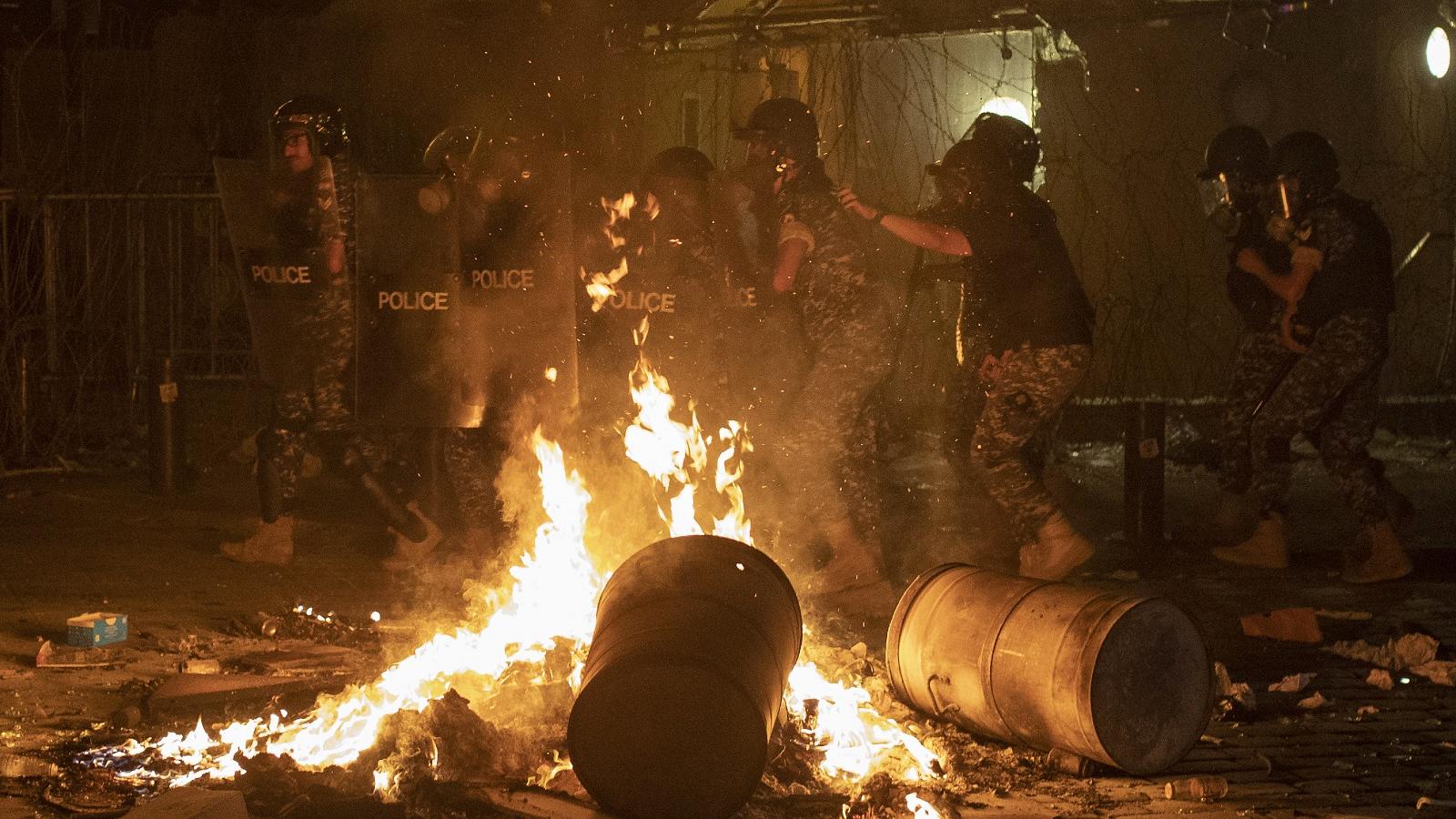
Today has seen protests on the streets of Beiruit, seemingly a peculiar response to what is reported to be a simple industrial accident, but it’s also an extension of the protests which have been off-and-on since last summer. Maybe tellingly, these on-going protests have never featured on Western front-pages before now.

The Guardian has an opinion piece, published yesterday and headlined Lebanon is no stranger to disaster – but this is like nothing we’ve ever seen”. According to the author Kim Ghattas, the people of Lebanon are angry, this explosion was the last straw:

How much more can one country and one people take? Is this a turning point? And if so, towards what? Full revolt and true change for a new beginning or total helplessness and defeat?

And, according to the author’s bio:

Kim Ghattas is a senior fellow at Carnegie Endowment for International Peace”

which makes them essentially a paid representative of the US State Department. This is a clear indication of where this is probably going.

Elsewhere in the Western press we’re being told that the people of Lebanon are angryover and over again. And the Guardian reports that rioters are being beaten and tear-gassed.

Emmanuel Macron was touring the city, and we’re told that crowds chanted for him to “do something” and “help us”.

Sky News reported:

a crowd gathered around him and shouted their anger, using slogans including “revolution!” and “the people want to bring down the regime”

Reuters has already called it a revolution”.

Are these protests organic, or being stoked from the outside? It’s hard to say, but only somebody willfully naive could discount US or NATO involvement at this stage.

That a blast which, though destructive, resulted in relatively little loss of life could so quickly escalate into political unrest, and even the phantom suggestion of regime change, seems unlikely.

So, whatever the cause of the explosion, it’s certainly being seized as a political opportunity. And, historically speaking, it’s very rare the US doesn’t have some hand in creating its own opportunities.

If this is a push for regime change, it is an oddly timed one, given the state of the Covid19 narrative. Perhaps sign that a distraction is required, or perhaps a sign that some people in the heart of the deep State are sick of his “pandemic” BS, and just want to do what they do best…unseat governments and steal resources.

Whatever shape this fallout takes, spare a thought for the people of Lebanon. Because no matter how it starts, crowds on the streets demanding NATO members “take action” never ends well for the Middle East.