Showing posts with label Ottawa. Show all posts

Tuesday, 30 April 2019

Focus on abrupt climate change in Canada

Canada is warming at twice the rate of the rest of the world

Canada is, on average, experiencing warming at twice the rate of the rest of the world, with Northern Canada heating up at almost three times the global average.

The study — Canada's Changing Climate Report (CCCR) — says that since 1948, Canada's annual average temperature over land has warmed 1.7 C, with higher rates seen in the North, the Prairies and northern British Columbia.
In Northern Canada, the annual average temperature has increased by 2.3 C.

Report here:
https://changingclimate.ca/CCCR2019/

Full download here:
https://changingclimate.ca/site/assets/uploads/sites/2/2019/04/CCCR_FULLREPORT-EN-FINAL.pdf
No photo description available.


Annie Pépin's kids were playing outside with her father Saturday as she cleaned the kitchen after supper. Sirens, and the blaring of a police cruiser's loudspeakers, shattered the evening calm.


"Evacuation now! Evacuation now!" she recalled hearing. "I got outside and I looked at my kids and they were screaming and crying. And then everybody was running."

A 50-metre section of a natural dike holding back the Lake of Two Mountains had been breached in Sainte-Marthe-sur-le-Lac, an off-island suburb northwest of Montreal.

Water immediately began pouring into the town. Witnesses heard trees snapping under the rushing torrent.

"The water came pouring in just like a tsunami.... It wasn't there and then it was there," a Sainte-Marthe resident, Michele Ellison, told a CBC News radio special on Sunday. "You had to get out fast."

Another Sainte-Marthe resident, Francis Labbé, was driving home when he heard the dike had been breached. Initially he thought he lived far enough away to be spared the onrushing water.

"When we arrived home, we had no choice but to consider that the water was rising at an impressive pace. We had approximately 40-45 minutes to do something," Labbé said.


Robert Pépin and his daughter Annie Pépin were at his home with her kids when their quiet evening was interrupted by police sirens, evacuation orders and a rushing wave of water. (Jay Turnbull/CBC)
He frantically moved anything of value upstairs. Then police knocked at his door and told him to stop and get out.

Roughly 200 Sûreté du Québec officers were deployed soon after the breach, working with local police, the fire department and Canadian soldiers to go door to door "extremely quickly" and vacate some 50 streets.

They managed to get more than 5,000 residents to high ground in just a few hours.

"Yesterday there were lives that were saved here by fire officials and police officers," said provincial police Sgt. Daniel Thibaudeau on Sunday morning.

"We took people out. If we hadn't done so, we'd be talking about serious injuries or deaths."

Nobody was injured and nobody is missing after an estimated 2,500 homes were evacuated. By 10 p.m., the water was more than two metres deep in the worst-hit areas.

Water levels continued to rise Sunday morning, prompting officials to evacuate another 100 properties, said Thibaudeau.

Roughly a third of the town is currently under water, flooding homes and streets a half-kilometre in-land. First-responders went door-to-door in the evacuated neighbourhoods on Sunday, monitoring water levels and ensuring residents were safe.

The Canadian Red Cross is on the scene, offering assistance to evacuees. People are being offered a place to sleep, as well as psychological support.

The vast majority of evacuees found friends and family to stay with. Around 50 people are being housed temporarily at the Olympia Arena in neighbouring Deux-Montagnes.

After touring Sainte-Marthe-sur-le-Lac on Sunday, Premier François Legault announced the Quebec government is giving an additional $1 million to help the Red Cross meet the most urgent needs of the evacuees.

Meanwhile, efforts to repair the dike are already underway. Authorities are also trying to stem the flow of water by building additional dikes on the flooded streets, and then pumping water back toward the breach.

Electricity was shut off to more than 2,000 Hydro clients in Sainte-Marthe-sur-le-Lac, a boil-water advisory was issued and residents were told not to flush their toilets for fear of sewer backups.


Because people had to leave so quickly, they may have left important items, such as medications or pets, behind, Thibaudeau said. In cases like that, he said people should contact city officials to see if an escort is possible.

"We don't recommend anyone go on their own," he said. "We ask for people to respect the barriers here."

Rescue personnel are able to retrieve pets and shelter the animals, he said. Police are also maintaining a presence in the neighbourhoods to ensure there is no criminal activity, he added.

Weather brings relief

With the situation in Sainte-Marthe-sur-le-Lac, nearly 7,700 Quebecers have been forced from their homes since spring flooding began in different areas around the province two weeks ago.

That's almost double the number of evacuees during the 2017 floods in Quebec, considered unprecedented at the time.

Around 5,500 homes across the province have been flooded this year, according to government figures, compared to 5,300 in 2017.


Residents of Sainte-Marthe-sur-le-Lac, an off-island Montreal suburb, try to salvage belongings on Sunday morning. (Ivanoh Demers/Radio-Canada)
"We are well aware that these are significant numbers," Public Security Minister Geneviève Guilbault said during a news conference at a government operations in Quebec City. "The next few hours will remain critical."

Guilbault said, though, that with no rain in the forecast until Wednesday, the situation should stablize.

"This will at last give our teams, and the residents affected, a chance to catch their breath," she said.

Public Security officials remain concerned about water levels around Gatineau and Lake Saint-Pierre in the Mauricie region, northeast of Montreal, along with Lake of Two Mountains.

"In the rest of the province, things seem pretty much under control. We've seen the worst," Legault said. "But those three spots we're monitoring very closely. There could be a deterioration over the next 48 hours."

To encourage thoughtful and respectful conversations, first and last names will appear with each submission to CBC/Radio-Canada's online communities (except in children and youth-oriented communities). Pseudonyms will no longer be permitted.

By submitting a comment, you accept that CBC has the right to reproduce and publish that comment in whole or in part, in any manner CBC chooses. Please note that CBC does not endorse the opinions expressed in comments. Comments on this story are moderated according to our Submission Guidelines. Comments are welcome while open. We reserve the right to close comments at any time.


https://www.cbc.ca/news/canada/montreal/sainte-marthe-sur-le-lac-dike-breach-flooding-1.5114366?__vfz=medium%3Dsharebar&fbclid=IwAR1Plmu72h7qnb_RYo8zL4yN5XF1puHmwTu6XKv4MqJxZ6xclRfmmmCjb24

From Paul Beckwith


More Bad Luck for Ottawa in the Climate Casino


Severe Climate Change Consequences affects places all around the planet, but disproportionately so. Now, it is Ottawa’s turn of bad luck in the Climate Casino (floods-tornadoes-more floods). Yesterday, the mayor declared a flooding emergency; today many soldiers from the army are deploying around the river for sandbagging. The day before, Ottawa City Council declared a climate emergency joining many other cities around the globe. I chat about ongoing flooding and my coffee bet projection for a peak flow rate of 12,000 cubic meters per second (cms) on May 5th (May 2017 peak was about 10,900 cms).

Saturday, 29 September 2018

Tornadoes in Ottawa, Canada


Will Tornado Alley Shift Northward Into Canada?

Paul Beckwith

Supercells are huge collections of stormclouds bunched together, with rotation. They often generate tornados, as happened recently in Ottawa, and a few days later, in Detroit. As rapid climate change proceeds, and the speed, waviness, location, and nature of jet streams changes, it is possible that “Tornado Alley” in the US will shift northward, and impact northern states and Canada greatly.


Tornado aftermath: 'devastating'


National Observer,
24 September, 2018


Word of Friday's tornado in the Ottawa region reached Laurel Wingrove and Alex Carlson at a Toronto wedding, and by Sunday morning they completed the grim pilgrimage back to the apartment they've called home for four months.
Almost nothing was waiting for them.
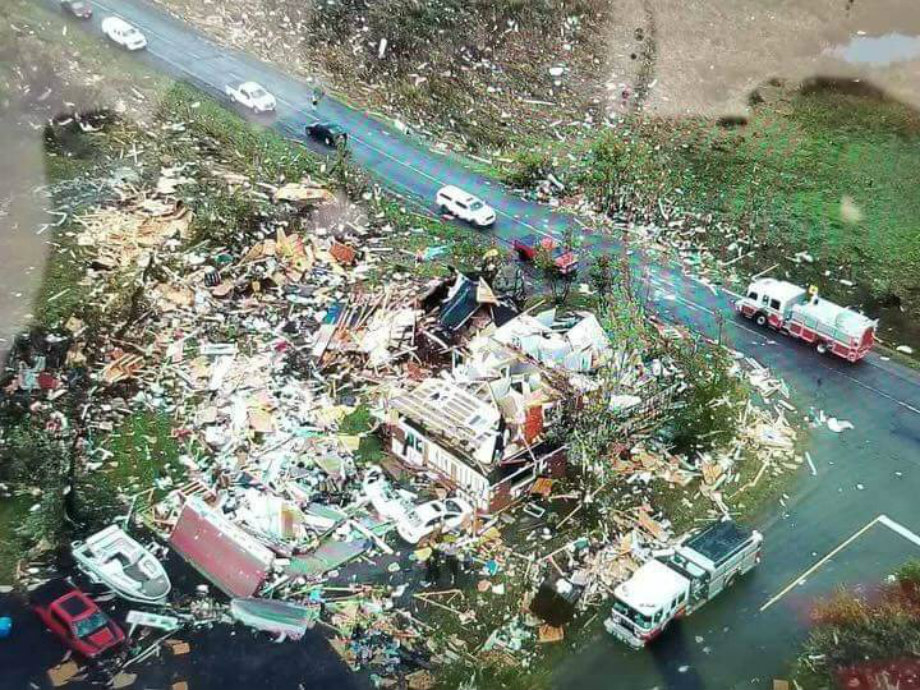
The roof was sheared off, the second storey of the edifice was open to the sky. Shredded and twisted shards of wood and metal filled the yard, where two crushed cars were parked. A large trash dumpster was flipped on its side.
"It could have been worse if we were here. Our bedroom's upstairs," said Carlson, 24.
"It's gone," added Wingrove, 25.
Their rural Ottawa neighbourhood of Dunrobin was one of the worst hit areas as twin tornadoes tore through Ottawa and across the Ottawa River to Gatineau, Que., on Friday. On the Ottawa side, 51 homes were destroyed or severely damaged, and this neighbourhood saw the "brunt of the damage," said Mayor Jim Watson.

Homes and vehicles were destroyed by a powerful twister that ripped through Dunrobin, shown here, a rural community near Ottawa on Sept. 21, 2018. Photo by Janet Coburn

The national weather agency said a powerful twister — with winds that reached 265 kilometres per hour — ripped through Dunrobin, about 35 kilometres west of the downtown area, before moving on to Gatineau.
Environment Canada said that at almost the same time a second, slightly less powerful, twister touched down in the south Ottawa neighbourhood of Arlington Woods.
The tornadoes caused massive damage, thrashing homes, tossing vehicles, snapping huge trees and injuring several people, at least two of whom were admitted to hospital in critical condition.
Throughout the Canadian capital region, shaken residents began returning to some of the hardest hit areas, taking stock of what was lost and trying to figure out what remained. For those facing uninhabitable destruction, police, firefighters and other emergency workers were helping them recover important documents, including identification.
For Wingrove and Carlson, some relief came quickly. A volunteer firefighter emerged with a set of file folders. Their passports were inside. Several minutes later, a smiling firefighter handed Carlson a silver laptop computer — the one that had valuable information about two business ventures.
"The community is going to come together. And everyone's making sure we're OK," said Carlson, who is also a volunteer firefighter. On Sunday, he was on crutches and wearing a cast on his left ankle — a result of one-month-old injury that sidelined him from the recovery efforts.

Province will help recovery

Ontario Premier Doug Ford toured Dunrobin on Sunday and pledged the province's full support to Ottawa residents recovering from Friday's tornadoes as he met with some of those hardest hit. Ford made the promise after meeting more local residents, returning to homes that the tornadoes had in some cases levelled, in the pastoral Dunrobin area littered with snapped power lines and scattered branches.
"We can replace the infrastructure, and we will. We will spare no resources in the province," Ford said, noting it was a blessing that nobody was killed.

Winds in this tornado on Sept. 21, 2018, near Dunrobin, an Ottawa-area community, reached 265 kilometres per hour. Photo by Janet Coburn

Meeting displaced residents at a local high school, Ford offered his sympathies and reassurances.
"We're putting the resources in, we are going to get it done," he told a sobbing woman seeking refuge at the school. "It's devastating."
"It is," she replied.
The premier was accompanied by Watson as he toured houses ravaged by the twister before it jumped the Ottawa River to Gatineau, Que.
"A lot of us have never seen anything like it," he said of the destruction. "It's shocking."
Ford later visited a public park in the Barrhaven area in Ottawa's south end, where volunteers had set up plastic tables in a field to feed 1,000 people their Sunday dinners. Loudspeakers blasted classic rock music, while candles lit the public bathrooms of the adjacent community centre.
"We'll get everyone back on their feet," Ford told an afternoon news conference.

Hydro crews working around the clock

Hydro crews — including extra workers from across Ontario — were working around the clock to untangle and repair fallen power lines and restore electricity to the region.
Friday's tornadoes and thunderstorms in eastern Ontario caused power outages to approximately 400,000 customers, Hydro One said Sunday night.
The utility said about 36,000 customers remained without power on Sunday night, while Hydro Quebec reported approximately 4,000 customers in the Outaouais region, which encompasses Gatineau, were blacked out.
"Throughout the weekend, our crews have worked tirelessly to get the lights back and we believe the majority of customers will have their power back by tonight," Hydro One CEO Greg Kiraly said in a release.
Bryce Conrad, the president of Hydro Ottawa, said some areas would not have power on Monday or this week. He has compared the damage to the city's power grid as being on the magnitude of the debilitating ice storm of 1998. A key power station was knocked out by the tornadoes, and Conrad said it looked like it was bombed.

Destruction in the community of Dunrobin, shown in the aftermath of a tornado that hit the Ottawa area on Friday Sept. 21, 2018. Photo by Janet Coburn

The lack of power meant a reduced work day for many on Monday with two local school boards announcing closures for the day. City officials, including the police chief, urged people to work at home or take the day off.
With 400 traffic lights still dark, they were trying to avoid rush hour chaos.
The Treasury Board and Statistics Canada also posted tweets Sunday telling their employees in Ottawa and Gatineau to stay home Monday, and if possible, work from there.
The Ontario government announced Saturday that it was activating the province's Disaster Recovery Assistance program in affected areas, while the Quebec government announced it would give the Red Cross $1 million to help with relief efforts.
Prime Minister Justin Trudeau said Sunday that he'd spoken with the mayors of Ottawa and Gatineau to discuss "how the community is recovering from the damages."
Trudeau, who was in Montreal to meet with the prime minister of Spain, also said he offered federal help to those in need.
Ford said it was too soon to put a dollar figure on the damage. He praised the non-partisan co-operation of the municipal, provincial and federal governments.
"It's amazing how everyone comes together. Forget the political stripes, they're out the window. We're a community, we're team Ontario, and we work together."

A truck overturned near hydro plant from Merivale, Ontario. photo from Janet Coburn
Damaged hydro plant in Merivale, Ontario, September 21, 2018. Photo courtesy of Janet Coburn.

Friday, 29 December 2017

World weather - 12/28/2017

"An Ice Age is coming"


Here’s the “proof”

It’s cold in’Murika”


New Year's Eve shocker! Temperatures in parts of the US to plummet to minus 36'6 deg C (minus 34 deg F): Meteorologists warn of frostbite

28 December, 2017


It's the kind of temperatures human beings shouldn't have to endure!

Most of the US will be plunged into Arctic conditions on New Year's Eve with some parts plummeting to minus 36.6 deg C (minus 34 deg F) with meteorologists warning of frostbite to exposed skin.

It's the Midwest and the Northeast who will witness the most severe cold with the wind-feel-factor magnifying the frigid temperatures.

2017 appears to be going out with a bang rather than a whimper after Record snow totals were smashed as Erie, Pennsylvania received 53 inches of snow in 30 hours, this is the greatest two-day total in the entire state of Pennsylvania.
The previous record was 44" in Morgantown, Pennsylvania on March 20 and 21, 1958.

It also beats the 13-day total snowfall record for Erie, Pennsylvania, which was 52.8" from Dec. 31, 1998, to January 12, 1998.

According to CNN, the snowfall total was more than four times the city's previous all-time Christmas record of 8.1 inches, and it also broke the record for most snowfall in one day in the city's history, which was 20 inches on November 22, 1956.

The snow didn't stop overnight, either.

Erie picked up another 24.5 inches of snow on Tuesday, bringing the two-day tally to 58.5 inches.

That is the highest two-day snowfall total in the entire state of Pennsylvania, according to the National Weather Service.

However, the storm, which actually began on Sunday, has dropped a grand total of 68 inches of snow, more than a metre on Erie, according to National Weather Service Cleveland. Erie County Executive Kathy Dahlkemper signed a Declaration of Disaster Emergency.

According to the Daily Mail, the brutal cold front is currently clobbering several states with many of the temperatures only reaching a high in the 20s and lows in the single digits well below the freezing point.

Wind chill advisories or warnings are in effect for all of North Dakota and Wisconsin, as well as swaths of South Dakota, Minnesota, Iowa, Michigan and Indiana.

In addition, wind chill advisories are also in effect for parts of Maine, Vermont, New Hampshire and New York.

Up to one million revellers are expected to gather in New York City's Times Square on Saturday night to celebrate. Forecasters predict the temperature to be around 12 degrees in the evening, however, it will feel dramatically colder due to the wind chill.


Iced cap: Ottawa currently coldest capital city in the world
Ottawa's temperature has fallen below those of capital cities in Russia, Kazakhstan and Mongolia


The extreme cold has pushed Ottawa well below the rest of the world's coldest capital cities.

Mongolia's capital, Ulan Bator, is on average the coldest national capital in the world.

But Ottawa's overnight temperature of –29 C on Wednesday fell below that for Ulan Bator, which experienced an overnight low of about –26 C.

Extreme cold weather grips Ottawa0:32

Moscow and Astana, Kazakhstan, two of the other coldest capitals according to the World Atlas, recorded Wednesday overnight lows of around 2 C and –13 C, respectively.

Some other temperatures from world capitals recorded overnight:

  • Helsinki 1 C
  • Reykjavik –4 C
  • Tallinn 0 C
  • Nuuk, Greenland –6 C

The overnight temperature in Novosibirsk, the unofficial capital of the Russian region of Siberia, reached a low of –14.


With wind chills making it feel like –36 in Ottawa, the public health office issued a frostbite warning that remained in effect Thursday