Showing posts with label North Sea. Show all posts

Tuesday, 12 September 2017

Warming of the North Sea

The media never tell you the half of it.

North Sea warming twice as fast as world's oceans

The average temperature of the North Sea has risen twice as fast as the oceans of the world. The changes are likely to alter the ecosystem and endanger indigenous fish such as cod.
DW,
9 September, 2017
Climate change has caused the North Sea's temperature to increase twice as fast as that of the world's oceans, according to Germany's Environment Ministry.
The average temperature of the North Sea rose by 1.67 degrees Celsius (3 degrees Fahrenheit) over the past 45 years, during which time the temperature of oceans such as the Pacific or Atlantic increased by 0.74 degrees Celsius on average.
That is according to an environment ministry response to a parliamentary question from the Green Party, the Neue Osnabrücker newspaper reported on Saturday.
The data is based on assessments up until 2010 from the Intergovernmental Panel on Climate Change and the Alfred Wegener Institutes.
The German government warned that the North Sea's temperature could rise by another 1.7 to 3.2 degrees Celsius by 2100.
The temperature increase could lead to the displacement of "indigenous species that fail to adapt," it warned.
"The warming of the sea waters has repercussions for many types of marine organisms. Especially, species that are sensitive to temperature will vanish," the Environment Ministry said.
As a result, cold-water species such as cod are likely to move further north after the degradation of their ecosystems and overfishing already hit populations.
In its place, fish accustomed to warmer waters such as the red gurnard, striped mullet, sardines, anchovies and sea bass are likely to move into the North Sea's once colder waters.
The impact of climate change on marine species also carries implications for fisheries.

The rising sea temperature is also expected to increase the intensity and frequency of storms along Germany's low-lying North Sea coast.

The North Sea last year recorded its second-highest average temperature of 11 degrees Celsius. Only in 2014 was the average temperature higher, at 11.4 degrees Celsius.

Saturday, 15 July 2017

Abrupt emergence of a large pockmark field in the German Bight, southeastern North Sea

Pockmark fields off Helgoland
Researchers discover methane vents in the German Bight


11 July, 2017

Within a period of a few months thousands of craters formed on the sea bed off the North Sea island of Helgoland. Gas escaping out of the sea floor entrained sand and upon settling created mounds. For the first time evidence for massive methane release has been discovered in the area of Helgoland Reef. Knut Krämer of MARUM – Center for Marine Environmental Sciences at the University of Bremen and colleagues have published their findings in the journal Scientific Reports.

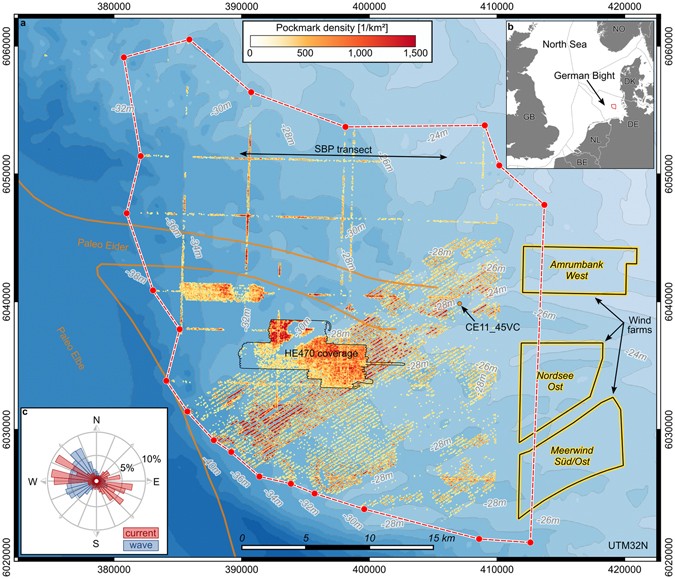
We were surprised to suddenly find a crater landscape in an area that used to be a flat expanse of sand”, says Knut Krämer, first author of the article and PhD student at MARUM – Center for Marine Environmental Sciences at the University of Bremen. Based on detailed surveys, the study describes a dramatic transformation in the Helgoland Reef region about 45 kilometers northwest of Helgoland. Until July 2015, this area was characterized by an almost flat and featureless sea floor. More recent mapping in November 2015 revealed a bottom strewn with depressions the size of tennis courts. Subsequent cruises with the research vessel Heincke in August and September 2016 confirmed that these craters covered an area of around 915 square kilometers, more than twice the area of the State of Bremen. Each square kilometer can contain up to 1,200 craters. Based on the associated high concentrations of methane in the sediments, the craters were identified as pockmarks.

Bacteria generate methane

The term pockmark is used to designate characteristic craters on sea beds that are formed by the release of liquids or gases from the sub-seafloor. They can be found worldwide in different types of water bodies, including lakes, rivers, estuaries, and in coastal to deep ocean waters. In clay-rich sediments and under low current and wave conditions, they can sometimes persist over centuries and remain as evidence of past gas releases.

In shallow coastal waters with sandy bottoms, under the forcing of tidal currents and waves, the craters are quickly erased, and therefore have been rarely observed before. Prior to the postglacial sea level rise, however, the near-coastal regions in particular were often wetlands and thus rich in organic material. 

Methane is commonly produced by the bacterial breakdown of this material. The gas can then accumulate underneath impermeable layers below the sea floor. 

Methane released into the atmosphere acts as a greenhouse gas approximately 25 times more effective than carbon dioxide (CO2).

Measurements by the research team have shown that around 6.9 million cubic meters of sediment were displaced as a result of the methane ejection – sand that would fill 200,000 standard shipping containers. “The total amount of methane released is difficult to estimate. We do not know exactly how the gas was distributed in the substrate prior to the release,” explains Knut Krämer. “But even a conservative estimate suggests an amount of around 5,000 metric tons. This would be equivalent to about two-thirds of the previously assumed annual emission of the entire North Sea.”

The sea floor is altered by currents and waves

Krämer and his co-authors presume that the trigger for the pockmark ejections was a series of storms with waves up to seven meters high and periods of around ten seconds that caused large pressure fluctuations in the sea bed. These acted like a pump on the gas stored there. The sea floor eventually yielded to the gas pressure and the gas escaped into the water column, dragging sediment with it. This was then redeposited on the lee side of the current or wave, producing a characteristic pattern of craters and mounds.

This study is an excellent example of cooperation among various institutes that are involved in coastal research,” says PD Dr. Christian Winter, chief scientist of the survey expedition and leader of the Coastal Dynamics working group at MARUM. “We obtain measurements together on the German research ships and combine the expertise of different disciplines.”

The Helgoland Reef pockmarks are the first to be observed of this form in the German Bight. Knut Krämer surmises that “the frequency of triggering storm waves suggests that this could be a recurring phenomenon that has been previously overlooked”. Detection of the relatively shallow craters has only become possible through recent advances in the development of highly accurate multibeam echosounders. It is also assumed that the craters, located in mobile, sandy sediments, will quickly be leveled again by waves and currents as soon as no more methane is being released.

Compared to methane emissions caused by humans, the amount from the pockmark field discovered here is small. It is equal to only 0.5 per cent of the annual anthropogenic methane emissions by Germany. It is believed, however, that coastal regions worldwide with rich methane occurrences are in a similar state of instability. It is therefore possible that highly dynamic coastal regions have been overlooked as an important contributor to the global methane budget, says Knut Krämer. “We hope that our article will help to stimulate scientific discussion and further investigations of these kinds of methane sources.”

Contact:

Knut Krämer
Telephone: 0421-21865582
Email: kkraemer@marum.de

Original publication:
Knut Krämer, Peter Holler, Gabriel Herbst, Alexander Bratek, Soeren Ahmerkamp, Andreas Neumann, Alexander Bartholomä, Justus E.E. van Beusekom, Moritz Holtappels und Christian Winter: Abrupt emergence of a large pockmark field in the German Bight, southeastern North Sea. Scientific Reports 7, 2017; DOI: 10.1038/s41598-017-05536-1

Further information/​photo material:
Ulrike Prange
MARUM Public Relations
Telephone: 0421 218 65540
Email: medien@marum.de


Figure 1
Figure 1
The Helgoland Reef pockmark field. (a) Extent of the field and pockmark density in relation to the course of the Paleo Eider and Paleo Elbe valley29. The location of the sub-bottom profiler (SBP) transect and location of core CE11_45VC from Fig. 4 are indicated. (b) Location of the Helgoland Reef pockmark field in the North Sea. (c) Histogram of the hydrodynamic climate at Helgoland Reef. The data were provided by the COSYNA system34operated by Helmholtz-Zentrum Geesthacht Zentrum für Material- und Küstenforschung GmbH. The maps in this figure were generated using QGIS Version 2.14.1143. Bathymetry data was made available by the GPDN project44. Maritime boundaries and wind farm polygons were made available by the EMODnet Human Activities project45, funded by the European Commission Directorate General for Maritime Affairs and Fisheries. Wind farm data were collected by the OSPAR Commission. Maritime boundaries were provided by the European Environment Agency. Land polygons ©OpenStreetMap contributors46 (available under the Open Database License; see www.openstreetmap.org/copyright).

ABSTRACT

A series of multibeam bathymetry surveys revealed the emergence of a large pockmark field in the southeastern North Sea. Covering an area of around 915 km2, up to 1,200 pockmarks per square kilometer have been identified. The time of emergence can be confined to 3 months in autumn 2015, suggesting a very dynamic genesis. The gas source and the trigger for the simultaneous outbreak remain speculative. Subseafloor structures and high methane concentrations of up to 30 μmol/l in sediment pore water samples suggest a source of shallow biogenic methane from the decomposition of postglacial deposits in a paleo river valley. Storm waves are suggested as the final trigger for the eruption of the gas. Due to the shallow water depths and energetic conditions at the presumed time of eruption, a large fraction of the released gas must have been emitted to the atmosphere. Conservative estimates amount to 5 kt of methane, equivalent to 67% of the annual release from the entire North Sea. These observations most probably describe a reoccurring phenomenon in shallow shelf seas, which may have been overlooked before because of the transient nature of shallow water bedforms and technology limitations of high resolution bathymetric mapping.

Monday, 28 July 2014

Warming of the oceans

Mediterranean anchovies caught in North Sea at Walton Pier
Shoals of fish that normally inhabit warm Mediterranean waters have been seen swimming in the North Sea off the Essex coast


BBC,
26 July, 2014

Angler Richard Holgate, who has fished off Walton-on-the Naze pier for decades, said it was the first time he had been able to catch anchovies.

"In 40 years fishing from the pier I have never seen them before," he said.
The Centre for Environment, Fisheries and Aquaculture at Lowestoft said some fish had moved to the North Sea waters.
Soaring temperatures in England have allowed the sea off the Essex coast to warm "four degrees above average to around 21C", said a Met Office spokeswoman, which is similar to the water temperature of the Mediterranean.
"Over the past few weeks the water has been unusually clear and we noticed the fish in good numbers in the shade below the pier," said Mr Holgate.
"They weren't in open water but in the shallows.
"Black bream, ballan wrasse and pollock are seen here but they swim around from the south-west coast but anchovies are from the Mediterranean so are highly unusual."
Richard HolgateRIchard Holgate said he had fished off Walton Pier for 40 years and had never seen anchovies before

The Centre for Environment, Fisheries and Aquaculture (Cefas) said: "Anchovy have historically occurred in the North Sea and numbers have been increasing in the southern North Sea, including the Thames Estuary areas, since the 1990s.
"It is thought that milder winters and warmer summers, amongst other factors, are supporting the anchovy population growth.
"A research paper was published by a number of organisations including Cefas in 2012, which looked into this in detail."

Monday, 17 September 2012

Overfishing


Just 100 cod left in North Sea
Overfishing has left fewer than 100 adult cod in the North Sea, it was reported


16 September, 2012

A survey of catches at European ports has found that fishermen did not catch a single cod over the age of 13 last year.

The findings raise concerns for future stocks of cod, which become more fertile as they age. The fish can live as long as 25 years and grow to 6ft.

Researchers warned a lower life expectancy meant a lower birth rate and a faster decline.

Callum Roberts, professor of marine biology at York University, told the Sunday Times that intense industrial fishing meant that few fish survived beyond the age of four, when they reach sexual maturity.

This means that there are fewer eggs and larvae to perpetuate future generations,” he said.

Analysis of around 500,000 fish in England and Wales found 191 million one-year-old cod and just 18 million three-year-olds.

In the North Sea, there were 65,300 tons of cod aged three or more while in 1971, a peak year for cod population, there were 276,000 tons.

The decline in cod has also meant a rise in populations of their prey such as scampi.

The research was carried out by Defra’s fisheries laboratory, the Centre for Environment, Fisheries and Aquaculture Science (Cefas).

Chris Darby, head of the Cefas team, said: “Our latest assessments suggest in 2011 there were 600 cod aged 12 to 13 in the North Sea, of which about 200 were caught.

None of the catches recorded at North Sea ports around Europe showed any fish aged 13 or over. Analysis of that data suggests there are fewer than 100 such fish in the whole North Sea.”

Scientists have appealed for a reduction in the cod quote from the North Sea down to 25,600 tons next year.

This year’s quota is 32,000 tons, compared to 360,000 tons in the 1970s.

Barrie Deas, chief executive of the National Federation of Fishermen’s Organisations, said: “The most effective measure in rebuilding fish stocks seems to be removing vessels from service by paying owners to decommission them.”

Tuesday, 31 July 2012

Major Chinese investment in oil


The Chinese Make An Offer For North Sea Oil That Britain Can't Refuse
History is being made in the North Sea, as China makes its first significant investment in its oilfields through two major deals.


30 July, 2012

State-controlled energy giant CNOOC last Monday unveiled a $15.1bn (£9.7bn) bid for Canada’s Nexen, the second biggest oil producer in the North Sea. If successful, the takeover will be China’s largest ever foreign investment.

That same day, Chinese refiner Sinopec said it would pay $1.5bn for a 49pc stake in the UK unit of Canada’s Talisman Energy, also a top 10 oil and gas producer in the North Sea.

Given the sums, no surprise that the cry from oil industry analyst Malcolm Graham-Wood at VSA Capital was: “The Chinese are coming with their wall of money!”

Still, money is not the only consideration in purchases of this kind, which will have to be signed off by the UK Government, among other authorities around the world. Eyebrows inevitably raise at the political niceties of having North Sea energy reserves in the hands of Beijing.

Consultancy Wood Mackenzie calculates that together the two Chinese firms will directly own 13pc of all UK oil production if both deals go through.

But for all the nervousness around China buying up local energy assets – urged on by a Chancellor looking outside the UK for much-needed investment – the reality is that Beijing is looking at a bigger picture.

After all, production from the North Sea oilfields peaked years ago, a change accompanied by a shift from bigger to smaller operators. The thinking is that China has not been seen in the North Sea so far, because it has not viewed the reserve potential as big enough.

There is also another consideration. From Beijing, political risk looks rather different to someone working out of say, London, or Washington.

For China, the high tax rates levied on North Sea oil producers are not offset by the sweetener of operating in a country seen to be, in Western eyes, without much political risk.

So what has changed, to make the Chinese want to take a dip? Nothing much for CNOOC, suggests Alex Grant, managing director of oil & gas investment banking at Jefferies. “I don’t think that [getting into the UK] was the driver for the deal – although the question now is whether they will seek to expand on their position,” he says.

Nexen, he points out, has significant assets across Canada, Nigeria and elsewhere. The Sinopec deal looks different, however. Through that purchase the Chinese are clearly getting into UK waters deliberately.

The driving force is that China is moving from a focus on untapped reserves to assets that are up and running, Grant argues.

Historically, the Chinese have been chasing big resources. They want molecules in the ground – that don’t lose their value as US Treasuries could,” he says. “I think the near-term focus has now moved to producing assets. They have acquired a lot of long-term resource in places such as Brazil and West Africa, and want production to fill the near-term gap.”

The logic does make sense. After all, if you have bought oil reserves which need to be developed before production starts, the costs of rigs, drilling and manpower gobbles up your cash before you start to see any returns. So why not buy a few fields already producing to make your balance sheets look a bit better in the short term?

The problem is that there is not an abundance of producing assets up for sale. Once an oilfield is in production there is little pressure to sell, as the profits cover running costs.

In that light, the UK’s oilfields, declining and lacking in scale as they may be, look more attractive. Industry watchers do not rule out the possibility of more acquisitions by China in the North Sea as it looks to build up its producing assets, whether through smaller bolt-on purchases or more large-scale buys.

That could signal opportunities for investors in the sector – provided that they back the right horses.

As for the practicalities if the deals go through, major changes are not expected.
Sinopec is buying into the North Sea through a non-operating interest, meaning Talisman will remain in charge. CNOOC, in contrast, will take over the show if it purchases Nexen. Still, the Chinese are well aware of the political sensitivities, so it would be a surprise if, say, CNOOC started cutting back on maintenance spending or do anything that might play into prejudices.
That is not to deny the deals bolster China’s position in many ways.
Just listen to the oil traders grumbling that CNOOC will be a step closer to information affecting crude prices, as Nexen’s Buzzard field plays a key role in setting prices for Brent, the benchmark London oil price.
But do not hold your breath for this to stop the purchases getting the green light from the UK. After all, where else is the money going to come from?
They are both big credible companies, with good technical expertise and strong balance sheets,” says Grant, who does not expect them to be held up on the UK side.
In a way they could not have come at a better time. Both deals bring well needed potential new investment to the North Sea.”