This
is pure provocation, knowing that Moscow's 'red line' is Ukraine
becoming part of NATO.
US
prepares military drill in W. Ukraine for mid-September
The
US and its allies are preparing to stage a military exercise in
western Ukraine, close to the Polish border, in mid-September. The
joint drill will involve over 1,000 troops from the US and Europe, as
well as from Ukraine.
2
September, 2014
Initially
planned for mid-July, the exercise – code-named 'Rapid Trident' –
was halted due to a significant escalation in the conflict between
Kiev and the southeastern regions of Ukraine.
Now,
as the fighting between the two sides continues, the US Army’s
European Command (EUCOM) plans to go ahead and stage the exercise on
September 16-26.
“At
the moment, we are still planning for [the exercise] to go ahead,”
US Navy Captain Gregory Hicks, spokesman for EUCOM, announced on
Tuesday.
The
annual exercise will take place at Yavoriv training center in the
city of Lvov, near Ukraine's border with Poland.
Around
200 US personnel will be involved in the drill, as well as 1,100
others from Ukraine, Azerbaijan, Britain, Canada, Georgia, Germany,
Latvia, Lithuania, Moldova, Norway, Poland, Romania, and Spain, EUCOM
said.
In
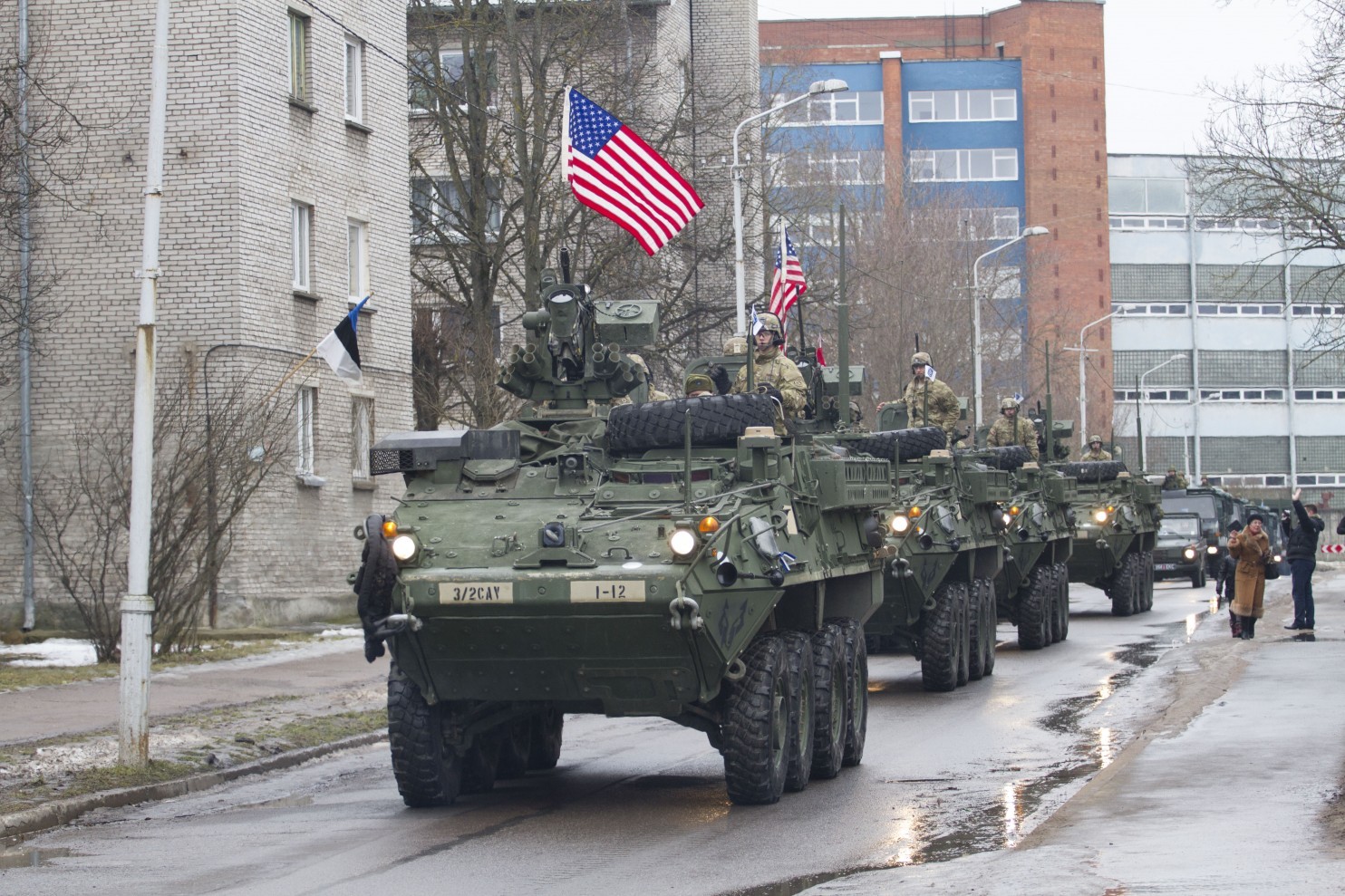
addition to staging air force exercises, the United States is moving
tanks and 600 troops to Poland and the Baltic states of Estonia,
Latvia, and Lithuania for joint maneuvers in October, Reuters
reports. The new deployment will replace a more lightly armed force
of paratroopers.
Rapid
Trident 2014 is designed to “promote regional stability and
security, strengthen partnership capacity and foster trust while
improving interoperability between the land forces of Ukraine, and
NATO and partner nations,” according to the US Forces in Europe
website.
The
exercise will be mainly focused on command post drills, patrolling,
and dealing with improvised explosive devices.
Despite
the involvement of many NATO members, Rapid Trident is not formally a
NATO drill.
The
Ukrainian-American exercises have taken place in Lvov since 2006
under the framework of NATO's broader 'Partnership for Peace,' which
Ukraine is part of.
This
year’s drill will mean the first significant deployment of US
troops and other personnel to Ukraine since the crisis erupted.
Last
year’s Rapid Trident, which focused on “airborne and air-mobile
infantry operations,” according to a report on the Rapid Trident
website, brought together 17 NATO countries for joint exercises.
The
announcement comes just two days before the NATO 2014 summit is set
to open in Wales. The alliance’s expansion to Eastern Europe is
expected to become one of the main discussions and the 28-member bloc
expects, despite internal opposition, to agree on the “more visible
NATO presence in the East.”
The
White House said the US and its allies are set to discuss plans to
significantly increase the readiness of NATO response forces.
White
House spokesman Josh Earnest told reporters that the meetings within
the summit are expected to involve discussions on potential
trainings, exercises, and other issues regarding infrastructure and
other needs in Eastern Europe.
Back
in June, US President Barack Obama pledged to invest $1 billion in
stepping up America's military presence in Eastern Europe amid the
Ukraine crisis. Also that month, Washington vowed additional military
help to Ukraine, as well as the potential training of its law
enforcement and military personnel.
Ex-NSA
Director, US Intelligence Veterans Write Open Letter To Merkel To
Avoid All-Out Ukraine War
2
September, 2014
Alarmed
at the anti-Russian hysteria sweeping Washington, and the specter of
a new Cold War, U.S. intelligence veterans one of whom is none other
than William Binney, the former senior NSA crypto-mathematician who
back in March 2012 blew
the whistle on the NSA's spying programs more
than a year before Edward Snowden, took the unusual step of sending
the following memo dated August 30 to German Chancellor Merkel
challenging the reliability of Ukrainian and U.S. media claims about
a Russian "invasion."
MEMORANDUM
FOR: Angela
Merkel, Chancellor of GermanyFROM: Veteran
Intelligence Professionals for Sanity (VIPS)SUBJECT: Ukraine
and NATO
We
the undersigned are longtime veterans of U.S. intelligence. We
take the unusual step of writing this open letter to you to ensure
that you have an opportunity to be briefed on our views prior to the
NATO summit on September 4-5.
You
need to know, for example, that accusations of a major Russian
"invasion" of Ukraine appear not to be supported by
reliable intelligence. Rather, the "intelligence" seems to
be of the same dubious, politically "fixed" kind used 12
years ago to "justify" the U.S.-led attack on Iraq. We saw
no credible evidence of weapons of mass destruction in Iraq then; we
see no credible evidence of a Russian invasion now. Twelve years ago,
former Chancellor Gerhard Schroeder, mindful of the flimsiness of the
evidence on Iraqi WMD, refused to join in the attack on Iraq. In our
view, you should be appropriately suspicions of charges made by the
US State Department and NATO officials alleging a Russian invasion of
Ukraine.
President
Barack Obama tried yesterday to cool the rhetoric of his own senior
diplomats and the corporate media, when he publicly described recent
activity in the Ukraine, as "a continuation of what’s been
taking place for months now … it’s not really a shift."
Obama,
however, has only tenuous control over the policymakers in his
administration – who, sadly, lack much sense of history, know
little of war, and substitute anti-Russian invective for a policy.
One year ago, hawkish State Department officials and their friends in
the media very nearly got Mr. Obama to launch a major attack on Syria
based, once again, on "intelligence" that was dubious, at
best.
Largely
because of the growing prominence of, and apparent reliance on,
intelligence we believe to be spurious, we think the possibility of
hostilities escalating beyond the borders of Ukraine has increased
significantly over the past several days. More important, we believe
that this likelihood can be avoided, depending on the degree of
judicious skepticism you and other European leaders bring to the NATO
summit next week.
Experience
With Untruth
Hopefully,
your advisers have reminded you of NATO Secretary General Anders Fogh
Rasmussen’s checkered record for credibility. It appears to us that
Rasmussen’s speeches continue to be drafted by Washington. This was
abundantly clear on the day before the U.S.-led invasion of Iraq
when, as Danish Prime Minister, he told his Parliament: "Iraq
has weapons of mass destruction. This is not something we just
believe. We know."
Photos
can be worth a thousand words; they can also deceive. We have
considerable experience collecting, analyzing, and reporting on all
kinds of satellite and other imagery, as well as other kinds of
intelligence. Suffice it to say that the images released by NATO on
August 28 provide a very flimsy basis on which to charge Russia with
invading Ukraine. Sadly, they bear a strong resemblance to the images
shown by Colin Powell at the UN on February 5, 2003 that, likewise,
proved nothing.
That
same day, we warned President Bush that our former colleague analysts
were "increasingly distressed at the politicization of
intelligence" and told him flatly, "Powell’s presentation
does not come close" to justifying war. We urged Mr. Bush to
"widen the discussion … beyond the circle of those advisers
clearly bent on a war for which we see no compelling reason and from
which we believe the unintended consequences are likely to be
catastrophic."
Consider
Iraq today. Worse than catastrophic. Although President Vladimir
Putin has until now showed considerable reserve on the conflict in
the Ukraine, it
behooves us to remember that Russia, too, can "shock and awe."
In our view, if there is the slightest chance of that kind of thing
eventually happening to Europe because of Ukraine, sober-minded
leaders need to think this through very carefully.
If
the photos that NATO and the US have released represent the best
available "proof" of an invasion from Russia, our
suspicions increase that a major effort is under way to fortify
arguments for the NATO summit to approve actions that Russia is sure
to regard as provocative.
Caveat emptor is an expression with which you are no doubt familiar.
Suffice it to add that one should be very cautious regarding what Mr.
Rasmussen, or even Secretary of State John Kerry, are peddling.
We
trust that your advisers have kept you informed regarding the crisis
in Ukraine from the beginning of 2014, and how the possibility that
Ukraine would become a member of NATO is anathema to the Kremlin.
According to a February 1, 2008 cable (published by WikiLeaks) from
the US embassy in Moscow to Secretary of State Condoleezza Rice, US
Ambassador William Burns was called in by Foreign Minister Sergey
Lavrov, who explained Russia’s strong opposition to NATO membership
for Ukraine.
Lavrov
warned pointedly of "fears that the issue could potentially
split the country in two, leading to violence or even, some claim,
civil war, which would force Russia to decide whether to intervene."
Burns gave his cable the unusual title, "NYET MEANS NYET:
RUSSIA’S NATO ENLARGEMENT REDLINES," and sent it off to
Washington with IMMEDIATE precedence. Two months later, at their
summit in Bucharest NATO leaders issued a formal declaration that
"Georgia and Ukraine will be in NATO."
Just
yesterday, Ukrainian Prime Minister Arseny Yatsenyuk used his
Facebook page to claim that, with the approval of Parliament that he
has requested, the path to NATO membership is open. Yatsenyuk,
of course, was Washington’s favorite pick to become prime minister
after the February 22 coup d’etat in Kiev. "Yats is the guy,"
said Assistant Secretary of State Victoria Nuland a few weeks before
the coup, in an intercepted telephone conversation with US Ambassador
to Ukraine Geoffrey Pyatt. You may recall that this is the same
conversation in which Nuland said, "Fuck the EU."
Timing
of the Russian "Invasion"
The
conventional wisdom promoted by Kiev just a few weeks ago was that
Ukrainian forces had the upper hand in fighting the anti-coup
federalists in southeastern Ukraine, in what was largely portrayed as
a mop-up operation. But that picture of the offensive originated
almost solely from official government sources in Kiev. There were
very few reports coming from the ground in southeastern Ukraine.
There was one, however, quoting Ukrainian President Petro Poroshenko,
that raised doubt about the reliability of the government’s
portrayal.
According
to the "press service of the President of Ukraine" on
August 18, Poroshenko called for a "regrouping of Ukrainian
military units involved in the operation of power in the East of the
country. … Today we need to do the rearrangement of forces that
will defend our territory and continued army offensives," said
Poroshenko, adding, "we need to consider a new military
operation in the new circumstances."
If
the "new circumstances" meant successful advances by
Ukrainian government forces, why would it be necessary to "regroup,"
to "rearrange" the forces? At about this time, sources on
the ground began to report a string of successful attacks by the
anti-coup federalists against government forces. According to these
sources, it was the government army that was starting to take heavy
casualties and lose ground, largely because of ineptitude and poor
leadership.
Ten
days later, as they became encircled and/or retreated, a ready-made
excuse for this was to be found in the "Russian invasion."
That is precisely when the fuzzy photos were released by NATO and
reporters like the New York Times’ Michael Gordon were set loose to
spread the word that "the Russians are coming." (Michael
Gordon was one of the most egregious propagandists promoting the war
on Iraq.)
No
Invasion – But Plenty Other Russian Support
The
anti-coup federalists in southeastern Ukraine enjoy considerable
local support, partly as a result of government artillery strikes on
major population centers. And we believe that Russian support
probably has been pouring across the border and includes,
significantly, excellent battlefield intelligence. But it is far from
clear that this support includes tanks and artillery at this point –
mostly because the federalists have been better led and surprisingly
successful in pinning down government forces.
At
the same time, we have little doubt that, if and when the federalists
need them, the Russian tanks will come.
This
is precisely why the situation demands a concerted effort for a
ceasefire, which you know Kiev has so far been delaying. What is to
be done at this point? In our view, Poroshenko and Yatsenyuk need to
be told flat-out that membership in NATO is not in the cards – and
that NATO has no intention of waging a proxy war with Russia – and
especially not in support of the ragtag army of Ukraine. Other
members of NATO need to be told the same thing.
For
the Steering Group, Veteran Intelligence Professionals for Sanity
William
Binney, former Technical Director, World Geopolitical & Military
Analysis, NSA; co-founder, SIGINT Automation Research Center (ret.)
David
MacMichael, National Intelligence Council (ret.)
Ray
McGovern, former US Army infantry/intelligence officer & CIA
analyst (ret.)
Elizabeth
Murray, Deputy National Intelligence Officer for Middle East (ret.)
Todd
E. Pierce, MAJ, US Army Judge Advocate (Ret.)
Coleen
Rowley, Division Counsel & Special Agent, FBI (ret.)
Ann
Wright, Col., US Army (ret.); Foreign Service Officer (resigned)
Ukraine
Crisis | UN planning
to invade in Ukraine with 4K
soldiers

 Posts
Posts





 Irina Galushko


