To
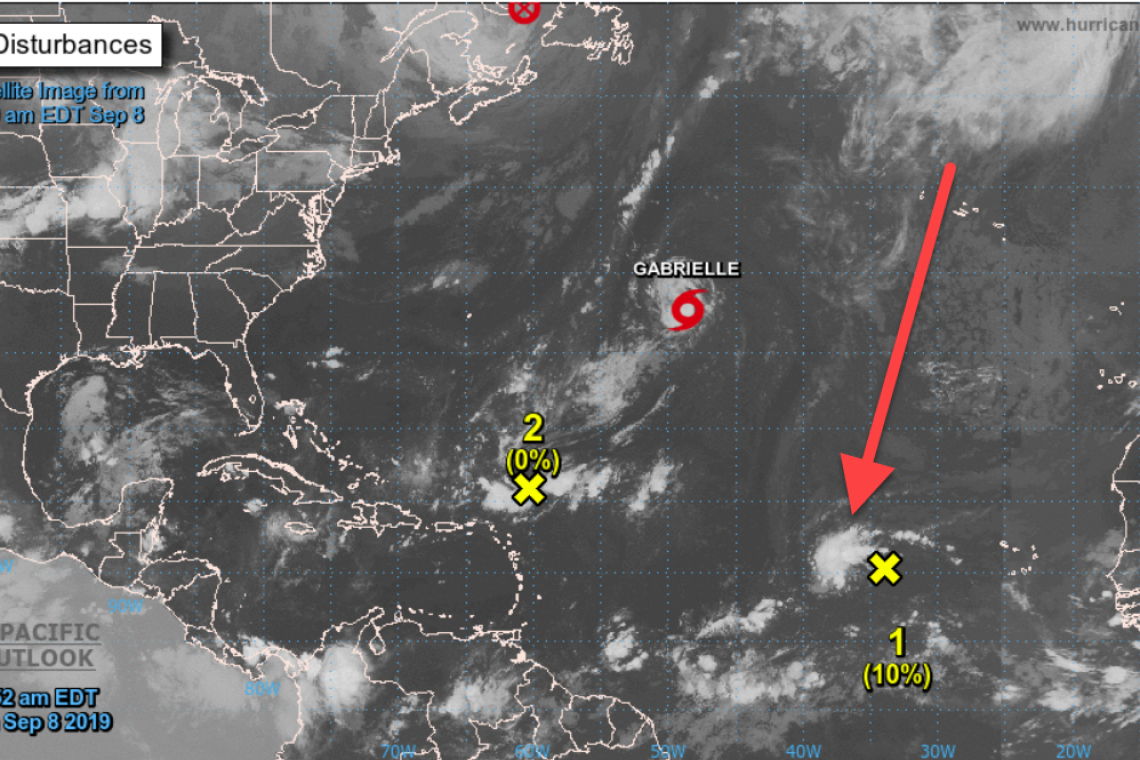
the south of the Bahamas, a new tropical formation seems to be in the
works. Dubbed Invest 95L, the storm could grow into Tropical Storm
Humberto by the weekend, posing a serious danger to an area of the
globe recently devastated by Hurricane Dorian.
A
group of thunderstorms labeled a “tropical disturbance” by the
National Weather Service poses a danger of becoming a more serious
and powerful storm in the coming days.
Invest
95L was marked by the National Hurricane Center (NHC) as “Potential
Tropical Cyclone Nine” in a 5 p.m. Thursday advisory that warned
the storm cluster “is expected to become a tropical storm and bring
tropical storm force winds to portions of the northwest Bahamas
within 36 hours,” a part of the island nation that was heavily
damaged just days ago by the powerful Hurricane Dorian.
If
the cluster reaches tropical storm strength, it would be named
Humberto and would bring heavy rain and strong winds to the Bahamas
and parts of eastern Florida. However, the NHC noted the storm poses
little danger of storm surges to the Bahamas.
The
northwestern Bahamian islands of Grand Bahama and Great Abaco were
utterly devastated by Dorian, which passed over them at a crawling
pace, unleashing 185 mph winds and a devastating storm surge that
swallowed much of the islands in seawater.
“The
storm is not expected to become a hurricane, especially since there
is lots of uncertainty in the forecast,” Tampa-based Bay News 9
reported Thursday evening. “The first potential track puts all of
Central Florida in its cone of uncertainty.”
In
fact, the storm’s projected path has changed significantly over the
past few days and might change further still. Some computer models
still have it passing across Florida and into the Gulf of Mexico, but
others have it hooking a hard right and going up the US East Coast,
following much the same track Dorian did.
And
yes, one of the models does pass through Alabama.
The
NHC is expected to send an Air Force Reserve Hurricane Hunter
aircraft on a mission above the storm late Thursday, to take more
accurate wind and air pressure measurements, which will help give a
better gauge of the storm’s power and potential.
While
Dorian loitered for more than 24 hours over some of the same parts of
the ocean that 95L will soon traverse, draining so much of the sea’s
hot water as to weaken the new storm significantly, the waters there
are “still plenty warm for development,” meteorological blog
Category 6 noted Thursday afternoon, observing the sea temperature in
the western Bahamas was a balmy 84 degrees Fahrenheit. Tropical
storms become stronger by passing over warm, wet updrafts rising from
the sea and weaken over cooler waters or land, both of which disrupt
the process of storm formation.
The
Weather Channel noted that if the storm coalesces and forms a
coherent center sooner rather than later, the models have it taking
the easterly track as a stronger storm, but if it forms later, it
will be weaker and is more likely to continue westward toward the
Gulf. Regardless, the storm is not expected to reach hurricane
strength, which happens when it has sustained 75 mph winds.
People
in the Bahamas - and this time Florida - are likely to get blasted by
yet another Hurricane; this one to be named "Humberto."
According to computer models from the National Hurricane Center,
Humberto will be bigger and stronger than Dorian, and will make
landfall in Florida.
Here's
the computer model:
To
give you perspective on how this differentiates from Dorian, take a
look at the size of the two storms and the Barometric Pressure listed
at the center of each: DORIAN
HUMBERTO
As
you can plainly see, Dorian had a much smaller storm field (green)
and higher (weaker) Barometric pressure of 944mb compared to Humberto
which has a MUCH larger storm field (green) and LOWER (stronger)
barometric pressure of 937mb.
As
always, I remind readers this is a computer MODEL based on known
weather history and projected weather patterns. The
storm course could change.
I
provide this news so that folk in potentially-affected areas can
either make preparations or decide to evacuate.
Spread
the word: It looks as though Florida's luck has run out with
Hurricanes. Humberto appears to be headed for direct
and brutal landfall in Florida.
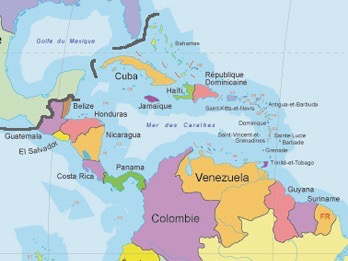
In a series of previous articles, we presented the SouthCom plan to provoke wars between the Latin-American nations in order to destroy the structures of all the States in the Caribbean Basin [1].
Preparations for wars of this magnitude, intended to follow on from the conflicts in the “Greater Middle East” according to the Rumsfeld-Cebrowski strategy, requires a decade [2].
After the period of economic destabilization [3] and that of military preparation, the actual operation should begin in the years to come by an attack on Venezuela by Brazil (supported by Israel), Colombia (an ally of the United States) and Guyana (in other words, the United Kingdom). It will be followed by others, beginning with Cuba and Nicaragua the “troïka of tyranny” according to John Bolton).
However, the original plan may be modified, particularly because of the return of the imperial ambitions of the United Kingdom [4] which may influence the Pentagon.
This is where we are now:
The
evolution of Venezuela
Venezuelan
President Hugo Chávez had developed relations with the Greater
Middle East on an ideological basis. He had in particular grown
closer to Iranian President Mahmoud Ahmadinejad and Syrian President
Bashar al-Assad. Together, they had imagined the possibility of
founding an intergovernmental organization, the “Free Allies
Movement”, on the model of the “Non-Aligned Movement”, which
was paralyzed by the alignment with the United States, over time, of
some of its members [5].
Although
Nicolas Maduro adopted the same language as Hugo Chávez, he chose a
very different foreign policy. It is true that he continued the
rapprochement with Russia and, in his turn welcomed Russian bombers
to Venezuela. He signed a contract to import 600,000 tonnes of wheat
in order to deal with starvation in his country. Above all, he
prepared to receive six billion dollars of investments, including
five in the oil sector. Russian engineers took over the posts which
were intended for Venezuelan workers but which they had abandoned.
Nicolas
Maduro reorganized the alliances of his country on new foundations.
He wove close links with Turkey, which is a member of NATO and whose
army presently occupies Northern Syria. Maduro went to Istanbul on
four occasions and Erdoğan went once to Caracas.
Switzerland
was an ally of Hugo Chávez, and had advised him for the composition
of his Constitution. Fearing that he would be unable to refine his
country’s gold in Switzerland, Nicolas Maduro looked to Turkey,
which transformed the raw material into bullion. In the past, this
gold had remained in Swiss banks as a guarantee for oil contracts.
From now on, the liquid assets were transferred to Turkey, while the
newly treated gold returned to Venezuela. This orientation may be
interpreted as being no longer founded on ideology, but on interest.
Everything depends on who benefits.
Simultaneously,
Venezuela became the target of a destabilization campaign which began
with the guarimbas demonstrations, continued with
the attempted coup d’etat on 12 February 2015 (Operation Jericho),
then by a series of attacks on the national currency, and organized
emigration. In this context, Turkey offered Venezuela the possibility
of avoiding US sanctions. The exchanges between the two countries
multiplied fifteen-fold in 2018.
Whatever
the evolution of the Venezuelan régime, nothing can justify what is
being prepared against its population.
Coordination
of logistical means
From
31 July to 12 August 2017, SouthCom organize a vast exercise with
more than 3,000 men from 25 allied states, including France and the
United Kingdom. The goal was to prepare a swift landing for troops in
Venezuela [6].
Colombia
Colombia
is a state, but not a nation. Its population lives geographically
separate according to social class, with enormous differences in the
quality of life. Almost no Colombian has ever spent time in a
neighborhood attributed to another social class than their own. This
strict separation has made possible the multiplication of
paramilitary forces and consequently armed interior conflicts which
have caused more than 220,000 victims in thirty years.
Colombian
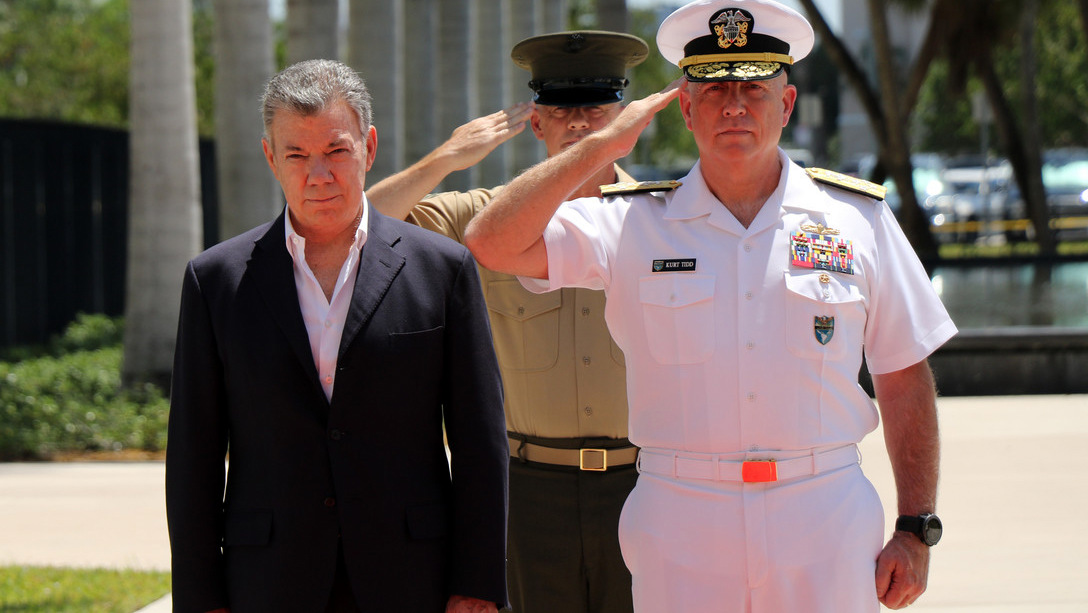
President Juan Manuel Santos, flanked by SOUTHCOM admirals, arrives
at SOUTHCOM’s Colombia military headquarters. Jose Ruiz | DoD
In
power since August 2018, President Iván Duque has challenged the
fragile peace concluded with the FARC by his predecessor, Juan Manuel
Santos – but not with the ELN. He has not dismissed the option of a
military intervention against Venezuela. According to Nicolas Maduro,
the United States are currently training 734 mercenaries in a
training camp situated in Tona with a view to carrying out a false
flag operation intended to spark a war with Venezuela. Taking into
account the sociological particularity of Colombia, it is impossible
to determine with certainty whether or not the training camp is
controlled by Bogota.
Guyana
In
the 19th century, the colonial powers agreed to a frontier between
British Guyana (presently Guyana) and Dutch Guyana (presently
Surinam). but no text has ever defined the frontier between the
British zone and the Spanish zone (presently Venezuela).
Consequently, Guyana administrates 160,000 km2 of forest which is
still a source of dispute with its larger neighbor. By virtue of the
Geneva agreement of 17 February 1966, the two states deferred to the
Secretary-General of the UNO (at that time the Burmese U Thant).
Nothing has changed since then – Guyana has proposed to bring the
case before the UNO Permanent Court of Arbitration, while Venezuela
prefers direct negotiations.
This
territorial dispute does not seem particularly urgent, because the
contested area is an uninhabited forest which was believed to be
without value – however, it is a huge area which represents
two-thirds of Guyana. The Geneva agreement has been violated 15 times
by Guyana, which specifically authorized the exploitation of a gold
mine. Above all, the stakes were raised in 2015 with the discovery by
ExxonMobil of oil deposits in the Atlantic Ocean, particularly in the
territorial waters of the contested zone.
The
population of Guyana is composed of 40 % Indians, 30 % Africans, 20 %
mixed race and 10 % American Indians. The Indians are a strong
presence in the civil services and the Africans in the army.
On 21 December, a vote of no confidence was lodged against the government of President David Granger, a pro-British, anti-Venezuelan General, in power since 2015. To everyone’s surprise, a deputy, Charrandas Persaud, voted against his own party, and in an atmosphere of indescribable chaos, provoked the fall of the government which had only a one-vote majority. Since then, the country is in a state of great instability – we do not know whether President Granger, who is presently undergoing chemotherapy, will be able to handle current affairs, while Charrandas Persaud left Parliament with an escort, via a back door, and has fled to Canada.
On 22 December 2018, in the absence of a government, the Ramform Tethys (under the flag of the Bahamas) and the Delta Monarch (Trinidad and Tobago) undertook submarine explorations in the contested zone on behalf of Exxon-Mobil. Considering that this intrusion violated the Geneva agreement, the Venezuelan army chased the two ships away. The Guyanese Minister for Foreign Affairs, working with current affairs, declared it a hostile act.
The United Kingdom Minister for Defense, Gavin Williamson, declared to the Sunday Telegraph on 30 December 2018 that the Crown was putting an end to decolonization, which had been Whitehall’s doctrine since the Suez affair in 1956. London is preparing to open a new military base in the Caribbean (for the moment the UK has bases only in Gibraltar, Cyprus, Diego Garcia and on the Falkland islands). The new base could be situated on Montserrat (West Indies), or more probably in Guyana, and should be operational in 2022 [7].
Guyana is a neighbor of Surinam (Dutch Guyana). Its President, Desi Bouterse, is wanted in Europe for drug trafficking – an affair which pre-dated his election. But his son, Dino, was arrested in Panama in 2013, despite the fact that he entered that country under a diplomatic passport. He was extradited to the United States where he was sentenced to 16 years of prison for drug trafficking – in reality because he was setting up the Lebanese Hezbollah in Surinam.
Brazil
In May 2016, Henrique Meirelles, the Minister of Finance for the transitional government of Libano-Brazilian Michel Temer, nominated Israelo-Brazilian Ilan Goldfajn as director of the Central Bank. Mereilles had also presided the Committee for the preparation of the Olympic Games, calling on Tsahal to coordinate the Brazilian army and police, thus guaranteeing the security of the Games. Simultaneously controlling the Central Bank, the army and the police of Brazil, Israel had no difficulty in supporting the popular movement of dissatisfaction in the face of the incompetence of the Workers’ Party.
Believing – without any solid proof – that Presidente Dilma Rousseff had fudged the public accounts in the context of the Petrobras scandal, the parliamentarians impeached her in August 2016.
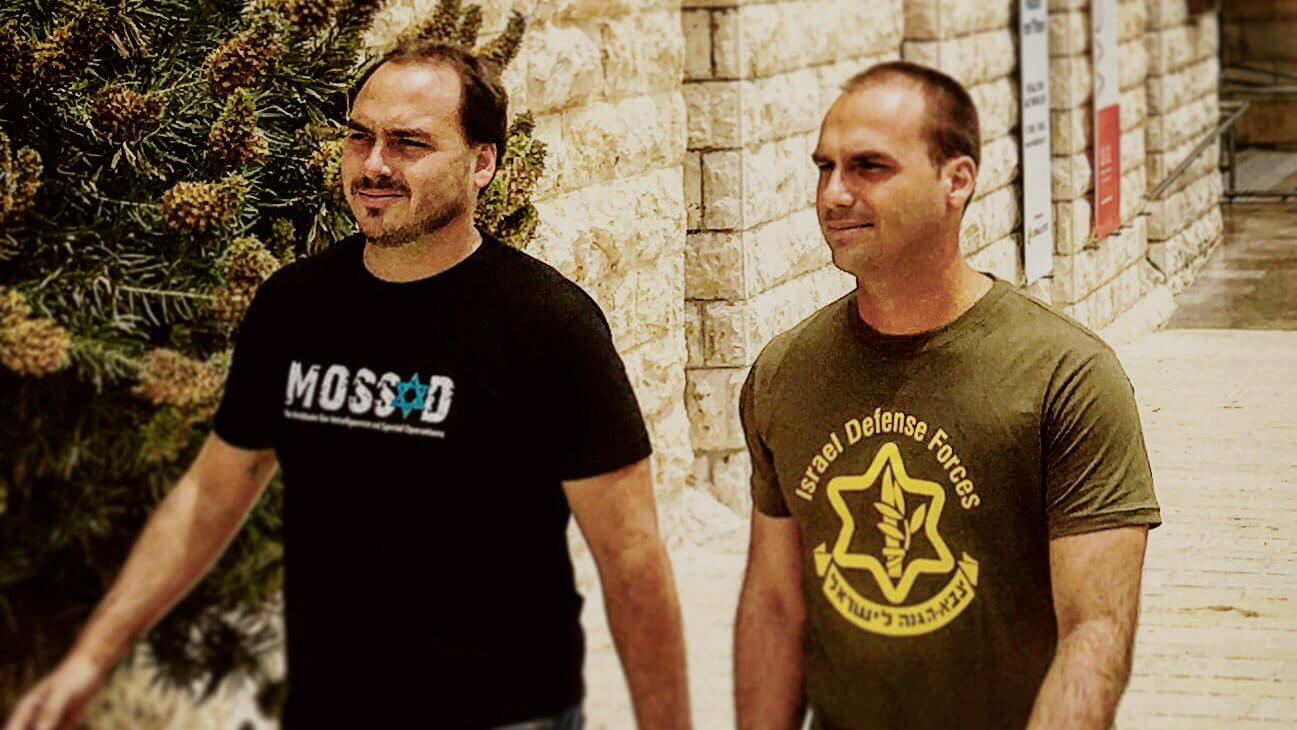
Bolsonaro’s sons don shirts depicting logos of Israel’s Mossad spy agency and “Israeli Defense Forces.” Photo | Twitter
During the Presidential election of 2018, candidate Jair Bolsonaro went to Israel to be baptized in the waters of the Jordan, and consequently obtained a massive percentage of the evangelical vote. He was elected with General Hamilton Mourão as his Vice-President. During the period of transition, Mourão declared that Brazil should prepare to send men to Venezuela as a “peace force” once President Maduro had been overthrown – comments which constitute a barely-disguised threat which President Bolsonaro attempted to downplay.
In an interview on 3 January 2019, on the TV channel SBT, President Bolsonaro spoke of negotiations with the Pentagon concerning the possibility of creating a US military base in Brazil. This declaration raised powerful opposition within the armed forces, for whom their country is capable of defending itself without assistance.
During his investiture on 2 January 2019, the new President welcomed Israeli Prime Minister Benjamin Netanyahu. This was the first time that an Israeli personality of this importance had been to Brazil. On this occasion, President Bolsonaro announced the coming transfer of the Brazilian embassy from Tel-Aviv to Jerusalem.
US Secretary of State Mike Pompeo, who also went to the investiture, where he met Peruvian Minister for Foreign Affairs Néstor Popolizio, announced with President Bolsonaro his intention to fight with him against the “authoritarian régimes” of Venezuela and Cuba. Returning to the United States, he stopped over in Bogota to meet with Colombian President Iván Duque. The two men agreed to work for the diplomatic isolation of Venezuela. On 4 January 2019, the 14 States of the Lima Group (including Brazil, Colombia and Guyana) met to agree that Nicolas Maduro’s new mandate, which begins on 10 January, is “illegitimate” [8]. This communiqué has not been signed by Mexico. Apart from this, six of the member-States lodged a complaint with the International Criminal Tribunal against President Nicolas Maduro for crimes against humanity.
It is perfectly clear today that the process towards war is underway. Enormous forces are in play, and there is little that can be done to stop them now. It is in this context that Russia is studying the possibility of setting up a permanent aero-naval base in Venezuela. The island of La Orchila – where President Hugo Chávez was held prisoner during the coup d’etat of April 2002 – would enable the storing of strategic bombers. This would constitute a much greater threat to the United States than the Soviet missiles stationed in Cuba in 1962.
[2] The Pentagon’s New Map, Thomas P. M. Barnett, Putnam Publishing Group, 2004. “The US military project for the world”, by Thierry Meyssan, Translation Pete Kimberley, Voltaire Network, 22 August 2017.
Top Photo | A US Naval Aircrewman surveys Honduran airspace from aboard an MH-60S Seahawk, assigned to the “Sea Knights” of Helicopter Sea Combat Squadron (HSC) 22. Photo | U.S. Navy
A
7.6 magnitude earthquake has struck in the Caribbean Sea north of
Honduras, briefly triggering multiple tsunami warnings in the area,
including for the coasts of Honduras, Belize, Puerto Rico and the
Virgin Islands.
The
powerful quake, which was felt across the region from Mexico to the
Honduran capital Tegucigalpa, struck some 36km northeast of Great
Swan Island around 2:51am GMT, according to US Geological Survey.
The
Pacific Tsunami Warning Center issued alert of possible waves up to
one meter above tide level in Honduras, Belize, Cuba, Mexico and
Jamaica. However, after detecting the formation of the waves, the
PTWC concluded that “based on observed data there is no threat”
and lifted some of its earlier warnings.
Still
the PTWC is advising residents of coastal areas to watch out for
“small sea level changes.” The agency projected that the
“earliest estimated time that hazardous sea level fluctuations and
strong ocean currents may begin” is after 5:20am GMT (1:20am
Atlantic Standard Time).
The
Pacific Tsunami Warning Center also lifted its multiple tsunami
advisories for the shoreline of Puerto Rico and the Virgin Islands,
where it earlier said waves of up to 0.3 meters were possible with a
threat of “fluctuations and strong ocean currents that could be a
hazard along coasts … beaches … in harbors … and in coastal
waters.”
There
were no immediate reports of casualties or major damage from the
shallow quake, which had a depth of just 10 kilometers. The director
of Honduras’ contingencies commission confirmed that the quake was
felt “in the majority” of the country with no reports of damage,
Reuters reports. Meanwhile Belize’s Emergencies Minister urged
residents of low coastal areas to stay vigilant for potential danger.
Hurricane
Maria Recovery + A Positive Course of Action
Storm
Clouds Gathering
On
September 18th, 2017 the eye of hurricane Maria passed directly over
Dominica. Winds hit at speeds of 195 miles per hour; first from the
east, then from the west.
The
wind brought torrential rains. Rivers and drains overflowed carrying
tangled masses of branches, fallen trees and mud into homes and
businesses. In a matter of hours entire villages were reduced to
piles of debris. This damage was inflicted across the entire nation
at the same time. From the outside it looked to many like a death
blow.
The
people of Dominica, however, are not the kind to wait passively for
help. They have a highly resilient and adaptive culture. The world
at large has a lot to learn from these people.
Here
is a window into a small societal collapse. Island of Dominica after
hurricane strike.
Post
Hurricane Maria Report - Dominica - October 11th (3 weeks in)
We
no longer have mobile connection at any of our positions. No way of
knowing how long it will take to get a connection back in the west.
In the meantime we have to go to the capital for all communications.
There
is a general consensus among those we talk to here that the country
is facing a full fledged economic collapse in addition to the
humanitarian crisis that is already developing. The country was
already at risk for a debt default. Now the infrastructure for the
old economy is totally devastated, and previous cash flows are not
coming back any time soon.
The
food situation on the east coast is horrendous. Many official relief
shipments are apparently being hoarded by those placed in charge of
local distribution, and is being handed out only to select friends,
or sold at ridiculous prices. Some grocery stores are open now, but
again, money is not flowing. So those who most need relief are not
getting it.
This
is a ticking time bomb. There are elements in many villages which
will resort to crime if their needs are not met soon.
With
communications down across the majority of the country, and the
government unable to coordinate effectively, many are starting to
realize that to pull out of this situation we are going to have to
organize our own solutions.
We
have people on the outside coordinating food relief shipments that we
will be distributing directly to the villages closest to us. We will
expand this as far as resources allow.
Our
core group is now operating like a semi-nomadic tribe at the moment.
We divide our time between the east and the west. Doing our best to
clean up, repairing what can be repaired, planting as much as
possible.
We
have finished clearing all but a small portion of the landslide from
our eastern compound. Our goal is to have the space safe for children
so that families can start returning within the next two months. To
accomplish this, several families are going to have to share the same
living space.
To
volunteer with the recovery effort or for shipping information
contact Sarah Subero for more information at:
The
White House has let a 10-day shipping waiver expire for Puerto Rico,
meaning foreign ships can no longer bring aid to the
hurricane-ravaged island from U.S. ports.
A
spokesperson for the Department of Homeland Security confirmed on
Monday that the Jones Act waiver, which expired on Sunday, will not
be extended.
U.S.
lawmakers and Puerto Rican officials had been pushing the
administration for an exemption from the Jones Act, a century-old law
that only allows American-built and -operated vessels to make cargo
shipments between U.S. ports.
They
argued that the waiver would help deliver gasoline and other critical
supplies more quickly and cheaply to the island in the wake of
Hurricane Maria. The island could be rebuilding and without power for
months.
The
Trump administration issued a weeklong waiver for Texas and Florida
after hurricanes Harvey and Irma, extending it for an additional week
in September to bolster relief efforts.
But
the White House did not initially lift the shipping restrictions for
Puerto Rico, sparking widespread public outcry and fueling
accusations that Trump is treating the U.S. territory differently
than the states hit by hurricanes.
The
administration agreed to temporarily lift the shipping restrictions
for Puerto Rico on Sept. 28.
But
officials have warned that the biggest challenge for relief efforts
is getting supplies distributed around Puerto Rico once they arrive,
while the U.S. shipping industry maintains that there are adequate
domestic companies available to assist with Puerto Rico’s recovery
efforts.
Lawmakers
in Congress are still pushing to roll back the Jones Act, with Sens.
John McCain (R-Ariz.) and Mike Lee (R-Utah) recently introducing
legislation that would permanently exempt Puerto Rico from the
shipping law.
At
McCain’s request, the bill was put on the Senate calendar under a
fast-track procedure that allows it to bypass the normal committee
process, but it has not been scheduled for any floor time.
“Now
that the temporary Jones Act waiver for Puerto Rico has expired, it
is more important than ever for Congress to pass my bill to
permanently exempt Puerto Rico from this archaic and burdensome law,"
McCain said in a statement.
"Until
we provide Puerto Rico with long-term relief, the Jones Act will
continue to hinder much-needed efforts to help the people of Puerto
Rico recover and rebuild from Hurricane Maria.”
FEMA
head Brock Long dismisses San Juan mayor's complaints: 'Political
noise'
FEMA
Administrator Brock Long said on Sunday that as his agency responds
to the crisis in Puerto Rico, it's also "filtered out" San
Juan Mayor Carmen Yulín Cruz, adding: "We don't have time for
the political noise."
More
than two weeks after Hurricane Maria lashed the island, killing 36
people, Cruz tweeted Sunday: "Increasingly painful to undestand
the american people want to help and US Gov does not want to help. WE
NEED WATER!" She later wrote, "Power collapses in San Juan
hospital with 2 patients being transferred out. Have requested
support from @FEMA_Brock NOTHING!"
"We
filtered out the mayor a long time ago," Long told ABC News'
Martha Raddatz on "This Week" Sunday, after Raddatz
mentioned the tweets. "We don't have time for the political
noise. The bottom line is, is that we are making progress everyday in
conjunction with the governor."
Cruz
and President Trump have traded shots in the weeks after the monster
storm made landfall. Late last month, the mayor appeared on
television in a black shirt with white letters that read, "HELP
US, WE ARE DYING." Cruz argued that federal aid had been slow to
reach Puerto Rico following Maria, which knocked out power to the
entire island.
Trump
tweeted the following day: "Such poor leadership ability by the
Mayor of San Juan, and others in Puerto Rico, who are not able to get
their workers to help." He added that Cruz was "very
complimentary only a few days ago," but "has now been told
by the Democrats that you must be nasty to Trump."
Later,
Cruz wore a short emblazoned with the word "NASTY" for an
interview with Univision.
Trump
visited the island last Tuesday. Afterwards, while Cruz said she
hoped new channels of communication with the White House would "put
in motion what is needed" to save lives, she also said Trump
sometimes was more a "miscommunicator in chief" than a
commander in chief.
"In
regards to the power failure, we are restringing a very fragile
system everyday," Long explained. "As we make progress,
simple thunderstorms pass through, knock the progress out."
Rebuilding
the island, he said, "is going to be a greater conversation for
the Congress in conjunction with the governor."
When
hospitals have power failures, intensive care unit patients are being
flown to the USNS Comfort, according to Long.
"As
far as the political noise, we filter that out, keeps our heads down
and continue to make progress and push forward restoring essential
functions for Puerto Rico," Long said in the interview.
US
Virgin Islands: The American citizens battered by hurricane Maria –
and forgotten
Most
of the 100,000 citizens here have no drinkable water or power, but
the territory has been overlooked in the storm’s aftermath
If
Irma hit like a right hook, then Maria was the sucker punch,
battering the islanders while they were already down. Almost a month
after the first of two deadly hurricanes collided with the US Virgin
Islands, the recovery is still in its infancy.
Power
lines droop over the main roads in Charlotte Amalie, the territory’s
capital. More than half of the roof of St Thomas’s commercial
airport no longer exists, replaced with sky blue tarps that ripple in
the breeze. All the territory’s schools remain closed, with hopes
to reopen on Tuesday. Around 90% of the territory is without power
and the vast majority of the population are still without potable
water.
While
the plight of neighbouring Puerto Rico, hit hard by Maria over two
weeks ago, has prompted a national outcry in the face of a slow
federal recovery effort, the continuing crisis on the US Virgin
Islands, home to 100,000 US citizens, has received less focus.
The
White House blamed “difficult logistics” for preventing Donald
Trump from stopping here during his trip to Puerto Rico earlier in
the week. But on Friday vice-president Mike Pence flew into the
American territory’s second island of St Croix, where Maria hit the
hardest. He vowed that the administration “will be with you every
day until the US Virgin Islands comes all the way back”.
The
territory’s governor, Kenneth Mapp, a registered Republican who ran
as an independent, backed the sentiment. “There is no country that
responds to disasters like the United States of America,” he said.
At
around the same time the politicians were speaking, 32-year-old
Tamika Francis was sifting through detritus at the Tutu Hi-Rise
public housing buildings just outside of Charlotte Amalie, where she
lives. Entire facades were blown out – front to back – by Irma. A
38-year-old woman was killed after falling from the building during
the winds, one of five fatalities in the territories. When Maria hit,
two weeks later, it dumped heavy rainfall on to the partially
skeletal building, flooding it once again.
What
is left looks like a bombsite. The remnants of residents’ lives –
refrigerators, mattresses, pots, pans, toilet seats, books – are
strewn in piles on the hilltop.
Although
about 160 of Tutu’s worst-affected families have been relocated to
shelters and given vouchers to find new housing; others, less
affected, had to remain behind. There is no water or electricity.
Francis carries pails collected from the cistern up a steep hill and
flights of stairs to supply her apartment.
“We’ve
been treated like dogs,” she said. “We have to scavenge for food,
for water.”
Velma
Samuel, 62, is a retired teacher’s aide and another resident who
remained in her apartment. She said she had seen no representatives
from the Federal Emergency Management Agency (Fema), the government
agency responsible for disaster management, present at the building
since Irma hit on 6 September.
She
experienced about a foot of flooding in her apartment during Irma and
Maria. It floods again whenever it rains. Mould now creeps up the
walls.
“As
fast as you could clean the mould out, you would find it somewhere
else,” she said.
Even
though the governor has vowed to relocate all of Tutu’s residents,
Samuel worried she would have to continue paying her rent, which is
financed by her social security payments, on the water damaged
apartment while she remained there.
In
Puerto Rico, the governor passed a blanket moratorium on public rent
payment until January 2018. A spokeswoman for the Virgin Islands
territorial emergency management agency [Vitema] said no such
arrangement was in place here.
“The
least they could have done was give us safe living quarters,”
Samuel said, reflecting on the horror of the night Irma hit. “You
can’t just take people and pitch them in a matchbox.”
Irma
drove through more than the sheetrock walls of Tutu Hi-Rise. It
destroyed two floors of t Thomas’s only hospital. The Roy Lester
Schneider hospital can now hold only 23 inpatients. Before Irma
destroyed the main medical wards and peeled off the roof membranes,
it held 169 beds.
Tina
Comissiong Dickson, the hospital’s chief compliance officer, was
one of those wheeling patients down to the lower levels. “It was
very intense,” she said, walking through an upper ward now covered
in mud, dangling wires and pools of water. “The winds and the water
were pounding in.”
Remarkably,
none of the patients were injured. But the hospital has evacuated 300
people to the US. It can no longer conduct significant surgeries, its
cancer ward – the only one in the territory – was entirely
destroyed, and the majority of dialysis patients are now evacuated
too.
When
Maria arrived a week later, with the roof already damaged, the
hospital was flooded once again. The water has not fully receded and
a few inches cover the floor of the cancer center, where Irma’s
winds destroyed the facility’s only MRI scanner. Commissiong
Dickson said the hospital had received significant federal
assistance, but added that it would take an estimated two years to
repair the damage.
Fema
has begun to roll out inspection teams. But, said agency spokeswoman
Renee Baffles, it had been “very difficult” to reach all the
island’s remote communities, many of which have no formal
addresses. More than 14,600 islanders have so far registered for
assistance with Fema, but there are undoubtedly many thousands more
in need of aid.
With
no access to the internet and no working radio or TV, Velma Samuel
and Tamika Francis had no idea how to contact Fema and apply for
assistance. Although the pair had given up hope for their government,
they had not given up on the island itself.
“I
love my island,” said Francis. “I was born and raised here. So no
matter what we go through here, I will never feel like like leaving,”
She
turned back towards the rubble and continued clearing it, piece by
piece.
This
piece was corrected on 8 October 2017. It initially referred to St
Martin. It should have said St Thomas. We also said Irma hit the
islands on 16 September; we should have said 6 September.

 Posts
Posts