Posts
Posts


I do not feel like posting any more. This article expresses what it is like in Sydney right now in the midst of the fires. This article is devoid of both blame and hopium, which makes it so0 much more readable.
Read and weep.
From disbelief to dread: the
dismal new routine of life in
Sydney's smoke haze
There’s nothing like going to sleep with the taste of ash in your throat to give you an actual, physiological understanding of real fear
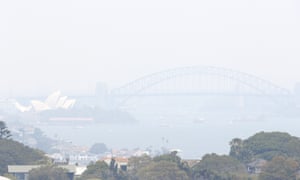
Smoke haze from wildfires fills the skyline in Sydney. ‘It feels like karma. This is what the scientists have warned us about, begged us to think of, all these years. It’s here. And it’s going to get worse.’ Photograph: Rick Rycroft/AP
 https://www.theguardian.com/australia-news/2019/dec/07/from-disbelief-to-dread-the-dismal-new-routine-of-life-in-sydneys-smoke-haze?CMP=twt_a-environment_b-gdneco&fbclid=IwAR0Jw2oB0Makh7SeyKeIFO8AhSGocVyi_vmvos34hwj0UBf--vfJQrSW4ss

https://www.news.com.au/technology/environment/weird-weather-anomaly-making-sydney-choke/news-story/04b58864b2f835efee52cb07f0c36a79?fbclid=IwAR1LTk8JWlYMXlfHZw4mBreJNlXbx0Sv3eO0WoMeL2KYRpJCl3OYgwrPFiQ

https://www.abc.net.au/news/2019-12-06/nsw-bushfires-mega-fire-north-of-sydney/11772568?fbclid=IwAR0sdBUD7sRm4UbDH6nFO2p8g_r1nbLqhLIVhmAXXFyiZDF84PbNE-zPo3c
Read and weep.
From disbelief to dread: the
dismal new routine of life in
Sydney's smoke haze
There’s nothing like going to sleep with the taste of ash in your throat to give you an actual, physiological understanding of real fear
Smoke haze from wildfires fills the skyline in Sydney. ‘It feels like karma. This is what the scientists have warned us about, begged us to think of, all these years. It’s here. And it’s going to get worse.’ Photograph: Rick Rycroft/AP
November,
201
Here’s
the dismal new routine of life in inner-city Sydney.
I get up around 7am, sniffing the air. Sometimes even through closed
windows you can smell how bad it is, but today it’s hard to tell. I
pad through the quiet house to peer out of the glass kitchen door at
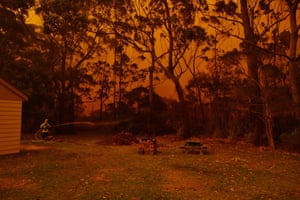
the sky: it’s cloudless, a fine pale yellow. Some days the light is
deep orange, a colour so striking that only a few weeks ago I’d be
compelled to snap a photo – but now it’s horribly familiar. When
it’s that colour, you don’t open the door. And you double back
through the house to make sure every window is tightly sealed.
Today
though, I step outside and take a (shallow) breath. Not too bad. In
our tiny courtyard the smoke is not actually visible right now, but
it still takes a few little forays, stepping back indoors and out
again, to determine whether the smell is worse inside the house or
out. This morning, outside seems marginally better, so it’s time to
move through the house, opening all the windows and doors, turning
the ceiling fans up high. With luck we’ll get a bit of “fresh”
air throughout in the next hour or so, before the smoke returns.
The big smoke: how bushfires cast a pall over the Australian summer
Next,
I check the wet laundry waiting in the basket – it smells mouldy
now after a couple of days, so I shove it back in the machine for
another wash. Maybe today we’ll be able to hang it outside. But
even then we’ll likely have to wash it again anyway. The smell
seems impossible to banish.
As
I open our windows this morning, the birds are squawking like crazy
in the eucalypts beyond our fence – another good sign. On the worst
days there’s a menacing quiet. But I can still taste smoke in the
back of my mouth, and the heaviness in my lungs remains. In recent
years I’ve largely grown out of my lifelong asthma, using
medication only once or twice a month. Now I’m using my reliever
several times a day. The health department urges
asthmatics to stay indoors, not to breathe outside if you can
possibly help it, and warns everyone against exercising
outdoors.
It’s
bizarre to see people ignoring this advice, keeping up their boxing
routines in the park, cheerlessly punching at each other through the
haze. Almost as surreal is walking past two men one evening outside a
pub, standing in the thick smoke, smoking
I
feel as though I’ve lost my ability to taste or smell anything but
smoke. And oddly it doesn’t even seem to smell like smoke anymore;
just an acrid, chemical, horrible odour in my clothes, my hair, the
sofa, the pillows. One morning I dress in clean clothes and walk 300
metres to the shopping mall across the road from my house. The
pharmacy, where I’m buying a new Ventolin, is deep inside, away
from the entrance. But still the cashier wrinkles her nose. “I can
smell it on you,” she says.
A
Blue Mountains pal receives messages from concerned friends in the
city. Her family lives 6km from one of the 150 fires burning
throughout the state. Later we learn this fire has taken out
20%
of the world heritage-listed national park,
but when I speak to her the wind direction is away from her town.
Impossibly, their sky is pure blue. When her husband returns from an
appointment in the city though, she texts me later: “He smells like
a barbecue.
On
one of the worst days, a friend tells me, Manly was filled with the
noise of sirens as city fire trucks attended false emergencies: smoke
alarms in houses and businesses were going off all day. Another
friend swims daily at an eastern suburbs harbour beach famous for its
crystal-clear water. Now she gets out of the water to find her skin
flecked with fine ash.
We
Sydneysiders are learning strange new symbols and language. Our
weather apps now carry dotted lines across the shining sun: smoke
haze. We learn the meaning of “temperature inversion”, in which
warm air traps cool – and smoke – beneath it; our weather reports
now carry air quality ratings. For the past month they’ve ranged
from “poor” to well beyond “hazardous”. In news updates about
the fires, it’s now commonplace to hear two horrific phrases: “seek
shelter” and “too late to leave”.
In
the inner city, people
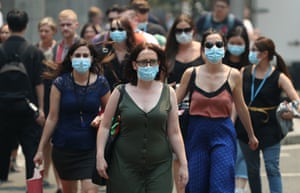
wear face masks to go about their business. In
the first days of the smoke, a visiting tourist wearing a large black
face mask was vox-popped on television. He’d bought the mask for
his trip to China, the American explained, but didn’t need it
there. He hadn’t expected to wear it peering through the haze at
the Sydney Opera House.
Facebook
chatter shifts from amused sightings of masks to suggestions of where
to buy them, to resignation: they don’t work anyway. They might
help your mood, but they’ll do nothing to stop the microscopic
particles entering your lungs, unless
they’re rated P2 and have super suction around the face.
Despite
this, I can’t help covering my mouth and nose for the few steps to
and from the car. I haven’t taken a train or bus in weeks; too much
walking involved.
The
fire danger warnings have a new category. Colours at the low-danger
end are green, moving through yellow and orange. The new one is a
deep, malevolent red with black stripes, and it’s called
“catastrophic”.
On
the first catastrophic warning day there’s a palpable fear, because
even expert firefighters have
never seen anything like this. The
winds are completely unpredictable. Nobody knows what will happen.
At
first we watch the footage – those walls of orange flame storeys
high – with our hands over our mouths. Money floods in to emergency
relief funds to
support “the fireys”, the
koala rescuers.
But as the days and weeks pass, here in Sydney the mood changes from
disbelief to hypervigilant fear to a kind of WTF petulance.
It’s still happening?
We’re used to turning our attention briefly, intensely, to “those
poor people” affected by climate change, then returning to normal
life. Now those poor people include us.
Internet
fights break out over whether it’s obscene to complain about the
smoke. Of course it is; we’re lucky, we of the middle-class inner
city. I can afford to buy a new Ventolin once a week, for example. I
have time to
do each load of laundry thrice before it smells clean. My work
doesn’t force me to remain outside, breathing in this shit all day
long. And of course, no fires have visited inner Sydney.
None of ours are among the 600-plus homes burnt to the ground. None
of us are among the dead.
But
also: it isn’t obscene
to find this intolerable. It is intolerable.
After
our petulance comes a stoic, patient reasoning. It’s good for us to
get this wake-up call. And it’ll be over soon. But that was weeks
ago, and the patience has been replaced by a grim, creeping dread. A
fear that it won’t be over soon, or ever. It feels like karma. This
is what the scientists have warned us about, begged us
to think of, all these years. It’s here. And it’s going to get
worse.
We
have the “Fires Near Me” app on our phones now, but I’m careful
not to zoom out too far from our immediate 50km zone. If you do, it’s
easy to panic. There are so many little fire symbols they overlap.
Weeks after they began, almost half are still classed “out of
control”. And zooming out brings the existential horror of what all
this really means. It also brings shame, at how we city dwellers have
managed to ignore what people in the regions have endured for years
now. Even as we’ve written the letters, donated the money and
attended the protests about the towns without water, the massive
fish kills,
the dust storms, the extinctions. Even if we’ve attended to all
this in our minds, there’s nothing like going to sleep with the
taste of ash in your throat to give you an actual, physiological
understanding of real fear.
A
few days ago, on the worst day here, I lay on my bed in the
afternoon. My lung cobwebs felt specially heavy, the sinus headache
intense. Outside, despite daylight saving time, it was almost dark at
4pm. I’d taken to putting towels to the gap under the front door.
My thoughts turned again, with fury, to our country’s leadership
vacuum. The prime minister’s family lives here in Sydney; surely by
now the man must be saying something?
I checked his social media pages. Prime minister Morrison’s
Instagram account carried grinning images of him – baseball cap in
place - atop a ladder, draping his family home in twinkly Christmas
lights. No
matter what’s going on each year, says
the PM of a burning nation, getting
in the Christmas spirit has always been such an important part of our
family life.
Outside
parliament in Canberra, a
woman sets up the burnt remains of her family’s destroyed house:
a few iron sheets, a leaning section of charred wooden framework,
twisted metal, black pots and pans. Her sign, painted on blackened
corrugated iron sheet, reads: “Morrison your climate crisis
destroyed my home.” Not very Christmassy, Melinda.
Back
here in the Marrickville morning, it’s nine o’clock and the birds
are growing quiet again. The smell is back. It’s astonishing how
quickly it arrives; you sense it first in the back of the throat. I
move through the house once more, closing all the doors and windows
tight
going
off”

https://www.news.com.au/technology/environment/weird-weather-anomaly-making-sydney-choke/news-story/04b58864b2f835efee52cb07f0c36a79?fbclid=IwAR1LTk8JWlYMXlfHZw4mBreJNlXbx0Sv3eO0WoMeL2KYRpJCl3OYgwrPFiQ

https://www.abc.net.au/news/2019-12-06/nsw-bushfires-mega-fire-north-of-sydney/11772568?fbclid=IwAR0sdBUD7sRm4UbDH6nFO2p8g_r1nbLqhLIVhmAXXFyiZDF84PbNE-zPo3c