Showing posts with label Hurricane Maria. Show all posts

Wednesday, 29 August 2018

Revealed: what we always knew about Puerto Rico


Puerto Rico raises death toll of Hurricane Maria to 2,975 from initial 64


Puerto Rico raises death toll of Hurricane Maria to 2,975 from initial 64

Almost 3,000 people died in the wake of Hurricane Maria, which battered Puerto Rico last September, the US territory announced after a new study.
Governor Ricardo Rosselló made the official announcement on Tuesday, following the publication of an independent study estimating the casualties at 2,975.

Commissioned by Governor Rosselló and carried out by the Milken Institute School of Public Health at George Washington University, the study found that the death toll was considerably higher than original reports.

In estimating the true death toll of Hurricane Maria, researchers looked at historical data to estimate how many people would have died had the storm not hit the island. That figure was then compared to the number of deaths reported from September 2017, when the hurricane hit, to February 2018, when the island still struggled with blackouts and a shortages of essential supplies on the road to recovery.

The study found that all age and income groups were affected by the sharp rise in mortality, but that the risk of death was markedly higher among the island’s poor. Among low-income Puerto Ricans, the risk of death was 45 percent higher.

An earlier survey, carried out by the government of the US territory and presented to Congress earlier this month, put the death toll at 1,427 above normal, but concluded that it cannot say for sure how many of those actually died as a result of the storm. The report did highlight the damage to Puerto Rico’s infrastructure and public health, and was accompanied by a request for $139 billion in aid.

The authorities' initial figure of 64 deaths was doubted by much of the media at the time, but was defended by Rosselló, until now. That figure was likely as low due to officials strictly classifying only certain deaths - such as those caused by collapsing buildings, flying debris, floods and drownings - as caused by the hurricane.

During our broader study, we found that many physicians were not oriented in the appropriate certification protocol," the report explains. "This translated into an inadequate indicator for monitoring mortality in the hurricane's aftermath."

A Harvard University study, published in May, estimated that there were 4,645 more deaths in Puerto Rico due to the storm. It garnered widespread media attention.

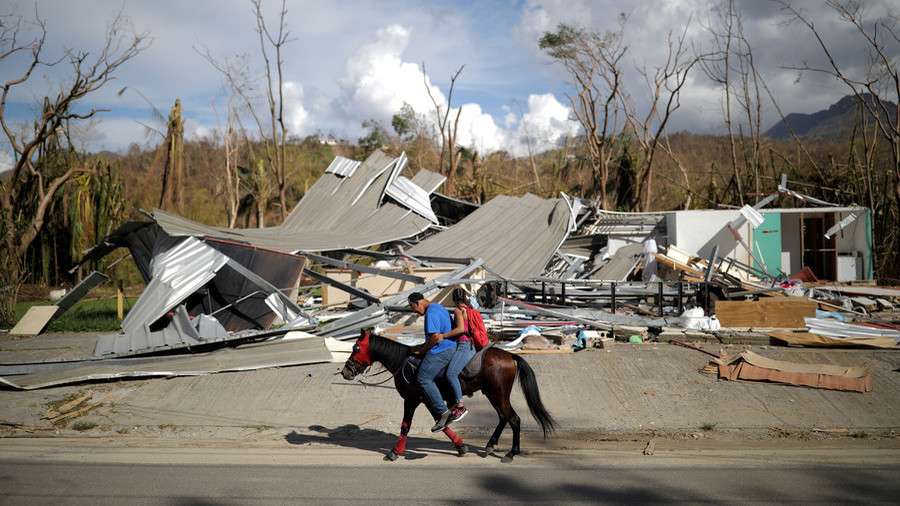
If the new figures are accurate, Hurricane Maria is the deadliest storm to have hit Puerto Rico since the 1899 San Ciriaco hurricane. It began as a tropical storm off the west coast of Africa, intensifying as it approached the Caribbean. It made landfall on Puerto Rico on September 20, battering the island with winds of up to 155 miles per hour, ripping buildings apart and uprooting trees.

The Trump administration was blasted for its response to the devastation, which was marked by delays in water and food deliveries. Carmen Yulín Cruz, the Democrat mayor of San Juan, got into a verbal spat with President Trump over his response to the crisis, which she said deserved “a 10 out of a scale of 100.”

The Mayor of San Juan, who was very complimentary only a few days ago, has now been told by the Democrats that you must be nasty to Trump.

Last year’s Atlantic hurricane season was a particularly active one. Puerto Rico was hit by storms Maria, Irma and Philippe, and was narrowly missed by hurricane Jose. With some of the island still without power, Puerto Rico now faces into a less threatening hurricane season this year.

Thursday, 7 June 2018

Disaster capitalism in Puerto Rico

Puerto Rico, “Playground for the Privileged”: Investors Move In as Homes Foreclose & Schools Close

Democracy Now1


While healthcare, the public school system and infrastructure in Puerto Rico are flailing nine months after Hurricane Maria ravaged the island, wealthy investors have descended on the island to turn a profit. 

We speak with Naomi Klein, author, journalist and a senior correspondent for The Intercept. Her new book is titled “The Battle for Paradise: Puerto Rico Takes on the Disaster Capitalists.” 

We also speak with Katia Avilés-Vázquez, a Puerto Rican environmental activist and member of Organización Boricuá de Agricultura Ecológica, and Elizabeth Yeampierre, executive director of UPROSE and co-chair of the Climate Justice Alliance


US media turns blind eye to the death of 5,000 Puerto Ricans

By Genevieve Leigh

5 June, 2018

Last week, a stunning new study was published in the New England Journal of Medicine by a team of Harvard scientists, who estimate that the true death toll from Hurricane María in Puerto Rico may be as high as 5,000. The report is a powerful blow to the lies of both the local and federal governments, which to this day officially acknowledge just 64 deaths.
The study is a damning exposure of one of the most monstrous cover-ups in US history. Eight months after the storm, the independent study by Harvard researchers provides the only comprehensive scientific assessment of the death toll from the hurricane and the grossly under-funded and incompetent recovery effort. It is the first and only study to use data collected from on-the-ground research and is undoubtedly the most accurate to date.
Despite the highly significant findings, the report has been virtually ignored by US cable news networks and online and print media outlets.
From Tuesday when the study was released until midday Wednesday, the three main cable news networks—Fox News, CNN and MSNBC—gave the Harvard study a combined total of just over 30 minutes of coverage. On Fox, the findings were given only 48 seconds of air time.

The report was released the same day that ABC television abruptly cancelled  the revived Roseanne television series after its star, Roseanne Barr, posted a racist tweet. The watchdog group Media Matters calculated that cable news networks covered Roseanne Barr’s tweet and her show’s cancellation 16 times as much as the deaths of thousands of US citizens in Puerto Rico.

The Harvard report was buried or ignored by the major newspapers. On Wednesday, the New York Times ran a single article on the study on page 13 of its print edition. There were no commentaries on the massive death toll on that day’s editorial or op-ed pages. By Thursday, the report had vanished from the Times’ print edition, while the Roseanne Barr story appeared on the front page and two full inside pages. USA Today had nothing at all on the Harvard study in its print edition.
Cable news coverage of Harvard Study verse Rosanne Barr Tweet
The media’s downplaying of the deaths of 5,000 people cannot be explained as a mere oversight. These multi-billion-dollar media giants have the resources and staff to cover virtually any story in any corner of the globe.
Hundreds of journalists were dispatched to cover the royal wedding in England just 10 days before the publication of the Harvard study. The same week that they all but ignored the news of thousands of deaths on US territory, the television broadcast and cable news programs devoted hours of coverage to a series of storms that caused a tiny fraction of the death and destruction caused by Hurricane Maria, in some cases making them the lead item on the evening news.
The team of Harvard scientists was able to accomplish in six weeks, with a $50,000 grant, what no media outlet even attempted to accomplish in eight months.
The downplaying of the Harvard study by the corporate media stems in large part from the fact that it exposes not only the criminal role played by the local and federal government, but also the complicity of the media. The Harvard study exposed the cover-up of not only the scale of devastation and suffering from the hurricane, but also the conditions of mass poverty and collapsed infrastructure on the island and the lack of preparation by the government for a serious storm.
Any serious examination of the situation in Puerto Rico would require the consideration of a host of social crimes that all point to the US corporate-financial oligarchy: a century of US imperialism, financial scheming and looting of public assets, decades of austerity, the denial of basic democratic rights, among other issues.
The staggering death toll revealed by the Harvard study raises a whole set of questions the media does not want raised:
* What was the true nature of the recovery effort?
* What were the conditions on the ground in Puerto Rico before the storm that led to such devastation?
* Why was the scope of the crisis on the island so systematically concealed from the general public?
In fact, the corporate media began downplaying the crisis soon after the hurricane struck Puerto Rico last September. The first Sunday after the storm, the five major political talk shows taken together dedicated less than one minute to the devastation from the storm and three out of the five shows didn’t mention Puerto Rico at all. At this time the entire island of Puerto Rico was without power and millions did not have access to clean water or medical care. Of the cable news networks that covered Hurricane Maria, the BBC initially mentioned Hurricane Maria on air more than the US networks.
-Online media coverage of Hurricane María compared to similar hurricane disasters
The attention given to Hurricane María was low even in comparison to that given similar hurricane disasters in the US last year. Data from the Media Cloud project at the MIT Media Lab shows that US media outlets ran 6,591 stories online about Hurricane María in Puerto Rico from September 9 through October 10. By comparison, for the equivalent periods, news outlets published 19,214 stories online about Hurricane Harvey in Houston and 17,338 on Irma in the Caribbean, including part of Puerto Rico and Florida.

Statistics from Media Matters show that overall coverage of the crisis sharply declined after President Donald Trump visited the US territory on October 3. It was during this trip that the President took the lead in denying the humanitarian crisis, claiming that what happened in Puerto Rico was not a “real crisis” like Hurricane Katrina in 2005 because supposedly only 16 had died from the storm in Puerto Rico. A Media Matters study found that prime time cable news coverage of Puerto Rico’s recovery plummeted after Trump’s visit to the island.

Prime-time cable news coverage of Puerto Rico recovery efforts
While thousands were dying from lack of basic medical care, the mainstream media was consumed by other matters, in particular the Democratic Party-led anti-Russian witch hunt and the anti-democratic #MeToo campaign.
The corporate-controlled media had no interest in reporting the real situation in Puerto Rico for two related reasons: first, the American financial oligarchy which it serves did not want to spend the money needed to provide essential services and save the lives of workers and poor people; and, second, it was consumed with a different priority—obtaining passage of the multi-trillion-dollar Trump tax cut for corporations and the rich.
The glossing over of the Harvard study by the major news outlets is consistent with the media’s treatment of all of the social crimes against the working class, from Hurricane Katrina in New Orleans to the BP oil spill to the Grenfell Tower fire in London.

One cannot help but note the parallels to the crisis in Flint, Michigan, where coverage of the poisoning of the water supply of an entire city was abruptly dropped after a visit by President Barack Obama. In Obama’s own version of Trump’s throwing paper towel rolls into a crowd in hurricane devastated Puerto Rico, Obama sipped a glass of Flint water on camera and dismissed the effects of lead poisoning on children, declaring that “we all ate some paint chips as kids.”

Saturday, 4 November 2017

Severe health hazards in post-hurricane Puerto Rico

Mold is blanketing Puerto Rico 

making it difficult for many to 


breathe.

According to the National Institute of Health (Clinical Microbiology Rev. July 2003; 16(3):497-516. Mycotoxins. By J.W.Bennett and M. Klich), “Mycotoxins are secondary metabolites produced by microfungi that are capable of causing disease and death in humans and other animals.  Mycoses range from merely annoying (e.g., Athlete’s Foot) to life-threatening (e.g., invasive Aspergillosis). Primary pathogens affect otherwise healthy individuals with normal immune systems. Opportunistic pathogens produce illness by taking advantage of debilitated or immune-compromised hosts……  The majority of human mycoses are caused by opportunistic fungi.”
“Mycoses are frequently acquired via inhalation of spores from an environmental reservoir. Skin contact with mold-infested substrates and inhalation of spore-borne toxins are also important sources of exposure.” (Bennett and Klich, ibid).
Diseases associated with inhalation of spores include toxic pneumonia, hypersensitivity pneumonia (characterized by inflammation of the lungs which can lead to scarring of the lungs, an irreversible condition that decreases lung capacity), sinusitis, tremors, chronic fatigue syndrome, kidney failure, biofilm, hair loss, skin conditions, vision disturbances, neurologic disturbances, diarrhea, nausea, vomiting, internal hemorrhaging, and abnormal liver levels. Exposure to mold, according to the Florida Department of Health, can cause cognitive problems such as memory loss and mood swings. In some individuals, these can lead to depression, fatigue and loss of interest in everyday activities. Mycotoxins can cause sleep disturbances and if left untreated, can lead to neurological problems such as impaired balance and difficulty walking.
31 October, 2017


The unfolding humanitarian crisis in Puerto Rico after Hurricane Maria barreled over the island is only getting worse. Alarm bells are being rung from humanitarian organizations on the ground that the deteriorating conditions are seriously impacting human health and survival. Warnings from the front lines are summarized in the excerpts below.


It’s an emergency that a month in should not be an emergency--but it is,” said Thompson, presenting a series of real-life scenarios that Puerto Ricans have been grappling with since driving rain and winds of 155 miles per hour took down the island’s entire electrical grid on Sept. 20. Without electricity, a great deal of daily life grinds to a halt: there’s no light at night, no fans or air conditioners to cool sweltering rooms, no easy way to charge phones or access the internet, no reliable way to keep hospitals running--the list goes on.


What would you do, Thompson asked, if your elderly mother, wheel-chair bound and desperately needing food and water, was stuck on the 17th floor of an apartment building in San Juan with no working elevator?


Or, what if the hurricane had drenched everything inside your house including all the mattresses, forcing you and your children to sleep on the floor where rats could be scampering? Or what if you lived in the countryside, stuck on the far side of a collapsed bridge, and you had no way to get drinking water because the storm knocked out your community’s delivery system? There’s no bottled water anywhere and a relief convoy hasn’t visited in days. What would you do?


Not everyone is suffering, Thompson pointed out. Those with money have options: They can get a hot meal in a restaurant; they can buy fuel for their cars and generators; they can purchase dry sheets and towels for their homes--and their homes, better built to begin with, may still have their roofs.


It’s hard to describe the complexity of it,” said Thompson. “Parts of San Juan look normal; parts look ravaged.”


According to the National Institute of Health (Clinical Microbiology Rev. July 2003; 16(3):497-516. Mycotoxins. By J.W.Bennett and M. Klich), “Mycotoxins are secondary metabolites produced by microfungi that are capable of causing disease and death in humans and other animals. Mycoses range from merely annoying (e.g., Athlete’s Foot) to life-threatening (e.g., invasive Aspergillosis). Primary pathogens affect otherwise healthy individuals with normal immune systems. Opportunistic pathogens produce illness by taking advantage of debilitated or immune-compromised hosts…… The majority of human mycoses are caused by opportunistic fungi.”

Mycoses are frequently acquired via inhalation of spores from an environmental reservoir. Skin contact with mold-infested substrates and inhalation of spore-borne toxins are also important sources of exposure.” (Bennett and Klich, ibid).

Diseases associated with inhalation of spores include toxic pneumonia, hypersensitivity pneumonia (characterized by inflammation of the lungs which can lead to scarring of the lungs, an irreversible condition that decreases lung capacity), sinusitis, tremors, chronic fatigue syndrome, kidney failure, biofilm, hair loss, skin conditions, vision disturbances, neurologic disturbances, diarrhea, nausea, vomiting, internal hemorrhaging, and abnormal liver levels. Exposure to mold, according to the Florida Department of Health, can cause cognitive problems such as memory loss and mood swings. In some individuals, these can lead to depression, fatigue and loss of interest in everyday activities. Mycotoxins can cause sleep disturbances and if left untreated, can lead to neurological problems such as impaired balance and difficulty walking.

Tarps are desperately needed right now,” said Thompson, noting that one rural woman she encountered had relied on her sister in the Dominican Republic, where more than 40 percent of the population lives in poverty, to send her one. “Some kind of lighting system is badly needed. There are all kinds of things you can’t get--insect repellent, [a type of ] batteries.”


But with the rainy season here, tarps top the list for some community leaders who are doing all they can to help ensure people have shelter. Thompson described the efforts of one woman who has been trying to get tarps for about 800 homes in different communities outside of San Juan: The woman approached the Federal Emergency Management Agency, or FEMA, which sent her to speak to the mayors of the communities. The mayors didn’t have tarps, so she went back to FEMA. No luck again. So next she called the tarp manufacturing companies in the US, and hit a dead end there, too.


She has been up and down for these communities and has not been able to get these tarps,” said Thompson.


Those efforts are playing out against a new worry for families whose homes have been exposed to the elements: mold.


A lot of times in hurricanes people forget to talk about just how hard it is to clean out your house, and the mold,” said Thompson. “It’s an increasing problem. People are just beginning to realize it.” Chlorine is what people need to try and tackle the problem, but the supplies are restricted.


You need a whole kit to take mold off,” said Thompson. “You need to educate people about that. And so how do you do that when there is no communication?” She said the public health department will need to organize a full effort to address the mold issue.


It seems everywhere you come up against another insurmountable problem," Thompson added.


The Centers for Disease Control and Prevention (CDC) reports that just under 8% of all people in the United States currently have asthma. However, for residents of Puerto Rico, that percentage jumps to as high as 19% of the population according to some studies.


For those with asthma, managing their condition with treatment options from their healthcare provider and avoiding asthma triggers are all important steps for their well-being and long-term health. Unfortunately, due to all the damage caused by Hurricanes Maria and Irma, there are now countless residential, commercial and institutional properties across the islands that have considerable mold contamination. This is due to water damage and elevated indoor humidity levels, exacerbated by a lack of air-conditioning and mechanical ventilation caused by power outages.


Exposure to elevated levels of mold can act as an asthma trigger for many who suffer from the condition,” said Harry Pena, President of Zimmetry Environmental. “We are coming across mold and other microbial issues in many of the properties we are called upon to inspect and provide our expertise. Recognizing the full extent of contamination, writing remediation protocols, overseeing mold removal activities, and performing post remediation clearance testing are all important activities we are currently involved with. These actions help to ensure mold and other indoor air quality issues don’t become a problem a few months from now for people living, working or going to school in these damaged properties.
Homes lay scattered after the passing of Hurricane Maria in Roseau, the capital of the island of Dominica, Saturday, Sept. 23, 2017. Lives have been lost around the Caribbean, including on hard-hit Dominica. (AP Photo/Carlisle Jno Baptiste)

HMN: What was the situation on the ground?


MC: Many homes in Puerto Rico were destroyed or severely damaged, some roads remain impassable, electrical power is unavailable across most of the island, food, potable water and basic amenities are scarce, and communication by phone, text, or email is difficult or impossible.


In addition to the immediate need for food, water, shelter and communication, this situation has profound implications for the health and wellbeing of 3.4 million of our fellow Americans. Diabetes and hypertension are highly prevalent in Puerto Rico and are readily treatable with medication. But what if you can’t reach your doctor to prescribe a medication because the phones don’t work? What if you can’t fill a prescription, because you’re not receiving your paycheck, the ATMs aren’t functional and you can’t afford your prescription co-pay? What if you do obtain your insulin, but you can’t keep it cold, because refrigeration requires electricity and you don’t own a generator?


HMN: What are the long-term consequences of that lack of infrastructure?


MC: As the days and weeks pass without the restoration of electrical service and communications, Puerto Ricans are running out of medications for myriad treatable conditions. Over time, the population burden of preventable illness, including the long-term complications of diseases such as diabetes and hypertension — blindness, neuropathy, kidney failure, heart attack, and stroke – will increase. While we were there, in the very early days of this crisis, we were already seeing the harbingers of this looming health care crisis - systolic blood pressures above 250 and blood sugars above 500 in patients who simply ran out of medication. The impact of this catastrophe on the health of Puerto Ricans will be felt for years.


HMN: What kind of care do people with these chronic illnesses need?


MC: Many people require home health services to stay alive. Home ventilators and oxygen concentrators require electricity. Patients dependent on tube feedings require a reliable source of specialized food and medical equipment. Patients with end stage kidney disease require regular dialysis. How will these services be provided? In the face of a collapsed infrastructure, public health agencies in Puerto Rico have been stretched thin in their attempts to meet these needs.


Finally, because there is no power, most hospitals in Puerto Rico remain in service only with the electricity generated by diesel generators. Fuel delivery remains erratic, and generators that were never meant to operate for more than a few days have been running, sometimes continuously, for weeks. Not surprisingly, generators fail sporadically, abruptly removing entire hospitals from the health care grid and leaving acutely ill patients with limited options until fuel can be delivered or repairs can be completed.

Saturday, 28 October 2017

Cremated bodies in Puerto Rici not included in official death toll

Puerto Rico Is Burning Its Dead, And We May Never Know How Many People The Hurricane Really Killed

People whose bodies are cremated are largely not being counted in the official death toll.
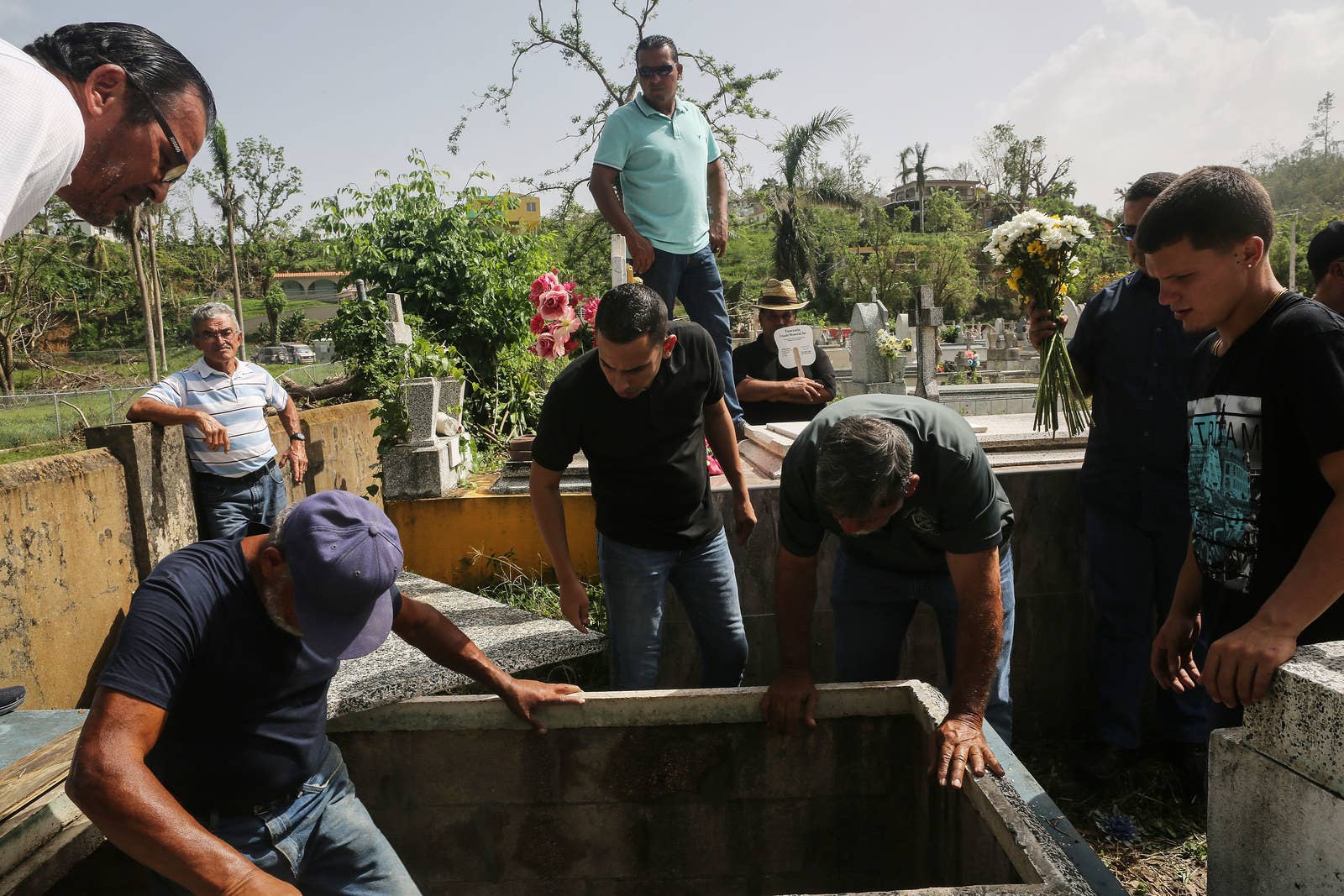

Mourners and cemetery workers gather at the gravesite on Oct. 19 in Utuado, Puerto Rico.
28 October, 2017


AGUADILLA, Puerto Rico — Funeral directors and crematoriums are being permitted by the Puerto Rican government to burn the bodies of people who died as a result of Hurricane Maria — without those people being counted in the official death toll.


The result is a massive loophole likely suppressing the official death count, which has become a major indicator of how the federal government’s relief efforts are going because President Trump himself made it one.


During Trump’s photo-op visit to the US territory — whose residents are US citizens — three weeks ago, he boasted that the death toll was just 16. It doubled by the time he returned to Washington that same day. The death toll is now at 51, a figure widely contradicted by what funeral homes, crematoriums, and hospitals on the ground tell BuzzFeed News.


Then, last week, when asked how he would rate the White House’s response to the crisis, Trump said, "I’d say it was a 10.” More than a month after the storm made landfall on Sept. 20, 2.6 million people are without power, at least 875,000 people don’t have access to running water, and 66% of the island still doesn’t have cell service.


Trump added, “I’d say it was probably the most difficult when you talk about relief, when you talk about search, when you talk about all of the different levels, and even when you talk about lives saved.” Meanwhile, two US representatives and 13 senators recently wrote letters to the acting head of homeland security requesting investigations into the death toll.


Last week, BuzzFeed News visited 10 funeral homes and crematoriums in two Puerto Rican municipalities on the territory’s western coast, Aguadilla and Mayagüez, at least two hours away from the bustling San Juan. The findings include:


Communication between the central institute certifying official hurricane deaths, called the Institute of Forensic Sciences, and funeral homes or crematoriums appears to be fully broken, with each side waiting for the other to take action.


The central institute is also giving crematoriums permission to burn bodies of potential hurricane victims — which is happening more because it is cheaper and logistically easier as families rebuild their lives — without examining them first, which means they are not being counted in the official death toll.


Disaster experts say this lack of a transparent and consistent approach to counting deaths means the toll is likely inaccurate.


And experts also say an inaccurate official death toll potentially cheats families out of FEMA relief funds and could hurt how future disasters are handled.


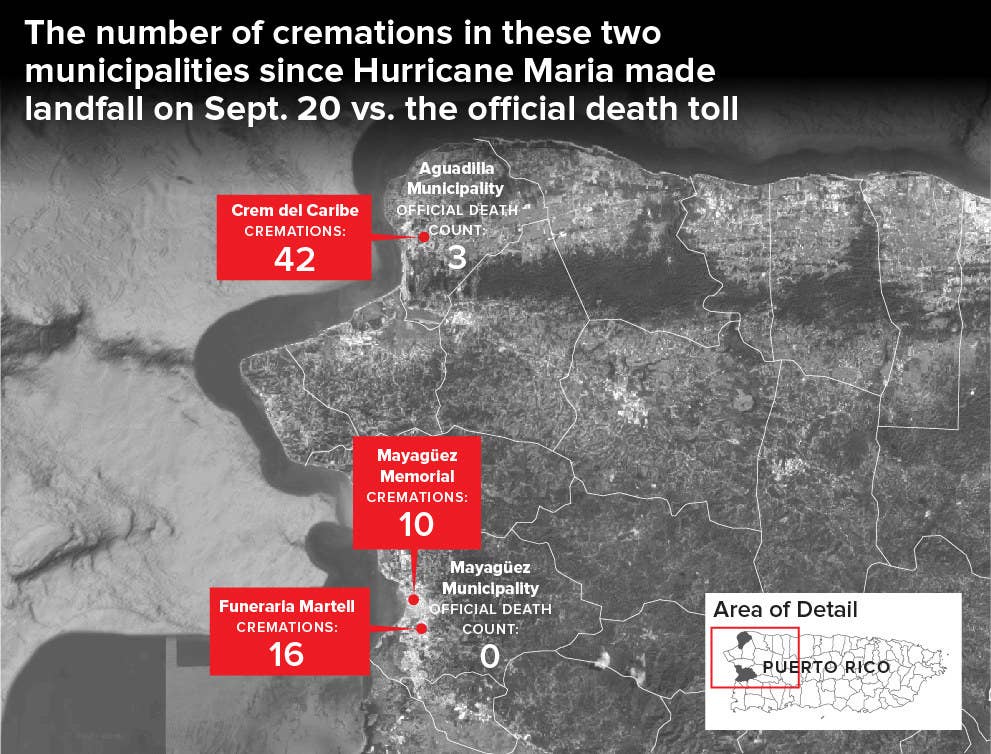
The funeral home and crematorium directors told BuzzFeed News that they had received dozens of bodies of people who died of hurricane-related causes — just the cases from these two municipalities would potentially more than double the death toll if they were included. The Forensic Institute permitted the bodies of at least 42 potential hurricane victims to be burned, according to one crematorium director.


Puerto Rico’s safety department says the funeral and crematorium directors should send any potential hurricane-related victims to the institute before they’re burned — but admit they haven’t actually officially communicated that to them.


John Mutter, a professor of earth sciences and public affairs at Columbia University who studied how the death count was handled after Hurricane Katrina, said Puerto Rico’s procedures seem to be “deliberately trying to keep the numbers low,” which he called “unconscionable.” Other experts called it a failure of bureaucracy.


The White House and the office of the Governor of Puerto Rico, Ricardo Rosselló, didn’t respond to a request for comment.


Asked directly if the number of hurricane-related deaths in Puerto Rico is being undercounted, a spokesperson for the Puerto Rico Department of Public Safety dodged, saying, “We can’t infer or reach any assumptions or inferences. If there really are cases like this, they have to present them to the authorities.”


But, at this point, many of those bodies have been burned to ash.
I never expected all of this”

In Aguadilla, a municipality of around 60,000, the official death toll currently counts three fatalities from the hurricane: one person who drowned in flooding, one person who fell off his roof while trying to repair hurricane damage, and one person who died of a bone infection.

But staff at the only crematorium in the municipality, Crem del Caribe, said they were given permission by the forensic institute to cremate at least 42 bodies of other people who had died as a result of the hurricane. That included people who died due to a lack of oxygen supply, failure of dialysis and oxygen machines because of the lack of electricity, and people who died of heart attacks. (Seventy-five percent of the island still has no power, and questions are being raised about the firm contracted to fix it.)

A lot of people have died as an indirect result of the hurricane,” said Jaime Domenech, crematorium director at Crem del Caribe. “Especially older people, who because of their health conditions many of them depended on electricity.”

The majority of those cases came from funeral homes in the area, like Vitin Alvarez, 68, who died a week after the hurricane made landfall.

Alvarez had Alzheimer’s disease, and his death certificate states his primary cause of death was respiratory failure. His wife, Blanca Alvarez, 63, told BuzzFeed News he died because she couldn’t get gasoline to power the generator he needed for his oxygen machine. There’s no mention of the lack of electricity on his certificate.

It’s so difficult to get gasoline. And there wasn’t a way to communicate with anyone,” Alvarez told BuzzFeed News outside her home in Aguadilla.

Alvarez cremated her husband because of financial concerns and because she was overwhelmed handling basic things like finding food and water after the hurricane. He was the first person in the Alvarez family ever to be cremated instead of buried.

We were always together. I’m still trying to adjust to life without him,” said Alvarez. “I never expected all of this to be happening at the same time.”

Several funeral directors told BuzzFeed News they’re seeing an increase in cremations over burials after the hurricane, in part because it’s less expensive and requires less planning as people rebuild. They had already seen an uptick in the number of cremations as a result of the financial crisis in Puerto Rico, they said, but said the numbers have increased even more in Maria’s aftermath.

The cremation cost Alvarez $1,300, she said. One funeral home director said burial services cost between $4,000 and $12,000 in Aguadilla.

She said her husband had life insurance but she’s still waiting for the payout. Alvarez wasn’t aware that FEMA has a disaster funeral assistance program “to help with the cost of unexpected and uninsured expenses associated with the death of an immediate family member when attributed to an event that is declared to be a major disaster or emergency.” FEMA did not respond to multiple requests for comment.
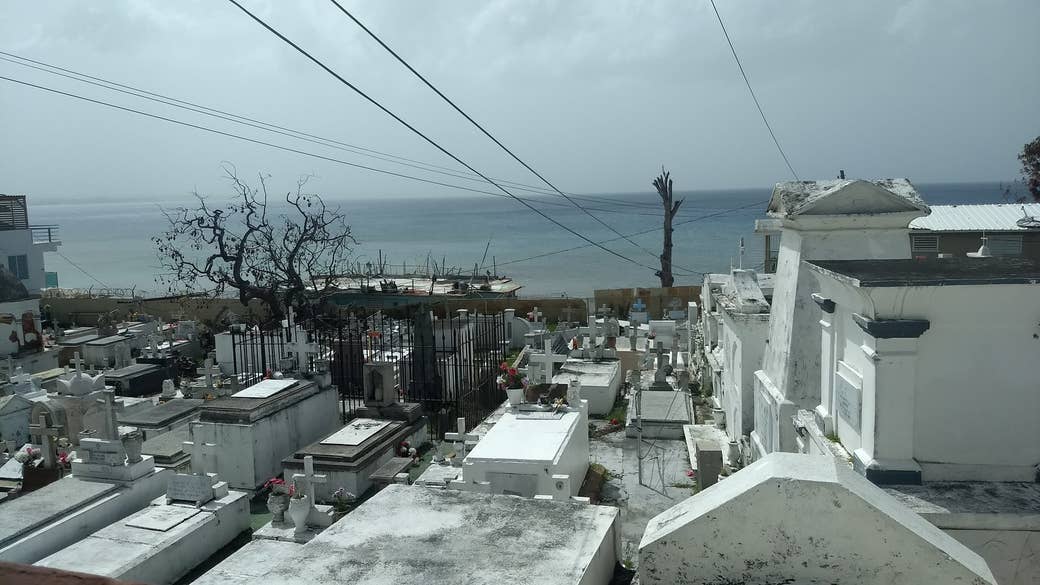
A cemetery in Aguadilla.


A confusing process


The Puerto Rican government has said that the island’s Institute of Forensic Sciences, in San Juan, must examine and certify the bodies of any hurricane-related deaths before they are counted in the official death toll. When the region isn’t dealing with a disaster, the bodies of people who killed themselves, suffered a suspicious death, or were possible victims of a crime are sent to the institute for investigation.

The spokesperson for the Puerto Rico Department of Public Safety, Karixia Ortiz Serrano, acting as spokesperson for the institute, told BuzzFeed News that the institute does not have guidelines for which hurricane-related deaths to add to the official death toll and which to keep off, and said they’re making decisions on a “case-by-case” basis.

There are no specific categories, but they look at the situation,” interview family members, “analyze it, and come to their decision — and everything has to be scientifically-based,” she said.

Here’s where things go awry.

The public safety department says it’s the responsibility of funeral homes, crematoriums, and hospitals to notify and send or bring bodies to the forensic institute if they’re possible hurricane-related deaths.

But all 10 funeral homes and crematorium directors BuzzFeed News spoke to said they haven’t received any specific guidance on what they’re supposed to do with the bodies of people who died as a result of the hurricane. Ortiz confirmed to BuzzFeed News that no official guidance was sent to funeral homes and crematoriums, many of which take in bodies that don’t need to go to the hospital first.

Ortiz says the directors of the facilities should know better. “They know that the place that they do all the scientific investigations is at the institute,” she said. “The funeral homes are in constant communication with the institute because they’re the ones that bring the bodies and take them back.”

Still, cremating a body requires written approval from the forensic institute — which has the option to ask for the bodies to be sent to San Juan for examination before they’re burned. But the funeral and crematorium directors who spoke to BuzzFeed News said the institute has given them permission to cremate dozens of bodies of people who died of hurricane-related causes, and were not asked to send them to the institute.

Asked specifically about this, Ortiz reiterated it’s on crematoriums and funeral homes to communicate with the forensic institute if they think a death should be examined for inclusion on the death toll.

We have heard,” that possible hurricane victims were being cremated without examination, Ortiz said. “We aren’t saying that they’re totally true or totally false. But what we are saying is, if you have a case like that, send us all the information to be able to look at it” before cremation.

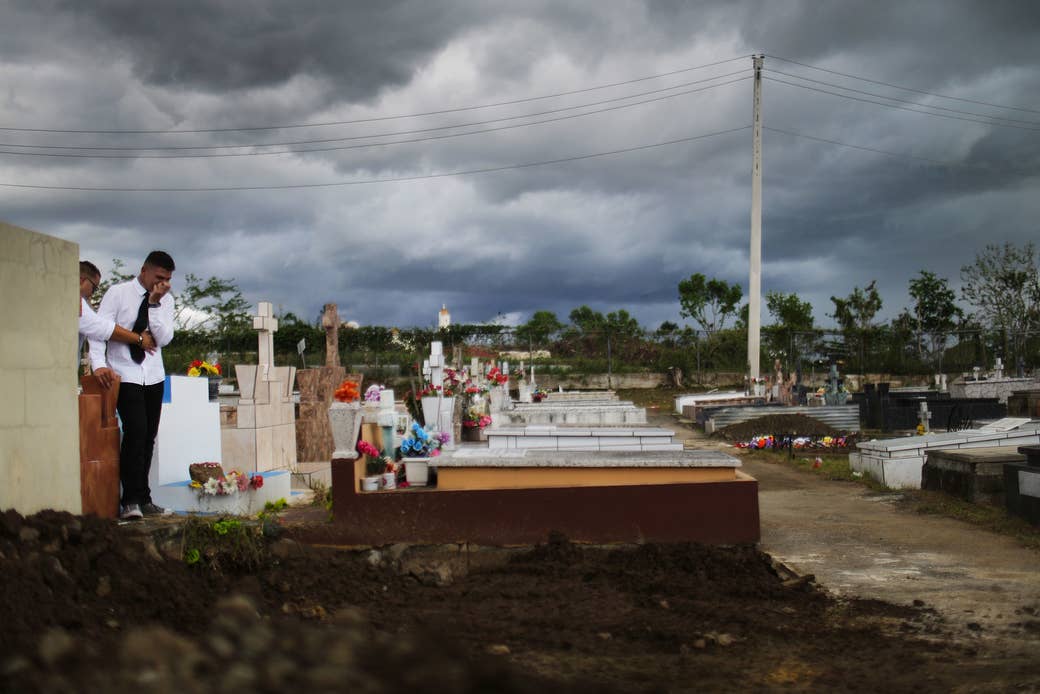
A mourner stands after the burial ceremony in Puerto Rico on Oct. 14.


Natural causes”


Many funeral directors have conflicting definitions of what counts as a hurricane-related death and what doesn’t.

Some funeral directors classified cardiac and respiratory failure after the hurricane as death by “natural causes” only. Others said they consider those hurricane-related because they happened as a result of the conditions created by the Maria: a lack of food, water, electricity, and fuel. (The official death toll does include people who had heart attacks, took their own life, and who died for lack of oxygen and electricity for dialysis machines.)
Experts said this goes back to a lack of guidance from the public safety department.

If you wanted to make the count as small as possible that’s the way to go about it,” Mutter, the Columbia professor, said about lack of uniform procedure and communication about certifying hurricane-related deaths. “Because somebody’s sitting there saying, this is a disaster death, this one is not.”

Mutter said that based on Puerto Rico’s poverty level and the strength of the storm, he would have expected the death toll to be in the hundreds by now.
In fact there’s a lot of deaths that come from the exacerbation of preexisting conditions by the trauma of the disaster event. And they are normally counted. They ended up being counted in Katrina. They are considered disaster deaths. If you take them out you get a small number,” he said.

A review of the funeral homes and crematoriums BuzzFeed News visited shows the discrepancies.

Monica Rodriguez, of Funeraria Soto Rodriguez, said her funeral home has received six bodies since the hurricane. Of those, four came from senior homes — their death certificates say they died of cardiac arrests. Another was a quadriplegic man who died of an infection after arriving at a hospital too late to be treated effectively, and another was a dialysis patient who died in their home when their machine failed. Two of the six were cremated, Rodriguez said.

Here’s her definition of a hurricane-related death: “You can’t exactly say these people died because of the hurricane, because they were old people or they already had health conditions,” she said, adding that in general, death certificates don’t necessarily account for the conditions in which someone died.

But she also said she believed the conditions created by the hurricane lead to these deaths.

I can tell you that we had four deaths of elderly people who were in senior homes. They didn’t have air-conditioning. It’s possible they didn’t have enough oxygen. I’m telling you about the conditions that were caused by the hurricane, not causes of death as they’re written” by doctors on death certificates, Rodriguez said.

At the Javariz funeral home in Aguadilla, 19 bodies have come in since the hurricane. Of those, most died during the hurricane or because of conditions created by the hurricane, said director Tomas Javariz. Thirteen were cremated.

Javariz considers two who died by suicide, five due to a lack of oxygen, one from an organ failure, and 11 attributed to cardiac or respiratory arrest as hurricane-related deaths.

He sent the two who died by suicide to the forensic institute — standard practice for suicide cases — but he said he didn’t send the others because the institute never asked for hurricane-related deaths. The institute gave him permission to cremate them.

Another funeral home in Aguadilla, Funeraria San Antonio, received six bodies since the hurricane. Those included one of the three counted in Aguadilla’s official death toll — a man who fell off his roof while trying to repair it — whose body was examined by the forensic institute in San Juan. Another died of cancer and the rest died of “natural causes,” an employee at the funeral home said, which included cardiac and respiratory arrests.

Funeraria Hernandez-Rivera, the fourth funeral home in the region, received 15 bodies since the hurricane, including five or six heart attacks, according to funeral director Raul Hernandez-Rivera. He also said that he didn’t believe those cases could be counted as hurricane-related because they didn’t involve people drowning or dying while trying to repair hurricane damage.

The institute gave him permission to cremate 8 of the 15 bodies. He sent one to the institute — the body of a woman who was bedridden and drowned during the hurricane — and she is counted in the official death toll.

In the nearby municipality of Mayagüez, there were no hurricane-related deaths, according to the official toll. That’s at odds with the number of cases received by local funeral homes.

Funeraria Fernandez received 13 bodies since the hurricane. They said at least six of those people died because of a lack of oxygen supply, and one died because of a dialysis machine not working, in addition to several heart attacks. Nine of those were cremated. Five were sent to the forensic institute for examination. None have been included in the death toll.

Another, Mayagüez Memorial, received 42 bodies since the hurricane, 10 of which were cremated with the forensic institute’s permission without an examination, according to a staff member there.

There were some that had to be the result of the hurricane,” said the staff member, who asked not to be named.

Funeraria Martell received 39 bodies since the hurricane — 16 were cremated with permission from the institute without examination.

I would say that almost all of them were [related to the hurricane],”said Germarie Hernandez, the funeral director. She said she received 10 cases from Hospital Perrea and three from the Centro Medico Mayagüez, all from the intensive care units. The other 26 cases came from private homes or senior homes.

That is a failure of government”


The lack of guidelines for creating an official death toll is a recurring problem after large-scale disasters in the US, according to experts, who say there is no federal standard because local coroners and governments have jurisdiction over counting and certifying deaths.

After Hurricane Katrina, FEMA organized teams of mortuary experts through the Department of Health and Human Services (HHS) — known as Disaster Mortuary Operational Response Teams or DMORT — to assist the state of Louisiana in counting storm-related deaths. (Puerto Rico’s safety department said they have 40 DMORT personnel assisting the Institute of Forensic Sciences in San Juan.)

During Katrina, FEMA also contracted Kenyon International, a private company that specializes in recovering and identifying remains after disasters. The company has not been contacted by federal agencies or the Puerto Rican government for relief on the island, they told BuzzFeed News. FEMA did not respond to a request for comment.

One of the things I advise governments to do is … come up with and put out guidance on what is the time period, the definition, the cause, manner, and mechanism [for counting deaths],” said Robert Jensen, CEO of Kenyon International, which also assisted authorities after 9/11, the Oklahoma City bombing, and the Grenfell Tower fire in London.

He said instructions should be clear for funeral homes on what the actions and reporting requirements are in cases like Maria.

What we want to be able to do is clearly identify what was the human cost in this event and make it easier,” he said. “In the absences of leadership or guidance, people are going to take action. The dead can’t just sit.”

He said the current lack of transparency and communication with those handling burials and cremations across the island means the count is less likely to be accurate.

That is a failure of government. That is part of the responsibility,” he said, adding that having accurate death toll data can be used to help governments prepare better for future disasters. For example, “We have one generator— it needs to go to location A and not location B.”

Short of having really clear guidance issued then you leave the decision up to each individual funeral director, doctor,” he said. “I’d love to say that it’s an intentional cover-up but it’s just bureaucracy at its worst.”

The forensic institute has heard from some funeral directors who said they had cases of hurricane deaths that had not been examined by the institute before burial or cremation, Ortiz said.

There were a few situations like this, and when [the director of the forensic institute] asked for information and specific data, and when she looked at the cases … it turned out that they were just rumors, or that they couldn’t be substantiated.”

Ortiz could not provide details about how many funeral directors had raised such concerns with the institute, or the details about the investigations that lead the institute to believe that they were “just rumors.” But the institute is open to investigating any case that’s specifically brought to them, she said.
If it’s a rumor they don’t register them,” she said.

Jensen said the Puerto Rican government’s process is not consistent with a scientific approach.

Scientifically based is great but the thing about science is it has to be repeated given the same conditions and everyone has to be able to repeat it given the same parameters,” he said.

Puerto Rico Governor Ricardo Rossello said three weeks ago that he had conducted a survey of the island’s hospitals and medical centers to update the death toll. The Department of Public Safety, when asked about the survey, said they will do them “periodically” but couldn’t say when. They said the government is in contact with hospitals but that there are communication difficulties that make it hard to do another survey.

Jensen said that after six months or a year, families will begin to think about the deaths of their loved ones in the context of this crisis — and whether they could have been eligible for more financial support through insurance policies if their loved ones’ deaths had been classified differently. One clear area they could have lost financial resources, he said, was in receiving federal grants through FEMA to assist with emergency funeral costs.

Here’s where it has an impact. It has an impact for different insurance policies, it has an impact on families,” he said, adding that in at least one other large-scale disaster Kenyon has worked on, families hired forensic experts months later to determine whether they had a legal case that first responders were at fault in their family members’ deaths.

In a national disaster you’re one of however many and everyone is focused on food, water, life support,” he said, “and that makes it just a little bit harder for the families of the dead because it feels like their life didn’t matter.” ●

CORRECTION


Karixia Ortiz Serrano, who is acting as the spokeswoman for the Institute of Forensic Sciences, works at the Puerto Rico Department of Public Safety. An earlier version of this article said she worked for the Puerto Rico Department of Public Health.