Showing posts with label Puerto Rico. Show all posts

Thursday, 29 August 2019

Hurricane Dorian bears down on Puerto Rico


Florida Declares State of 

Emergency as Hurricane 

Dorian Continues to 

Strengthen


29 August, 2019

Hours after Tropical Storm Dorian was upgraded to a Category 1 hurricane over the eastern Caribbean Sea, the US state of Florida declared a state of emergency.
Wednesday afternoon, Florida Governor Ron DeSantis issued a state of emergency for 26 counties regarding the projected arrival of Hurricane Dorian on the state's eastern coast later this week. Weather reports suggest the cyclone could reach Category 3 strength by the time it reaches the state on Sunday, according to the National Hurricane Center.


“It’s important for Floridians on the East Coast to monitor this storm closely," DeSantis said in a Wednesday statement. "Every Florida resident should have seven days of supplies, including food, water and medicine, and should have a plan in case of disaster. I will continue to monitor Hurricane Dorian closely with emergency management officials. The state stands ready to support all counties along the coast as they prepare.”
The measure will allow federal, state and local officials to better coordinate preparations for, as well as reactions to, the arrival of the hurricane, which is likely to require evacuations and bring widespread flooding, downed trees and power lines, and require rescues.

​The storm is presently just off the northeastern coast of Puerto Rico, having previously passed over Barbados and St. Lucia in the Windward Islands. It has top speed winds of 80 mph, according to Accuweather. It could deliver between 4 and 8 inches of rain to parts of Florida.
Earlier this week, Axios reported that US President Donald Trump had more than once suggested trying to disperse the massive storms by detonating nuclear weapons inside of them. However, the president rejected the assertion, and experts explained it was an implausible solution.

Wednesday, 28 August 2019

Hurricane Watch In Puerto Rico for Dorian


Trump signs emergency declaration for Puerto Rico as it braces for tropical storm

Trump signs emergency declaration for Puerto Rico as it braces for tropical storm
RT,
29 August, 2019

US President Donald Trump has approved an emergency declaration for Puerto Rico, instructing federal agencies to handle all disaster relief efforts on the island as it is about to be hit by tropical storm Dorian.
The Department of Homeland Security and the Federal Emergency Management Agency (FEMA) have been authorized to coordinate the disaster relief efforts “which have the purpose of alleviating the hardship and suffering caused by the emergency on the local population,” the declaration states.
FEMA is specifically empowered to “identify, mobilize, and provide…all equipment and resources necessary” to fend off the impending humanitarian crisis.
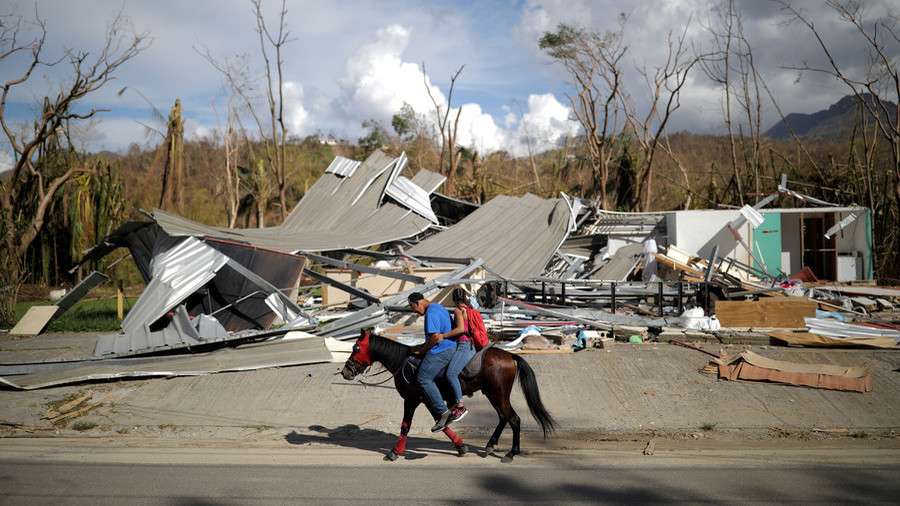
Dorian has been gathering momentum as it sweeps through the Caribbean, having already caused power blackouts and knocked down trees in Barbados and St. Lucia. It is feared that the island, which is still reeling from the devastating 2017 hurricane Maria, might sustain a direct hit from the storm, which is forecasted to reach near-hurricane strength before making landfall on Wednesday night.

The U.S. National Hurricane Center located Dorian some 300 miles of Ponce, Puerto Rico on Tuesday. The storm, with sustained winds reaching 50 mph as of Tuesday night,  is projected to become more powerful within the next 24 hours.
After it touches down in Puerto Rico, Dorian is projected to go northwest to the Bahamas, moving towards eastern Florida, which it is predicted to reach on Sunday night.
Trump has faced a near-constant torrent of criticism for his handling of Hurricane Maria, with opponents and local authorities blaming the US president for turning a blind eye to the plight of the people there as many of the locals are still living in makeshift homes or ramshackle buildings and are subject to occasional power outages.
Trump has brushed off all the Maria-related criticism, instead boasting about the “fantastic job” his administration has done to mitigate the disaster and the amount of money it funneled to the island.
Trump took to Twitter again on Tuesday to hail the multi-billion dollar but ill-fated relief effort he had greenlighted for Puerto Rico, claiming it was “an all-time record of its kind for “anywhere.”’

Wow! Yet another big storm heading to Puerto Rico. Will it ever end? Congress approved 92 Billion Dollars for Puerto Rico last year, an all time record of its kind for “anywhere.”
However, his critics argue that the money allocated for the island ultimately failed to reach those in need.
Last month, tens of  thousands of water bottles intended for hurricane survivors in Puerto Rico were found sitting in a field unopened.
Puerto Rico declared a state of emergency on Tuesday, and has been placed under a hurricane and a tropical storm watch.

Thursday, 1 November 2018

The sudden loss of insects on Puerto Rica and the Sixth Mass Extinction


We live in the midst of the sixth great Extinction and no one gives a fuck
Why scientists are so worried by the huge, sudden loss of insects
A stunning paper on Puerto Rican insects is just one story in an age of mass extinction.


Puerto Rico’s protected rainforests are losing insects — fast. Wolfgang Kaehler/LightRocket/Getty Images

Vox,
17 October, 2018


In Puerto Rico’s rainforest, scientists have observed an astounding loss of life at the very base of the food web. It’s the insects.

As an alarming new study in Proceedings of the National Academy of Sciences outlines, between 1976 and 2013, the number of invertebrates (like insects, spiders, and centipedes) in the Luquillo rainforest caught in survey nets plummeted by a factor of four or eight. When measured by the number caught in sticky traps, invertebrates declined by a factor of 60. These dramatic drops occurred despite the fact that the forest is a protected wildlife area.

The researchers note that this loss of invertebrates — which serve as food for many other forms of life in the ecosystem — has also coincided with losses of birds, lizards, and frogs. “The food web appears to have been obliterated from the bottom,” the Washington Post’s Ben Guarino reported on the study. Guarino’s story quotes one invertebrate expert who called the research “hyper alarming.”

The report is just one example of a larger, troubling trend: Insects — including yes, bees — and other critters are rapidly disappearing around the world. A 2017 study in Germany noted a 75 percent decline in flying insects over three decades. “The widespread insect biomass decline is alarming,” the authors wrote, “ever more so as all traps were placed in protected areas that are meant to preserve ecosystem functions and biodiversity.”

There’s no one reason why so many critters are dying, and researchers are still unclear on what’s driving the change. Climate change (and changing drought and weather conditions) is strongly implicated. And it’s also partly due to environmental toxins and possibly pesticides. But it’s fair to say they’re mainly dying because humans are changing the world for the worse.

Humans are driving a huge array of species to extinction

Two monkeys in the snow
A baby monkey is cuddled by its mother to keep warm as the sub-zero temperatures freeze life during a fresh snowfall in Tangmarg.
 Tauseef Mustafa/AFP/Getty Images The world is losing biodiversity, fast. If you take stock of all the studies that point to the fact we’re living in an age of mass extinction, perhaps even the sixth mass extinction, it can all feel overwhelming.

Mammals, the branch of the animal kingdom to which we belong, are also in peril, another study, also published in PNAS this week, illustrates. More than 300 mammal species have been wiped out since humans overran the world after the last ice age (and an additional 25 percent of all mammals alive today are threatened with extinction). The study asks a simple question: How many years would it take for evolution to naturally replace all the species that have died as a result of humans?

Their answer: 3-7 million years. Science writer Ed Yong points out “that’s at least 10 times as long as we have even existed as a species.”

It’s important to take stock of what we lose when we lose species. A 2017 report in Science Advances found that around 60 percent of primate species are threatened with extinction — all due to human activity.

The report found every member of the primate family Hominidae (great apes, which includes gorillas and chimpanzees) is endangered or critically threatened (except for us). Around 87 percent of Indriidae (larger lemurs) are similarly endangered or threatened.

Think of what that means: Primates are our closest relatives on Earth. If we can understand them better, we can understand ourselves. Here’s how Carl Zimmer at the New York Times explains it:

The first primates evolved roughly 80 million years ago, and then split into the living lineages over millions of years. By comparing our biology to those of other primates, we have learned about the evolution of our brains, our vision and our vulnerability to diseases.

But don’t necessarily consider primate losses to be more important, or painful, than insect losses. Insects and other arthropods form a hugely important foundation in many ecosystem animal food webs. They also are the world’s pollinators, ensuring that plants produce new seeds and new generations. Without the foundation of insects, the ecosystem collapses.

We need to take stock of the wildlife we’ve lost

Here’s one more sobering example of just how many species around the world are threatened.

The past few decades have seen a massive die-off of amphibians, which scientists fear are some of the most vulnerable animals to losses in a rapidly changing world. That may be because amphibians need both healthy aquatic and terrestrial environments to thrive. Change just one enough, and species suffer.

In 2010, a survey of 25,780 species of vertebrates found that 41 percent of the amphibians were threatened with extinction. “On a per-species basis, amphibians are in an especially dire situation, suffering the double jeopardy of exceptionally high levels of threat coupled with low levels of conservation effort,” the study noted. Since just 1970, 200 species of frog have perished.

Earlier this year, researchers, tried to estimate a weight for all of life on Earth. It was a fun exercise, putting humanity’s relative small weight on Earth in dramatic contrast to the weight of all the other forms of life. There are an estimated 550 gigatons of carbon of life in the world. And we all weigh just .06 gigatons.

If everyone on the planet were to step on one side of a giant balance scale, and all the bacteria on Earth were to be placed on the other side, we’d shoot violently upward. That’s because all the bacteria on Earth combined are about 1,166 times more massive than all the humans.

We’re a small part of the living world, but yet, we make such an outsized impact on it.

The authors of the weight estimate were also sure to calculate what was missing from their figures. They estimated that the mass of wild land mammals is seven times lower than it was before humans arrived. Similarly, marine mammals, including whales, are a fifth of the weight they used to be because we’ve hunted so many to near extinction.

Although plants are still the dominant form of life on Earth, the scientists suspect there used to be approximately twice as many of them — before humanity started clearing forests to make way for agriculture and our civilization. Animals are going extinct 1,000 to 10,000 faster than you’d expect if no humans lived on Earth.

Insects dying off in Puerto Rico may seem like a small — but shocking — story. What’s all the more alarming is that stories like it are happening everywhere.

With so much devastating and widespread loss, it’s hard to say where we should focus our attention — other than just working to stem the progression of climate change. In Science, Jonathan Baillie, the chief scientist at the National Geographic Society, and Ya-Ping Zhang, the vice president of the Chinese Academy of Sciences, argued that half of all land should be protected for wildlife by 2050, to give plants and animals a chance to thrive.

This is a lofty, perhaps unrealistic goal. But we’ve taken so much from wildlife. We need to think more about how to stop taking environments away from plants and animals. “Simply put,” they write in Science, “there is finite space and energy on the planet, and we must decide how much of it we’re willing to share.”

Saturday, 20 October 2018

The 'Bugpocalypse'


'One of Most Disturbing Articles I Have Ever Read' Scientist Says of Study Detailing Climate-Driven 'Bugpocalypse'

"A truly scary new study finds that insect populations in protected Puerto Rican rainforests have fallen as much as 60-fold."


"This study in PNAS is a real wake-up call—a clarion call—that the phenomenon could be much, much bigger, and across many more ecosystems," David Wagner, an invertebrate conservation expert at the University of Connecticut. (Photo: Alias 0591/Flickr/cc)

When a scientist who studies the essential role insects play in the health of the ecosystem calls a new study on the dramatic decline of bug populations around the world "one of the most disturbing articles" he's ever read, it's time for the world to pay attention.

"Climate warming is the driving force behind the collapse of the forest's food web."
—Bradford Lister and Andres Garcia
 
The article in question is a report published Monday in the Proceedings of the National Academy of Sciences (PNAS) showing that in addition to annihilating hundreds of mammal species, the human-caused climate crisis has also sparked a global "bugpocalypse" that will only continue to accelerate in the absence of systemic action to curb planetary warming.
 
"This study in PNAS is a real wake-up call—a clarion call—that the phenomenon could be much, much bigger, and across many more ecosystems," David Wagner, an invertebrate conservation expert at the University of Connecticut, said in response to the new report. "This is one of the most disturbing articles I have ever read."

Authored by Bradford Lister of Rensselaer Polytechnic Institute and Andres Garcia of National Autonomous University of Mexico, the study found that "[a]rthropods, invertebrates including insects that have external skeletons, are declining at an alarming rate."

"We compared arthropod biomass in Puerto Rico's Luquillo rainforest with data taken during the 1970s and found that biomass had fallen 10 to 60 times," the researchers write. "Our analyses revealed synchronous declines in the lizards, frogs, and birds that eat arthropods. Over the past 30 years, forest temperatures have risen 2.0 °C, and our study indicates that climate warming is the driving force behind the collapse of the forest's food web. If supported by further research, the impact of climate change on tropical ecosystems may be much greater than currently anticipated."

As the climate crisis intensifies, Lister and Garcia continued, "the frequency and intensity of hurricanes in Puerto Rico are expected to increase, along with the severity of droughts and an additional 2.6–7 °C temperature increase by 2099, conditions that collectively may exceed the resilience of the rainforest ecosystem."

"Holy crap," Wagner of the University of Connecticut told the Washington Post when he learned of the 60-fold drop of bug populations in Puerto Rico's Luquillo rainforest. "If anything, I think their results and caveats are understated. The gravity of their findings and ramifications for other animals, especially vertebrates, is hyperalarming."

The latest disturbing evidence of the destruction the climate crisis is inflicting across the globe comes just a week after the Intergovernmental Panel on Climate Change (IPCC) warned that the world must cut carbon emissions in half by 2030 in order to avert global catastrophe as soon as 2040.

"Unfortunately, we have deaf ears in Washington," concluded Louisiana State University entomologist Timothy Schowalter, who has studied the Luquillo rainforest for decades.

Wednesday, 29 August 2018

Revealed: what we always knew about Puerto Rico


Puerto Rico raises death toll of Hurricane Maria to 2,975 from initial 64


Puerto Rico raises death toll of Hurricane Maria to 2,975 from initial 64

Almost 3,000 people died in the wake of Hurricane Maria, which battered Puerto Rico last September, the US territory announced after a new study.
Governor Ricardo Rosselló made the official announcement on Tuesday, following the publication of an independent study estimating the casualties at 2,975.

Commissioned by Governor Rosselló and carried out by the Milken Institute School of Public Health at George Washington University, the study found that the death toll was considerably higher than original reports.

In estimating the true death toll of Hurricane Maria, researchers looked at historical data to estimate how many people would have died had the storm not hit the island. That figure was then compared to the number of deaths reported from September 2017, when the hurricane hit, to February 2018, when the island still struggled with blackouts and a shortages of essential supplies on the road to recovery.

The study found that all age and income groups were affected by the sharp rise in mortality, but that the risk of death was markedly higher among the island’s poor. Among low-income Puerto Ricans, the risk of death was 45 percent higher.

An earlier survey, carried out by the government of the US territory and presented to Congress earlier this month, put the death toll at 1,427 above normal, but concluded that it cannot say for sure how many of those actually died as a result of the storm. The report did highlight the damage to Puerto Rico’s infrastructure and public health, and was accompanied by a request for $139 billion in aid.

The authorities' initial figure of 64 deaths was doubted by much of the media at the time, but was defended by Rosselló, until now. That figure was likely as low due to officials strictly classifying only certain deaths - such as those caused by collapsing buildings, flying debris, floods and drownings - as caused by the hurricane.

“During our broader study, we found that many physicians were not oriented in the appropriate certification protocol," the report explains. "This translated into an inadequate indicator for monitoring mortality in the hurricane's aftermath."

A Harvard University study, published in May, estimated that there were 4,645 more deaths in Puerto Rico due to the storm. It garnered widespread media attention.

If the new figures are accurate, Hurricane Maria is the deadliest storm to have hit Puerto Rico since the 1899 San Ciriaco hurricane. It began as a tropical storm off the west coast of Africa, intensifying as it approached the Caribbean. It made landfall on Puerto Rico on September 20, battering the island with winds of up to 155 miles per hour, ripping buildings apart and uprooting trees.

The Trump administration was blasted for its response to the devastation, which was marked by delays in water and food deliveries. Carmen Yulín Cruz, the Democrat mayor of San Juan, got into a verbal spat with President Trump over his response to the crisis, which she said deserved “a 10 out of a scale of 100.”

The Mayor of San Juan, who was very complimentary only a few days ago, has now been told by the Democrats that you must be nasty to Trump.

Last year’s Atlantic hurricane season was a particularly active one. Puerto Rico was hit by storms Maria, Irma and Philippe, and was narrowly missed by hurricane Jose. With some of the island still without power, Puerto Rico now faces into a less threatening hurricane season this year.