Showing posts with label AMEG. Show all posts

Monday, 11 January 2016

Peter Wadhams interview

Peter Wadhams Interview: Could Modern Civilization Collapse?


Dec 16, 2015

Open letter from AMEG on COP21

The Arctic Methane Emergency Group finally releases its commentary on the failure of the COP21 climate talks recently held in Paris. Our group has decided to take a stand after much deliberation to try to end the madness of climate change denial on all levels in the face of incontrovertible scientific evidence of an impending planetary emergency. The global climate leadership organizations of COP21 have been mired in consensus bureaucracy and lacked the political will, ability and courage to take the actions necessary to mitigate this emergency and are just rearranging the deck chairs on the Titanic while kicking the can down the road.

This letter, signed by many of the esteemed climate scientists in our group, hope to sound the alarm that we have no time to waste in taking action to avert the melting of the Arctic and Antarctica causing destructive sea level rise, the loss of Arctic sea ice and reflective albedo which leads to extreme weather patterns, floods, droughts, and water shortages causing crop loss, starvation and the massive refugee situation which is just the tip of the proverbial iceberg. Tipping points are rapidly approaching and we are losing our window of opportunity to slow down this process to give long-term climate mitigation strategies time to be developed and implemented.

We want to thank John Nissen, the Chairman of the Arctic Methane Emergency Group for leading this deliberation and facilitating this letter.

Keith Nealy Climate Consulting
Arctic Methane Emergency Group, AMEG

COP21: Paris deal far too weak to prevent devastating climate change, academics warn
Exclusive: Some of the world’s top climate scientists have launched a blistering attack on the deal


9 January, 2016


The Paris Agreement to tackle global warming has actually dealt a major setback to the fight against climate change, leading academics will warn.

The deal may have been trumpeted by world leaders but is far too weak to do help prevent devastating harm to the Earth, it is claimed.
In a joint letter to The Independent, some of the world’s top climate scientists launch a blistering attack on the deal, warning that it offers “false hope” that could ultimately prove to be counterproductive in the battle to curb global warming.
The letter, which carries eleven signatures including professors Peter Wadhams and Stephen Salter, of the universities of Cambridge and Edinburgh, warns that the Paris Agreement is dangerously inadequate.
Because of the Paris failure, the academics say the world’s only chance of saving itself from rampant global warming is a giant push into controversial and largely untested geo-engineering technologies that seek to cool the planet by manipulating the Earth’s climate system.
The scientists, who also include University of California professor James Kennett, argues that “deadly flaws” in the deal struck in the French capital last month mean it gives the impression that global warming is now being properly addressed when in fact the measures fall woefully short of what is needed to avoid runaway climate change.
This means that the kind of extreme action that needs to be taken immediately to have any chance of avoiding devastating global warming, such as massive and swift cuts to worldwide carbon emissions – which only fell by about 1 per cent last year – will not now be taken, they say.


Pla

The hollow cheering of success at the end of the Paris Agreement proved yet again that people will hear what they want to hear and disregard the rest. What they disregarded were the deadly flaws lying just beneath its veneer of success,” the academics write in the the letter, also signed by Dr Alan Gadian of the University of Leeds and Professor Paul Beckwith of the University of Ottowa in Canada.
What people wanted to hear was that an agreement had been reached on climate change that would save the world while leaving lifestyles and aspirations unchanged. The solution it proposes is not to agree on an urgent mechanism to ensure immediate cuts in emissions, but to kick the can down the road.”
The authors don’t dispute the huge diplomatic achievement of the Paris Agreement – getting 195 world leaders to sign up to a global warming target of between 1.5C to 2C and pledging action to cut carbon emissions.
But they say the actions agreed are far too weak to get anywhere close to that target. Furthermore, the pledges countries have made to cut their carbon emissions are not sufficiently binding to ensure they are met, while the Paris Agreement will not force them to “rachet” them up as often as they need to.
Of even greater concern, they say, is the lack of dramatic immediate action that was agreed to tackle global warming. The Paris Agreement only comes into force in 2020 – by which point huge amounts of additional CO2 will have been pumped into the atmosphere. The signatories claim this makes it all but impossible to limit global warming to 2C, let alone 1.5C.
The Paris Agreement’s heart was in the right place but the content is worse than inept. It was a real triumph for international diplomacy and sends a strong message that the sceptics have lost their case and that the science is correct on climate change. The rest is little more than fluff and risks locking in failure,” said Professor Kevin Anderson of Manchester University, who has not signed the letter but agrees with its argument.
Peter Wadhams, professor of ocean physics at the University of Cambridge and a signatory of the letter, said the prospects for curbing global warming following the Paris Agreement are now so dire that he advocates a charge into geo-engineering – not something he recommends lightly. “Other things being equal I’m not a great fan of geo-engineering but I think it absolutely necessary given the situation we’re in. It’s a sticking plaster solution. But you need it because looking at the world, nobody’s instantly changing their pattern of life,” Prof Wadhams said.
Pumping huge amounts of water spray into clouds to make them bigger and brighter so that they reflect sunlight back into the atmosphere – known as Marine Cloud Brightening – offers the best geo-engineering prospect, he said.
Geo-engineering technologies – which also envisage putting giant mirrors in space or whitening the surface of the ocean to deflect incoming solar radiation back into space – are controversial because of fears that they are technically demanding, would be extremely expensive while interfering with the climate system could have damaging unintended consequences for the planet.
A spokesman for the United Nations Framework Convention on Climate Change  said: “The Paris Agreement is a resounding declaration of political intent by all the world’s nations. We are fully confident that countries are not sitting on their haunches waiting until 2020 before doing anything,” he said. 

The letter


The hollow cheering of success at the end of COP21 agreement proved yet again that people will hear what they want to hear and disregard the rest. What people wanted to hear was that an agreement had been reached on climate change that would save the world while leaving lifestyles and aspirations unchanged. 
What they disregarded were the deadly flaws lying just beneath its veneer of success.  As early as the third page of the draft agreement is the acknowledgment that its CO2 target won’t keep the global temperate rise below 2 deg C, the level that was once set as the critical safe limit. The solution it proposes is not to agree on an urgent mechanism to ensure immediate cuts in emissions, but to kick the can down the road by committing to calculate a new carbon budget for a 1.5 deg C temperature increase that can be talked about in 2020.

Given that we can’t agree on the climate models or the CO2budget to keep temperatures rises to 2 deg C, then we are naïve to think we will agree on a much tougher target in five years when, in all likelihood, the exponentially increasing atmospheric CO2 levels mean it will be too late.

More ominously, these inadequate targets require mankind to do something much more than cut emissions with a glorious renewable technology programme that will exceed any other past human endeavour. They also require carbon to be sucked out the air. The favoured method is to out-compete the fossil fuel industry by providing biomass for power stations. This involves rapidly growing trees and grasses faster than nature has ever done on land we don’t have, then burning it in power stations that will capture and compress the CO2 using an infrastructure we don’t have and with technology that won’t work on the scale we need and to finally store it in places we can’t find.  To maintain the good news agenda, all of this was omitted from the agreement.
The roar of devastating global storms has now drowned the false cheer from Paris and brutally brought into focus the extent of our failure to address climate change. The unfortunate truth is that things are going to get much worse. The planet’s excess heat is now melting the Arctic Ice cap like a hot knife through butter and is doing so in the middle of winter. Unless stopped, this Arctic heating will lead to a rapid release of the methane clathrates from the sea floor of the Arctic and herald the next phase of catastrophically intense climate change that our civilisation will not survive.
The time for the wishful thinking and blind optimism that has characterised the debate on climate change is over. The time for hard facts and decisions is now.  Our backs are against the wall and we must now start the process of preparing for geo-engineering. We must do this in the knowledge that its chances of success are small and the risks of implementation are great.  
We must look at the full spectrum of geoengineering. This will cover initiatives that increase carbon sequestration by restoration of rain forests to the seeding of oceans. It will extend to solar radiation management techniques such as artificially whitening clouds and, in extremis, replicating the aerosols from volcanic activity. It will have to look at what areas that we selectively target, such as the methane emitting regions of the Arctic and which areas we avoid.
The high political and environmental risks associated with this must be made clear so that it is never used as an alternative to making the carbon cuts that are urgently needed. Instead cognisance of these must be used to challenge the narrative of wishful thinking that has infested the climate change talks for the past twenty one years and which reached its zenith with the CO21 agreement. In today’s international vacuum on this, it is imperative that our government takes a lead. 
Signed by

Professor Paul Beckwith, University of Ottowa 
Professor Stephen Salter – Edinburgh University
Professor Peter Wadhams – Cambridge University
Professor James Kennett of University of California.
Dr Hugh Hunt – Cambridge University
Dr. Alan Gadian -Senior Scientist, Nation Centre for Atmospheric Sciences, University of Leeds
Dr. Mayer Hillman - Senior Fellow Emeritus of the Institute of the Policy Studies Institute
Dr. John Latham – University of Manchester
Aubrey Meyer  – Director, Global Commons Institute.
John Nissen -  Chair Arctic Methane Emergency Group
Kevin Lister - Author of "The Vortex of Violence and why we are losing the war on climate change"

Saturday, 20 December 2014

As the world sleepwalks towards collapse and global conflagration: AMEG speaks out at COP20

"Using best scientific evidence, secondly to finding effective and affordable means to deal with the situation, and thirdly communicating these matters to authority and the general public"  -- AMEG

We can agree on the science - but on the "solutions"

"Do you mean we do nothing"
"Nothing you can do will make any difference to the outcome".
Accelerating Towards an Arctic Blue Ocean Event


For the last 8,000 years we’ve had [relatively] amazing stability with constant weather temperatures and sea level. This stability has allowed the development of agriculture, civilization, industrialization, and a population of 7 billion and rising. This apparent stability is entirely a fluke. It is by amazing good luck that we are here today looking back on the past.”
John Nissen (12-4-2014), Arctic Methane Emergency Group


8 December, 2014

On the 4th, 5th, and 6th of December of the year 2014, the Arctic Methane Emergency Group (AMEG) held press briefings at the COP-20 United Nations Climate Change Conference that is taking place in Lima, Peru. For those unfamiliar with AMEG, here is a summary about them from their website that illustrates their proven track record of predictions:

AMEG is a group of determined scientists, engineers, communicators and others, dedicated firstly to establishing what really is happening to our planet (especially in the Arctic) using best scientific evidence, secondly to finding effective and affordable means to deal with the situation, and thirdly communicating these matters to authority and the general public.
AMEG aims to position itself in the centre ground – neither overstating nor understating the dangers of climate change. We are only alarmist in the sense that we are drawing attention to the more unpleasant realities of rapid Arctic warming and climate change, which have been downplayed or ignored by IPCC, unwittingly backed up by the media. We are determinedly optimistic as regards promoting an intervention strategy against all the odds, believing that mankind must have the collective intelligence to sort out the mess that mankind has got itself into.

In early 2012, AMEG gave evidence to the UK’s Environment Audit Committee in their inquiry on protecting the Arctic. Much of our evidence was dismissed by government advisers, but all our evidence has been borne out by subsequent observations and events, including: the rapid rise in temperature of Arctic ocean and atmosphere; the dramatic decline of sea ice to a record minimum in September 2012 (following the exponential downward trend we had warned the committee about); the exponential increase in release of the potent greenhouse gas, methane, from the Arctic Ocean seabed; the exponential increase in melting of the Greenland Ice Sheet and consequent sea level rise; and the continuing disruption of the jet stream patterns we expected from Arctic warming, with resulting climate change in the form of weather extremes (despite a continuing hiatus in global warming), causing widespread crop failures and increase in the food price index above the crisis level, thus promoting civil conflict in a number of Asian and African countries where food prices have recently escalated, including most notably Syria.

Recent independent research, by scientists in AMEG and elsewhere, puts beyond reasonable doubt our assertion that the Arctic is locked in a vicious cycle of warming and melting, with the sea ice well past its tipping point. The current albedo forcing from snow and sea ice retreat is now estimated at around 0.4 to 0.5 Watts per square meter, averaged globally, amounting to 200 to 250 terawatts heating in the Arctic – more than mankind’s total energy consumption.  This albedo forcing is liable to double within a few years as the snow and sea ice further retreat. AMEG believes that the vicious cycle of warming and melting can only be broken by rapid intervention to cool the Arctic.  

Although AMEG’s research has concentrated on the Arctic and its effect on climate change, our study of IPCC’s own evidence suggests just how serious are the long-term prospects of climate change due to both CO2 and methane – far more serious than claimed by IPCC itself. The carbon budget for CO2 – the allowable amount of CO2 to avoid dangerous climate change – has already been used up, if one takes into account the effect of methane and other greenhouse gases. If one also takes into account the climate forcing through albedo loss in the Arctic, then it is clear that the world is heading for extremely dangerous global warming by mid-century, even without Arctic methane. The only way to head off such a disaster is by reducing the level of greenhouse gases in the atmosphere well below their current levels, using a combination of aggressive reduction in both CO2 and methane emissions but also by removal of CO2 from the atmosphere.

The videos of all three press briefings are below. They essentially cover much of the same material, but are all worth watching for the details that the different speakers give illustrating mankind’s dire predicament. Following the videos, I summarize AMEG’s discussions along with their conclusions. We truly are at a turning point in the survival of our species.
SUMMARY OF AMEG PRESS BRIEFINGS:

• The tipping point for the collapse of Arctic glaciers has been breached and a runaway meltdown of the North Pole ice cap is currently unfolding. Arctic ice is decaying exponentially. (For a better visualization, picture an area of ice the size of the state of Maine being lost every year since 1979.):
Highly reflective snow and ice is being replaced by dark sea water which is much more [absorbent] of solar energy causing the Arctic to warm much, much faster than the rest of the planet. This is destabilizing the atmospheric air circulation and ocean circulation. It is reducing the temperature gradient or difference between the equator and the pole which slows down the jet stream making it wavier with higher ridges and troughs. The jet stream has also become prone to stagnating in the same region. Very warm, humid southerly air can go to much higher latitudes than before, and cold arctic air can go to much southerly latitudes than before. This in itself is representing an enormous positive reinforcing feedback (not positive for humans) which is carrying more and more heat up into the Arctic and more and more coldness from the Arctic further south. What this will do is fracture the jet streams, leading us to a very different world, a less predictable climatic world where weather extremes such as torrential rains and extended droughts and floods come to dominate the weather system. The frequency, severity, and duration of these events all increase. These events also occur in regions where we did not have this before. For example, we get 80cm(32 inches) of snow in the Atacama Desert which is the driest region of the planet – an unprecedented event. We get torrential rains where we had desert before. We get desert where we had moderate temperatures before. This is already happening now with just 0.85 °C of warming that the world has experienced since the start of the industrial revolution. This situation is very dependent on the conditions in the Arctic. As the Arctic continues to exponentially decline in snow and sea ice cover, these extremes will undoubtedly have to increase. The physics of the system says so. Because we now live in a warmer planet, there is more evaporation of the oceans leading to more water vapor in the atmosphere which fuels stronger storms. (The atmosphere can hold 7% moisture for every 1°C increase in average temp. Since we have increased the average temp by ~0.8°C from pre-industrial times, we have 6% more water vapor in the atmosphere). Because we have changed the chemistry of the atmosphere, we have changed the planet’s weather and climate.

• Once we reach a point of no Arctic sea ice, perhaps as early as September 2015, this will create a “blue ocean event” in which all the heat from the sun will be able to penetrate Arctic waters, vastly accelerating the rate at which the Arctic is warming. Consequently, massive disruption of atmospheric circulation and ocean currents will ensue, thus locking the Arctic into an ice-free state. Global sea levels will rapidly rise and climate chaos will ramp up.

• The East Siberian Arctic Shelf, containing hundreds to thousands of times more heat trapping gases than what are presently in the atmosphere, is in the process of releasing a catastrophic amount of greenhouse gases.

• Climate models do not take into account fractures, imperfections in the sea floor, regions of unfrozen subsea methane and other weak points in methane deposits. The models simply treat these areas as uniform slabs that will act in a predictable and symmetrical manner.

• Historical ice core and sediment records show numerous instances of the Earth having undergone abrupt climate change of 5-6°C or greater within a very short time period, one or two decades.

• The initial heat-trapping strength of methane(CH4) is up to several hundred times more powerful than CO2 during the first couple decades of its release into the atmosphere before degrading into CO2.

• Collapse of Civilization is assured at a 4°C rise in global temperature.
Scientists consider a global warming of 6°C to be a threat to the survival of humanity, and anything beyond an increase of 2°C to be intolerable (as recorded at the Asia-Europe Summit by Khor, September 2006). Link

Even conservative IPCC projections of BAU predict a 4°C rise in global temperature by the end of the century and this estimate does not include the methane release from the Arctic seabed, permafrost and tundra. No where in its reports does the IPCC state that a 4°C would be catastrophic to civilization and life on Earth.

• Simply attempting to “adapt” to anthropogenic climate change is not a realistic option.

• The meme of money and profit holds sway over all of society.

• The operating system of global civilization, i.e. neoclassical economics, is fatally flawed and it will kill us.

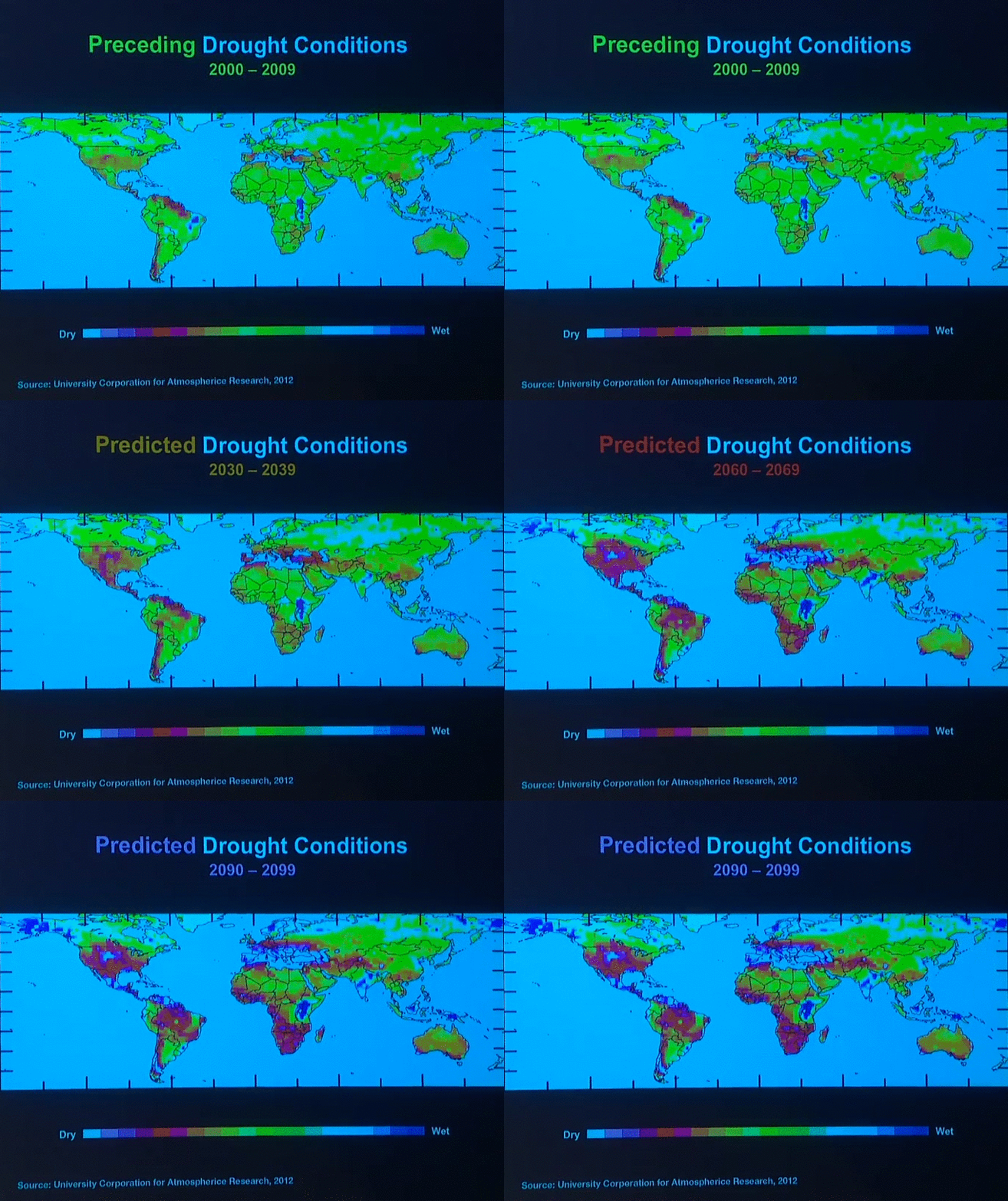
• The consequences of predicted drought from global warming will make food production impossible in most of the world…
imageedit_27_9878978785

AMEG’S CONCLUSIONS ARE:

• A life-affirming system of ecological economics must replace the current ecocidal model of neoclassical economics.

• Institutions must divest from fossil fuel investments and burst the carbon bubble.

• Techniques for cooling the Arctic need to be implemented now, such as spraying salt into the atmosphere to thicken clouds. Additionally, carbon sequestration techniques need to be implemented now, such as biochar burial which is a carbon negative technology that also enriches soil fertility.

• The world must recognize that a 2°C target is not the benchmark we need to worry about right now. We need to worry about and immediately deal with the destabilization and disruption of our climate and weather patterns that are already occurring today at 0.85 °C.

• Only a concerted international effort will provide us with a chance to mitigate and adapt to climate change by building a deep toolbox of approaches to reducing greenhouse gas emissions. However, reducing emissions alone will not be sufficient. An active withdrawal of CO2 from the atmosphere will need to be a part of managing climate change.

AMEG does not mention the Antarctic which was recently found to be melting three times faster than a decade ago:

The glaciers in the embayment lost mass throughout the entire period. The researchers calculated two separate quantities: the total amount of loss, and the changes in the rate of loss.

The total amount of loss averaged 83 gigatons per year (91.5 billion U.S. tons). By comparison, Mt. Everest weighs about 161 gigatons, meaning the Antarctic glaciers lost a Mt.-Everest’s-worth amount of water weight every two years over the last 21 years.

The rate of loss accelerated an average of 6.1 gigatons (6.7 billion U.S. tons) per year since 1992.

From 2003 to 2009, when all four observational techniques overlapped, the melt rate increased an average of 16.3 gigatons per year — almost three times the rate of increase for the full 21-year period. The total amount of loss was close to the average at 84 gigatons.

Also in the news a few months ago was the realization that Greenland’s ice sheet loss has doubled in just the last five years. Greenland’s ice is much more unstable and prone to collapse than previously thought, and it alone holds enough ice to raise sea levels by nearly twenty-three feet. Paul Beckwith notes that the rate of change in ice melt from Greenland and Antarctica has doubled every seven years for the last couple decades and that if we continue on this trend, then the world will indeed experience a sea level rise of nearly twenty-three feet by 2070.

Last month a seemingly reassuring headline stated that ‘Alaska shows no signs of rising Arctic methane‘ according to NASA’s CARVE project (Carbon in Arctic Reservoirs Vulnerability Experiment), but any hopes about the ticking methane time bomb in the Arctic were quickly dashed after reading the article:

High concentrations of atmospheric methane have been measured at individual Arctic sites, especially in Siberia. This adds to the concern that massive methane releases are already occurring in the far North. NASA’s multiyear Carbon in Arctic Reservoirs Vulnerability Experiment (CARVE) is the first experiment to establish emission rates for a large region of the Arctic…

Alaska composes about one percent of Earth’s total land area, and its estimated annual emissions in 2012 equaled about one percent of total global methane emissions. That means the Alaskan rate was very close to the global average rate.
That’s good news, because it means there isn’t a large amount of methane coming out of the ground yet,” said lead author Rachel Chang, formerly at Harvard University, Cambridge, Massachusetts, and now an assistant professor and Canada Research Chair in Atmospheric Science at Dalhousie University, Halifax, Nova Scotia.

Charles Miller of NASA’s Jet Propulsion Laboratory, Pasadena, California, the principal investigator for CARVE, noted that results from a single year cannot show how emissions might be changing from year to year. “The 2012 data don’t preclude accelerated change in the future,” he said.

Vast amounts of carbon are stored in undecayed organic matter—dead plants and animals—in Arctic permafrost and peat. Scientists estimate that there is more than twice as much carbon locked in the frozen North as there is in the atmosphere today. The organic material won’t decay and release its carbon as long as it stays frozen. But climate change has brought warmer and longer summers throughout the Arctic, and permafrost soils are thawing more and more. If large amounts of undecayed matter were to defrost, decompose and release methane and carbon dioxide into the atmosphere, the impact on global temperatures would most likely be enormous.
Because no other program has made measurements as comprehensive and widespread as CARVE’s, Chang said, One of the challenges is that we have nothing to compare our results to. We can’t say whether emissions have already increased or stayed the same. Our measurements will serve as a baseline.”

We already know that methane levels have increased two-and-a-half times since the pre-industrial era and “since 2007 atmospheric methane has been on a renewed sustained increase… due to planetary feedback emissions.” Methane has “more than doubled its 800,000 [year] maximum”:
This increase in atmospheric methane started as a result of carbon feedback feedback methane (CH4) from anomalously high temperatures in the Arctic and greater than average precipitation in the tropics, rather than from increased industrial emissions (Dlugokencky et al, 2009). Link

We also know that scientists continue to be shocked and awed at the increasingly accelerated rate at which glaciers around the world are melting. Essentially, industrial civilization is whistling past the graveyard.
Because of AMEG’s honest assessment about the climatic state of the world and the horrific future mankind faces, I support their efforts. We have no time left for philosophical musings about the ethics of AMEG’s geo-engineering ideas to cool the Arctic or debating why, how, and who is responsible for the mess we are in. 
The Blue Ocean Event is coming and time is not on our side.

Tuesday, 9 December 2014

Carbon Dioxide levels rising

Mauna Loa Methane Measure Shows Rising Rates of Increase Through End 2014

8 December, 2014

Mauna Loa Methane early December
(Atmospheric methane levels as measured at the Mauna Loa Observatory. Image source:NOAA/ESRL.)

Atmospheric methane levels as measured by the Mauna Loa Observatory (MLO) showed a continued steepening rate of increase through late 2014 — featuring one rather troubling spike late last month.

The measure, which has been recording atmospheric methane levels since the middle of the 20th Century, continued to ramp higher with readings hitting an average of 1850 parts per billion by late November.

Notably, this increase is at a faster pace than yearly averages for all of the last decade.

In addition, a single spike to 1910 parts per billion took place last month. This large departure of 60 parts per billion above the average was somewhat unusual for the Mauna Loa measure. The collection site is rather far from human or Arctic emissions sources which makes it less likely to feature anomalous spikes due to local influences. This particular spike also represents the largest single departure from the base line measure since 1984 (when the ESRL record begins).

Overall drivers of the more recent increase in global methane levels beginning around 2007 come from an increase in human emissions (likely due to rising rates of fossil fuel exploitation — primarily through hydrofracking and coal mining) as well as what appears to also be an increase in Arctic emissions. Large methane sources in Siberia, over the East Siberian Arctic Shelf, in the Laptev Sea, the Nares Strait, and west of Svalbard have been observed in both satellite monitors and through observations taken by scientists and researchers on the ground. 

Overall, a significant overburden of greenhouse gasses centers on the Arctic and appears to be enhanced by local carbon (methane and CO2) sources in the region.

More comprehensive measurements of methane releases over Alaska (according to NASA JPL), on the other hand, have not yet shown methane release departures above the global norm for land areas. But the observational record for Alaska composes just one year (2012), so there is no way to yet determine if permafrost carbon and methane releases from the tundra in that region increased to achieve their current rates. It is worth noting generally that the terrestrial zone for Alaska and its off shore region are not, as yet, major carbon release hot spots.

Global Warming Potential at Least 20 Times CO2

Methane (CH4) is an important greenhouse gas due to the fact that its global warming potential (GWP) over short periods is much higher when compared to a similar volume of CO2 (most measures consider the GWP of methane to be 20 times that of a similar volume of CO2). That said, methane’s residence time in the atmosphere is much shorter than CO2 and CO2 volumes are much larger. So CO2 is considered to be a more important gas when it comes to long term climate change. Nonetheless, CH4 increases since the start of the industrial revolution put it as the #2 gas now forcing the world to warm.

Very large outbursts of CH4 from the global carbon store (including terrestrial and ocean stores) during the Permian and PETM are hypothesized to have set off very rapid increases in global temperature. For some prominent researchers, this potential hazard is seen to be very low under current warming conditions. Others, however, seem very concerned that a rapid methane outburst under the very fast rate of human warming could be a tipping point we are fast approaching.

Observations in a Murky Scientific Context

It is important to note that the current profile of atmospheric methane increase does not yet look like one of catastrophic release. Instead, what we see is an overall ramping up of atmospheric levels.

The issue of catastrophic release potential — raised by Peter Wadhams, the Arctic Methane Emergency Group, and Dr. Simeletov and Shakhova among others — is not one that is certain or settled in the science.

As an example, Dr. Shakhova identifies a substantial but non-catastrophic 17 megaton atmospheric release from the East Siberian Arctic Shelf (equal to about 8 percent of the human emission and a substantial increase from a previous estimate of 8 megatons per year in 2010) as currently ongoing. However, both Simeletov and Shakhova have been the object of criticism due to their identification of a risk of a 3.5 gigaton per year methane release should all the East Siberian Arctic Shelf methane hot spots become active. Such a release would, in one year, nearly double the amount of all methane currently in the atmosphere (5 gigatons).

Dr. Peter Wadhams, another Arctic expert, has also received criticism for his assessment that a 50 gigaton release from the large subsea Arctic methane stores could be possible as sea ice retreat spurs Arctic Ocean sea floors to warm.
Other scientists such as GISS lead Gavin Schmidt and prominent Earth Systems modeler David Archer have noted that such very large releases aren’t currently likely. They point to natural traps that tend to tamp down sea based release rates (sometimes stopping as much as 90 percent of a destabilized methane source from hitting the atmosphere). They also note that current warming has probably not yet exceeded levels seen during the Eemian (130,000 years ago) and no large methane releases were observed at that time from Arctic carbon stores like the ESAS. They tend to take the view that any increasing rate of release coming from Arctic methane stores in particular and Arctic carbon stores in general will be very slow — so slow as to not be a significant amplifier of human warming (less than 5 percent) this century.

In general, between these two rather extreme and increasingly polarized views on Arctic methane, there appears to be very little in the way of middle ground.  

 Although, a loosely related survey of permafrost carbon experts found a consensus opinion that the total carbon emission (including CO2 and methane) from land based tundra alone would equal between 10 and 35 percent of the current annual human emission by the end of this Century. It’s worth noting that this survey assessment does not include potential releases from the submerged permafrost in the ESAS or releases from other global carbon stores as a result of human warming.

The current rapid pace of human-caused warming — heating some regions of the Arctic as fast as 0.5 to 1 C per decade — also caused some of Archer and Schmidt’s scientific forebears, particularly James Hansen, to be rather less dismissive of the potential for a significant release from global methane stores, especially those in the Arctic. In any case, current human greenhouse gas emissions of nearly 50 gigatons CO2e each year are now in the process of pushing global temperatures past Eemian thresholds. An excession likely to elevate Anthropocene temperatures beyond all Eemian estimates before the mid 2030s under current rates of global greenhouse gas emissions and expected increases in fossil fuel burning.

So it is in this murky scientific context that we must interpret risks involving a continuing and apparently ramping rate of atmospheric methane increase. And what we can say with certainty is that there is little evidence that we are now hitting an exponential rise in global atmospheric methane levels. But that there is some evidence that a risk for such an event is real and requires much more detailed research and public dissemination of information to put what are some very valid concerns to rest.


Links:

Monday, 8 December 2014

AMEG press conference on the methane emergency - continued

These are the continuing press conferences held by AMEG at the Lima climate change conference.

I have not had a chance yet to go through them so am presenting them 'as is'.

Hey seem to be a mixture of AMEG's proposed 'solution' to the predicament - through a mixture of divestment and geoengineering- and a presentation of the science by Paul Beckwith.

I have also added a recent interview with Guy McPherson as I personally all into the group (a tiny minority) who consider that any interventions are not going to make any difference to the fate of human civilisation, indeed, to the future of the human species.

I would like to acknowledge my respect towards the scientists of AMEG who have been brave enough to take on the consensus of the herd and tell the world as it is even as I have more than a few doubts about their proposed course of action.

AMEG press conference on the Methane Emergency - continuation


Lima Climate Change Conference - December 2014


Press briefing
Lima, Peru - Wednesday, 03 December 2014


Abibimman Foundation: United Planet Faith & Science Initiative


To watch the video GO HERE


Friday, 05 December 2014

To watch the video GO HERE


Saturday, 06 December 2014

To watch the video GO HERE

The following commwents are from Mike Ferrigan, via Facebook:

"Intervention in terms of the Geoengineering proposed by AMEG to cool the planet in Guy's and my humble opinion is futile and we are both on the record as not supporting this


This is is in no way a disparagement of the great work AMEG does in informing us of the dangers of methane release into the atmosphere".