Thursday, 1 May 2014

Nuclear near-misses

Risk of nuclear accidents is rising, says report on near-misses


29 April, 2014

A report recounting a litany of near-misses in which nuclear weapons came close to being launched by mistake concludes that the risk of potentially catastrophic accidents is higher than previously thought and appears to be rising.
Too Close for Comfort: Cases of Near Nuclear Use and Options for Policy, published by Chatham House, says that "individual decision-making, often in disobedience of protocol and political guidance, has on several occasions saved the day", preventing the launch of nuclear warheads.
The report lists 13 instances since 1962 when nuclear weapons were nearly used. In several cases the large-scale launch of nuclear weapons was nearly triggered by technical malfunctions or breakdowns in communication causing false alarms, in both the US and Russia. Disaster was averted only by cool-headed individuals gambling that the alert was caused by a glitch and not an actual attack.
The Chatham House authors say the risks appear to be rising. Nuclear weapons are spreading – most recently to North Korea – and disarmament is stalling. Russia and the US still have an estimated 1,800 warheads on high alert, ready to launch between five and 15 minutes after receiving the launch order – a fact that becomes all the more significant with rising tensions over Ukraine.
"The question today is: are these risks worth it?" said Patricia Lewis, Chatham House research director for international security and one of the report's authors. "You can imagine a situation in which tensions rise and signals come in and people misinterpret what is going on. Will people always have sound enough minds to take the time to make a reasoned decision?"
The mental state of some of the leaders who had their fingers on the nuclear button has sometimes been a source of worry. Richard Nixon and Boris Yeltsin both raised concerns among their top advisers with their heavy drinking. In May 1981 the newly elected French president, François Mitterrand, left the French nuclear launch codes at home in the pocket of his suit.
President Jimmy Carter did the same in the 1970s, and the suit as well as the codes were taken to the dry cleaners. The US launch codes went missing again when Ronald Reagan was shot on 30 March 1981. FBI agents had them, along with the injured president's bloodied trousers.
Monday's report focuses on cases in which nuclear weapons came close to being launched deliberately on the basis of bad or incomplete information. However, there is an additional risk of accidents inherent in the maintenance of stockpiles of more than 17,000 warheads held by Russia, the US and the other seven nuclear-armed states.
Some of those accidents were described in a book published last year, entitled Command and Control.
Author Eric Schlosser gives an account of an incident in September 1980 in Damascus, Arkansas, in which a maintenance engineer dropped a socket wrench into a silo holding a Titan II nuclear missile, igniting its fuel and triggering an explosion which sent the warhead flying. It landed near a road but did not detonate.
In an earlier accident in January 1961, a B-52 bomber broke up over North Carolina, dropping its two nuclear bombs over the town of Goldsboro. One of the bombs activated, engaging its trigger mechanism. A single low-voltage switch was all that stood between the eastern US and catastrophe.
Whoops apocalypse
These are some of the incidents that illustrate how close the world has come to accidental nuclear apocalypse:
Washington, June 1980 A faulty computer chip triggered a nuclear attack warning on the US, giving the impression that more than 2,000 Soviet missiles were on the way.
Cuba, October 1962 Four nuclear-armed Soviet submarines were deployed in the Sargasso Sea at the height of the Cuban missile crisis. US warships had warned Moscow that they would be practising dropping depth charges, but the message did not reach the submarines. With his communications cut off and believing himself under attack, one commander ordered a launch of nuclear warheads, declaring: "We're going to blast them now." He was persuaded to desist by his second-in-command.
Soviet Union, September 1983 Shortly after midnight on 25 September an alert sounded at a Soviet satellite early warning station. The data suggested five intercontinental ballistic missiles were heading towards the country. Lieutenant Colonel Stanislav Yevgrafovich defied protocol by not reporting the incident to his superior, gambling that it was a false alarm. It turned out that sunlight glinting off US territory had confused the satellite.
Russia, January 1995 On 25 January Norwegian scientists launched a Black Brant rocket to study the aurora borealis over the Svalbard region. They warned Moscow but the message never reached the radar operators at the Russian early warning stations, who mistook the rocket for an incoming Trident submarine-launched missile. President Boris Yeltsin was discussing his decision with his top military commander when the rocket fell wide of Soviet territory.

• This article was amended on 30 April 2014 to correct the spelling of Mitterrand.

'Compromised oil pipeline' in Alaskan tundra

BP pipeline sprays ‘oily mist’ over 33 acres of Alaskan tundra


RT,
30 April, 2014
Alaska state officials confirmed Wednesday that an oily mist sprung from a compromised oil pipeline and sprayed into the wind without stopping for at least two hours, covering 33 acres of the frozen snow field in the oil well's vicinity.
The discovery was at the BP-owned Prudhoe oil field on Alaska’s North Slope, the northernmost region of the state where a number of profitable oil fields sit beneath the tundra. The Alaska Department of Environmental Conservation (DEC) revealed that BP officials found the mist during a routine inspection on Monday.
Initial reports said that 27 acres had been covered, although that figure was updated later on Wednesday. The cause is still under investigation, according to the Associated Press, but officials know that the mist was made up of a mixture of gas, crude oil, and water. They also reported that while the noxious mist was distributed over such a wide area by 30 mph winds, no wildlife was impacted.
BP spokeswoman Dawn Patience said the company is “still assessing repairs” and will soon know what, if any, long-term effects the spill could have.
The Prudhoe Bay region, like elsewhere in the North Slope, is home to a great number of migratory birds and caribou, as well as other animals, such as a massive porcupine herd. Clean-up efforts are expected to be complete before birds pass through the region again in the coming weeks.
The company was at fault in at least two oil spills in the same region since 2006. That year, an estimated 267,000 gallons of oil seeped through a quarter-inch sized hole in a corroded BP pipeline. That accident went unnoticed for five days, until an oil worker smelled the aroma of crude when driving through the area, according to Think Progress.
The company spent $500 million on upgrading 16 miles of pipeline that transported oil into a processing facility dubbed Gathering Center 2.
Instead of acting as a warning to the company, though, the 2006 spill only served as a preview for a 2009 spill that sent approximately 14,000 gallons from a pipeline into the tundra and wetlands of Prudhoe Bay.
“The 2009 spill vividly demonstrates that BP has not adequately addressed the management and environmental compliance problems that have plagued it for many years,” US government lawyers said in a court filing that sought to levy steep fines onto BP, as quoted by Bloomberg.
“This rupture was the result of a predictable and preventable freezing of produced water within the pipeline that caused the pipe to over-pressurize and burst. Eerily similar to the 2006 spill, BP ignored alarms that warned of the pipe’s eventual rupture and leak.”
Officials made the most recent finding less than a week after a report from the US National Research Council (NRC) announced that regulators are not prepared to effectively respond to an Arctic oil spill. The 198-page assessment authored by scientists at the request of the American Petroleum Institute and the Coast Guard found that while more research still needs to be done, the current situation is bleak.
“The lack of infrastructure in the Arctic would be a significant liability in the event of a large oil spill,” the report stated, as quoted by the Associated Press. “It is unlikely that responders could quickly react to an oil spill unless there were improved port and air access, stronger supply chains and increased capacity to handle equipment, supplies and personnel.”
Most of the information regulators have gathered on how to respond to oil spills comes from warmer areas, such as the Gulf of Mexico – the site of another massive BP oil spill in April 2010. Yet the drilling areas far to the north remain largely isolated from the resources in the Gulf, with the Chukchi and Beaufort Seas located more than 1,000 miles from the nearest deep water port.
As such, the NRC recommended the US quickly institute “a comprehensive, collaborative, long-term Arctic oil spill research and development program.”

Accelerating climate change

Another positive feedback

Carbon loss from soil accelerating climate change

Research published in Science today found that increased levels of carbon dioxide in the atmosphere cause soil microbes to produce more carbon dioxide, accelerating climate change.
Research published in Science found that increased levels of carbon dioxide in theatmosphere cause soil microbes to produce more carbon dioxide, accelerating climate change. Credit: NAU IDEA Lab

24 April, 2013

Two Northern Arizona University researchers led the study, which challenges previous understanding about how carbon accumulates in soil. Increased levels of CO2 accelerate plant growth, which causes more absorption of CO2 through photosynthesis.

Until now, the accepted belief was that carbon is then stored in wood and soil for a long time, slowing climate change. Yet this new research suggests that the extra carbon provides fuel to microorganisms in the soil whose byproducts (such as CO2) are released into the atmosphere, contributing to climate change.


"Our findings mean that nature is not as efficient in slowing global warming as we previously thought," said Kees Jan van Groenigen, research fellow at the Center for Ecosystem Science and Society at NAU and lead author of the study. "By overlooking this effect of increased CO2 on soil microbes, models used by the Intergovernmental Panel on Climate Change may have overestimated the potential of soil to store carbon and mitigate the greenhouse effect."


In order to better understand how soil microbes respond to the changing atmosphere, the study's authors utilized statistical techniques that compare data to models and test for general patterns across studies. They analyzed published results from 53 different experiments in forests, grasslands and agricultural fields around the world. These experiments all measured how extra CO2 in the atmosphere affects plant growth, microbial production of carbon dioxide, and the total amount of soil carbon at the end of the experiment.


"We've long thought soils to be a stable, safe place to store carbon, but our results show soil carbon is not as stable as we previously thought," said Bruce Hungate, director of the Center for Ecosystem Science and Society at NAU and study author. "We should not be complacent about continued subsidies from nature in slowing climate change."


Story Source:

The above story is based on materials provided by Northern Arizona University. Note: Materials may be edited for content and length.

Journal Reference:
Kees Jan van Groenigen, Xuan Qi, Craig W. Osenberg, Yiqi Luo, and Bruce A. Hungate. Faster Decomposition Under Increased Atmospheric CO2 Limits Soil Carbon Storage. Science, 2014 DOI: 10.1126/science.1249534

The 2014 Arctic melt season off to an early start

Summer 2014 Melt Season to Ramp up in Early May Heat Wave: Fixed Jet Stream, Dual Ridges Form Sea Ice Achilles Heel


30 April, 2013

For many months the weather pattern has been essentially fixed. A ridge over China and Eastern Russia combined with warm air flows over Central Asia to amplify heat from Siberia and on into the Arctic Ocean. On the other side of the Pacific, a harmonic pattern involving warm southerly air flows over Alaska and Western Canada has also transported an inordinate amount of highly anomalous heat into the Arctic.
These warm ridges have been consistently reinforced by high amplitude Jet Stream waves. During the Winter of 2013-2014, these same atmospheric heat transport engines collapsed the polar vortex, causing melt, avalanches, and 60 degree F temperatures for Alaska in January all while pulling Arctic air down over the Eastern United States throughout the winter months.
For Alaska, Western Canada and the Eastern US, it is a general pattern that has now lasted nearly 14 months. A blocking pattern that weather historians everywhere should take note of as a general evidence of atmospheric changes resulting from human-caused warming and a validation in observation to the findings of Dr. Jennifer Francis.
Early Season Melt in the Bering Sea

This warm air flow also severely retarded sea ice formation in the Bering Sea between Alaska and far Eastern Russia throughout winter. Now, this poorly formed ice is rapidly melting out as a barrage of storms and continued warm, southerly air flows result in ongoing degradation. Recent observations show a rather extreme loss of sea ice in this region over the past 18 days:
Bering and Chukchi Seas April 10Bering and Chukchi Seas April 27
(LANCE-MODIS comparison of Bering and Chukchi Sea Ice on April 10 [left image] and April 27 [right image]. Image source: LANCE MODIS. Hat Tip to Arctic Sea Ice Forums Poster Frivolousz21.)

As we can clearly see in the two images above, both snow cover and sea ice have experienced severe losses in this region from April 10 to April 27. Warm southerly winds have continued to push ice northward enhancing melt as temperatures typically remained near or above -2 C (the temperature at which sea ice begins to melt) in most regions. Snow losses amplified warmer than freezing water flows into adjacent ocean basins, also enhancing sea ice losses as land masses continued to warm.
Heat Pulse for Bering, Chukchi, East Siberian and Beaufort Seas

Over the next six days, this general warming trend is expected to spike, bringing with it a front of much hotter than usual temperatures extending along a broad zone of the Arctic Ocean north of Canada, Alaska and East Siberia and nearly reaching the North Pole at maximum extent.
The pulse is expected to bring 18-32 F above average temperatures for this region, pushing daily highs into the mid 30s to mid 40s over the Arctic Ocean and to nearly 50 F over waters directly adjacent to the Alaskan coast. GFS model runs for May 2, 2014 show this powerful warm air invasion, indicated by the wave of green on the map below, extending well into the Arctic Ocean with extraordinarily warm temperatures in the mid-to-upper 60s over a broad swath of Central Alaska:
Arctic Heatwave Friday May 2
(GFS temperature model for May 2, 2014. Image source: University of Maine.)

Such an intense warm pulse will greatly involve the Bering, the Chukchi, the East Siberian and Beaufort Seas. It will likely most significantly impact sea ice in regions of the Bering Sea and near-shore zones of the Chukchi and Beaufort. The early season heat wave may also enhance the ice weakening process throughout the affected zone by softening the sea ice and by creating the potential for melt pond formation.
The Major Impact of Early Season Melt Pond Formation

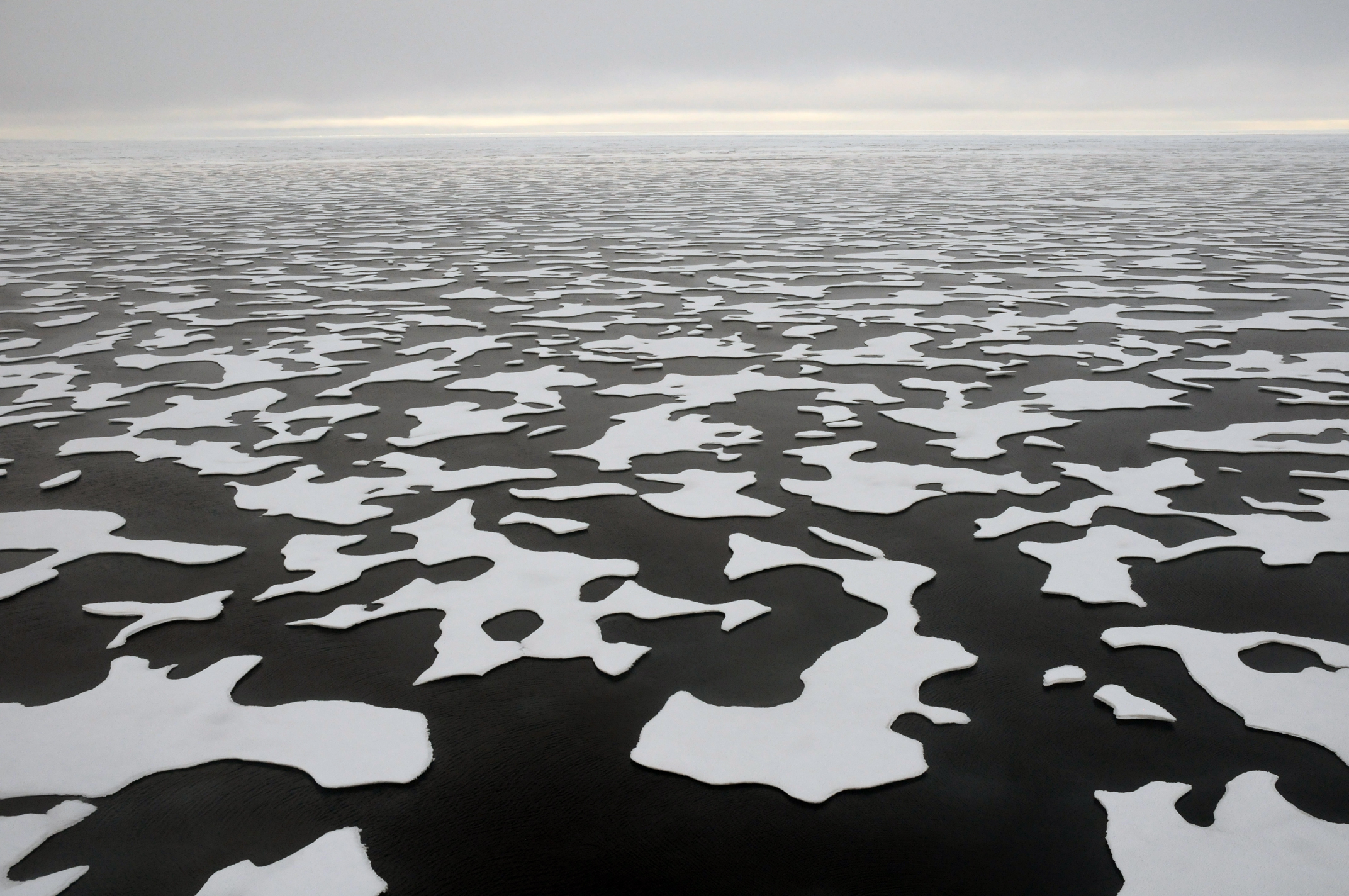
During May and June, early melt pond formation can have a dramatic impact on sea ice melt much later in the season as the darker pools reduce ice sheet albedo serving as a kind of heat lens that bores down through the ice surface. Eventually, the melt ponds connect, forming larger and larger volumes over the ice face until the sea ice is almost completely overwhelmed. In the last phase, melt breaks down through the ice surface to contact the ocean. At this point, the sea ice is typically splintered into much smaller and disassociated fragments.
A recent paper in the journal Nature has found that a multiplication of such early season melt ponds may well be a predictive indicator of end season sea ice extent, area and volume values come September.
The paper notes:
Our simulations show that melt ponds start to form in May, a maximum extent of 18% is reached in the climatological mean at mid-July, and there are hardly any exposed ponds left by mid-August. The strong interannual variability and the positive trend are striking. Whereas in 1996, the year with the highest September ice extent since 1979, the maximum pond fraction reaches only 11%, in 2012, the year with the lowest September ice extent, up to 34% of the sea ice is covered by ponds.

Massive interconnection of sea ice melt ponds
(Major expanse of dark sea ice melt ponds in the Chukchi Sea during June of 2010. Image source: The Polaris Project.)

Achilles Heel For the Arctic During the Summer of 2014

The most recent hot pulse for this region may just be the first of many as the spring and summer melt season progresses. Jet Stream patterns continue to remain fixed, delivering much hotter than normal temperatures throughout the Western Canadian, Alaskan, and East Siberian regions. Furthermore, snow cover losses for these regions are particularly well advanced further enhancing the likelihood of warm air invasions from these rapidly heating continental zones. Anomalously large and extreme early season fires may also result in a degree of albedo loss as smoke and soot is drawn northward to darken both remaining snow cover and sea ice.
As such, this zone represents a kind of sea ice Achilles heel as the 2014 melt season progresses. If we do see major losses and a progression toward record melt, it will likely come as a result of extreme weather patterns emerging from the continental zones spanning East Siberia, Alaska and Western Canada.
Links:

Early ice break-up in Alaska

Barrow Sea Ice Break-up: Dark Open Water In Late April


Barrow Sea ice break-up late April
(Image source: Barrow Sea Ice Cam.)


30 April, 2013

The warming trend that we provided predictive analysis for yesterday has barely even begun and we already have visible dark, open water off Point Barrow, Alaska as of late Tuesday evening on April 29.  A large polynya that had opened up off the northern Alaskan coast has now extended well past Barrow and landward toward the near-shore waters. By late evening, the open water had invaded to within about 200 yards of shore along and past the Point Barrow coastline.

In broader summary, the open water polynya stretches from Cape Lisburne to past Point Barrow and measures between 20 and 50 miles in width. General trends show this large polynya continuing to expand northward into the Chukchi Sea, a motion that is likely to continue for at least the next few days.
Some cooling will likely return after the currently building Arctic heatwave, but it is questionable if it will be enough to result in a refreeze given the prevailing and much warmer than usual conditions.
Sea ice break-up at Point Barrow typically begins in mid-to-late June. It often involves both the formation of open water offshore as well as sea ice motion near-shore. Though the polynya removed ice from the off-shore waters of Point Barrow today, the near-shore ice still remains grounded, so this admittedly impressive event cannot technically be considered a break-up. That said, it appears that we are seeing a very early initiation of melt conditions for the Barrow region.
With warmer weather settling in, heat stresses to the local and regional sea ice will likely continue to ramp up. So, in other words, this early season melt event has only just begun.
large polynya April 28
(Large polynya extending from Cape Lisburne to about 80 miles past Point Barrow on April 28. The polynya continued to enlarge even as it invaded the near-shore regions of Point Barrow on April 29th. Image source: LANCE-MODIS.)

Links:


the Exile

As I have been looking back at my own life, trying to make sense of it all this chapter from Clarissa Pinkola Estes’ book “Women Who Run With The Wolves” has come my way.

Although this book was written for women and there are special reason why this holds true for the Feminine and men, as a rule, have been allowed to follow their own path there is a universal message here.

Although the conditioning is quite different men who choose to be different and not conform to the values that they are expected to live by are exiles nonetheless.

I would like to dedicate this to Michael Ruppert who, by the end of his life, had really internalised their message of the need for the reunification of the Eagle at the Condor, the masculine and the feminine .

Also to Guy McPherson and all of us who endeavour to be faithful to our own natures and to truth as we perceive it.

---SMR


Finding one’s pack: belonging as blessing
Clarissa Pinkola Estes
- from “Women who Run with the Wolves”


The problem of the exiled one is primaeval. Many fairy tales and methods centre around this theme of the outcast. In such tales, the central figure is tortured by events outside her venue, often due to a poignant oversight. In “the sleeping beauty” the 13th fairy is overlooked and not invited to the christening, which results in a curse being based upon the child, effectively excising everyone in one way or another. Sometimes exile is forced through sheer meanness, as when the stepmother casts her stepdaughter out into the dark wood in “Vasalissa the wise”.

Other times exile comes about as the result of a naive error. The Greek god Haefestus took his mother’s, Hera’s slide in an argument with Zeus, her husband. Haefestus became infuriated and hurled a off Mt Olympus, vanishing and crippling him.

Sometimes exile comes from striking a bargain one does not understand, such as in the tale of a man who agrees to wander as a beast for a certain number of years in order to win some gold, and later discovers his given her soul to the devil in disguise.

The “ugly duckling” has many versions, all of which contain the same nucleus of meaning, but each is surrounded by different frills and furbelows reflecting the cultural background of the story as well as the poetry of the individual teller.

The core meanings we arc concerned with of these: the duckling of the story is symbolic of the wild nature, which, when pressed into circumstances of little nurture instinctively strives to continue no matter what. The wild nature instinctively holds on and holds out, sometimes with style, other times with little grace, but holds on nevertheless. In fact goodness for that. For the wild each woman, duration is one of her greatest strengths

The other important aspect of the story is that when an individual’s particular kind of soulfullness, which is both an instinctual and spiritual identity, is surrounded by psychic acknowledgement and acceptance, that person feels life and power as never before. Ascertaining one’s own psychic family brings a person vitality and belongingness,


Exile of the unmatched child


In the story, the various creatures of the village here at the “ugly” duckling and one way or another pronounce him unacceptable. He is not likely in reality, but he does not match the others. He is so different that he looks like a black bean and a bushel of green peas. The mother duck at first tries to defend this duckling whom she believes to be her offspring. But finally she is profoundly divided emotionally and withdraws from caring for the alien child.

His siblings and others of his community fly at him, peck at him, torment him. They mean to chase him away. And The ugly duckling is heartbroken really, to be rejected by his own. It is a terrible thing, especially since he really did nothing to warrant had other of them look different and act a little different. If truth be told, we have here, before the creature is even half grown, duckling with a massive psychological complex.

…

Girl children who display a strong instinctive nature often experience significant suffering in early life. From the time they are babies, there taken captive, domesticated, told they wrongheaded and improper. The wildest natures show up early. There are curious, artful, and have gentle eccentricities of various sorts, ones that, if developed, will constitute the basis for the their creativity for the rest of their lives. Considering that the creative life is the soul's food and water, this basic development is excruciatingly critical.

Generally, early exile begins through no fault of their own and is exacerbated by the misunderstandings, the cruelty of ignorance or intentional meanness of others. Then, the basic self of the psyche is wounded early on stop when this happens, the girl begins to believe that the negative images her family and culture reflect back to her about herself I not only totally true but also totally free of bias, opinion and personal preference. The girl begins to believe she is weak, ugly, unacceptable, and that this will continue to be true the matter how hard she tries to reverse.

A girl is banished for the exact reasons we seein  “the ugly ducking.” In many cultures, there is an expectation when the female child is born that she is or will become a certain type of person, acting in a certain time-honoured way, that she will have a certain set of values, which if not identical to the families, then at least based on the family’s values, and which at any rate will not rock the boat. These expectations are defined very narrowly when one or both parents suffer from a desire for the “the angel child,” the “perfect” conforming child.

In the parents' fantasy whatever child they have will be perfect and will reflect only the parents ways and means. If the child is wildish, she may, unfortunately, be subjected to her parents attempts at psychic surgery over and over again, for they are trying to remake the child, and more so trying to change what her soul requires of her. Though her soul requires seeing, the culture of around her requires sightlessness. Though her soul wishes to speak its truth, she is pressured to be silent.

Neither the child’s soul or her psyche can accommodate this. Pressured to be “adequate,” in whatever manner authority defines it, can chase the child away, or underground, or set her to wander for a long time looking for a place of nourishment and peace.…

The most destructive cultural conditions for a woman to be born into and to live under those that insist on obedience without consultation with one’s soul, those with no loving forgiveness rituals, those that force a woman to choose between soul and society, those where compassion to others is walled off by economic tears or caste systems, where the body is seen as something needing to be “cleaned” or as a shrine to be regulated by fiat, whether new, the unusual, all the different engenders no delight, and where curiosity and creativity are punished and denigrated instead of rewarded, or rewarded only if one is not a woman, where painful acts perpetrated on the body and called holy, and whenever a woman is punished unjustly common as Alice Miller puts it succinctly, “for her own good,” with a soul is not recognised as being in its own right.


The mistaken zygote


Have you ever wondered how you managed to end up in such an odd family is yours? If you have lived your life as an outsider, as a slightly odd or different person, if you are alone, one who lives at the edge of the mainstream, you have suffered. Yet the also comes a time to roll away from that, to experience a different advantage point, to emigrate back to the land of one’s own kind.

… So the answer to Why me, Why this family, Why am I so different, is, of course, that there are no answers to these questions. Still, the eco-need something to chew on before it’ll let go, so I propose three answers regardless.
Prepare yourself. Here they are.

We are born the way we are, and into the odd families we came through 1) just because (almost no one will believe this), 2) the self has a plan and our pea brains are two tiny to parse it  many find this a hopeful idea), or 3) because of the Mistaken Zygote Syndrome (well… yes, may be… But what is that?)

Your family thinks you’re an alien. You have feathers, they have scales. Your idea of of a good time is the forest, the wilds, the inner life, the outer majesty. Their idea of a good time this folding towels. If this is so for you and your family, and you are the victim of the Mistaken Zygote Syndrome.

Your family moved slowly through time, you moved like the wind; they allowed, you are soft, or they are silent and use saying. You know because you just know stop they want proof and a 300 page dissertation. Sure enough, it’s the Mistaken Zygote Syndrome.

You’ve never heard of that? Well see, the zygote ferry was flying over your hometown one night, and all the little zygoes in her basket were hopping and jumping with excitement.

You were indeed destined for parents who would have understood you, but the Zygote Fairy hit turbulence and, oops, you fell out of the basket over the wrong house. You fell head over heels, head over heels, right into a family that was not meant to you. Your “real” family was 3 miles farther on.

That is why you fell in love with a family that wasn’t yours, and that lived 3 miles over. You always wished Mrs and Mr So And So were your real parents. Chances are they were meant to be.

… This is why your parents are alarmed every time you come home or call. They worry, “what will she do next? She embarrassed us last time, God only knows what she will do now. Ai!” The cover their eyes when they see you coming and it is not because your light dazzles.

All you want is love, all they want is peace.

The members of your family, for their own reasons (because of their preferences, innocence, injury, constitution, mental illness, or cultivated ignorance), are not so good at being spontaneous with the unconscious, and of course your visit home countries the trickster archetype, the one who stirs things up. So before you even broken bread together, the trickster madly dances by just dying to drop one of her hairs and the family stew

Even though you don’t mean to upset the family, they will be upset no matter what. When you show up, everyone and everything seems to go quite mad will stop

it is a sure sign of wild zygotes  in the family if the parents are offended all the time and the children feel as though they can never do anything right.

The unwild family wants only one thing, but the Mistaken zygote is never able to figure out what it is, and if she could, it will make her hair stand up on exclamation points full..

Prepare yourself, I will tell you this big secret, this is what they really want from you, that mysterious, momentous thing.

The unwild want consistency.

They want you to be actually the same today as you were yesterday. They wish you not to change with the days to remain as at the beginning of Steaming Time.

Ask the family if they want consistency and they will answer affirmatively. In all things? No, they will say, only in the things that matter. Whatever these things are that count and their value system, they are always anathema to wild nature of women. Unfortunately “the things that matter” to them are not cohesive with the “things that matter” to the wild child.…

… While socialisation of the children is an important thing, to kill the interior a criatura is to kill the child. The West Africans recognise that to be harsh with a child is to cause its soul to retreat from its body, sometimes just a few feet away, other times many days walk away.

… What is the basic nutrition for the soul? Well, it differs from creature to creature, but here are some combinations. Consider them psychic macrobiotics. For some women air, night, sunlight and trees are necessities. For others, words, paper, and books are the only things that satiate. For others, colour, form, shadow, and clay are the absolutes. Some women must leap, bow, and run, for their souls crave dance. Yet others crave only a tree leaning peace.


… Mistaken Zygote’s learn to be survivors. It is tough to spend years among those who cannot help you to flourish. Being able to say that one is a survivor is an accomplishment. For many, the power is in the name itself. And yet comes a time in the individual nation process when the threat or trauma is significantly passed. Then is the time to go to the next stage after survivorship, to healing and thriving

If we stay as survivors only without moving to thriving, we limit ourselves and cut our energy to ourselves and our power in the world to less than half. One can take so much pride in being a survivor that it becomes a hazard to further creative development. Sometimes people are afraid to continue beyond survivor status, for it is just that – a status, a distinguishing mark, a “damn-straight, bet your buttons, better believe it” accomplishment…

But thriving means, now that the bad times are behind, to put ourselves into occasions of the lush, the nutritive, the light, and there to flourish, to thrive with bushy, shaky, heavy blossoms and leaves. It is better to name ourselves names that challenge us to grow as free creatures. That is thriving, that is what was meant for us.

Ritual is one of the ways in which humans put their lives in perspective, whether it be Purim, Advent, or drawing down the moon will stop ritual calls together the shades and spectres in people’s lives, sorts them out, puts them to rest.…

Ofrendas, (which) are altars to those who have passed from this life… Tributes, memorials, and expressions of deepest regard for the loved ones no longer on this plane. I find it helps many women to make an ofrenda to the child they once were, rather like a testament to the heroic child…

… This way of looking at the past accomplishes several things: it gives perspective, a compassionate rendering of times past, by laying out what one experience, what we made of it, what is admirable. It is the admiring of it, rather than the being of it, that releases the person.

To be the child survivor beyond its time is two over identified with an injured archetype. To realise the injury, and yet memorialise it, allows thriving to come forth. Thriving is what was meant for us on this earth. Thriving, not just surviving, is our birthright as women.

Do not cringe and make yourself small if you are called the black sheep, the maverick, the lone wolf. Those with slow seeing say a nonconformist is a blight on society. But it has been proven over the centuries, that being different means standing at the edge means one is practically guaranteed to make an original contribution, a useful and studying contribution to her culture.

When seeking guidance, don’t ever listen to the tiny hearted. Be kind to them, keep them with blessing, cajole them, but do not follow their advice.

If you have ever been called defiant, incorrigible, forward, cunning, insurgent, unruly, rebellious, you’re on the right track. Wild Woman is close by.

Journalism


Wildfire in Siberia

Video: Far-east wildfire ignites military depot, massive explosions rock Siberia, deaths reported


At least 11 people have been killed in explosions at a military depot in Russia's Transbaikal. Over 400 people have been evacuated, but this figure may grow. There were reportedly 20 explosions at the ammunitions depot after a fire in a nearby forest reached it.