Showing posts with label strike. Show all posts

Saturday, 7 December 2019

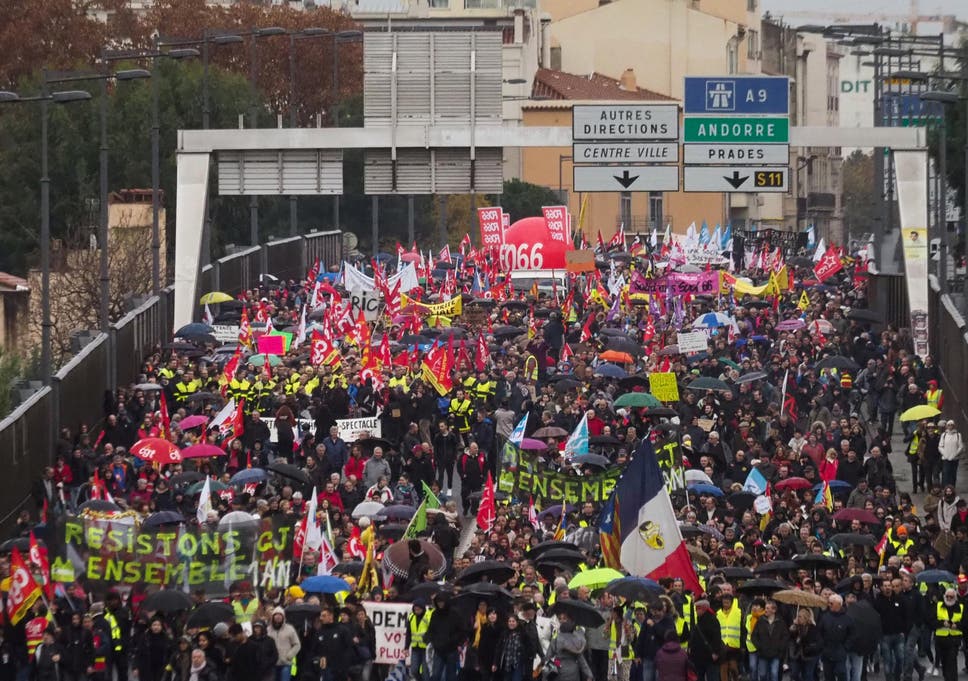
France paralyzed by national strike


https://www.dailymail.co.uk/news/article-7759497/France-paralysed-nationwide-strike.html?fbclid=IwAR0Fy5tDNHk_UhJMQQELcptDb_FB4nC7G-hcNep__b7eyHav96ncV9Jiu6g


France national strike grinds country to halt but government refuses to back down
What we’ve got to do is shut the economy down,’ union boss says. ‘People are spoiling for a fight’
People protest against the pension overhauls, in Perpignan, southern France, on 5 December 2019 as part of a national general strike

5 December, 2019

One of the biggest public sector strikes to hit France in decades looks set to continue after the French government stood by its plans to introduce controversial pension reforms.

Nationwide action on Thursday paralysed transport links in the country, while schools, hospitals and postal services also faced severe disruption.

More than 200 demonstrations took place across the country, with extensive security checks taking place in Paris. Before the protests even began on Thursday morning, police had detained around 65 people in the French capital.

Later in the day, riot police fired teargas at protestors, while businesses, cafes and restaurants along march routes were urged to close.

Popular tourist attractions were also shut down due to staff shortages, including the Eiffel Tower, the Musée d’Orsay and the Palace of Versailles.

Despite the disruption, President Emmanuel Macron stood by the proposed pension reforms, which were a key promise of his election campaign in 2017.

Under the reforms, 42 different pension schemes would be replaced by a single unified system designed to revitalise the country’s economy.


Those in opposition say the universal pension is an attack on workers’ rights and would mean people have to work longer for less.
There is no set end to the strike and some predict it could last until at least Christmas. Similar nationwide strikes in 1995 eventually resulted in the government capitulating to the unions’ key demands.
Union official Christian Grolier of the Force Ouvrière (Workers’ Force) said: “What we’ve got to do is shut the economy down. People are spoiling for a fight.”
A presidential official said Mr Macron “is convinced that the reform is needed, he is committed to the project he presented to the French public in 2017”.
Prime Minister Edouard Philippe is expected to lay out the framework for the reform next week.
Additional reporting by agencies

This is the BBC that has made no mention of the Yellow Vests for most of this last year

Sunday, 30 June 2013

Brazil protests

Brazil President Dilma Rousseff meets youth protesters as rumours mount of general strike
Brazil President Dilma Rousseff pledged on Friday to open new channels of dialogue with the nation's youth, who have dominated the nationwide protests that have rocked the country over the past two weeks.


29 June, 2013


Ms Rousseff and Education Minister Aloizio Mercadante met leaders from 25 youth organisations, including student and labour unions, as well as gay rights advocates, as part of the Brazilian leader's continuing talks with different interest groups.

No concrete announcements resulted from the talks in the capital city of Brasilia, which Ms Rousseff described as the start of a dialogue with the nation's youth.

Though no follow-up meetings have yet been scheduled, the July 8 launch of a long-planned government website focusing on youth issues will help facilitate continued talks, Ms Rousseff's office said.

The demonstrations took off earlier this month over a 10-cent rise in bus and subway fares in Sao Paulo and evolved into a mass, nationwide movement voicing public anger over a range of issues such as government corruption, poor education and health care.

Scattered smaller protests continued on Friday, with a demonstration by taxi drivers near Rio de Janeiro's Santos Dumont domestic airport over proposed changes to the rules governing taxi licenses.

Riot police in Sao Paulo state used tear gas grenades to disperse a small group of demonstrators who had blocked a multi-lane highway, and another demonstration was under way in the north-eastern city of Natal.

Social networks, which were a main forum for organising protest last week that brought hundreds of thousands of people onto the streets, were abuzz yesterday with rumours of a general strike on Monday.

According to the posts on social media, the strike is to take place in every state and will focus on demands for better public services and an end to corruption as well as labour-related issues like reducing the work week from 44 to 40 hours and shelving a bill to allow companies to increase the use of outsourced workers.

However, representatives of Brazil's two biggest unions, the Central Workers Union and Union Force, said they knew nothing about a general strike. They said they are planning a national slowdown for July 11.


Friday, 14 June 2013

Greece's General Strike

Today's Greek General Strike Will Not Be Televized


13 June, 2013


The Greek national broadcaster ERT situation is nowhere near a resolution, and the nation's political stability remains in the balance with  Antonis Samaras’s coalition partners, Evangelos Venizelos of PASOK and Fotis Kouvelis of Democratic Left, appealing to him Wednesday for talks on the future of the TV and radio station, but the premier has so far stood by his decision to close and later reopen ERT, leaving the government’s future in doubt. 

What is certain to make matters worse is that today, 

Greek public transport and state services will be disrupted as thousands of workers join a 24-hour snap general strike called on Wednesday by the country’s two main labor unions, GSEE and ADEDY, in protest to ERT's shut down. 

The claim is that Samaras' unilateral decision was the equivalent of a coup, which of course is not true: one can't overthrow a country in which sovereignty has long since been ceded to the European Commission, and Germany in specific.


However, the market has no reason to worry about cracks forming in its ivory tower: since the journalists will also be on strike, and since the TV station is obviously shut down, there is no danger of a real-time video stream from Syntagma showing the all too well known Athens riots. As for Istanbul, that is another matter.


From Kathimerini:


Buses, trolley buses and trains will not be running at all, while staff on the Athens metro, the Athens tram and the Piraeus-Kifissia electric railway (ISAP) will run a reduced service, from 9 a.m. to 9 p.m. There will be no metro service to Athens International Airport, with trains stopping as Doukissis Plakentias station as the remaining section of metro route to the airport is operated by the Hellenic Railways Organization (OSE) whose workers will be striking all day.
 
International flights are expected to be disrupted between 3-5 p.m. when air traffic controllers are to walk off the job. A five-hour walkout by staff of the Civil Aviation Authority, starting at noon, is expected to disrupt domestic flights.
 
The general strike, which is the third this year, will also upset public services, closing tax offices and schools, and leaving hospitals to operate on emergency staff.
 
A protest rally organized by GSEE and ADEDY is to be held outside ERT’s headquarters in Aghia Paraskevi, northeastern Athens, at 11 a.m. The unions called on workers from all sectors to join them to show solidarity for the sacked ERT workers, condemning the government’s move as “unprecedented and provocative.”
 
There will also be a media blackout as journalists will be on strike.


Tuesday, 30 April 2013

Guantánamo hunger strike worsens


Guantánamo Bay hunger strike prompts arrival of medical back-up
US military confirms presence of 40-strong team as 21 of 100 detainees refusing food are approved for force-feeding


29 April, 2013


A 40-strong medical back-up team has arrived at Guantánamo Bay, as the number of inmates taking part in a hunger strike continues to rise, the US military has confirmed. By Monday, 100 detainees were refusing food, with 21 having been approved for force-feeding.

Authorities said that the "influx" of medical reinforcements had been weeks in the planning. But the news will fuel speculation that the condition of hunger-striking prisoners at Guantánamo Bay is deteriorating. Shaker Aamer, the last British resident being kept at the centre, told his lawyer earlier this month that authorities will soon see fatalities as a result of the current action.

"I cannot give you numbers and names, but people are dying here," said Aamer, who is refusing food.

The action is a protest against conditions at the centre, as well as the indefinite nature of the remaining prisoners' confinement. Aamer has been cleared for release twice, but is still behind bars after 11 years. He has never been charged or faced trial but the US refuses to allow him to return to the UK, despite official protests by the British government.

Of the 166 detainees left at Guantánamo, almost two-thirds are on hunger-strike. Five of those approved by guards to be subjected to force-feeding are in hospital.

Increased media attention to the plight of prisoners at Guantánamo Bay has led to renewed calls for President Barack Obama to close the camp. In the face of pressure from Congress, Obama dropped a 2008 campaign pledge to close the camp.

The current hunger strike is believed to have begun on 6 February and initially involved a minority of detainees. But the number taking part has steadily increased. Two weeks ago, guards attempted to break the resolve of those refusing food by moving detainees from communal areas and placing them in single cells, where they could be monitored more closely. That action led to violent clashes in which US troops fired four "less-than-lethal" rounds on inmates.

US authorities said on Monday that the decision to bring in a back-up medical team was made as increasing numbers of inmates began to refuse food. "We will not allow a detainee to stave themselves to death and we will continue to treat each person humanely," a Guantánamo Bay spokesman, Lt Col Samuel House, said.

He added: "Detainees have the right to peacefully protest, but we have the responsibility to ensure that they conduct their protest safely and humanely."


Wednesday, 23 January 2013

Economic news


Worldwide unemployment hits new high: report
Five years after the global financial crisis hit, unemployment numbers continue to soar, with a record 202 million people worldwide expected to be officially jobless this year, the International Labour Organization said Tuesday.


21 January, 2013


Last year saw a clear resurgence of the crisis, the UN’s labour body said in its annual report on global employment trends, pointing out that jobless numbers rose by four million to 197 million in 2012.

This figure means that today there are 28 million more unemployed people around the world than they were in 2007,” before the crisis, ILO chief Guy Ryder told reporters in Geneva Monday.


Last year’s unemployment number inched up towards the all-time record of 199 million reached at the epicentre of the crisis in 2009, but “we will beat that record in 2013″, an ILO expert told AFP.

In fact, another 5.1 million people are expected to join the jobless ranks this year, bringing the total number to more than 202 million.

That number is expected to rise by another three million in 2014 and should hit 210.6 million by 2017, ILO said, adding that the global unemployment rate was expected to stay steady at 6.0 percent until then.

The trends are very much (going) in the wrong direction,” Ryder said, lamenting a “noticable worsening of the unemployment situation around the world”.

The impact of the economic crises on the global labour market had in many cases been worsened by incoherence between monetary and fiscal policies and “a piecemeal approach” to the problems, especially in the eurozone, the report said.

Weakened by faltering aggregate demand, the labour market has been further hit by fiscal austerity programmes in a number of countries, which often involved direct cutbacks in employment and wages,” it said.


At the same time, “labour force participation has fallen dramatically … masking the true extent of the jobs crisis,” ILO said, pointing out that 39 million people dropped out of the labour market altogether last year as job prospects became increasingly gloomy.

Young people have been especially hard-hit by the expanding jobless trend, the UN agency said, pointing out that there are currently some 73.8 million youths, aged 15 to 24, without work worldwide.

And the slowdown in economic activity is likely to push another half million into unemployment by 2014,” the report cautioned.

Last year, the global youth unemployment rate stood at 12.6 percent, and it was expected to rise to 12.9 percent by 2017, according to ILO.

The crisis has dramatically diminished the labour market prospects for young people, as many experience long-term unemployment right from the start of their labour market entry,” the UN agency said, adding that it had never seen anything similar during previous downturns.

Today, around 35 percent of all young people on the dole in advanced economies have been out of work for six months or longer, up from just 28.5 percent in 2007, the report showed.


20,000 Layoffs in Spanish Banks, 40% Pay Cuts, Pension Contributions Halted; Spanish Bank Unions Announce Strike; Protests Snowball; When's the Breaking Point?


21 January, 2013


Spanish banks have already shed 30,000 jobs in its banking crisis. Another 20,000 cuts are due in 2013, along with pay cuts and reduced pension contribution. In response Spain's Banking Unions Announce Strikes.


 Workers at three of Spain's bailed-out banks will stage strikes in coming weeks as they fight mass layoffs, unions said on Monday, spreading industrial unrest to a sector where walkouts have so far been rare.

While the banks, crippled by a property bubble that burst five years ago, have hogged headlines, employees have so far mostly kept a low profile even as protests become a way of life elsewhere in Spain.

But about 20,000 layoffs planned for 2013, almost 10 percent of the total, could reduce the workforce to levels last seen in 1975, data from the unions showed.

Alarmed at the scale of cuts, employees from across the industry will demonstrate on January 23, while workers from Bankia, Banco de Valencia and NovaGalicia Banco will strike on February 6 and hold partial strikes before then.

Protests are snowballing and becoming more visible, as bankers take to the street and join judges, doctors, bus drivers and garbage workers as strikes become almost a daily occurrence across recession-bound Spain.

As well as losing their jobs, workers at the likes of Bankia are being asked to take 40 to 50 percent pay cuts and many will see pension contributions halted for several years.

Many of Bankia's more than 20,000 employees also bought shares in its listing in June 2011 and face seeing their savings practically wiped out.

The deadline for negotiations between unions and Bankia is Feb 9.

Spain's banks have shed over 30,000 jobs since the start of the global financial crisis in 2007, data from the Comisiones Obreras union showed. With about 20,000 more set to be axed in 2013, the banking workforce could drop to 218,500 by year end.


When's the Breaking Point?


With 26% unemployment and rising, as well as corruption and fraud at the highest levels in government, I keep wondering when the breaking point will hit Spain.

All I can suggest is some time in 2013.


Other stories -


"The U.K.’s financial industry will lose 43,000 jobs in six months, according to a forecast from the Confederation of British Industry, as companies shrink and reduce costs."
Downsize, downsize, downsize; cut, cut, cut. -- RF


"Steadily dropping water levels in the Great Lakes threaten to leave the Canadian economy high and dry as shipping routes evaporate and water dependent industries shut down, costing billions of dollars, according to one expert."


"A World Bank report released last year notes that the shadow economy of eastern European states ranges from 17 percent to 33 percent of GDP."


If you need a lesson on how to cut your own throat, this is it. Singapore is one of the last places I want to be when the excrement hits the fan. -- RF


Thursday, 6 December 2012

Protest against shock doctrine

Christchurch: Teachers unconcerned strike action illegal


Radio NZ,
6 December, 2012


Teachers planning to strike in response to the Government's proposed shake-up of Canterbury's education system say they don't care if the industrial action early next year is unlawful.


Primary and intermediate teachers throughout Canterbury have voted overwhelmingly in favour of striking on 19 February over the proposal to close, move or merge 36 schools in the post-quake reorganisation.


A strike is only legal if there has been a breakdown in collective bargaining, or for health and safety reasons.


Nicky Penney, a teacher from Branston Intermediate, says the action is too important for the education community to be worried by legalities.


Another teacher, John Leadbetter, says as far as he's concerned the illegality is just a technicality. "We're here for the kids, we're here for the community," he said.
The union-organised meeting in Christchurch on Wednesday considered three options; to strike next week, to strike in the New Year, or to take no strike action.


Glenys Palmer, deputy principal of Bamford school, was one of 183 who voted to strike next week, saying she thinks the community would support immediate action.


There were 693 votes in favour of taking industrial action and 143 against.
Ian Leckie, president of the teacher's union, the NZEI, told Radio New Zealand's Morning Report the entire plan for the region's education system is flawed.


He said the plans to downsize of the workforce and closing or merging school is working on the false assumption that Christchurch is going to stay the same as it is now.


Angry Christchurch teachers vote to unlawfully strike in protest against the government's massive shakeup of education in Canterbury - including proposals to close 13 schools and merge 26 others. John Leadbetter is a teacher at Parkview School in Christchurch.


Wednesday, 5 December 2012

Christchurch teachers take action

ChristchurchTeachers to consider strike action
Hundreds of Christchurch teachers could strike over the Education Ministry's "extreme" overhaul of the region's schools.

5 December, 2012

The New Zealand Educational Institute (NZEI) has called a meeting of Christchurch members for 4pm today to decide whether to take industrial action over the Government's education overhaul.


President Ian Leckie told Radio New Zealand this morning that a "a whole range of options right through to strike action" would be considered".

"Here we have teachers, principals and support staff saying enough is enough."

The meeting, expected to be the biggest of its kind in Christchurch, arose from its members' concern about the proposals to merge, move or close some of the city's schools.

NZEI members felt there was a lack of real consultation over the proposals and an unrealistic time-frame imposed on schools to respond, he said.

"Quite clearly this has to stop. It has to be redone and redone properly.

"Thirty eight schools closing or merging - that's extreme measures. It's ridiculous measures far beyond what is needed. Quite clearly people are upset not just about the decisions but the consultation," he said.

Leckie told The Press schools were concerned the ministry had based its proposals to close 13 and put 26 through some form of merger on "wrong or poor quality information".

NZEI is the country's largest education union, representing about 50,000 principals, teachers and support staff working in primary, intermediate and secondary schools as well as early childhood centres, special education and school advisory services. Members work at almost every education facility in Christchurch.

Schools affected by the proposals have until Friday to complete a 10-week consultation period and hand in submissions to the ministry. "Amongst the concerns from teachers and school communities is a lack of any real consultation over the proposals and the unrealistic time frame imposed on schools to respond," Leckie said.

Last night a spokesman for the ministry said NZEI Te Riu Roa has not approached it with any specific concerns about the information provided as part of its plans for Christchurch.

"The data used in formulating the proposals is robust. It was drawn from information provided by schools [rolls and infrastructure] and informed by reports from property professionals, the Christchurch City Council, the Canterbury Earthquake Recovery Authority, and other agencies."

While the ministry admitted there have been some errors, the spokesman said: "In every case where an inaccuracy has been raised by schools, the ministry has investigated and clarified or updated it as appropriate.

"All of the information has been provided to schools in good faith based on the best information available at the time. In some cases this has been superseded as result of more recent student roll and property related information."


Wednesday, 7 November 2012

South African massacre


South Africa mine massacre photos prompt claims of official cover-up
Police accused of planting weapons next to Marikana miners' bodies in bloodiest such incident since end of apartheid


6 November, 2012


Police in South Africa have been accused of planting weapons on the bodies of dead miners as part of an official cover-up of the Marikana massacre, in August.

Damning photographic evidence was presented to an independent commission of inquiry examining the deaths of 46 people during nearly six weeks of violent strikes at the Lonmin-owned mine.

The revelation follows a series of media reports alleging that on the worst day of bloodshed, when 34 striking miners were killed, some were subjected to execution-style shootings away from the TV cameras.

Photographs taken by police on the night of 16 August showed more weapons by the bodies than photos taken immediately after massacre, the commission was told. The crime scene expert Captain Apollo Mohlaki, who took the night pictures, admitted the discrepancy.

In one picture, a dead man is seen lying on rocky ground near the mine; a second picture, taken later that same day, is identical except that a yellow-handled machete is now lying under the man's right hand. Mohlaki said he saw the weapon under the man's arm in the night photo he took, but when looking at the day photo of the same body, he said of the weapon: "It is not appearing. I don't see it."

George Bizos, a veteran human rights lawyer representing the mine workers, said the evidence presented at the commission indicated an attempt to alter the crime scene.

"The evidence clearly showed there is at least a strong prima facie case that there has been an attempt to defeat the ends of justice," he said. "Changing the evidence is a very serious offence."

Bizos, who defended Nelson Mandela during the Rivonia trial, half a century ago, called for high-ranking officials to be brought before the commission to explain whether they granted colleagues permission to move traditional weapons from where they had been found.

Ishmael Semenya, a police representative, said the national police commissioner, Riah Phiyega, had launched an investigation two weeks previously, after receiving evidence that one of the crime scenes had been tampered with.

But Bizos said Phiyega's investigation was not to be trusted because of her public statements shortly after the massacre. Three days later, Phiyega was quoted as saying: "Safety of the public is not negotiable. Don't be sorry about what happened."

Video evidence shown to the inquiry on Monday also indicated that some of the slain miners may have been handcuffed. Family members at the hearing wept as they saw two lifeless bodies with their hands tied behind their back.

When asked if he had seen whether any of the dead miners' hands were bound, Mohlaki said he had not. "If I am looking at the video, there is a person handcuffed possibly, but on the day I did not observe that," he said.

In one of the videos, police can be heard joking and laughing loudly next to the dead bodies, which lie scattered amid dust and blood. Bizos called for a transcript of what the police were saying.

In August, television footage of police opening fire on the miners caused shock around the world. And in subsequent weeks, the journalist Greg Marinovich produced a series of reports for the Daily Maverick website pointing to evidence that some of the miners had died at a second site, having probably been killed in cold blood. Autopsy reports allegedly show that several of the dead had bullet wounds in the back.

On Monday Dali Mpofu, a lawyer representing about 270 injured and arrested miners, told the inquiry: "Evidence is going to be led to the effect that the people at scene two were hiding away when they were shot."

Mpofu said one of the bodies recovered from the scene, known as Body C, stood out from the rest because it was "riddled" with 12 bullet wounds; all the other bodies had single bullet wounds.

The massacre of 34 workers was the bloodiest security incident since the end of apartheid, in 1994. The inquiry has heard that at least 900 bullets‚ "400 live rounds and 500 rubber bullets", were fired that day. It followed 10 fatalities, including those of two police officers who were hacked to death.

In the immediate aftermath, the authorities sought to portray the miners, who were striking illegally, as responsible for the violence. Some 270 of the striking miners were arrested and charged with murder, though the charges were later dropped.

The strike ended in September after workers agreed a 22% pay rise with the mine's owners, the platinum giant Lonmin.

The inquiry began last month and is expected to continue for four months, investigating the roles played by police, miners, unions and Lonmin in the deaths. It has been plagued by complaints that family members were unable to attend and allegations that police have arrested and tortured witnesses. Mpofu told the commission last week: "One person [said] he was beaten up until he soiled himself. Another lost the hearing in his right ear and another had visible scarring."

With their reputation already in tatters, the police have been criticised for a lack of full disclosure to the commission, which last week was shown a 41-minute police video that appeared to have missed out everything important.

James Nichol, a lawyer representing the families of the dead miners, said of the photo anomaly: "Even the police service did not know about these new photos until two Thursdays ago. Who concealed them until then? It's astonishing they have not come to light until now.

"There are only two possible conclusions: a cover-up and a systematic planting of evidence."

Referring to a video played to the commission, Nichol added: "What was grossly offensive was that you see dead bodies and what you hear is the raucous laughter of police officers."

Asked if he suspected a police cover-up, David Bruce, a senior researcher in the criminal justice programme at the Centre for the Study of Violence and Reconciliation, said: "To my mind, there is no question about that. When we're talking about a cover-up, we're talking about something very elaborate. There's a massive pattern of concealment that seems to permeate what the government is doing at the moment."

The police had followed an "illegal doctrine" of using maximum force that could be traced back to the government, in particular to the police minister, Nathi Mthethwa, Bruce added. "The issues of responsibility do go very directly to the minister," he said. "The police said the Friday after the massacre that they used maximum force and you've got several incidents where the minister recommended maximum force. As far as I'm concerned, it's an open-and-shut case."

Bruce called for Mthethwa and Phiyega to resign. "We have a government who are completely shameless. If you have any integrity around the office of the minister of police, something like that should have been followed the next day by the resignation of the minister."