Showing posts with label South Africa. Show all posts

Friday, 25 December 2020

The “Scary” Mutant COVID

We Are Being Told The “Scary” Mutant COVID In South Africa Is Even More Dangerous Than The “Super COVID” In The UK 


Economic Collapse Blog,

24 December, 2020


A new mutant strain of COVID-19 that has been dubbed “501.V2” has gotten completely out of control in South Africa, and authorities are telling us that it is an even bigger threat than the “Super COVID” that has been causing so much panic in the United Kingdom.  Of course viruses mutate all the time, and so it isn’t a surprise that COVID-19 has been mutating.  But mutations can become a major issue when they fundamentally alter the way that a virus affects humans, and we are being told that “501.V2” is much more transmissible than previous versions of COVID and that even young people are catching it a lot more easily.  That is potentially a huge concern, because up until now young people have not been hit very hard by the COVID pandemic.

The British press is using the word “scary” to describe this new variant, and at this point it has become the overwhelmingly dominant strain in South Africa…

The new mutant, called 501.V2, was announced in Cape Town last Friday and is believed to be a more extreme variant than Britain’s new Covid strain which has plunged millions into miserable Christmas lockdowns.

Cases in South Africa have soared from fewer than 3,000 a day at the start of December to more than 9,500 per day, with the mutant accounting for up to 90 percent of those new infections.

If this same pattern happens elsewhere as this new mutant strain travels around the globe, then “501.V2” could eventually almost entirely replace all of the older versions of COVID.

Authorities are optimistically telling us that the recent vaccines that have been developed will “likely” work against this new variant, but the truth is that they will not know until testing is done.

And if the vaccines don’t work against “501.V2”, we could be back to square one very rapidly.

For now, countries all over the globe are banning flights from South Africa in a desperate attempt to isolate this new version.  The UK, Germany, Switzerland, Turkey and Israel are among the nations that have banned those flights, but so far the United States is not on that list.

So people that are potentially carrying this new version of COVID continue to enter the U.S. on a daily basis.

For the United Kingdom, this flight ban may have come too late because two cases of “501.V2” have already been identified on British soil

Two cases of a new, “more transmissible” COVID-19 variant linked to South Africa have been identified in the UK, the health secretary has said.

Both cases are contacts of people who travelled from South Africa over the last few weeks, Matt Hancock said at a Downing Street news conference.

If the new vaccines are effective against “501.V2”, authorities believe that they already have the long-term answer to this new variant.

But if those vaccines don’t work, this pandemic could be entering a far more deadly new phase.

And of course we are hearing about more problems with these new vaccines on a daily basis.  Thousands of adverse reactions have already been reported to the CDC, and more reports continue to pour in as more people get the shots.  Here is one example from New York City

A health care worker in New York City had a serious adverse reaction to a coronavirus vaccine, officials said on Wednesday.

New York City Health Commissioner David Chokshi said during a news conference that the unidentified worker experienced a “significant allergic reaction” to the vaccine. He added that the worker was treated for the reaction, and is in stable condition and recovering.

We should not be surprised that there are major issues with experimental mRNA vaccines that are based on entirely new technology that were rushed into production without proper testing.

And of course there are tens of millions of Americans that will never take any mRNA vaccine that literally “hijacks your cells” under any circumstances.

On the other hand, most of the U.S. population seems to think that these new vaccines will bring this pandemic to an end, but if they don’t work against new mutant versions of the virus that won’t be true at all.

It is so important to take a balanced view of these things.

Unfortunately, when it comes to COVID most people fall into two camps.

The first camp is totally freaked out because they think that COVID is about the worst thing that could ever happen to the United States and they tend to favor extremely draconian measures to prevent the spread of the virus.

But the truth is that the COVID pandemic pales in comparison to other great pandemics throughout human history.  The Black Plague and the Spanish Flu Pandemic each killed at least 50 million people.  As for the COVID pandemic, the global death toll has not reached the 2 million mark even if the official numbers are accurate.  If a pandemic of this nature is freaking people out so much, what is going to happen when a truly killer plague is unleashed in our society?

The second camp either thinks that the pandemic is greatly exaggerated or that the virus doesn’t even exist at all.  Even though hordes of people are catching the virus all around us, many out there continue to deny the reality of this crisis.

I simply do not understand that.  So many people that I know around the country have gotten the virus, and that includes quite a few big names.  For example, the following is an excerpt from an article in which Daisy Luther shares what her experience with COVID was like

Days 3-5: Over the next three days, chills and fever were almost constant. My joints and muscles hurt. Getting up to go to the bathroom felt like an expedition up a mountain.  I was tired and winded. I had very little appetite and even less of an inclination to cook food so I existed mostly on peanut butter and crackers and leftover soup. I was absolutely exhausted and so cold that I shivered violently when I got out from under my bed piled high with blankets. I had super-weird dreams. My cough worsened, my head hurt, and my throat was still mildly sore.

I drank lots of water and electrolyte beverages. My thirst remained unquenchable regardless of how much I drank. I took vitamins (C, D3) and took Zinc supplements. These are my regular supplements but I doubled that.

Days 6-9: The line to get a test at the local clinic was long and filled with people who were coughing up a lung. There was no way I’d be able to stand in that line for an hour, as sick as I felt. Besides, I figured if I didn’t have Covid, I’d get it standing in the line so I opted not to be tested.

This part made me think of the worst case of the flu I ever had, except intensified by about four times. It was terrible.

I usually let a fever run its course but by Saturday I felt so awful that I gave in and began treating symptoms. My normal temp is in the 96s and my temperature throughout these days stayed between 101-103. I staggered ibuprofen and acetaminophen, and I also used a mild muscle relaxant and my Ventilyn inhaler. The meds didn’t get rid of my fever but reduced the chills to a tolerable level. I slept almost around the clock, waking up for a couple of hours here and there to check on website stuff. Fortunately, I have a wonderful team who kept things running for us. One day blurred into the next and I considered going to the doctor again, but couldn’t muster the energy. I felt like if I just got a little more sleep I’d be okay.

My cough was getting far worse and now my ribs and abdominal muscles hurt. It was a deep painful cough that caused me to clutch my chest every single time inhaled deeply.

So to summarize, yes the COVID pandemic is real, but it is not the end of the world.

More people are going to get sick, and some will suffer intensely, but the vast majority of those that get the virus will survive.

If you want to wear a mask, then wear a mask.

If you don’t want to wear a mask, then don’t wear a mask.

We should be free to make our own choices, and we should also be free to experience the consequences for those choices.

Unfortunately, there are way too many people out there that think that they have the right to censor and control what we say and what we do, and that trend is likely to only get worse as our society continues to spin out of control in the years ahead.

The latest COVID-19 mutated strain - This is what Dr. Samadi thinks will happen


Saturday, 3 October 2020

An important panel discussion on covid-19 for those in the Southern Hemisphere

Especially if you come from Australia, New Zealand or South Africa this is essential viewing.

LINE IN THE SAND: LIVE NOW


Del Bigtree, Pete Evans, Mikki Willis , Rocco Galati, Susan Stanfield, Michael Tellenger, Zach Bush , Sherri Tenpenny, Dr Buttar, Nurse Kate, Dolores Cahill, Mark Steele , Dr Northrup , Pam Popper,RFK, Dr Lewis,Tom Brown and many more

Thursday, 1 October 2020

Monday, 21 January 2019

Breakdown in Southern Africa

"It Feels Apocalyptic" - A Letter From Zimbabwe, Where The Country Remains In Total Shutdown

20 January, 2019

Zimbabwe is once again at the brink of economic collapse, making a mockery of President Emmerson Mnangagwa’s claim that the country is open for business.
As Bloomberg reports,  many shops and factories have shut their doors because of a lack of customers and those that continue to trade are open to haggling over prices to secure hard currency. At an appliance shop in the capital, Harare, a salesman whispers that a Whirlpool Corp. washing machine priced at about $5,000 if paid for electronically will sell for $1,500 in cash, while at a nearby electrical warehouse, a $600 invoice is whittled down to $145 for payment in dollar bills.

But, as OilPrice.com's Tsvetana Paraskova reports, Zimbabwe is on a three-day nationwide strike and protests are erupting in the streets after the government of the southern African country doubled fuel prices, making gasoline sold in Zimbabwe the most expensive gasoline in the world. 


We are now in our third day of complete shutdown throughout the whole of Zimbabwe.

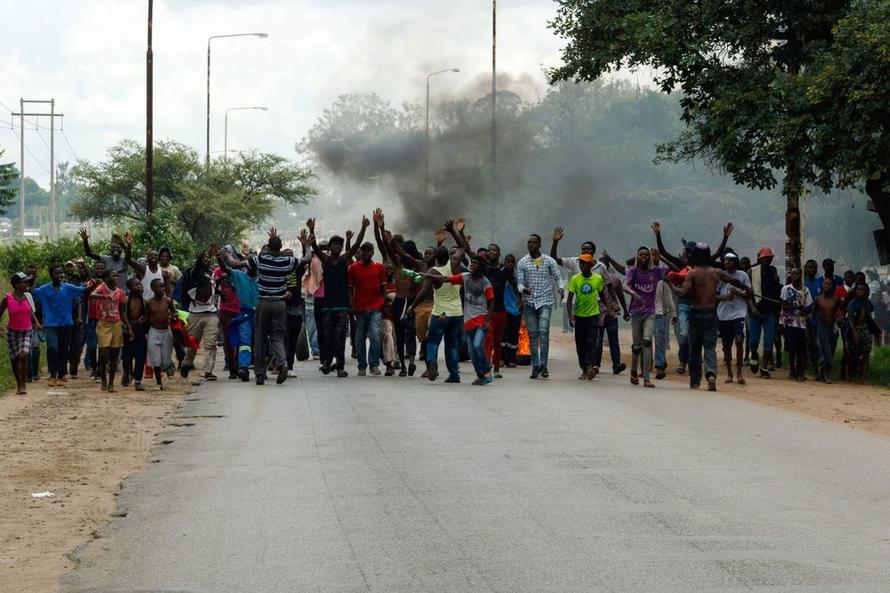
Banks are closed, schools are closed, roads are closed in and out of the main towns and transport systems have shut down.
There are no newspapers to be bought, the Internet has been shut down by the government and everything is at a complete standstill.

People are too afraid to move around as a result of the burning of vehicles by vigilante groups and the complete dearth of any updated information or warnings due to the total social media blackout. This means that no WhatsApp messages or photos can be sent, no one can access Facebook or Messenger, and the situation is very tense.

In some centres it almost feels apocalyptic. We have heard gunfire, and before the Internet was closed down, saw pictures of dead and wounded people. 
It is unclear how many people have died but before the media blackout, it was reported that there had been five deaths and more than 200 people had been arbitrarily arrested.

Elements of the police and military are also involved in ensuring that there is a complete shutdown. People in civilian dress armed with AK-47 rifles have been seen in some areas. It is clear that these are military personnel.
Amnesty International has condemned the military crackdown and has called on the Zimbabwean authorities to ensure restraint by security forces and respect the public’s right to protest.

Zimbabwe Lawyers for Human Rights reported prior to the blackout that they had received reports of soldiers and police breaking into homes in townships overnight and assaulting suspected demonstrators.

Contacts in the diplomatic corps and the political opposition are also completely in the dark, along with the rest of us.

This morning I spoke to Nelson Chamisa, leader of the opposition Movement for Democratic Change (MDC) Alliance, and it is clear that no one knows what is going on because the entire country has been effectively silenced.

I have also spoken to lawyers regarding the arrest once again of Pastor Evan Mawarire who inadvertently triggered the highly successful #ThisFlag social media protest action in April 2016 because he could no longer afford to pay school fees. This led to his arrest on trumped up charges and his high profile court case. Since then, his activities have been under constant surveillance.

Police officers arrive at his flat this morning in central Harare and took him to the Law and Order section, charging him under a false charge of incitement to commit public violence.

The crisis was precipitated on Sunday (January 13) by President Emmerson Mnangagwa when he announced a shock increase of 200 percent in the fuel price – this in a country with more than 90 percent unemployment and where the struggle to survive escalates daily. Mr Mnangagwa promptly left the country for Russia and has not returned. Reports say that he has gone there to “discuss Russian assistance to modernise the military”.

Right now the situation remains eerie and uncertain. If this goes on for much longer, the humanitarian crisis will escalate. We cannot buy food because the shops are all closed and transport systems have closed down. Most of the hospitals are without essential medicines and also staff because doctors and nurses can’t even get to work.

This is an unprecedented situation in Zimbabwe and internationally. Even in wartime Europe, the people could get newspapers, transport systems operated, retail outlets were still open and people could communicate.

I cannot send you an e-mail or a photograph – it is a very weird situation.

The only thing we can do at this point is to ask for your prayers as we face this time of escalating fear and uncertainty.

Ben Freeth
Executive Director
Mike Campbell Foundation
Harare, Zimbabwe

From neighbouring South Africa

Vesti Special Report: World Remains Silent as White Genocide Ramps Up in South Africa!


Sunday, 30 December 2018

Severe drought in South Africa


From a part of the world we hear very little about

Drought Hurts South Africa Corn, Soy Plantings, Grain SA Says

28 December, 2018

The window for planting corn and soybeans in South Africa has passed, and with hardly anything planted in western growing ares because of drought, the likelihood of the need for imports increases, a grain farmers’ lobby group said.

The probability of a repeat of the 2016 drought is increasing daily” Jannie de Villiers, the chief executive officer of Grain SA, said in an emailed statement Thursday. “Some of the scenarios we are facing look even grimmer than the previous drought. The financial position of most farming units in the production area are far worse than it was in 2016. The current grain prices are not high enough and thus do not favor nor encourage farmers to take a similar risk by planting beyond the optimum window, as they did in 2016.”

The country is Africa’s top corn producer but profitability has been squeezed as a record crop in 2016-17 that boosted stocks was followed by another good harvest this year. Farmers are coming under pressure because of dry conditions when they should be planting corn for the new season, Jacques Taylor, the head of sub-Saharan Africa at equipment-maker Deere & Co., said earlier this month.

Rainfall in 2015 was the lowest since records began in 1904 because of El Nino, with cities including Johannesburg recording their highest temperatures yet. Cape Town, among the continent’s top tourist destinations, is recovering from its worst drought that’s seen water rationing.

Monday, 10 September 2018

Hypocrsy and doube s standards over land expropriation in South Afrixa


This article from the Washington Post was uncritically reproduced by NZ media.

We weren't far beyond the ending of the apartheid regime in South Africa and the whole world was aghast (and still is) at Robert Mugabe's actions against white farmers many of whom were accepted by this country.

And yet when South Africa, which looks to the tottering on the edge wants to repeat the exercise any reporting of this is dismissed as right-wing, white supremacy – truth be damned!

An essentially violent process of forced expropriations that would not have been out of place in Stalin's USSR is now painted as "social justice" and might even (sic) "improve South Africa's economy"

I can't think of any social engineering of this sort based on hatred that has succeeded – especially given this period of human history.


To say this is all hypocrisy and double standards would be a gross understatement.

The promise and peril of South African land reform
ANALYSIS: Right-wing groups have been sounding the alarm about proposed land reforms in South Africa, where the ruling African National Congress party is preparing to amend the country's constitution to make it easier for the government to redistribute farmland without compensation.

On August 22, US President Donald Trump caused a stir with a tweet on the subject: "I have asked Secretary of State @SecPompeo to closely study the South Africa land and farm seizures and expropriations and the large scale killing of farmers."

The tweet, possibly intended to capitalise on racial tensions, was in part inaccurate - there is no large-scale killing of farmers going on.

But the part about plans to make land seizures easier is accurate.

The move is ostensibly about racial justice - white farmers own about 72 per cent of the country's individually owned farmland, which they wouldn't own if not for colonialism and apartheid.

The idea is to take some of that land and give it to black farmers.

This is, naturally, a morally contentious issue - opponents will argue that since the current owners didn't do the seizing, they're entitled to compensation.

But the policy is also about economics - South Africa's unemployment rate has been rising and now is more than 27 per cent, a rate higher than anything suffered by the US during the depths of the Great Depression.

The government has been trying to put people to work by employing them in community and social services, but there's only so much that can do.

It might also be a good idea to consider sending restless unemployed people out into the countryside to farm.

There are good reasons to believe that this might work - not only to absorb the country's surplus labour force, but to increase the country's agricultural output as well.

The reason is a curious fact about farming that defies the trend for many other industries: negative economies of scale.

In most industries, bigger is better; a huge factory can usually produce cars or computer chips more efficiently than a small one, while a large national chain store can optimise its purchasing and logistics more efficiently than a mom-and-pop shop.

In agriculture, that's also true in terms of overall productivity - a large mechanised farm doesn't use much labour, allowing it to produce lots of food cheaply.

But small farms, especially in developing countries, tend to be more efficient in their use of land.

Growth economist Dietrich Vollrath has a blog post summarising the relevant academic literature.

An inverse relationship between land yield and farm size - meaning smaller farms making more intensive use of each acre - was recorded in India by the Nobel Prize-winning economist Amartya Sen in 1962.

Many subsequent papers and books have confirmed this observation.

The relationship doesn't hold for commercial farms in developed countries like the US or NZ, but it seems like a universal feature of developing economies, including South Africa.

Theorists have struggled to explain this strange phenomenon - if large commercial farms are less productive than small family farms, it should make sense for the owners of the big farms to just rent some of their land to family farmers, increasing output and splitting the proceeds.

But for some reason that doesn't work - when small farmers manage their own land, they work harder and get more out of the land.

Journalist Joe Studwell, in his book How Asia Works, speculates that it's simply a matter of motivation - when small farmers feel like they're in business for themselves rather than for a landlord, they put in the extra work to do things like intensive weeding and individual plant care.
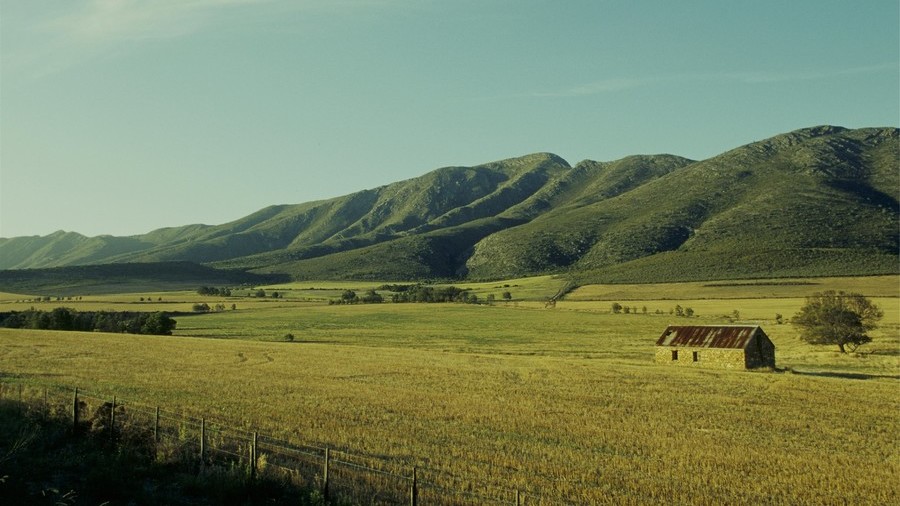
Land will be given to black farmers, but South Africa's government will have to be careful to make sure it's in small parcels (file photo).
This isn't efficient in terms of profit.

But if you have a huge pool of idle labour, as South Africa does, small farming could be a highly effective way to put people to work.

Studwell believes that it was land reform - expropriating farmland from wealthy landlords at below-market prices and handing it out to small farmers - that kicked off economic growth in Japan, Taiwan and South Korea.

So whatever one thinks of the morality of land expropriation in South Africa, it could give the country's economy a boost.

The World Bank in a 2009 book suggested exactly this approach, discussing some of the promises and pitfalls.

These promises and pitfalls can be seen by examining the experience of neighbouring Zimbabwe.

In the 1990s and 2000s, Zimbabwe expropriated its remaining white-owned farmland without compensation, handing it over to black farmers.

This resulted in improved agricultural yields, rising incomes for farmers and reduced rural poverty.

But the new small farmers didn't end up using all of the land that was given to them, and total agricultural production suffered.

The production of maize, a staple crop, fell by more than half during the early 2000s and 2010s, and the country was forced to start importing food.

The country famously became an economic basket case under President Robert Mugabe, suffering hyperinflation and an economic crash.

But interestingly, maize production recovered to its earlier levels in 2017, and some argue that land reform's positive effects will ultimately prove more enduring than Mugabe's economic mismanagement.

So if South Africa decides to go through with extensive land reform, it will be important to get things right.

Farmers should only be given as much land as they're willing and able to use, and they should be supported by high-quality training and agricultural extension services.

Crucially, the government should allow the market to dictate what crops the new small farms grow, rather than issuing orders about what to plant.

These policies will help make land reform a success, hopefully alleviating South Africa's unemployment and setting it on the road to economic development.

* Noah Smith is a Bloomberg Opinion columnist. He was an assistant professor of finance at Stony Brook University, US.

From Australia's Foreign Correspondent

Now, the Guardian, which was aghast at the murders of farmers in Zimbabwe and the expropriation of land at the time now contends that it is all 'normal'.
Forty-seven farmers reportedly killed in 2017-18, consistent with decline since peak in 1998 when 153 died

This is what the Guardian said about Mugabe and land seisures 18 years ago

Mugabe land seizures force hundreds of farm owners to flee


Sat 3 Jun 2000

Hundreds of Zimbabwe's white farmers prepared to leave their land yesterday following Robert Mugabe's announcement of the seizure of 804 mostly white-owned farms for the resettlement of poor black farmers.

"I don't know how to even begin leaving my farm," said Jim Sinclair, a white farmer faced with eviction by early next month. "I had reckoned it would take five months to wind up the farm, not a few weeks."

He said he feared an increase in lawlessness. "This gives carte blanche to anybody who wants to move onto the farms. Some of them are armed."

Five white farmers have been killed since Mr Mugabe's supporters began invading farms three months ago.

In 1980, as president of the Commercial Farmers Union, he encouraged white farmers to continue under majority rule. Now Mr Sinclair sees little hope for Zimbabwe's large-scale farming. "This will tear the heart out of commercial agriculture," he said. "It's the beginning of the end of the economy of this country."

Other farming families have begun packing up valuables in fear that their property will be invaded immediately.

"Our biggest fear is that there will be an influx onto the farms by people who are just going to go shopping for land, livestock and equipment," said Colin Cloete, a CFU official. The group is setting up a programme to help farmers relocate their families, protect farm workers, move household goods and livestock.

An extraordinary government gazette was published yesterday announcing the confiscations. Some of the farms involved are owned by black Africans, most of whom are critics of Mr Mugabe.

Mr Mugabe's action will enable his government to take possession of farms covering nearly 2m hectares (5m acres), by the time of the election on June 24 and 25.

"The president has called for a fast-track kind of resettlement with no elaborate infrastructure," said Vincent Kwenda, the director of land resettlement. But critics claim that without redevelopment only subsistence farming will be possible on seized land.

People will be moved onto the farms by the end of June, despite the fact that the farm owners have 30 days to lodge legal objections to the confiscations. The new land legislation, written by Mr Mugabe and enacted last week, gives farmers few grounds to contest the seizures.

Far from praising Mr Mugabe's move, many black Zimbabweans are dismissing it as an election ploy that will be disastrous for the country's long-term stability.

"It is an election gimmick which will result in environmental damage and will speed up our economic decline," said John Makumbe, a political science lecturer at the University of Zimbabwe.

"The people will not get adequate infrastructure, financial support or training to cultivate the land productively. It is unfortunate that Mugabe is so scared of losing power that he will damage the environment and the economy just to stay in office."

The new legislation states that Britain is obliged to pay for the land seized from the African people during the colonial period. If Britain does not pay, states the law, then the Zimbabwe government is authorised to seize the land without paying compensation.

The British government had earmarked £37m for much-needed land reform in Zimbabwe, but Mr Mugabe's current land grab will not qualify for the funds.

"Land reform in Zimbabwe can only really succeed if it is transparent and legal," said the British high commissioner, Peter Longworth, yesterday.

"We have always said we are prepared to participate in such a plan. We are aware, as are many others, that well managed land reform is an important factor for social stability."

Other international donors are expected to shun Mr Mugabe's hurried land expropriations. Officials from the United Nations Development Programme and the president of South Africa, Thabo Mbeki, have attempted in recent days to broker a compromise deal to raise international funds to pay for the white-owned farms. But Mr Mugabe rejected the imposition of any conditions on how the land reform should be carried out.

The economic effects of Mr Mugabe's hasty land resettlement are expected to be disastrous. The properties confiscated comprise nearly a quarter of the country's large-scale farms. Zimbabwe's commercial farming sector provides 40% of the country's export earnings and is the largest single employer, supporting 2m.

The seizures could also trigger a failure of Zimbabwe's commercial banks which have lent more than £431m to the farming sector.

The Foreign Office minister, Peter Hain, last night described a visit to Zimbabwe today by the shadow foreign secretary, Francis Maude, as "irresponsible" given the country's present volatility.


Wednesday, 29 August 2018

More on South African land expropriation


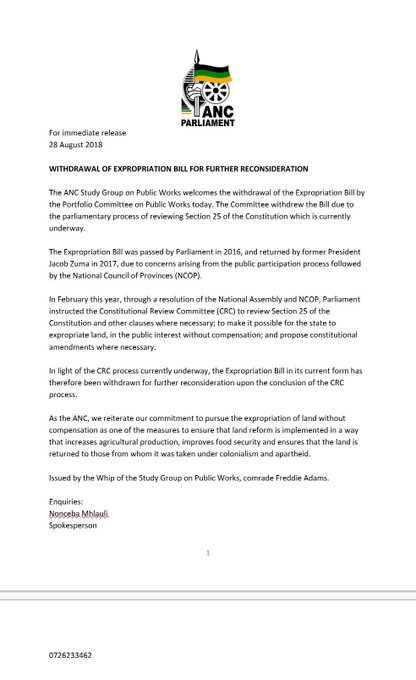
South Africa’s ruling ANC says land expropriation bill withdrawn for further reconsideration

South Africa’s ruling ANC says land expropriation bill withdrawn for further reconsideration

28 August, 2018


A bill allowing the South African government to seize private land without compensation has been withdrawn by the Portfolio Committee on Public Works pending further study, according to the ruling African National Congress.

In 2015, the ANC proposed a constitutional amendment allowing the government to seize and redistribute land without any compensation to its owners. The draft, which has not been adopted so far, evoked widespread international outrage and multiple media reports of alleged violence against white South African farmers, including murders.

The committee’s chairperson, Humphrey Mmemezi, said the bill was referred to parliament on procedural grounds, but they couldn’t duplicate a separate parliamentary process.

If we, as Parliament, resolve to hear the people of South Africa on that important clause, it then goes without question that we must send the bill back to Parliament,” he said, adding the committee had no choice but to withdraw it.

However, the ANC reiterated its commitment to pursue the country’s controversial land reform program. The ruling party wants to redistribute the land confiscated from white farmers to the black citizens of the country. Since the end of apartheid in 1994, the ANC has followed a “willing-seller, willing-buyer” model. Under the plan, the government buys land from white landowners and redistributes it among black citizens of the country. However, the land reform program has not brought the results the ANC wanted.

South African President Cyril Ramaphosa announced this month that his government is enforcing a change in the constitution to allow the expropriation of land without compensation. According to the ANC, the white minority in the country still own most of the land more than two decades after the end of apartheid.


Much of the farmland in South Africa is owned by the country’s white minority, also known as Afrikaners, descendants of Dutch and English settlers. The former British colony instituted a policy of strict racial segregation, known as apartheid, in 1948. It was formally abolished in 1994.

The ANC government denies there is a widespread or systematic campaign to kill or expel white farmers, but maintains that major redistribution is needed to correct the legacy of colonialism. A number of Afrikaners have already emigrated, with as many as 15,000 Boers recently expressing interest in settling in southern Russia.

There has been a reported rise in violent attacks against farmers in South Africa. There were 74 farm murders and 638 attacks, primarily against white farmers, in 2016-17, according to data by minority rights group AfriForum.

The South African officials reportedly seized two farms last week from owners who refused to accept the government-set compensation.