Showing posts with label starvation. Show all posts

Tuesday, 14 November 2017

Millions Face Starvation in Yemen

Millions Face Starvation in Yemen Due to Saudi Arabia’s Blockade

Michael Krieger

13 Movember, 2017


Two years ago, German intelligence warned the world of the unique risks Saudi Arabia posed to the region. I covered it at the time in the post, German Intelligence Warns – Saudi Arabia to Play “Destabilizing Role” in the Middle East

Here’s an excerpt:

Saudi Arabia is at risk of becoming a major destabilizing influence in the Arab world, German intelligence has warned. 
Internal power struggles and the desire to emerge as the leading Arab power threaten to make the key Western ally a source of instability, according to the BND intelligence service. 
The current cautious diplomatic stance of senior members of the Saudi royal family will be replaced by an impulsive intervention policy,” a BND memo widely distributed to the German press reads. 
Saudi Arabia has previously been accused of supplying arms and funding to jihadist groups fighting in Syria, including Islamic State in Iraq and the Levant (Isil).


At the core of this intelligence warning was none other than crown prince Mohamed bin Salman, or MBS. I’ve been warning about the specific dangers presented by his brazen and sociopathic personality for years, and the recent purge finally threw it all into the spotlight for everyone to see.


MBS has already wreaked havoc on portions of the region with his reckless and failed polices with respect to both Yemen and Qatar. Today’s post will focus on the humanitarian catastrophe unfolding in Yemen, courtesy of the Saudi crown prince.
The New York Times reported last week:
Saudi Arabia’s three-day-old blockade of entry points to Yemen threatens to plunge that war-ravaged country into a famine that could starve millions of people, the top relief official of the United Nations said Wednesday.

The Yemen crisis has worsened since the Saudis imposed the blockade on Monday after a missile was fired deep into their territory by the Iran-backed Houthi rebel group, which has been warring with a Saudi-led military coalition for nearly three years.

Despite Saudi Arabia’s assurances that the measure was temporary while it reviews inspection procedures, virtually all humanitarian deliveries to Yemen have been halted, including at least three United Nations airplanes full of emergency supplies. 

Mr. Lowcock said the Saudis must immediately allow the entry of food and medicine at all seaports, permit the immediate resumption of air services to the cities of Sana and Aden, and provide an “assurance of no further disruption to these services.”

Without such steps, he said, Yemen will suffer “the largest famine the world has seen for many decades, with millions of victims.”

The World Food Program, the anti-hunger agency of the United Nations, which has been feeding seven million people a month in Yemen, is now unable to do so, Mr. Lowcock said. “What we need is a winding down of the blockade to save the lives of those people.”
The country is struggling with an acute hunger crisis that has affected at least 17 million people, more than a third of them considered close to famine. Yemen also suffering a cholera scourge that has sickened nearly one million.
Humanitarian supply lines to Yemen must remain open,” said Robert Mardini, the Red Cross’s regional director for the Near and Middle East. “Food, medicine and other essential supplies are critical for the survival of 27 million Yemenis already weakened by a conflict now in its third year.”


Since then, the Saudis have opened the port of Aden and a crossing at Wadea, but this is woefully inadequate.

As Al Jazeera notes:
On Friday, the UN office for the coordination of humanitarian aid, OCHA, said the coalition was still blocking desperately needed UN aid deliveries to Yemen, despite the reopening of Aden and Wadea.
Humanitarian movements into Yemen remain blocked,” said OCHA spokesman Russell Geekie.
The reopening of the port in Aden is not enough. We need to see the blockade of all the ports lifted, especially Hodeida, for both humanitarian and for commercial imports.”
UN aid chief Mark Lowcock told the Security Council this week that unless the blockade is lifted, Yemen will face “the largest famine the world has seen for many decades, with millions of victims”.
Stylianides echoed Lowcock’s concerns.
Yemen “is suffering the world’s worst humanitarian crisis, with more than two-thirds of its population in need of humanitarian assistance”, he said in a statement.
The EU shares the concerns expressed by… Lowcock and calls for full and unrestrained access to be restored immediately, to avoid Yemen suffering the largest famine in decades,” Stylianides said.


What we’re looking at here is potentially the worst famine in decades, and it’s important for decent U.S. citizens from across the political spectrum to admit our government’s hands are soaked in blood.

As The Intercept reported:
Saudi Arabia relies heavily on the U.S. military for intelligence sharing, refueling flights for coalition warplanes, and the transfer of American-made cluster bombs, rockets, and other munitions used against targets in Yemen.
Congress, however, has never authorized U.S. support for the war, which has caused 10,000 civilian deaths and has spiraled in recent months into one of the worst humanitarian crises of the century. For two years, Saudi Arabia and its allies have imposed a sea and air blockade around Yemen. Now, more than 7 million Yemenis face starvation and thousands, mostly children, are dying from cholera. Coalition warplanes have repeatedly struckcrowded marketshospitalspower plants, and other civilian targets.
Several members of Congress indicated an interest in the issue, noting that the Obama and Trump administrations’ reliance on the 2001 Authorization for Use of Military Force to justify U.S. involvement in the conflict is absurd. That authorization, after all, was designed to fight the terrorist groups responsible for the September 11 attacks, not to intervene in Yemen’s civil war.
For 16 years, the executive branch has pointed to the AUMF as legal justification for its involvement in conflicts across the Middle East and Africa, a strategy that is legally questionable. But the use of the AUMF in the Yemeni context is especially bizarre given that the AUMF’s target is Al Qaeda, and the group AQAP — Al Qaeda in the Arabian Peninsula –is fighting alongside the U.S.-Saudi coalition against the Houthi rebels.
One bipartisan legislative attempt to force a vote on authorization for the war, H.Con.Res.81, faced a major setback last week after appearing to gain political momentum. On November 1, lawmakers stripped the bill of its privileged status, meaning the bill no longer maintains a fast-track to a floor vote. The legislation was designed to invoke the War Powers Act of 1973 to terminate U.S. involvement in the Yemen War.
Because the bill is no longer privileged, it will head back to the the House Foreign Affairs Committee, which is led by Rep. Ed Royce, R-Calif., a lawmaker who has expressed deep support for the Saudi-led military campaign. Few expect the legislation to move forward now that it is back in Royce’s domain. In April, the representative read a statement of support for the Saudi-led campaign in Yemen and entered into the congressional record an opinion column written by a Saudi general.
The move to crush H.Con.Res.81 was apparently negotiated by Democratic and Republican leadership. As part of a compromise, there will be some congressional debate over the war, though no on-the-record vote for authorization. As The Intercept previouslyreported, Rep. Steny Hoyer, D-Md., the Democratic whip, was among the Democratic leaders opposed to invoking the War Powers Act to bring U.S. involvement in the war to an end.
Still, sponsors of the legislation are hoping to force a debate and an on-the-record vote over the war.
Our national security interests in Yemen are unclear, yet we are giving money and military assistance to Saudi Arabia so they can continue to wage war in Yemen,” said Rep. Thomas Massie, R-Ky., one of 43 co-sponsors. “This military action was never authorized by Congress and the American people deserve an open debate by their elected officials.”
Rep. Walter Jones, R-N.C., also a co-sponsor of the resolution, expressed frustration that House Speaker Paul Ryan has refused to allow a vote on the war and disappointment that the compromise solution negotiated by congressional leadership will not include a binding vote.
This is part of my frustration about the fact Congress does not meet its constitutional responsibility when sending young men and women to die for this country, and we have a constitutional duty that we must debate war,” Jones said. “The vote to go to war in Yemen, we can’t even get a vote on this resolution. To me this is the way Congress does not work. We don’t work because we do not uphold the constitution.”


Meanwhile, many of the cretins in Congress can’t be bothered to answer questions about Yemen.


Unconstitutional war that could create the worst famine in decades? Meh, I’m too busy trying to figure out how to provide tax breaks to oligarchs.

After all, who cares, there’s just too much money to be made from war.
BERLIN — As U.N. and international humanitarian agencies raise the alarm over the Saudi blockade of aid deliveries to Yemen, European and American officials have remained mostly silent. The few remarks coming out of Western capitals in recent weeks have hardly been messages of support for the Yemenis in the midst of a catastrophic humanitarian crisis — in fact, quite the opposite.
Two weeks ago, Britain’s then-Defense Minister Michael Fallon offered a blunt assessment of the government’s view on the controversy. “I have to repeat, sadly, to this committee that obviously other criticism of Saudi Arabia in this Parliament is not helpful,” Fallon told the parliamentary defense committee, to which he defended the planned sale of several fighter jets to Saudi Arabia. (Fallon has since resigned over sexual harassment allegations.)
In response to a missile attack from Yemeni territory targeting Saudi Arabia — which triggered the most recent escalation of the crisis — President Trump similarly ignored the plight of civilians in the war-torn country and instead went on to praise U.S. weapons sold to Saudi Arabia.
Both the United States and Britain have been making more money with arms sales to Saudi Arabia in recent years than ever before. Human rights critics fear that Saudi Arabia has not only bought their weapons but their acceptance for its policies.
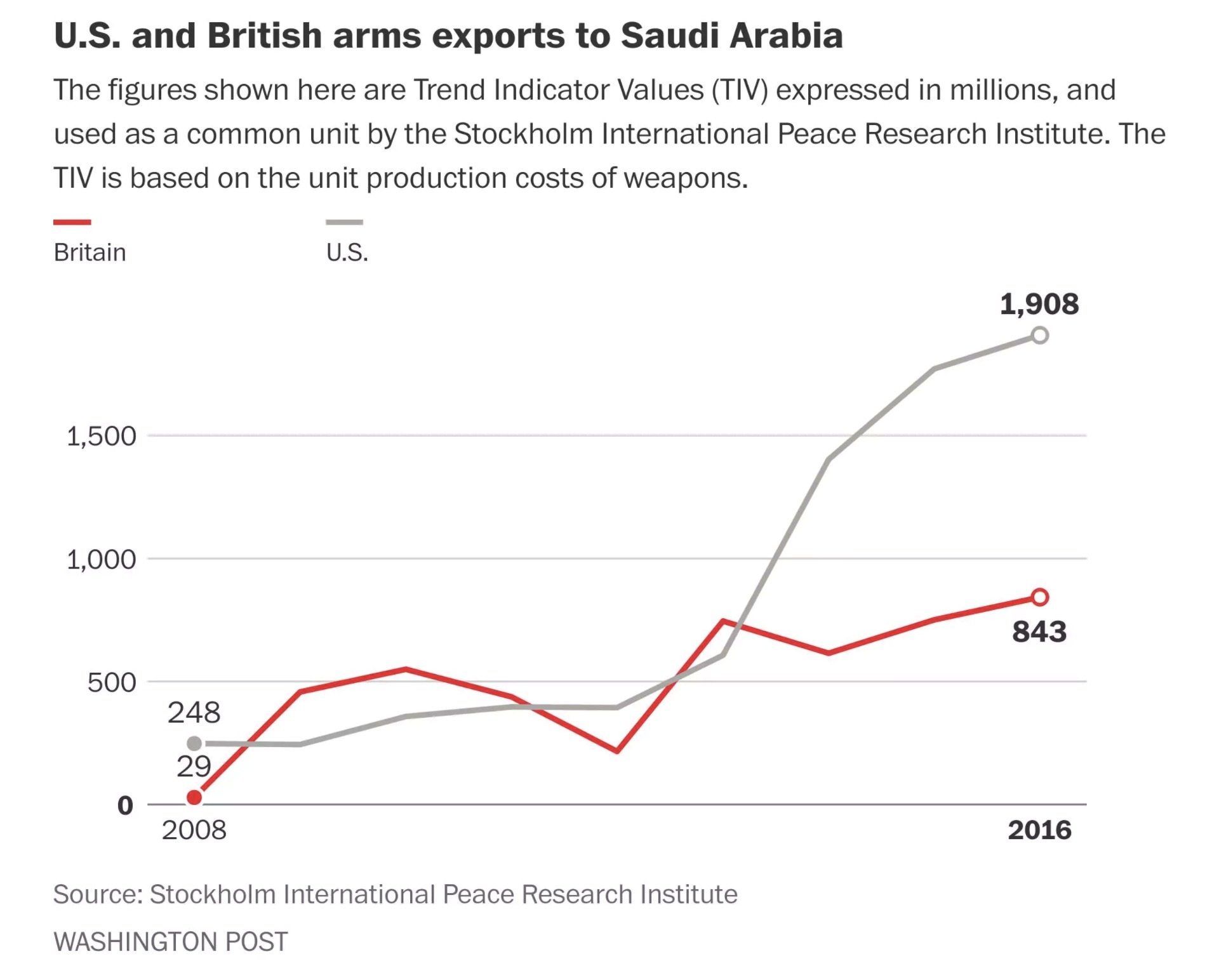
Of course Saudi Arabia’s attractiveness to Western countries is not just about arms sales. On Thursday, Downing Street said it would provide Saudi energy giant Aramco with credit guarantees of $2 billion to facilitate trade between the two countries. Britain and the United States are both trying to persuade Aramco to hold its much anticipated IPO (valued at hundreds of billions of dollars) on the London and New York stock exchanges, with President Trump tweeting that such move would be “Important to the United States!”
In the United States, the Obama administration similarly suspended the sale of precision guided munitions to Riyadh last year. However, the Trump administration is believed to be working on the resumption of such sales. A separate major U.S. arms export deal to the kingdom was struck in May, and Trump has voiced increasingly strong support for the Saudi leadership ever since. Similarly, Germany is still exporting military equipment to the kingdom, although it now appears to be refraining from direct arms deliveries.

If that’s not MAGA, then I don’t know what is.

If E.U. politicians were determined to implement an arms embargo on Saudi Arabia, parliamentarians would have to persuade the governments of all member states to agree to such a ban. With more than a dozen nations profiting from arms and military equipment exports to the kingdom, the chances of such an embargo being implemented anytime soon are virtually nonexistent.

Attempts by nongovernmental organizations to force governments into committing to an embargo enforced by courts have so far also been blocked. Campaigners suffered a major defeat this summer, when London’s high court ruled that Britain was not complicit in alleged war crimes in Yemen by allowing the Saudi military to use its arms.

The court refused to say how it came to its conclusion, however, and barred the public from accessing the key evidence.

It always makes sense when you follow the money.


Friday, 15 March 2013

Global poverty and the banks

Goldman Sachs Made 400 Million Betting On Food Prices In 2012 While Hundreds Of Millions Starved
Michael Snyder


8 March, 2013


Why does it seem like wherever there is human suffering, some giant bank is making money off it?  According to a new report from the World Development Movement, Goldman Sachs made about 400 million dollars betting on food prices last year.  Overall, 2012 was quite a banner year for Goldman Sachs.  As I reported in a previous article, revenues for Goldman increased by about 30 percent in 2012 and the price of Goldman stock has risen by more than 40 percent over the past 12 months.  It is estimated that the average banker at Goldman brought in a pay and bonus package of approximately $396,500 for 2012.  So without a doubt, Goldman Sachs is swimming in money right now.  But what is the price for all of this "success"?  Many claim that the rampant speculation on food prices by the big banks has dramatically increased the global price of food and has caused the suffering of hundreds of millions of poor families around the planet to become much worse.  At this point, global food prices are more than twice as high as they were back in 2003.  Approximately 2 billion people on the planet spend at least half of their incomes on food, and close to a billion people regularly do not have enough food to eat.  Is it moral for Goldman Sachs and other big banks such as Barclays and Morgan Stanley to make hundreds of millions of dollars betting on the price of food if that is going to drive up global food prices and make it harder for poor families all over the world to feed themselves?
This is another reason why the derivatives bubble is so bad for the world economy.  Goldman Sachs and other big banks are treating the global food supply as if it was some kind of a casino game.  This kind of reckless activity was greatly condemned by the World Development Movement report...

"Goldman Sachs is the global leader in a trade that is driving food prices up while nearly a billion people are hungry. The bank lobbied for the financial deregulation that made it possible to pour billions into the commodity derivative markets, created the necessary financial instruments, and is now raking in the profits. Speculation is fuelling volatility and food price spikes, hurting people who struggle to afford food across the world."
So shouldn't there be a law against this kind of a thing?
Well, in the United States there actually is, but the law has been blocked by the big Wall Street banks and their very highly paid lawyers.  The following is another excerpt from the report...
"The US has passed legislation to limit speculation, but the controls have not been implemented due to a legal challenge from Wall Street spearheaded by the International Swaps and Derivatives Association, of which Goldman Sachs is a leading member. Similar legislation is on the table at the EU, but the UK government has so far opposed effective controls. Goldman Sachs has lobbied against controls in both the US and the EU."
Posted below is a chart that shows what this kind of activity has done to commodity prices over the past couple of decades.  You will notice that commodity prices were fairly stable in the 1990s, but since the year 2000 they have been extremely volatile...
Commodity PricesThe reason for all of this volatility was explained in an excellent article by Frederick Kaufman...
The money tells the story. Since the bursting of the tech bubble in 2000, there has been a 50-fold increase in dollars invested in commodity index funds. To put the phenomenon in real terms: In 2003, the commodities futures market still totaled a sleepy $13 billion. But when the global financial crisis sent investors running scared in early 2008, and as dollars, pounds, and euros evaded investor confidence, commodities -- including food -- seemed like the last, best place for hedge, pension, and sovereign wealth funds to park their cash. "You had people who had no clue what commodities were all about suddenly buying commodities," an analyst from the United States Department of Agriculture told me. In the first 55 days of 2008, speculators poured $55 billion into commodity markets, and by July, $318 billion was roiling the markets. Food inflation has remained steady since.
The money flowed, and the bankers were ready with a sparkling new casino of food derivatives. Spearheaded by oil and gas prices (the dominant commodities of the index funds) the new investment products ignited the markets of all the other indexed commodities, which led to a problem familiar to those versed in the history of tulips, dot-coms, and cheap real estate: a food bubble. Hard red spring wheat, which usually trades in the $4 to $6 dollar range per 60-pound bushel, broke all previous records as the futures contract climbed into the teens and kept on going until it topped $25. And so, from 2005 to 2008, the worldwide price of food rose 80 percent --and has kept rising.
Are you angry yet?
You should be.
Poor families all over the planet are suffering so that Wall Street bankers can make bigger profits.
It's disgusting.
Many big financial institutions just seem to love to make money on the backs of the poor.  I have previously reported on how JP Morgan makes billions of dollars issuing food stamp cards in the United States.  When the number of Americans on food stamps goes up, so does the amount of money that JP Morgan makes.  You can read much more about all of this right here: "Making Money On Poverty: JP Morgan Makes Bigger Profits When The Number Of Americans On Food Stamps Goes Up".
Sadly, the global food supply is getting tighter with each passing day, and things are looking rather ominous for the years ahead.
According to the United Nations, global food reserves have reached their lowest level in nearly 40 years.  Global food reserves have not been this low since 1974, but the population of the world has greatly increased since then.  If 2013 is another year of drought and bad harvests, things could spiral out of control rather quickly...
World grain reserves are so dangerously low that severe weather in the United States or other food-exporting countries could trigger a major hunger crisis next year, the United Nations has warned.
Failing harvests in the US, Ukraine and other countries this year have eroded reserves to their lowest level since 1974. The US, which has experienced record heatwaves and droughts in 2012, now holds in reserve a historically low 6.5% of the maize that it expects to consume in the next year, says the UN.
"We've not been producing as much as we are consuming. That is why stocks are being run down. Supplies are now very tight across the world and reserves are at a very low level, leaving no room for unexpected events next year," said Abdolreza Abbassian, a senior economist with the UN Food and Agriculture Organisation (FAO).
The world has barely been able to feed itself for some time now.  In fact, we have consumed more food than we have produced for 6 of the last 11 years...
Evan Fraser, author of Empires of Food and a geography lecturer at Guelph University in Ontario, Canada, says: "For six of the last 11 years the world has consumed more food than it has grown. We do not have any buffer and are running down reserves. Our stocks are very low and if we have a dry winter and a poor rice harvest we could see a major food crisis across the board."
"Even if things do not boil over this year, by next summer we'll have used up this buffer and consumers in the poorer parts of the world will once again be exposed to the effects of anything that hurts production."
We desperately need a good growing season next summer, and all eyes are on the United States.  The U.S. exports more food than anyone else does, and last summer the United States experienced the worst drought that it had seen in about 50 years.  That drought left deep scars all over the country.  The following is from a recent Rolling Stone article...
In 2012, more than 9 million acres went up in flames in this country. Only dredging and some eleventh-hour rain kept the mighty Mississippi River from being shut down to navigation due to low water levels; continuing drought conditions make "long-term stabilization" of river levels unlikely in the near future. Several of the Great Lakes are soon expected to hit their lowest levels in history. In Nebraska last summer, a 100-mile stretch of the Platte River simply dried up. Drought led the USDA to declare federal disaster areas in 2,245 counties in 39 states last year, and the federal government will likely have to pay tens of billions for crop insurance and lost crops. As ranchers became increasingly desperate to feed their livestock, "hay rustling" and other agricultural crimes rose.
Ranchers were hit particularly hard.  Because they couldn't feed their herds, many ranchers slaughtered a tremendous number of animals.  As a result, the U.S. cattle herd is now sitting at a 60 year low.
What do you think that is going to do to meat prices over the next few years?
Meanwhile, the drought continues.  According to the U.S. Drought Monitor, this is one of the worst winter droughts the U.S. has ever seen.  At this point, more than 60 percent of the entire nation is currently experiencing drought.
If things don't turn around dramatically, 2013 could be an absolutely nightmarish year for crops in the United States.  If 2013 does turn out to be another bad year, food prices would soar both in the U.S. and on the global level.  The following is from a recent CNBC article...
The severe drought that swept through much of the U.S. last year is continuing into 2013, threatening to cripple economic growth while forcing consumers to pay higher food prices.
"The drought will have a significant impact on prices, especially beef, pork and chicken," said Ernie Gross, an economic professor at Creighton University and who studies farming issues.
So let us hope for the best, but let us also prepare for the worst.
It looks like higher food prices are on the way, and millions of poor families all over the planet will be hard-pressed to feed their families.
Meanwhile, Goldman Sachs will be laughing all the way to the bank.

Sunday, 30 December 2012

Child malnutrition in Yemen


The US will continue to make its own contribution to killing Yemeni children with its drone attacks.

Food shortage threatens to kill thousands of Yemeni children
For decades Yemen has suffered critical food shortage affecting nearly half the country’s population of 25 million, including hundreds of thousands of children.


17 December, 2012


A popular uprising against a decades-old dictatorship and the consequent instability further damaged the country’s already poor infrastructure and weakened the government’s ability to provide basic services to the poor.

About 60 percent of Yemeni children were chronically malnourished and about 15 percent – 257 thousand children under the age of five – suffer from acute malnourishment, according to a report by UNICEF Yemen. At least 700,000 are reportedly suffering from Moderate Acute Malnutrition (MAM).

Jeremy Hopkins, acting Head of Office UNICEF Yemen, said Yemeni children suffer the second highest rate of chronic malnutrition in the world.

Malnutrition

Yemen is faced with two types of crises: acute malnutrition and chronic malnutrition, Hopkins explained.

Chronic malnutrition is “a huge challenge for Yemen ever since we have been able to collect data on it,” he added.

Hopkins said there are critical long-term outcomes to children diagnosed with chronicle malnourished.

A child who is chronically malnourished will suffer lifelong problems and physical challenges. He or she will not reach full development.”

In June 2012, UNICEF in Yemen reported that approximately 10 million people throughout the country lack access to food security, with nearly a million children suffering from acute malnutrition.

We have been collecting a lot of data which now tell us that there is approximately 1 million acutely malnourished children, of whom about a quarter are severely acutely malnourished.

Severely acutely malnourished child is nine times more likely to die from some (complicating factor) like diabetes, diarrhea, measles,” Hopkins said.

He explained that a child with acute malnutrition would be “extremely thin, frail, and likely to die if no interventions” were to take place.

Lack of food and sanitary water

According to data gathered by UNICEF, half of the severely acutely malnourished children suffer from diarrhea as a result of “not washing [their] hands after going to the toilet” accompanied by other unhealthy hygiene practices.

Poor food products may also lead a child to become vulnerable to acute or chronicle malnourishment.

This may happen if a mother doesn’t feed her child for the first six months following birth as "the child is highly likely to suffer,” said Hopkins.

Food prices are increasing in Yemen making it difficult for families to feed their children, increasing the rate of possible malnutrition. Citizens are finding it difficult to have access to social services to provide to their children such as water, health and vegetation.

Rapid intervention

A child who suffers from acute malnutrition requires “rapid intervention” clinically and needs food supplements which are provided by UNICEF through the government.

Government and NGO partners are working together to insure raising the awareness to families on the seriousness and leading causes of malnutrition and how to prevent it.

In May, Gulf Arab states and the West have pledged more than $4 billion in aid to the impoverished state. More than $3.25 billion was provided by Saudi Arabia alone.

UNICEF along with other humanitarian partners continue to advocate for the government to assume full responsibility in the implementation of the action plans associated with the recently approved national food security, nutrition, and several other nutrition-related development and humanitarian strategies.

Wednesday, 7 November 2012

Earth changes


-->
Weatherwatch: Extreme weather dwarfed by impact of volcanic eruption
Paul Brown


4 November, 2012

A drop in crop yields in the UK and many other grain producing countries, as a result of extreme weather, has increased prices worldwide, and may cause serious hardship. But these consequences would be dwarfed by the catastrophe that a volcano could unleash on a heavily populated planet.

Evidence unearthed in London's Spitalfields of mass graves, dated to 1258, shows that between 20 and 40 bodies were buried at once in a series of pits in the cemetery. There were both sexes, with adults and children together. They are believed to be famine victims because they had no battle injuries and it was a century before the Black Death.

The same year the monk Matthew Paris of St Albans recorded "unendurable cold" in the winter that suspended all cultivation and killed calves. In June spring had still not arrived and wheat was so scarce that "a very large number of poor people died."

Contemporary chroniclers in other continents also record appalling weather and mass starvation. Geologists have found that over both hemispheres, as far south as Antarctica, there is a thick layer of volcanic ash from the same period. The sheer quantity of aerosols projected into the atmosphere would have blotted out the sun and wiped out crops. The volcano responsible for this devastation and mass starvation is not known, but 850 years is a short gap in geological time. Somewhere this monster is dormant and could erupt again.


-->
Ancient Supervolcano Affected the Ends of the Earth


5 November, 2012

About 74,000 years ago, the Toba volcano on the Indonesian island of Sumatra erupted with catastrophic force. Estimated to be 5,000 times larger than the 1980 eruption of Mount St. Helens, it is believed to be the largest volcanic event on Earth in the last 2 million years.

Toba spewed enough lava to build two Mount Everests, it produced huge clouds of ash that blocked sunlight for years, and it the left behind a crater 31 miles (50 kilometers) across. The volcano even sent enough sulphuric acid into the atmosphere to create acid rain downpours in the Earth's polar regions, which researchers have found evidence of in deep ice cores.

"We have now traced this acid rain in the ice caps on Greenland and Antarctica," glaciologist Anders Svensson, of the Niels Bohr Institute at the University of Copenhagen, said in a statement.

"We have long had an idea of at what depth the Toba eruption could be found in the Greenland ice cap, but we found no ash, so we could not be sure," Svensson added. "But now we have found the same series of acid layers from Toba in the Greenland ice sheet and in the ice cap in Antarctica. We have counted the annual layers between acid peaks in ice cores from the two ice caps and it fits together."

The ice cores could offer more evidence about how the changed Earth's climate was drastically changed in the years after the colossal eruption. Researchers had previously estimated that such an event would have prompted a cooling of up to 10 degrees C (18 degrees F) in the global temperature for decades, but the ice cores show the cooling was probably short and not consistent across the globe.

"In the temperature curves from the ice cores we can see that there is no general global cooling as a result of the eruption," Svensson said. "There is certainly a cooling and large fluctuations in temperature in the Northern Hemisphere, but it becomes warmer in the Southern Hemisphere, so the global cooling has been short."

The new evidence also promises to settle some archaeological debates. The Toba eruption occurred at a critical point in early human history when Homo sapiens were first venturing out of Africa into Asia. However, there is wide disagreement about how early human were affected and whether large parts of the population were wiped out by the blast.

Layers of ash from the Toba eruption have been found in Asia and serve as a very important reference horizon for ancient archaeological clues from this period that are too old to be carbon dated. The ice cores now provide another backdrop against which to place ancient finds.

"The new precise location of the Toba eruption in the ice cores will place the archaeological finds in a climatic context, which will help to shed light on this critical period of human history," Svensson said.

The study is detailed in the journal Climate of the Past.