Showing posts with label sinkholes. Show all posts

Friday, 17 June 2016

Giant sinkholes in Texas on verge of catastrophic collapse

Texas: Giant unstable sinkholes are growing, could be on verge of catastrophic collapse


15 June, 2016

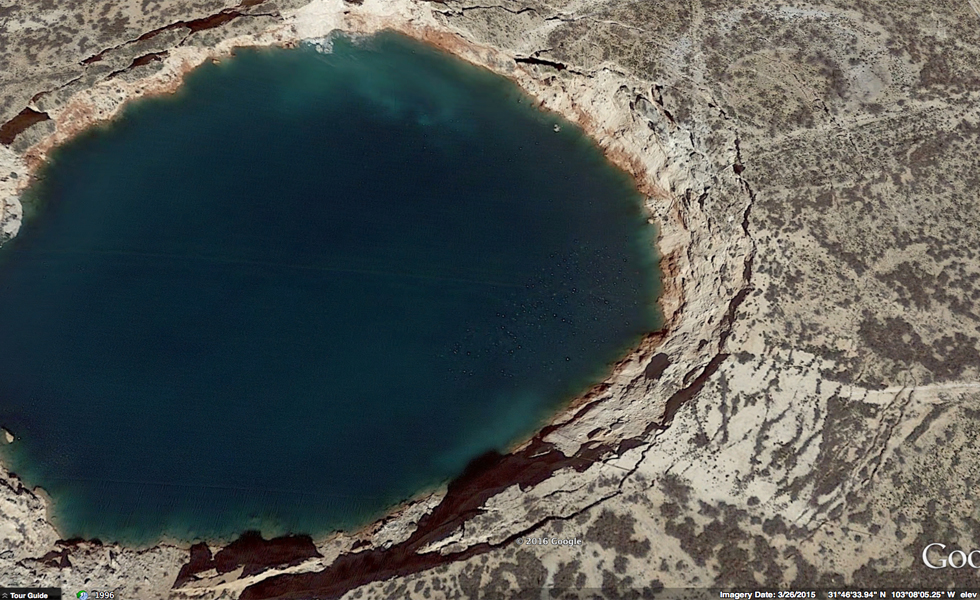
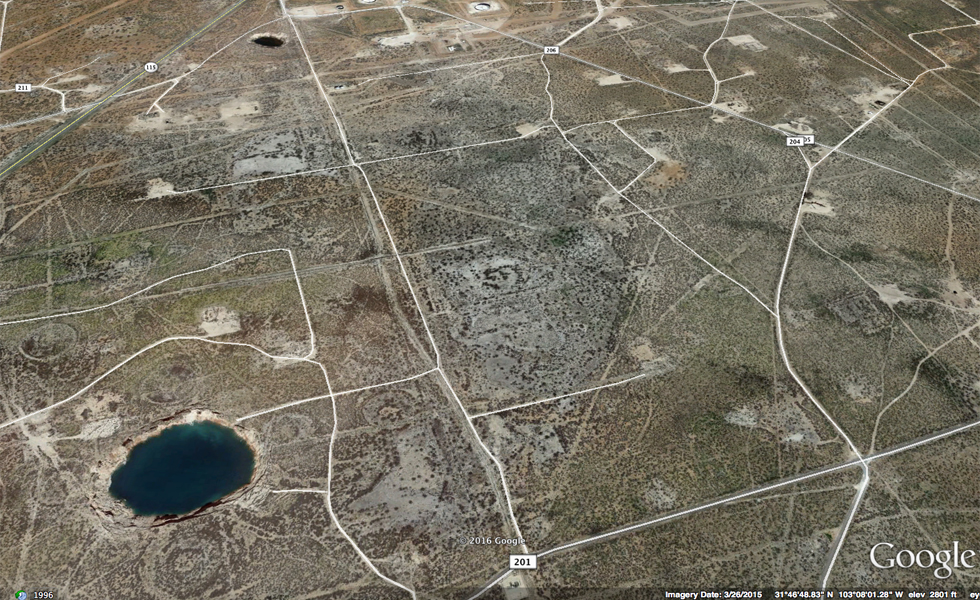
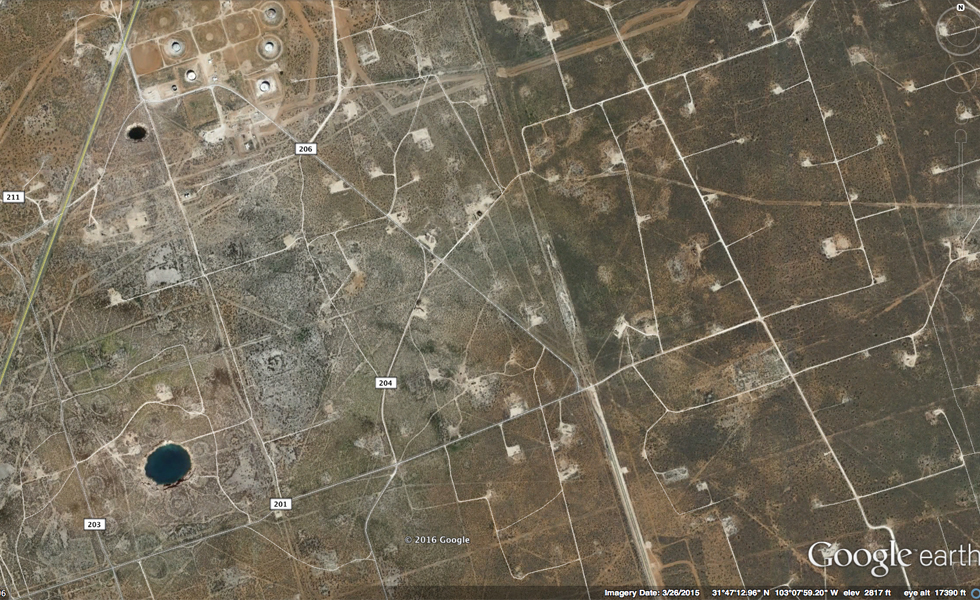
Two giant sinkholes in Texas are getting bigger and are at risk of collapsing – the effects of which could be "catastrophic", scientists have warned. The sinkholes, found in the towns of Wink and Kermit, have been observed via satellite, and images indicate major changes could be underway.

The two sinkholes are currently a mile apart. The first one – Wink 1 - appeared in 1980, while the second – Wink 2 – opened up in 2002. They were caused by intense gas and oil extraction in the region from the 1920s to the 1960s. Wink 1 is currently 110m across, while Wink 2 can reach up to 270m.

Researchers from the Southern Methodist University in Dallas have now carried out a study on the sinkholes using satellite radar remote sensing. Publishing their findings in the journal Remote Sensing, the team found the sinkholes are unstable as a result of changing groundwater levels and minerals being dissolved.

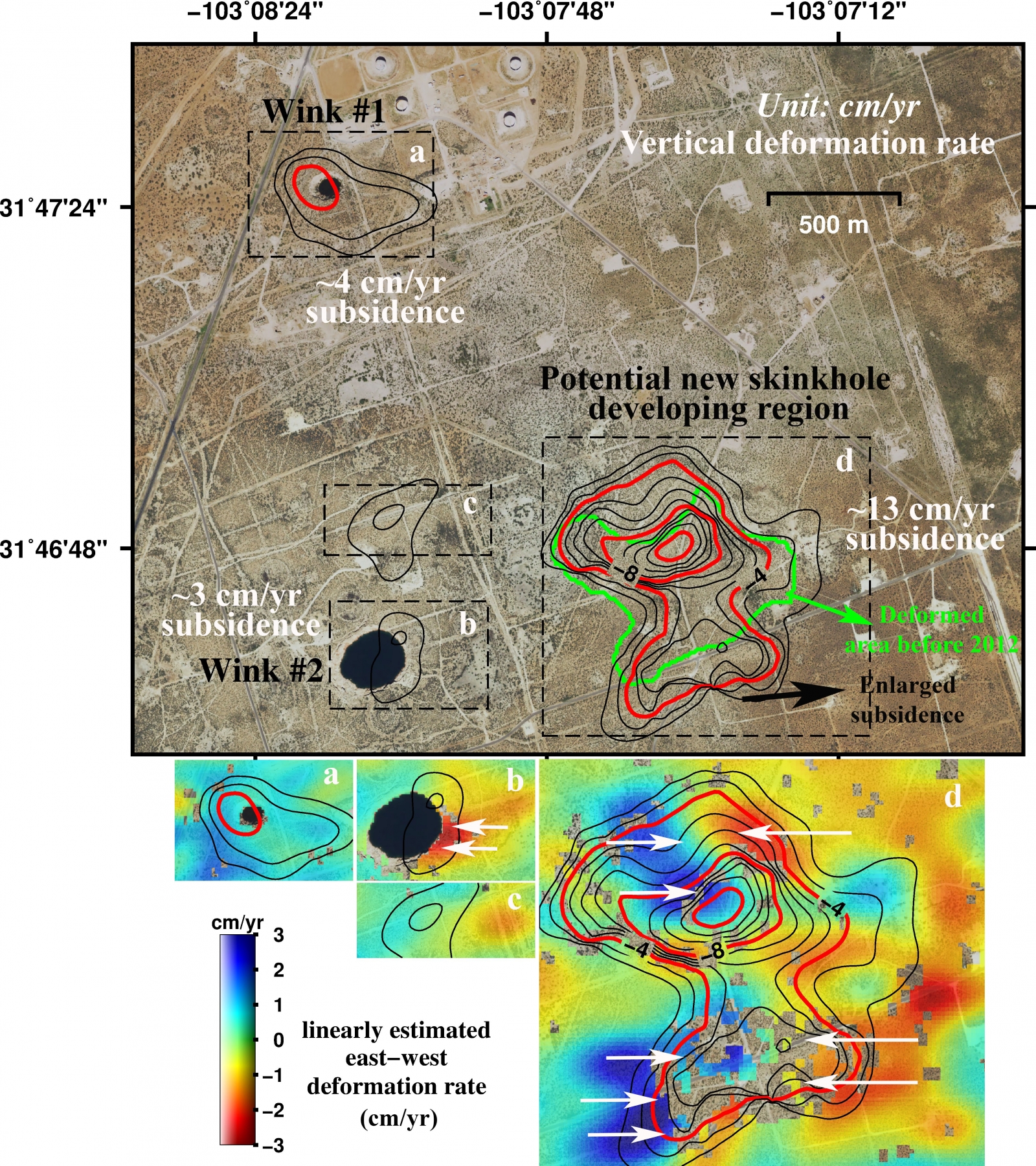
The team also found large areas of subsidence around the sinkholes, indicating more could appear in the future, or that they could collapse into one massive sinkhole. Jin-Woo Kim, one of the study authors, said: "This area is heavily populated with oil and gas production equipment and installations, hazardous liquid pipelines, as well as two communities. The intrusion of freshwater to underground can dissolve the interbedded salt layers and accelerate the sinkhole collapse. A collapse could be catastrophic."

The town of Kermit, which is close to the most unstable of the two sinkhole, has a population of around 6,000. Wink meanwhile has 940 residents. The area also has active oil fields. "A sinkhole collapse can be severe under natural conditions, but it could be catastrophic in urban settings or at oil/gas exploration facilities," the scientists wrote.
texas giant sinkhole

Measurements from satellite radar images of two giant West Texas sinkholes (dark black areas) shows the ground around them is sinking, including indications a potential new sinkhole is developing.Southern Methodist University
The satellite images show that when groundwater levels rise, the ground lifts up. The groundwater then increases the rate at which the salts are being dissolved, which then in turn causes the surface to subside. Both holes are getting bigger, while areas connected to the sinkholes are also showing signs of deformation – something the authors say could be an "alarming precursor" to future hazards.
"Sinkhole formation has previously been unpredictable, but satellite remote sensing provides a great means to detect the expansion of the current sinkholes and possible development of new sinkholes," Kim said . "Monitoring the sinkholes and modelling the rate of change can help predict potential sinkhole development... Following our study, we are collecting more high-resolution satellite data over the sinkholes and neighbouring regions to monitor further development and collapse."
"giant sinkhole texasclass="credit" itemprop="copyrightHolder" style="padding: 0px; margin: 0px; font-size: 12px; color: rgb(153, 153, 153);"Southern Methodist University
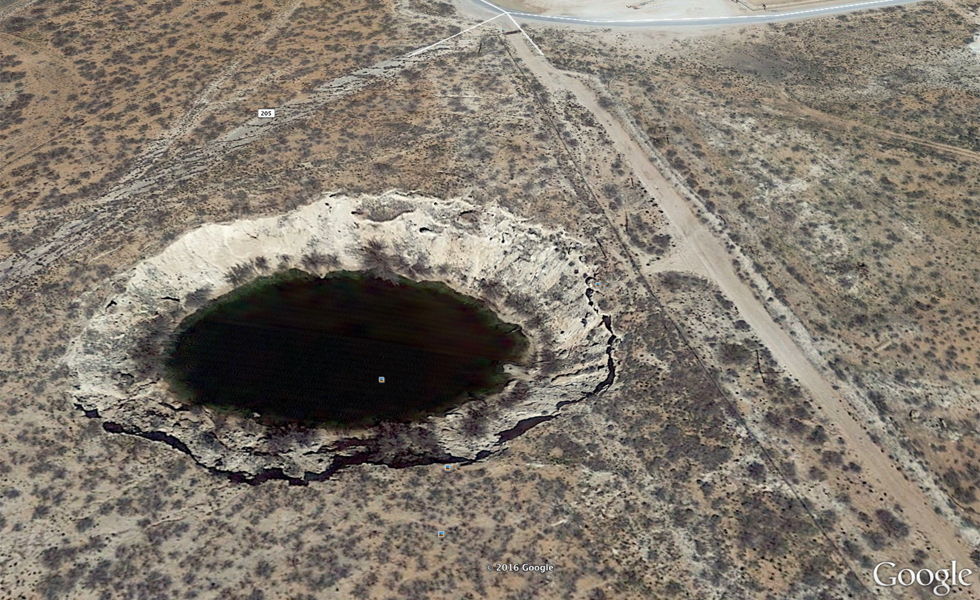
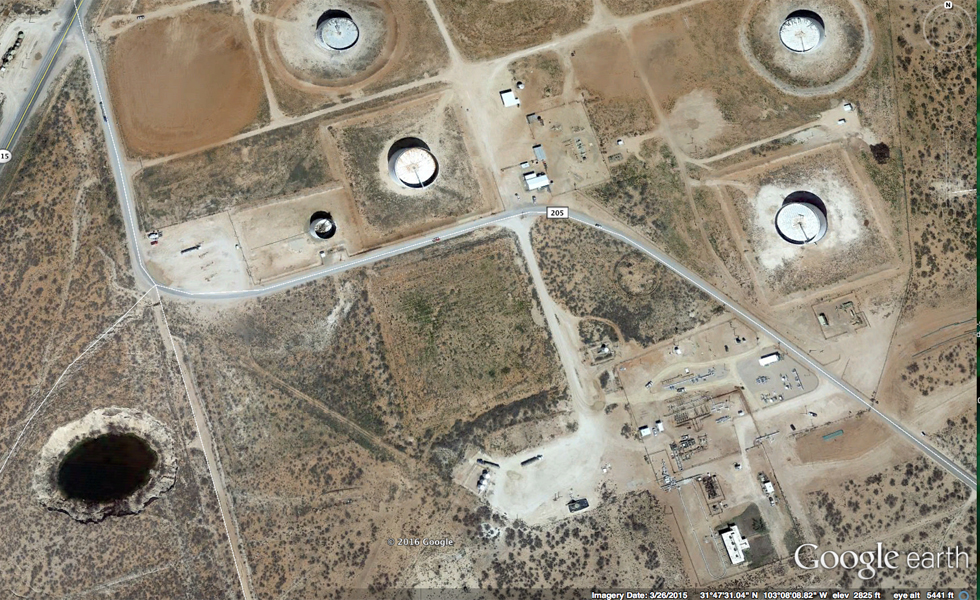
giant sinkhole texas

giant sinkhole texasWink 2  Southern Methodist University

giant sinkhole texas

giant sinkhole texas


Sunday, 22 March 2015

Nature's Revenge: Sinkholes in the Dead Sea

Nature’s revenge’: Dead Sea surrounded by 3,000+ sinkholes growing at alarming rate
Hundreds of sinkholes are forming each year around the drying Dead Sea that could face being completely parched by 2050. Its basin shrinks by a meter per year due to severe water mismanagement.


A sinkhole filled with water is seen on the southern shores of the Dead Sea (Reuters)

RT,
21 March, 2015


It’s nature's revenge,” Gidon Bromberg, the Israeli Director at EcoPeace Middle East, told ABC. EcoPeace unites environmental activists

These sinkholes are a direct result of the inappropriate mismanagement of water resources in the region,” said Bromberg, who believes that the total number of sinkholes has grown to over 3,000. Just ten years ago roughly 1,000 sinkholes had been reported, according to Smithsonian magazine.

Dead Sea sinkholes growing at alarming rate http://dlvr.it/93gRfb 

The Dead Sea, actually a lake, has existed in its present form, after splitting off from a larger water mass for the past 18,000 years. But since the 1950s Israel and Jordan have diverted the flow of the Jordan River, turning a once powerful flow into a trickle, full of sediment.

As a result, the Dead Sea is 800 million cubic meters short of water each year, and its level has fallen for 40 meters. As it recedes, it leaves behind salty deposits. While initially, these are firm, over the following years, the salt is dissolved, by rain, groundwater and river flows, creating a cavity underneath the ground.

These cavities can collapse any time, creating a deadly sinkholes. Several sinkholes can merge together, producing giant, gaping craters.

Sink holes like this one at Mineral Beach beside the Dead Sea on the West Bank are becoming more common

While no official statistics are kept about the deaths and injuries caused by them, there are hundreds of warning signs dotted around the edge of the water.

Last month Jordan and Israel signed a ground-breaking $900 million deal that will see a desalination plant built on the edge of the see, which will have water pumped into it via a canal from the Red Sea. Unfortunately, the costly project, approved by the World Bank is unlikely to significantly curb the deterioration, as it will only pump 100 million cubic meters of wastewater into the Dead Sea.

This sink hole beside the Dead Sea, caused by collapsing alt deposits left by the lake, has filled with water

See also - 

Sinkholes threaten banks of Dead Sea: Thousands of pits open up as salt lake dries up due to overuse of water

  • Environmental group estimates there are 3,000 sinkholes beside Dead Sea
  • It claim that new sink holes are on the banks appearing almost every day 
  • They say the lake is being over exploited causing it to drop by 4 feet a year
  • Fresh water is being drawn into salt pockets left behind by receding lake
  • This dissolves the underground salt, causing the earth above to collapse 
The salt formations, seen in the aerial view above, are left behind as the mineral rich water evaporates away

Monday, 24 February 2014

Sinkholes

Sinkholes on the increase after UK's wet winter
Geologists say sinkholes are still rare and trying to predict where they might occur is futile


22 February, 2014


As if flooded homes and disrupted power supplies have not created enough misery, Britain's wettest winter on record has created perfect conditions for sinkholes, 10 of which have been reported this month. Cars, roads and bits of homes have tumbled into the voids created after the ground collapses into subterranean cavities.

Sinkholes have occurred at between five and 10 times the normal rate in February, said Tony Waltham, an expert on the phenomenon. He said the increase was unsurprising after three unusually wet months. "It is exactly as extraordinary as this being the wettest winter on record. It is a direct correlation with rainfall," he said.

Too much water can cause soluble rocks such as gypsum and chalk to dissolve and erode, creating underground shafts. But too little water can also be a cause. If ground water is removed through abstraction or prolonged drought, underground rocks can crumble under the pressure from above.

Sinkholes can occur slowly or suddenly, depending on the material that coats the surface. Sand will subside along with the material beneath, meaning a gradual sinking. But a more robust material such as clay can hold together for much longer, leaving a chasm beneath.

This month the Met Office predicted that climate change would manifest in Britain as larger, wetter and more frequent storms. Geologists say that would lead to more sinkholes. "What climate change is likely to do is to increase the extremities of the weather," said Waltham. "You get more big storms, you get more big sinkholes."

Alan Cripps, from the Royal Institute of Chartered Surveyors, said assessing properties for underground cavities was prohibitively expensive for most homeowners and not a common surveying practice.

Tony Cooper, from the British Geological Survey, said sinkholes were still very rare and predicting them was futile. "It is impossible to comment on where a sinkhole will appear next, it will most likely depend on where the next heavy rain events occur.

"To put them in perspective, just consider how many houses recently have been affected by sinkholes, how many have been flooded and how many have been storm-damaged. You will see that sinkholes are not the big problem that has to be dealt with, but they are more unusual."

Nigel Cassidy, a geologist at Keele University, said recent flooding showed that the UK's infrastructure was not coping with the runoff from storms. "We don't manage our storm drainage properly, from a flooding point of view. One of the implications of not having that is the higher risk of sinkholes in urban areas." He said government deregulation of development could exacerbate the problem.

About 15% of the UK's bedrock is soluble limestone, found mostly in the south-east where the majority of the recent sinkholes have occurred. Underground hollows can be created naturally by the erosion of rock over thousands of years. Large holes in Hemel Hempstead and Croxley Green in Hertfordshire were probably the result of this type of erosion or a historic chalk mineshaft.

Highly soluble gypsum also occurs in small pockets, including beneath Ripon in North Yorkshire where a sinkhole destroyed a house this week. The erosion of gypsum takes place on a timescale of tens of years, as opposed to thousands of years for limestone.


Saturday, 21 September 2013

The Dead Sea


Dead Sea being eaten by sinkholes: huge chasms appearing in the region at a rate of one per day
  • The Dead Sea is drying up at a rate of one meter per year causing sinkholes
  • There are now over 3,000 sinkholes around the Dead Sea on the Israeli side
  • This compares to 40 in 1990, with the first sinkhole appearing in the 1980s


18 September, 2013

The Dead Sea is drying up at an incredible rate leaving huge chasms of empty space in its wake.

These chasms appear in the form of large, devastating sinkholes and are increasing in number throughout the region. 

Experts claim they are now forming at a rate of nearly one a day, but have no way of knowing when or how they will show up. 

Dead Sea E
The Dead Sea is drying up at an incredible rate leaving huge chasms of empty space in its wake


Estimates by Moment magazine suggest that, on the Israeli side alone, there are now over 3,000 sinkholes around the Dead Sea.

This compares to just 40 counted in 1990, with the first sinkhole appearing in the 1980s. 

The Dead Sea spans more than 60 miles through Israel, the West Bank, and Jordan. 

Its waters are 10 times saltier than the northern Atlantic Ocean because it has no outlet. This means that any minerals that flow there, stay there.

Dead Sea
The Dead Sea spans more than 60 miles through Israel, the West Bank, and Jordan. Its waters are 10 times saltier than the northern Atlantic Ocean because it has no outlet. This means that any minerals that flow there, stay there

Dead Sea
An aerial view shows a close up of a salt formation inside a large sinkhole on the shores of the Dead Sea. The increase in sinkholes is directly related to the Dead Sea drying up at a rate of one meter per year

The increase in sinkholes is directly related to the Dead Sea drying up at a rate of one meter per year.


Sinkholes are basically bowl-shaped features that form when an empty space under the ground creates a depression. 

The depression is the result of a reaction between freshwater and salt buried in a subterranean level beneath the surface.

When the freshwater dissolves the salt, it creates a void, causing the landscape around and above it to suddenly collapse.

Over the last few decades, increasing numbers of people have been drawn to the Dead Sea causing its salt water to dry up.

This leaves more fresh water in the area to dissolve the salt and create more cavities.

Dead Sea
Sinkholes pock-mark the emerging shoreline of the Dead Sea near Ein Gedi. The sinkholes are caused by fresh groundwater dissolving subterranean salt deposits that once formed the bottom of the Dead Sea

Dead Sea
To bring the world's attention to Dead Sea's plight artist Spencer Tunick shot the first mass nude shoot in the Dead Sea in 2011


One solution being presented by the World Bank is to create a canal linking the Dead Sea to either the Red Sea. 

But environmentalists warn that doing this could spell the end for the Dead Sea.

Experts believe more needs to be done to highlight the plight of the Dead Sea and come up with a solution.

For instance to bring the world's attention to the challenge artist Spencer Tunick shot the first mass nude shoot in the Dead Sea in 2011.

Human intervention has just about killed the Dead Sea,’ Alon Tal, professor in the Department of Desert Ecology at Ben-Gurion University of the Negev, told Moment magazine.

It will take extraordinary human measures—careful, wise intervention and positive regional cooperation—to save it.’ 

Dead Sea
Estimates suggest that, on the Israeli side alone, there are now over 3,000 sinkholes around the Dead Sea


Wednesday, 4 September 2013

Extreme weather


Another edition of climate calamity

 Signs Of Change The Past Week Or So August 2013
Part 3


Saturday, 17 August 2013

Sinkholes

How sinkholes are swallowing streets around the world - in pictures


15 August, 2013


It seems like stuff of Hollywood films – the ground opens up and swallows whole buildings, cars, roads and even people. But that is exactly what happened on Monday when a sinkhole 100ft wide opened up in Florida, causing the Summer Bay Resort ay Clermont, near Disney World, to collapse into the pit.


A sinkhole typically occurs naturally in the Earth’s surface. In Florida, much of the land straddles limestone caverns that are weakened by water erosion, sometimes causing them to cave in. The phenomenon is not uncommon, as this worldwide selection shows. For example, in 2007, a sinkhole 150m deep and 20m wide swallowed 20 homes in Guatemala City. In 2011, a huge sinkhole appeared overnight on a road in Beijing, swallowing a truck just after its driver and passenger escaped – though that was believed to have been caused by the digging of a tunnel for an underground railway.


But natural sinkholes are particularly common in Florida, where insurance claims for sinkhole damages submitted between 2006 and 2010 totalled $1.4bn (£900m). Florida and Tennessee are the only two US states which offer insurance to protect and cover home owners for sinkholes. Despite being very destructive, sinkholes rarely kill.


 A sinkhole in Guatemala City, in February 2007

 A car after being sucked into a sinkhole in Toledo, Ohio, in July

The huge crater at the collapsed Pinheiros subway station in Sao Paulo, Brazil,


Thursday, 15 August 2013

Extreme weather events

Signs Of Change The Past Week Or So August 2013 
- Part 1


The first 10 days of August has been both strange and extreme with some dramatic and intense moments. 


Monday, 13 May 2013

More sinkholes in California

Volcano? California homes sinking one by one in now abandon subdivision near volcanic field


12 May, 2013

Homes are sinking  in a California subdivision built on top of volcanic country. Eight homes have been abandoned so far and 10 more are under an imminent evacuation notice after cracks appeared in the ground and entire sections dropped 10 feet into the ground.

A Tudor-style house was a long-time dream of Scott and Robin Spivey, who lived in the Lake County neighborhood for 11 years.

But the Spiveys were forced to evacuate when cracks began appearing in their walls in March. The small cracks turned into gaping fractures, which culminated in their 600-square-foot garage dropping 10 feet below the street.

It didn’t take much longer for the houses on both sides of the Spiveys’ dream house to collapse as well. Scott Spivey, a former building inspector, stated, “We want to know what is going on here.”

Randall Fitzgerald, a writer who bought his home in Lakeside Heights a year ago, added, “It’s a slow-motion disaster.” Frustrated homeowners have been forced to watch as a hilltop with sweeping views of Clear Lake and the Mount Konocti volcano slowly swallows the subdivision.

The California homes that are sinking were built 30 years ago. The movement is different than the sinkholes in Florida, which have been known to swallow entire homes in an instant. Rather, this collapse can move several feet in one day, then just centimeters the next.

County public works director Scott De Leon added that the sinking homes are confusing to more than just the homeowners. He added, “We have a dormant volcano, and I’m certain a lot of things that happen here are a result of that, but we don’t know about this.”

Some of the subdivision movement is happening on shallow fill, according to De Leon. However, a geologist has warned that the ground could be compromised down to bedrock, which rests 25 feet below the surface. Cracks have also appeared recently in roads well beyond the shallow fill.

In a bid for answers to stop the California homes from sinking further, officials have inspected the development’s original plans. But they have found nothing to account for the problem. Tom Ruppenthal, a consultant from Utility Services Associates in Seattle, suggested that groundwater may have shifted course.

The homes that have already sunk have been tagged for mandatory removal. But the hillside is so unstable, it can’t support the equipment needed to complete the job.


Saturday, 11 May 2013

Bayou Corne sinkhole


Footage of breach at giant Louisiana sinkhole — Water rushing through gaping hole (VIDEO)


10 May, 2013

Texas Brine’s western berm encountered five breaches overnight. Two breaches have been repaired, one breach is small and has not been repaired yet and two larger breaches continue to fill the sinkhole and containment area. Texas Brine has indicated that repairs will occur once water levels have stabilized


May 10, 2013 footage of breached berm at the giant sinkhole in Assumption Parish, LA:


.

Saturday, 20 April 2013

Fukushima update

Radioactive Reality (19 April 2013) TEPCO "takes up to 100yrs for Radiation to reach Pacific"


About the major leakage of highly contaminated water, Tepco published the assessment of the environmental influence. The leaking reservoirs are 880 m from the sea. About Sr-90 and Tritium, Tepco estimated it takes 10 ~ 100 years for the nuclides to penetrate underground to reach sea. Because they don't even know the ground water level, [...]
http://fukushima-diary.com/category/d...


Latest Headlines:


11:29 AM EST on April 19th, 2013 | 2 comments
Asahi: Gov't had plan to inject cement into Fukushima reactors using pipes a mile away


10:11 AM EST on April 19th, 2013 | 13 comments
Report: Every U.S. nuclear plant has staff of workers checking eBay to buy old parts (AUDIO)


12:16 AM EST on April 19th, 2013 | 9 comments
ABC: Major magnitude 7.2 quake strikes off northern Japan


08:59 PM EST on April 18th, 2013 | 23 comments
Wired: 'Healthy debate' about location of Fukushima corium — Lava can melt a foot of concrete per hour — Cooling with water may not stop corium flow


12:38 PM EST on April 18th, 2013 | 54 comments
Emergency declared at U.S. nuclear plant after lightning strike — "Venting of Unit 1 primary containment" — 'Normal' radiation levels reported — NRC mobilizes response center


11:31 AM EST on April 18th, 2013 | 14 comments
Giant Louisiana sinkhole swallows more land after 'burp' — Water continuing to move — "Indication that event is not over"


10:21 AM EST on April 18th, 2013 | 20 comments
Official: Crime scene investigation at site of Texas blast — ATF bringing in explosives dogs — Determining if fire was intentionally set (VIDEO)


06:18 AM EST on April 18th, 2013 | 37 comments

CBS: Up to 70 feared dead, hundreds injured after Texas explosion — 50-unit apartment building ripped apart — "Like a war zone" (VIDEO)

02:49 PM EST on April 17th, 2013 | 8 comments
Fire shuts down unit at nuclear plant — Officials: "Triggered by 'minor' fire in oil tanker outside reactor building"


12:45 PM EST on April 17th, 2013 | 22 comments
Authorities: 'Coordinated act' against California power substation and phone services (VIDEO)


10:39 AM EST on April 17th, 2013 | 28 comments
Officials: Giant Louisiana sinkhole "likely to be permanent" — Thousands of years to fill in?


09:48 AM EST on April 17th, 2013 | 25 comments
Intense jolt hits Northeast Japan — Series of quakes near Tokyo — Country has 18 quakes M4.0 and over today


09:12 AM EST on April 17th, 2013 | 4 comments
'Medical emergency' inside containment building at US nuclear plant — "Working in contaminated area when event occurred"


10:54 PM EST on April 16th, 2013 | 31 comments
Sabotage: High-powered rifle used in attack on California power substation — Same perpetrators blamed for cutting AT&T fiberoptic cables — Objective was "shutting down the system" — FBI now leading investigation (VIDEO)


02:24 PM EST on April 16th, 2013 | 64 comments
Bullet holes riddle key California power substation causing heavy damage — 10,000 gallon oil spill — Statewide Emergency Alert to conserve energy — 911 calls not working nearby


12:52 PM EST on April 16th, 2013 | 11 comments
Book: Hijackers had airplane in nosedive heading for U.S. nuclear reactor — "A very, very scary situation" -Energy Official


09:15 AM EST on April 16th, 2013 | 8 comments
Emergency declared after fire at U.S. nuclear plant — Lasted almost 30 minutes


08:09 AM EST on April 16th, 2013 | 6 comments

Paper: 50 micro-earthquakes a day at giant Louisiana sinkhole — Blamed on 'breaking rock' underground — Sidewall of cavern still collapsing

02:44 AM EST on April 16th, 2013 | 20 comments
Multiple nuclear plants now on 'Heightened Awareness' after Boston Marathon bombings — Reactors in New York, New Hampshire, Massachusetts affected


05:10 PM EST on April 15th, 2013 | 48 comments
Update: Boston police say 3rd explosion at JFK library... "Understand this is an ongoing event" — "Not related to marathon attack" says library spokeswoman (VIDEO)


03:47 PM EST on April 15th, 2013 | 106 comments
OT: Multiple explosions near Boston Marathon finish line — 3 reported dead — "Somebody's leg flew by my head" — Blood-stained sidewalks (PHOTO)


02:47 PM EST on April 15th, 2013 | 14 comments
Photo: 22-foot gash in Arkansas oil pipeline — "Substantially larger" than thought -Official
http://enenews.com/


If a child undergoes one annual health checkup, he/she will receive 10,000 yen (these days it's close to US$100) worth of book coupons (gift certificates for books). 
http://ex-skf.blogspot.com/


Workers at Fukushima Daiichi conducting operations without safety equipment
http://enformable.com/enformologue

Thursday, 11 April 2013

Sinkholes in Samara, Russia

The Russian city being 'eaten alive': Cars, buses, and trucks disappear beneath the earth as they are swallowed by giant sinkholes
  • Citizens of Samara live in daily fear of the ground disappearing beneath them
  • Dozens of holes have sprung up across the city in recent weeks
  • The sinkholes have left a trail of devastation and reportedly claimed one life


9 April, 2013


It is believed at least one person has lost their life as a result of one of the crashes caused by the sinkholes.

The citizens of the city have now signed a petition urging authorities to find a solution.

Sinkholes are common hazards in mining regions, plaguing areas where miners have burrowed into layers of soluble minerals and accidental floods have followed.

But natural sinkholes can take thousands of years to form and vary in size.


They are usually the result of what are known as Karst processes, which occur when a layer of rock such as limestone underneath the ground is dissolved by acidic water.

Typically rainfall seeps through the soil, absorbing carbon dioxide and reacting with decaying vegetation. As a result, the water that reaches the soluble rock is acidic.

The acidic water then erodes the soluble rock layers beneath the surface creating cavernous spaces.

Then, when it is no longer supported because of the cavity below, the soil or sand over the limestone collapses into a sinkhole.

The collapse of the surface can happen suddenly or over a few hours. Heavy rainfall or poor drainage systems can trigger a collapse.

Citizens in Berezniki, Russia, have also been plagued by sinkholes.

Census data, though, shows that about 12,000 people left the town between 2005 and 2010, after a number of holes opened up.

They are also common in Florida, America.

Jeff Bush, 37, was swallowed into a sinkhole and killed while he slept in his bed in February in the Tampa Bay area of Florida.


Sunday, 24 February 2013

Mother Nature on the Move -- Sinkholes and landslips

With thanks to the Extinction protocol.

Massive landslip in the UK


23 February, 2013

THERE is no end in sight to the severe disruption a landslide has caused for Scunthorpe area rail passengers, according to a leading rail expert.

Sim Harris, managing editor at Railnews, the national newspaper for the British rail industry, says the landslide near Hatfield Colliery that is affecting thousands of North Lincolnshire rail passengers is the worst in decades.

The disruption for passengers travelling between Scunthorpe and Doncaster has seen their journeys extended by up to an hour as they take buses to and from their destination.

Work cannot begin repairing the track until the landslide stops moving – and officials at Network Rail say they have no idea when this will be.
Mr Harris says it could be at least May before normal services resume.
Mr Harris said: "Landslips themselves are not that uncommon and over the last year there have been quite a few because of the heavy rain that we have had.

"There have been a lot of landslips that have not been rail-related, but some railways have been affected.

"This one is certainly the worst in my recollection and you have to go back a long way to find anything of this nature.

"In 1953, there were floods along the east coast service near Newcastle, where bridges were washed away.

"I don't think I have seen anything like this in recent memory. I don't recall anything as serious as this.

"There is no end in sight."


He says repairing the line will not be an easy task.

"Until the ground stops moving, there is not much that Network Rail can do – their hands are tied.

"When it stops moving, it will take more than five minutes to rebuild four tracks of main railway. There are junctions that are involved which make it much more difficult.

"Not only are both sides of the railway tracks wrecked, the foundations and drainage are a dog's breakfast, it is more than just a matter of the railway."
Freight services are now being directed through Lincoln and Brigg.

He said: "I understand there's no guarantee this will be over in eight weeks."


Unprecedented landslip in Spain


Notizas de Navarra (translated),
21 Febraury, 2013

Heavy rains in recent weeks have caused a major landslide in Subiza (Cendea of ​​Galar) that has devastated rural roads, farms and caused serious damage to two electrical towers that are at serious risk of falling. 

The landslide is located on the southeast slope of Mount of Forgiveness, towards Bells, and therefore did not affect any house in this small town of Basin, about 190 inhabitants. 

The dimensions of the land mass, dragged stones and vegetation, as a result of heavy rainfall are calculated such that can reach 800 meters long and 700 wide.

 “It is of immense dimensions, and quite tremendous.” I’ve never seen one this big slide,” claimed yesterday Esteban Faci, geologist of the Government of Navarre, in an initial field assessment. 

Continuous rains, during January and February, along with the snowmelt, are behind this spectacular landslide, which began about three or four weeks, according to Ismael Amatriain. 

As if it were a glacier, the tongue of land, rocks and vegetation has shifted gradually from the hillside, taking about six or seven fields of wheat and barley crops with it. It has also destroyed three rural roads; sometimes breaking them so dramatically that you could see a stretch perfectly, you can see where the next, 10 or 15 feet had moved. 

In addition, roads, are covered by tons of earth in places, and have large and deep cracks. The council has sealed off many of these roads, making access totally impassable. The landslide also destroyed a cattle track that crossed the region.


Nightmarish cracks, splits land in Kashmir


21 February, 2013

At least 200 families of Yamrad Bala, 16 km from Handwara have been forced to migrate to other locations after cracks developed in the land around their houses.

The cracks are widening constantly giving a nightmarish experience to the inhabitants.

Locals said that land was developing cracks, which were widening with each passing day.

They expressed fear that their residential structures may collapse anytime and result in devastation of life and property.

The land is developing cracks and it appears that major soil erosion may wreak havoc to life and property,” said Habibullah Qureshi, a local.

The village is located at a slope and a non-metallic road connects it with the Handwara town.

We have a joint family of 18 members living under a single roof. Fearing collapse of our house, we were forced to vacate the during night and stay with relatives in Magam since Monday,” Muhammad Ayoub, a local said.

Some families who muster courage to stay in their homes during nights said it was a nightmarish experience for them to spend nights amid increasing fear of widening of cracks.

Following a representation by locals about soil erosion in the village, a team from Soil Conservation Department accompanied by Tehsildar Handwara Ghulam Ahmad Khan today visited the village.

Officials of Soil Conservation Department collected the sample of soil and sent it for testing. There is no need to panic and necessary measures will be taken for the safety of inhabitants of the village,” Khan said.

Most of the families vacated their houses and moved to safer location in nearby localities during nights.

Staying for nights here may prove disastrous because land is developing more cracks at different places. For past two days, we have been moving to other locations to spend nights and avoid any eventuality,” a local Muhammad Sarwar said.

Most of the houses in the village are multi-storied wooden structures and only a small number of houses have a concrete foundation.

Locals appealed the district administration to take necessary steps for their safety on the basis of the report on soil testing.

The soil may have turned marshy after many years. If that is the case, then the entire village may be forced to migrate to other areas for rehabilitation,” said another local Abdul Rashid Lone.

Giant sinkhole swallows rice field in China

Frozen rice fields in Sichuan province were swallowed up by a massive sinkhole Tuesday, with farmland collapsing into a pit ten metre across in the province’s Weiyuan county.
The cave-in occurred around 7pm on February 5, with an explosive sound heard by villagers 100 meters away, which some compared to the sound of firecrackers.
No one was reported to have been killed or injured, according to China News Service, but villagers will have to deal with the gaping holes in the middle of their land, while authorities monitor the area for further geologic instability.
Shanghai List

A second sinkhole?: State Officials Investigate Bubbling Lake Peigneur
KATC,
21 February, 2013
The state is taking a closer look at what residents say are bubbles in Lake Peigneur in Iberia Parish.
The departments of Natural Resources and Environmental Quality took samples from Lake Peignuer today to find out what is causing the bubbles.


Last night, public officials, residents and other groups spoke out against AGL Resources, which wants to expand natural gas storage below salt caverns under the lake. Residents fear it could be another disaster waiting to happen--like the current sinkhole in Assumption Parish.


Residents near Lake Peigneur are already on edge since a 1980 accident involving an oil drilling rig. A miscalculation sent the rig's drill directly into the salt mine instead of under the lake. The whirlpool that was created swamped several acres of land and was strong enough to swallow barges from a nearby canal.


Fast forward to today--this is AGL's second attempt to get its permit. Several concerned residents want AGL's permit denied.


"We have unknown bubbling, it's definite. There's no two ways about it," Nara Crowley, President of Save Lake Peignuer, Inc. said.


Crowley is worried that the bubbles indicate big problems, and she's against AGL's proposed expansion of an underground natural gas storage facility.


"They should deny this permit. We should have the environmental impact statement we've always asked for because that's all we've ever asked for, and stop this project," Crowley said.


"If we get a big sink hole what's going to happen? We don't know. The previous accident in 1980 took in 150 acres of land, What's this one going to do," concerned resident David Lecompte said.


DNR says that its investigation into the bubbles is not related to AGL's permit process. But what they find out could have an effect.


"We want to get to the bottom of it too, and discover if this is something that requires some action, or if it's something that ends up being harmless. It might be something that needs to be acted on," Patrick Courreges, Department of Natural Resources, Director of Communications said.


Geological event rips road in Arizona

A 150-foot section of U.S. 89 south of Page that buckled and sunk four feet Wednesday might have been caused by a “geologic event,” according to the Arizona Department of Transportation. 
The road collapsed at mile post 526 just 2.5 miles north of the intersection with U.S. 89A, about 25 miles south of page, according to an ADOT spokesman. He said the incident was not related to the weather. 
The road was closed in both directions and there was no estimation when the highway would reopen, said an ADOT spokesman. 
ADOT officials said northbound U.S. 89 was closed at the U.S. 89A junction, which takes motorists west toward Jacob Lake. In Page, U.S. 89 was closed at the junction with State Route 98. Northbound motorists were being routed to U.S. 160 east to State Route 98, and north on SR 98 back to U.S. 89 in Page. The detour is about 45 miles longer than the direct route, the spokesman said. 
The Coconino College campus in Page was also closed because of the road closure. DPS reported a number of collisions within the collapse, but none appeared to be serious. No injuries were reported. No other information was immediately available.
KPHO