Showing posts with label deflation. Show all posts

Monday, 5 November 2018

On the coming crash


Deflation Coming Not Inflation – Charles Nenner
Greg Hunter


World renowned geopolitical and market cycle expert Charles Nenner said three months ago that interest rates would not rise when everybody else was fearing a spike. Nenner was right. What is Nenner seeing now? Nenner says, “Short term around the 6th or 7th of November, we are going to get a short term low in the stock market. So, we expect a bounce, and there is a better low the middle of December. So, we should have a rally into January, but longer term the market is down for a couple of years. I just remember in 2000 when the market tanked, it was an expansion of 11 years, and I still remember on CNBC them saying how could we be so stupid, we thought it would never end. So, it’s the same thing now. 

The expansion is so long, people think it will never end . . . I wouldn’t count on it. Our cycles also show that GDP should go lower, unemployment should go up and inflation is not going to be there. On the contrary, I am more worried about deflation than inflation when the economy turns down. It’s a whole different ball game than anybody thinks.”

Lots of people have been concerned that interest rates are going up, but that is the opposite of what Nenner’s charts show. Nenner says, “No interest rates are going down, especially on the long side.”
In the stock market, Nenner is sticking to his long time prediction of a huge correction with a downside target of DOW 5,000. Nenner explains, “You know that has been my prediction for the last couple of years, and it should take until the end of 2021 to the beginning of 2022. Based on my cycles, it is not going to start happening until the end of this year. On the contrary, we should start some bounces soon. . . .In the 1990’s, the DOW was 5,000 to 6,000, and don’t think it will be the end of the world. Life is not going to stop.”
On gold, Nenner predicts prices going up during the coming deflation. Nenner says, “It will take a little time to rally, but our target is $2,500 per ounce. People say how can you look for no inflation and also see gold going up in price? If you look at the history of finance, most bull markets in gold were in deflationary periods, not inflationary periods. Why gold in deflationary periods? If everything loses value, people will run to gold because at least they will have something.”
On the U.S. dollar, Nenner says, “Short term, the dollar should start getting weaker. . . . I think the dollar in the U.S Dollar Index is around 96, and I think it goes below 96, and I think it will go lower. I think next year the euro will surprise on the upside.”
On the enormous global debt of $250 trillion, Nenner warns, “In the 1930’s, Roosevelt had the same problem. He had a lot of debt, but because of inflation, he paid maybe 15 cents on the dollar. The problem here is there is no inflation. There is going to be deflation. With liquidity problems, when rates go up, we are really going to have a major problem because the money that you owe doesn’t go down, and you have to pay everything back. That is very concerning.”
Join Greg Hunter as he goes One-on-One with cycle expert Charles Nenner.


Sunday, 27 March 2016

"[We] have to switch [the Japanese] mindset... we are looking for the trigger."

Japan's Finance Minister Accidentally Reveals How It All Ends: "War"


26 March, 2016

While this all started with a currency "war," it seems - according to a stunningly candid transcript of Japan's finance minister's conversation with none other than Paul Krugman - that the real endgame here is actual war. Aso remarked that "a similar [deflationary mindset] had occurred in the US in the 1930s. What solved the question? War! Because World War II had occurred during the 1940s and that became the solution for the United States. [We] have to switch [the Japanese] mindset... we are looking for the trigger."


Japanese Prime Minister Shinzo Abe has been the most hawkishly militaristic PM of a generation, shifting from the passive society to an aggressor, beginning around 2013. This has only been emboldened by rising nationalism and escalatuing tensions in the South China Sea.

We note this by way of background as just-released transcripts of a conversation between Japanese finance minister Aso and Uber-Keynesian Paul Krugman reveal perhaps the reality that Japan faces as its economic and social structure collapses...


(Minister of Finance Aso)
During the 1930’s, I remember that in the United States likewise there was a situation of deflation. And the New Deal policies have been introduced by then President Roosevelt. As a result, it worked out very nicely, but the largest issue associated with it is that for a long period of time entrepreneurs and managers of companies did not go to make a capital investment by receiving the loan. It had continued up until the late 1930’s and that is the situation occurring in Japan too. The record high earnings have been generated by the Japanese companies but they would not spend in the capital investment. There are lots of earnings at hand on the part of the corporate in Japan. It should be used for wage hike or dividend payment or the capital investment, but they are not doing that. They are just holding onto their cash and deposits. Reserved earnings have kept going up.
A similar situation had occurred in the US in the 1930’s.
What solved the question? War! Because World War II had occurred during the 1940’s and that became the solution for the United States. So, let’s look at the entrepreneurs in Japan. They are stuck with the deflationary mindset.
They have to switch their mindset and should start making capital investments. We are looking for the trigger. That is the utmost concern.
(Prof. Krugman)
The important point about the war from the macroeconomic point of view is that it was a very large fiscal stimulus. That fact that it was a war is very unfortunate. It was simply something that led to a fiscal stimulus that would not otherwise have happened.
In fact, the story in the 1930’s was that the New Deal, Roosevelt backed off the fiscal stimulus in 1937, because then, as now, there were many calls for balancing the budget. That was a terrible mistake. It caused the major second recession.
Yes, obviously we are looking for ways to achieve something like that without war.

Obviously... though war would be handy eh? All that ammunition manufacturing and no inflationary pressure as everyone of them gets shot away. What could go wrong?

So here is  74 seconds of pure Krugmanism from the mouth of the man himself - Keynes 1939 (pre-war) radio address on the beginning of The Grand Experiment...


Monday, 31 August 2015

Deflationary Collapse and Oil prices

If you want some real analysis rather than some half-baked opinions that you find on Facebook then read this.
Deflationary Collapse Ahead?


26 August, 2015


Both the stock market and oil prices have been plunging. Is this “just another cycle,” or is it something much worse? I think it is something much worse.

Back in January, I wrote a post called Oil and the Economy: Where are We Headed in 2015-16? In it, I said that persistent very low prices could be a sign that we are reaching limits of a finite world. In fact, the scenario that is playing out matches up with what I expected to happen in my January post. In that post, I said
Needless to say, stagnating wages together with rapidly rising costs of oil production leads to a mismatch between:
  • The amount consumers can afford for oil
  • The cost of oil, if oil price matches the cost of production
This mismatch between rising costs of oil production and stagnating wages is what has been happening. The unaffordability problem can be hidden by a rising amount of debt for a while (since adding cheap debt helps make unaffordable big items seem affordable), but this scheme cannot go on forever.
Eventually, even at near zero interest rates, the amount of debt becomes too high, relative to income. Governments become afraid of adding more debt. Young people find student loans so burdensome that they put off buying homes and cars. The economic “pump” that used to result from rising wages and rising debt slows, slowing the growth of the world economy. With slow economic growth comes low demand for commodities that are used to make homes, cars, factories, and other goods. This slow economic growth is what brings the persistent trend toward low commodity prices experienced in recent years.
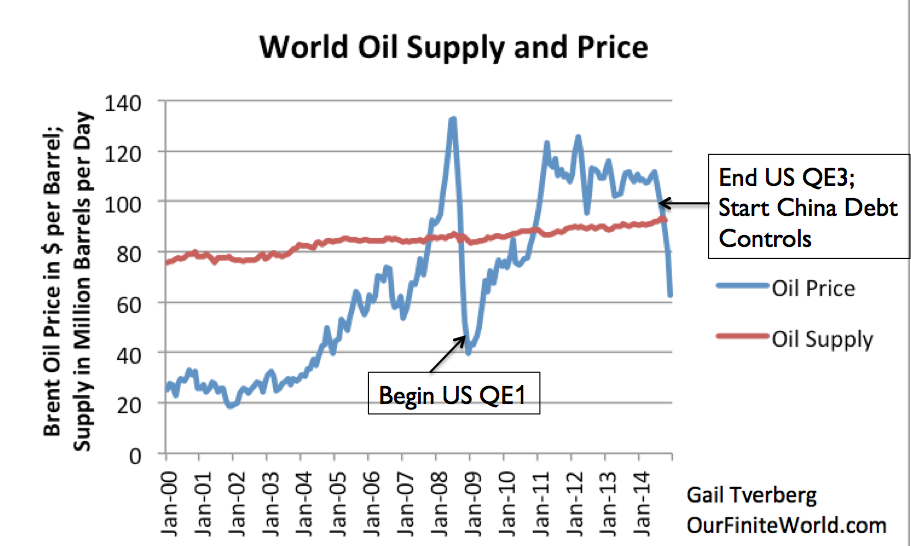
A chart I showed in my January post was this one:
Figure 1. World Oil Supply (production including biofuels, natural gas liquids) and Brent monthly average spot prices, based on EIA data.
The price of oil dropped dramatically in the latter half of 2008, partly because of the adverse impact high oil prices had on the economy, and partly because of a contraction in debt amounts at that time. It was only when banks were bailed out and the United States began its first round of Quantitative Easing (QE) to get longer term interest rates down even further that energy prices began to rise. Furthermore, China ramped up its debt in this time period, using its additional debt to build new homes, roads, and factories. This also helped pump energy prices back up again.

The price of oil was trending slightly downward between 2011 and 2014, suggesting that even then, prices were subject to an underlying downward trend. In mid-2014, there was a big downdraft in prices, which coincided with the end of US QE3 and with slower growth in debt in China. Prices rose for a time, but have recently dropped again, related to slowing Chinese, and thus world, economic growth. In part, China’s slowdown is occurring because it has reached limits regarding how many homes, roads and factories it needs.
I gave a list of likely changes to expect in my January post. These haven’t changed. I won’t repeat them all here. Instead, I will give an overview of what is going wrong and offer some thoughts regarding why others are not pointing out this same problem.

Overview of What is Going Wrong
  1. The big thing that is happening is that the world financial system is likely to collapse. Back in 2008, the world financial system almost collapsed. This time, our chances of avoiding collapse are very lim.

  2. Without the financial system, pretty much nothing else works: the oil extraction system, the electricity delivery system, the pension system, the ability of the stock market to hold its value. The change we are encountering is similar to losing the operating system on a computer, or unplugging a refrigerator from the wall.

  3. We don’t know how fast things will unravel, but things are likely to be quite different in as short a time as a year. World financial leaders are likely to “pull out the stops,” trying to keep things together. A big part of our problem is too much debt. This is hard to fix, because reducing debt reduces demand and makes commodity prices fall further. With low prices, production of commodities is likely to fall. For example, food production using fossil fuel inputs is likely to greatly decline over time, as is oil, gas, and coal production.

  4. The electricity system, as delivered by the grid, is likely to fail in approximately the same timeframe as our oil-based system. Nothing will fail overnight, but it seems highly unlikely that electricity will outlast oil by more than a year or two. All systems are dependent on the financial system. If the oil system cannot pay its workers and get replacement parts because of a collapse in the financial system, the same is likely to be true of the electrical grid system.

  5. Our economy is a self-organized networked system that continuously dissipates energy, known in physics as a dissipative structure. Other examples of dissipative structures include all plants and animals (including humans) and hurricanes. All of these grow from small beginnings, gradually plateau in size, and eventually collapse and die. We know of a huge number of prior civilizations that have collapsed. This appears to have happened when the return on human labor has fallen too low. This is much like the after-tax wages of non-elite workers falling too low. Wages reflect not only the workers’ own energy (gained from eating food), but any supplemental energy used, such as from draft animals, wind-powered boats, or electricity. Falling median wages, especially of young people, are one of the indications that our economy is headed toward collapse, just like the other economies.

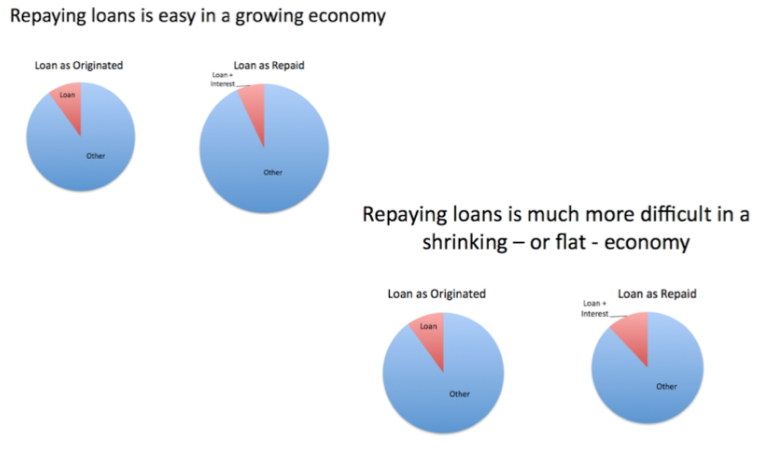
  6. The reason that collapse happens quickly has to do with debt and derivatives. Our networked economy requires debt in order to extract fossil fuels from the ground and to create renewable energy sources, for several reasons: (a) Producers don’t have to save up as much money in advance, (b) Middle-men making products that use energy products (such cars and refrigerators) can “finance” their factories, so they don’t have to save up as much, (c) Consumers can afford to buy “big-ticket” items like homes and cars, with the use of plans that allow monthly payments, so they don’t have to save up as much, and (d) Most importantly, debt helps raise the price of commodities of all sorts (including oil and electricity), because it allows more customers to afford products that use them. The problem as the economy slows, and as we add more and more debt, is that eventually debt collapses. This happens because the economy fails to grow enough to allow the economy to generate sufficient goods and services to keep the system going–that is, pay adequate wages, even to non-elite workers; pay growing government and corporate overhead; and repay debt with interest, all at the same time. Figure 2 is an illustration of the problem with the debt component.
    Figure 2. Repaying loans is easy in a growing economy, but much more difficult in a shrinking economy.
    Figure 2. Repaying loans is easy in a growing economy, but much more difficult in a shrinking economy.
Where Did Modeling of Energy and the Economy Go Wrong?
  1. Today’s general level of understanding about how the economy works, and energy’s relationship to the economy, is dismally low. Economics has generally denied that energy has more than a very indirect relationship to the economy. Since 1800, world population has grown from 1 billion to more than 7 billion, thanks to the use of fossil fuels for increased food production and medicines, among other things. Yet environmentalists often believe that the world economy can somehow continue as today, without fossil fuels. There is a possibility that with a financial crash, we will need to start over, with new local economies based on the use of local resources. In such a scenario, it is doubtful that we can maintain a world population of even 1 billion.

  2. Economics modeling is based on observations of how the economy worked when we were far from limits of a finite world. The indications from this modeling are not at all generalizable to the situation when we are reaching limits of a finite world. The expectation of economists, based on past situations, is that prices will rise when there is scarcity. This expectation is completely wrong when the basic problem is lack of adequate wages for non-elite workers. When the problem is a lack of wages, workers find it impossible to purchase high-priced goods like homes, cars, and refrigerators. All of these products are created using commodities, so a lack of adequate wages tends to “feed back” through the system as low commodity prices. This is exactly the opposite of what standard economic models predict.

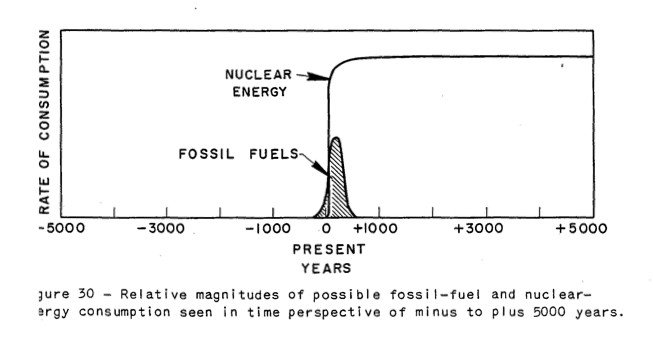
  3. M. King Hubbert’s “peak oil” analysis provided a best-case scenario that was clearly unrealistic, but it was taken literally by his followers. One of Hubbert’s sources of optimism was to assume that another energy product, such as nuclear, would arise in huge quantity, prior to the time when a decline in fossil fuels would become a problem.
    Figure 2. Figure from Hubbert's 1956 paper, Nuclear Energy and the Fossil Fuels.
    Figure 3. Figure from Hubbert’s 1956 paper, Nuclear Energy and the Fossil Fuels.
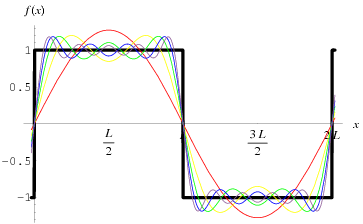
    The way nuclear energy operates in Figure 2 seems to me to be pretty much equivalent to the output of a perpetual motion machine, adding an endless amount of cheap energy that can be substituted for fossil fuels. A related source of optimism has to do with the shape of a curve that is created by the sum of curves of a given type. There is no reason to expect that the “total” curve will be of the same shape as the underlying curves, unless a perfect substitute (that is, having low price, unlimited quantity, and the ability to work directly in current devices) is available for what is being modeled–here fossil fuels. When the amount of extraction is determined by price, and price can quickly swing from high to low, there is good reason to believe that the shape of the sum curve will be quite pointed, rather than rounded. For example we know that a square wave can be approximated using the sum of sine functions, using Fourier Series (Figure 4).
    Figure 3. Source: Wolfram Mathworld.
    Figure 4. Sum of sine waves converging to a square wave. Source:Wolfram Mathworld.
  1. The world economy operates on energy flows in a given year, even though most analysts today are accustomed to thinking on a discounted cash flow basis.  You and I eat food that was grown very recently. A model of food potentially available in the future is interesting, but it doesn’t satisfy our need for food when we are hungry. Similarly, our vehicles run on oil that has recently been extracted; our electrical system operates on electricity that has been produced, essentially simultaneously. The very close relationship in time between production and consumption of energy products is in sharp contrast to the way the financial system works. It makes promises, such as the availability of bank deposits, the amounts of pension payments, and the continuing value of corporate stocks, far out into the future. When these promises are made, there is no check made that goods and services will actually be available to repay these promises. We end up with a system that has promised very many more goods and services in the future than the real world will actually be able to produce. A break is inevitable; it looks like the break will be happening in the near future.

  2. Changes in the financial system have huge potential to disrupt the operation of the energy flow system. Demand in a given year comes from a combination of (wages and other income streams in a given year) plus the (change in debt in a given year). Historically, the (change in debt) has been positive. This has helped raise commodity prices. As soon as we start getting large defaults on debt, the (change in debt) component turns negative, and tends to bring down the price of commodities. (Note Point 6 in the previous section.) Once this happens, it is virtually impossible to keep prices up high enough to extract oil, coal and natural gas. This is a major reason why the system tends to crash.

  3. Researchers are expected to follow in the steps of researchers before them, rather than starting from a basic understudying of the whole problem. Trying to understand the whole problem, rather than simply trying to look at a small segment of a problem is difficult, especially if a researcher is expected to churn out a large number of peer reviewed academic articles each year. Unfortunately, there is a huge amount of research that might have seemed correct when it was written, but which is really wrong, if viewed through a broader lens. Churning out a high volume of articles based on past research tends to simply repeat past errors. This problem is hard to correct, because the field of energy and the economy cuts across many areas of study. It is hard for anyone to understand the full picture.

  4. In the area of energy and the economy, it is very tempting to tell people what they want to hear. If a researcher doesn’t understand how the system of energy and the economy works, and needs to guess, the guesses that are most likely to be favorably received when it comes time for publication are the ones that say, “All is well. Innovation will save the day.” Or, “Substitution will save the day.” This tends to bias research toward saying, “All is well.” The availability of financial grants on topics that appear hopeful adds to this effect.

  5. Energy Returned on Energy Investment (EROEI) analysis doesn’t really get to the point of today’s problems. Many people have high hopes for EROEI analysis, and indeed, it does make some progress in figuring out what is happening. But it misses many important points. One of them is that there are many different kinds of EROEI. The kind that matters, in terms of keeping the economy from collapsing, is the return on human labor. This type of EROEI is equivalent to after-tax wages of non-elite workers. This kind of return tends to drop too low if the total quantity of energy being used to leverage human labor is too low. We would expect a drop to occur in the quantity of energy used, if energy prices are too high, or if the quantity of energy products available is restricted.

  6. Instead of looking at wages of workers, most EROEI analyses consider returns on fossil fuel energy–something that is at least part of the puzzle, but is far from the whole picture. Returns on fossil fuel energy can be done either on a cash flow (energy flow) basis or on a “model” basis, similar to discounted cash flow. The two are not at all equivalent. What the economy needs is cash flow energy now, not modeled energy production in the future. Cash flow analyses probably need to be performed on an industry-wide basis; direct and indirect inputs in a given calendar year would be compared with energy outputs in the same calendar year. Man-made renewables will tend to do badly in such analyses, because considerable energy is used in making them, but the energy provided is primarily modeled future energy production, assuming that the current economy can continue to operate as today–something that seems increasingly unlikely.

  7. If we are headed for a near term sharp break in the economy, there is no point in trying to add man-made renewables to the electric grid. The whole point of adding man-made renewables is to try to keep what we have today longer. But if the system is collapsing, the whole plan is futile. We end up extracting more coal and oil today, in order to add wind or solar PV to what will soon become a useless grid electric system. The grid system will not last long, because we cannot pay workers and we cannot maintain the grid without a financial system. So if we add man-made renewables, most of what we get is their short-term disadvantages, with few of their hoped-for long-term advantages.
Conclusion

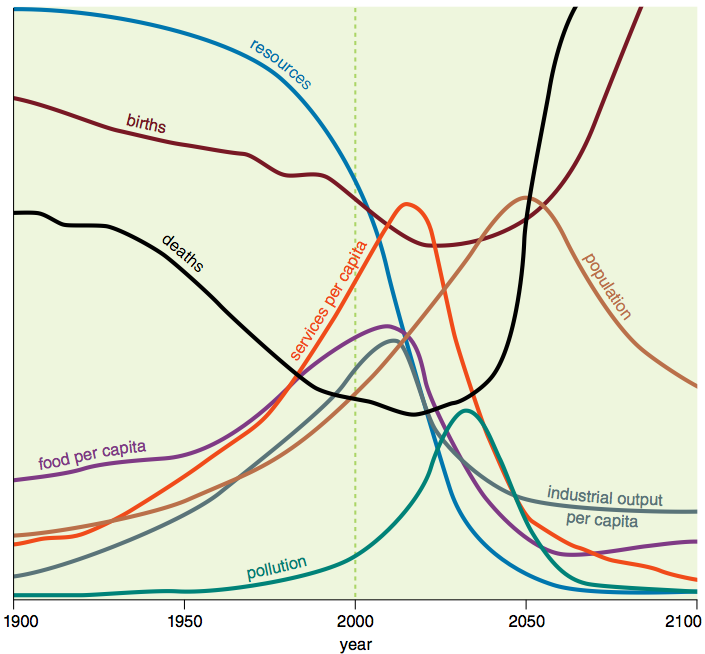
The analysis that comes closest to the situation we are reaching today is the 1972 analysis of limits of a finite world, published in the book “The Limits to Growth” by Donella Meadows and others. It models what can be expected to happen, if population and resource extraction grow as expected, gradually tapering off as diminishing returns are encountered. The base model seems to indicate that a collapse will happen about now.
Figure 5. Base scenario from 1972 Limits to Growth, printed using today's graphics by Charles Hall and John Day in "Revisiting Limits to Growth After Peak Oil" http://www.esf.edu/efb/hall/2009-05Hall0327.pdf
Figure 5. Base scenario from 1972 Limits to Growth, printed using today’s graphics by Charles Hall and John Day in “Revisiting Limits to Growth After Peak Oil” http://www.esf.edu/efb/hall/2009-05Hall0327.pdf

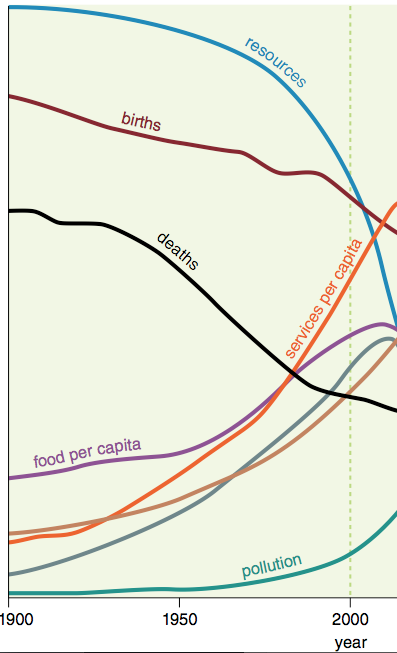
The shape of the downturn is not likely to be correct in Figure 5.  One reason is that the model was put together based on physical quantities of goods and people, without considering the role the financial system, particularly debt, plays. I expect that debt would tend to make collapse quicker. Also, the modelers had no experience with interactions in a contracting world economy, so had no idea regarding what adjustments to make. The authors have even said that the shapes of the curves, after the initial downturn, cannot be relied on. So we end up with something like Figure 6, as about all that we can rely on.
Figure 6. Figure 5, truncated shortly after production turns down, since modeled amounts are unreliable after that date.
Figure 6. Figure 5, truncated shortly after industrial output per capita (grey) and food per capita turns down, since modeled amounts are unreliable after that date.
If we are indeed facing the downturn forecast by Limits to Growth modeling, we are facing  a predicament that doesn’t have a real solution. We can make the best of what we have today, and we can try to strengthen bonds with family and friends. We can try to diversify our financial resources, so if one bank encounters problems early on, it won’t be a huge problem. We can perhaps keep a little food and water on hand, to tide us over a temporary shortage. We can study our religious beliefs for guidance.

Some people believe that it is possible for groups of survivalists to continue, given adequate preparation. This may or may not be true. The only kind of renewables that we can truly count on for the long term are those used by our forefathers, such as wood, draft animals, and wind-driven boats. Anyone who decides to use today’s technology, such as solar panels and a pump adapted for use with solar panels, needs to plan for the day when that technology fails. At that point, hard decisions will need to be made regarding how the group will live without the technology.
We can’t say that no one warned us about the predicament we are facing. Instead, we chose not to listen. Public officials gave a further push in this direction, by channeling research funds toward distant theoretically solvable problems, instead of understanding the true nature of what we are up against. Too many people took what Hubbert said literally, without understanding that what he offered was a best-case scenario, if we could find something equivalent to a perpetual motion machine to help us out of our predicament


Wednesday, 17 April 2013

Meanwhile in the markets....


Gold goes bear-shaped: Billions lost as precious metal plummets
Billionaire John Paulson lost almost $1 billion as gold posted its steepest decline in 30 years hitting $1,361 per ounce. The precious metal is no longer seen as a safe-haven asset.


RT,
16 April, 2013


Those who decided that it was too early to dump gold for good, lost a lot in the past few days. Billionaire John Paulson lost almost $1 billion of his personal wealth in the past two days as gold price fell to its lowest in almost two years, losing 13%, Bloomberg reports. Out of around $9.5 billion invested across his hedge funds, some 85% is invested in gold.

Influential investor George Soros seemed well prepared for the slump. He said earlier in April that gold has been “destroyed as a safe haven” during the euro crisis. However he added he expected the global central banks to continue buying gold to support prices.

Speaking with the South China Morning Post, Soros sounded cautious on the metal.

“It has disappointed the public, because it is meant to be the ultimate safe haven. But when the euro was close to collapsing last year, actually gold went down, because if people needed to sell something, they could sell gold,” Soros said.

Soros said he did not expect gold “to go down.” However he started significantly shortening his positions in gold in 2011 when he dubbed gold “the ultimate bubble." Back then he sold most of his holdings in the bullion-backed SPDR Gold Trust and iShares Gold Trust funds and invested in mining instead.

Some experts believe its is too early to drop gold. If the economy in the US does not recover, gold might yet be a worthy hedge.

Renowned bond investor Bill Gross, the manager of PIMCO's Total Return Fund said in early February said that he saw gold as a “stellar inflationary hedge” as global central banks attempt to reflate their economies.

Investor Jim Rogers commenting on the latest gold drop to Bloomberg, said he’s not buying the commodity yet, as he expects it to go even lower.

“This may be the correction that gold needs,” said Rogers, chairman of Rogers Holdings. “If it goes down enough, I will start buying it,” Rogers told reporters in Singapore.


Gold slump not such a great surprise

Experts say gold dropped so significantly due to a number of short and long term reasons. JPMorgan sees falling global inflation as the main factor slashing gold’s value as a sustainable hedge.

In the short term, the main reason for gold's weakness is the rise of the US dollar value due to the credit crisis in Europe. Signals that the US economy is recovering may force the Federal Reserve to withdraw its stimulus package sooner than expected, the Economic Times reports.

Goldman Sachs lowered its gold price prognosis expecting accelerating US economic growth. The price forecast for 2013 was lowered to $1,545 an ounce from $1,610. The forecast for 2014 hints at a further decline to $1,350 an ounce from $1,490.

Global investors were seen getting rid of gold and transferring their funds in riskier assets. Weak economic data from China and reports that Cyprus could sell of its gold reserves to pay off debts contributed to the latest slump in the gold price.

Сommodities super cycle over?

Meanwhile analysts at Citigroup claim the commodities super cycle might be over. Citi Research’s Ed Morse, released a report on Friday, to coincide with the historic gold slump, while oil prices demonstrated a steep decline as well.

“The second quarter should provide another affirmation that the so-called commodity super cycle has finally ended and should usher in the first ‘normal’ year in over a decade in which, broadly, commodity prices end the year lower than when the year started,” Morse’s reports said adding that the super cycle headed towards the end for several years dubbing it “Supercyle Funeral” that began in 2011. This year would be the “afterparty,” he added.

Experts also foresee a drop in prices for aluminum, copper and nickel by some 5%-10% in 2013, and by 8% to 13% in the following year.

Thursday, 24 January 2013

Shedlock makes the case for deflation

Mish Shedlock: Why I'm a Deflationist Who Likes Gold - Interview on Goldmoney


On Tuesday I had a nice opportunity to Chat with GoldMoney's Andrew Duncan.

I explain why I am deflationist who like gold, why most of the Austrians went wrong in ignoring credit, how hyperinflationists are too US-centric in their approaches, and why credit events are more likely (at least in the short-term) to happen in Japan, China, or Europe.

I also discuss currency wars, the deflationary forces of robots on jobs and the balance of trade. On the humorous side, I answer the question as to what I would do if I were put in charge of the Fed.


Wednesday, 9 January 2013

Max Keiser: Deflation and War

A much classier rant from Max Keiser.

Max and Stacey Episode 390: Deadly Deflation and WWIII


In this episode, Max Keiser and Stacy Herbert discuss the butch welfare Queens in Virginia, Maryland and DC who rely on the 'untouchable' Pentagon budget. They also discuss the US deploying both its FMDs -- "financial extortion", "monetisation" and "devaluation" -- to finance its debt and deficit requirements and its troops to 35 African nations.

In the second half of the show, Max Keiser talks to Dan Collins of TheChinaMoneyReport.com about the petro-yuan, China's gold and the problem with the fact that nobody in Africa wants to buy America's opium - credit default swaps.


Thursday, 25 October 2012

Deflation


Japan Is Not A Good Example Of How Deflation Typically Plays Out
Nicole Foss ('Stoneleigh)


23 October, 2012

Japan is not a good example of how deflation typically plays out. As Ilargi points out, they were an exporting powerhouse exporting into the biggest consumption boom the world has ever seen. They also had a very large pile of money to burn through building their four lane highways from nowhere to nowhere, since they were the world's largest creditor when their bubble burst in 1989. This is clearly not our situation.

No one will be exporting their way out of a global economic depression. In contrast, exporters are going to feel the pain big time as their markets dry up. We can expect trade wars and protectionism to abound. Take note Germany, Scandinavia, Australia, New Zealand etc etc.

We have had the inflation, only instead of a currency hyperinflation, we experienced a 30 year credit hyper-expansion. Either one amounts to an expansion of money plus credit compared to available goods and services, and is therefore inflation. Credit is equivalent to money on the way up, but not on the way down. Credit loses 'moneyness' and credit instruments are massively devalued in a great deleveraging. This is deflation by definition and it is already underway. Debt monetization is nothing in comparison with the scale of the excess claims to underlying real wealth that stand to be eliminated.


I agree that the currency of a deflating nation strengthens. This is exactly why we have been writing about the value of the US dollar increasing, which it has done. The bottom came in a long time ago, and despite the set backs that are an integral part of a fractal market, the trend is up, and will be for some time. That's not to say it will be for the long term - far from it in fact - but for now that is the case. We have made it clear that cash is a short term bet (of the order of a few years), and that the longer term strategy is to move into hard goods at the point when one can reasonably afford to do so with no debt.

Some could do so now, while others would have to wait for prices to fall, as they inevitably do in a deflation, but not immediately. Price movements follow changes in the money supply. We have been in a counter-trend reflation since 2009, and prices have risen as a result. They may continue to do so for a while after the reflation is clearly over, but then the trend will reverse.

Prices will fall, but purchasing power will fall faster, meaning that prices will rise in real terms for most people. Those who have preserved capital as liquidity will find their purchasing power enormously increased, but most others will lose purchasing power because they will have no access to credit, highly unfavourable employment circumstances, rising property taxes and very little actual money.

The fiat currency regime will eventually descend into chaos as beggar-thy-neighbour devaluations become the norm, but not everyone can devalue at will or at once. The market will decide relative values for the next while.

Money will go from where the fear is to where the fear is not. It will be leaving the European periphery, and increasingly the entire eurozone, and flooding into currencies like the USD, the Swiss franc, the Swedish krona, and temporarily the British pound. It doesn't matter if the US is downgraded. Market participants will ignore the ratings agencies and vote with their feet on a kneejerk flight to safety.


You might think that the US indicators are much closer to the hyperinflation set-up than to deflation. I would disagree of course, for reasons Ilargi has explained (plummeting velocity of money for instance). I would also point out that people extrapolate the trend of the last three years forward, but fail to anticipate trend changes. We are in one. Many markets have topped already (gold, silver, commodities, oil etc), and the rolling top of the last year or so is about to claim the American stock market as well.

The rollover in the markets will drag the real economy down with it, with a time lag, since the time constant for changes in the real economy is much longer than for the financial world where value is virtual. We are headed into the teeth of the Greatest Depression, or at least the most significant one since the fourteenth century.

Hyperinflation is simply not on the cards any time soon. The depression will proceed for many years before that becomes a serious risk, unless you live in the European periphery that is, where currency reissue is a very real risk in the relatively short term.

In those currencies, loss of faith in New Drachmas, New Pesetas or New Lira is very likely, and the periphery countries will be cut off from international debt financing, with hyperinflationary results. That is not the situation in the US at all, and won't be for quite a long time. Eventually, when international debt financing is dead and buried, then printing will be a risk and a loss of faith in the erstwhile reserve currency could be expected.

In the meantime, debts defaults are going to skyrocket, each one doing its bit to destroy the value of credit instruments, and subtract from the effective money supply. This is already underway, and the great asset grab has begun as a result. Witness the asset stripping of Greece for instance.

In Europe, endless bailouts of sovereigns and the well-connected are doing nothing to increase the money supply or the velocity of money. In contrast, the ineffectuality of governments is doing nothing more than feeding the cycle of fear by demonstrating their impotence time after time. They are trying to overcome contraction, but are fighting an irresistible headwind. It is not going to work. Europe is already in contraction, and as fear will be increasingly in the ascendancy, that will only get worse.

Government obligations will be shed right, left and centre (by governments of the right, left and centre) because they will have no choice. Yes, this will lead to anarchical unrest, and yes, this will be met with a heavy-handed repressive response. Social polarization is very much on the cards - governments vs people, haves vs have-nots, natives vs immigrants, employers vs workers, unionized vs non-unionized, Us vs Them in general terms. This will not be pretty, to say the least. Just because it is a bad thing does not mean that it cannot happen, or that government, by their actions, can make any difference to the outcome.

Bailouts are never for the little guy. The creditors hold the political power and write the rules. They will not allow debtors off the hook. Instead of repayment in money, they will take people's freedom instead, making debt slavery much more real than it is today. Debts will not be forgiven, but sold on to more aggressive debt collectors. This is already happening in the US, where debt collection is becoming increasingly unconscionable.

Debts will only be effectively forgiven when people have nothing useful to repay, not even their labour. By then the middle classes will probably be living in latter day Hoovervilles, like the Villas Miserias populated by the formerly middle class Argentines.

Savers will have all the buying power, IF they have managed to get their savings away from dependence on the solvency of middle men. Otherwise they will likely disappear in a giant black hole of credit destruction, as yet more excess claims to underlying real wealth.