Showing posts with label financial collapse. Show all posts

Thursday, 4 February 2021

Michael Snyder on the ramifications of GameStop

 The Exact Same Thing That Is Happening To GameStop Is Eventually Going To Happen To The Stock Market As A Whole


Economic Collapse,

4 February, 2021

Stock is only worth what someone is willing to pay for it at a particular moment in time.  Sadly, this is a lesson that many GameStop traders are learning right now.  Just a few days ago, GameStop had surged above $300 a share and a lot of investors that had gotten caught up in the frenzy thought that they were suddenly rich.  But you only make money in the stock market when you get out.  Those that sold at the peak of the bubble were extremely fortunate, but most GameStop investors are determined to hold on to the bitter end, and the end will definitely be quite bitter indeed.

I think that it is great that a horde of retail investors want to punish the short sellers, but GameStop is definitely not a long-term investment.

In fact, the fair value for a share of GameStop stock is probably less than a dollar.

So it was quite bizarre that “the Reddit army” was able to push the price of the stock to more than $300 a share.  Ultimately, any really determined group of investors can temporarily pump up the price of any stock, but in order for it to stay elevated there must be buyers that are willing to purchase the stock at that level day after day.

Everyone knew that GameStop was going to come back down, and that has happened in dramatic fashion during the last two trading sessions

Shares of GameStop sank further on Tuesday, with shares of the volatile retail-trader favorite sliding 60% to finish at $90 per share.

The tumble follows a more than 30% drop during the regular market session Monday after finishing at $325 per share on Friday. That brings the two-day loss to 72%.

For the sake of GameStop investors, I hope that the stock bounces back a bit on Wednesday, but it is just a matter of time before it returns to a level that is much closer to fair value.

Some investors such as Dave Portnoy got really excited about what Reddit traders were trying to do, and he got in at the very top of the bubble.  Now that several of those stocks have cratered, Portnoy has lost approximately 700,000 dollars

After the bell, Portnoy provided an update on his AMC, NOC, and NAKD positions. He said he bought them at the “absolute high” and sold them at the “exact bottom.” In total, he said losses amounted to $700k, something we noted earlier.

That has got to hurt.

Others have also seen the value of their stock holdings drop in precipitous fashion.

For example, Keith Gill saw the value of his holdings in GameStop drop by 13 million dollars on Tuesday alone…

Keith Gill — who goes by DeepF——Value on Reddit and Roaring Kitty on YouTube — says he suffered a loss north of $13 million on Tuesday alone from his GameStop bet, but he’s still not selling.

He’s the man who helped inspire the epic short squeeze in GameStop last week that sent shockwaves through Wall Street. Through YouTube videos and Reddit posts, Gill attracted an army of day traders who cheered each other on and piled into the brick-and-mortar video game stock and call options, creating a massive short squeeze as the shares jumped 400% last week alone.

I know that he says that he is doing this to make a point, but I have a feeling that someday he is going to look back and kick himself for not selling when he had the chance.

Golden opportunities come along very rarely in life for most people, and when they do it is important to take advantage of them.

Of course one of the big reasons why GameStop crashed was because Robinhood had restricted trading in that stock, and now that the stock has crashed Robinhood is rolling back the limitations

Robinhood on Tuesday rolled back more of its trading limitations, now allowing clients to buy up to 100 shares of GameStop.

GameStop climbed off the lows as the Robinhood changes were announced.

Speaking of Robinhood, this whole episode has exposed the fact that they were never actually “looking out for the little guy” at all.  The following comes from Senator Josh Hawley

Enter Robinhood—as in, steal from the rich. Robinhood was the trading platform for the little guy. No fees, no hassle. It was Big Tech, once again, allegedly democratizing another sphere of American life captured by elite control. But like the tech platforms, Robinhood wasn’t really about its users. Its bread was buttered by selling the data on users’ trades to the big players—the elite guys, like Citadel—to give them inside tips on where retail investors were sending their money. And the Citadel guys, in turn, pay off their regulators—like treasury secretary Janet Yellen—in their years away from government for favors when they’re back in power.

What a crooked system we have, but our politicians will never have enough courage to actually try to change it.

And of course the so-called “guardians of democracy” in the mainstream media relentlessly defend our extremely corrupt system.

Sadly, it is just a matter of time before the entire house of cards comes crashing down for good.

The talking heads on television are preaching to us about the dangers of “the GameStop bubble”, but the truth is that our entire stock market has become one gigantic bubble.

As I keep reminding my readers, if the market were to drop by 50 percent tomorrow, it would still be way overvalued.

Price to earnings ratios always return to their historical averages eventually, and it will be no different in our case.

Of course we should hope that the eventual crash can be put off for as long as possible, because the collapse of the stock bubble will severely hurt millions of people financially.

But as sure as you are reading this, it will happen.

So I really don’t want to hear any more babbling from the sanctimonious idiots in the financial community that are trying to tell us that GameStop investors “had it coming”.

Yes, everyone could see that the GameStop saga was not going to end well, but everyone should also be able to see that things are not going to end well for the market as a whole.

If you can make some money in the short-term by playing the stock market, that is great.

But as our friends at Zero Hedge like to say, “on a long enough timeline the survival rate for everyone drops to zero”. 

Tuesday, 2 February 2021

A populist uprising

 Situation Update, Feb 1 – Populist financial uprising may tear down the entire RIGGED system

Natural News,

1 February, 2021 


The silver lining for the events of the last year is that huge numbers of people are awakening to fact that everything is rigged:

  • The elections are rigged.
  • Wall Street is totally rigged. There is no “free market.”
  • The courts are rigged and no longer provide anything resembling “equal justice.”
  • The money supply is rigged with fiat currency and endless money printing.
  • The news is rigged with fake news from the globalist-controlled media.
  • Speech is rigged by the tech giants that censor truth and promote lies.

Yet now, thanks to public access to the stock market, people are discovering they can stick it to the system by participating in “short squeeze” actions by purchasing certain assets. This is the entire story behind the WallStreetBets / Robinhood / GameStop phenomenon that we’ve all witnessed over the past week.

More importantly, we believe that certain strategic groups are using the same strategy to expose the vulnerabilities of the entire fraudulent system as a prelude to bringing that system down. In other words, certain white hat groups are, we believe, actually working to accelerate the demise of the fraudulent financial system in order to replace it with a more honest money system after the crash.

The entire house of cards of our current system is built entirely out of fakery and fraud. And I don’t mean just the stock market, but also the entire U.S. government which depends on endless debt creation for its very existence. The debt printing machine is the Fed, and the Fed is intertwined with the monopolistic banks (like JP Morgan) that stay afloat by manipulating both stocks and precious metals (such as silver).

The silver market has long been suppressed by these banksters and their government financial thugs as a way to hide the true extent of their debt spending and currency fraud. If gold and silver were to be allowed to find their true price, they would skyrocket compared to dollars, exposing the weakness and fraud of the entire dollar-based debt system that has stolen 98% of its value from the American people since 1971. (That’s how much the dollar has lost in real purchasing power.)

Now, retail investors are countering the silver market manipulations by purchasing physical silver. Right now, there’s hardly an ounce of physical silver to be found anywhere, as most of the supplies were sold out over the weekend. In London, the bullion banks are reportedly short 100 million ounces of silver, and the shortage is spreading like wildfire.

The banks are fighting back hard today, and after silver spot hit $30, the banks organized a counter attack that drove the price back down, but they’re being forced to deploy very costly financial weapons to achieve price suppression, and sooner or later, they will run out of ammunition.

Why does all this matter? Because the banksters suppress the market by trading paper contracts that claim to represent silver, but in reality there’s no physical silver behind those paper contracts. The entire system is a complete fraud, yet it is used by the globalist banks to suppress the price of real silver through paper contract manipulation. This allows them to continue pushing the propaganda delusion that claims fiat currencies hold value, when in reality they hold nothing.

When retail investors buy physical silver, it puts enormous pressure on the entire silver ecosystem and “squeezes” those who hold the fake paper contracts, in some cases forcing them to come up with the actual physical silver they owe or end up defaulting on the silver delivery implied by their paper contracts.

Many people who are currently buying silver contracts are demanding delivery of that silver, and they’re doing this on purpose, as a strategy to force the fraud of the silver paper market out into the open. Other retail investors are merely buying silver as a smart hedge against the coming collapse of the dollar and other fiat currencies, since owning physical metal is one of the key strategies for surviving a global debt collapse.

Silver, like gold, is an atomic element. This means it cannot be destroyed except through nuclear fusion or fission. Once you own physical silver in your possession, you can’t lose it by forgetting a password, or having a bank failure or even through a house fire. Silver doesn’t burn away, it just melts… but it’s still silver.

In my podcast today, I repeat something I’ve said for years: The best safe havens from the coming financial collapse are land, gold and silver. Other physical stores of wealth include firearms, ammunition, tractors (farm equipment), diesel fuel and storable food.

Why do you think Bill Gates and Jeff Bezos are buying up hundreds of thousands of acres of land across America? It’s because land is the last-ditch store of wealth when the entire broken financial system comes crashing down.

And that’s where all this is headed: The collapse of the debt system followed by the bankruptcy of the US government under Biden. Old Joe will be relegated to signing blank executive orders as he remains “president” of a bankrupt shell of a former government that will fall as quickly as the old Soviet Union. States like Texas will quickly declare their own sovereignty and begin rolling out their own state-based money systems and military defense operations.

When this happens, you don’t want to be anywhere near a Democrat-controlled city or state, as those will collapse into lawlessness and total chaos. Only red counties have a chance at maintaining the rule of law, thanks to ethical, law-abiding citizens who won’t put up with the chaos and violence of the Left.

Plus, many productive citizens and small business owners have already moved out of blue cities and states. The vast majority of the populations left behind in those hellhole cities like Seattle, Portland, Chicago, Detroit and Los Angeles are government handout recipients who contribute nothing to society. That’s why those cities will collapse very quickly: There’s almost no one left who knows how to do anything!

Full details of all this are found in today’s Situation Update podcast for February 1st:


This week, we’ll be covering the silver squeeze, the financial markets and the accelerating tyranny and insanity of the Biden regime. 

THERE IS NO SILVER LINING IN THIS 

PROBLEM FOR ANY OF US


the Commonsense Show

Saturday, 30 January 2021

Now Reddit Investors Are Talking About Targeting Silver, And That Could Change EVERYTHING

 I like nice simple explanations such as this on matters financial

"This is for you, Dad.


"I remember when the housing collapse sent a torpedo through my family. My father's concrete company collapsed almost overnight. My father lost his home. My uncle lost his home. I remember my brother helping my father count pocket change on our kitchen table. That was all the money he had left in the world. While this was happening in my home, I saw hedge funders literally drinking champagne as they looked down on the Occupy Wall Street protestors. I will never forget that.


"My Father never recovered from that blow. He fell deeper and deeper into alcoholism and exists now as a shell of his former self, waiting for death.


"This is all the money I have and I'd rather lose it all than give them what they need to destroy me. Taking money from me won't hurt me, because i don't value it at all. I'll burn it all down just to spite them.


"This is for you, Dad."


ROBINHOOD-WINKED: 

GLOBAL ELITES STEAL BACK 

FROM THE PEASANTS


Today on TruNews, we discuss the war on people being waged by the kings and queens of globalism, as everything from crazy Q-Anon to daring to day trade is now a crime in the new America. 


We detail the real story behind the fortification of the Capitol and the criminalization of buying Gamestop ‘stonks’ on Robinhood after hearing about billionaire hedge funds conspiring to destroy childhood memories. 


We also address the death investors who made a killing during the pandemic, as the SEC gives a by to billionaires Jeff Bezos and Bill Gates for ‘insightful’ stock trading, while setting Peter Strzok’s spurned wife loose on the revolutionaries ransacking Wall Street through Reddit. 


Doc Burkhart, Edward Szall, Matt Skow. Airdate 01/29/2021


Watch the broadcast HERE


Understanding the Whole 

"Gamestop" Debacle on Wall 

Street this week


Hal Turner,

29 January, 2021


There is gigantic tumult taking place this week on Wall Street, with the entire Stock and Bond market talking about Gamestop.  

Here's an explanation of what went on:


So some bigshots in Hedge Funds on Wall Street got beaten at their own game, and now they're all screaming that the general public should not be allowed to do what Wall Street itself has been doing for decades!

Put simply, for the filthy rich, it's somehow OK for THEM to manipulate pricing to grab other people's money, but when the general public gets together to do the exact same thing (and thereby wipe out the filthy rich) it should somehow be illegal.

A bunch of Day-Traders who talk amongst each other on a chat server named "WallStreetBets" hosted by DISCORD, realized they could act together and drive the value of a stock up to their own benefit because a Hedge Fund publicly reported they had a position in that stock (Gamestop).  So the Day Traders began buying Gamestop stocks and the price went up.

Firs thing that happened was the rich guys, who saw themselves starting to lose Billions to these Day Traders, had the chat hosting server SHUT OFF to prevent people from talking about it!

The chat server, a company named DISCORD, shut down the chat server then apparently lied about why they did it.  Here's the DISCORD explanation:
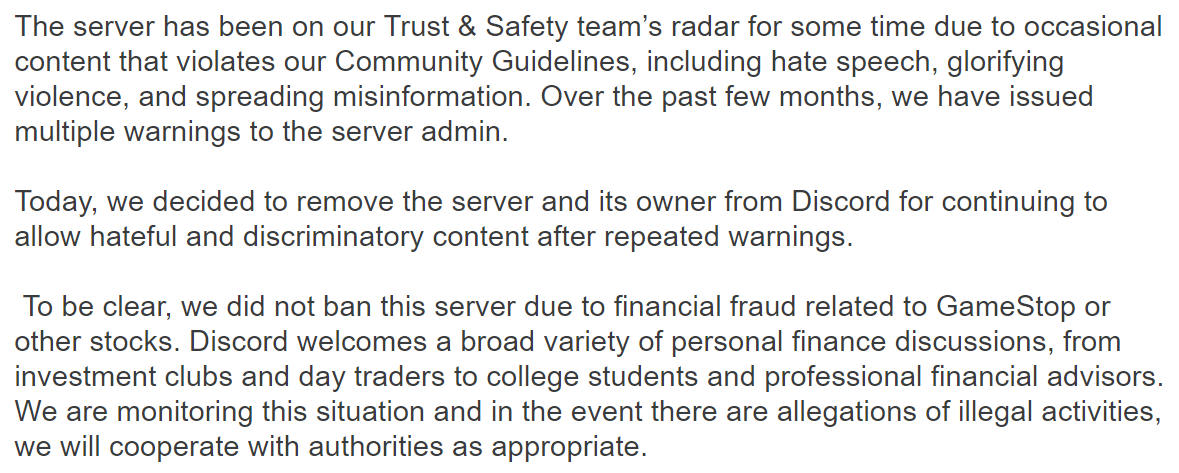
Oh, so group buying of stocks is now "Hate Speech?"  "Racism?"  Even the Wall Street Journal called it "Straight up White Supremacy."   (HT Remark: WOW, these filthy rich guys pull out all the stops when trying to justify their manipulation of the markets! ! ! ! )


Now Reddit Investors Are 

Talking About Targeting 

Silver, And That Could Change 

EVERYTHING


http://theeconomiccollapseblog.com/now-reddit-investors-are-talking-about-targeting-silver-and-that-could-change-everything/


Making matters worse is what Stock Brokerage Houses did during this fiasco:  They took it upon THEMSELVES to prevent their customers from buying more stick in Gamestop!   This meant that the general public was being prevented from buying more of the stocks, and thereby putting more of a hurt on certain of their Hedge Fund buddies!   That's price-fixing and it is a violation of the Sherman Anti-Trust Act . . . but the Brokerage Houses did it anyway.

Then, in an even more spectacular act, at least one Brokerage House, Robinhood, decided it would begin SELLING the stocks held by their customers, **** WHETHER THE CUSTOMER WANTED TO SELL OR NOT ****

This had the effect of driving DOWN the price of the stock, thus saving the Hedge Fund and screwing their customers out of profits.

The Stock Market showed itself to be completely "rigged" this week, with the ultra rich who own Stock Brokerages, showing they are perfectly willing to engage in outright price-Fixing and actually STEAL their own customer's stocks (by selling them without authorization) so as to protect their rich buddies.

If people leave their money in Stock Brokerages after this brazen display of criminality, they're fools.  People should start pulling ALL their money out of stock brokerages that committed these acts and drive those brokerages out of business immediately.

(Securities Laws require me to tell you that "I am NOT a licensed financial planner and cannot give financial advice.  Consult a licensed professional  -- the same type that did the price-fixing and stealing -- before making any financial decisions.)


For decades, the big fish on Wall Street have been able to do virtually anything that they want, but now the small fish are fighting back and it has been a beautiful thing to watch.  Finally it is payback time, and the losses have been absolutely staggering.  In fact, Reuters is reporting that short sellers have lost more than 70 BILLION dollars so far this year.  But nobody should be crying for the short sellers.  As Charles Payne pointed out during an epic rant on Fox Business, the short sellers have ruthlessly crushed countless businesses over the years, and they did so without showing any mercy whatsoever.

So now the big hedge funds want mercy themselves?

It’s not likely to happen.

After sending GameStop, AMC and other beleaguered stocks into the stratosphere, now investors on Reddit are talking about going after a really huge whale.

The silver market is perfectly primed for an epic short squeeze, and a coordinated assault by retail investors could make it happen.

The following is an excerpt from the post on the “WallStreetBets” Reddit subgroup that everyone is talking about

The silver futures market has oscillated between having roughly 100-1 and 500-1 ratio of paper traded silver to physical silver, but lets call it 250-1 for now. This means that for every 250 ounces in open interest in the futures market, only 1 actually gets delivered. Most traders would rather settle with cash rather than take delivery of thousands of ounces of silver and have to figure out to store and transport it in the future.

The people naked shorting silver via the futures markets are a couple of large banks and making them pay dearly for their over leveraged naked shorts would be incredible. It’s not Melvin capital on the other side of this trade, its JP Morgan. Time to get some payback for the bailouts and manipulation they’ve done for decades (look up silver manipulation fines that JPM has paid over the years).

The way the squeeze could occur is by forcing a much higher percentage of the futures contracts to actually deliver physical silver. There is very little silver in the COMEX vaults or available to actually be use to deliver, and if they have to start buying en masse on the open market they will drive the price massively higher. There is no way to magically create more physical silver in the world that is ready to be delivered. With a stock you can eventually just issue more shares if the price rises too much, but this simply isn’t the case here. The futures market is kind of the wild west of the financial world. Real commodities are being traded, and if you are short, you literally have to deliver thousands of ounces of silver per contract if the holder on the other side demands it. If you remember oil going negative back in May, that was possible because futures are allowed to trade to their true value. They aren’t halted and that’s what will make this so fun when the true squeeze happens.

That post has already been upvoted more than 9,400 times, and it appears that a consensus is building that this is going to be the next big thing after the raid on GameStop short sellers is done.

On Thursday, the price of gold was up 4.5 percent in anticipation that something might happen, and much of that price movement was apparently caused by short sellers that feverishly rushed to close their positions

“After watching GameStop (NYSE:GME) and other shorts getting blasted, rumours that silver could be targeted has traders preemptively covering shorts just in case,” said Tai Wong, a trader at investment bank BMO in New York.

As Eric King has pointed out, if Reddit investors really do decide to go all-in on silver, they could do some serious damage…

“Chris, I just calculated the last 4 trading days in GameStop (GME) in dollar terms and it totals $82.3 billion. I think annual silver production is roughly 1 billion ounces and at current prices that would total about $25 billion. That means yesterday’s trading volume in GameStop of $29.9 billion would have purchased more than the entire annual silver mine production! And the last 4 trading days in GameStop ($82.3 billion in dollar terms) would have purchased more than a staggering 3-times the entire annual global silver mine production! This type of buying would obviously create one hell of a violent short squeeze in the silver market.”

Of course the other side doesn’t exactly play fair.

On Thursday, Robinhood and other trading platforms suddenly restricted trading in some of the key stocks that retail investors have been targeting

Shares of AMC Entertainment Holdings, BlackBerry Ltd., Bed Bath & Beyond Inc., Express Inc., GameStop Corp., Koss Corp., Naked Brand Group and Nokia Corp. have been restricted to “position closing only,” Robinhood said in a blog post.

The decision means traders cannot initiate new positions in shares of those companies and can only sell existing holdings. The company also raised margin requirements for certain securities.

There are allegations that Robinhood and other trading platforms were persuaded to shut down trading in those stocks by the big fish on Wall Street, but Robinhood and the other trading platforms are denying this.

And Robinhood is also denying that it forced some users to suddenly dump their shares in GameStop and other key stocks

No, Robinhood tells The Verge, it didn’t sell off full shares of GameStop, AMC, and other buzzy stocks without permission from its traders.

That contradicts the stories of twelve people who spoke with The Verge, saying that the app unexpectedly sold off their holdings in some of these companies. Quite a number of Robinhood users expressed their surprise on social media today that the app was selling off their stakes, and we tracked down a dozen of them. These traders didn’t believe they had prompted the sales, and they said they weren’t aware of anything on their account that would have automatically triggered them.

Hopefully authorities will investigate and get to the bottom of what actually happened.

At this point, Robinhood has already been slapped with two lawsuits because of what took place on Thursday…

Two Robinhood users filed separate lawsuits against the brokerage app Thursday after it and other apps restricted trading of certain securities.

The first lawsuit filed in the Southern District Court of New York alleges that Robinhood “purposefully, willingly, and knowingly” restricted certain securities transactions, including GameStop. The other filed in the Northern District Court of Illinois alleges that the app manipulated its platform.

And it is being reported that the House and the Senate will both be holding hearings on the matter…

The U.S. House Financial Services and Senate Banking committees said on Thursday they will hold hearings on the stock market after users of investment apps faced trading limits following the “Reddit rally” that put a charge into GameStop and other volatile stocks that were touted in online forums.

“We must deal with the hedge funds whose unethical conduct directly led to the recent market volatility and we must examine the market in general and how it has been manipulated by hedge funds and their financial partners to benefit themselves while others pay the price,” said Representative Maxine Waters, a Democrat who heads the House panel.

After everything that just went down, I don’t know how Robinhood is going to survive.

There are also rumors of a “liquidity crisis” at Robinhood, but the company insists that those rumors are simply not true.

Meanwhile, the firm has “tapped at least several hundred million dollars” in emergency credit in recent days…

Robinhood Markets, the trading app that’s popular with investors behind this month’s wildest stock swings, has drawn down some of its bank credit lines to ensure it has enough cash to clear trades, according to people with knowledge of the matter.

The firm, according to one of the people, has tapped at least several hundred million dollars, a significant amount of money for a firm that was valued at about $12 billion a few months ago. Robinhood’s lenders include JPMorgan Chase & Co. and Goldman Sachs Group Inc., according to data compiled by Bloomberg. Representatives for Robinhood and those banks declined to comment.

I have a feeling that this story is not going to end well for Robinhood.

But for the retail investors that are changing the course of history, this is truly an amazing time.

Finally, the small fish are standing up for themselves and are fighting back against the big fish, and the big fish have good reason to be quite scared.


Tuesday, 27 October 2020

The bond market collapses

The interesting thing about this is ABSOLUTE SILENCE about this in the British (and presumably, Antipodean) media.


Three cents. Two cents. Even a mere 0.125 cents on the dollar.

More and more, these are the kinds of scraps that bondholders are fighting over as companies go belly up.

Bankruptcy filings are surging due to the economic fallout of Covid-19, and many lenders are coming to the realization that their claims are almost completely worthless. Instead of recouping, say, 40 cents for every dollar owed, as has been the norm for years, unsecured creditors now face the unenviable prospect of walking away with just pennies -- if that.

While few could have foreseen the pandemic’s toll on the economy, the depth of investors’ pain from corporate distress was all too predictable. Desperate to generate higher returns during a decade of rock-bottom interest rates, money managers bargained away legal protections, accepted ever-widening loopholes, and turned a blind eye to questionable earnings projections. Corporations, for their part, took full advantage and gorged on astronomical amounts of debt that many now cannot repay or refinance.

It’s a stark reminder of the long-lasting repercussions of the Federal Reserve’s unprecedented easy-money policies. Ultralow rates helped risky companies sell bonds with fewer safeguards, which creditors seeking higher returns were happy to accept. Now, amid a new bout of economic pain, the effects of those policies are coming to bear.

Debt issued by the owner of Men’s Wearhouse, which filed for court protection in August, traded this month for less than 2 cents on the dollar. When J.C. Penney Co. went bankrupt, an auction held for holders of default protection found the retailer’s lowest-priced debt was worth just 0.125 cents on the dollar. For Neiman Marcus Group Inc., that figure was 3 cents.

CDS Sadness

Credit default swap auctions portend steeper-than-usual losses

Sources: Creditex and Markit

Note: data limited to U.S. companies

The loose lending terms that investors have agreed to mean that by the time corporations file for bankruptcy now, they’ve often exhausted their options for fixing their debt loads out of court. They’ve swapped their old notes for new ones, often borrowing against even more of their assets in the process. Some have taken brand names, trademarks, and even whole businesses out of the reach of existing creditors and borrowed against those too. While creditors always do worse in economic downturns than in better times, in previous downturns, lenders had more power to press companies into bankruptcy sooner, stemming some of their losses.

The pandemic is upending industries like retail and energy, making it unclear how much assets like stores and oil wells will be worth in the future. The underlying problem for many companies, though, is that they have astronomical levels of debt after borrowing with abandon over the previous decade, then topping up with more to get them through the pandemic.

For bondholders, the kind of liabilities that companies have added makes the problem worse. Loans have been a particularly cheap form of debt for many companies over the last decade. Those borrowings are usually secured by assets, leaving many corporations with more secured debt than they’ve had historically. That means that unsecured bondholders end up with less when borrowers go broke.

“We’ll see companies gradually hitting the wall -- it’s just a question of when and how fast,” said Dan Zwirn, founder of Arena Investors, a $1.7 billion investment firm with an emphasis on credit. “There’s just going to be way more downside.”

Record Lows

The recent low values for bonds in credit derivatives auctions signal that in future bankruptcies owners of unsecured bonds, not to mention loans, may suffer a bigger hit than usual, according to research from Barclays Plc. The median value for companies’ cheapest debt in credit derivatives auctions this year is just 3.5 cents on the dollar, a record low and far below the 23.4 cent median for 2005 through 2019.

The value of a company’s bonds in an auction for credit derivatives payouts doesn’t necessarily equal how much money bondholders will actually recover when a bankruptcy is complete. But lower auction values do tend to correlate to lower recoveries, according to Barclays. Lower market values also reflect investor concerns.

The auctions represent the value of a company’s cheapest unsecured bond, although usually most of a borrower’s unsecured notes trade around the same price in bankruptcy, according to Barclays. When a company defaults or files for bankruptcy, an investor that bought a credit default swap receives a payout equal to 100 cents on the dollar minus the auction value of the cheapest-to-deliver security.

Loan Pain

It’s not just bond investors that will suffer from low recoveries. Amid the pandemic downturn, loan investors could find themselves losing 40 to 45 cents on the dollar, compared with historical averages of 30 to 35 cents, according to Barclays.

One factor that is hurting money managers is the erosion of investor protections known as covenants, as more and more high yield and leveraged loan deals are covenant-lite, meaning they feature minimal such safeguards. When corporations had more restrictive covenants, borrowers had less room to fix their debt outside of court, sending them into bankruptcy closer to the first sign of trouble.Now companies have more leeway to seek extra financing when they’re in trouble, and to give lenders providing additional funds the right to jump to the front of the line if the company does go bankrupt.

“Covenant-lite paper usually means by the time you get back to the table with the borrower, the house is on fire,” said Sanjeev Khemlani, a senior managing director at FTI Consulting. “All of that extra time you had before, that’s just gone away.”

Oaktree Deal Crushed a Leveraged Loan and Exposed Market’s Woes

Investors that bought a J. Crew Group Inc. term loan at par back in 2014 may have thought they were making a relatively safe bet, since it was secured debt. When the company started struggling a few years later, it moved intellectual property including its brand name into a new entity, a move enabled by relatively loose covenants.

The company then exchanged some of its existing bonds for new notes secured by the intellectual property as well as preferred stock and equity in its parent company, as part of a broad restructuring. Loan investors ended up suffering: after the company filed for bankruptcy in May, the 2014 obligation was worth less than 50 cents on the dollar, according to Bloomberg loan valuation estimates. (J. Crew exited bankruptcy in September.)

FTI’s Khemlani, who advises lenders with senior claims on borrowers’ assets, said investors should make an effort to “put some teeth” into their agreements with borrowers now as they fall into distress, regaining some lost protection.

In addition to shifting assets, companies have also been doing more distressed exchanges in recent years, where troubled corporations offer creditors new, debt that often ranks higher in the repayment pecking order in exchange for relief like lower principal or later maturities or both. Creditors that participate can stem their losses in the event of a bankruptcy, but investors that sit the deal out can end up worse off.

The popularity of distressed exchanges has also contributed to a general rise in secured debt in companies’ capital structures. That means that more investors -- holders of loans and secured bonds -- are fighting for the same scraps when a company files for bankruptcy. Almost 20% of the debt in the U.S. high-yield bond market is now in some way secured, according to Barclays, versus just 6% in 2000. The number of businesses that had taken out just loans and no other form of debt almost doubled between 2013 and 2017, according to JPMorgan Chase & Co. data.

https://www.bloomberg.com/news/articles/2020-10-26/bond-defaults-deliver-99-losses-in-new-era-of-u-s-bankruptcies?fbclid=IwAR28Kgw6WcYqFL4ffDGHP6EldHSAGimGHl3XG3A0GVk_y9Ea4a4ARrgT678


US stocks suffered their worst selloff in weeks Monday as Wall Street grappled with a nationwide surge in coronavirus infections and continued doubts about another stimulus package.

The Dow Jones industrial average sank as much as 965.41 points, or 3.4 percent, to 27,370.16 in early trading after the US recorded more than 83,000 new COVID-19 cases on both Friday and Saturday — breaking the previous mid-July peak of about 77,000.

The blue-chip index recovered to close down 650.19 points, but it was still the worst day since at least Sept. 3, when it shed about 1,025 points before closing down 807.77 points. The S&P 500 similarly dropped as much as 2.9 percent before clawing back losses to close down 1.9 percent to start the final week of trading before the presidential election. The tech-heavy Nasdaq lost 1.6 percent.

“The double whammy of a stalled stimulus bill and new highs in cases is a harsh reminder of the many worries that are still out there,” said Ryan Detrick, chief market strategist for LPL Financial.

Investors appeared unnerved by the new resurgence in the virus — which could do even more damage during the colder fall and winter months — despite news that British drugmaker AstraZeneca’s experimental vaccine provoked an immune response.

Recent spikes in infections have led to renewed lockdown measures in European countries such as the UK and Italy, raising further questions about the pandemic’s economic harm. But White House chief of staff Mark Meadows told CNN on Sunday that the US is “not going to control the pandemic” because COVID-19 is “a contagious virus just like the flu.”

“It is becoming difficult for investors to keep a cool head,” said Milan Cutkovic, market analyst at Axi. “Whether there will be another major sell-off or a continuation of the stock market rally will likely depend on how quickly governments and central banks will react to the latest developments in the COVID-19 pandemic.”

It also looks increasingly unlikely that Congress and the Trump administration will reach a deal on a new stimulus bill to blunt the virus’s economic impact before the Nov. 3 election. Economists say more spending is needed to continue the nation’s recovery from the economic collapse that the pandemic caused in the spring.

House Speaker Nancy Pelosi (D-Calif.) said Sunday that she’s not giving up hope for an agreement, but Senate Majority Leader Mitch McConnell (R-Ky.) has reportedly opposed a large-scale package.

“I think that as we headed to the election, there was a set of fears” about a surge in COVID infections along with a lack of stimulus, Jim Paulsen, chief investment strategist at the Leuthold Group, told The Post. “And there’s just enough news to bring them all together at relatively high market levels.”

“A stimulus package would have been a nice distraction and seen households and businesses through to the new year when everything will be much clearer,” Craig Erlam, senior market analyst at OANDA, said in a commentary. “Alas, investors have far too much faith in lawmakers on Capitol Hill.”

https://nypost.com/2020/10/26/stock-futures-tumble-amid-covid-19-surge-and-stimulus-doubts/?fbclid=IwAR0SEA6owYsdrgni5e6RbTOYdBNEpbakgp51zaXxjlhmhGAqfm7KM-IwTrg

In London...


Creditors Finally Wake Up To 

An Apocalyptic Reality: Bond 

Losses As High As 99%


Zero Hedge,

26 October, 2020


Back in March 2016, we published an article explaining how the coming default cycle - when it finally hits - would be different: it would be marked by record low recovery rates. While there were many reasons for that, three stood out: i) the disconnect between fundamentals and asset prices thanks to the Fed's constant manipulation of markets, ii) the record layering of debt upon debt, much of it secured, and iii) the years of covenant-lite deals that stripped most if not all creditor protections over the past decade (something which as we noted recently has resulted in bitter creditor fights and a "civil war" involving some of the most prominent names in investing).

Fast forward to today when Bloomberg picks up on what we said almost five years ago, and in "Bond Defaults Deliver 99% Losses in New Era of U.S. Bankruptcies" writes that more and more, bondholders are fighting over recoveries as low as 1 cent. The story should be familiar as we have discussed in constantly in recent months: in a post-covid world, where bankruptcy filings are surging, many lenders are coming to the realization that their claims are almost completely worthless, just as we warned would happen in 2016.

Instead of recouping, say, 40 cents for every dollar owed, as has been the norm for years, unsecured creditors now face the unenviable prospect of walking away with just pennies -- if that.

Several stark examples of this epic collapse in recoveries is the current price of a handful of retailers' bonds. Men’s Wearhouse, which filed in August, traded this month for less than 2 cents on the dollar. When J.C. Penney Co. went bankrupt, an auction held for holders of default protection found the retailer’s lowest-priced debt was worth just 0.125 cents on the dollar. For Neiman Marcus that figure was 3 cents. Indeed, as the following chart of median CDS auctions finds record low recoveries for bondholders (which of course is great news for all those who bought the CDS).