Showing posts with label Vietnam. Show all posts

Saturday, 31 October 2020

The news they don't want you to pay attention to

If you didn't have outlets like this blog or TruNews you would never know any of this. While the world moves towards war we are distracted, either by trivia or by propaganda


The Winds of War


Chinese and American
 defence officials have agreed to hasten talks during a potential crisis this week in a move described by analysts as crucial to preventing all-out conflict between the world’s largest militaries.
Just days before the United States presidential election and amid 
rumours that the Trump administration might launch an attack
 against Chinese-claimed islands in the 
South China Sea
, the two militaries discussed crisis prevention and management on Wednesday and Thursday via teleconference for the first meeting of the Crisis Communications Working Group.

“The two sides agreed on the importance of establishing mechanisms for timely communication during a crisis, as well as the need to maintain regular communication channels to prevent crisis and conduct post-crisis assessment,” the Pentagon said in a statement.

Participants in the working group included representatives of the office of the Secretary of Defence, the Joint Staff and the US Indo-Pacific Command. The Chinese participants included representatives of the Central Military Commission’s Office for International Military Cooperation, the CMC Joint Staff Department and the PLA Southern Theatre Command.


With the situation in the West Pacific remaining tense due to the increasing US military provocations against China in recent months, the Chinese Defense Ministry said on Thursday that the US Department of Defense has communicated with China and will make more communication and cooperation to ease tensions and avoid conflict.

Chinese experts said that although some senior officials in the Trump administration are making more and more provocations to endanger bilateral ties as well as the regional security in the West Pacific, leaders of the US Defense Department remained cautious and reasonable, because they know how terrifying it could be if China and the US become involved in a military conflict.

Chinese Defense Ministry spokesperson Wu Qian said on Thursday's monthly press conference that the militaries of China and the US were currently holding a virtual meeting for crisis communication, and more exchanges and consultations on issues including maritime military security will be held by the year's end. 

Experts believe the announcement aims to cool down military tensions with solid facts. Although some officials in the Trump administration want to create an "October surprise" by using US-China tensions, they are unlikely to risk a war with China, so military provocations by the US might be reduced.

https://www.globaltimes.cn/content/1205137.shtml


American troops in Japan are ready to land on the disputed Senkaku Islands to fight off a Chinese invasion, a senior general has said, in the most explicit US commitment so far to defending the territory.

Lieutenant-General Kevin Schneider, commander of US Forces Japan, was speaking after landing on a Japanese aircraft carrier during ten-day military exercises between US and Japanese forces that are explicitly directed at deterring Chinese aggression in the East China Sea.


U.S. Secretary of State Mike Pompeo is wrapping up a tour of Southeast and South Asia in Vietnam, where he again sought to counter the growing influence of China, only days before President Donald Trump faces challenger and former Vice President Joe Biden in the U.S. presidential election.

"We look forward to continuing to work together to build on our relationship and to make the region -- throughout Southeast Asia, Asia and the Indo-Pacific -- safe and peaceful and prosperous," Pompeo said on Friday, according to Reuters, in greeting Vietnamese Prime Minister Nguyen Xuan Phuc in Hanoi.

Phuc responded by asking for "sincere cooperation" from the U.S. in support of a peaceful region and progress in trade and investment ties, Reuters said.

https://asia.nikkei.com/Politics/International-relations/Pompeo-in-Vietnam-warns-Beijing-over-South-China-Sea

India-US together can deliver deterrence to China: Mike Pompeo | Interview


The Philippines
 should expect 
China
 to seize control of some of its waterways if a war breaks out between Beijing and Washington, according to former Philippine armed forces chief Emmanuel Bautista.
The archipelago’s strategic location with routes linking the 
South China Sea
 and Pacific Ocean make it a “key terrain”, the retired general told an online forum last week.

He identified these routes as the Bashi Channel next to the Batanes and Babuyan islands near Taiwan, and the straits of Mindoro, Cebu, Balabac, San Bernardino and Surigao within the Philippine Islands.

“If you want to influence the South China Sea, you need to control these chokepoints,” he said.


https://www.scmp.com/week-asia/politics/article/3107664/china-would-seize-philippines-war-us-former-military-chief


A “gray zone” arms race is emerging in the South China Sea, where China’s rising use of para-military forces to assert its contested claims could soon be met by rival maritime militias from Southeast Asia.

Long outgunned and outspent by China, the Philippines is now moving to create its own militia sea forces, to be known as the Cafgu Active Auxiliary Service (CAAS), to protect its interests in adjacent waters including within its vast exclusive economic zone (EEZ).

The military move, if approved, would come in response to China’s growing use of para-military forces, including the use of small vessels to systematically swarm contested islands and strategic features, to intrude ever deeper into Philippine-claimed waters

https://asiatimes.com/2020/10/philippines-taking-aim-at-chinas-sea-militias/


The tank traps on the beaches of Kinmen Island are a stark reminder that Taiwan lives under the constant threat of a Chinese invasion — and fears of a conflict breaking out are now at their highest in decades.

Democratic Taiwan has learned to live with the warnings of Beijing’s authoritarian leaders that they are ready and willing to seize a place it views as part of its territory.

But that background static has reached hard-to-ignore levels recently with China’s jets now crossing into Taiwan’s defense zone at an unprecedented rate and the People’s Liberation Army releasing propaganda simulating an invasion of the island — and even an attack on U.S. bases in Guam.

Not since the mid-1990s, when China fired missiles into the Taiwan Strait during a moment of heightened tension, has the saber-rattling been so loud.

https://www.japantimes.co.jp/news/2020/10/30/asia-pacific/taiwan-anxiety-china-saber-rattling/


As the United States’ commitment to defending Taiwan is questioned amid Chinese threats of invasion, once unimaginable proposals are being debated in the American military — including the return of U.S. forces to Taiwan.

While U.S. forces withdrew from Taiwan after Washington formalized diplomatic ties with Beijing in 1979, a new proposal to re-establish the United States’ first permanent ground forces is stirring controversy.

The proposal, which was published in an essay in the September-October edition of the U.S. Army Military Review, a professional journal of the army, contends that to effectively deter an increasingly capable Chinese military from an attack on Taiwan, the United States “needs to posture its forces in a way that would inevitably trigger a larger conflict and make plain its commitment to Taiwanese defense.”

“The United States needs to consider basing ground forces in Taiwan if it is committed to defending Taiwanese sovereignty,” according to the proposal.

Combat-credible heavy U.S. forces in Taiwan, the essay said, could not only go far in repelling a Chinese cross-strait operation, “but also serve as a tripwire that would inevitably trigger a wider conflict not acceptable to China.”

https://www.japantimes.co.jp/news/2020/10/28/asia-pacific/us-forces-taiwan-china/

Saturday, 9 June 2018

Climate refugees: 1.7 million have beem forced tp migrate from the Mekong Delta

Climate Change Indicated in Forced Migration of 1.7 Million from Mekong Delta


8 June, 2018

Global sea level rise caused by fossil fuel burning is an issue that is creating worsening impacts to cities, nations, and civilization itself. And according to recent reports out of Vietnam, 1.7 million people have migrated from the low-lying Mekong Delta region over the past decade. Primary causes included climate change and poverty.


(Sea level rise now threatens all low-lying regions with increased flooding, loss of crops, and, in some cases, forced migration. Recent reports indicate that hundreds of thousands have already left the Mekong delta as a result.)

Rising oceans have forced Vietnam to erect a system of dykes of up to 4 meters in height in an increasingly complex system of coastal defense barriers. These barriers have saved lands from inundation as the ocean off the low-lying Mekong Delta continues to rise year-after-year. However, the dykes have not prevented salt water from moving further and further up the Mekong River. And during recent years, this salt water has inundated soils used for rice production.

Such salt water inundation has wiped out crops for many farmers. For example, in the Soc Trang region, the farmers of Thang Dong saw their crops completely wiped out during 2013 as salt water seeped into the soil and killed off food-producing plants. In low-lying near coastal regions, the story has been much the same for Mekong farmers. And with less reliable crops come increasing poverty.

(Salt water increases in soils as seas rise. The Mekong Delta is just one of many low-lying regions under threat by human caused climate change and its related sea level rise. Image source: Vietnam Times.)

When crop production is no longer tenable due to climate change impacts, many farming families have been forced to move on. A majority cite poverty as the root cause. But 14.5 percent are more aware — noting that climate change was what ultimately forced them to leave.

The Delta regions of the world are among the most agriculturally productive on Earth. But, as with Mekong, all such regions face ocean flooding and salt water invasion. As a result, a key aspect of global food production is under threat. A factor that has recently weighed in high average global food prices and an increase in the number of under-nourished people by 38 million last year.


Wednesday, 20 September 2017

Major storms in Japan, China, Vietnam and Romania

"The Day After Tomorrow" says it so pefectly!

Caribbean and the Gulf of Mexico acting as "The Day After Tomorrow!" Another massive quake hits Mexico! Massive mag 7.1 hits again...


Another massive quake has hit Mexico for the second time in 3 weeks, a mag 7.1 - 5km ENE of Raboso, Mexico just 11 days after a massive mag 8.2 struck the west coast which was the biggest Mexican earthquake in 100 years.


According to La Times, today's quake is on the anniversary of a 1985 quake that did major damage to the capital.

While we are focusing on the Caribbean this is truly global weather!

500,000 people evacuated from Japan and China with heaviest rain in 40 years from Tropical Storm Talim

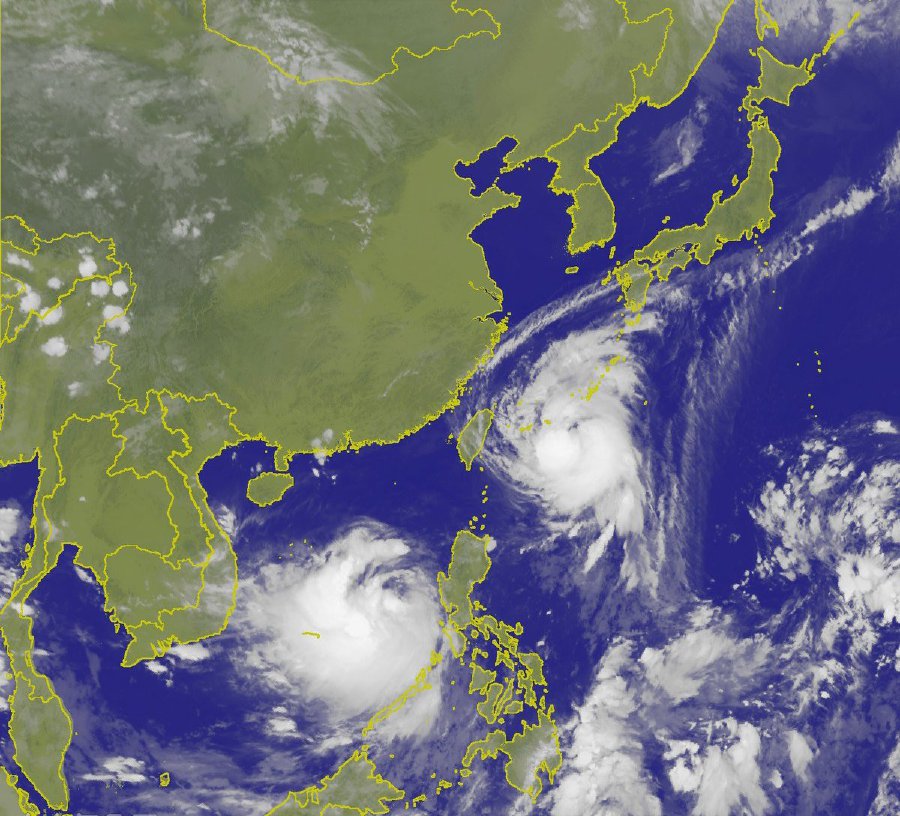
NASA-NOAA's Suomi NPP satellite saw Extra-Tropical Storm Talim on Sept. 18 at 0254 UTC over southwestern Japan. Credits: NOAA/NASA Goddard MODIS Rapid Response Team

19 September, 2017


Hundreds of thousands were evacuated Sunday after Tropical Storm Talim made landfall in Japan, packing strong winds and heavy rainfall.
Nearly a foot of rain has already fallen in parts of eastern Kyushu, according to weather.com meteorologist Chris Dolce.

The torrential downpours could result in flooding and landslides.
In Kagoshima Prefecture, 230,000 people were evacuated, EuroNews.com reports.

Nearly 60,000 were issued evacuation orders in parts of Oita and Miyazaki prefectures, the Japan Times reports.

"The mountains seem about to collapse," a resident of Asakura told EuroNews.
"I think it will be okay but I am still scared."

A 71-year-old man is reportedly missing in Oita prefecture, where more than 500 people have become stranded, Xinhuanet reports.

Operators of bullet trains reported stoppages due to power outages and the heavy rain, Bloomberg reports.

The storm caused flight cancellations Saturday after bringing high winds and significant rainfall to the country's southern islands.

China Airlines, Tigerair Taiwan and EVA Airways have all cancelled flights, Focus Taiwan reports. The storm will continue to affect Japan with heavy rain and gusty winds as it accelerates northeastward according to Dolce.

Before hitting mainland Japan, Talim caused more than 18,000 homes in the city of Miyako, located about 1,000 miles southwest of Tokyo and home to 54,000 people, to lose power.

The highest 24-hour rainfall total in more than 40 years was recorded there Wednesday.

Trees were uprooted and power lines knocked down on Miyako Island and its neighbouring islands, the Ryukyu Shimpo newspaper reported to SBS.com.
The Miyako-Jima Island airport clocked a wind gust of 108 mph late Wednesday, local time, and picked up a 24-hour record rainfall of 18.86 inches, notes weather.com meteorologist Jon Erdman. Over a two-day period, Miyako-Jima picked up 20.30 inches, also a record, there, dating to 1977. Talim pushed high surf toward the coast of China, where more than 200,000 people had been evacuated from the Chinese provinces of Fujian and Zhejiang of Wednesday.
According to UNTV, the storm had already raised the tide more than 30 feet in Yuhuan, in the Zhejiang province. "We've evacuated all the people here, providing them with daily supplies," said Yongxing Community Committee of Sansha City deputy director Zhao Heng.

Typhoon Doksuri tore through Vietnam this weekend killing 4 with almost 100,000 evacuated and 123,000 homes destroyed


Photo indianexpress.com
19 September, 2017

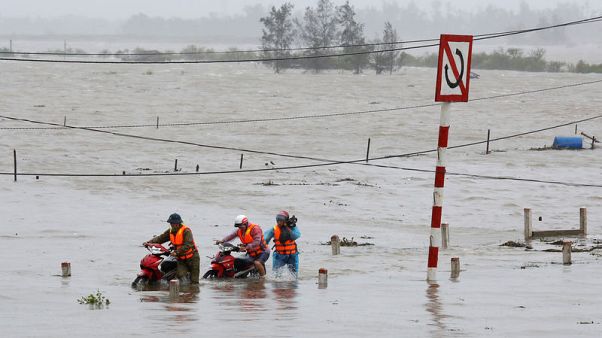
Shaken residents in central Vietnam were piecing their homes and businesses back together yesterday after a powerful typhoon hammered large swathes of the country's coast, leaving at least four people dead.

Typhoon Doksuri tore through Vietnam on Friday afternoon, reducing structures to piles of debris and knocking out electricity and telecommunications in several provinces, in one of the worst storms to hit the country in years.

Residents woke up yesterday to find widespread destruction in normally idyllic coastal communities popular among beachgoers.

"I sat inside my house, covering my ears, I didn't dare leave as I was so scared," said Ms Mai Thi Tinh, whose restaurant in Ha Tinh province was completely destroyed.

"The power is still off so we can't do anything.

I don't know how long it will take to recover."

At least four people were killed and eight injured, according to Vietnam's Disaster Management Authority.

Photo naijatwitter.com

Some 123,000 homes were damaged, and trees and power lines were torn down in five hard-hit provinces, the disaster agency said.

"The wind was so bad that I hid under the bed.

I'm old but I'm afraid of death," said 70-year-old retired teacher Tran Ngoc Khang.
Prime Minister Nguyen Xuan Phuc visited Ha Tinh province yesterday to survey the damage.

"We have to quickly mobilise forces to repair houses and damaged schools...
We have to ensure people can get back to normal life," he said on state-run Vietnam Television. Nearly 80,000 people were evacuated as the storm bore down, while the government deployed a quarter of a million troops and a fleet of vehicles and shpis.

Forecasters warned of a risk of flooding and landslides as the storm swept through the central and northern parts of the country.

Vietnam's central coast is routinely lashed by storms, especially during the tropical storm season from May to October.

Vietnam has already been hit by severe weather this year, with 140 people dead or missing in natural disasters since January, according to official figures.

After an unseasonal heatwave with temps well above 30deg C powerful storms kill 8 and injure 70 in Western Romania as winds reach 100km/h

Photo wacotrib.com

19 September, 2017


Eight people lost their lives and almost 70 were injured as powerful storms hit Western Romania on Sunday evening.

The wind reached speeds of up to 100 kilometers per hour bringing down hundreds of trees, electricity poles, and tearing household roofs.

The most affected areas were Timis and Arad counties, in Western Romania, where six people were killed in the storm.

In Timisoara, a woman died after being hit by the branches of a tree at the city zoo.

Another man lost his life after a billboard fell on his car, according to local Mediafax. Some 27 more people were injured in Timisoara, where the wind was so powerful that it even overturned trucks on the road.

Two people were also killed in Bistrita-Nasaud county, in Northern Romania.
One of them was hit by a tree in the city's park.

In Alba county, over 15,000 households were left without electricity as the powerful wind broke the electricity lines.

Six people were also injured in Alba.

Romania has experienced unusually hot weather for this time of year in the last few days, with temperatures reaching 34 degrees Celsius in the Southern regions on Sunday.

The weather is expected to turn bad in the next few days and rain may take over the country.


Friday, 15 September 2017

Two typhoons in Asia

Typhoon Talim veers away from Taiwan, moves towards Japan

Image result for Typhoon Talim veers away from Taiwan, moves towards Japan


TAIPEI (Reuters) - Taiwan will lift a shipping warning later on Thursday after Typhoon Talim veered away from the island and moved towards Japan but the capital, Taipei, and other cities can expect heavy rains from the storm, meteorologists said.

Some flight cancellations could also still be expected as northern Taiwan is lashed by heavy rain.

Talim had gained in strength since Wednesday as it approached Taiwan’s northern cities, according to the Central Weather Bureau (CWB), but it has now shifted north and will not make landfall in Taiwan.

It also might not hit the Chinese mainland as it veers towards Japan, the bureau said.

Japan’s southern Ryukyu Islands have begun to feel the effects, with reports that strong winds and heavy rainfall have caused power outages as the typhoon churns in the sea between Taiwan and Japan with maximum sustained wind speeds at sea of 173 km/h (107 mph) and gusts of up to 209 km/h (130 mph).

The bureau said bad weather associated with the storm will still be felt in the north and northeast of Taiwan on Thursday.

The effects of Talim have been less severe than many international weather authorities predicted, including those of us in Taiwan, the U.S., China and Japan,” said CWB forecaster Wang Chun-hsien.

Talim had been expected to move towards China, where more than 200,000 people in Fujian and Zhejiang provinces have been evacuated, China’s official Xinhua news agency said.

The CWB’s current forecast projected the storm to veer northeast towards Japan’s western coast. However, it could change course again.

China Airlines and EVA Airways, Taiwan’s two largest carriers, said they would cancel some international flights later on Thursday due to the storm’s proximity.

Typhoons are a seasonal routine for Taiwan, but the island has stepped up preparations since Typhoon Morakat in 2009. Morakat was the deadliest typhoon to hit the island in recorded history, killing close to 700 people, most in landslides.


Wind and rain lash Vietnam as Typhoon Doksuri hits

Image result for Wind and rain lash Vietnam as Typhoon Doksuri hits

HA TINH, Vietnam (Reuters) - Typhoon Doksuri lashed central Vietnam on Friday, tearing roofs from houses, knocking out power and causing localized flooding, in the country’s most powerful storm in years.

Nearly 80,000 people have been evacuated from coastal regions in preparation for Doksuri. Winds exceeded 130 km (80 miles) per hour, according to Vietnam’s meteorological agency.

The state news agency said the roofs had been blown from 260 houses in the ancient city of Hue. Electricity was knocked out in parts of Ha Tinh and Quang Binh provinces after the wind brought down power lines along with trees and billboards.

Four fishing boats sank as they were making their way back to land, state radio said. Many fishermen had dragged their small wooden boats into the streets of coastal towns to try to stop them from being carried away.

Streets in parts of Ha Tinh province were flooded. Airlines said 46 flights were canceled between the capital, Hanoi, in northern Vietnam and Ho Chi Minh City, the commercial hub in the south.

Vietnam’s disaster prevention committee has said the storm surge from Doksuri could be greater than 2 meters (2.2 yards).


There were no immediate reports of deaths on Friday, but one person drowned in central Vietnam on Thursday after flooding caused by heavy rain that preceded Doksuri.


Vietnam often suffers from destructive storms. Floods in northern Vietnam killed at least 26 people and washed away hundreds of homes in August. Last year, more than 200 people were killed in storms


Typhoon Doksuri Forces 100,000 to Evacuate in Vietnam; Officials Warn Storm Could Be Worst in a Decade   

Sean Breslin 

14 September, 2017


As many as 100,000 residents have been ordered to evacuate their homes in Vietnam ahead of Typhoon Doksuri, according to local media.

An offshore fishing ban was issued as the storm got closer to the Asian nation of 93 million, Channel News Asia said. Tens of thousands fled Ha Tinh province along the country's north-central coast, and officials said they would do anything necessary to move citizens away from the water before the storm arrived.

"(We) have to evacuate people resolutely, even forcefully ... to avoid any casualties when the storm arrives," Vietnam's Deputy Prime Minister Trinh Dinh Dung said Thursday.


Doksuri has already been a deadly storm. At least four died and six others are missing in the Philippines after the typhoon dumped heavy rain and buffeted the archipelago with strong winds, according to the New York Times. After the storm struck the Philippines, dozens of flights were canceled in central Vietnam and the evacuations of residents in Ha Tinh and Quang Binh were ordered, the report added.

Authorities have told residents to expect heavy rain, flooding and landslides from the storm, according to the Bangkok Post. Doksuri is expected to make landfall Friday, the Vietnamese national weather forecast center told the Associated Press. Officials issued a category four "danger" warning – the second-highest warning level – and said the storm could be the worst to hit the country in a decade, Channel News Asia also reported.

"We have prepared sandbags to put on the roof so when the storm arrives it won't be blown off," Ha Tinh resident Nguyen Thi Que told state-controlled news site Zing.

Vietnam also put 250,000 soldiers on standby ahead of Doksuri, Channel News Asia said.

It has been a deadly year for severe weather in Vietnam; some 140 people have been killed or remain missing as a result of flooding and other extreme weather, the report added.

Meanwhile on the other side of the Pacific


Hurricane Max weakens rapidly over southern Mexico


14 September, 2017


Hurricane Max slammed into Mexico's southern Pacific coast Thursday, dumping rain on an area east of the resort city of Acapulco before rapidly weakening into a tropical storm as it moved inland into Guerrero state.


The coastline where Max made landfall is sparsely populated and dotted with fishing villages.


Guerrero Gov. Hector Astudillo warned that the rains would continue all night. Near Acapulco, the government worked frantically to widen a channel to the sea to prevent a coastal lagoon from flooding.


The U.S. National Hurricane Center had earlier issued a hurricane warning for the coastline between Zihuatanejo and Punta Maldonado, and said the storm could bring "life-threatening flash floods and rainfall" to Guerrero and Oaxaca states.


The center said the rapidly weakening Max should become a tropical depression in the coming hours before dissipating early Friday.


Max had maximum sustained winds of 45 mph (70 kph) and was located about 80 miles (130 kilometers) east of Acapulco Thursday night. It was heading toward the east at 7 mph (11 kph), the hurricane center reported.


Acapulco, about 30 miles (60 kilometers) from where the hurricane made landfall, was hit by strong winds and rain that blew down some branches on the city's coastal boulevard.


Also Thursday, Tropical Storm Norma formed farther out to the west in the Pacific and was expected to strengthen and head toward the resort-studded Baja California Peninsula.


Norma was located about 360 miles (580 kilometers) south of the twin resorts of Los Cabos at the peninsula's southern tip.


The storm had winds of 45 mph (75 kph) and was moving north at 6 mph (9 kph). On that track Norma could be at hurricane strength near Los Cabos by Sunday or Monday.


Los Cabos was hit by Tropical Storm Lidia in early September, causing at least five deaths.