SUPER TYPHOON GONI - WIND REACHES SPEED OF 374 KM/H
Sam Carana, via Facebook
Super Typhoon Goni approaches the Philippines on October 31, 2020 18:00 UTC at 850 mb with wind reaching speeds as high as 374 km per hour or 232 miles per hour (at green circle).
Instantaneous Wind Power Density was as high as 551.5 kW per square meter.
Earlier that day, at 12:00 UTC, Super Typhoon Goni came with waves as high as 16.09 meter or 52.8 feet (second image, at green circle).
If you didn't have outlets like this blog or TruNews you would never know any of this. While the world moves towards war we are distracted, either by trivia or by propaganda
defence officials have agreed to hasten talks during a potential crisis this week in a move described by analysts as crucial to preventing all-out conflict between the world’s largest militaries.
Just days before the United States presidential election and amid
, the two militaries discussed crisis prevention and management on Wednesday and Thursday via teleconference for the first meeting of the Crisis Communications Working Group.
“The two sides agreed on the importance of establishing mechanisms for timely communication during a crisis, as well as the need to maintain regular communication channels to prevent crisis and conduct post-crisis assessment,” the Pentagon said in a statement.
Participants in the working group included representatives of the office of the Secretary of Defence, the Joint Staff and the US Indo-Pacific Command. The Chinese participants included representatives of the Central Military Commission’s Office for International Military Cooperation, the CMC Joint Staff Department and the PLA Southern Theatre Command.
With the situation in the West Pacific remaining tense due to the increasing US military provocations against China in recent months, the Chinese Defense Ministry said on Thursday that the US Department of Defense has communicated with China and will make more communication and cooperation to ease tensions and avoid conflict.
Chinese experts said that although some senior officials in the Trump administration are making more and more provocations to endanger bilateral ties as well as the regional security in the West Pacific, leaders of the US Defense Department remained cautious and reasonable, because they know how terrifying it could be if China and the US become involved in a military conflict.
Chinese Defense Ministry spokesperson Wu Qian said on Thursday's monthly press conference that the militaries of China and the US were currently holding a virtual meeting for crisis communication, and more exchanges and consultations on issues including maritime military security will be held by the year's end.
Experts believe the announcement aims to cool down military tensions with solid facts. Although some officials in the Trump administration want to create an "October surprise" by using US-China tensions, they are unlikely to risk a war with China, so military provocations by the US might be reduced.
American troops in Japan are ready to land on the disputed Senkaku Islands to fight off a Chinese invasion, a senior general has said, in the most explicit US commitment so far to defending the territory.
Lieutenant-General Kevin Schneider, commander of US Forces Japan, was speaking after landing on a Japanese aircraft carrier during ten-day military exercises between US and Japanese forces that are explicitly directed atdeterring Chinese aggressionin the East China Sea.
U.S. Secretary of State Mike Pompeo is wrapping up a tour of Southeast and South Asia in Vietnam, where he again sought to counter the growing influence of China, only days before President Donald Trump faces challenger and former Vice President Joe Biden in the U.S. presidential election.
"We look forward to continuing to work together to build on our relationship and to make the region -- throughout Southeast Asia, Asia and the Indo-Pacific -- safe and peaceful and prosperous," Pompeo said on Friday, according to Reuters, in greeting Vietnamese Prime Minister Nguyen Xuan Phuc in Hanoi.
Phuc responded by asking for "sincere cooperation" from the U.S. in support of a peaceful region and progress in trade and investment ties, Reuters said.
to seize control of some of its waterways if a war breaks out between Beijing and Washington, according to former Philippine armed forces chief Emmanuel Bautista.
The archipelago’s strategic location with routes linking the
and Pacific Ocean make it a “key terrain”, the retired general told an online forum last week.
He identified these routes as the Bashi Channel next to the Batanes and Babuyan islands near Taiwan, and the straits of Mindoro, Cebu, Balabac, San Bernardino and Surigao within the Philippine Islands.
“If you want to influence the South China Sea, you need to control these chokepoints,” he said.
A “gray zone” arms race is emerging in the South China Sea, where China’s rising use of para-military forces to assert its contested claims could soon be met by rival maritime militias from Southeast Asia.
Long outgunned and outspent by China, the Philippines is now moving to create its own militia sea forces, to be known as the Cafgu Active Auxiliary Service (CAAS), to protect its interests in adjacent waters including within its vast exclusive economic zone (EEZ).
The military move, if approved, would come in response to China’s growing use of para-military forces, including the use of small vessels to systematically swarm contested islands and strategic features, to intrude ever deeper into Philippine-claimed waters
The tank traps on the beaches of Kinmen Island are a stark reminder that Taiwan lives under the constant threat of a Chinese invasion — and fears of a conflict breaking out are now at their highest in decades.
Democratic Taiwan has learned to live with the warnings of Beijing’s authoritarian leaders that they are ready and willing to seize a place it views as part of its territory.
But that background static has reached hard-to-ignore levels recently with China’s jets now crossing into Taiwan’s defense zone at an unprecedented rate and the People’s Liberation Army releasing propaganda simulating an invasion of the island — and even an attack on U.S. bases in Guam.
Not since the mid-1990s, when China fired missiles into the Taiwan Strait during a moment of heightened tension, has the saber-rattling been so loud.
As the United States’ commitment to defending Taiwan is questioned amid Chinese threats of invasion, once unimaginable proposals are being debated in the American military — including the return of U.S. forces to Taiwan.
While U.S. forces withdrew from Taiwan after Washington formalized diplomatic ties with Beijing in 1979, a new proposal to re-establish the United States’ first permanent ground forces is stirring controversy.
The proposal, which was published in an essay in the September-October edition of the U.S. Army Military Review, a professional journal of the army, contends that to effectively deter an increasingly capable Chinese military from an attack on Taiwan, the United States “needs to posture its forces in a way that would inevitably trigger a larger conflict and make plain its commitment to Taiwanese defense.”
“The United States needs to consider basing ground forces in Taiwan if it is committed to defending Taiwanese sovereignty,” according to the proposal.
Combat-credible heavy U.S. forces in Taiwan, the essay said, could not only go far in repelling a Chinese cross-strait operation, “but also serve as a tripwire that would inevitably trigger a wider conflict not acceptable to China.”
The pawns of the Grand Chessboard are starting to move much more boldly – in an unpredicted by the punditry decision the Philippines have asked U.S. forces to leave their islands indefinitely. It was impossible to think even 10 or 15 years ago that a country as completely militarily helpless as the Philippines would dare to stand up to Uncle Sam, but now this has become a reality. In a microcosm this move could be blamed on Duterte’s fiery personal character, or as some sort of fluke, but this is a growing trend that will probably continue for at least the next few years, in which ideology actually plays a major unseen role.
The Philippines are a poor troubled island nation that is starting to get its house in order thanks mostly to a powerful charismatic central figure, but if we look at the country through the lens of “Geopolitics 101” then we can see that this nation has more value than one would think due to its location.
If we can believe the maps of U.S. base locations presented to us via various forms of media then we can see that even without Manila’s blessing the U.S. still dominates the Pacific Ocean as a whole. Total control of the Atlantic and the Pacific thanks to the Allied victory in WWII has been very good for America to say the least and they need to continue to maintain it. The thing that makes losing the Philippines bad for the U.S. is that it could seriously erode the U.S.’s ability to create a naval blockade around China.
Although not stated explicitly one of the key reasons for China’s Belt and Road Initiative is the fact that at any moment Washington could completely cut off China’s sea trade. One of the reasons why Chinese goods have come to dominate the global market is due to the rise of cheap shipping costs. Loading a massive boat with cheap goods allows China to make things on the other half of the world for far less, than American workers can in their own country. But without waterways (cheap shipping), the Chinese advantage would be smashed and China as we know it today could be shattered.
The Philippines are located in the region of a potential Naval blockade, meaning that without them suffocating the Chinese from a naval standpoint becomes much more difficult and perhaps impossible. Not surprisingly, Duterte has been accused of making a pivot to China so perhaps his motivations for getting rid of the U.S. are not entirely morality based, but then again as a weak country the only way for the Philippines to matter is by playing great powers against themselves (or perhaps Chinese bribe money is sweeter). It is very possible that for this group of islands to have any sovereignty it needs bigger players to be fighting over
It may be too early to say because of Duterte’s bold move “the dominos are falling” but this is not the only nation that is trying to or has successfully removed U.S./NATO forces. The Kyrgyz ended foreign operations in their country most of which used their largest airport in Bishkek. (On a personal note it was very odd and humiliating to see an international airport with more foreign military planes in Bishkek than civilian, there were also many accusations of bad behavior towards locals including one alleged murder). Surprisingly even the Iraqi government which was essentially built by the U.S. has asked their forces to leave the country after the assassination of Iranian General Soleimani. Even the Mainstream Media admits that tens of thousands of Japanese have protested against U.S. bases in other country (again due to alleged abuse of locals). However, the government of Japan has made no formal requests to have U.S. forces leave, but quietly the constitutional ban on having a real military is being worn away by Tokyo as it has seen its first round of military expansion in decades.
In order for the U.S. to maintain its global military presence it needs to take a look at cases in which occupation has been seen as a positive by locals – South Korea. No matter what one’s personal feelings are about the North and South, the simple fact of the matter is that the Korean Peninsula is an all or nothing game. If the U.S. were to give up on Seoul then the North (with Chinese support) would come down and “unify” the nation. Many South Koreans are happy with the status quo and without the USA being around their lives are going to change quickly violently (and from their perspective) for the worse. This American necessity is not felt in Iraq, the Philippines or Kyrgyzstan, but if Washington wants to remain in these places they need to create it. The Cold War is over and America’s classic strategy of “side with Capitalism and you’ll get jeans and cars” is longer an option as the Chinese and to a lesser extent the Russians can also offer up plenty of Materialism.
A key factor in the Cold War division of the world was ideology. This allowed the U.S. and USSR to put foreign bases all over the planet. The collapse of America’s ideological strength will continue to allow uppity nations to one-by-one say good-bye forever. “The Russian are bad” or “we’ll give you Materialism” are no longer enough to justify foreign occupation. Washington needs to come up with a new ideological strategy and the Russians and Chinese need to be ready for this and at the same time continue to chip away at the failing Monopolar World. When locals see people they perceive as foreigners dominated their country, walking around with guns and occasionally abusing locals there needs to be some sort of grand justification for this.
In the Philippines there is not such justification. There is no reason from Manila’s or the man-on-the-street’s perspective that American troops should be in their country. The ideological erosion of American values after the U.S. victory in the Cold War must be stopped if the U.S. wants to remain the only global hyperpower.
Rescuers
continued to search for survivors from Monday's quake, centered just
50 miles northwest of Manila, the capital. That quake killed at least
16 people, according to The Associated Press. So far, it appears that
Tuesday's 6.4 magnitude quake in Eastern Samar province did not cause
any casualties or major damage.
Monday's
magnitude 6.1 quake struck Pampanga province, north of Manila,
shortly after 5 p.m. local time. A supermarket collapsed in the
municipality of Porac, killing at least five people, the AP reports.
Others remain missing.
One
man was reportedly pulled out alive from the supermarket's rubble on
Tuesday morning, to cheers from onlookers.
"We're
all very happy, many clapped their hands in relief because we're
still finding survivors after several hours," Porac Councilor
Maynard Lapid told the AP.
Fifteen
of the dead were in Pampanga province, the state news service
reported. Philippine President Rodrigo Duterte arrived in the
affected area Tuesday, where he inspected the damage and was briefed
on the situation.
Aurelia
Daeng, 65, told Reuters that she was in her family's drugstore when
Monday's quake struck. "It was very strong. It was our first
time experiencing something like that," she told the news
service. "This one, it's terrifying."
Monday's
quake also shook the nation's capital, where panicked office workers
fled buildings, some in hard hats, according to Reuters. Video showed
water cascading from a skyscraper's rooftop pool in Manila.
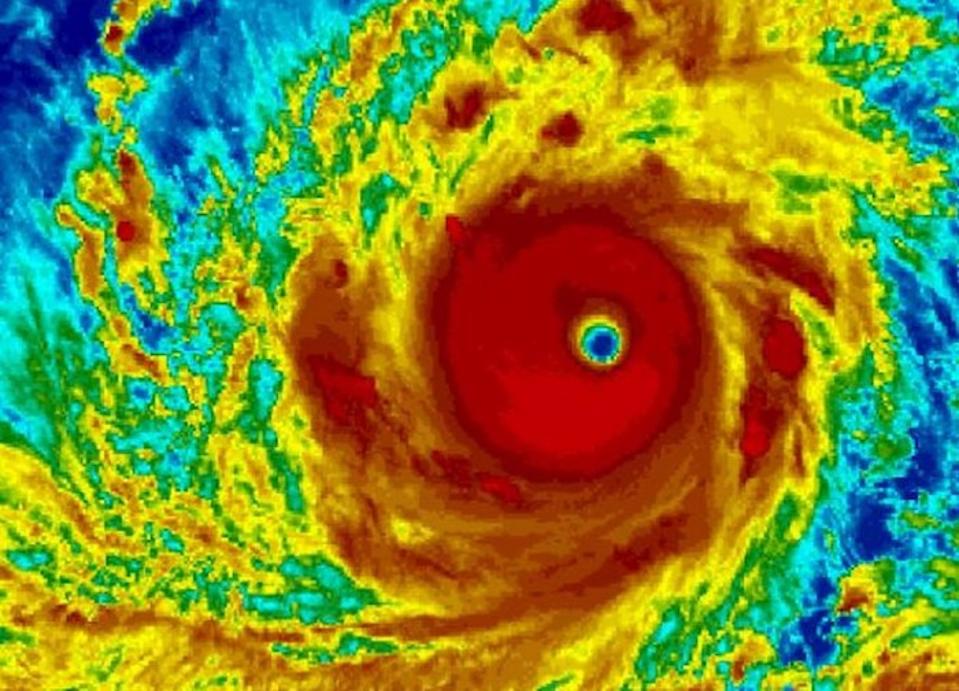
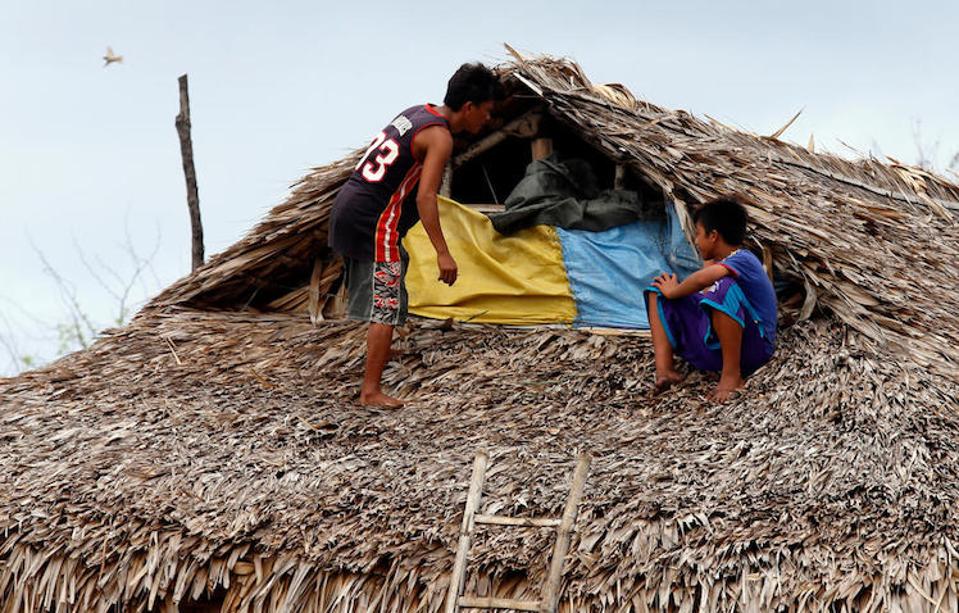
An estimated 5 million people — nearly half of them children — are facing threats of strong winds, heavy rains, flooding and landslides as Super Typhoon Mangkhut — known as Ompong in the Philippines — descends on Luzon, the largest and most populous island in the Philippines. UNICEF is closely monitoring the massive storm's progress.
5 million people — nearly half of them children — are in the storm's path
Residents in high-risk and low-lying areas have been urged to evacuate. With maximum sustained winds of 165 mph, Mangkhut/Ompong is being called a "textbook super typhoon." The storm is expected to producelife-threatening storm surges up to 19 feet along the coastline.
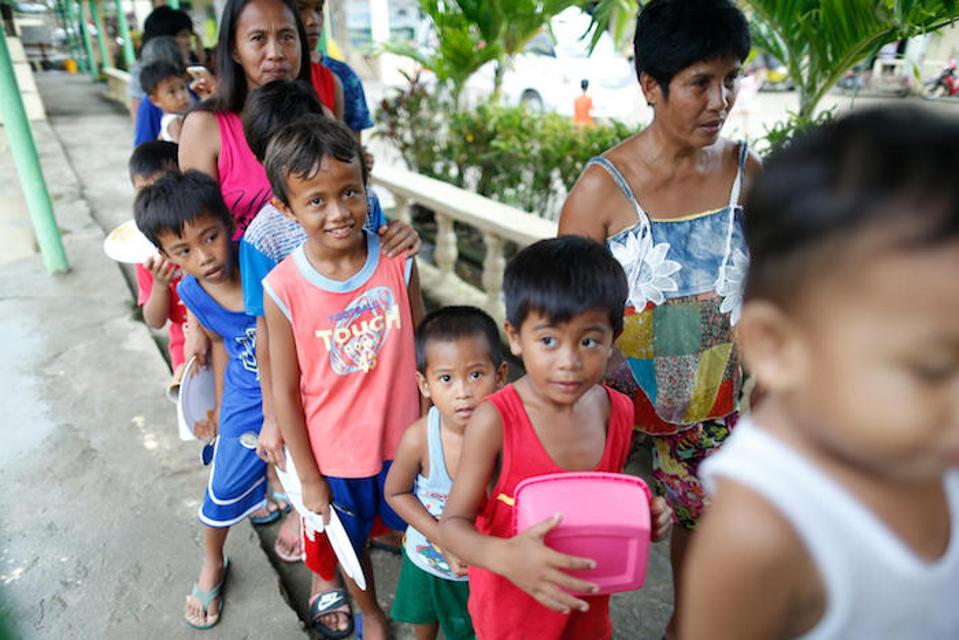
Schools and government buildings have been turned into shelters to house the thousands of evacuees fleeing the storm. Mangkhut/Ompong also poses a major risk to property, destroying or damaging houses, schools, health centers, roads, bridges, crops and farmland.
A collision course with Luzon, the Philippines' most populous island
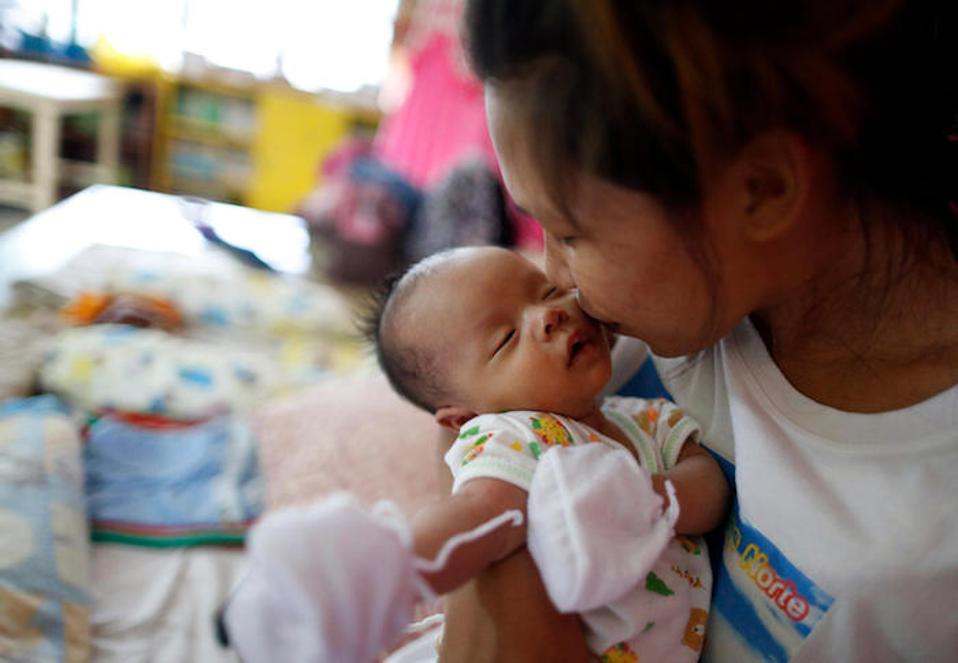
Children are the most vulnerable in any emergency situation
"Children are the most vulnerable in an emergency situation," said UNICEF Representative Lotta Sylwander. "UNICEF stands ready to provide support and assistance to the Philippine Government and to local government units in the affected areas to respond to this brewing storm. We also call on parents and local communities to heed the government's call to evacuate to safe spaces, to ensure populations — especially children, pregnant mothers and vulnerable families — are safe from possible damage brought about by Ompong."
Across the globe, when emergencies strike, UNICEF is always committed to helping children and families survive and stay safe and healthy. Last year alone, UNICEF responded to 337 humanitarian emergencies — from conflicts to natural disasters — in 102 countries. Working with local partners, UNICEF steps up where help is needed most, delivering urgently needed supplies like safe drinking water, hygiene sanitation kits and medicines. Trained staff offer psychosocial support and educational materials to get children back to learning and playing as soon as possible.

 Posts