Showing posts with label Scotland. Show all posts

Wednesday, 5 December 2018

Salmon have DISAPPEARED in Scotland


Another tipping point breached: Salmon have disappeared in Scotland: Not a single salmon caught during the entire season.

Photo salmon-fishing-scotland.blogspot.com
the Big Wobble,
26 November, 2018


It used to be the best salmon fishing in the world

But now Global warming is being blamed for Scotland's worst salmon season in living memory.

Some beats on famous rivers like the Spey and the Nith recorded not a single salmon caught during the entire season.

Just two salmon were caught on the River Fyne in Argyll this year, where once more than 700 were caught each season.

The number of fish caught by anglers has been so low that some estates have stopped selling permits for once-popular beats because there is no fish to catch.
Tourism has been hit, sales of salmon tackle have slumped and ghillies have lost their jobs.

Experts believe rising temperatures blamed on global warming have badly hit the salmon's feeding grounds with related changes in current patterns also affecting their migration.

Roger Brook, director of the Argyll Fisheries Trust, said: "Salmon are in decline everywhere but they're declining more on the west coast of Scotland and they're declining more the further down the west coast you go.

"It's dreadful now in Argyll.

It's a crisis in Argyll.

I don't know whether it's too late now to put it right."
This year's cold spring and the summer heatwave created the "perfect storm" for poor fishing conditions.

But experts believe the steep decline in numbers since the 1960s is deep-rooted and warn the future is bleak.

Survival rates for salmon at sea have fallen as low as 3 per cent with global warming and ocean fishing fleets among the likely causes.

Professor Ken Whelan, a leading salmon specialist investigating the downturn, said: "Absolutely there's a crisis in salmon fishing.

What we have now is a situation where you're looking at very modest numbers of fish coming back and you really can't afford to lose any from any kind of man-made effects."

Andrew Flitcroft, the editor of Trout and Salmon magazine, said: "This has been undoubtedly the worst season I've witnessed in my lifetime."

In January 2017, the collapse of Alaska's salmon fishing caught the headlines.
 
The federal government issued a disaster declaration for Alaska's pink salmon fishery and several other salmon and crab fisheries along the West Coast. 
Gov. Bill Walker requested the declaration after the 2016 pink salmon harvests in Kodiak, Prince William Sound, Chignik and lower Cook Inlet came in far below forecast, the Alaska Journal of Commerce reported.
 
The estimated value of Kodiak's catch in 2016 was about $2 million, compared to a five-year average of $14.6 million.
 
The disaster declaration granted by U.S. Secretary of Commerce Penny Pritzker on Wednesday gives Kodiak and the other Alaska fisheries the ability to seek disaster relief assistance from Congress because of the unexpected large decreases in salmon returns.

Sunday, 26 June 2016

60% support for Scottish independence after Brexit vote

Some 60% of Scots Would Vote for Scottish Independence Amid Brexit Results

Almost 60 percent of Scots would vote for independence from the United Kingdom (UK), following the UK referendum on the exit from the European Union (EU), known as Brexit, a survey conducted for the publication of Sunday Post revealed


26 June, 2016


MOSCOW (Sputnik) — On Thursday, the United Kingdom held a referendum on its membership of the European Union. In Scotland, 1.6 million voted in favor of remaining part of the European Union, while about one million voted in favor of leaving.

The survey which was conducted a few hours after the official announcement of the Brexit results reveals that 59 percent of Scots would support the idea of the ​​independence from the UK.


In a referendum held in September 2014 Scottish voters backed remaining within the UK by a margin of 55 percent to 45 percent.

The new survey results show that pro-independence sentiments are gaining popularity among the elderly population, with 47 percent of senior citizens saying they would now vote for an independent Scotland.

On June 15, the Ipsos MORI poll for STV news held in Scotland indicated that 47 percent of respondents agree that there should be a new vote on Scottish independence within two years if the United Kingdom decides to leave the European Union, whereas 45 percent believe otherwise.
On Saturday, Scotland First Minister Nicola Sturgeon announced that the Scottish cabinet has agreed to begin work on legislation to enable another independence referendum.
New Scotland referendum officially on the table after 62% of Scottish vote remain. Situation has indeed changed
 

Saturday, 9 May 2015

Election fraud in the UK elections

The British elections delivered Scotland to the ...and England to the Tories. Labour has been trounced and the Lib Dem and UKIP leaders have lost their seats. A result heaven sent to the Tory fascists of David Cameron. Look forward to further breakdown and the eventual breakup of the “United” Kingdom.

As we reported lat September it is highly liklely the results in the Scottish referendum last September were rigged


Was the UK election rigged?

Polling station
 Photograph: Ian Forsyth/Getty Images
200,000 + Voting papers were reported missing from a van that was stolen in London bound for Hastings/Eastbourne, East Sussex, Then the Tories gain seats and the number of votes total the same amount of missing votes in 30+ of those seats, giving them the majority rule, it was rigged.


Here is my coverage from the Scottish referendum


Police Probe Glasgow Voter Fraud Allegations

And media coverage


Dozens queue to complain in Hackney, wrong ballot papers issued in two wards of Bournemouth, and some expats say forms arrived too late


More than 200,000 ballot papers have gone missing after a van containing them was stolen by thieves ahead of next week's election.

72,300 of the blank election ballot papers were intended for the Hastings and Rye constituency in East Sussex, while the remaining 130,000 were headed to Eastbourne.


Election 2015: Van carrying 200,000 Hastings and Eastbourne ballot papers stolen


ballot paper
The papers were being taken to constituencies Hastings and Rye and Eastbourne
29 April, 2015

A van carrying more than 200,000 ballot papers destined for two constituencies in East Sussex has been stolen.

The papers were due to arrive in Eastbourne and Hastings and Rye ahead of the 7 May general election, but were taken in the Dagenham area of London before the van arrived.

Metropolitan Police do not believe the van was purposely targeted because of its contents, but it instead was merely a coincidence.

More than 70,000 of the papers were meant for Hastings. The council has spoken to the Electoral Commission and said it has taken steps to ensure the ballot papers will now not be used in the upcoming elections and for replacement ones to be delivered.

A spokesperson said: "We've spoken to the Metropolitan Police and it very much seems like it was a case of mistaken identity – we don't believe they deliberately targeted the ballot papers. I expect there are some very disappointed thieves out there somewhere.

"We will be able to tell if the papers used were stolen. The ones that we will be using will be different to the ones that were stolen."

A further 130,000 papers due for Eastbourne were also lost as the van was taken. The council also said they will be printing a different colour batch of replacement papers in order to prevent fraud.

A spokesperson added: "One unavoidable anomaly is that the previously issued postal vote ballot papers are on the original colours and can be posted or handed in at a polling station right up to close of poll on 7 May. However, these ballots have to be returned with the associated paperwork and go through a rigorous scanning process separate to the other ballots. They are not placed in ballot boxes at the polling stations.

"We have taken advice from the Electoral Commission and are confident that the steps we have implemented will ensure the accurate and successful completion of the elections on 7 May."

I will leave you with comments from Lee Nelson of UK Collapse Radio

You ain't seen nothing yet! These election results have been no shock for me, been saying that tories will win all year. Cameron was sneaky enough to lie until blue in the face that he's stopped an economic collapse, well he didn't and hasn't. What has kept our country afloat is a nation of consumers and wage slaves, rise in immigration (again, part of the long term economic plan) and using sanctions and tests to force people into low paid menial work, and lets not forget the £375 billion dumped into the banking system. If you think the last five years were bad then you're gonna love the next five. 


Which puts us well on track for the next rounds of violence and public anger, more austerity and more division within the communities and country as the country implodes.

This all changes nothing in relation to collapse of human industrial civilisation, the push to infinite growth will carry on regardless and will continue to destroy what little chance of survival we as a species could of hoped for. We have already taken a big step away from the opportunity of a controlled demolition and we are at the mercy of mother nature, and we are gonna lose.

So many people walk around with their heads in the sand, don't know and don't care about what's happening in the world around us, to busy with their own self centered little ego tripping lives or to dumb from listening to ill informed peers......


Most imformed New Zealanders and Australians will know about Crosby andTextor.


There were several critics from within the Conservative party of how the secretive Australian was masterminding their campaign. Not any more.

Thursday, 15 January 2015

Peak oil

Something tells me Mike Ruppert would be humming.
Oil price crash threatens the future of the North Sea oilfields
Scottish government pledges to try to preserve offshore energy sector jobs, with prices having fallen 60% in the last six months

oil price
Are the lights set to go out for oil production in the North Sea? Analysts claim it could happen if the oil price drops by just a few more dollars. Photograph: Sean Smith for the Guardian

14 January, 2015

The potential impact of the oil price slump on Scotland was underlined as a leading energy expert warned on Wednesday that North Sea oilfields could be shut down if the oil price fell by just a few more dollars.

The rising sense of crisis about the plummeting price – which has fallen 60% in the last six months – prompted the Scottish government to promise an emergency taskforce to try to preserve jobs in the offshore energy sector.

Meanwhile, Mark Carney, the governor of the Bank of England warned that the Scottish economy was heading for a “negative shock”.

The oil industry consultancy Wood Mackenzie said that at the current price for Brent blend, of $46 a barrel, some UK production was already failing to break even, and further falls could endanger output.

Robert Plummer, a research analyst with the firm, said that at $50 a barrel oil production was costing more than its value in 17 countries, including the US and UK.

Plummer told Scottish Energy News: “Once the oil price reaches these levels producers have a sometimes complex decision to continue producing, losing money on every barrel produced, or to halt production, which will reduce supply.”

Concern about cutbacks was heightened Wednesday when Shell announced it was scrapping a $6.4bn (£4.2bn) energy project in the Middle East because it was no longer commercial, with oil prices falling to six-year lows.

Plummer said that if oil prices fell to $40, a small but significant part of global supply would become “cash negative”, although some operators would choose to keep producing oil at a loss rather than stop production.

Large companies such as Shell, BP and Chevron, have already spoken of hundreds of job cuts in Aberdeen amid expectations that overall spending across the industry will be slashed by anywhere up to 30% for the coming year.

Carney told MPs on the Treasury select committee that falling oil prices would deal a blow to the Scottish economy but that the decline would be offset by the boost to the wider British economy due to the falling petrol prices. “It is net positive for the UK economy,” he said. “It is a negative shock to the Scottish economy, which is substantially mitigated … by the nature of the economic union that exists.”

He was asked about an estimate suggesting the price slide could wipe £6bn off Scottish GDP, but he said the bank had not calculated the hit to Scotland.

Nicola Sturgeon, Scotland’s first minister, outlined plans to set up a new energy jobs taskforce with the aim of maintaining jobs and mitigating the impact of losses.

Speaking on a flying visit to the oil capital of Aberdeen she said: “The recent drop in the price of a barrel of crude oil, combined with the mismanagement of oil and gas fiscal policy by the UK government, and other challenges facing the industry, pose a threat to a number of jobs.

The North Sea has made an enormous contribution to the Scottish and UK economies over the last 40 years. It is now vital, in order to prolong the life of the industry beyond 2050 and maximise economic benefits, that the UK government maintains the momentum for fiscal and regulatory change in the oil and gas sector.”

The SNP has faced criticism in recent weeks for its failure to respond to the growing crisis in Scotland’s North Sea oil and gas business.

Labour accused SNP ministers of “sitting on their hands” and failing to tackle the impact of plummeting oil prices, which fell to $115 before the summer.

Scottish Labour’s finance spokeswoman, Jackie Baillie, said: “The falling oil price is the biggest threat to jobs in Scotland since [the close of the steel plant at] Ravenscraig, and the Scottish government has been silent on the issue.”

The chancellor, George Osborne, used the autumn statement last month to cut taxes but the industry has said his initiatives did not go far enough.

Treasury officials have since been asked to work on a wider-ranging package of measures. A recent report for the Department for Business, Innovation and Skills had warned that 35,000 jobs would be at risk over the next five years – and that was largely concluded before the latest oil price slump.

Drilling levels had collapsed in the North Sea even when prices exceeded $100, partly because of rising costs and a hike in taxes by the government three years ago.

With production falling fast over the last 10 years the government requested an industry review by the oil industry figure Sir Ian Wood; it called for a huge shake-up of regulation in the sector.

Shell, in a joint statement with its partner, Qatar Petroleum, about the Ras Laffan petrochemical scheme, said: “The decision came after a careful and thorough evaluation of commercial quotations from EPC [engineering, procurement and construction] bidders, which showed high capital costs rendering it commercially unfeasible, particularly in the current economic climate prevailing in the energy industry.”

The cutbacks in the oil and gas industry are global. Shell also just unveiled plans to slash 300 jobs at its Albian tar sands project in Alberta, while Suncor, another company in Canada, said it would make 1,000 redundancies.

Carney warned on Wednesday of other financial risks linked to the falling oil price. He said it could lead to defaults on debt repayments by emerging market economies, although he refused to name which ones.

He also pointed to risks in the junk bond markets, which fund US shale exploration, reiterating a point made in the Bank of England’s twice yearly update on risks to the financial system published last month.


Saturday, 10 January 2015

Record Winds Rage Over Scotland

Jet Stream Re-Mangled: Record Winds Rage Over Scotland As Polar Amplification Ramps Up Yet Again

9 January, 2015

Polar Amplification January 9
(Polar Amplification on Friday January 9, 2014 plainly visible in the GFS summary. Another warmer than average day for the Arctic in a warming world. Image source:Climate Reanalyzer.)
For the Arctic, it’s another much warmer than normal day…

Temperature anomalies for the region spiked to 3.55 degrees Celsius above the, already hotter than normal, 1979-2000 average. And a swath of the Arctic Ocean stretching from Greenland to Siberia experienced extraordinary 15-22 C above average temperatures.

It’s another day of Arctic Amplification — the fourth in an ongoing progression this week. Another day of extreme dipole temperature anomalies. And another day of record-setting weather. All symptoms, plain as day, of a world undergoing a fit of rapid, human-induced heating.

Warmth in The High Arctic Drives the Cold Out

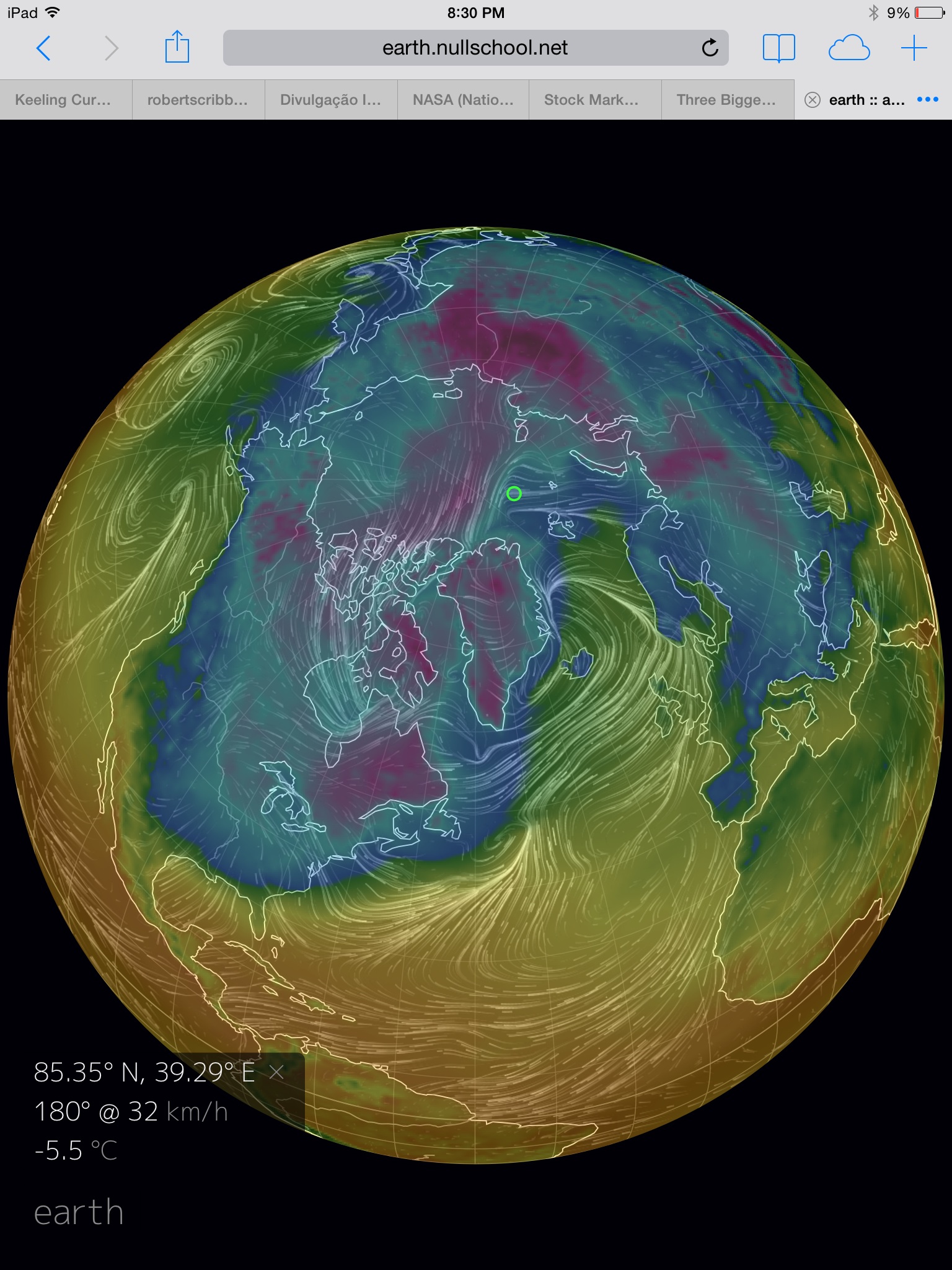
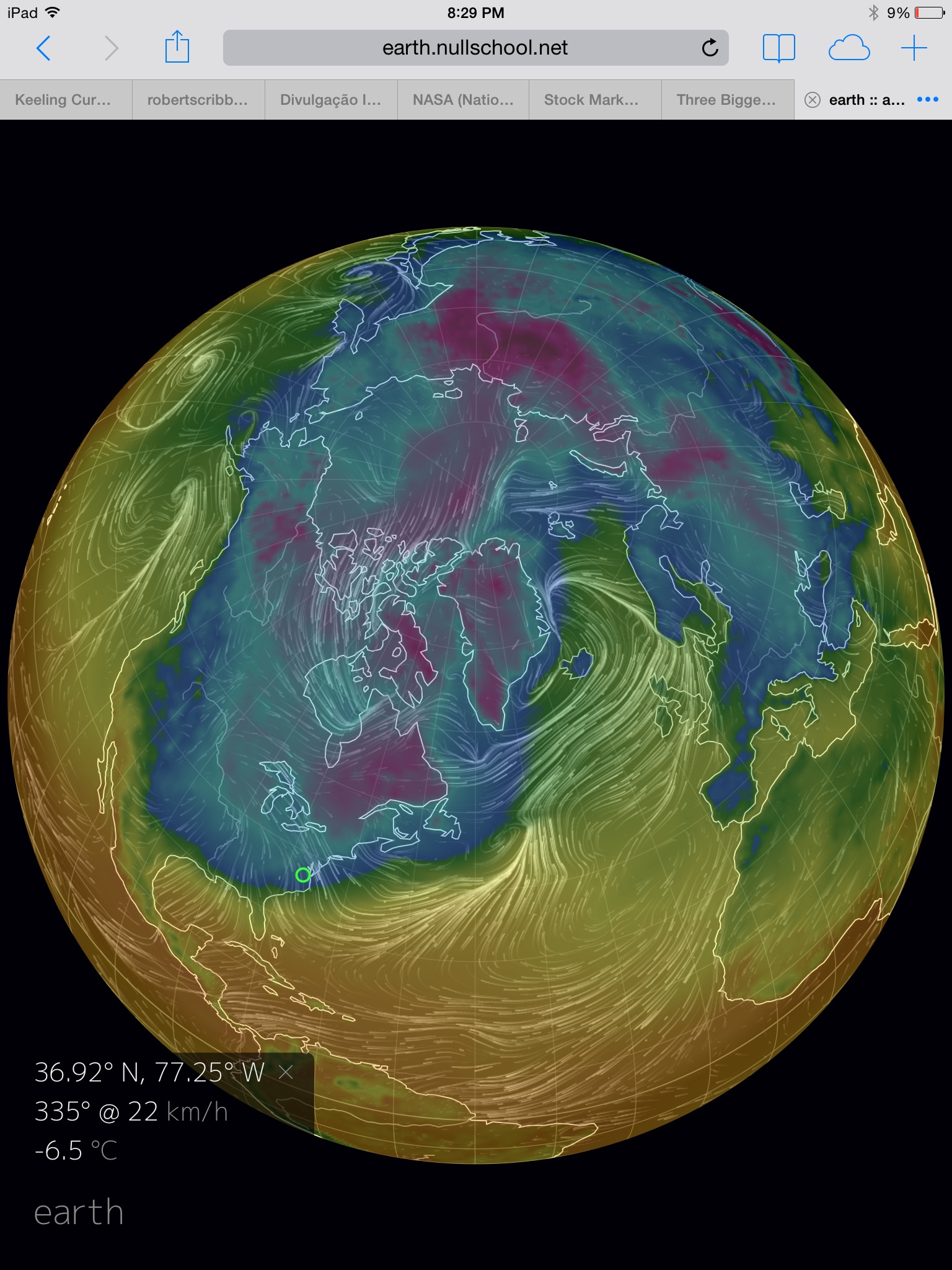
Last night, while studying Earth Nullschool, I found a temperature of 27 F near Zemlya — an Island in the Arctic Ocean off Siberia. The night before last, I captured these two pictures — one of a region a few hundred miles south of the North Pole and well north of Svalbard at 22 F and another of the surface temperature near Richmond, Virginia at 20 F.

imageimage
(Top frame temperature at 85.3 North, 39.2 East. Bottom frame temperature at 36.9 North and 77.3 West. In other words — it’s warmer up north than down south. Image source: Earth Nullschool. Data Source: NOAA, Global Forecast System Model.)
In other words, it was warmer just off Santa’s front porch than it was thousands of miles to the south in Richmond, VA.

In technical meteorological parlance there’s a term for such warm north, cold south temperature variations — dipole. In this case, it’s a cold North American Continent and a warm Atlantic Ocean pushing much higher than average temperatures far into the Arctic.

Jet Stream Re-Mangled — High Amplitude Jet Stream Waves

Such a warm airs surging north forcing cold airs south arrangement can result in some pretty extreme waviness in the Jet Stream. The kind of waviness that Dr. Jennifer Francis has warned is set off by just the kind of Arctic warming we witnessed this week.
And, as we can plainly see in the map below, we have an extraordinary meridional pattern in the Jet Stream occurring in perfect coordination with the current instance of polar heating:

image
(Last night’s extaordinarily high amplitude Jet Stream pattern. Note the greatly intensified storm track setting Scottland directly into its sights. Image source: Earth Nullschool. Data Source: NOAA, Global Forecast System Model and various.)
I suppose some may call this kind of instance circumstantial. But what a circumstance, especially when one considers the plainly obvious and visible mechanism of the current polar temperature spike, the subsequent southward displacement of warm air from the polar zone, and the related warm air invasion flooding up from the North Atlantic into the heat compromised polar core.
It’s as easy to see as 1,2,3.

This re-arranging of air masses has re-instated the kind of circulation pattern around Greenland we warned about during late November of 2014. A kind of off-center displacement of air masses that shoves cold toward hot and can result in some rather extreme weather.

Record-Setting Winds over Scotland Last Night

Dr. Francis has also mentioned this resulting heightened severe weather potential in her research. And she can count herself among such visionaries as Dr. James Hansen who warned of ramping storm intensity resulting from a combined polar amplification and melting and softening of the remaining great glaciers in Greenland and, later, Antarctica.

Unfortunately, the more recent polar amplification episode did set off a spate of rather extreme weather in Scotland. The North Atlantic storm track intensified as temperature differentials ramped up. On Tuesday, a 930 mb low bombed out between Greenland and Iceland. Fed by a massive meridional air-flow, this storm soon generated very strong winds raging across the North Atlantic.

By last night, these winds roared throughout Scotland, peaking at 113 miles per hour — a new all-time record for the Northern Isles since wind measures began in 1970.

In a return to the kind of extreme weather that battered the UK for much of the winter of 2013-2014, trees were torn down, power lines unmoored and roads and railways blocked. This, in turn, forced a wide-scale emergency response throughout Scotland after last night’s brutal battering by hurricane force winds. 
From the BBC:

The storm caused the suspension of all ScotRail trains, although some limited services are now running. More than 46,000 homes are currently without power as the Atlantic jet stream caused gusts of more 100mph(160km/h).

So the observational evidence is pretty clear. Here we have yet another instance where polar heating is driving some rather extreme Jet Stream changes coupled with related instances of record extreme weather. And as human-related warming continues to intensify, we are likely to see far worse instances than today’s minor episode.

Links:

Scientific Hat Tip to Dr. Jennifer Francis and James Hansen
Hat Tip to commenters JPL and DTLange


Alarm over Kara Sea 


permafrost thawing


Remember the big sinkhole on Yamal Peninsula discovered last summer? Scientists have now discovered leaking methane gas from the shelf west of Yamal. That is where Gazprom will drill

Kara Sea with Beloye Ostrov north of the Yamal Peninsula. 
9 January, 2015

If the temperature of the oceans increases by two degrees as suggested in some reports, it will accelerate the thawing to the extreme. A warming climate could lead to an explosive gas release from the shallow areas,” says PhD Alexei Portnov at Centre for Arctic Gas Hydrrate, Climate and Environment (CAGE) with the Arctic University of Norway in Tromsø.

Not far from the shores of the Yamal Peninsula is Gazprom planning for extensive drilling for more natural gas. Both the Leningradskoye- and Rusanovskoye fields are on the Western shelf of Yamal in the Kara Sea. In total, Gazprom plans to develop 20 offshore fields in the Kara Sea.

Portnov and his colleagues have recently published the results from studies done on the seafloor of the Kara Sea in the Russian Arctic. The results are scary reading: The West Yamal shelf is leaking at depths much shallower than previously believed. 
Researcher PhD Alexei Portnov. (Photo: CAGE)
Significant amount of gas is leaking at depths between 20 and 50 meters,” the paper reads.
Terrestrial Arctic is always frozen, average ground temperatures are low in Siberia which maintains permafrost down to 600-800 meters ground depth. But the ocean is another matter. Bottom water temperature is usually close to or above zero. Theoretically, therefore, we could never have thick permafrost under the sea,” says Portnov “However, 20 000 years ago, during the last glacial maximum, the sea level dropped to minus 120 meters. It means that today´s shallow shelf area was land. It was Siberia. And Siberia was frozen. The permafrost on the ocean floor today was established in that period,” says Portnov.
It is the permafrost that keeps the methane gas in the sediments. With warmer climate and warmer water in Arctic Oceans the permafrost layer is melting. It is also the permafrost under the seabed that stabilizes gas hydrates, ice-structures that usually need high pressure and low temperatures to form. 
Gas hydrates normally form in water depths over 300 meters, because they depend on high pressure. But under permafrost the gas hydrate may stay stable even where the pressure is not that high, because of the constantly low temperatures,” explains Alexei Portnov.
Gas hydrates contain huge amount of methane gas. It is destabilization of these that is believed to have caused the huge sinkholes that appeared as out of nowhere on the Yamal Peninsula last summer.
The study has discovered that gas is released in an area of at least 7,500 m2, with gas flares extending up to 25 meters in the water column. 
With a warmer climate, more permafrost will melt, and more methane gas will leak out. The fear is a “point of no return” where leakages of methane will continue to warm the climate even if all human-caused releases are stopped. 
Methane is a potent greenhouse gas, 28 times more powerful than CO2.

Under, you can see a video where scientits are climbing into the mysterious crater on the Yamal Peninsula. 


Planes flew from New York to London at near-supersonic speeds due to powerhouse jet stream


9 January, 2015

A jet stream roaring across the North Atlantic at more than 200 miles per hour early Thursday morning nearly succeeded in bringing back supersonic air travel for the New York to London route. Several flights from New York's John F. Kennedy International Airport made the trip from there to London's Heathrow Airport (from gate to gate) in about five hours and 20 minutes.

British Airways Flight 114, a Boeing 777-200 jet, took off from JFK at 10:50 p.m. ET, and landed at 9:06 a.m. local time, taking just five hours 16 minutes to make a trip that typically takes more than six hours.

At one point, according to Flight Aware, the jet was traveling at a groundspeed, which is the speed at which the plane is traveling relative to ground level, of 745 miles per hour. For comparison, the speed of sound at sea level is 761 miles per hour.


British Airways Flight
IMAGE: FLIGHTAWARE.COM

In
In other words, the 777 helped British Airways live up to its legacy of operating the Concorde aircraft on that route until 2003.


(The actual airspeed of the 777 was considerably lower, though, and the plane was traveling within normal design limits, below the speed of sound at altitude, according to Flight Aware data.)