Showing posts with label oil industry. Show all posts

Sunday, 6 October 2019

Even Putin Is Now Worried About Climate Change


Putin changes 
course on climate 
change


4 October, 2019


Why Vladimir Putin Suddenly Believes in Global Warming
 – Julian Lee


President Vladimir Putin needs to go green quickly to stop the permafrost from melting, so that Russian oil and gas companies can keep pumping the hydrocarbons that are warming the planet and making the permafrost melt.
Even I’m struggling with the warped logic of that one, but it’s the conclusion I’ve reached from Russia’s sudden ratification of the Paris climate accord and from reading the latest report of the Intergovernmental Panel on Climate Change.


Until now, climate change has been seen as a “good thing” for Russia — at least in part. Warming waters have opened up the Northern Sea Route across the top of the country and made it practical, if not necessarily economic, to search for and exploit oil and gas resources beneath the Arctic seas. Who remembers the Shtokman gas project?
Yet the warming that is opening up the Arctic seas may be starting to have a less beneficial effect on the frozen landmass of northern Russia, the heartland of the country’s oil and gas development and production.


Monday, 8 October 2018

The oil wars


Despite the president’s Alzheimers or narcissism (or because of it? He is capable of saying things that are brutally true that others’ would dare.

Saudi Arabia can survive ‘2,000 years’ without US help & not face civil war like America – MBS

Saudi Arabia can survive ‘2,000 years’ without US help & not face civil war like America – MBS

RT,
6 Octoer, 2018

Saudi society fully supports the royals and those few fringe extremist elements who stir trouble are being dealt with, believes crown prince Mohammed bin Salman, who claimed the kingdom can survive for 2,000 years on its own.


Known in the West by his initials MBS, the crown prince may, as he said, ‘love’ working with the US and Trump but, when it comes to thinking of examples of successful managers of social change, he is decidedly ‘America last.’ Any drastic financial, political and legal reforms come with a hefty price tag, he emphasized, drawing parallels with the history of the United States.

“...if you look at the United States of America, when for example they wanted to free the slaves. What was the price? Civil war. It divided America for a few years. Thousands, tens of thousands of people died to win freedom for the slaves,” Bin Salman told Bloomberg, in a wide-ranging interview published Friday.


“Here we are trying to get rid of extremism and terrorism without civil war, without stopping the country from growing, with continuous progress in all elements,” the crown prince added. “So if there is a small price in that area, it’s better than paying a big debt to do that move.”

Two weeks? Try 2,000 years!


Bin Salman brushed off US President Donald Trump’s somewhat humiliating comments about Saudi Arabia perishing within two weeks without American support, saying that his kingdom existed decades before the US and will need “something like around 2,000 years to maybe face some dangers.”
 

“Actually, we will pay nothing for our security," the prince firmly stated, explaining that since Trump’s statements were clearly addressed to a domestic audience he did not find them offensive.


“We believe that all the armaments we have from the United States of America are paid for, it’s not free armament,” he reiterated. Explaining that, after Trump became US president, Saudi Arabia has already agreed to procure nearly 60 percent of its arms from Washington, he emphasized that Riyadh owes nothing extra because it always pays for weapons supplies in cash.


“I love working with him. I really like working with him,” bin Salman said of Trump, calling his comments a “one percent”disagreement between allies.

Saudis aren’t scared, only 1,500 ‘extremists’ arrested in 3 years


Bin Salman has been the public face of “reforms” that Riyadh has embarked on to diversify its economy and relax some of its laws – such as allowing women to drive, for example – since he became crown prince of Saudi Arabia in 2017.
Asked about discontent with the pace of those reforms and why some Saudis seem afraid to speak to journalists, bin Salman said they shouldn’t be and that only those “extremists” who organize street protests or cooperate with foreign “intelligence agencies” should fear imminent arrest. In the course of “fighting extremism, fighting terrorism” over the past three years, only “about 1,500” people have been arrested, he claimed, comparing it to 50,000 in Turkey after the attempted military coup there.


Anyone shown to have “links with intelligence against Saudi Arabia or extremism or terrorists” will face Saudi law, bin Salman stated. “We have do to this. We cannot fight extremists having 500 or 700 extremists on the streets recruiting people.” He named Iran and Qatar as the main suspects.


While the Salafist Saudi Kingdom has long been at odds with the predominantly Shia Islamic Republic on the other side of the Gulf, relations with Qatar have soured in recent years. Riyadh and its allies declared a blockade of the peninsular monarchy in June 2107, accusing Qatar, the owners of Al Jazeera, of secretly collaborating with Iran and of supporting Islamic State (IS, formerly ISIS/ISIL) and other terrorists. The tensions show no signs of ending anytime soon.


Saudi Arabia Tells Trump No More Oil

  • This is a risk for Saudi Arabia, because Saudi Arabia has always depended a great deal on the United States
  • the Trump administration has its answer--Saudi Arabia does not intend to deploy any more of its vaunted spare capacity to counter rising prices

5 October, 2018

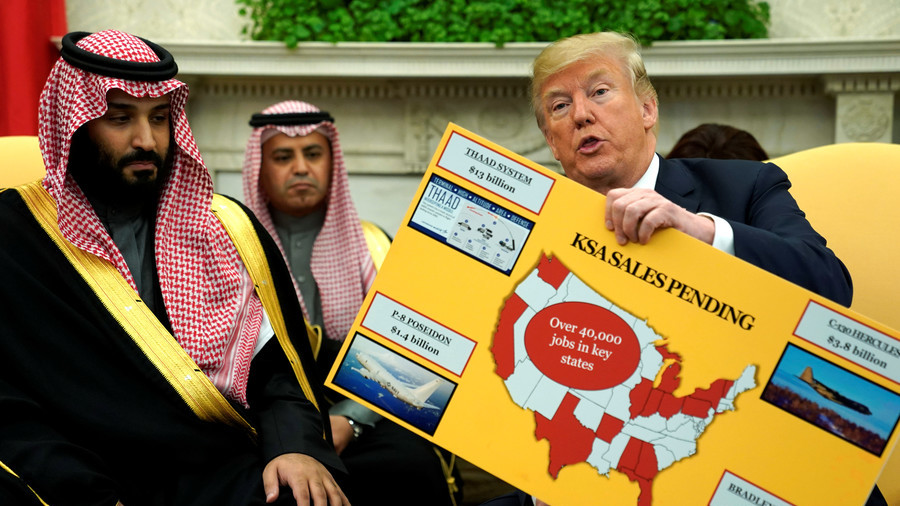
Saudi Arabian Crown Prince Mohammad bin Salman responded publicly to President Donald Trump's recent spate of Tweets and statements concerning oil. While the President has been asking for Saudi Arabia to increase oil production to flood the market and keep prices down, the prince said no. This is a risk for Saudi Arabia, because Saudi Arabia has always depended a great deal on the United States --even its currency is pegged directly to the U.S. dollar--and the Trump administration has shown that it will take a hard stance on economic issues even with its closest allies.


President Donald Trump meets with Saudi Crown Prince Mohammed bin Salman in the Oval Office of the White House, Tuesday, March 20, 2018, in Washington. (AP Photo/Evan Vucci)

This week, oil prices reached highs not seen in four years. The international benchmark, Brent, hit $86 per barrel and the U.S. benchmark, WTI jumped to over $76 per barrel. U.S. President Donald Trump has been unrelenting in his public and private pressure on OPEC and Saudi Arabia to produce more oil and lower prices. After all, from his perspective, the increase in prices is a result of his new sanctions against Iran - which Saudi Arabia fully supports - and therefore, Saudi Arabia should deploy its spare capacity to ensure that American consumers don't face undue pain at the pump.

Saudi Arabian oil minister Khalid al Falih tried to reassure markets that Saudi Arabia would increase production but that the market is actually very well supplied. The 9% increase in oil prices over the past 3 months, he said, is the fault of financial speculators, not a lack of supply. He's right, but the market and the speculators didn't believe him.

That wasn't what the Trump administration wanted to hear, so the President ratcheted up his war of words during a rally in Mississippi. He delivered a low level threat to Saudi Arabia's King Salman when he said the following:

We protect Saudi Arabia. Would you say they're rich? And I love the King ... King Salman but I said 'King, we're protecting you. You might not be there for two weeks without us. You have to pay for your military.

Still, oil prices barely budged and the AAA reported that gasoline prices in the United States have reached their highest levels in 4 years.

Soon after, Saudi crown prince Mohammad bin Salman addressed global oil prices in an interview with Bloomberg where he said,

The request that America made to Saudi Arabia and other OPEC countries is to be sure that if there is any loss of supply from Iran, that we will supply that. And that happened....So we export as much as 2 barrels for any barrel that disappeared from Iran recently. So we did our job and more. We believe the higher price that we have in the last month, it’s not because of Iran. It’s mostly because of things happening in Canada, and Mexico, Libya, Venezuela and other countries that moved the price a little bit higher.

Now the Trump administration has its answer--Saudi Arabia does not intend to deploy any more of its vaunted spare capacity to counter rising prices . There is still the opportunity for more oil to come on to the market from other places - the neutral zone between Saudi Arabia and Kuwait, the United States, Canada, Iraq, Kazakhstan, Azerbaijan, Libya and Nigeria. But all of those will take some time and investment. Saudi Arabia could put another 500,000 barrels per day on the market tomorrow - if it wanted to. But according to the crown prince, it does not.

Now the ball is in President Trump's court.


Ellen R. Wald, Ph.D. is a historian and consultant on energy and geopolitics. She is the author of Saudi, Inc., president of Transversal Consulting & a Senior Fellow at the Atlantic Council


Kuwait Oil to U.S. Stops for 1st Time Since 1990-91 Gulf War
  • Kuwait is selling oil into Asia where it fetches higher prices
  • U.S. net imports of foreign oil have dropped to a 45-year low

2 October, 2018

Kuwait has all but stopped shipping crude to the U.S. for the first time since the aftermath of Saddam Hussein’s invasion in 1990, eroding an economic link between Washington and the Arab petro-monarchy.

The halt is the latest sign that booming demand for oil in Asia, particularly as the U.S. re-imposes sanctions on Iran, and rising supplies from America on the back of the shale revolution are re-drawing petroleum trade routes.


U.S. imports of Kuwaiti crude fell to zero over four weeks through late September, the first time that shipments have completely stopped since weekly data became available in June 2010, according to the U.S. Energy Information Administration. Based on monthly data, Kuwaiti shipments to the U.S. haven’t stopped since May 1992, when the OPEC producer was still recovering from oil-field fires ignited by retreating Iraqi troops in the first Gulf War.

Kuwait is diverting its barrels instead into the more lucrative Asian market, where prices are higher for the type of high-sulfur crude the small Middle Eastern nation pumps, according to a person familiar with the matter, who asked not to be identified because the matter isn’t public.

Kuwaiti oil fetches about $80 a barrel in Asia compared with about $79 in the U.S., according to Bloomberg calculations based on benchmark prices and the country’s official selling prices. Kuwaiti crude sells at about $76 a barrel in Europe.

“Iranian sanctions are providing a chance for others to sell more into Asia where prices are better than for sales into the U.S.,” Andy Lipow, president of consultant Lipow Oil Associates LLC, said in Houston.

While its shipments to the U.S. have plunged, Kuwait faces limits on its production due to a dispute with Saudi Arabia over shared oil fields along their border where both nations in the past pumped as much as 500,000 barrels a day. The shared fields in the so-called neutral zone halted production more than three years ago, though the two governments are in talks to reactivate them.

Kuwait Petroleum Corporation’s reduction of crude exports were "coordinated with U.S. and European clients," the company said in a statement on Kuwait News Agency (KUNA) website. The American market is "strategically important" and its supply contracts are "functional", the state-owned oil producer said.

Kuwait has typically exported about 80 percent of its oil to Asia, and those shipments are increasing with the ramp-up of operations at the Nghi Son Refinery and Petrochemical Co. in Vietnam. KPC co-owns the plant, which can process 200,000 barrels a day.


INDIA TO BUY 9 MILLION BARRELS OF IRANIAN OIL IN NOVEMBER DESPITE US SANCTIONS: MEDIA

India To Buy 9 Million Barrels Of Iranian Oil In November Despite US Sanctions: Media
An Iranian crude oil supertanker anchored off Singapore. IMAGE: REUTERS

India will buy 9 million barrels of Iranian oil in November despite US sanctions, Reuters reported on October 5 citing “two industrial sources”.
“Refiners have placed November nominations to lift 1.25 million tonnes [about 9 million barrels] of oil from Iran,” Reuters quoted one of the sources as saying.

According to the report, Indian Oil Corp will lift 6 million barrels of Iranian oil and Mangalore Refinery and Petrochemicals Ltd 3 million barrels.
The US sanctions targeting Iran’s oil sector are set to be imposed on November 4. The Trump adminsitration claims that the move is designed to limit the Iranian economic capabilities and thus its involvement in conflicts in Syria and Iraq. Furthermore, Washington hopes that this will force Teheran to request negotiations to reach a new “pro-US” deal on its missile and nuclear programs.
It’s intersting to note that on October 5, India reached with Russia a contract on deliver of S-400 air defense systems. This move also came despite US threats to impose sanctions on any power buying Russian weapons and military equipment.


India’s purchases of US crude oil have fallen by 75 percent over the past four months as the subcontinent stocks up on Iranian crude, Reuters has reported.

Thursday, 16 June 2016

Global oil markets

Global market may face oil shortage in 3-5yrs – Rosneft CEO


© Spencer Platt / Getty Images / AFP
© Spencer Platt / Getty Images / AFP


RT,
15 June, 2016


The oil market is reaching a balance faster than analysts predicted and a period of sustained oil price rises is not far off, according to Rosneft CEO Igor Sechin. He added that low investment may cause oil shortages in three to five years.

The logo of the Organization of the Petroleum Exporting Countries (OPEC) is pictured at its headquarters in Vienna, Austria © Heinz-Peter Bade

"According to analysts, the average oil price is expected at $40-45 per barrel in 2016. Oil demand in the world continues to grow, while production, primarily in the US, decreases,” Sechin said in an interview with Italian business newspaper Il Sole 24.


Oil prices have almost doubled since the January lows, without any agreement between world producers, said Sechin. “It indicates the fundamental stability of the oil market. Moreover, the oil market is reaching its balance quicker than analysts had predicted.”


The head of Rosneft said the global market may face an oil shortage in three to five years and producers might need a deal to share output increases and release strategic reserves.

Sechin also told the newspaper Rosneft wants to expand cooperation with Italy's Eni, which could further participate in Russia’s large-scale extraction projects. The two companies signed a strategic cooperation agreement in 2012 to jointly explore fields in the Russian offshore reserves of the Barents and Black Seas, and to exchange technology and staff.


The Russian oil producer and another partner Norway's Statoil hope to discover a large oil field in the Sea of Okhotsk, according to Sechin.

"Together with Norwegian partner Statoil we started drilling two exploratory wells in the Magadan-1 and Lisyansky areas in the Sea of Okhotsk… and we hope to find a deposit with resources of over 100 million tons of oil equivalent,” Sechin said Wednesday at the annual meeting of shareholders


Saudi efforts to 'modernise' its economy away from oil are just PR tactics - and the West is lapping them up
For years, oil analysts have suggested that Saudi reserves are nothing like the kingdom claims them to be

Robert Fisk

pp-obama-saudi-4-epa.jpg

28 April, 2016


Just like his adventure in Yemen, Saudi Arabia’s young Deputy Crown Prince Mohamed bin Salman got it all wrong this week. It’s not Saudi Arabia which suffers from “oil addiction”, it’s we who are addicted. The unique Saudi drug – a cocktail of wealth, arrogance and infantile Puritanism – is far more dangerous, since it depends on the arithmetic (or myth) of its 716 billion barrels of oil reserves.

If this statistic is as ill-conceived as the Sunni Saudi war on Yemen’s Shiite Houthis, along with its massive civilian casualties, then Prince Mohamed’s ‘reforms’ – oiled (if that’s the right word) by a $2 trillion public investment fund which would take over ownership of the state oil company Aramco – will have to kick in long before the deadline of his ‘Vision 2030’.

For years, oil analysts have suggested that Saudi reserves are nothing like the kingdom claims them to be – a suggestion which became far more disturbing when Wikileaks disclosed last year that the US embassy in Riyadh had warned Washington that Saudi reserves could be 40 per cent less than we were led to believe.

The source was Sadad al-Husseini, the former head of exploration at Aramco. He later angrily explained that he’d been misrepresented by the American diplomats whose note, already at least six years old, contained “many patently inaccurate statements”. But back in 2004, oil analysts such as banker Matthew Simmons, after studying 200 technical papers on Saudi reserves, were saying that the country’s oil was “peaking”, its oil fields already damaged by using salt water to maintain pressure.

These rumours were only reinforced by Saudi Arabia’s refusal to reveal any details of their reserves. Thus, Prince Mohamed’s promise that a privatisation of Aramco would increase transparency and limit corruption will be viewed with the usual scepticism.

“People used to be unhappy that files and data of Aramco are undeclared,” he announced. “Today they will be transparent.” Well, maybe. But like the women who will supposedly have a larger economic role and the expatriates who will have an “improved status” in the country (though this surely doesn’t apply to the armies of Indian, Bangladeshi and Pakistani labourers in Saudi Arabia), we’ve heard it all before.

More than 30 years ago, the Sunday Times was taken in by Saudi claims of imminent reforms – inviting foreign journalists to the country to learn of striking changes has long been a Saudi routine – but even then reporters spotted the real problems of Riyadh and other Gulf capitals.

Martin Woollacott, one of my early heroes in the trade of reporting, wrote in 1981 that what he called “welfare stateism” in the region was producing a class of people “that is losing sight of the relationship between work and reward, that is incipiently anti-foreign… It is wide open for an ideology which would purge it of its unease and guilt without materially reducing its privileges. The youth of this alienated middle class and confused, if materially comfortable, working class is already showing signs of going in the most likely direction – toward political Islam.”

Woollacott, let us remember, was writing before the Taliban, before al-Qaeda, 20 years before 9/11 and its 15 Saudi hijackers – and 33 years before the emergence of Isis. And this, of course, was what was missing from Prince Mohamed’s triumphalism this week.

How can we believe in the massive planned changes in the social structures of Saudi Arabia, its emergence as a global investment power, when its monarchy is locked into eternal marriage with the same crude Wahabi faith practiced by the Taliban, al-Qaeda and Isis?

How can we listen to the good Prince saying that “we will not allow our country ever to be at the mercy of commodity price volatility or external markets” when Saudi Arabia is, in truth, at the mercy of an army of head-chopping, anti-Shiite puritans who support the assault on Yemen (which, with eight other nations in tow but with futile inappropriateness, was code-named “Operation Decisive Storm”), and regularly express their loathing of Iran, Syria, and many of the Shia Muslims in Lebanon?

No wonder, as the Washington Post revealed this month, the Saudis are spending millions on Washington’s top law, lobby and public relations companies to promote foreign investment in the Saudi economy – some of them, according to the paper, “tasked with coming up with content for the [Saudi Washington] embassy’s official Twitter and YouTube accounts”. The PR firm Qorvis, it turned out, also ran the Twitter account for the Syrian Opposition Coalition. Firms like Podesta, BGR Government Affairs, DLA Piper and Pillsbury Winthrop are trying to raise the Kingdom’s “visibility”.

After threats to release the missing – or “redacted” – pages of the 9/11 report, Barack Obama’s snotty criticism of Gulf “free riders” in his Atlantic magazine interview, and the Clinton-Sanders support for US families who want to sue foreign governments like Saudi Arabia for 9/11, these PR firms have a lot of work to do – and a lot of money to make.

Interestingly, the Podesta Group – with a $140,000 monthly contract with the Centre for Studies and Media Affairs at the Saudi Royal Court, was founded by Tony Podesta, a Democratic lobbyist and major contributor to La Clinton herself.

And all this without mentioning that oil still floats away from the Gulf at scarcely $35 a barrel. Or about the unchanging and absolute nature of the Saudi monarchy. Or about Saudi education reform or tax revenue. Or about a Saudi woman’s right to drive a car. Or about the decapitations that the Saudis still inflict on those who trade in drugs.

But not on those, of course, who suffer from that most dangerous of narcotics: oil addiction.


Thursday, 9 June 2016

A record world fossil fuel consumption

Forget the propaganda hype about renewable energy.

This is the reality. They have no intention of taking the foot off the pedal.

World Sets Record For Fossil Fuel Consumption


8 June, 2016


Each year in June two very important reports are released that provide a comprehensive view of the global energymarkets. The highlight of the recently released Renewables 2016 Global Status Report was that the world’s renewable energy production has never been higher. But the biggest takeaway from this year’s BP Statistical Review, released Wednesday, may be that the world’s fossil fuel consumption has also never been higher.


While global coal consumption did decline by 1% in 2015, the world set new consumption records for petroleum and natural gas. The net impact was a total increase in the world’s fossil fuel consumption of about 0.6%. That may not seem like much, but the net increase in fossil fuel consumption — the equivalent of 127 million metric tons of petroleum — was 2.6 times the overall increase in the consumption of renewables (48 million metric tons of oil equivalent).


As a result, despite the record increase in renewable consumption, global carbon dioxide emissions once again set a new all-time record high. Carbon dioxide emissions in 2015 were 36 million metric tons higher than in 2014, and marked the 6th straight year a new record high has been set. But perhaps the silver lining is that 2015 marked the 2nd straight year that the increase was smaller than the year before. Carbon dioxide emissions in 2013 were 505 million tons higher than in 2012, but then 2014 and 2015 respectively saw increases of 224 million metric tons and 36 million metric tons.


The primary reason for the slowdown in the growth of carbon dioxide emissions was the reduction in global coal consumption, but this was offset by a nearly 2 million barrel per day (bpd) increase in global oil consumption. Notably, oil consumption in the U.S. rose for the 3rd straight year, and is now at the highest levels since 2008. U.S. crude oil consumption is now back to within 6% of the all-time high consumption level set in 2005.


Global crude oil production increased by 2.8 million bpd in 2015, led by a 1 million bpd increase in U.S. production. The bulk of the rest of the world’s oil production increase came from OPEC, which cumulatively boosted production by 1.6 million bpd over 2015. BP’s definition of crude oil “includes crude oil, shale oil, oil sands and NGLs (natural gas liquids – the liquid content of natural gas where this is recovered separately).” Per this definition, the U.S. was the world’s top crude oil producer with 12.7 million bpd of oil production in 2015 (the highest production number ever recorded for the U.S.). Saudi Arabia was in 2nd place at 12.0 million bpd.

Friday, 3 June 2016

The world oil market - 06/02/2016


The Day That OPEC Died: Saudis Aim to Bankrupt Cartel, Seek Oil Monopoly
The oil export alliance failed to reach an agreement to cap production on Thursday. Saudi Energy Minister Khalid al-Falih again walked away from the table as the kingdom looks to consolidate market share.


2 June, 2016


The collapse in negotiations, along with a forward-looking refusal by the influential Saudi delegation to consider capping production, means a free-for-all fight for market share among the world’s oil producers that is all but certain to lead to collapsing oil prices.

Economic analysts have already raised the alarm that oil-export dependent countries like Venezuela, Algeria, and war-torn Libya, who lack access to global credit markets, will be unable to weather the storm, leading to humanitarian crises and widespread social strife.

Why is Saudi Arabia pushing for overproduction?

In February 2016, world oil prices cascaded to $27 per barrel, down from a July 2008 peak of $145 per barrel, as the Saudis ramped up oil production from a 2009 dip. In the midst of the 2008 market crash, Saudi’s top oil official, Deputy Crown Prince Mohammad bin Salman, called for the kingdom to immediately increase oil production to 11.5 million barrels of oil per day, and then to 12.5 million barrels daily by the end of 2016.

Energy market analysts initially scoffed at the aggressive move to undercut world oil prices, noting that Saudi Arabia’s own budget is dependent on a $66.70 per barrel oil price, with oil-extraction prices much higher for other OPEC countries. Market watchers predicted that Saudi Arabia would eventually push the oil alliance to cap production so as to keep prices at economically sustainable levels.

Saudi Arabia instead sought to increase market share when competitor peers were at their most vulnerable. North American oil producers, unlike Saudi Arabia, are not state-sponsored enterprises propped up by government handouts during down markets. When these US and Canadian oil resource industries fell into bankruptcy they became ripe for capture by foreign investors.

As energy analyst Marin Katusa told Radio Sputnik, Saudi Arabia has swooped into the North American energy market, through private equity firms, buying US and Canadian fracking technology and oil fields at pennies on the dollar.

Similarly, the kingdom looks to rebuff efforts by other OPEC members to expand oil market share. By pushing oil prices to their lowest level in years, the Saudis look to not only bankrupt Western oil companies, but also render insolvent entire oil producing states in order to snatch up foreign oil resources on the cheap.

Oil prices have recovered some in recent months, to $49 per barrel, due to oil disruptions in Canada after the Fort McMurray fire and oil extraction remaining offline in war-torn Syria, Iraq, and Nigeria.

Before Thursday’s OPEC meeting, Radio Sputnik sat down with Justin Dargin, Global Energy Scholar at the University of Oxford to discuss the fracturing of OPEC and the kingdom’s plans to corner oil energy markets.


Do OPEC member states face a fiscal crisis if an agreement is not reached?

"Yes, the breakeven oil price, which is the price that most OPEC member states need for their budgets to remain solvent, for most Gulf States, is between $80 and $100 per barrel, to maintain their budgetary outlays without having to go into some kind of major deficit," said Dargin. "The price currently is not viable for the long term, but I believe there is this sentiment for the OPEC members that prices may rebound in the future."

The analyst suggested that the market rebound over the past few months may be little more than an oasis for the smaller, fiscally-strapped OPEC member states, based primarily on seasonal demand changes, especially an increase in demand during the summer for air conditioning, travel, and leisure.

Dargin noted that he does not expect that market prices will recover in the near-term, citing a lack of structural changes in the market after prices collapsed to a low of $27 in February.

Can smaller OPEC member states survive these historically low prices?

"We can see already that in the case of Venezuela that they are not weathering it very well and they don’t have as much sway in OPEC as other members," said Dargin. "It will be quite hard for Venezuela and the smaller producers to encourage or force Saudi Arabia to come to an agreement."


"Many of these smaller oil producers like Venezuela and Algeria will not be able to weather the storm and it will be a very rough road ahead," he said.


The Tanker Armada Off Singapore Starts To Unload As Gasoline Goes Into Backwardation


2 June, 2016

The story of the unprecedented build up of various commodity tankers off the coast of Singapore, as well as everywhere else, has been duly covered here as well as the reasons behind it.

  Notably, two weeks ago we cautioned that with the contango no longer leading to profitable offshore storage of oil, many shipping companies would have to start offloading their cargo, or as we recently reported, have started incurring debt to fund said storage costs in hopes of avoiding shifting storage to land:


[S]toring oil on ships can be profitable when prices for future delivery of crude are higher than in spot market, a term structure known as contango, as long as future prices are high enough to offset tanker charter costs. However, with the one-year contango for Brent futures collapsing from $7.60 per barrel in January to just $4, far below the $10 that traders say is currently required to make floating storage financially attractive, suddenly parking oil offshore leads to storage losses. The same goes for WTI. 
At a charter cost of more than $40,000 a day for a Very Large Crude Carrier (VLCC) that can store 2 million barrels, the contango is nowhere near steep enough to make it profitable to store oil on tankers for sale at a later date.
This has led to a dramatic development in the oil market: debt-funded storage. Reuters writes that the need to store oil is so strong that traders are calling up banks to finance storage charters despite there being no profit in keeping fuel in tankers at current rates.
"We are receiving unusually high amounts of queries to finance storage charters," said a senior oil trade financier with a major bank in Asia. "These queries come from traders fully aware that they will not make a profit from storing the oil. This isn't a trade play, it's the oil market looking for places to store unsold fuel," he added.

As we warned, this is a very dangerous idea, and one which only works if oil prices continue rising; meanwhile it is only a matter of time before much of the 200 million barrels in oil parked offshore have to come back on land. But while we wait for the offshore oil glut to start being offloaded, one place where tankers are already delivering their wares is in the massively glutted gasoline market.
As Reuters reports, the number of tankers storing gasoline in waters off Singapore and Malaysia is dwindling as the fuel is sold off or shifted to cheaper onshore storage because of changes in forward delivery terms. With the economics of storing the fuel on tankers no longer viable due to a stronger forward market, there are now fewer than three long-range (LR) vessels holding gasoline in the area.

According to Reuters, citing traders, by the end of this week all remaining tankers could be discharged as the fuel's owners seek to sell the gasoline or store it more cheaply onshore. "It's not economical to store gasoline on ships now compared to before unless they have no buyers or land storage," said one Singapore-based gasoline trader with knowledge of the deals. Ships recently used to store gasoline were chartered by Statoil, Total, Vitol, Gunvor and Unipec, trading arm of China state refiner Sinope.

A typical LR tanker can store 55,000 to 75,000 tonnes of gasoline, depending on the size of the ship.
The reason why gasoline cargos are now starting to be aggressively offloaded is that the gasoline market forward price curve will flip to backwardation from July, meaning lower prices for future deliveries than for those sold immediately. That contrasts with the contango structure for the first-half of the year, with future deliveries more expensive than prompt cargoes, making it attractive to store gasoline for sale at a later date. A month ago, April in the forward curve was about $1 a barrel below May, with the June price about 30-40 cents below July. This contango will flip into backwardation from July.

The current weak market is in part due to an expected fall in gasoline imports from top regional consumer Indonesia, where state oil firm Pertamina is expected to reduce imports later this year as it negotiates deals to make more of the fuel. Even if the stored fuel is not sold, traders are shifting the gasoline into onshore tanks because they estimate it costs at least $100,000 less a month to hold the fuel on land.
According to Reuters, Chinese gasoline exports are also up more than 50 percent for the first four months of the year, although going forward, China could scale back its volumes. "Maintenance in May and June, particularly at (Chinese) teapot refiners will ... lower gasoline output," analysts at BMI Research said in a note to clients this week, while strong Chinese demand would help tighten the regional market.
Perhaps, but meanwhile Chinese gasoline stocks have never been greater as the country imports tremendous amounts of gas which apparently has no end-user demand, which is forcing China to store even more of it, both on land and in the sea.
And now that the curve is about to enter backwardation, all that gasoline stored at sea is about to come back to land, and bring China's gasoline stocks to even higher record levels.
In other words, the global glut is now not only at the crude and distillate level, but also in global gasoline stocks.
It also means that contrary to conventional wisdom that Chinese end demand is driving global consumption, China is merely storing copious amounts of the refined crude production chain in land and on sea, in hopes demand comes back. So far it is failing to do that. 
And now, we await for the crude contango to tighten further and force some of the 200 million barrels of oil held at sea to come back on shore, where it will have to be promptly sold as much of the world's onshore storage is practically full.

The Untold Story Behind 


Saudi Arabia’s 41-Year U.S. 


Debt Secret


How a legendary bond trader from Salomon Brothers brokered a do-or-die deal that reshaped U.S.-Saudi relations for generations.


Bloomberg,
30 May, 2016

Failure was not an option.

It was July 1974. A steady predawn drizzle had given way to overcast skies when William Simon, newly appointed U.S. Treasury secretary, and his deputy, Gerry Parsky, stepped onto an 8 a.m. flight from Andrews Air Force Base. On board, the mood was tense. That year, the oil crisis had hit home. An embargo by OPEC’s Arab nations—payback for U.S. military aid to the Israelis during the Yom Kippur War—quadrupled oil prices. Inflation soared, the stock market crashed, and the U.S. economy was in a tailspin.

Officially, Simon’s two-week trip was billed as a tour of economic diplomacy across Europe and the Middle East, full of the customary meet-and-greets and evening banquets. But the real mission, kept in strict confidence within President Richard Nixon’s inner circle, would take place during a four-day layover in the coastal city of Jeddah, Saudi Arabia.

The goal: neutralize crude oil as an economic weapon and find a way to persuade a hostile kingdom to finance America’s widening deficit with its newfound petrodollar wealth. And according to Parsky, Nixon made clear there was simply no coming back empty-handed. Failure would not only jeopardize America’s financial health but could also give the Soviet Union an opening to make further inroads into the Arab world....[ ]


To read article GO HERE