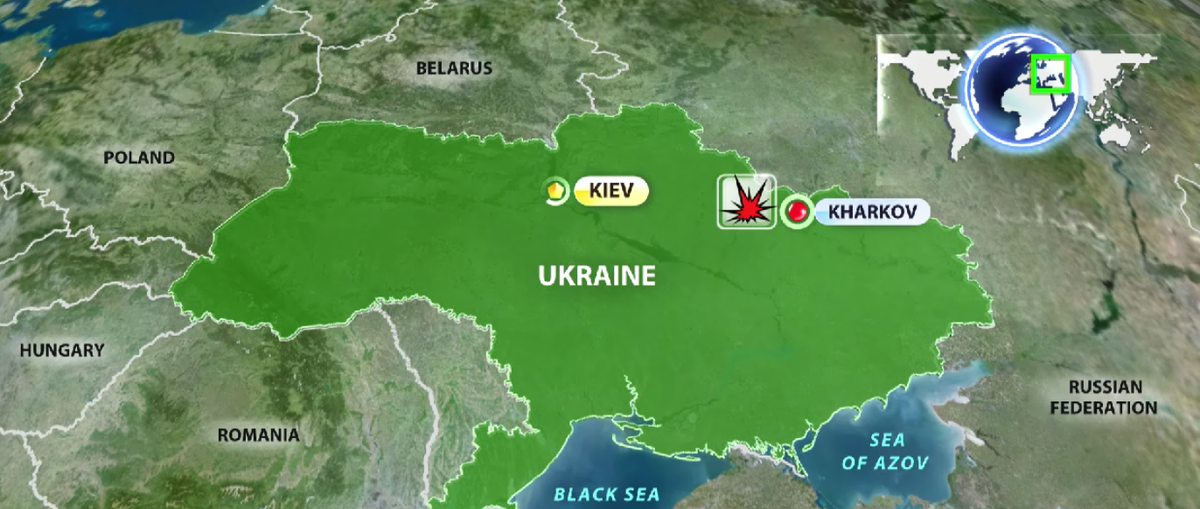
Pro-Russian
crowd storms regional HQ in Luhansk while Donetsk looks likely to
declare autonomy after May vote
Ukraine's
beleaguered government appeared to have lost control of law and order
in the east of the country on Tuesday, after police again failed to
stop a pro-Russian crowd from seizing a key administrative building.
Some
3,000 activists – some in masks and military fatigues – stormed
the regional government HQ in the eastern city of Luhansk. Police
supposed to guard the building let the crowd inside. A pro-Russian
militia had occupied the security service office in Luhansk, a town
of 465,000, just 20 miles (32km) from the Russian border.
The
unwillingness of security structures to defend public buildings from
separatist occupation has been a theme in eastern Ukraine since early
April. Supporters of the "Donetsk People's Republic" have
taken over a string of city halls and police stations. An armed unit
from Crimea – led by an alleged Russian colonel – has also
established a de facto military capital in the town of Slavyansk.
But
in recent days Kiev's tentative grip on local law enforcement in the
east appears to have slipped completely. In Luhansk riot police stood
passively in a courtyard, kettled in by separatists armed with bats
and hammers. "The regional leadership does not control its
police force," Stanislav Rechynsky, an aide to the interior
minister in Kiev, told Reuters. "The local police did nothing."
In
a statement on Tuesday, Ukraine's interim president, Oleksandr
Turchynov, said: "The vast majority of law enforcement officials
in the east are not able to fulfil their obligation to protect our
citizens."
On
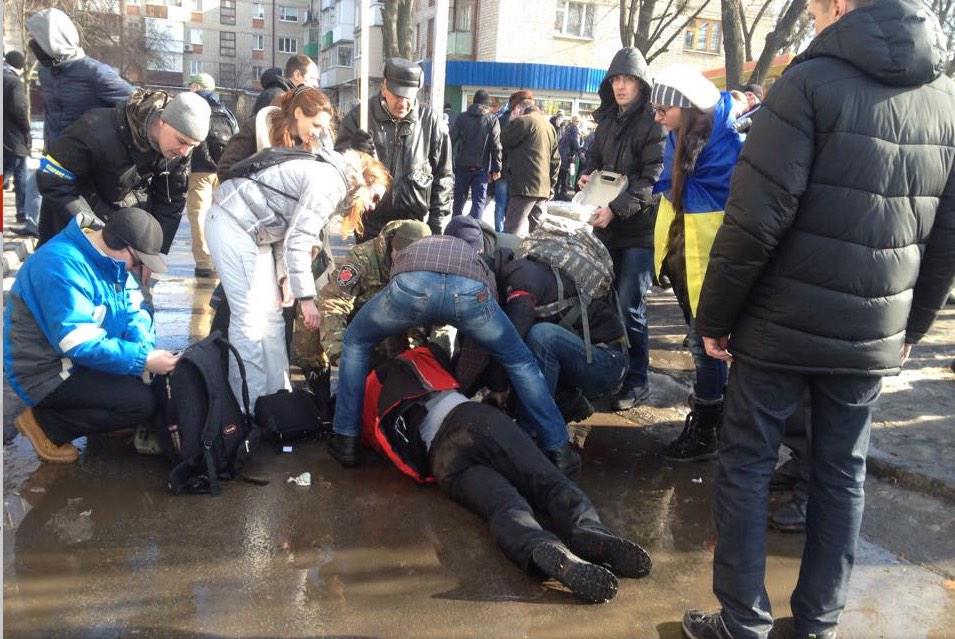
Monday in Donetsk another contingent of riot police in full battle
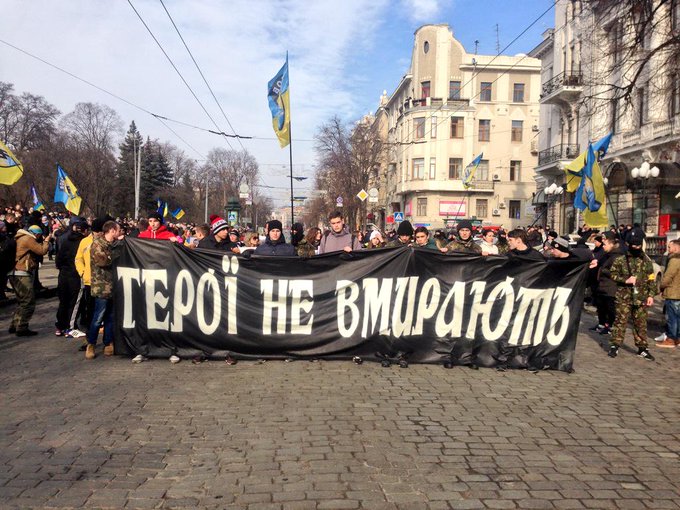
gear had looked on as pro-Russian thugs attacked a peaceful pro-unity
rally. The separatists beat Ukraine supporters with iron rods.
Fourteen people needed hospital treatment. Two were seriously
injured. The mob also took five hostages: supporters of the city's
Shakhtar Donetsk football team, who had formed a protective cordon at
the front of the rally. The five were taken to an office near
Donetsk's occupied regional administration. They were eventually
released on Tuesday.
Later
on Tuesday, seven or eight police officers in light blue uniforms
stood outside the office where the hostages had been kept. The scene
was peaceful. A few feet away volunteers from the "Donetsk
People's Republic", dressed in military fatigues, guarded the
entrance. They wore orange and black ribbons, the symbols of the
"republic's" anti-Kiev revolution. The two groups appeared
to be on friendly terms.
Asked
if the police had gone over to the separatists, the captain in
charge, Yevgeny, said: "Among the police there are different
opinions. Obviously our job is to uphold the law and apply it
neutrally."
The
"republic" has announced its own self-organised referendum
on the region's future status, to be held on 11 May. "I don't
make any secret of the fact that I'm for a referendum," Yevgeny
added. Another policeman chipped in: "We'll take part.
Personally I'm for Russia".
The
police were reluctant to talk about the bloody events of the previous
night, when they failed to protect civilians from attack. But one
officer who was there said: "This situation is all Kiev's fault.
They say we in the east are slaves, half-humans. They revere people
like Stepan Bandera [the second world war Ukrainian nationalist
leader] who shot our brothers. We are normal citizens like everyone
else."
Standing
next to their patrol car, still striped with Ukraine's blue and
yellow colours, the officers reeled off a list of grievances. These
included low pay – $200-$250 (£120) a month. (One policewoman,
Svetlana, said: "I'm supposed to give my life for this. Who is
going to come to my mother afterwards and say "thanks for your
daughter?") They also complained that a mistrustful Kiev had
confiscated their service revolvers three weeks ago. "I can't
exactly defend myself," Yevgeny said, showing off his empty
holster.
The
captain said he was one of 400 Donetsk region police officers sent to
the capital to deal with anti-Yanukovych demonstrations, which began
last November. The experience had left him bitterly disillusioned. He
had nothing but contempt for the new government, part-formed from the
protest movement, he said. Other officers who had not been in Kiev
repeated claims made by Russian TV that the Maidan protesters were
paid narco-maniacs, and unemployed "fascists".
The
police even had sympathy for pro-Russian gunmen in Slavyansk, who are
holding 40 people prisoner, including seven European military
observers. One officer said: "Kiev started all this by arresting
our activists. They [in Slavyansk] are merely defending their
rights."
The
US embassy in Kiev said on Tuesday the abduction of the OSCE
inspectors and the attack on demonstrators by pro-Russian thugs in
Donetsk on Monday were acts of "terrorism".
"There
is no place for these examples of inhuman behaviour in a modern,
democratic society. This is terrorism, pure and simple," it said
in a statement.
On
Tuesday the EU followed the US in widening sanctions, naming a
further 15 people it is targeting because of their roles in the
Ukraine crisis. The list included General Valery Gerasimov, chief of
the Russian general staff and first deputy defence minister, and
Lieutenant General Igor Sergun, identified as the head of GRU, the
Russian military intelligence agency.
The
Russian foreign minister, Sergei Lavrov, dismissed the new sanctions.
"We reject the sanctions … imposed by the United States and
the European Union against all common sense, in relation to the
events in Ukraine."
One
pro-Russian activist, 39-year-old Igor Vasilyovich, said at least
half of the local police supported the cause. "They understand
that without Russia we can't live properly," he said. Igor
admitted that not everybody in Donetsk – population one million –
was an enthusiast for the new unelected "republic". "We're
the active minority. We'll lead the passive majority," he said.
But what if the "republic" didn't succeed? "Then we'll
start a partisan war," he replied.
Serhiy
Taruta, the new governor sent by Kiev to head the Donetsk region,
admits that the police and security services in the east are not
doing their job. His officials attribute this to what they call
"post-Maidan syndrome".
Many
were sent to the capital, and were told that the protesters in Kiev
were their enemies. Now back in the east, the same enemies are
running the country. They are also unsure whether Viktor Yanukovych –
the president who fled to Russia – might come back again.
One
official said: "They [the police in the east] feel a mental
fight over who is their master. The problem is they are not sure if
it is Kiev, or Yanukovych and his family. We've had a lot of
conversations with commanders and officers. They are people from
here, and they feel angry and afraid."
The
official said the Donetsk police were acutely aware that the Russian
police salary was $2,000 – 10 times higher than their own. They
also regarded the Berkut riot police – disbanded for their alleged
role in the shooing of Maidan protesters – as local heroes. The
Donetsk police chief Konstantin Pozhidaev was doing all he could, the
official said, conceding: "It will take more time to achieve
meaningful order."
With
a separatist referendum looming, Donetsk's pro-Kiev administrators
have little time left. Much of the region is unlikely to vote, but
that will probably not deter the "People's Republic" from
declaring an overwhelming victory. One self-appointed "deputy",
Anatoly Aneshenko, said on Tuesday the oblast or region was certain
to declare autonomy.
What
would happen to those who opposed this outcome? "Well, they can
leave," he said.

 Posts
Posts