Showing posts with label Jordan. Show all posts

Thursday, 3 January 2019

Jordan running out of options for water supply


Jordan to drill fossil water wells a half-mile underground – “After this, we are out of chances”

Diagram showing how deep Jordan must drill to reach fossil water, more than 3600 feet. Graphic: Robin Muccari / NBC News

1 January 2019

AMMAN, Jordan (NBC News) – For the past decade, Khawla Qisi has trapped herself at home on Fridays. It’s the only day of the week her apartment building receives water, and she has to make the most of it.

I can't do anything else but focus on the water," she said.

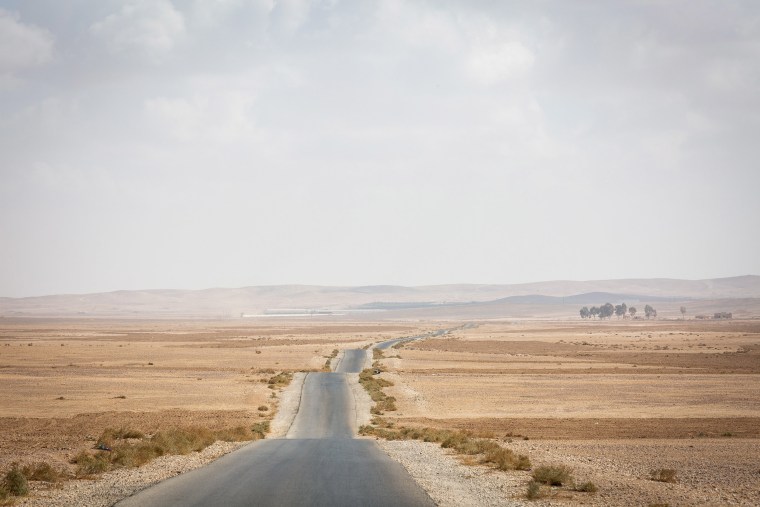
Image: A barren field south of Amman, Jordan's capital. This area is proposed to be used for several wells that requires digging up to 1000 metres in depth

Jordan has struggled with its water supply for decades. The arid nation receives roughly 20 days of rain per year and climate change is making conditions worse just as water demands from the growing population increase.

At the center of the government's efforts to obtain more of this precious resource is a patch of desert swirling with dust devils about 32 miles south of Amman.

Seven new wells are scheduled to be built here to tap the Disi, a deep aquifer that contains so-called fossil water that accumulated 10,000 to 30,000 years ago. It's the last source of fresh groundwater for the country, experts say.

"After this, we are out of chances," said Marwan Al-Raggad, a hydrogeology professor at the University of Jordan.

Reaching it requires drilling about twice as deep as groundwater aquifers — which are typically 1,640 feet underground and refilled by rainwater.

It means huge energy is needed to extract this water,” said Ali Subah, general secretary of Jordan's water and irrigation ministry. “It will be expensive.” [more]

Monday, 22 October 2018

Jordan Canceling Annexes of Peace Treaty With Israel


Confirmed in the ISRAELI press


Jordan Canceling Annexes of Peace Treaty With Israel, King Abdullah Says

Following recent protests, King Abdullah says Jordan will terminate parts of the treaty that allowed Israeli ownership rights under Jordanian sovereignty in the Naharayim/Baqura area and the Zofar/Al-Ghamr area


JORDAN "ANNULS" PARTS OF PEACE TREATY WITH ISRAEL


21 October,2018
Jordan has informed Israel it has decided to annul parts of the peace treaty with Israel, King Abdullah says.
To "annul" means "to declare invalid."
This is a completely unexpected development in the Middle East and has absolutely catastrophic implications.  
As of 8:43 AM eastern daylight time (EDT) on Sunday, October 21, 2018, it is not yet known which parts of the Peace Treaty Jordan plans to declare annulled.
 

UPDATE 9:07 AM EDT --

The Israel–Jordan peace treaty or in full "Treaty of Peace Between the State of Israel and the Hashemite Kingdom of Jordan" sometimes referred to as Wadi Araba Treaty, was signed in 1994. The signing ceremony took place at the southern border crossing of Arabah on 26 October 1994. Jordan was the second Arab country, after Egypt, to sign a peace accord with Israel.
The treaty settled relations between the two countries, adjusted land and water disputes, and provided for broad cooperation in tourism and trade. It included a pledge that neither Jordan nor Israel would allow its territory to become a staging ground for military strikes by a third country.
In 1987 Israeli Foreign Affairs Minister Shimon Peres and King Hussein tried secretly to arrange a peace agreement in which Israel would concede the West Bank to Jordan. The two signed an agreement defining a framework for a Middle Eastern peace conference. The proposal was not consummated due to Israeli Prime Minister Yitzhak Shamir's objection. The following year Jordan abandoned its claim to the West Bank in favor of a peaceful resolution between Israel and the PLO.
Discussions began in 1994. Israeli Prime Minister Yitzhak Rabin and Foreign Minister Shimon Peres informed King Hussein that after the Oslo Accords with the PLO, Jordan might be "left out of the big game". Hussein consulted with Egyptian President Hosni Mubarak and Syrian President Hafez al-Assad. Mubarak encouraged him, but Assad told him only to "talk" and not sign any accord. 
U.S. President Bill Clinton pressured Hussein to start peace negotiations and to sign a peace treaty with Israel and promised him that Jordan's debts would be forgiven. The efforts succeeded and Jordan signed a nonbelligerency agreement with Israel. Rabin, Hussein and Clinton signed the Washington Declaration in Washington, DC, on 25 July 1994. The Declaration says that Israel and Jordan ended the official state of enmity and would start negotiations in order to achieve an "end to bloodshed and sorrow" and a just and lasting peace
On 26 October 1994, Jordan and Israel signed the peace treaty in a ceremony held in the Arava valley of Israel, north of Eilat and near the Jordanian border. Prime Minister Rabin and Prime Minister Abdelsalam al-Majali signed the treaty and the President of Israel Ezer Weizman shook hands with King Hussein. Clinton observed, accompanied by US Secretary of State Warren Christopher. Thousands of colorful balloons released into the sky ended the event.
Egypt welcomed the agreement while Syria ignored it. However, the Lebanese militia group Hezbollah resisted the treaty and 20 minutes prior to the ceremony launched mortar and rocket attacks against northern Galilee towns. Israeli residents, who were forced to evacuate the towns for the safety of shelters, took with them transistor radios and mobile TVs in order not to miss the historical moment of signing a second peace treaty with an Arab state.

THE TREATY

The Peace treaty consists of a preamble, 30 articles, 5 annexes, and agreed minutes. It settles issues about territory, security, water, and co-operation on a range of subjects.
Annex I concerns borders and sovereignty. Section Annex I (a) establishes an "administrative boundary" between Jordan and the West Bank, occupied by Israel in 1967, without prejudice to the status of that territory. Israel recognizes Jordan's sovereignty over the Naharayim/Baqura area (including Peace Island) and the Zofar/Al-Ghamr area.
Annex II concerns water and related matters. Pursuant to Article 6 of the Treaty, Jordan and Israel agreed to establish a "Joint Water Committee" (Article VII).
Annex III concerns crime and drugs.
Annex IV concerns environment.
Annex V concerns Border Crossings, passports and visas. Article 6 stipulates that ″Each Party has the right to refuse entry to a person, in accordance with its regulations″.
The Agreed Minutes of the treaty give some details about the implementation of the peace treaty.


MAIN PRINCIPLES

  1. Borders: The international boundary between Israel and Jordan follows the Jordan and Yarmouk Rivers, the Dead Sea, the Emek Ha'Arava/Wadi Araba, and the Gulf of Aqaba.
  2. Diplomatic relations and co-operation: The Parties agreed to establish full diplomatic and consular relations and to exchange resident embassies, grant tourists visas, open air travel and seaports, establish a free trade zone and an industrial park in the Arava. The agreement prohibits hostile propaganda.
  3. Security and defense: Each country promised respect for the sovereignty and territory of each side, to not enter the other's territory without permission, and to cooperate against terrorism. This included thwarting border attacks, smuggling, preventing any hostile attack against the other and not cooperating with any terrorist organization against the other.
  4. Jerusalem: Article 9 links the Peace Treaty to the Israeli–Palestinian peace process. Israel recognized the special role of Jordan in Muslim Holy shrines in Jerusalem and committed itself to give high priority to the Jordanian historic role in these shrines in negotiations on the permanent status.
  5. Water: Israel agreed to give Jordan 50,000,000 cubic metres (1.8×10⁹ cu ft) of water each year and for Jordan to own 75% of the water from the Yarmouk River. Both countries could develop other water resources and reservoirs and agreed to help each other survive droughts. Israel also agreed to help Jordan use desalination technology in order to find additional water.
  6. Palestinian refugees: Israel and Jordan agreed to cooperate to help the refugees, including a four-way committee (Israel, Jordan, Egypt and the Palestinians) to try to work towards solutions.

Follow-up


Following the agreements, Israel and Jordan opened their borders. Several border-crossings were erected, allowing tourists, businessmen and workers to travel between the two countries.[13] Israeli tourists started to visit Jordan, many to see the sela ha'adom("Red Rock") of Petra – a stone-carved Nabatean city which had fascinated Israelis during the 1950s and 1960s, often luring adventurers to visit it secretly.
In 1996 the two nations signed a trade treaty. As part of the agreement, Israel assisted in establishing a modern medical center in Amman.
In December 2013, Israel and Jordan signed an agreement to build a desalination plant on the Red Sea, near the Jordanian port of Aqaba, as part of the Red Sea–Dead Sea Canal.
 

ANNEX BEING CANCELLED 


Jordanian King Abdullah II informed Israel, on Sunday, that he will not renew two annexes of the 1994 peace treaty between Israel and Jordan concerning territory leased to Israel. 
The territories in question are al-Baqura and al-Ghamr, which are also known as Naharyaim and Zofar in the Hebrew language.

King Abdullah II posted a tweet on his Twitter account, which read “Baqura and Ghamr areas have always been our top priority and our decision is to end Article 2 of Annexes I (b) of the Jordan-Israel Peace Treaty emanating from our keenness to take whatever is necessary for Jordan and Jordanians.” 

Israel leased the land for 25 years upon the signing of the peace treaty and the deadline for renewing leases of the treaty is this upcoming Thursday.

Due to the deadline for renewal approaching, King Abdullah II has faced ongoing pressure from the Jordanian parliament not to renew the leases and to return the territory to full Jordanian sovereignty.

It is noteworthy that 87 lawmakers have also signed a petition regarding the issue.

Last week, mass demonstrations took place in Amman, as well as social media campaigns demanding that Jordan reclaim sovereignty over Baqura and Ghamr, with slogans such as "The people want national honor" and "The story is about national sovereignty."

Several demonstrators also demanded Jordan to cancel the entire peace treaty with Israel.

WHAT THIS MEANS


It is important to note that when a Land Lease is up, the persons/entities who enjoyed that Lease MUST LEAVE.
Thus, the stage is now set for Israel to BE LEGALLY COMPELLED to get out of specific areas.  Will they?  Or will there now be a fight?
Stay tuned.


Tuesday, 1 May 2018

Warmonger Pompeo in Jordan

Mike Pompeo, Jordan's King Agree on 'Urgent Need' to Confront Iran in Syria
US Secretary of State Mike Pompeo has traveled to Jordan to discuss with the kingdom's authorities the situation around Syria, the Israeli-Palestinian conflict, and Iran nuclear deal.


30 April, 2018


WASHINGTON (Sputnik) — The US State Department said that Mike Pompeo, Jordan’s king agreed on 'urgent need' to confront Iran's ‘destabilizing’ activities in Syria.

"Secretary Pompeo met with King Abdullah on April 30 and reaffirmed the strong bond and strategic partnership between the United States and Jordan," Nauert said on Monday. "The Secretary and King Abdullah agreed on the urgent need to confront Iran’s destabilizing presence and malign behaviors in Syria and the region."
Pompeo and King Abdullah also discussed other regional issues such as defeating the Islamic State terrorist group (banned in Russia) and facilitating a peace deal between Israel and Palestine, Nauert said.
They also discussed working to support bilateral ties between the United States and Jordan, she added.

Pompeo made three stops in the Middle East this weekend to discuss critical regional and bilateral issues with officials in Saudi Arabia, Israel and Amman.
Jordan's Border Security

The United States will help Jordan protect its borders as threats to the peace in the country continue to emanate from Syria, Pompeo at a joint press conference with Jordanian Minister of Foreign Affairs Ayman Safadi in Amman on Monday.
Pompeo reiterated that the US goal is to defeat the Daesh terror group.
"We must not let Syria again become a safe haven for the Islamic State* [Daesh] or for any other terrorist group," he said.
Pompeo also noted that another US goal is to ensure a safe and timely delivery of humanitarian aid and de-escalate violence.
The secretary of state said he discussed with Safadi the issue of "deterring the use of chemical weapons," and said they agreed that support should continue for a "political resolution to the conflict".
The United States is fully committed to the ceasefire arrangement in southwest Syria, Pompeo added.
Safadi hailed the creation of the de-escalation zone in the south of Syria an example of cooperation between the United States, Jordan and Russia.
Israeli-Palestinian Conflict

Speaking of the conflict, Pompeo underscored ongoing US support for a two-state solution.
We’re certainly open to a two-party solution. That is a likely outcome,” he said.
At the same time, the United States is calling on Israelis and Palestinians to restart political dialogue aimed at achieving peace in the Middle East, he added.
Palestine seeks the establishment of a state on the territories of the West Bank, including East Jerusalem, which is partially occupied by Israel, and the Gaza Strip. The Israeli government has refused to recognize Palestine as an independent political and diplomatic entity, and continues to build settlements in occupied areas, despite objections from the United Nations.


Peace efforts began in the 1970s, culminating in the 2003 road map for peace proposed by the Middle East Quartet — the United States, the United Nations, the European Union and Russia. Since then, the two-state solution has been the main objective for mediators.


Monday, 26 March 2018

Photos Capture US Military Vehicles Arriving in Jordan

Alleged PHOTOS Capture US Military Vehicles Arriving in Jordan
The news comes hot on the heels of the accusations of the US planning strikes on governmental forces in neighboring Syria by Russia earlier this week. Washington has previous experience of launching strikes without the authorization of the UN Security Council, when it attacked Syria's Shairat airbase in April 2017


24 March, 2018


The Telegram channel Directorate 4, which monitors the situation in Syria and Iraq, has published pictures of US heavy military equipment arriving in Jordan via the military transport ship "Liberty pride" for future participation in the annual military drills "Eager Lion." During the process of unloading, vehicles looking like M1A2 "Abrams" tanks, the M113's variation for medical evacuation and the M2A3 "Bradley" armored personnel carriers were spotted.


Saudi Arabia, Qatar, Kuwait, Bahrain and other US allies will join the "Eager Lion" military exercises, which have been conducted every year since 2010. After the latest reports of a planned US strike on Syrian governmental forces these drills could possibly create tensions between Jordan and neighboring Syria.

Is the US and Turkey Positioning for Syrian Offensive?


Israeli News Live

The Turkish government has started their attack on Kurdish fighters in Sinjar province of Iraq, this is located a distance from Turkish border no obvious threat for the Turkish government. But what it does do is give the Turkish military a tactical advantage to invade Syria from the East and North. The US has just unloaded yet another Liberty Ro Ro ship in Jordan with tanks armored personnel carriers, it seems NATO is preparing the final offensive on Syria with direct engagement. class="yt-simple-endpoint style-scope yt-formatted-string" 


Israel Strikes Hezbollah Position Lebanon / Hamas launching Rockets


Israel comes under heavy rocket attack from the Gaza Strip the Iron Dome put into action. At the same time Israel launched airstrikes on Hezbollah position near Syrian and Lebanon border. 


From Chinese TV

Syria opposition, civilians evacuate Eastern Ghouta


From the pro-terrorist al-Jazeera

Tuesday, 9 May 2017

Is a US-led invasion of Syria immanent?

BREAKING NEWS - URGENT: US, UK & JORDAN MASSING TROOPS, TANKS AND ARMOR ON SYRIA-JORDAN BORDER


8 May, 2017

A blitz of reports are coming out of Syria indicating the US, Britain and Jordan have massed "thousands" of troops and hundreds of vehicles described as "heavy armor, including tanks" on the border between Jordan and Syria. Fears of IMMINENT INVASION are causing locals to flee the region.

 The red-highlighted region on the map is the Syrian Province of Homs.   Numerous CONFIRMED reports indicate the foreign troops are massed inside Jordan, less than one kilometer from the Syrian Border.

UPDATE 7:54 PM EDT --

Reports of the massed US, UK and Jordanian Troops also state that "at least 4,000 militants" are also assembled with the US/UK/Jordan Force!  Many of these "militants" are from Al Qaida and ISIS, begging the question, who the hell is the United States government working with in Syria?
The Syrian Arab Army (SAA) told SuperStation95 just moments ago via telephone that they launched an important offensive in the southeastern countryside of Damascus this past weekend that targeted a large rebel pocket in the Badiya region of the province.

According to the Syrian Army officer in Damascus with whom we spoke, the US-Jordanian Coalition  increased their presence at the Jordanian border in order to possibly deter the advancing Syrian government forces that are pushing to the Badiyah region of southeast Homs.

“We have intelligence reports revealing the build-up of US and Jordanian forces near the border,” the officer said."
Photos from the region show literally HUNDREDS of military vehicles, armored personnel carriers and tanks, as seen in the Tweet below:
The US and Jordanian military may be prepping a massive invasion of Syria, intelligence reports gathered from surveillance drones suggest.

Damascus is on high alert after some 400 American and Jordanian military vehicles were located at a military base less than a kilometer from the desert border with eastern Homs earlier today.
  
UPDATE 8:18 PM EDT --
Reporters Rami Al-Lolah covering events in Syria is now reporting additional massing of troops by the US, UK and Jordan, along the southernmost border of Syria-Jordan, as shown on his map below:


This is a developing story as of 7:47 PM eastern US time on May 8.  Please check back for updates. . . 

In pictures: Syrian drones spot hundreds of US, Jordanian armored vehicles at the border


AMN,
8 May, 2017

DAMASCUS, SYRIA (0:00 A.M.) – The US and Jordanian militaries may be prepping a massive invasion of Syria, intelligence reports gathered from surveillance drones suggest.

Damascus is reportedly on high alert after some 400 American and Jordanian military vehicles were located at a Jordanian military base near the Syrian desert border earlier today.
More pictures of the drone surveillance here
Chris Tomson | Al-Masdar News

The foreign convoys may launch an incursion to aid allied Free Syrian Army (FSA) proxies based around the Al-Tanf border crossing.

In 2017 alone, FSA satellite forces have entered Sweida and Deir Ezzor while also coming dangerously near Palmyra and Damascus, areas under Syrian Arab Army (SAA) control.
In response to the looming invasion, the SAA has begun a large-scale offensive along the Damascus-Baghdad highway in a bid to dislodge FSA rebels from the Al-Tanf border crossing are link up with friendly Iraqi border guards.
The photos validate previous reports by an Al-Masdar News military source suggesting a major Jordanian and US buildup at the Syrian border


Is North Korea a Diversion for a US-Jordan Invasion of Syria?


3 May, 2017

Syrian President Bashar Al-Assad said that his country has information that Jordan is planning to send its troops into southern Syria in cooperation with the United States….’Jordan is not an independent country. Whatever the United States wants, it will happen,’ said Assad.”
Middle East Monitor
In the event of a de-facto partition of Syria, the US and its allies will get a strategically important region. It is through Deir Ezzor that the proposed gas pipeline from Qatar is supposed to run….The Deir Ezzor province is also home to Syria’s largest oil deposit, the Al-Omar. …the city and the province are of particular value since the deposits there contain the highly valuable light sweet crude usable in the production of gasoline and diesel fuel.”
South Front, “The Stronghold of Deir Ezzor; What You Need to Know”
The United States is not going to launch a preemptive attack on North Korea.  The risks far outweigh the rewards and, besides, the US has no intention of getting bogged down in a conflict that doesn’t advance its geopolitical objectives. The saber-rattling is just an attempt to divert attention from the Syria-Jordan border where the US and Jordan are massing troops and equipment for an invasion of Syria. That’s what’s really going on. The Korean fiasco is a smokescreen.
True, the Trump administration is milking the situation for all its worth, but that doesn’t mean that they want a war with the North. That’s not it at all.  Washington wants to deploy its controversial THAAD anti-missile system to South Korea, but it needs a pretext to do so. Hence, the ominous threat of an “unstable, nuclear-armed North Korea”, that’s all the justification Washington needed to get its new weapons system deployed. Mission Accomplished.
But the Terminal High Altitude Area Defense system (THAAD) isn’t aimed at North Korea, it’s aimed at China, and China knows it which is why it has protested its deployment repeatedly. The US wants to surround China and Russia with military bases and missile systems that are integrated into its broader nuclear weapons system. These lethal systems are a crucial part of Washington’s plan to pivot to Asia and rule the world into the next century. Here’s the rundown from Tass:
Anti-missile elements that are being deployed around the world are part of a very dangerous global project aimed at securing US’ overall overwhelming superiority to the prejudice of security interests of other states….The US missile defense architecture is tilting the strategic balance of forces in the area of offensive weapons and creates more and more serious risks of global instability.” (“US anti-missile systems in Eastern Europe violate INF Treaty”)
And here’s how Russian President Vladimir Putin summed it up:
The US is developing an anti-missile defense system which”….when it is operational… “there will be a moment in time when our entire nuclear capability will be neutralized, which means that the entire global balance of power will be overturned.. This means one of the powers will have absolute security and be able to do whatever it likes in regional conflicts. We’re talking about unrivaled power in global conflicts. ..This system forces us to create weapons that can nullify the system asymmetrically.” (Tass)
Is missile defense something the American people should want?
Heck no. Just think of the number of people that Uncle Sam has slaughtered in the last 16 years. Now try to imagine if all the constraints on Washington’s rampaging were removed allowing the US to conduct its bloody war on the world with complete impunity?
No one in their right mind would ever give the Washington crazies that kind of power. It’s a prescription for global annihilation.  Besides, absolute security for one country means no security for everyone else.
But deploying the THAAD anti-missile system is just one part of Washington’s North Korea swindle. The fear-mongering is also being used to grease the wheels of the Military Industrial Complex (MIC). Here’s the scoop from The Hill:
Sen. John McCain’s (R-Ariz.) push for a $7.5 billion fund to bulk up the U.S. military’s capabilities in the Asia-Pacific is gaining momentum as tensions with North Korea mount. The commander of U.S. forces in the region threw his support behind the idea this week,  “This kind of money can help us bring together our allies and partners,” said Patrick Cronin, senior director of the Asia-Pacific Security Program at the Center for a New American Security. …The … proposal has gained more visibility amid the intensifying concerns over North Korea and its nuclear program.” (“McCain plan gains momentum amid North Korea threats”, The Hill)
So the MIC lackeys in Congress had already been pushing this latest boondoggle, but they needed a trumped up crisis in North Korea to put them over the finish line.  Typically, the process is called “creative advertising”, which means scaring the shit out of the public so you can rip them off. Here’s more from the same article:
“I’d like to thank Chairman McCain and this committee for proposing and supporting the Asia-Pacific Stability Initiative,” Adm. Harry Harris, commander of U.S. Pacific Command, said at Thursday’s hearing. “This effort will reassure our regional partners and send a strong signal to potential adversaries of our persistent commitment to the region.”
The weapons manufacturers love sugar-daddy McCain who’s always on-hand with gobs of moolah.
Here’s more: “We can thank North Korea for one thing in this,” said Harry Kazianis, director of defense studies at the Center for the National Interest”.  “They’re amplifying the imbalance in the Asia-Pacific.” (The Hill)
Good idea, let’s thank North Korea for this latest windfall for the weapons makers. Why not?  Let’s send Kim a nice big valentine from the American taxpayer with John McCain’s name writ large at the bottom.
In any event,  Washington’s policy towards North Korea hasn’t changed. All the chest thumping and fireworks are just part of a circus sideshow designed to justify additional defense splurging and missile deployment. At the same time, the media is trying to divert attention from critical developments in the Middle East, particularly the Syria-Jordan border where Washington has rallied its proxy-fighters into a makeshift army that will (likely) invade southern Syria, charge northward to Deir Ezzor,  establish a no-fly zone over the occupied territory, and partition the area east of the Euphrates preventing loyalist forces from reestablishing Syria’s sovereign borders. That appears to be the basic game-plan. Check this out from the Middle East Monitor:
The Syrian regime of President Bashar Al-Assad said that his country has information that Jordan is planning to send its troops into southern Syria in cooperation with the United States…
We have this information, not only from mass media, but from different sources”… 
Speaking to The Washington Post, King Abdullah of Jordan  reiterated that a planned joint operation could take place against terrorists. “It is a challenge, but we are ready to face it in cooperation with the US and Britain.” (“Assad accuses Jordan of planning Syria invasion”,  Middle East Monitor)
The pretext for the invasion will be to fight ISIS, but the real goal is to seize the eastern part of the country consistent with a plan that was concocted by the Brookings Institute two years ago. After 6 years of covert support for CIA-backed militants on the ground, the Trump administration appears to be leaning towards a more traditional military approach. Here’s more from the LA Times:
Reports have also emerged of Jordanian and U.S. troops on the section of the Jordanian border opposite southwest Syria, a possible prelude to a campaign in which rebels, supported by Jordanian and coalition forces on the ground, would overrun Islamic State’s pocket in the Yarmouk basin, near southwestern Syria’s borders with Israel and Jordan.”  (“How long can Jordan keep walking the Middle East tightrope?”,  LA Times)
Naturally, Moscow is concerned about the developments on the Jordanian border. Last week, Russian Foreign Minister Sergei Lavrov issued a statement saying, “We will pay special attention to the issues most important for us which concern the situation on the Jordan-Syria border.”
Also worrisome, is the fact that US Defense Secretary James “Mad Dog” Mattis has been traveling across the Middle East rallying Washington’s allies in Saudi Arabia, Egypt and Israel.  Mattis sees the fighting in Syria as a proxy-war between the US and Iran for influence in the region. This same erroneous view is shared by all of the main powerbrokers in the Trump administration.
Everywhere there’s trouble in the region, you find Iran,” Mr. Mattis said on a stop in Riyadh, adding that nations in the region are working to “checkmate Iran and the amount of disruption, the amount of instability they cause.”
These latest developments take place just days before the resumption of negotiations in Astana, Kazakhstan (May 3 and 4). Russia, Turkey, Iran and a number of the leaders from the rebel groups will gather to see if they can agree on the terms of a ceasefire and an eventual settlement to the 6 year-long war. The Trump administration’s cruise missile attack on a Syrian airbase in early April has boosted the morale of many of the jihadists militias and is keeping them away from the bargaining table.   In other words,  Trump’s unexpected escalation has sabotaged Putin’s efforts to resolve the crisis and end the hostilities. The last thing Washington wants in Syria is peace.
A number of reports have confirmed that Trump has handed control of his foreign policy to his Generals, Mattis and McMaster. And while Mattis has shown little interest in getting more deeply involved in the Syrian conflict, McMaster sees Russia as a “hostile revisionist power” that “intimidates our allies, develops nuclear weapons, and uses proxies under the cover of modernized conventional militaries.”
McMaster is a hard-boiled militarist with a driving animus towards Russia.  In a speech he delivered at The Center for Strategic and International Studies, McMaster offered this remedy for so called ‘Russian aggression’. He said:  “what is required to deter a strong nation that is waging limited war for limited objectives… is forward deterrence,  …(is) convincing your enemy that (he) is unable to accomplish his objectives at a reasonable cost.”
McMaster can be expected to use his  “forward deterrence” theory in Syria by trying to lure Putin into a confrontation with US forces east of the Euphrates.   But there’s no reason to think that Putin will fall into the trap, in fact, it seems highly unlikely given the potential for a catastrophic face-off between the two nuclear-armed superpowers. Instead, Putin will probably take the high-road, present his case to the UN Security Council, and denounce  the US intervention as another example of Washington’s destabilizing and expansionistic foreign policy.
Putin’s worst mistake would be to base his strategy entirely on the situation on the battlefield. He doesn’t need to liberate every inch of Syrian soil to win the war. Let the US and its proxies seize the territory, establish their military bases and no-fly zones,  throw up a DMZ along the Euphrates, and wade deeper into the Syrian morass.  Putin has other fish to fry. He needs to focus on winning hearts and minds, strengthening alliances and building a broader coalition. He needs to look like the only adult in the room, the rational leader whose sole ambition is to end the dispute and restore security. He needs to establish a contrast between his behavior and that of his recklessly-violent and mentally-unstable rival, Washington, whose flagrant  disregard for international law and civilian lives has plunged the Middle East and Central Asia into chaos and carnage.
If Putin’s ultimate goal is to rebuild the system of global security based on the bedrock principles of national sovereignty and greater representation for all the countries in the world, he must lead by example. Restraint and maturity in Syria will move him closer to that goal.