Showing posts with label peak water. Show all posts

Thursday, 3 January 2019

Gaza may be uninhabitable in ONE YEAR due to water crisis

Water crisis may make Gaza Strip uninhabitable by 2020

PBS,
1 January, 2019


In the Gaza Strip, 97 percent of freshwater is unsuitable for human consumption, and raw sewage pours into the Mediterranean Sea. Facilities for desalinating and treating water function on only a limited basis, as Israel controls the flow of fuel and supplies into the region. But Israelis, too, could face consequences from contaminated water. Special correspondent Fred de Sam Lazaro reports.

Read the Full Transcript
Amna Nawaz:

Last night, we began our series on the Middle East's water crisis in Israel.

Tonight, special correspondent Fred de Sam Lazaro reports from the Gaza Strip, a region the United Nations predicts will be uninhabitable by next year, partly due to the severe shortage of water.

Fred de Sam Lazaro:

Twice a week, Khamis Al Najjar and his wife, Madlain, go down the street to a municipal water station to fill containers of drinking water for their family of nine, including six children and Madlain's mother.

The water costs nearly a third of the monthly government stipend on which they survive. Khamis lost a leg in a construction accident years ago and is unable to work.

Madlain Al Najjar (through translator):

We are really suffering with the water situation right now.

Fred de Sam Lazaro:

The water is not only costly. It's often polluted. The United Nations says just 10 percent of Gaza's two million people have access to safe drinking water.

Madlain Al Najjar (through translator):

My children get sick because of the water. They suffer from vomiting, diarrhea. Often, I can tell the water is not clean, but we have no other option.

Fred de Sam Lazaro:

Ninety-seven percent of Gaza's freshwater supply is unsuitable for human consumption. The underground aquifer that has long supplied freshwater to Gaza has been overdrawn. The void has been filled with seawater and untreated sewage.

Abdul Rahim Abu from the Gaza Water Authority said the municipality can't afford to treat the water.

Abdul Rahim Abu (through translator):

Eighty to 85 percent of people here don't pay their water bills because a majority of the people live in poverty. And the municipality doesn't have the ability to pay for fuel to keep the water pumps running.

Fred de Sam Lazaro:

Along the beach each day, young men drag in a meager catch. Food is scarce, they said. Unemployment in Gaza is over 40 percent, over 60 percent among young people.

It is one of the most significant consequences of Israel's 11-year blockade of the Gaza Strip, which followed the election of the militant Islamist party Hamas.

Cross-border skirmishes are common here. Everything from Hamas rockets to smaller improvised explosive devices attached to balloons are lobbed at Israel. Each time, it provokes a vigorous Israeli military response.

Israel has also severely restricted the flow into Gaza of equipment and supplies. Uri Shor of Israel's Water Authority says seemingly innocuous supplies for infrastructure, cement, for instance, are often diverted. Others are weaponized.

Uri Shor:

If they want to bring in Gaza something that might also be turned against Israel as building rockets or as building tunnels, of course, we have a problem with that.

Fred de Sam Lazaro:

The standoff has greatly hindered efforts to address the water crisis.

Back in Gaza, this $10 million desalination plant, built with European aid, is the first installment in a large project to bring clean water to the Strip. But fuel and electricity supplies, controlled by Israel, allow it to operate only about four hours a day.

A large solar array that could fill the gap sits idle because cables to connect it have been held up at the border, says Gaza Water Authority Director Monther Shoblaq.

Monther Shoblaq:

Without real cooperation and coordination and approvals between Palestinians, Israelis, and especially from the Israeli, this project will not be materialized.

Fred de Sam Lazaro:

But a lack of water in Gaza isn't the only issue.

The blockade has created a massive sanitation crisis here in Gaza, where, every single day, 110 million liters of sewage, raw and untreated, are discharged directly into the Mediterranean, into the very waters that feed the desalination plants in Israel, which are visible from here, barely five miles up the coast.

Gidon Bromberg:

The Ashkelon desalination plant produces on its own 15 percent of Israel's domestic drinking water.

Fred de Sam Lazaro:

On the Israeli side, I met Gidon Bromberg, co-director of an environmental group called EcoPeace, which tries to broker cooperation among all parties.

Gidon Bromberg:

The water security of Israel is very much connected to the water and sanitation situation in Gaza. The Israeli military can build a fence around Gaza. We can say to the public that we are disengaging from Gaza, but the environment doesn't allow us to actually do that.

Fred de Sam Lazaro:

EcoPeace uncovered, and widely publicized satellite imagery confirming that pollution from Gaza was affecting the Ashkelon plant and at times forcing it to close.

He said the situation also imperils the health of Israelis living near the Gaza border.

Gidon Bromberg:

We used our connections with the mayors, with the Israeli mayors, here around Gaza to come out and write a letter to the prime minister that we, the people, who have been at front line of rockets from Gaza refuse to be at the front line of potential pandemic disease.

Fred de Sam Lazaro:

Israel's government did agree to sell more electricity to Gaza for water and sewage treatment. A World Bank-financed sewage treatment plant recently came online after 14 years of delays.

But again fuel shortages still hinder its operations. Once again, politics has gotten in the way, Bromberg says, in this case, internal Palestinian rivalries, in which the Fatah Party of President Mahmoud Abbas has resisted bring electricity into Gaza to punish Hamas.

Gidon Bromberg:

In Gaza, electricity, water is also hereto being used as a tool in the internal political fights.

Fred de Sam Lazaro:

Former Palestinian Water Minister Shaddad Attili concedes Palestinian infighting has worsened the situation.

Shaddad Attili:

And who's paying the heavy price? It's the people of Gaza. Who's drinking undrinkable water? It's our people of Gaza. Who's delivering blue babies is our people in Gaza.

There are — our women, they are delivering blue babies because of the nitrate in the water. So, all people punishing our people in Gaza.

Fred de Sam Lazaro:

Amid all the intransigence, the U.N. predicts that, at this rate, Gaza will become uninhabitable by 2020.

Mohamad Ammar:

We pump the water so there are these water tanks as a storage.

Fred de Sam Lazaro:

International aid agencies are trying to help with the water crisis. Oxfam recently opened a pilot desalination plant. It plans to rehabilitate 45 similar facilities that have fallen into disrepair across Gaza, says spokesman Mohamad Ammar.

Mohamad Ammar:

In this project, we target 1,200 households and more than 6,000 individuals. In general, our plan is to target half-a-million in the coming two years.

Sana’a Lubad (through translator):

We drank contaminated water for a long time, until Oxfam came and gave us clean water.

Fred de Sam Lazaro:

The Lubad family is one of the lucky early recipients. Once every two weeks, Oxfam fills their small rooftop tank with 130 gallons of desalinated water.

Absent a political solution, it appears, Gaza's ocean-size crisis is being addressed a few gallons at a time.

For the "PBS NewsHour," I'm Fred de Sam Lazaro in Gaza City.

Amna Nawaz:

Fred's reporting is in partnership with the Under-Told Stories Project at the University of St. Thomas in Minnesota.


Dec 20
Watch 8:27
Why Iraq’s biblical paradise is becoming a salty wasteland
By Jane Ferguson

Nov 14
Israeli defense minister resigns over Gaza cease-fire deal
By Aron Heller, Associated Press

Nov 12
Thousands of mourners in Gaza demand revenge after deadly Israeli raid
By Fares Akram, Tia Goldenberg, Associated Press


Jordan running out of options for water supply


Jordan to drill fossil water wells a half-mile underground – “After this, we are out of chances”

Diagram showing how deep Jordan must drill to reach fossil water, more than 3600 feet. Graphic: Robin Muccari / NBC News

1 January 2019

AMMAN, Jordan (NBC News) – For the past decade, Khawla Qisi has trapped herself at home on Fridays. It’s the only day of the week her apartment building receives water, and she has to make the most of it.

I can't do anything else but focus on the water," she said.

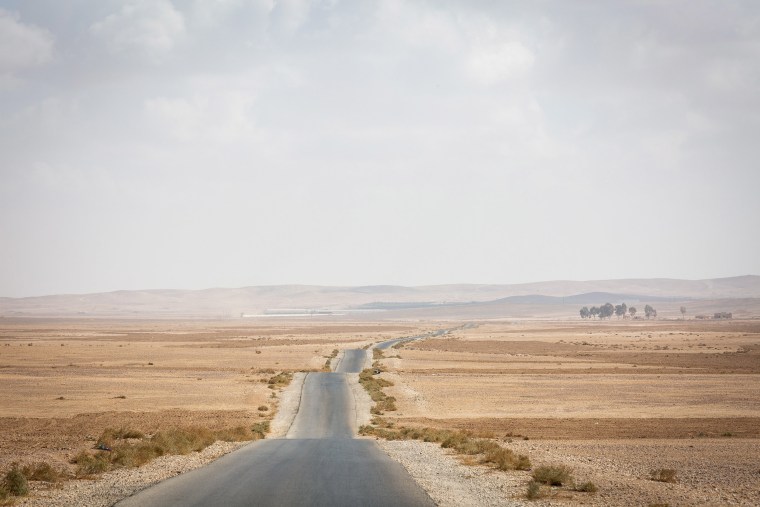
Image: A barren field south of Amman, Jordan's capital. This area is proposed to be used for several wells that requires digging up to 1000 metres in depth

Jordan has struggled with its water supply for decades. The arid nation receives roughly 20 days of rain per year and climate change is making conditions worse just as water demands from the growing population increase.

At the center of the government's efforts to obtain more of this precious resource is a patch of desert swirling with dust devils about 32 miles south of Amman.

Seven new wells are scheduled to be built here to tap the Disi, a deep aquifer that contains so-called fossil water that accumulated 10,000 to 30,000 years ago. It's the last source of fresh groundwater for the country, experts say.

"After this, we are out of chances," said Marwan Al-Raggad, a hydrogeology professor at the University of Jordan.

Reaching it requires drilling about twice as deep as groundwater aquifers — which are typically 1,640 feet underground and refilled by rainwater.

It means huge energy is needed to extract this water,” said Ali Subah, general secretary of Jordan's water and irrigation ministry. “It will be expensive.” [more]

Monday, 17 June 2013

Peak Water


Hydraulic fracturing fuels water fights in U.S. dry spots
'We don't want to look up 20 years from now and say, ‘Oops, we used up all our water’’


16 June, 2013

The latest domestic energy boom is sweeping through some of the nation's driest pockets, drawing millions of gallons of water to unlock oil and gas reserves from beneath the Earth's surface.


Hydraulic fracturing, or the drilling technique commonly known as fracking, has been used for decades to blast huge volumes of water, fine sand and chemicals into the ground to crack open valuable shale formations.


But now, as energy companies vie to exploit vast reserves west of the Mississippi, fracking's new frontier is expanding to the same lands where crops have shriveled and waterways have dried up due to severe drought.


In Arkansas, Colorado, New Mexico, Oklahoma, Texas, Utah and Wyoming, the vast majority of the counties where fracking is occurring are also suffering from drought, according to an Associated Press analysis of industry-compiled fracking data and the U.S. Department of Agriculture's official drought designations.


While fracking typically consumes less water than farming or residential uses, the exploration method is increasing competition for the precious resource, driving up the price of water and burdening already depleted aquifers and rivers in certain drought-stricken stretches.


Some farmers and city leaders worry that the fracking boom is consuming too much of a scarce resource, while others see the push for production as an opportunity to make money by selling water while furthering the nation's goal of energy

independence.

Along Colorado's Front Range, fourth-generation farmer Kent Peppler said he is fallowing some of his corn fields this year because he can't afford to irrigate the land for the full growing season, in part because deep-pocketed energy companies have driven up the price of water.


"There is a new player for water, which is oil and gas," said Peppler, of Mead, Colo. "And certainly they are in a position to pay a whole lot more than we are."
In a normal year, Peppler said he would pay anywhere from $9 to $100 for an acre-foot of water in auctions held by cities with excess supplies. But these days, energy companies are paying some cities $1,200 to $2,900 per acre-foot. The Denver suburb of Aurora made a $9.5 million, five-year deal last summer to provide the oil company Anadarko 2.4 billion gallons of excess treated sewer water.


In South Texas, where drought has forced cotton farmers to scale back, local water officials said drillers are contributing to a drop in the water table in several areas.


For example, as much as 15,000 acre-feet of water are drawn each year from the Carrizo-Wilcox Aquifer to frack wells in the southern half of the Eagle Ford Shale, one of the nation's most profitable oil and gas fields.


That's equal to about half of the water recharged annually into the southern portion of the aquifer, which spans five counties that are home to about 330,000 people, said Ron Green, a scientist with the nonprofit Southwest Research Institute in San Antonio.


The Eagle Ford, extending from the Mexican border into East Texas, began to boom in 2011, just as Texas struggled with the worst one-year drought in its history. While conditions have improved, most of the state is still dealing with some level of drought, and many reservoirs and aquifers have not been fully replenished.


"The oil industry is doing the big fracks and pumping a substantial amount of water around here," said Ed Walker, general manager of the Wintergarden Groundwater Conservation District, which manages an aquifer that serves as the main water source for farmers and about 29,000 people in three counties.


"When you have a big problem like the drought and you add other smaller problems to it like all the fracking, then it only makes things worse," Walker said.
West Texas cotton farmer Charlie Smith is trying to make the best of the situation. He plans to sell some of the groundwater coursing beneath his fields to drillers, because it isn't enough to irrigate his lands in Glasscock County. Smith's fields, like the rest of the county, were declared to be in a drought disaster area this year by the USDA.


"I was going to bed every night and praying to the good Lord that we would get just one rain on the crop," said Smith, who hopes to earn several thousand dollars for each acre-foot of water he can sell. "I realized we're not making any money farming, so why not sell the water to the oil companies? Every little bit helps."


The amount of water needed to hydraulically fracture a well varies greatly, depending on how hard it is to extract oil and gas from each geological formation. 


In Texas, the average well requires up to 6 million gallons of water, while in California each well requires 80,000 to 300,000 gallons, according to estimates by government and trade associations.


Depending on state and local water laws, frackers may draw their water for free from underground aquifers or rivers, or may buy and lease supplies belonging to water districts, cities and farmers. Some of the industry's largest players are also investing in high-tech water recycling systems to frack with gray or brackish water.


Halliburton, for instance, recently started marketing a new technology that allows customers to use recycled wastewater, calling it an "investment to further the sustainable development of the oil and gas industry." The American Petroleum Institute, the principal lobbying group for the industry, said its members are working to become less dependent on fresh water, and instead draw on other sources.


"Recycling wastewater helps conserve water use and provide cost-saving opportunities," said Reid Porter, a spokesman for the group.


In some states, regulators have stepped in to limit the volume or type of water that energy companies can use during drought conditions.


In northwest Louisiana, as the production rush began in the Haynesville Shale in 2009, the state water agency ordered oil and gas companies to stop pulling groundwater from the local aquifer that also supplied homes and businesses, and use surface water instead. That order is still in effect and has helped groundwater levels to recover, said Patrick Courreges, a spokesman for the Louisiana Department of Natural Resources.


In Colorado's Weld County, home to Peppler's farm and more than 19,000 active oil and gas wells, some officials see selling unneeded portions of their allotments from the Colorado River as a way to shore up city budgets.


The county seat of Greeley sold 1,575 acre-feet of water last year to contractors that supply fracking companies, and made about $4.1 million. It sold farmers nearly 100 times more water but netted just $396,000.


"The oil and gas industry is a small but significant player," said Jon Monson, director of the city's water department, which has designated 35 fire hydrants where haulers may fill up their tanks to truck to gas wells. "Just knowing that oil and gas is a boom-and-bust industry, we are trying to not get used to it as a source of revenue because we know it won't last."


Some environmental groups argue that local and regional planners should let the public weigh in on how much drilling can be supported in drought-stricken areas. 

Some states require oil and gas companies to disclose the chemicals and the amount of water they use in fracking operations on FracFocus.org, a website formed by industry and intergovernmental groups in 2011, but the statistics are not complete.


"We don't want to look up 20 years from now and say, 'Oops, we used up all our water,'" said Jason Banes of the Boulder, Colo.-based Western Resource Advocates.


In California, oil companies are pressing for further exploration of the massive Monterey Shale, a 1,750-square-mile area extending from the agricultural Central Valley to the Pacific Ocean that federal energy officials say could ultimately comprise two-thirds of the nation's shale oil reserves.


In Ventura County, at the southern tip of the Monterey Shale and an hour north of Los Angeles, drought-induced pressures on local water systems are already visible; one local water district predicts some groundwater wells will go dry by summer.


David Schwabauer, a fourth-generation farmer in the county, said overtures by companies that want to drill new wells amid his avocado and lemon groves are prompting difficult conversations about how to manage the family farm. One orchard relies on irrigation from an overdrawn aquifer, while the other is kept alive using expensive water piped in from the distant Sierra Nevada mountains.


"Some parts of the family have very strong feelings against it, given the challenges that we face environmentally," Schwabauer said. "But other parts of the family are very comfortable with it, because we still have to stay in business. 
We still haven't reached a decision."


Cumulative groundwater 

Graph of the Day: 
depletion in the U.S. and  major aquifer systems or  categories, 1900-2008


Cumulative groundwater depletion in the United States and major aquifer systems or categories, 1900 through 2008. Graphic: USGS / Konikow, 2011


In addition to widely recognized adverse environmental effects of groundwater depletion, the depletion also impacts communities dependent on groundwater resources in that the continuation of depletion at observed rates makes the water supply unsustainable in the long term. However, depletion itself must certainly be unsustainable and the observed rates of depletion must eventually decrease as economic and physical constraints lead to reduced levels of extraction. Yet the data in table 2 and figure 57 demonstrate that the rates of depletion for some of the major aquifer system and land use categories during 2001–2008 are the highest since 1900, and in fact account for 25 percent of the total depletion during the 108-year period. Nevertheless, the rate of depletion is leveling off or becoming self-limiting in a number of areas, most notably the western alluvial basins (since 1980) and to a lesser degree the Central Valley (since the early 1990s).


Konikow (2011) also notes that oceans represent the ultimate sink for essentially all depleted groundwater. The surface area of the oceans is approximately 3.61×10⁸ km2 (Duxbury and others, 2000). If the estimated volumes of depletion were spread across the surface of the oceans, it would account for approximately 2.2 mm of sea-level rise from 1900 through 2000 and 2.8 mm of sea-level rise from 1900 through 2008. The observed rate of sea-level rise during the 20th century averaged about 1.7 mm/yr, but had increased to about 3.1 mm/yr since 2000 (Bindorf and others, 2007). Thus, depletion in the United States alone can explain 1.3 percent of the sea-level rise observed during the 20th century, and 2.3 percent of the observed rate of sea-level rise during 2001–2008.

Monday, 27 May 2013

Mike Ruppert on the Lifeboat Hour

Water and Shadows


WATER AND SHADOWS 

– Have you noticed how tense and edgy everything is? Have you seen irritability quotients soaring? The times are getting harder. It is beginning to really sink in that not only is Near Term Extinction a possibility, it is likely… and that the human race waited too long to bite the bullet and do the hard things, the things it has been trained and taught to be afraid of doing.

Now, (apparently all of a sudden) it has become clear that fresh water – or the lack thereof – may be one of the most important threats we face. The infinite-growth corporate paradigm is rushing openly and brutally to control fresh water sources that are rapidly disappearing. And on taking inventory we are finding out that there’s a lot less water than we have been led to believe. What’s left is being privatized and commodified – or poisoned by fracking and shale oil – rapidly.

We’ll have some help getting through this with a clip from a recent fabulous Joe Rogan podcast featuring Graham Hancock, and the legendary Bob Marley. We will also face and examine a very dark shadow which emerged this week in Boulder, Colorado. And we will look at a topic which can no longer be ignored: self defense.

There may be a place that we hope for, in which we will all someday live without fear, where love and unity govern. But to get there we have to walk through the shadows that live in our own interiors. Consciousness governs reality. Shadows (the things we don’t see or acknowledge) are also consciousness. What is happening in the world right now is that events are dragging these shadows up as hard lessons to be faced in our search for the Hundredth Monkey, and evolution.

--- Mike Ruppert


Saturday, 25 May 2013

The Big Dry


The Colorado River, The High Plains Aquifer And The Entire Western Half Of The U.S. Are Rapidly Drying Up


24 May, 2013

What is life going to look like as our precious water resources become increasingly strained and the western half of the United States becomes bone dry?  Scientists tell us that the 20th century was the wettest century in the western half of the country in 1000 years, and now things appear to be reverting to their normal historical patterns.  But we have built teeming cities in the desert such as Phoenix and Las Vegas that support millions of people.  Cities all over the Southwest continue to grow even as the Colorado River, Lake Mead and the High Plains Aquifer system run dry.

So what are we going to do when there isn’t enough water to irrigate our crops or run through our water systems?  Already we are seeing some ominous signs that Dust Bowl conditions are starting to return to the region.  In the past couple of years we have seen giant dust storms known as “haboobs” roll through Phoenix, and 6 of the 10 worst years for wildfires ever recorded in the United States have all come since the year 2000.  In fact, according to the Los Angeles Times, “the average number of fires larger than 1,000 acres in a year has nearly quadrupled in Arizona and Idaho and has doubled in every other Western state” since the 1970s.  But scientists are warning that they expect the western United States to become much drier than it is now.  What will the western half of the country look like once that happens?
A recent National Geographic article contained the following chilling statement…
The wet 20th century, the wettest of the past millennium, the century when Americans built an incredible civilization in the desert, is over.
Much of the western half of the country has historically been a desolate wasteland.  We were very blessed to enjoy very wet conditions for most of the last century, but now that era appears to be over.
To compensate, we are putting a tremendous burden on our fresh water resources.  In particular, the Colorado River is becoming increasingly strained.  Without the Colorado River, many of our largest cities simply would not be able to function.  The following is from a recent Stratfor article
The Colorado River provides water for irrigation of roughly 15 percent of the crops in the United States, including vegetables, fruits, cotton, alfalfa and hay. It also provides municipal water supplies for large cities, such as Phoenix, Tucson, Los Angeles, San Diego and Las Vegas, accounting for more than half of the water supply in many of these areas.
In particular, water levels in Lake Mead (which supplies most of the water for Las Vegas) have fallen dramatically over the past decade or so.  The following is an excerpt from an article posted on Smithsonian.com
And boaters still roar across Nevada and Arizona’s Lake Mead, 110 miles long and formed by the Hoover Dam. But at the lake’s edge they can see lines in the rock walls, distinct as bathtub rings, showing the water level far lower than it once was—some 130 feet lower, as it happens, since 2000. Water resource officials say some of the reservoirs fed by the river will never be full again.
Today, Lake Mead supplies approximately 85 percent of the water that Las Vegas uses, and since 1998 the water level in Lake Mead has dropped by about 5.6 trillion gallons.
So what happens if Lake Mead continues to dry up?
Well, the truth is that it would be a major disaster
Way before people run out of drinking water, something else happens: When Lake Mead falls below 1,050 feet, the Hoover Dam’s turbines shut down – less than four years from now, if the current trend holds – and in Vegas the lights start going out.
Ominously, these water woes are not confined to Las Vegas. Under contracts signed by President Obama in December 2011, Nevada gets only 23.37% of the electricity generated by the Hoover Dam. The other top recipients: Metropolitan Water District of Southern California (28.53%); state of Arizona (18.95%); city of Los Angeles (15.42%); and Southern California Edison (5.54%).
You can always build more power plants, but you can’t build more rivers, and the mighty Colorado carries the lifeblood of the Southwest. It services the water needs of an area the size of France, in which live 40 million people. In its natural state, the river poured 15.7 million acre-feet of water into the Gulf of California each year. Today, twelve years of drought have reduced the flow to about 12 million acre-feet, and human demand siphons off every bit of it; at its mouth, the riverbed is nothing but dust.
Nor is the decline in the water supply important only to the citizens of Las Vegas, Phoenix, and Los Angeles. It’s critical to the whole country. The Colorado is the sole source of water for southeastern California’s Imperial Valley, which has been made into one of the most productive agricultural areas in the US despite receiving an average of three inches of rain per year.
You hardly ever hear about this on the news, but the reality is that this is a slow-motion train wreck happening right in front of our eyes.
Today, the once mighty Colorado River runs dry about 50 miles north of the sea.  The following is an excerpt from an excellent article by Jonathan Waterman about what he found when he went to investigate this…
Fifty miles from the sea, 1.5 miles south of the Mexican border, I saw a river evaporate into a scum of phosphates and discarded water bottles. This dirty water sent me home with feet so badly infected that I couldn’t walk for a week. And a delta once renowned for its wildlife and wetlands is now all but part of the surrounding and parched Sonoran Desert. According to Mexican scientists whom I met with, the river has not flowed to the sea since 1998. If the Endangered Species Act had any teeth in Mexico, we might have a chance to save the giant sea bass (totoaba), clams, the Sea of Cortez shrimp fishery that depends upon freshwater returns, and dozens of bird species.
So let this stand as an open invitation to the former Secretary of the Interior and all water buffalos who insist upon telling us that there is no scarcity of water here or in the Mexican Delta. Leave the sprinklered green lawns outside the Aspen conferences, come with me, and I’ll show you a Colorado River running dry from its headwaters to the sea. It is polluted and compromised by industry and agriculture. It is overallocated, drought stricken, and soon to suffer greatly from population growth. If other leaders in our administration continue the whitewash, the scarcity of knowledge and lack of conservation measures will cripple a western civilization built upon water.
Further east, the major problem is the drying up of our underground water resources.
In the state of Kansas today, many farmers that used to be able to pump plenty of water to irrigate their crops are discovering that the water underneath their land is now gone.  The following is an excerpt from a recent article in the New York Times
Vast stretches of Texas farmland lying over the aquifer no longer support irrigation. In west-central Kansas, up to a fifth of the irrigated farmland along a 100-mile swath of the aquifer has already gone dry. In many other places, there no longer is enough water to supply farmers’ peak needs during Kansas’ scorching summers.
And when the groundwater runs out, it is gone for good. Refilling the aquifer would require hundreds, if not thousands, of years of rains.
So what is going to happen to “the breadbasket of the world” as this underground water continues to dry up?
Most Americans have never even heard of the Ogallala Aquifer, but it is one of our most important natural resources.  It is one of the largest sources of fresh water on the entire planet, and farmers use water from the Ogallala Aquifer to irrigate more than 15 million acres of crops each year.  It covers more than 100,000 square miles and it sits underneath the states of Texas, New Mexico, Oklahoma, Colorado, Kansas, Nebraska, Wyoming and South Dakota.
Unfortunately, today it is being drained dry at a staggering rate.  The following are a few statistics about this from one of my previous articles
1. The Ogallala Aquifer is being drained at a rate of approximately 800 gallons per minute.
2. According to the U.S. Geological Survey, “a volume equivalent to two-thirds of the water in Lake Erie” has been permanently drained from the Ogallala Aquifer since 1940.
3. Decades ago, the Ogallala Aquifer had an average depth of approximately 240 feet, but today the average depth is just 80 feet. In some areas of Texas, the water is gone completely.
So exactly what do we plan to do once the water is gone?
We won’t be able to grow as many crops and we will not be able to support such large cities in the Southwest.
If we have a few more summers of severe drought that are anything like last summer, we are going to be staring a major emergency in the face very rapidly.
If you live in the western half of the country, you might want to start making plans for the future, because our politicians sure are not.