Tuesday, 31 March 2015

Extinction Radio

Extinction Radio – Sunday, 28 March, 2015


Catch Extinction Radio FM on Sundays at 11 PM BST /6 PM EDT/ 3PM PDT at activatemedia.org

Part one


Part two


Part three

The action of a police state

I wrote about what I regard as a False Flag on the same day that more damaging revelations about government spying by the GCSB on New Zealand's spying partners.

I still think it was primarlly about deflecting attention away from this, but it has also been used to try and put fear into a movement that opposes the use of a highly-toxic poison used to fight bovine tuberculosis in what is seen as a strategic industry.

Now tell me we don't have a fascist state (albeit one with, up-to-now, velvet gloves)


Anti-1080 activists raided by police, interrogated
1080 raid made pair 'feel like criminals'

Rolf and Ute Kleine, of Takaka, say they were made to feel like terrorists when police searched their home and business as part of an investigation into a 1080 contamination scare.


Takaka couple say they were made to feel like terrorists when police searched their home and business as part of an investigation into a 1080 threat to dairy company Fonterra.

Rolf and Ute Kleine, open anti-1080 activists, were eating breakfast at their Pohara home on Wednesday when they saw four unmarked cars pull into their driveway about 7am.

At least 10 police officers got out of the cars and knocked on the door.

The police officers, believed to be from Auckland, presented two search warrants - one for their home and the other for their business, Takaka Infusion, a vegetarian teahouse and bakery outlet.

The warrants said police had reasonable grounds to suspect Rolf and Ute of blackmail, a criminal offence, and that searches of their properties would find evidence of this.

Rolf and Ute were not allowed to leave the detectives' sight. Ute said a police officer watched while she brushed her teeth.

They were both taken to separate police stations for questioning - Rolf to Motueka and Ute to Takaka.

"It was all recorded and filmed and at the same time they searched the shop and searched our home - everything - the computers, cellphones, and they came up with questions in between," Rolf said.

"They looked at everything that we Googled in the last five years."

Ute said: "I was pretty nervous, of course, and shocked and traumatised."

There are good reasons why Rolf and Ute were questioned as part of the police investigation into letters sent to Federated Farmers and Fonterra in November threatening to contaminate milk products, including infant formula, if New Zealand did not stop using 1080 by the end of March.

In 2012, Rolf wrote three "strong" letters to Fonterra about 1080 pellets being dropped close to dairy farms in Golden Bay.

In the letters he expressed concerns that milk products would be contaminated.

However, he signed the letters with his name, address and phone number and printed them off for police two weeks ago.

The Kleines are from Germany and police told them the threat letter seemed as though it was written by someone with English as a second language.

They are also part of the Golden Bay anti-1080 group Beyond 1080 and voted for the Ban 1080 Party at last year's election.

"I fully understand that you have to investigate," Ute said.

However, they have concerns about how police went about their business.

Rolf was questioned for six hours and Ute for four. When they returned home they said their veranda door was wide open, rubbish had been tipped out on a benchtop, insulation had been

ripped from a ventilation system and there were dirty boot prints all over the floor.

The search of their business meant they lost a day's income.

Ute said the police officers were polite, but she felt disrespected.

"We felt totally like criminals."

Rolf said: "I really felt like a terrorist and it's such a bad feeling. Really knowing you never did anything in your life and it's enforced on you. It's really unbelievable. They could have done it in a different way."

A police spokesman said specific individuals or details of the investigation would not be discussed.

"In the course of a criminal investigation, police staff must act professionally at all times and there is a clear expectation that staff will act lawfully," he said in a written statement.

"If any issues arise from this activity then there are a number of avenues by which these concerns can be addressed."

Rolf and Ute condemned the threat letters.

"We think it's really awful. It's something really terrible and we feel really how can you do that to parents as well," Rolf said.

"An anti-1080 protester would never do it because everyone's pointing."

Ute said that she was afraid that police were searching for someone to blame.

Beyond 1080 spokeswoman Rebecca Reider said Rolf and Ute were some of the "sweetest people in the world" and the way they were treated by police was troubling.

"They picked some of the nicest people in the world to paint as terrorists," she said. "I just find it really unfortunate that lovely people who have expressed a particular political opinion in the past are now being treated as criminals."


From Radio NZ

Police target 1080 activists after contamination threat


Four months after a threat was made to poison infant formula with 1080, police have been targeting anti-1080 activists. Several in the Golden Bay area have been questioned in the last week including Takaka teashop owner Rolf Kleine and environmental scientist and anti 1080 activist


My comments - 

I looked up the Kleines on Google and could not find a single reference to them outside of the two above reports. That showed me exactly how 'active' they have been. It seems they don't even bother expressing their views on Facebook!

There is no doubt that this is a complete false flag and if you want to understand why this has been chosen - just think the word 'DAIRY'. 1080 is used to kill possums in the fight against bovine tuberculosis as well as to protect our native bush.

It is also extremely toxic for other species. If you own a dog on the West Coast you run the very real risk that it might end up dead from 1080 poisoning.

It is almost an impossibility that anyone (if they indeed exist) could get their hands on the stuff - we are not talking about the green pellets - you don't put that into infant formula- but the white powder that comes from the US. It is under incredible security.


Listen to the following comments.

The only people who could get 1080 pellets are Animal Control Products. There is tight security as 1080 is imported from Tull Chemical Company in Alabama, USA  and goes to Animal Control Products in Wanganui, where they incorporate it into various baits, and there would be no power outside the factory. If there's 1080 powder it's an inside job

(NOTE - not an exact quote)


It is no accident that Key, when interviewed on Radio New Zealand's first reaction was "GCSB" and then, as an afterthought, "tuberculosis...dairy". Not a thought about NZ's native bush and birds - he doesn't give a shit about that!

"If you capitulated on the back of a threat like this where would it ever stop? Ultimately, the next issue would be that they don't like the GCSB or they don't like something else the government does...."


No doubt about it. This was a false flag carried out by this government, first - and - foremost to try and deflect attention away from damaging revelations about government spying and secondarily, to have a chilling effect on any dissent and opposition to anything that will effect our dairy industry.


If they are willing to suspend democracy in Canterbury, why wouldn't they do this?

Monday, 30 March 2015

Yarosh: "The authorities are more afraid of the Right Sector than the seperatists"


Ukraine's Right Sector 
Leader Wants Donbas Residents Deported
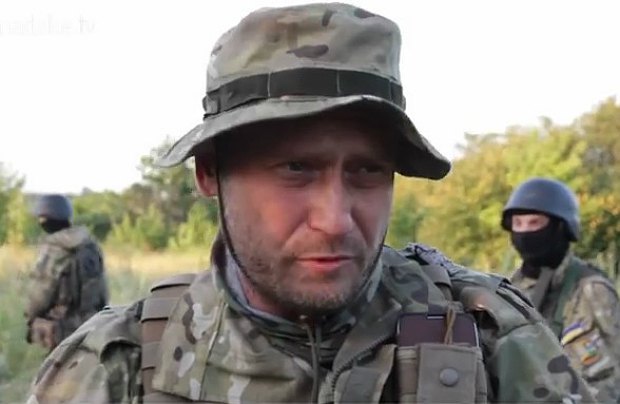
Dmitri Yarosh, Rada MP and leader of Ukraine's Right Sector, has declared that the unruly residents of eastern Ukraine must be deported and deprived of their civil rights before a program of 'affectionate Ukrainianization' can begin.


29 March, 2015

In an interview for Ukrainian newspaper Obosrevatel published on Sunday, Ukrainian Right Sector leader and Rada deputy Dmitri Yarosh stated that the unruly residents of eastern Ukraine should be deported and deprived of their civil rights.

Yarosh noted that much of Donbas is populated by 'Sovoks', an insulting slang term in Ukrainian and Russian derived from the word 'Soviet'. Yarosh stated that the region "is populated by Sovoks –real Sovoks. And they should be deported. We have to deal with those who do not want to live by the rules and the laws of the state in a very harsh manner. This includes deportation, the deprivation of civil rights, and so on. Without force, it will not be possible to do anything with the region, to turn the tide so to speak."

The Right Sector leader added that the region's "unruly" residents must also be dealt with. "If we get rid of the unruly ones, everything will be fine, quiet and peaceful. And then, of course, a program of affectionate Ukrainianization can begin." The MP noted that "spiritual rebirth" can begin only if authorities act in a consistent and forceful manner.

Yarosh cited Ukrainian authorities' response to events in Konstantinovka, Donetsk, controlled by the Ukrainian military, where an inebriated Ukrainian armored vehicle driver recently crashed into a crowd of people and crushed and killed an eight-year-old girl in a hit and run incident, leading to riots in the streets.

"The events in Konstantinovka are an example of what I mean. If we had shown even a little bit of weakness…Right from the beginning a whole bunch of 'heroes' began crawling out of the woodwork, using the tragedy in their own separatist interests. And when our guys came out and began shooting into the air and arresting the instigators of riots, everything ceased at once. This is the rule," Yarosh explained.

The MP noted that in his view, there are still many "real patriots" of Ukraine in the region, and that the present anti-Kiev attitudes are the result of many years of Russian propaganda and the removal of genuinely Ukrainian spiritual values. Yarosh explained that the "guys from Donetsk and Lugansk regions" fighting for the Ukrainian army "should become the [new] elite, on whose basis a qualitatively new society can be built…And those Vatnik [slang for Russians blindly loving their country], criminal oligarchic attitudes sitting in the minds of ordinary people for one reason or another must be removed."

As part of an effort to get the country's volunteer battalions under his control, Ukrainian president Petro Poroshenko is said to have offered Right Sector leader Dmitri Yarosh a post in the Ministry of Defense.

The extreme nationalist leader noted that he has accepted the president's invitation to come work in the Ukrainian Ministry of Defense, adding that he has chosen to do so on a volunteer basis.

Speaking about the Ukrainian army's recent losses on the battlefield, Yarosh recalled that "we faced a route near Ilovaisk…On the one hand, we have learned to fight, with morale at a high level. But things are very bad when a pride of lions is led by sheep. They cannot lead us to victory, and only roll us back…Speaking about the current situation on the front, our forces are still threatened by several encirclements. And I don't know, again, whether the sheep will react to this, or whether they are playing some sort of geopolitical game."

The Right Sector is a far-right wing Ukrainian nationalist party. In January and February of 2014, the movement's members participated heavily in fighting with Ukrainian police in the streets of Kiev, and in the capture of government buildings during the Euro-Maidan coup. Since April, they have taken the lead in the crushing of protest movements in eastern Ukraine, and enforcing the new order of the revolutionary government. In addition, they have also been involved in Kiev's military operation in Donbas. Right Sector's Ukrainian Volunteer Corps includes two battalions operating in eastern Ukraine, as well as eight reserve battalions throughout the rest of the country.

In November 2014, the Russian Supreme Court declared the Right Sector to be an extremist organization, and its activity has been banned on the territory of the Russian Federation. Earlier, in March, 2014, Russian authorities issued an arrest warrant against Dmitri Yarosh for incitement of terrorism, and for his organization's combat operations in the First Chechen War against the Russian military.


Dmitry Yarosh to Poroshenko: "We toppled Yanukovich, and can topple you". Interview.


29 March, 2015

Translated by Kristina Rus


 Our conversation took place on the day the "Right Sector" was ordered to leave the area of the ATO, and a new head of administration was introduced in Dnepropetrovsk. The leader of the "Right Sector" shared with us how he sees the situation, and also spoke about the relationship with the authorities, the future of the volunteer battalions, and much more.

About the order to leave the area ATO

I was preparing the draft laws on social protection of volunteers, but, as far as I understand, the President put a stop to it. In my opinion, Poroshenko does not understand still, what country he lives in, does not understand the realities. I am not forcing events from my side. And they are shaking the situation for some reason. Our politicians who have become state officials, by circumstances, by the will of the people, by the blood that was spilled on the Maidan [did not earn the power themselves, but were given the power by those like Yarosh - KR], in this war are too dependent on the opinions from abroad. Putin, Merkel, Hollande. 

They are given an algorithm of behavior, and they will follow it. Even if it is at the expense of national interests, even the sacred, the blood of the guys who died. This is where it "shoots" from. [The government betrayed the patriots, surprise - the "patriots" served their role and are no longer needed, but they don't want to step back  - KR] 

I realized this even at the airport. They begged me for a long time to take the Right Sector out of there. When the fighting intensity came down due to the "truce," which was quite ephemeral. At the end of November I pulled the fighters. Often my guys stopped the [UAF] soldiers from running away and under a barrel of a gun simply did not allow to give up the airport. [This is a war of the "radical patriots" and not of the people of Ukraine, and Yarosh doesn't get it, thinking most of them are traitors of the motherland - KR] Twice we were given the order to leave the airport.


As soon as we left - the old terminal was surrendered. It became clear that the new terminal is next - in a matter of time it will be either captured or surrendered.

Although we offered a lot of options. To move the firing positions outside of its territory. To blow up the runway across, to dig a trench, 600 meters from the control tower, which we controlled. We went there first, and then brought in the experienced soldiers. Captured the height over the airfield. That is, we planned to fully capture it, and under normal control and operations there would be no problems with retaining this location. We even proposed to build a new terminal!

They looked at us, like... But it is very simple. Need shipping containers, they are dug into the ground, filled with soil, even a tank can't get them, it can be done in one day. They didn't agree to anything. Now there is a [Right Sector] company in Shirokino, another scandal began. I was already told that there is an order for the withdrawal of troops of the Right Sector from Peski and Shirokino, and anyway, we're represented across the entire front, I  have medical brigades and combat units. Many do not like it. Including soldiers.


About the relations with the army

When our guys are under fire, they, as a rule, do not sit back and fire in response. Mainly, we are in good relations with those brigades, with which we fought before together [thats it? - KR]. But before the injury, when I was in Lugansk region, near Schastje, drove the medics, we were not accepted well... But there the war is different than in Donetsk region. Checkpoints are close to each other. They even go to visit each other (laughs). Like it was in Afghanistan, when field commanders agreed among themselves, existed peacefully. Until there was an incident when national guardsmen on a jeep flew into a checkpoint to the other side without stopping (were drunk), and they were shot. From our side they began to pull APC's, to take them out, from that side they began to pull the heavy weapons, and that's how it starts.


About lawmaking, plans and relations with the authorities

I want to introduce some bills, to form the armed forces under three categories: conscripts, contractors and volunteers. To make DUK [Volunteer Corps] a volunteer reserve, with its own area of responsibility. One of the bills I have already registered. My assistants betrayed me. Of course, changes will have to be made in other legislation.

It will be a natural relationship of the armed forces and volunteers. We never subordinated to them. We initially established normal relations with the main command. Only those suggestions that we have received back in the spring... Initially, for example, agreed in the AP [Presidential Administration], with Pashinsky that we will work under the main directorate of intelligence. But in the Ministry of Defense, they tell us: "Territorial defense" in God knows which region. Wait, but we talked about something else?! "No, we'll change it later..." Uh, no, guys, I say, I know your Ministry of Defense, the bureaucracy, you will find any reason not to let us fight. Had to refuse. And later there were many such proposals. To join one brigade, then another. Everyone who wanted to go, went to "Aidar", "Azov", UAF, we do not force anyone. But there are people who don't believe the military commanders, and have reasons not to believe. After Ilovaysk, Debaltsevo.

Now I talk with the fighters, they ask: "Who are you leaving us to rip us apart?" If they (the government - ed.) managed well, if we had normal upgraded armed forces, with normal approach to staff, there would be no need for any DUC, nor anything else. And what I see, not in all, but in many units - no work with the staff. So that a political officer would come, explained the political situation, explained the motivation, why you are here, why to storm or to protect an object, this doesn't happen. [Ukrainian soldiers don't understand what they are fighting for, and Yarosh wants to explain it to them - KR] This is the Soviet model, they do not work. But we are doing everything according to NATO standards. The lack of bureaucracy gives full mobility. We are not perfect, but much more efficient than today's regular army. If only we had sufficient quantity of weapons, I think, we would outnumber the armed forces (laughs). I know many, among the commanders and fighters of armed forces of Ukraine, who would immediately come to our side, if we were given weapons.

They [the authorities] only can't understand one thing - they think that I am competing with them for power. I don't need it at all!. If I wanted power - I would have long started to work on that. All I want is to win the war and to babysit grandchildren - nothing more.

[Didn't you just describe how you want to call the shots? - KR]

(Wife Olga: "What about me?!.." - Yarosh: "Well, and you, of course, sweetie! We will babysit each other!")

They added amendments to the bills that I proposed, at the last session on Thursday they were supposed to vote, but did not vote, and it is unclear if they will vote at all, after all these statements about the "cynical Banderites" [Poroshenko slip of tongue - KR], and "those who love to shoot" (regarding the killing of the SBU agent - ed.)... I know that he (Poroshenko - ed) is afraid of us. Can't stand us. I told him everything in his face. When Ilovaysk happened, and the first agreements. The battle is raging, and I am told - "Minsk agreement is signed". Called his assistant, said, tell him it's complete idiocy. And the betrayal of national interests. And also said: we toppled Yanukovych and can topple you too. He got very offended.


I can understand a lot: diplomatic maneuveringg, buying time, creating the armed forces. But what killed me was a truce in September. Debaltsevo. There was, for example, the moment when in Gorlovka only a company of the separatists was left, we could go in there. Debaltsevo could be prevented. And what? No orders. Lost a chance, they were building up forces. And we were denied requests for arms. But they (the authorities - ed) are afraid of the Right Sector more than of the terrorists, obviously.


On foreign instructors

Every experience should be adopted. Will come in handy. We also hired instructors, they came from all over the place. Our army did not fight, their army came back from Iraq, Afghanistan, and so on. When instructors see that our guys are interested, they are happy to share the knowledge, it is very useful. They compared, went to the army. They say this is not a drill, they [army soldiers - KR] are not interested. They do one hour of training, and done. But the volunteers light up, they have a million questions, of course, the instructors love it. In one of my battalions there are four Georgian instructors, they also went through training. When they work, they are very organized. Perfect supply, communications. When they see someone managing a battle with text messages on a cell phone (laughs), it's hard for them to understand.

On the work in the Verkhovna Rada

I didn't really want to do it, the truth is, the guys came up with the idea, I did not really want it, knew that it's not for me.


What will happen to the volunteer battalions

Legitimization of the status may help to save the volunteer units. But DUK just cannot go under the subordination of the armed forces, under their command. Because it means we will be liquidated. I have some commanders without higher military education, and some even without any higher education. They will immediately loose their positions. But they are more efficient than those with two diplomas. We must have our own system of knowledge, hierarchy, and the opportunity to grow. This should be reflected in the law. Then, after the war, if they wish, they can receive a higher education. Our Charter says: DUK is formed and operates only during the period of war [undeclared? - KR]. We will return Crimea, restore our territorial integrity, and then dissolve. We have more discipline than the army. But it is normal to see a commander on the front lines. Find me a  general, who will come there and lead the men from the trenches.

Our fighters are well provided with helmets, body armor, and so on. We are supported by volunteer organizations. If we will depend on [state] tenders, it will be useless. We never set a goal to obtain heavy equipment, we are light infantry, at most - we can have mortars. Will not say no to tanks, of course, but it is not the goal. We offer a completely different model of warfare. After air reconnaissance, armored pickups or "Cougars" can appear at the front, work on a target in three minutes and disappear. The [enemy's] artillery will cover the position, but there will be no one there.


About the "ceasefire"

It is relative, we see that there is fighting on many fronts. How long it will last - depends on Putin and his decisions. They have assembled forces for a strike, they will have deceptive battles, and there will be the main ones. 3-4 shock troops they already have. There are some in Donetsk, they may go to Konstantinovka, Slavyansk, for them it is symbolic. The second direction is Mariupol. The third - Stanitsa Luganskaya, Schastye, another cauldron may develop there. And Volnovakha. They will wait until the fields are dry to start the offensive. We don't see their chessboard, may be they will have aviation. 


About relations with Kolomoisky


I saw him twice in my life, there is no special relationship. With Gennady Korban, Slava Oleynik, Boris Filatov I have a friendly relationship. But then again, we also met after the revolution. War, so to speak, made us friends. I judge by real results. I saw that the guys are working not for their own pocket but for the country. That's the main thing.

Although I hear different things about "Privat", and I don't deny it. Gena wrote yesterday in FB, that in our country the conditions are such that you cannot legally do business. And it's true. If you want to achieve anything, you have to violate the rules, and only then you will achieve something. I am very grateful for everything they've done for us, even though we never asked for anything. Help with the body armor, helmets, cars, without them it would be much harder. I am grateful to them, as a resident of this region. We saw the situation in Kharkov, Odessa, couldn't do this there. But they managed to do it, despite the influence of Vilkul clan, which has considerable influence here. We will ensure that they (the members of the clan - ed.) don't raise their head, we can't afford to lose the Dnepropetrovsk region. Without options. 


The changing media narrative on abrupt climate change

See what the story the media was telling back in 2007, even in late-2011

Now that methane emissions are going exponential the media has gone silent on the matter, and denial and avoidance are the order of the day while the US goes full tilt with plans to extract oil in the Arctic.

When was the last time Igor Semiletov or Natalia Shakhova were quoted in MSM (especially the Guardian)

The answere is July, 2013. I suspect that, in the world of abrupt climate change denial, that will have been the last time.


Polar bear standing atop an iceberg floating in the Beaufort Sea, Arctic Ocean, Alaska

Welcome to the world of suicidal ecocide

"Countdown to Doomsday" Methane Release MSNBC


Vast methane 'plumes' seen in Arctic ocean as sea ice retreats


13 December, 2011

Dramatic and unprecedented plumes of methane - a greenhouse gas 20 times more potent than carbon dioxide - have been seen bubbling to the surface of the Arctic Ocean by scientists undertaking an extensive survey of the region.

The scale and volume of the methane release has astonished the head of the Russian research team who has been surveying the seabed of the East Siberian Arctic Shelf off northern Russia for nearly 20 years.

In an exclusive interview with The Independent, Igor Semiletov of the International Arctic Research Centre at the University of Alaska Fairbanks, who led the 8th joint US-Russia cruise of the East Siberian Arctic seas, said that he has never before witnessed the scale and force of the methane being released from beneath the Arctic seabed.

"Earlier we found torch-like structures like this but they were only tens of metres in diameter. This is the first time that we've found continuous, powerful and impressive seeping structures more than 1,000 metres in diameter. It's amazing," Dr Semiletov said.

"I was most impressed by the sheer scale and the high density of the plumes. Over a relatively small area we found more than 100, but over a wider area there should be thousands of them," he said.

Scientists estimate that there are hundreds of millions of tons of methane gas locked away beneath the Arctic permafrost, which extends from the mainland into the seabed of the relatively shallow sea of the East Siberian Arctic Shelf.

One of the greatest fears is that with the disappearance of the Arctic sea ice in summer, and rapidly rising temperatures across the entire Arctic region, which are already melting the Siberian permafrost, the trapped methane could be suddenly released into the atmosphere leading to rapid and severe climate change.

Dr Semiletov's team published a study in 2010 estimating that the methane emissions from this region were in the region of 8 million tons a year but the latest expedition suggests this is a significant underestimate of the true scale of the phenomenon.

In late summer, the Russian research vessel Academician Lavrentiev conducted an extensive survey of about 10,000 square miles of sea off the East Siberian coast, in cooperating with the University of Georgia Athens. Scientists deployed four highly sensitive instruments, both seismic and acoustic, to monitor the "fountains" or plumes of methane bubbles rising to the sea surface from beneath the seabed.

"In a very small area, less than 10,000 square miles, we have counted more than 100 fountains, or torch-like structures, bubbling through the water column and injected directly into the atmosphere from the seabed," Dr Semiletov said.

"We carried out checks at about 115 stationary points and discovered methane fields of a fantastic scale - I think on a scale not seen before. Some of the plumes were a kilometre or more wide and the emissions went directly into the atmosphere - the concentration was a hundred times higher than normal," he said.

Dr Semiletov released his findings for the first time last week at the American Geophysical Union meeting in San Francisco. He is now preparing the study for publication in a scientific journal.

The total amount of methane stored beneath the Arctic is calculated to be greater than the overall quantity of carbon locked up in global coal reserves so there is intense interest in the stability of these deposits as the polar region warms at a faster rate than other places on earth.

Natalia Shakhova, a colleague at the International Arctic Research Centre at the University of Alaska Fairbanks, said that the Arctic is becoming a major source of atmospheric methane and the concentrations of the powerful greenhouse gas have risen dramatically since pre-industrial times, largely due to agriculture.

However, with the melting of Arctic sea ice and permafrost, the huge stores of methane that have been locked away underground for many thousands of years might be released over a relatively short period of time, Dr Shakhova said.

"I am concerned about this process, I am really concerned. But no-one can tell the timescale of catastrophic releases. There is a probability of future massive releases might occur within the decadal scale, but to be more accurate about how high that probability is, we just don't know," Dr Shakova said.

"Methane released from the Arctic shelf deposits contributes to global increase and the best evidence for that is the higher concentration of atmospheric methane above the Arctic Ocean," she said.

"The concentration of atmospheric methane increased unto three times in the past two centuries from 0.7 parts per million to 1.7ppm, and in the Arctic to 1.9ppm. That's a huge increase, between two and three times, and this has never happened in the history of the planet," she added.

Each methane molecule is about 70 times more potent in terms of trapping heat than a molecule of carbon dioxide. However, because methane it broken down more rapidly in the atmosphere than carbon dioxide, scientist calculate that methane is about 20 times more potent than carbon dioxide over a hundred-year cycle


CO2 emisson levels

Climate Change: CO2 Threat Level


The present level of CO2 is 405.46 ppm
The highest record of CO2 recorded is 411.52 ppm


To see the CO2 emission clock GO HERE

Counting down to Armageddon

Doomsday Clock Moves Closer to Midnight As California’s Last Active Nuke Plant Puts Millions at Risk

nukes3650
The Diablo Canyon Power Plant near scenic San Luis Obispo on the Golden State’s central coast sits in an area where several new fault lines have been discovered over the decades. The situation at California’s last remaining active nuclear plant has generated widespread concern about whether the U.S. Nuclear Regulatory Commission has learned anything at all from Fukushima.


24 March, 2015


Humanity’s clock is ticking but few in power seem to recognize how late it’s getting. The Bulletin of the Atomic Scientists has been keeping time though with their “Doomsday Clock,” established in 1947 to convey threats to humanity and the planet in the new atomic age launched by the Manhattan Project two years before. Widely recognized as an indicator of the world’s vulnerability to catastrophe from nuclear weapons, global climate change and other emerging technologies, the Doomsday Clock was moved forward two minutes in January to 11:57 p.m. It’s the closest the clock has been to midnight since the height of the Cold War in 1984.

The clock ticks now at just three minutes to midnight because international leaders are failing to perform their most important duty—ensuring and preserving the health and vitality of human civilization,” the Bulletin’s Science and Security Board stated in their announcement. “The probability of global catastrophe is very high, and the actions needed to reduce the risks of disaster must be taken very soon.”

Global climate change and the nuclear weapons industry were listed as the primary threats, but the Bulletin’s analysis also cited “the leadership failure on nuclear power.” The Bulletin noted that “the international community has not developed coordinated plans to meet the challenges that nuclear power faces in terms of cost, safety, radioactive waste management, and proliferation risk.” The triple meltdown at Japan’s Fukushima Dai-ichi power plant in 2011 brought the issue to global attention after an unpredictable earthquake stronger than the plant was built to withstand overwhelmed the reactors in conjunction with a massive tsunami. This unprecedented disaster even led the U.S. Nuclear Regulatory Commission (NRC) to establish a Fukushima Lessons Learned Division. But the situation at California’s last remaining active nuclear plant has generated widespread concern about whether the NRC has learned anything at all from Fukushima.

Diablo Canyon—An American nuclear plant with troubling similarities to Fukushima

The Diablo Canyon Power Plant near scenic San Luis Obispo on the Golden State’s central coast sits in an area where several new fault lines have been discovered over the decades. Controversy flared in 2014 due to revelations about regulatory safety questions from the plant’s former senior resident inspector Michael Peck, who served in that role from 2007-12. Peck became concerned that new seismic data suggested the plant was operating outside the safety margins of its license. He issued a non-concurrence in 2012, a Dissenting Professional Opinion in 2013 and a DPO Appeal in 2014. Debate between Peck and his bosses at the NRC has centered around what methodology should be used to determine whether the plant could survive a massive quake it might not be built to withstand.

Michael Peck at Avila Beach, near Diablo Canyon. Photo credit: Michael PeckMichael Peck, former senior resident inspector of Diablo Canyon Power Plant, at Avila Beach, near Diablo Canyon. Photo credit: Michael Peck


I wrote the non-concurrence, DPO, and the Appeal to draw attention to the failure of the NRC to enforce nuclear safety rules and license requirements at the Diablo Canyon Power Plant. These requirements include the regulatory safeguards relied on to protect California residents from a radiation release following a major earthquake,” Peck said in a recent interview by both phone and email.

He went on to explain how NRC regulations require a plant’s operating license to be amended before “non-conservative” changes are applied to safety analysis methodologies, yet PG&E had been allowed to make such changes without a license amendment.

PG&E completed a reevaluation of Diablo Canyon seismology in January 2011. This reevaluation concluded that three local faults were capable of exceeding equipment seismic qualification limits established by the facility design basis. In September 2014, PG&E completed an additional reevaluation as mandated by California Assembly Bill 1632. This latest reevaluation revealed that several of these faults are even more capable than previously considered,” Peck explained. “PG&E created the appearance that the facility design basis remained satisfied by presenting the reevaluation results using less conservative methods than specified in the facility license. While these new methods and assumptions may or may not be technically justifiable, NRC rules required that PG&E first obtain an amendment to the Operating License before they were used in facility safety analyses. When applying the licensed methodology, the new seismic data results in stress levels on important equipment well in excess of safety limits. As a result, key safety barriers protecting the public from a radiation release may fail following a major earthquake.”

nukes2650Michael Peck at the Diablo Canyon Power Pant.

Peck went against the politically desired outcome because PG&E was no longer adhering to the parameters of the plant’s license and the NRC was no longer enforcing it.

Bypassing this regulatory framework was not only irresponsible but also represented a serious violation of the public trust. The amendment process also would have provided public notice and hearing opportunities for these facility safety analysis changes that directly affect the principle safety barriers for ensuring public protection from radiation,” Peck dded.

The NRC put together a three-person “independent” panel to rule on Peck’s DPO. Eric Leeds, director of the NRC’s Office of Nuclear Reactor Regulation, appointed Mike Case, director from the Division of Engineering in the NRC’s Office of Nuclear Regulatory Research, as panel chair. Peck, as DPO submitter, was entitled to recommend one panel member and selected NRC’s Rudolph Bernhard, a senior reactor analyst. The other panel member selected by Leeds, Brit Hill, is a bit more curious. Hill is COO of NUTECH Energy Alliance, a Houston-based oilfield services company. He previously spent 13 years working for the notorious Halliburton Company, before moving on to NUTECH (which was co-founded by former Halliburton execs). NRC spokesperson Lara Uselding says Hill has relevant seismic experience and has worked with NRC for almost a decade.

The panel apparently spent almost a year analyzing Peck’s DPO before rejecting it in May of 2014 and declaring that PG&E had satisfied all regulatory requirements. A primary issue for Peck was a difference of opinion about Diablo Canyon’s Safe Shutdown Earthquake (SSE), the level of seismic activity the plant could withstand. Peck says the panel used “circular logic” in justifying a change to the seismic standard that conflicted with the facility’s license application (FSAR) and then used that assumption to support their conclusion.

When I asked the Panel Chairman (Mike Case) the basis for their assumption, he directed me to a recently changed FSAR Section (Revision 21). NRC regulations (10 CFR 50.59) required PG&E to first obtain an amendment to the Operating License before changing either the facility design basis or using a less conservative methodology or input assumptions in safety analyses that demonstrate that the design basis is satisfied. So, the basis the Panel chairman provided was built on an unauthorized change of the Operating License by PG&E,” Peck says.

Peck’s concerns about circular logic by the NRC drew support of varying parties such as the Union of Concerned Scientists (UCS) and environmental non-profit Friends of the Earth.

Dave Lochbaum, director of the Nuclear Safety Project for the UCS, authored a November 2013 report, “Seismic Shift: Diablo Canyon Literally and Figuratively on Shaky Ground,” in which he backed Peck’s concerns and voiced some of his own. “Of the 100 reactors currently operating in the U.S., the two at Diablo Canyon top the NRC’s list as being most likely to experience an earthquake larger than they are designed to withstand,” wrote Lochbaum.

He cited figures indicating that “the Diablo Canyon reactors are more than 10 times more likely to experience an earthquake larger than they are designed to withstand than the average U.S. reactor” and he calculated that “the chance such a large earthquake will occur at Diablo Canyon over the 40-year lifetime of the plant is … about 1 in 6—which is a toss of a die.”

PG&E sought to have the NRC increase the SSE value to a level PG&E believed its reactors could withstand, but that had not been justified by a rigorous analysis meeting the NRC’s regulatory standards,” Lochbaum wrote. “David Copperfield and other magicians get paid when performing such feats of illusion. PG&E also gets paid for its illusion from the revenue generated by the continuing operation of Diablo Canyon’s two reactors.”

Lochbaum used the NRC’s seismic data to calculate that Diablo Canyon could be expected to suffer an earthquake larger than its SSE every 256 years. Reached by email, he put that number into context by comparing it with what happened at Fukushima.

That seems like a fairly rare event. But for comparison, the odds that Fukushima would experience a tsunami as large as it experienced on March 11, 2011, were about one such tsunami every 1,000 years or so … So, Diablo Canyon is nearly four times more likely to experience an earthquake larger than its SSE than Fukushima was to experience its devastating tsunami,” Lochbaum explained.

Peck submitted an appeal to the DPO decision in June of 2014, stating that the decision appeared to be built around a misunderstanding of the plant’s license requirements and agency rules. But his concerns were again rejected. “I have exhausted the NRC processes for raising nuclear safety concerns,” Peck wrote in an editorial for the Santa Barbara Independent in September. “I was left with the impression that the NRC may have applied a different standard to Diablo Canyon.”

Part of the NRC’s justification for rejecting Peck’s appeal is that Peck agreed in a meeting last summer with Mark Satorius, the NRC’s Executive Director for Operations, that there is “no immediate or significant safety issue” at Diablo Canyon.

I was only agreeing that there wasn’t an imminent threat of a core meltdown,” Peck says, standing by his concerns that the plant continues to operate outside the safety margins of its license. “We consider an immediate safety issue one requiring immediate intervention to protect the public from an imminent or potential release of radioactive material. We consider a significant safety issue one representing an increase of core damage probability in the range of about one in a hundred. The probability of a large earthquake at Diablo Canyon is outside of this frequency range.”

That said, NRC regulations require the plant design basis to ensure important plant structures, systems, and components are designed to withstand the effects of the most severe earthquake reported for the site and surrounding area. PG&E’s new seismic evaluations indicated that local faults can produce about twice the ground motion established by the facility license. While a major earthquake is unlikely to occur, as we saw in Japan, the consequence to the local population can be quite severe,” Peck added. “The lack of an ‘immediate or significant safety issue’ does not justify the failure of the NRC to enforce agency regulations and license requirements at Diablo Canyon …”

Lochbaum backed Peck again in another report for the UCS last August, citing information that UCS had acquired from the NRC through Freedom of Information Act requests. “It is clear and undeniable that Dr. Peck’s findings are correct: the company’s [PG&E] evaluation of the Shoreline Fault and its implications on safety at Diablo Canyon is incomplete and does not use methods and assumptions accepted by the NRC,” Lochbaum concluded.

A Congressional hearing debates the diabolical questions at Diablo Canyon

Peck’s dissent drew the attention of California Sen. Barbara Boxer, who made Diablo Canyon a focal point of the Senate Environment and Public Works Committee’s Dec. 3 hearing on “NRC’s Implementation of the Fukushima Near-Term Task Force Recommendations and Other Actions to Maintain and Enhance Nuclear Safety.” Daniel Hirsch, who lectures on nuclear policy at the University of California-Santa Cruz, testified and compared the situation at Diablo Canyon with Fukushima to illustrate the NRC’s failure to learn from the Japanese disaster.

In the Diablo case, the decisions have turned out to be erroneous, over and over again. And yet the pattern is repeated, over and over again. How many times do they get to be wrong before something changes?” Hirsch asked. “Unless we fix these problems—of regulated entities pressing for exceptions to and weakening of safety requirements and of regulators viewing themselves more as advocates for and allies of the industry they are to regulate rather than primarily protectors of public safety—we will not have learned the lessons of Fukushima.”
Hirsch went on to elaborate on the historical pattern of political interference and subterfuge at Diablo Canyon.

NRC and PG&E attempt to avoid public licensing hearings on the critical seismic issues. Overly optimistic assumptions are thus chosen, only to be, time and time again, disproven by newly discovered scientific facts. Rather than shut the plant down or require sufficient upgrades to address the newly revealed seismic challenges, NRC and PG&E carve more and more safety margins out of the design, using ever less conservative (i.e., less protective) assumptions and methodologies. And they try to do this behind closed doors, with the public locked out of their right to evidentiary hearings … The problem is that nature may not go along with the regulatory fictions. As at Fukushima, an earthquake larger than the plant can withstand could occur at any moment. And as at Fukushima, it will not be an act of nature, but a man-made disaster, caused by the failure of our institutions. “

Tony Pietrangelo, Senior Vice President and Chief Nuclear Officer at the Nuclear Energy Institute, testified along with NRC commissioners in support of PG&E and NRC’s decisions at Diablo Canyon. “Differing professional opinions do occur among the 4,000 staff at the NRC, and the NRC has a process for addressing them. In this case, the conclusion was that, ‘there is not now nor has there ever been an immediate safety concern’ with this issue at Diablo Canyon. In addition, the panel concluded that older analytical techniques were overly conservative and no longer technically justified since the license at Diablo Canyon allows for newer technologies to be used,” Pietrangelo said.

Peck doesn’t doubt “that the geo-science has improved greatly since the 1980s,” but he remains steadfast that PG&E is still violating the terms of Diablo Canyon’s license.

PG&E didn’t even bother to ask for NRC permission to use the new methods associated with the September 2014 data.  They just went ahead and used them.  Remember, the plant would be shut down if PG&E used the methods and inputs required by the license,” Peck points out.

PG&E stands by their seismic data, asserting that they have completed exhaustive research to confirm Diablo Canyon is not vulnerable to a potential earthquake stronger than it’s designed to withstand.

As the NRC confirmed in the hearing, Diablo Canyon is being operated safely and is in compliance with its seismic licensing requirements,” PG&E spokesperson Blair Jones said to the media after the hearing, adding that the company’s Long Term Seismic Program (LTSP)continues to assess seismic safety at the plant. “The LTSP is a unique program in the U.S. commercial nuclear power plant industry. It is comprised of a geosciences team of professionals who partner with independent seismic experts on an ongoing basis to evaluate regional geology and global seismic events to ensure the facility remains safe. Because of our LTSP and decades of industry-leading research, the seismic region around Diablo Canyon is among the most studied and understood areas in the nation.”

Daniel Hirsch’s argument that NRC management has greater allegiance to profits than safety gained further ammunition in the early part of 2015 when American diplomats at the International Atomic Energy Agency’s (IAEA) Convention on Nuclear Safety were blamed for rejecting a Swiss-led European Union proposal to strengthen international nuclear safety rules.

Opposition to the Swiss proposal mirrors the situation of the international nuclear industry,” Paris-based Mycle Schneider, lead author of the World Nuclear Industry Status Report, told Bloomberg.com. “Nuclear operators are confronted with severely shrinking profit margins everywhere.”

The U.S. delegation insisted that it did not oppose the initiative due to increasing costs and market losses to the nuclear industry, saying that current upgrades are adequate. But watchdog group Beyond Nuclear took issue, noting that the NRC had already shown its hand by rejecting another reactor safety upgrade recommendation from its own Japan Lessons Learned Task Force.

The lesson, now unlearned by the Commission, would have ordered all U.S. operators of Fukushima-style reactors (GE Mark I and Mark II boiling water reactors) to install high capacity external radiation filters for hardened vents on the vulnerable containment systems,”reported BeyondNuclear.org. “Senior staff had concluded that installing external filters was ‘a cost-benefited substantial safety enhancement’ to more reliably manage the next severe nuclear accident by venting the extreme heat, high pressure, explosive gases while still significantly reducing the consequences by capturing large amounts of radioactivity. However, the UBS international energy investment bank had earlier predicted that the Commission would likely vote down its senior managers’ recommendation because of the ‘added stress this places on the incumbent’s portfolio’ and ‘the fragile state of affairs’ of their licensees’ financial and economic condition.”

As for Michael Peck, he now works as a senior instructor at the NRC’s Technical Training Center in Tennessee, a position he applied for after he saw the writing on the wall at Diablo Canyon.

I went from being the ‘senior resident inspector’ to having both performance and conduct issues after I submitted the non-concurrence,” Peck explains about his departure from Diablo Canyon. “I felt that [NRC] Region IV was setting me up to involuntarily reassign me to their Dallas-Fort Worth office.  Over the years, I’ve seen it happen to many other inspectors. So, rather than wait for the other shoe to drop, I applied and was selected for the position in Chattanooga.  I’m sure that had I not filed the non-concurrence or DPO, I would still be a senior resident inspector.”

It looks like the controversial status of Diablo Canyon will be decided in the courts. Washington, DC-based non-profit Friends of the Earth has filed a lawsuit against the NRC in the U.S. District Court of Appeals for the District of Columbia, the court that reviews decisions of federal agencies. The lawsuit asks the court to order the NRC to conduct public hearings on the amending of Diablo Canyon’s license and to shut down the plant until that process concludes.

The NRC motioned to have the case dismissed but on February 20 the D.C. Circuit ruled not to grant the motion and that the case should be heard on its merits. “This is a big victory,” said Damon Moglen, senior strategic advisor for Friends of the Earth, in a press release. “The public has a right to know what the NRC and PG&E won’t admit—hundreds of thousands of people are put at immediate risk by earthquake danger at Diablo Canyon.”