Tuesday, 30 September 2014

Amercian bombing in Syria

By mistake? US-led jets bomb grain silos in Syria, 'civilians killed'

RT,
29 September, 2014


US-led coalition airstrikes destroyed grain silos and other targets in parts of northern and eastern Syria dominated by Islamic State, killing civilians while only wounding ISIS fighters, according to an organization monitoring war in Syria.
The overnight bombings hit mills and grain storage facilities in Manbij, a militant-held town in northern Syria. Coalition forces possibly mistook the structures for Islamic State holdings, said the Syrian Observatory for Human Rights on Monday.
The US military responded to the claims later Monday morning, according to Reuters, saying that Islamic State vehicles were adjacent to the grain storage facility, and that there is no evidence of civilian casualties.

The United States and Arab allies have conducted airstrikes against Islamic State and other jihadist groups in Syria since last week, and in Iraq since last month. The stated goal of the coalition’s bombing campaign is to cripple Islamic State operations, including bases, combat forces, and supply lines. Islamic State, an Al-Qaeda splinter group that reportedly has as many as 30,000 fighters in the region, has come to control large areas of Syria and northern Iraq since the beginning of the Syrian civil war in 2011. The group is also known as ISIS or ISIL.

A U.S Air Force KC-10 Extender refuels an F-22 Raptor fighter aircraft prior to strike operations in Syria, Sept. 26, 2014. These aircraft were part of a strike package that was engaging ISIL targets in Syria. (U.S. Air Force photo by Tech. Sgt. Russ Scalf)
The destruction of grain silos in Manbij only killed civilians, said Rami Abdulrahman, the head of the Observatory, which claims to have a network of sources throughout Syria.

"These were the workers at the silos. They provide food for the people," he said Monday. Abdulrahman could not offer an exact casualty count.
The airstrikes "destroyed the food that was stored there,” he added, according to AP. Neither Reuters nor AP could immediately verify his claims. The Britain-based Observatory was founded in 2006 and is chiefly opposed to President Bashar Assad’s government in Syria.
Manbij is between the divided city of Aleppo to the west and the northern border town of Kobani, near Turkey, which is controlled by Syrian Kurdish forces. In the pursuit of Kobani, Islamic State offensives have forced tens of thousands of Kurds to seek refuge elsewhere.

The Syrian army - which is not officially allied with the US-led coalition but is aided by any aggression against mutual foes Islamic State - also conducted air raids in Aleppo province Sunday night, hitting spots east of Aleppo city with barrel bombs and other ordnance, the Observatory said. Syrian forces also targeted the western city of Hama.
The US-led bombing campaign also hit an Islamic State controlled gas plant in the eastern Syrian city of Deir al-Zor, wounding many of the group’s members, according to the Observatory. The airstrikes targeted Kuniko gas plant that feeds a power station in Homs that supplies electricity to several provinces and powers oil field generators, the Observatory said.

The United States and allies have said revenue-generating oil facilities held by Islamic State are a priority in the bombing campaign.

The US and coalition forces also bombed areas of Hasaka city in the northeast, as well as areas outside of the northern city of Raqqa, a main territorial stronghold for Islamic State.
AFP Photo / Russ Scalf

The coalition against Islamic State includes Saudi Arabia, Bahrain, the United Arab Emirates, Qatar, and Jordan. Many European countries also are involved with efforts to strike Islamic State group in Iraq, including France, the Netherlands, Denmark, Belgium, and Britain.

If the Observatory’s sources are correct about civilian casualties in Manbij, that would add to the 19 civilians the Observatory has reported have been killed by coalition bombings, according to AP.
A U.S Air Force KC-10 Extender refuels an F-22 Raptor fighter aircraft prior to strike operations in Syria, Sept. 26, 2014. These aircraft were part of a strike package that was engaging ISIL targets in Syria. (U.S. Air Force photo by Tech. Sgt. Russ Scalf)

Human Rights Watch said Sunday that it confirmed with local residents the deaths of at least seven civilians - two women and five children - from a US missile strike on September 23 in the town of Kafr Derian, of Idlib province. The group said two men were also killed in the strike, but that they many have been extremist fighters.

"The United States and its allies in Syria should be taking all feasible precautions to avoid harming civilians," said Nadim Houry, the deputy Middle East director for Human Rights Watch.
"The US government should investigate possible unlawful strikes that killed civilians, publicly report on them, and commit to appropriate redress measures in case of wrongdoing."


The advance of ISIS in Iraq

Isis an hour away from Baghdad - with no sign of Iraq army being able to make a successful counter-attack
US air strikes are failing to drive back Isis in Iraq where its forces are still within an hour’s drive of Baghdad.

Patrick Cockburn

The Iraqi army, plagued by corruption, absenteeism and supply failures, has little chance against Islamist fanatics using suicide bombings and fluid tactics. And US air strikes are making little difference

29 September, 2014

Three and a half months since the Iraqi army was spectacularly routed in northern Iraq by a far inferior force of Isis fighters, it is still seeing bases overrun because it fails to supply them with ammunition, food and water. The selection of a new Prime Minister, Haider al-Abadi, to replace Nouri al-Maliki last month was supposed to introduce a more conciliatory government that would appeal to Iraq’s Sunni minority from which Isis draws its support.

Mr Abadi promised to end the random bombardment of Sunni civilians, but Fallujah has been shelled for six out of seven days, with 28 killed and 117 injured. Despite the military crisis, the government has still not been able to gets its choice for the two top security jobs, theDefence Minister and Interior Minister, through parliament.

The fighting around Baghdad is particularly bitter because it is often in mixed Sunni-Shia areas where both sides fear massacre. Isis has been making inroads in the Sunni villages and towns such as in north Hilla province where repeated government sweeps have failed to re-establish its authority.
Mr Abadi is dismissing senior officers appointed by Mr Maliki, but this has yet to make a noticeable difference in the effectiveness of the armed forces, which are notoriously corrupt. During the battle for Mosul, Iraq’s second-largest city, in June, Iraqi government forces nominally numbered 60,000 in the army, federal police and local police, but only one third were actually on duty. A common source of additional income for officers is for soldiers to kickback half their salaries to their officers in return for staying at home or doing another job.

The same system is universal in civilian ministries, which have far more people on their payroll than are actually employed.

A World Bank report just published reveals that out of 8,206 guards employed by one ministry only 603 were actually working. Some 132 senior officers have recently been sacked by Mr Abadi, but there is as yet no sign of the army being able to make a successful counter-attack against Isis. Worse, in Baghdad it has been unable to stop a wave of car bombs and suicide bombers, which continue to cause a heavy loss of civilian life.


An example of the continued inability of the Iraqi army to remedy the failings, which led to its loss of Mosul and Tikrit, came on 21 September when Isis overran a base at Saqlawiya, near Fallujah, west of Baghdad after besieging it for a week.

The final assault was preceded, as is customary with Isis attacks, by multiple suicide bombing attacks. A bomber driving a captured American Humvee packed with explosives was able to penetrate the base before blowing himself up.

This was followed up by an Isis assault team dressed in Iraqi army uniforms. Some 820 government soldiers stationed at the base broke up into small groups and fled by backroads but were ambushed.

What is striking about the loss of Saqlawiya is that during a siege lasting a week the Iraqi army was unable to help a garrison only 40 miles west of Baghdad. Complaints from the troops that they were left without reinforcements, ammunition, food or water are very much the same as those made in the first half of 2014 when rebels led by Isis outfought some five government divisions, a third of the 350,000-strong army, and inflicted 5,000 casualties.

Fallujah fell in January and the army was unable to recapture it.

A woman in the village of Alizar, on the border between Turkey and Syria, keeps guard during the night, fearful of mortar attacks from Isis A woman in the village of Alizar, on the border between Turkey and Syria, keeps guard during the night, fearful of mortar attacks from Isis (Getty)
The US could embed observers with Iraqi troops to call in air strikes in close support, but people in the Sunni provinces are frightened of being reoccupied by the Iraqi army and Shia militias bent on revenge for their defeats earlier in the year. In areas where there are mixed Sunni-Kurdish populations both sides fear the military success of the other.

The military reputation of the Kurdish soldiers, the Peshmerga, has taken a battering since their defeat in Sinjar in August where its troops fled as fast as the Iraqi army had done earlier. The Peshmerga have not done much fighting since 1991, except with each other during the Kurdish civil wars, and even in the 1980s their speciality was rural guerrilla warfare, wearing the enemy down with pinprick attacks by 15 to 20 fighters.

Before the deployment of US air power, Isis in Iraq used motorised columns with 80 to 100 men which would launch surprise attacks.

With the possibility of US air strikes, this kind of highly mobile warfare is no longer feasible without taking heavy losses, But Isis has shown itself to be highly adaptable and is still able to operate effectively despite US intervention.

The problem for the US and its allies is that even if Iraqi divisions are reconstituted, there is no reason to think they will not break up again under Isis attack. The main military arm of the Baghdad government will remain Iranian-backed Shia militias, of which the Sunni population is terrified.


Massive protests in Hong Kong

Hong Kong protests: Chief executive Leung Chun-ying denies Chinese troops will help to quell demonstrations
Tens of thousands of pro-democracy protesters remained on the streets of Hong Kong for a fourth night on Monday, defying calls for them to disperse as the biggest challenge to Beijing’s authority in 25 years continued to swell.


High-school demonstrators protest in Hong Kong.


 High-school demonstrators protest in Hong Kong. Photograph: Xaume Ollers/AFP/Getty Imag

Pro-democracy campaigners say this will ensure that only those who support the government in Beijing will be allowed to stand. They are demanding a free choice of candidates for the role of chief executive.

Last night the protests had spilt out of the central financial district on Hong Kong island, one of the world’s biggest business hubs, and into other key areas. Some banks have suspended trading, shops closed early and some schools will remain closed today.

Police said they used 87 rounds of tear gas on Sunday night in what they said was a necessary but restrained response to protesters’ efforts to push through cordons and barricades. They said 41 people were injured, including 12 police officers. Pepper spray was also used and protesters were baton charged.

Last night, however, the riot police were stood down as the use of tear gas appeared to have backfired. The crowds grew as people finished work and joined weary-looking students camped on major roads near the city’s government headquarters and in several other parts of Hong Kong.

The students are protecting the right to vote, for Hong Kong’s future. We are not scared, we are not frightened, we just fight for it,” said Carol Chan, a 55-year-old civil service employee who took two days off to join the protests after being angered by the police use of tear gas.

China has called the protests illegal and endorsed the Hong Kong government’s efforts to quell them, saying they are undermining the city’s image as a safe financial haven. Beijing has taken a hard line against perceived threats to the Communist Party’s monopoly on power. This is the biggest challenge since Tiananmen Square in 1989, which ended in a massacre. A similar outcome this time would be a disaster for Hong Kong’s reputation and for Beijing. But if the protesters succeed, democracy activists on the mainland will be emboldened.

Hong Kong’s chief executive, Leung Chun-ying, was forced to deny rumours on Monday that the Chinese army might intervene. “I hope the public will keep calm. Don’t be misled by the rumours,” he said.
China has also warned other countries not to interfere, after the UK Foreign Office said it was “concerned” about the violence in its former colony. It called on the authorities to preserve long standing freedoms by a move to “universal suffrage”.

Instead of candlelight on Monday night, protesters staged “mobile light” protests, holding up their mobile phones with their screens glowing.

Protest leader Benny Tai, a founder of the Occupy Central campaign, also called on Mr Leung to step down. Addressing crowds on Monday night, he also condemned the use of force on Sunday. “People use peace and hope, while the government used tear gas and pepper spray,” he said.

On Sunday night protesters wore rain capes, surgical masks and swimming goggles and used umbrellas to shield themselves from the tear gas and pepper spray.

While many residents support the calls for greater democracy – dubbed the “umbrella revolution” although the crowds’ demands fall far short of revolution – not everyone supports the protests.

In an email to the BBC a resident called Cyrus Chiu said: “I am one of the silent majority who would not take part in the riot because Beijing has already made one major concession by allowing the people to vote in choosing our next chief executive.

You may argue that only two or three nominees are allowed for us to choose, thus virtually barring any chance for a pro-democracy candidate to be considered.

Yet every citizen does have one vote, and this right to choose our own leader is unprecedented throughout the 200-year history of Hong Kong,” he said.

http://www.independent.co.uk/news/world/asia/hong-kong-protests-chief-executive-leung-chunying-denies-chinese-troops-will-help-to-quell-demonstrations-9763394.html
Live coverage from the South China Morning Post

9.55am: Twitter has put together a graphic showing how the Hong Kong protests have sparked worldwide debate over the last few days. At the peak of the conversation Twitter says there were 12 tweets a second being sent on the Hong Kong protests, as the world watched the territory's civil disobedience movement clash with police.
Twitter has also created a graphic of the most widely shared pictures. To see the full interactive graphic and the most shared pictures click here...
9.35am: Here are the aircraft flying in formation over Victoria Harbour this morning. They have been identified as Government Service Aircraft, which routinely patrol the area.
A bus in Mong Kok is covered in messages, including calls for CY Leung to step down and 'No riot police' messages. Photo: SCMP
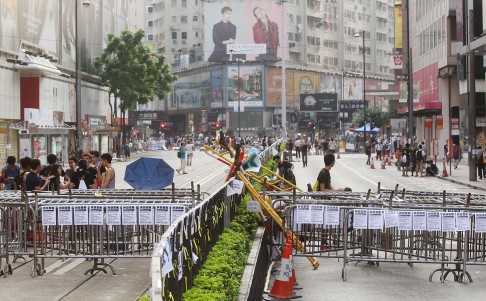
9.13am: In Causeway Bay the streets have been cleaned by protesters keen not to leave the site dirty.
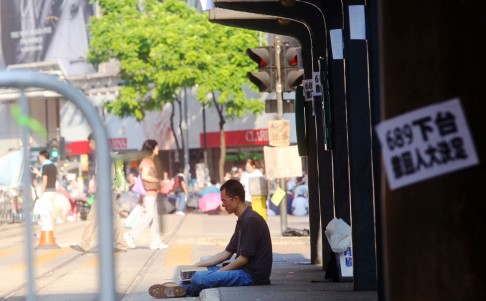
A lone protester sitting outside a barricade at the junction of Yee Wo Street and Sugar Street, who gave his name as TK So, 33, said he had remained there all night by himself during the protest so he could alert others if police arrived.
"I want to be here in case the police come, so I can tell everyone else," he said. "Plus I want to let newcomers know - they can sit here too."
So said he had been following the debate on constitutional reform and believed Beijing and the Hong Kong government were deceiving the public.
A lone protester remains outside the barricade in Causeway Bay. Photo: May Tse
Barricades block the roads in Causeway Bay, where streets have been cleaned by protesters. Photo: May Tse
The Academy for Performing Arts Alumni Association calls for Wan Chai campus to re-open. Association said school premises should be open during class boycott to provide shelter for students but the academy's decision to keep campus locked from Sunday at 5pm till October 2, barring students, teachers and alumni from entering, was unreasonable.
9.01am: At the chief executive's office at Tamar, police officers are guarding the building while journalists are preparing for Leung Chun-ying's weekly briefing before the Executive Council.
Classes in all Wan Chai, Central and Western District schools and kindergartens are cancelled again today. The government has said in other districts schools should "exercise flexibility" for pupils who are late or absent due to traffic problems.
The transport department has said more than 20 minibus routes have been altered or suspended.
8.52am: This is the dramatic moment last night that a car was driven at a group of protesters in Mong Kok. those gathered were forced to scatter as the car sped through the crowd without slowing.
The driver abandoned the car and fled. Read the full story here...
A TV screengrab shows the moment a car was driven at protesters
The scene in Connaught Road which was last night packed with protesters. Organisers are urging people to continue the occupation. Photo: Timmy Sung
8am: Planes and helicopters spotted flying low over Victoria Harbour. Two helicopters and two planes have been reported. More on this when we have further information.
Meanwhile there are just a few police officers guarding the entrance to Tim Mei Avenue near government headquarters. Metal barricades have been removed and protesters can enter the avenue without police interference - something that wasn't allowed yesterday.
Protesters read the paper in Mong Kok after a night on the street
7.45am: Hong Kong is once again waking up to commuter disruption, extended journeys and blocked roads. Many of the overnight protesters have headed home, although organisers are urging them to stay in place until reinforcements arrive.
In Mong Kok hundreds of people remain at the junction of Nathan Road and Argyle Street, with many sitting reading the paper to each other over breakfast.
In Admiralty the crowd is thinning out as many leave for work or school. Organisers are attempting to rally protestersto stay and man the barricades.


The Hong Kong Protest: 

What It's All About


29 September, 2014

Considering that as recently as 3 weeks ago the leader of the Occupy Central movement in Hong Kong decided to throw in the towel, after admitting that his civil disobedience movement’s pursuit of democracy had “failed” as a result of waning public support, many are shocked by how aggressively Hong Kong's students took up the baton: almost as if the mystery sponsor behind the ISIS blitz-ascent from obscurity had decided to "destabilize" yet another region. Tongue-in-cheek kidding aside, for everyone confused about the context of this weekend's at time very violent student protests, here is Evergreen GaveKal with its wrap up of the "Hong Kong Democracy Protests."

By Tom Holland, of Evergreen GaveKal

The inhabitants of Hong Kong were treated over the weekend to the unusual spectacle of police battling political protesters in the city’s streets. Baton charges and volleys of tear gas might be common enough tactics in New York or London, but not in Asia’s leading international financial center. The rapid escalation of the protests over the weekend and the police’s strong-arm response shocked locals, and triggered a -2% fall in the city’s benchmark Hang Seng stock index on Monday morning as investors worried about the impact of continued unrest on Hong Kong’s markets, its economy and its future as Beijing’s laboratory of choice for China’s financial liberalization.

Only a few weeks ago it seemed that Hong Kong’s pro-democracy movement was a spent force. After Beijing ruled out open elections for the chief executive of the territory’s government, the leader of Occupy Central admitted that his civil disobedience movement’s pursuit of democracy had “failed”. However, Hong Kong’s students and high school pupils failed to take heed. Last Friday a group of around 200 stormed security fences blocking off the ‘Civic Square’ outside the government’s headquarters to stage a sit-down protest against official obduracy. 

The heavy-handed police response prompted thousands more protesters to descend on the site over the weekend and on Monday morning the city woke up to find a civil disobedience campaign dismissed as irrelevant just weeks before had paralyzed the area surrounding Hong Kong’s government headquarters. With the mood highly febrile ahead of a public holiday on Wednesday to mark the Communist Party’s assumption of power in China, the fear is that the crowds of protesters could swell further over the course of the week, prompting an even more uncompromising response from the city’s Beijing-backed government.


The worst case scenario—that the Beijing government will deploy the People’s Liberation Army to restore order at the barrel of a gun—is extremely improbable.
It would be a public relations disaster for China’s leaders. However, it is equally hard to envisage any lasting rapprochement between Hong Kong’s pro-democracy movement and the city’s government. Indeed, although the protesters’ overt cause may be their campaign for free and open elections, many are motivated by underlying grievances both towards the mainland, which they fear is swamping Hong Kong’s unique identity and culture, and towards the city’s own administration, which they believe to favor the interests of property and business tycoons over the aspirations of  local people.


As a result, even if this week’s protests end peacefully, the discontent will rumble on. And if slowing Chinese growth and rising US interest rates inflict economic hardship on the city, the dissatisfaction is only likely to mount. In recent years the combination of mainland money flows and rock-bottom mortgage rates—Hong Kong’s currency is pegged to the US dollar, so local borrowing costs follow US rates—have propelled the city’s property prices to record highs, up 300% from their 2003 low. While any slump would make property more affordable, it would also hammer the balance sheets of the city’s middle class property-owners, many of whom are inclined to sympathize with the weekend’s demonstrators.

Against that backdrop, an extended campaign of civil disobedience is likely to weigh further on Hong Kong’s stock market, already down -8.3% since early September. A new equity trading link between the Hong Kong and Shanghai market, which is due to go live towards the end of October, may not help much. With the valuations on Hong Kong listed-stocks bang in line with their mainland peers, there are currently few arbitrage opportunities to be exploited. And with Beijing’s ‘mini-stimulus’ to support the mainland economy running out of steam and the People’s Bank of China resisting pressure for a full-scale monetary easing, the chances that a continued rally in mainland stock prices will support the Hong Kong market look slim.

Finally, some critics have suggested that the weekend’s pro-democracy demonstrations could prompt Beijing to choose Shanghai’s Free Trade Zone over Hong Kong as the favored venue for its financial liberalization program. Possibly, but one year after it was opened with great fanfare, progress at drawing up rules to govern capital flows in and out of Shanghai’s new zone is glacially slow and almost entirely opaque. The mainland city still looks decades away from mounting a credible challenge to Hong Kong.

Even so, hopes that Hong Kong investors will benefit from a new spate of mainland liberalization measures look exaggerated. With China’s growth rate now slowing towards 7%, exposing the vulnerabilities of China’s financial system, complete interest rate liberalization and a full opening of the capital account are receding further into the future. That may preserve Hong Kong’s pole position. But along with the gathering momentum of pro-democracy protests, it will also limit future opportunities for growth.


More terrorist raids in Melbourne, Australia

Australia: Police carry out terror raids in Flemington, Seabrook, Meadow Heights, Broadmeadows and Kealba
Victoria Police and the Australian Federal Police are conducting anti-terror raids across five Melbourne suburbs.


30 September, 2014


In a joint operation, officers are executing search warrants in Flemington, Seabrook, Meadow Heights, Broadmeadows and Kealba.

One man has been taken into police custody at Seabrook. Police moved a car parked in the driveway of the Seabrook into the garage for further examination as more federal police arrived at the scene just after 11am, including forensic officers.

Fairfax Media understands the raids are related to terrorism financing.
Earlier suggestions that explosives were discovered at a Dallas property are incorrect.

Police have also said the raids are not related to the shooting of a teenage terror suspect in Endeavour Hills last week.

The Australian Federal Police stated: "This operational activity is not in response to a threat to public safety nor is it related to last week's incident at Endeavour Hills."

On Tuesday last week, an 18-year-old terror suspect was shot by police after stabbing two officers outside the Endeavour Hills police station.

Australian Federal Police conduct terror raids at a property in Seabrook in Melboune.
A man is led away by police in Seabrook as simultaneous raids are carried out across Melbourne on Tuesday morning. Photo: Jason South

The suspect, later named as Numan Haider, stabbed a Victoria Police officer and an Australian Federal Police member, who were investigating him over allegations he had recently unfurled an Islamic State flag in a suburban shopping centre and made several inflammatory remarks about the AFP and ASIO on social media.
Police have also confirmed the raids are not related to earlier anti-terror raids in Brisbane and Sydney.

On September 18, more than 800 police officers were involved in Australia's largest counter-terror operations in Brisbane and Sydney. One man was charged with preparing to commit a terror attack. Earlier this month, Australia's terror threat level was raised from medium to high, which means authorities consider an attack likely.

Premier Denis Napthine said Victoria Police Chief Commissioner Ken Lay had briefed him on the anti-terror raids this morning. "I am advised they are part of a long-running ongoing operation," Dr Napthine told 3AW. 

He reiterated the searches were not a response to any direct threat to public safety. 

"They're not about a specific threat or there is certainly no immediate concern for public safety," Dr Napthine said.

A dozen Federal Police officers were at the Seabrook home on Tuesday morning, where they took one man into custody.

The bearded man, wearing a grey hoodie, was taken by police just before 8am. Police have at least one sniffer dog, which entered the house. Police have since moved two wheelie bins and closed the gates at the house at Seabrook..

The man reportedly moved into the neat, brick house with a double garage about a year ago with his wife. The AFP has so far refused to make a specific statement about that raid.

The man who left the house with police did not have handcuffs on. Police would not confirm whether he was arrested or whether he left with police of his own free will. Police have not removed anything from the house. The man moved into the house with his young wife, who is in her mid-20s, about a year ago, according to neighbour Herve Du Buisson Perrine. Mr Du Buisson Perrine said the man spoke to him almost every day. "Mostly small talk, about plants. I talk to him in my garden, he is working on his garden, me on mine. I am surprised, very very surprised," Mr Du Buisson Perrine said. "He is a very nice person, he seems a very nice person to me." Mr Du Buisson Perrine, a retired local school teacher, said his wife woke him on Tuesday morning to tell him of the raids next door. He said the man had moved in after a woman, believed to be his aunt, moved out last December. He said he believed the family were from Lebanon.


Monday, 29 September 2014

Vice president of Russia interviewed

We very rarely get the chance to watch “Sunday with Vladimir Soloviev” because it is not translated into English.

Here is a rare opportunity to watch prime-time Russian TV


Dmitri Rogozin interviewed by Vladimir Soloviev


Today, thanks to the fantastic work of the Saker Community [English Transcription & Translation: Marina (Russian Saker), Katya (Oceania Saker) & CG (Russian Saker) Editing & Production: Augmented Ether (Oceania Saker)] I can share with you a most interesting interview of Dmitri Rogozin, Deputy Prime Minister of Russia, Head of the Military-Industrial Commission, Special Envoy of the President and one of the most interesting and influential representatives of the "Eurasian Sovereignists" and the man who, one day, could succeed Vladimir Putin. Rogozin is absolutely hated by the Atlantic Sovereignists and by the AngloZionist Empire.

This interview is important because it shows what Russia is really doing while keeping up the pretense of "partnership" with the AngloZionist Empire: preparing for war while hoping that it can be avoided. In this interview, Rogozin speaks to a domestic audience in one of the most popular shows on Russian TV. Thanks to the Saker Community you will now see the Russia which the MSM never shows you and the one which frightens the Empire so much.

Enjoy!!


Investigation of voting fraud

This is from 10 days ago.

I wonder if anything will come of this. Would I be surprised if it didn't? No.

Police Probe Glasgow Voter Fraud Allegations


Election officials are asked to secure suspect ballot papers after claims of electoral fraud in Scotland's biggest city.


19 Sepetember, 2014


Police are investigating allegations of voter fraud in the Scottish referendum in Glasgow, election officials have confirmed

Colin Edgar from Glasgow City Council told Sky's Kay Burley police were called in after evidence emerged of 10 possible incidents of electoral fraud in the city.
The allegations appear to centre on attempts at personation at some polling stations.
Mr Edgar said: "We've had a number of suggestions over the course of the day that people have turned up at the polling station to vote and they appear to have voted already.
"This is called personation if it turns out to be what it actually is.
"So what's happening tonight is we know which boxes those votes went into and we know the numbers on the votes, so the police have asked us to identify those votes, to take them away, keep them for evidence and hand them to them."

A suspect ballot paper in a police evidence bag at the Glasgow count
Mr Edgar said presiding officers had alerted officials to incidents of possible electoral fraud.
"Somebody turned up to vote, they gave their name, the presiding officer went to cross off their name on their list of voters to give them a ballot paper and found that their name had already been crossed off and a ballot paper already issued to somebody who apparently had the same name."
He said the ballot papers would be traced and kept secure overnight before being passed to Police Scotland.
Staff at the count will search for them using blue gloves to avoid contaminating the evidence with fingerprints.
The votes would remain part of the count until police prove fraud has taken place, a Glasgow City Council spokeswoman said.
The real voter is given a special vote which is not included in the count until the allegations are proven, she said.
Mr Edgar said fraud could have been committed because there is no requirement for voters to prove their ID at polling stations in UK elections.
Staff at the count will use gloves to search for suspect ballot papers
A Police Scotland spokesman said the force "takes the safety and security of the independence referendum extremely seriously and is working with partner agencies including local authorities and the chief counting officer to ensure the integrity of the ballot".
"Any crime committed will be investigated appropriately," he added.
Stewart Hosie, the SNP's Treasury spokesman at Westminster, said it was "very sad that people feel the need to engage in any kind of impersonation".
He told Sky News: "I think that's a daft thing to do.
"The ballot papers have been identified, they will be taken away and fingerprinted, the police will do their job and I'm sure whoever has done it will be caught and sentenced.
"That's the correct procedure. It won't change the result but of course it shouldn't have happened, it is a silly, silly, thing for anyone to try to do."

Trans-Pacific Partnership

The TPPA’s Dirty Little Secret: How US could write NZ’s Laws


13 August, 2014

Press Release: Professor Jane Kelsey: A new website launched today http://tppnocertification.org/ has exposed what University of Auckland law professor Jane Kelsey calls ‘the dirty little secret of the TPPA’.

Behind the seemingly benign term “certification” hides an extraordinary power that the US is expected to assert if the Trans-Pacific Partnership Agreement (TPPA) is concluded’.
Effectively, the US claims the right to decide what a country’s obligations are under a trade and investment agreement and refuses to bring the agreement into force in relation to that country until it has changed its laws, regulations and administrative processes to fit the US interpretation’, Professor Kelsey explained.
Statements from members of US Congress and the US Trade Representative (USTR) suggest prime targets for New Zealand would be our copyright and patent laws, the foreign investment vetting regime, the procedures by which Pharmac operates, and Fonterra’s ‘anti-competitive monopoly’.
The other eleven governments are aware of the certification process and many are concerned. But no one has told the public how the US can effectively redraft our laws.’
Professor Kelsey has co-authored a memorandum that draws on the experience of countries that have been subjected to the US certification process in recent years.
It reveals how US officials have been directly involved in drafting other countries’ relevant laws and regulations to ensure they satisfy US demands. This includes reviewing, amending and approving proposed laws before they are presented to the other country’s legislature. The USTR even demanded that Guatemala implement new pharmaceutical laws that were not in the formal text, and which the government had strenuously resisted during the negotiations.
Communications within the Office of the USTR on the Peru US Free Trade Agreement were secured under the US Freedom of Information Act and show how brutal the US can be: ‘We [USTR] have to redraft the regs and the law – Peru needs to accept them without changes’.
Similar communications might never be released under New Zealand’s Official Information Act, because they involveinformation entrusted to the government in confidence from another government.
In other words New Zealanders, including MPs, might never know that the US was involved in writing our laws and demanding the right to sign them off even before Parliament gets to see them’, Professor Kelsey warned.

Everyone knows the US is driving the TPPA. But agreeing to a final text, in the knowledge that the US will then play the certification card, would mean conceding the right of US officials to oversee the making of New Zealand’s laws and regulations.

’
READ ABOUT THE POLITICIANS PUSHING THIS AGENDA: http://dirtypoliticsnz.com

Bryan Gould: Right to be troubled about secret partnership
Bryan Gould


Trade-offs made by the Government won't be seen for four years. Photo / AP

29 September, 2014

Getting lawyers to agree on anything is notoriously difficult. So when 100 retired judges, prominent legal academics, lawmakers and leading practitioners from New Zealand and overseas put their names to something, it's time to sit up and take notice.

What is it that raises the concern of so many eminent lawyers? It is the prospect that our Government is about to trade away - in secret - an important part of our powers of self-government.

The Trans-Pacific Partnership (TPP) being negotiated is presented as a straightforward free trade agreement. But it is clear that the Americans will insist (as they have done with other similar agreements) that the agreement should allow foreign corporations to stop our Government (or any future government) from changing New Zealand law in a way they think might undermine their value.

Private companies from the other eight countries, even though not themselves parties to the agreement, would be able to sue our government, not in our own courts, but in private tribunals set up specifically for the purpose (and existing practice shows that the arbitrators in such tribunals can be judges one day and lawyers for litigants the next).

Under these arrangements, an American corporation, for example, would be given far more extensive rights against our government than any New Zealand company would ever have. It would mean that a future government, perhaps elected to change policy in an area like environmental protection or health and safety (smoking comes to mind), could be threatened with a crippling lawsuit unless it backed off.

The rights protected by these provisions go far beyond real property rights and include financial instruments, mining concessions, intellectual property, public-private partnership contracts and even market share.

Nor is it just the Government that would be hog-tied. A particular worry for lawyers is that our courts, too, could be overruled. The foreign investment tribunals have decided that courts are part of a country's government (riding roughshod over any doctrine of the separation of powers) and that they, too, must comply. Even if our courts had upheld the validity of a law properly passed by Parliament, that decision could be challenged by a foreign corporation alleging it breached their rights under the TPP. Even a jury decision in private litigation could be challenged and lead to the Government paying millions in compensation.

In a recent case brought by Chevron, for example, a tribunal ordered the Ecuador Government, in defiance of its constitution, not to enforce a ruling by Ecuador's Appeal Court that Chevron must pay $18 billion to clean up toxic waste in the Amazon Basin.

The concerns expressed by the 100 signatories to the lawyers' open letter released today do not arise from mere speculation. Provisions like those causing concern have a well-established track record. When there were only a few cases, no one took much notice. But as American and European companies investing and trading overseas have increasingly enforced the rights arising from these treaty provisions, concerns have grown.

And with good reason. There has been an exponential increase in the numbers of such cases brought by (largely American) foreign corporations against governments which are parties to agreements similar to the proposed TPP. More than $675 million has been paid out in awards made by the special tribunals in cases involving US companies alone.

What adds to the concern is that the negotiations on these arrangements are being conducted by our Government in secret. We are not allowed to know what is being discussed, and by the time the TPP is presented to Parliament, the deal will have been done. There will be no meaningful debate or select committee scrutiny. We won't even be allowed to see what trade-offs the Government has made until four years after the text has been signed.

Yet the concessions made in secret by today's Government would permanently lock New Zealand into a marketplace controlled and dominated by foreign corporations. Voters would be left without any possibility of redress.

When the Prime Minister was asked about these issues when the negotiations began some months ago, he described fears of special legal rights for foreign investors as "far-fetched" and pooh-poohed any concerns. Yet the Australian Government has been quite open in declaring that it will oppose any such provision, basing itself on the Australian Productivity Commission's warning that it would have no economic justification and carry policy and fiscal costs.

Our own Government, by contrast, has demonstrated in its dealings with overseas corporations like Warner Bros, Sky City and Shanghai Pengxin how far it is prepared to go to accommodate overseas business interests. We have good reason to fear that the TPP will continue that process.

We have already sold off into foreign ownership a higher proportion of our national assets than any other developed country. The TPP could mean that control over what remains, now and into the future, would in effect be handed over to international corporations.

This is a heavy price to pay for a trade deal in which our partners, at most, commit to buy what they want to buy anyway.