Wednesday, 31 July 2013

The attack on freedom of the press in NZ


There is some discussion to the challenge to freedom of journalism in this country because it concerns 'one of their own'.

The only real coverage and anlysis of this issue has been done by Scoop. For this  please GO HERE

Parliament admission 'a bombshell'
Tracy Watkins


31 July, 2013

Speaker David Carter's admission that Parliament supplied a ministerial inquiry with Fairfax Media journalist Andrea Vance's phone records is a bombshell.

It comes on the back of Parliament's admission that Vance's movements were also tracked as part of the Government's efforts to find the "mole" who leaked her a report on the Government Communications Security Bureau.

Fairfax Media got wind something was up when Vance was hastily summoned to the Speaker's office yesterday morning.

A deeply embarrassed Carter owned up to the breach and offered Vance an extraordinary apology.

Only days ago, Carter gave Parliament an assurance that the phone records were not handed over.

The admission raises more questions than it answers - including why it has taken so long for the truth to come out.

The other burning question - on whose say-so was the information handed over - has also gone unanswered.

In the case of the phone records, Carter says that the information was supplied by a low-level contractor without first checking with either himself or Parliamentary Service general manager Geoff Thorn.

Carter says he can't explain why it happened when apparently the inquiry - headed by former public servant David Henry - never asked for Vance's telephone records.

That suggests either an extraordinarily cavalier attitude towards media freedom, or a culture in which reporters are considered a fair target for investigation.

The latest, equally sinister, revelations that the Defence Force lumped journalists in with subversives and extremists such as al Qaeda suggest the latter.

That should be deeply disturbing to everyone. Journalists working in the parliamentary precinct deal regularly with sensitive information provided by confidential sources.

Their ability to hold MPs and the Government to account would be seriously compromised if neither they nor their sources can have any faith that their every move and phone call is not being tracked.


Call for Speaker to act as watchdog on reporters' records
Fairfax Media's political editor says decisions on Press Gallery journalists' private information need to be made only by Parliament's Speaker, not low-level bureaucrats.


31 July 2013

The Speaker of the House, David Carter, has personally apologised to Fairfax Media's Andrea Vance after her phone records were released to an inquiry looking into the leaking of a report about the Government Communications Security Bureau.

Last week, Mr Carter said the records were not handed over, but on Tuesday said he had been made aware that a Parliamentary Service contractor inadvertently provided three months' worth of Ms Vance's phone records to Mr Henry.

The political editor at Fairfax Media, Tracy Watkins, says the release puts Press Gallery reporters' confidence in their own privacy at risk and the handling of their information needs to be better managed.

"It really cuts to the heart of our ability to operate around Parliament and talk to MPs and bureaucrats as well and be confident that that's not going to be somehow tracked for the purposes of finding out who our sources are," she told Radio New Zealand's Morning Report programme.

Ms Watkins says there must be firm protocols and clear understanding that decisions no records are made at a level lower than the Speaker.

"If for instance we were asked would we ever hand over details that might in any way compromise a source, we would never do that. So we need a watchdog in place to make sure our rights are protected, and that needs to be the Speaker, ultimately."

The chair of the Parliamentary Press Gallery, Clare Trevett, says the ability of journalists to do their job should be sacrosanct and says she was shocked that the phone records were released.

Green Party co-leader Russel Norman says the release of the journalist's records, claims another journalist's phone calls were monitored by the Defence Force and progress through Parliament of GCSB legislation which could allow metadata to be collected on journalists amount to a systematic attack on the media.

Dr Norman says the committee needs to find out who in the Parliamentary Service decided it was acceptable to release the phone records as well as MP Peter Dunne's emails.

Deputy leader of the Labour Party, Grant Robertson, told the House on Tuesday the handing over of the phone records was a serious and disgraceful action.

Prime Minister John Key says the Government has enormous respect for the fourth estate. He says he doesn't think journalists should be subject to surveillance, and they are not.

Media Freedom Committee chair Tim Murphy says the wider issue in the release of phone records to the ministerial inquiry is that different arms of the state seem to think they can get information any way they wish. He says the fact a contractor decided to pass along the records, which were not requested, defies rational belief.


Release of journalist's emails condemned

The release of a Press Gallery journalist's phone records to a top-level inquiry has been roundly condemned in Parliament and by members of the media.


Political journalists discuss impact of phone log leak


We're joined by the Fairfax Media political editor, Tracy Watkins, and the former TVNZ head of news and public relations consultant Bill Ralston, who is also a former press gallery journalist.


Former PM Sir Geoffery Palmer comments


Greens co-leader still confused over leak details

An about turn by Parliament's Speaker on how a political reporter's phone records were given to a prime ministerial inquiry seems to have only added to confusion over the chain of events.


Dr Russel Norman speaking in Parliament: 
“Freedom and democracy relies on a free press.”


http://www.youtube.com/watch?v=8KehFyVWh4c#action=share


Private information public under National Government

Tuesday, 30 July 2013, 3:25 pm
Press Release: Green Party
30 July 2013
Private information public under National Government

Revelations that the Henry inquiry, acting on John Key’s mandate, obtained a journalist’s phone records highlight a culture where private information is public under the National Government, the Green Party said today.
In response to Green Party written questions Speaker David Carter has revealed that journalist Andrea Vance’s telephone records were given to the John Key-mandated Henry inquiry.
“It’s a dark day for democracy when a journalist’s phone records can be secretly taken and given without her permission to an inquiry acting under the Prime Minister’s authority,” Green Party Co-leader Russel Norman said today.
“In response to my written questions Speaker David Carter has admitted previous answers he provided to me were wrong. Mr Carter previously said the Henry inquiry sought Ms Vance’s email records but now Mr Carter says that was incorrect and instead the inquiry was provided the records unprompted.
“We need to know who took it upon themselves to offer up that information and I am sure the Privileges Committee will look at it.
“The reality is that there is a culture that has developed under this Prime Minister where rules and rights are treated as expendable.
“Further Green Party written questions, which we are releasing today, show that Parliamentary Service released then United Future leader Peter Dunne’s email records to the Henry inquiry without his permission on the basis of an email from John Key’s chief of staff Wayne Eagleson.
“When the PM’s office said ‘jump’ Parliamentary Service said ‘how high?’ It is clear Parliamentary Service felt pressured by the PM’s office to comply.
"We are seeing a pattern of anti-democratic and menacing behaviour by the Prime Minister and the Prime Minister's office that is alarming," Dr Norman said.

Below are Green Party Questions that the speaker is changing his answers to:
Q: Who, if anyone, approached the Parliamentary Service seeking approval to access Andrea Vance’s telephone records? 
A: The Henry Inquiry requested information relating to internal phone calls made to and from the internal phone number used by Andrea Vance. 
Link: http://www.parliament.nz/en-nz/pb/business/qwa/QWA_08496_2013/8496-2013-dr-russel-norman-to-the-speaker-of-the-house

Q: Did the Parliamentary Service grant approval to anyone to access Andrea Vance’s telephone records?
A: No.


Media Commentator Gavin Ellis posted to Kiwi Journalists Association Facebook page

“Journalists will condemn in the strongest terms the open assault on media freedom represented by the seizure of a Dominion Post reporter's phone records. Members of the Kiwi Journalists Association Facebook page (which is restricted to present and former professional journalists) can add their support to this condemnation by 'liking' this post. The result will be forwarded to the New Zealand Government.” 

The Anonymous attack on NZ government websites

There is something very wrong when New Zealand gets attention from RT two days in a row.

Dotcom says Anonymous protest hack of NZ govt websites will backfire
Hackers disabled several websites of New Zealand's ruling party to protest a new law that would enable the country’s spy agency to snoop on its citizens. Kim Dotcom said hacking the sites only gave PM John Key “a new excuse to pass the GCSB bill”.


RT,
30 July 2013


Dear Anonymous NZ, hacking National Party websites is just giving John Key a new excuse to pass the #GCSB bill (cybercrime). Please stop it.
186 РЕТВИТОВ 65 ИЗБРАННЫХ


Dotcom, the MegaUpload founder who the victim of Government Communications Security Bureau (GCSB) snooping last year, is among those outraged by the New Zealand bill. However, the internet mogul said on Twitter that hacking National Party websites would only make things worse.


The bill was actually prompted by disclosures that the Bureau had illegally spied on Dotcom, who is fighting attempts by the US government to extradite him on charges of Internet piracy, copyright infringement, and money laundering.

On July 28 hacktivist group Anonymous uploaded a video on YouTube claiming responsibility for the hacking of fourteen websites, including those for Prime Minister John Key and Finance Minister Bill English. The attack was prompted by Key’s refusal to listen to protests against the ''despicable piece of legislation''.

“This new law allows to spy on New Zealanders without a warrant. We strongly condemn this bill,” the video message explained. “John Key, do you think you can pass a new law without a majority of New Zealanders behind it?”


A screenshot from gerrybrownlee.com

The websites of the Prime Minister and Finance Minister were restored after being attacked around midnight. The website of the Deputy Leader of the National Party Gerry Brownlee is still disabled.

The surveillance bill, which is expected to be passed in parliament, would give the GCSB carte blanche to listen in on citizens’ phone conversations. As things stand now, it spies on foreign targets via electronic listening posts but is not allowed to spy on New Zealand citizens or residents.

The law has been slammed by Internet and civil rights groups, prompting street protests over the weekend. Thousands of people turned out in eleven cities and towns across New Zealand in what was dubbed as an “uphill battle” to stop the bill from coming into effect.

''It has come to our attention that the thousands that have marched against this bill has still not been enough to send John Key and Peter Dunne a message," Anonymous said in the video message.

"John Key make no mistake the majority of New Zealanders oppose this bill. Due to your own arrogance and your unwillingness to listen to the people we have decided to take direct action.''

Anonymous promised that the websites would remain offline until the National Party patched its web servers or withdrew the bill and apologized to those it had affected, including Kim Dotcom.

Last January New Zealand police stormed Dotcom’s mansion, seizing assets and digital material. A judge later condemned the raid as illegal and ordered law enforcement to return items that were seized that were not directly linked the case against Dotcom. The judge’s decision also led to an official apology from Key to Dotcom, who alleged that the GCSB collaborated with the US government in a bid to comply with the extradition order issued by Washington.


Ruling against whistleblowers


US judge rules that Espionage Act does not require proof of any harm done
In another potential setback for whistleblowers, a US judge has made a ruling that essentially lowers the requirements for government prosecutors to prove damage to national security committed by alleged leakers.


RT,
30 July 2013


The case concerns Stephen Jin-Woo Kim, who in 2010 was indicted on two counts of disclosing national defense secrets to Fox News reporter James Rosen the year prior. Kim’s information was based on an intelligence report which was available to a limited number of government employees.

Judge Colleen Kollar-Kotelly ruled that the prosecution does not need to show that the information Kim allegedly leaked could damage US national security or benefit a foreign power, even potentially.

Her ruling went against the 1985 v. Morison case, in which Samuel L. Morison was convicted of unauthorized disclosure of satellite imagery to Jane’s Defence Weekly. Kollar-Kotelly said that she disagreed with the precedent it set, which required prosecution to prove harm to national security.

“The Court declines to adopt the Morison court’s construction of information relating to the ‘national defense’ insofar as it requires the government to show that disclosure of the information would be potentially damaging to the United States or useful to an enemy of the United States,” Judge Kollar-Kotelly wrote.

That decision could well modify interpretation of the 1917 Espionage Act for future whistleblower cases. Kim’s legal defense says that without the need to prove harm done to national security, the Espionage Act is essentially converted into a “Government Secrets Act.”

“The requirement that disclosure of the information be ‘potentially damaging’ is ‘implicit in the purpose of the statute and assures that the government cannot abuse the statute by penalizing citizens for discussing information the government has no compelling reason to keep confidential,” wrote the defense.

In her ruling, the judge accepts the prosecution’s argument that interpretation of the Espionage Act does not necessitate that the government prove its case, contrary to 1985 v. Morison and subsequent cases since then.

“By its terms, Section 793(d) [of the Espionage Act] does not require the United States to prove any harm, whether potential or not…” wrote the prosecution.

Kim’s story has become one of the most well known instances of an Obama administration clampdown on government information leaks, and attracted national attention following disclosure of a warrant for Rosen’s personal emails and the potential to prosecute the reporter as a co-conspirator. That warrant came to light on the heels of evidence showing far wider surveillance of phone records pertaining to the Associated Press.

Federal prosecutors have argued that Kim’s leak falls under harm to national defense, while Kim and his defense team have countered that the information was well known within Washington, and that the Justice Department is exceeding the spirit and definition of espionage laws.

Kim allegedly told Rosen in 2009 that North Korea was planning to test a nuclear warhead - information which then became key for Rosen’s subsequent article entitled “North Korea Intends to Match UN Resolution with New Nuclear Test.”

Last week, Kim’s defense attorney, Abbe Lowell, argued that other national security officials could have communicated with Fox News reporter James Rosen prior to him publishing his story on North Korea’s nuclear program.

Court documents from Kim’s trial included details of contacts made by Fox News either directly or to the offices of three other potential sources in government, all who denied any involvement in the leak. Those sources included former deputy national security adviser Denis McDonough, former counterterrorism adviser John Brennan – who now serves as CIA director - and former deputy national security adviser for operations, Mark Lippert - now an assistant secretary of defense.

The case brought against Kim is unlikely to go to trial before early 2014, according to The Washington Post.

Bradley Manning verdict

Manning not guilty of aiding the enemy, faces 130+ yrs in jail on other charges


RT,
30 July, 2013

A US military judge has found Army private Bradley Manning "not guilty" of aiding the enemy. However, he was found guilty of 20 remaining charges, meaning that he still faces the possibility of up to 136 years behind bars. Sentencing begins tomorrow.


Sitting in the military courtroom at Fort Meade, Md., Colonel Denise Lind delivered her verdict shortly after 1 p.m. EDT on Tuesday. Manning had chosen to put all his faith in the judge, rather than a panel of his peers – a risky gamble that initially seemed to pay off for the 25-year-old Army intelligence analyst – the charge could have carried a life sentence without parole. 


US Army Private First Class Bradley Manning leaves a military court facility after hearing his verdict in the trial at Fort Meade, Maryland on July 30, 2013. (AFP Photo/Saul Loeb)

US Army Private First Class Bradley Manning leaves a military court facility after hearing his verdict in the trial at Fort Meade, Maryland on July 30, 2013. (AFP Photo/Saul Loeb)

However, Manning still faces the possibility of up to 136 years behind bars, having been found guilty of six charges of espionage, five counts of theft, and four counts of embezzlement of government property. In total, Judge Lind found him guilty of 20 of the 22 offenses he could have been charged with. Manning was found not guilty of espionage for the release of the infamous "Collateral Murder" video.  

Credit: Alexa O'Brien


Guilty of almost everything BUT aiding the enemy.


Manning's family issued a statement saying that while they are "obviously disappointed in today’s verdicts, we are happy that Judge Lind agreed with us that Brad never intended to help America’s enemies in any way."  Wikileaks expressed a similar sentiment but still aired disappointment at Manning's future possibilities.

“Well, of course I’m pleased that the judge decided to throw out the most serious charges of aiding the enemy, which of course was ludicrous” Kristinn Hrafnsson, WikiLeaks spokesman, told RT. “One isn’t filled with any optimism. Last week, the judge allowed the prosecution to change some of the charges on the last day of the trail.”

Sentencing begins on Wednesday at 9:30am. Some 40 witnesses will be called for this stage of the process, meaning it could potentially take the whole of August to finalize his penalty. The extent of the punishment he could still face has roused upset from human rights and justice organizations.  


'Those responsible for the war crimes remain free'


"The US government has refused to investigate credible allegations of torture and other crimes under international law despite overwhelming evidence...yet they decided to prosecute Manning who it seems was trying to do the right thing – reveal credible evidence of unlawful behavior by the government," said Amnesty International's Senior Director of International Law and Policy, Widney Brown, in a statement shortly after the verdict was read.

“The Espionage Act itself is a discredited relic of the WWI era, created as a tool to suppress political dissent and antiwar activism, and it is outrageous that the government chose to invoke it in the first place against Manning,” said the Center for Constitutional Rights in a statement.

“We now live in a country where someone who exposes war crimes can be sentenced to life even if not found guilty of aiding the enemy, while those responsible for the war crimes remain free,” it admonished.

Index on Censorship also jumped to condemn the guilty verdicts, saying that Manning "leaked files in order to inform the world about what really happened during the Iraq War to no personal gain." Sean Gallagher, its editor, urged the court to "show leniency" when sentencing Manning tomorrow. 
Protesters rallying in support of the whistleblower gathered outside the Military Recruiting Office on Tuesday, holding signs and posters that described Manning as a hero. Chanting “Free Bradley Manning”and “Three Years is Enough,” the activists stood outside the Fort Meade courtroom in the hours leading up to the verdict.


Supporters of U.S. Army Pfc. Bradley E. Manning hold signs to show support during a demonstration outside the main gate of Ft. Meade July 30, 2013 in Maryland. (Alex Wong/Getty Images/AFP)

For more pictures visit RT gallery 


In the days leading up to the verdict, celebrities, public thinkers and European Parliamentarians all voiced support for Manning and urged the president to free him. Over the weekend, protesters in 40 cities throughout the world took part in an “International Day of Action” to call for Manning’s liberation. “Exposing war crimes is not a crime,” and “Bradley Manning: hero not criminal,” were some of the bold statements displayed on the signs. Wearing “truth” t-shirts and waving signs, the group of loyal "truth-activists" proclaimed their respect for the young Army intelligence analyst, and celebrated Col. Lind’s decision.

During the eight-week trial, government prosecutors argued that Manning indirectly aided al-Qaeda by sharing thousands of classified documents with the anti-secrecy website WikiLeaks in late 2009 and early 2010. The terrorist organization downloaded the information, and Maj. Ashden Fein told the judge that Manning expected the material would be seen by al-Qaeda. The prosecution depicted Manning as an ill-intentioned traitor who sought fame and notoriety. 
The defense portrayed Manning as a naïve, but well-intentioned young man who simply wanted to generate a debate about the costs of warfare. Attorney David Combs called his client a humanist and a whistleblower, describing him as “somebody that wants to inform the American public.”

“I believe that if the general public… had access to the information… this could spark a domestic debate as to the role of the military and foreign policy in general,” Manning said in March, speaking from a 35-page prepared statement for the court.

In closing arguments, Coombs asked the judge to consider whether Manning was truly a traitor, or whether he was “a young, naïve, good-intentioned soldier who had human life, in his humanist believes, center to his decisions – whose sole focus was, ‘maybe I just can make a difference, maybe make a change?’” 


Chuck Heyn of Veterans for Peace, a supporter of U.S. Army Pfc. Bradley E. Manning, holds a sign to show support during a demonstration outside the main gate of Ft. Meade July 30, 2013 in Maryland. (Alex Wong/Getty Images/AFP)

Although Col. Lind found Manning not guilty of aiding the enemy, the 25-year-old native of Crescent, Okla., faces 21 counts, including espionage, computer fraud and theft charges. He could still receive time in military jail. In March, Manning admitted to sending classified material to WikiLeaks, including 470,000 Iraq and Afghanistan battlefield reports and 250,000 State Department diplomatic cables and material. He pled guilty to 10 lesser charges, which could still lead to a maximum sentence of 20 years imprisonment.

The verdict was a landmark decision that could predict how US authorities handle individuals disclosing state secrets. WikiLeaks founder Julian Assange on Friday expressed his fear that if Manning were convicted of aiding the enemy, it would be “the end of national security journalism in the United States.”The progression of the high-profile case may still instil fear into potential whistleblowers, especially in combination with the United States’ handling of former NSA contractor, Edward Snowden.

But for now, Col. Lind’s “not guilty” verdict of aiding the enemy has served as a cause for hope and celebration among truth-advocates and supporters of Bradley Manning’s efforts to expose the war crimes and wrongdoings of the US government.


Here is Democracy Now! coverage


Watch live streaming video from democracynow at livestream.com


Tuesday, 30 July 2013

Arctic sea ice

Reflections on Arctic sea ice surprises...

Paul Beckwith


29 July, 2013

1) The cyclone that just passed through the Arctic was much weaker than the US navy sea ice motion projections and GFSx/ECMWF forecasted. http://www7320.nrlssc.navy.mil/hycomARC/navo/arcticicespddrf_nowcast_anim30d.gif


2) Although sea ice volume must still be dropping, the cyclone pushed the ice apart. http://www7320.nrlssc.navy.mil/hycomARC/navo/arcticictn_nowcast_anim30d.gif When highly ridged, thick ice is pushed apart, the sea ice area (defined as the region with 100% concentration) can actually flatten or even increase. This flattening can be observed in the Japan satellite date: http://www.ijis.iarc.uaf.edu/en/home/seaice_extent.htm


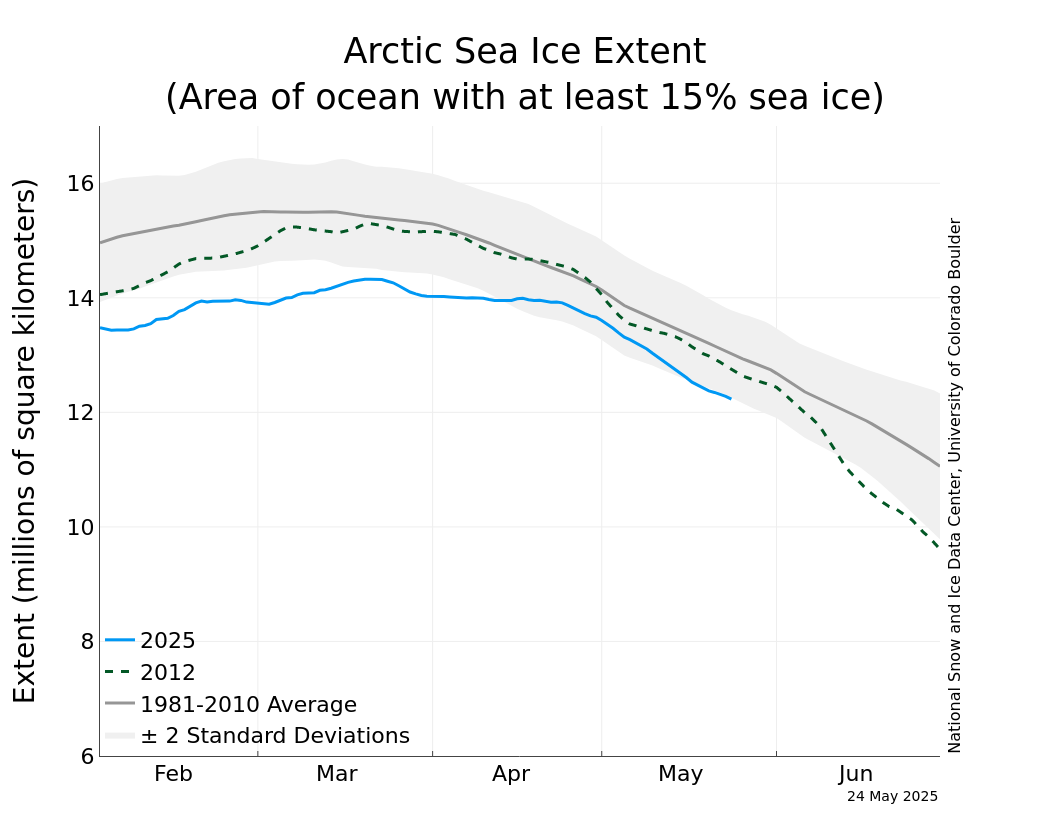
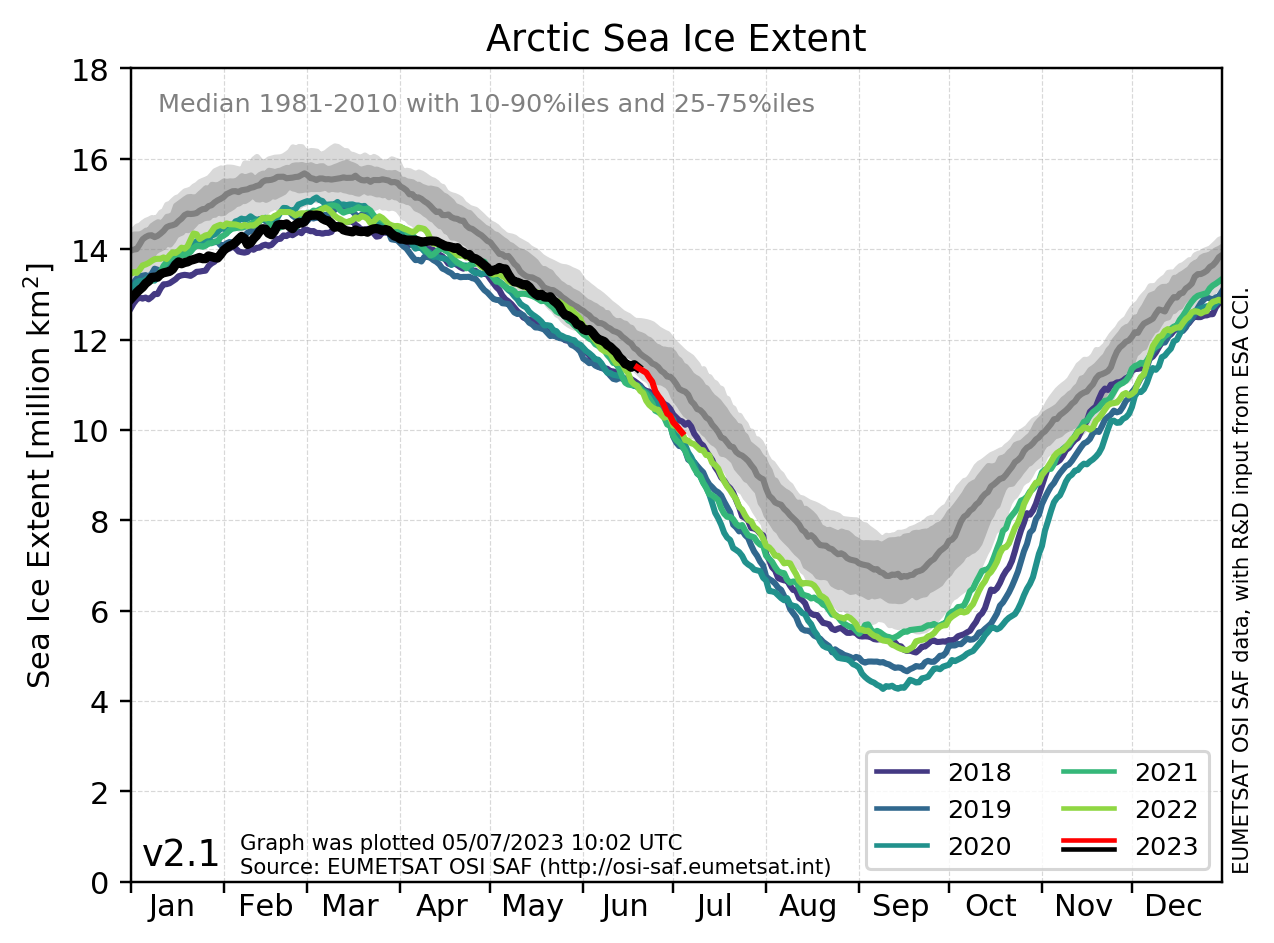
3) Sea ice extent (defined as regions with ice concentration >15%) still decreased according to NSIDC http://nsidc.org/data/seaice_index/images/daily_images/N_stddev_timeseries.png but was shown to flatten and even INCREASE according to DMI. http://ocean.dmi.dk/arctic/plots/icecover/icecover_current_new.png (image shown below).


4) The sea ice seems to be dictating the local weather above the Arctic more than the atmosphere. The larger surface area of ice (from all the fractured chunks) is undergoing rapid melt but the whole blob of ice is perhaps suppressing large cyclones.


5) The ice behavior this whole melt season is turning out to be very different from what we have seen in the past. Namely, the massive cracking and fracturing back in March, the persistent cyclones in May and June gouging out greatly thinned ice regions around the north pole, and now the resilience of the ice during the latest cyclone (and perhaps suppression of a large cyclone like last year)


6) Bottom line. Greatly fractured ice seems to be more durable to cyclones than expected, or even changing the ocean/atmosphere/ice system to suppress such cyclones. It appears that the ridged ice just north of the Canadian Arctic archipelago (that people mislabel as multi-year ice (MYI)) is spreading out in an effort to save the rest of the pack. I appears that my prediction of zero sea ice at the end of this season may be a spectacular fail!!! Still another 6 weeks of melt left to go, so we continue to observe in awe:) Fascinating stuff...


From Sam Carana:

Also have a look at the animation I added at the bottom of the post at http://arctic-news.blogspot.com/2013/07/arctic-cyclone-july-2013.html (shown below) showing the cyclone's huge impact on sea ice concentration.

 Also, have a look at http://arctic-news.blogspot.com.au/2013/07/open-water-at-north-pole.html which concludes that, while satellite images may indicate that the sea ice is still several meters thick in many locations, huge amounts of surface water may be present on top. 

The albedo of water is far lower than ice, so less sunlight is reflected back into space and a lot more heat is absorbed by the water, further accelerating the sea ice melt. 

This spells bad news for the remaining sea ice, since the melting season still has quite a bit of time to go.