Saturday, 30 June 2012

Oil Prices and sanctions


Oil price up 9%, Iran sanctions backfire
Oil prices have risen more than 9 percent on concerns about the potential results of sanctions on Iran’s oil industry and the strong gains in world stock markets on the back of the recent European Union summit.


30 June, 2012

The oil surge happened on Friday when heavy trading led to the fourth largest daily gain on record, Reuters reported.

Light, sweet crude for August delivery finished 9.4 percent or $7.27 higher at $84.96 a barrel, which was the biggest one-day oil rise in percentage terms since March 2009.

Oil owed its gains for the day to a wider market rally, with the euro and world stocks rising after eurozone leaders agreed to recapitalize regional banks.

Data from the US Commodity Futures Trading Commission indicate that throughout the second quarter, hedge funds and other speculators had bet big on lower oil prices.

"We had significant second-quarter trends that may all be in the process of reversing, including the risk-off trade triggered by the EU instability," Tim Evans, an energy analyst for Citi Futures Perspective, was quoted as saying.

"What has changed today is the market sentiment, the fundamentals may evolve at a more glacial pace," he added.

Iran's crude oil is subject to an EU embargo starting on July 1 that also bars EU insurance firms from covering Iran's exports


Euro sovereign debt


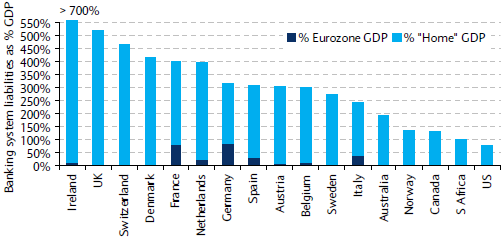
20 European Banks have
liabilities above 50 percent of their home country GDP


Why an EU FDIC is highly unlikely in the short-term.


The crisis in Europe is boiling over yet again.  The central connecting factor of all of this is too much debt relative to production.  Debt in itself is not a bad thing.  If you borrow modestly for a home and have sufficient income to cover your mortgage payment then this might actually be beneficial.  When things go haywire is when you leverage up.  You had people buying homes that were 10 to 12 times their annual income.  This however is a modest example compared to investment banks that were levered 30-to-1 and in somecases even higher.  The issue with theEuropean Union is the lack of cohesion but also the amount of debt relative to their production.  True colors do not shine in boom times but do come out in crisis.  The issue at hand for the moment is that stronger more productive economies with moderate levels of debt will need to step in if they are to bailout the periphery where debt levels are extreme relative to the local country GDP.  Politically you can see how this is not going well.  In the US, even though the bailouts were geared heavily in favor of the banks, few doubt the power of the Fed in stepping in and bailing out a big bank in California all the way to New York.  This is not exactly the scenario playing out in Europe.

Banking system liabilities

The biggest bank in the US, JP Morgan Chase has liabilities of roughly 13 percent of US GDP.  Compare this to the massive banking liabilities of some European banks:

Banking system liabilities as percent of GDP
20 European banks have liabilities upwards of 50 percent of their home country GDP!  This is just incredible and actually demonstrates the deep issues in the European Union.  This weekend there will be talks about methods of backing up all deposits in similar fashion to our FDIC.  The problem of course is that you will have systems where banks are more stable like in Germany and France needing to go on the hook for the deposits of other countries with banking systems that are unstable.  This is hardly going to go over well and the political changes hitting the EU are centering on who will end up picking up the bill.

It is unlikely that this will go over well and it is unlikely anything substantive will come from this week meetings.  This is why anything that comes out of the meetings this weekend is likely to be weak and unlikely to provide any aid to the ailing system.  Just look at the chart above.  The only nations that have the financial strength to do anything are unlikely to tie their banking systems directly to these ailing economies.  But then this begs the question of how much power does the European Central Bank really have over the member nations.  Does this become more of a symbolic union or is this really a cohesive trading bloc?
They were also kicking around schemes regarding banks paying a central tax to create this insurance fund but this would take roughly a decade to have any meaningful capital to deal with the current crisis.  In other words, this is now a methodical game of banking chess.

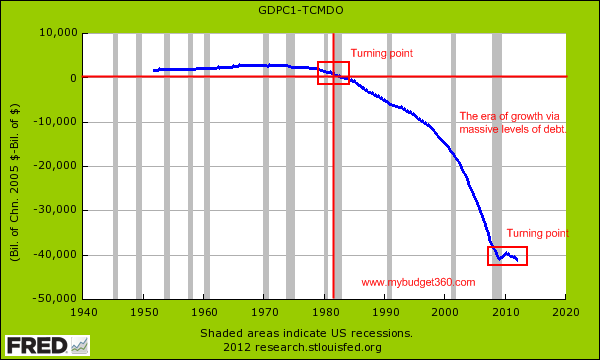
So while all eyes are on Europe for the next few years, the US still has tough times ahead because we have been growing on massive debt expansion:

gdp minus total credit market debt

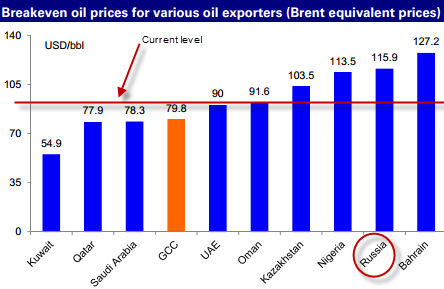
Since the 1980s, we have been spending money we don’t have to expand our economy.  But in relation to the European Union we are in better shape.  Because of this the safe haven trade is benefitting the US.  All in all this is shaping up to be a challenging time for late 2012 and early 2013 since the US has major challenges ahead with Medicare and the massive number of baby boomers retiring.  The European Union is already impacting global demand for goods as we look at China for example and just look at how oil prices will impact many nations around the world:

Breakeven Brent production
Source:  Sober Look

Many oil dependent countries need oil at a certain point before it is profitable.  But with demand curtailing, prices have fallen significantly.  Things are always bigger than they appear when it comes to massive debt or bad trades including the JP Morgan Chase loss that is looking more and more expensive.  The EU as the biggest trading bloc in the nation has some major challenges ahead and none of them are pro-growth.

The LIBOR banking investigation


A Huge Break in the LIBOR Banking Investigation
By Matt Tabibi


28 June, 2012

This is a huge story:
On Wednesday, Barclays won the race to reach a deal with U.S. and British regulators, beating UBS, which was reportedly the first bank to begin cooperating with international antitrust authorities. Barclays agreed to pay at least $450 million to resolve government investigations of manipulation of Libor and the Euro interbank offered rate (or Euribor): $200 million to the U.S. Commodity Futures Trading Commission$160 million tothe criminal division of the U.S. Department of Justice and $92.8 million to Britain's Financial Services Authority.

I wrote about the Libor investigation in the current issue of Rolling Stone, in "The Scam Wall Street Learned From the Mafia," about muni bond bid-rigging. 

Throughout this spring, while the Carollo bid-rigging case played out in a Manhattan courtroom, negotiations between banks and regulators were going on in this far larger cartel-corruption case. It’s been clear for some time now that a number of players had begun cooperating, and the only question was which bank was going to settle first.

Despite widespread expectation that it would be UBS, it turned out to be Barclays. 

You know how in Law and Order Jack McCoy always puts the two murder accomplices in separate rooms and tells them both that whoever talks first wins? Something like that happened here. In any case, the Department of Justice filing on the settlement contained excerpts of emails and other evidence that recall the taped phone conversations in the Carollo case: once again, we have seemingly incontrovertible evidence of wide-scale market manipulation. From Alison Frankel at Reuters:
Barclays employees agreed to manipulate the rates they submitted to the banking authority that oversees the daily Libor report for seemingly anyone who asked them to monkey with it: senior Barclays officials concerned that the bank would look weak if it reported too high a borrowing rate; interest rate swap traders trying to improve Barclays' derivatives trading position; even former Barclays traders begging for favors. We're talking naked, blatant manipulation. Here's one exchange cited in the DOJ filing:
Trader: "Can you pls continue to go in for 3m Libor at 5.365 or lower, we are all very long cash here in ny."
Libor rate submitter: "How long?"
Trader: "Until the effective date goes over year end (i.e. turn drops out) if possible."
Submitter: "Will do my best sir."

This is unbelievable, shocking stuff. A sizable chunk of the world’s adjustable-rate investment vehicles are pegged to Libor, and here we have evidence that banks were tweaking the rate downward to massage their own derivatives positions. The consequences for this boggle the mind. For instance, almost every city and town in America has investment holdings tied to Libor. If banks were artificially lowering the rates to beef up their trading profiles, that means communities all over the world were cheated out of ungodly amounts of money.

First there were huge bid-rigging settlements for Chase, UBS, Bank of America, GE and Wachovia. Now we’ve got a $450 million settlement for Barclays for Libor manipulation, and one imagines this won’t be the end of it. Anyway, more on this to come soon, and if you’re wondering, yes, there should be a lot more press on this.


EU "memorandum of understanding"


Laughable Text of EU "Memorandum of Understanding"; ESM Not Been Ratified Yet Already Requires Changes; How Much ESM Firepower Is There?


29 June, 2012

Futures are flying over a "breakthrough" that supposedly will lower borrowing costs for Italy, Spain, and Ireland.  The "breakthrough" is a modification to the terms of the ESM to allow "the possibility" to recapitalize banks directly.

Amusingly, the existing ESM agreement has not even been ratified. The agreement is still on hold in Germany (numerous other countries have yet to ratify as well).

Yet the "
Memorandum of Understanding" worked out at the summit today appears to require changes to the ESM.

Other ambiguous statement from the eurogroup committee are simply laughable. Here is the complete text. Emphasis added in places.
 EURO AREA SUMMIT STATEMENT - 29 June 2012 -
• We affirm that it is imperative to break the vicious circle between banks and sovereigns. The Commission will present Proposals on the basis of Article 127(6) for a single supervisory mechanism shortly. We ask the Council to consider these Proposals as a matter of urgency by the end of 2012. When an effective single supervisory mechanism is established, involving the ECB, for banks in the euro area the ESM could, following a regular decision, have the possibility to recapitalize banks directly. This would rely on appropriate conditionality, including compliance with state aid rules, which should be institution-specific, sector-specific or economy-wide and would beformalised in a Memorandum of Understanding. The eurogroup will examine the situation of the Irish financial sector with the view of further improving the sustainability of the well-performing adjustment programme. Similar cases will be treated equally.

• We urge the rapid conclusion of the Memorandum of Understanding attached to the financial support to Spain for recapitalisation of its banking sector. We reaffirm that the financial assistance will be provided by the EFSF until the ESM becomes available, and that it will then be transferred to the ESM, without gaining seniority status.

• We affirm our strong commitment to do what is necessary to ensure the financial stability of the euro area, in particular by using the existing EFSF/ESM instruments in a flexible and efficient manner in order to stabilise markets for Member States respecting their Country Specific Recommendations and their other commitments including their respective timelines, under the European Semester, the Stability and Growth Pact and the Macroeconomic Imbalances Procedure. These conditions should be reflected in a Memorandum of Understanding. We welcome that the ECB has agreed to serve as an agent to EFSF/ESM in conducting market operations in an effective and efficient manner.

• We task the Eurogroup to implement these decisions by 9 July 2012.

ESM Under Review by German Constitutional Court

Bear in mind that ESM ratification in Germany has already been delayed subject to Review by German Constitutional Court
 Germany's highest court asked the country's president on Thursday to delay ratification of the permanent euro bailout fund, the European Stability Mechanism, and the fiscal pact into law next week. If he complies, the move could delay the implementation of the ESM by several weeks in the latest setback for Chancellor Angela Merkel.

The Constitutional Court, anticipating challenges to the legislation, wanted more time to review documents. German President Joachim Gauck, hardly three months in office, was already faced with an important decision. If he complied with the request from Karlsruhe, at least one piece of legislation proposed by Chancellor Merkel and her coalition government -- the permanent bailout fund known as the European Stability Mechanism (ESM) -- would undoubtedly be delayed. The ESM was originally scheduled to come into force on July 1, 2012.
More Challenges Coming
The proposed changes will put German taxpayers (eurozone taxpayers in general) at more risk. Thus, it's safe to say that more challenges to the ESM are coming.
However, let's assume for the moment that Finland, Austria, Germany, and the Netherlands accept more taxpayer risk. (Admittedly that's quite an assumption).
Is this a euro-saving breakthrough? 

Van Rumpoy Calls Summit a "Breakthrough"
 After 13 1/2 hours of talks ending at 4:30 a.m. in Brussels today, leaders of the 17 euro countries dropped the requirement that governments get preferred creditor status on crisis loans to Spain’s blighted banks, European Union President Herman Van Rompuy said. Banks can also be recapitalized directly with European bailout funds rather than being channeled through governments, he said.

Merkel left the summit, which continues at 10 a.m., without addressing specifics of the agreements. She said there were decisions on “future measures within the framework of our methods that we will have through” Europe’s two rescue funds. “I think we will have a successful conclusion.”

The euro rose to as high as $1.2628, the strongest since June 21. Euro-area finance ministers will enact today’s deal at a meeting on July 9, Van Rompuy said, calling the accord a “breakthrough.”
Breakthrough? Really? How Much Firepower is Needed?


Bloomberg reports ...
  1. The EU’s two rescue funds may only amount to about 20 percent of the outstanding debt of Italy and Spain, limiting its ability to lower the nations’ borrowing costs.
  2. The EU’s two rescue mechanisms, the European Financial Stability Facility and the yet-to-start ESM, may have 500 billion euros ($621 billion) available for purchases.
  3. Italy and Spain have about 2.4 trillion euros combined of outstanding bonds, bills and loans.

For now, the market is pleased with this non-breakthrough. Let's see how long it lasts. I suspect not long.


Syrian conflict

NATO Proxies Turkey and Saudi Arabia Move to War Footing on Eve of Syrian ‘Peace Summit’
By Finian Cunningham


June 28, 2012


The NATO-backed covert aggression against Syria could be reaching a tipping point for all-out war involving state forces. That should be no surprise. For the past 16 months, NATO and its regional proxies have been steadily increasing the violence and turmoil inside and outside Syria, while the Western corporate-controlled media maintain the ridiculous fiction that the bloody chaos is largely due to the government forces of President Bashar Al Assad cracking down on “peaceful protesters”.
Ironically, the crisis is culminating at the same time that the United Nations convenes an emergency summit on Syria in Geneva this weekend. The meeting, which is ostensibly aimed at “reviving the Kofi Annan peace plan”, will be attended by the five permanent members of the UN security council and other “invited” regional states. The irony is that leading NATO members, the US, Britain and France, as well as their Turkish and Arab allies who will also be attending the crisis conference, are the very parties that have deliberately created the precipice for all-out war in the Middle East.
As dignitaries fly into Geneva to “salvage peace in Syria”, there is a lockstep military build-up on the northern and southern flanks of Syria underway, with news that Turkey has dispatched battlefield tanks, missile batteries and heavy artillery to its Syrian border, while to the south Saudi Arabia has announced that its military forces have been put on a “state of high alert”.
Ankara’s military mobilization along its 800km land border with Syria came within hours of the declaration by Turkey’s prime minister Recep Tayyip Erdogan slating Syria as “a hostile state”. The immediate cause of the deterioration in relations between the neighbouring countries is the downing of a Turkish fighter jet last week in Syrian territorial waters. Syria claims it was acting in self-defence after the Phantom RF-4E warplane entered its airspace on Friday. Ankara has so far failed to give an explanation for why one of its warplanes was making such a provocative low-flying manoeuvre into Syrian airspace. But the Turkish government has announced that any move by Syrian armed forces towards its border will be viewed as another “hostile act” that it will respond to. How’s that for a provocative tether? Especially towards a country that is being attacked by armed groups crossing over its border with Turkey.
Meanwhile, on the same day that Turkey is militarizing along its border with Syria, Saudi Arabia’s King Abdullah makes an unprecedented announcement putting his armed forces on high alert “due to the tense situation in the Middle East”. Using vague and contrived language, the Saudi ruler warned against “foreign or terrorist attacks” to justify the mobilization of the kingdom’s armed forces.
The military pincer movement against Syria tends to support the analysis that the downing of the Turkish fighter jet was a deliberate set-piece scenario designed to furnish a cause for war, or at least a stepping up of the international psy-ops campaign of intimidation against Syria.
It is notable that the circumstances surrounding the shooting down of the warplane have yet to be clarified. The Syrians seem to have firm grounds for acting in the way they did given the provocative conduct of the Turkish fighter jet. And there is an onus on the Ankara government to give some explanation for the unusual military manoeuvre, especially in the light of claims that the aircraft was on a reconnaissance mission on behalf of anti-Assad forces on the ground in Syria. Yet almost reflexively, before details have been established about the incident, Turkey has moved on to a war footing. Equally telling is that Saudi Arabia, a key ally of Ankara in opposition to Syria, has simultaneously moved also on to a war footing – without any substantive grounds for such a mobilization.
Some informed analysts have said that the Turkish-Saudi pincer on Syria is more aimed at intensifying the psy-ops pressure on Bashar Al Assad to cave in and relinquish power. Hisham Jaber, director of the Beirut-based Center for Middle East Studies, told Press TV that Ankara and Riyadh will balk at an all-out war with Syria because both are well aware that any such conflict will bring in Iran, Russia and China in support of their ally in Damascus.
Nonetheless, there is an ineluctable logic towards all-out war. Ever since the armed insurrection by foreign mercenaries was instigated in Syria’s southern town of Deraa in mid-March 2011, Turkey and Saudi Arabia have played key roles in fomenting the covert campaign of aggression to overthrow the Assad government – a campaign that is authored by leading NATO members, the US, Britain and France. The division of labour is such that Turkey has supplied land bases to organize the mercenaries from Libya, Saudi Arabia, Lebanon and Iraq; while Saudi Arabia provides the money – up to $100 million – to buy weapons and pay wages for the soldiers of fortune; and ultimately it is Washington, London and Paris that are calling the tactical shots in the NATO war plan on Syria.
As several other commentators have pointed out, this war plan is aimed at asserting Western capitalist hegemony in the oil-rich Middle East and Central Asia regions. Afghanistan, Iraq, Libya, Syria are part of an overarching bid for “full-spectrum dominance” that will eventually target, overtly, Iran, Russia and China.
It is this crucial wider context of war-making by the waning capitalist powers that underscores the gravity of the military build-up inside and outside Syria. The dynamic for war has a compelling, nefarious logic – as the history of world wars testifies.
Which makes the Geneva “crisis conference” this weekend appear all the more ludicrous. In attendance are the US, Britain, France, Turkey and the Gulf Arab monarchical states of Kuwait and Qatar. All are professing to support a peaceful solution in Syria even though all the above are funnelling weapons, logistics and personnel to wage a brutal, terrorist assault on that country – an assault that has now led to the precipice of all-out regional war.
Also attending the UN conference are secretary general Ban Ki-moon and the UN/Arab League special envoy to Syria, Kofi Annan. The UN and the Arab League and these two figureheads in particular have shown themselves to be willing dupes to NATO’s war of aggression on Syria, and beyond, by indulging in the charade that the Western powers are “supporting peace” instead of denouncing them as “supporting war”. Significantly, the UN and Annan have not invited Iran to attend the conference as a result of US pressure. How provocative is that? Iran clearly has vital interests at stake given its proximity and geopolitical threats from the encroaching war on its Syrian ally.
The other ghost missing from the feast in Geneva this weekend is Saudi Arabia. The omission of Saudi Arabia should not be seen as some kind of consolation to Syrian and Iranian sensibilities, but rather as a way of shielding the House of Saud from embarrassment. Considering the incendiary role of Saudi Arabia in Syria, and possibly the region’s conflagration, the Saudi rulers should be summoned to a top seat at the “peace summit” – to face the most withering questions about their warmongering, criminal interference in a neighbouring state.
Then, using Nuremburg principles, prosecutors should proceed to arraign the rulers in Riyadh along with their accomplices in Washington, London, Paris and Ankara.
Finian Cunningham is Global Research’s Middle East and East Africa Correspondent


Lavrov-Clinton talks: ‘Very good chance’ of progress on Syria in Geneva
Washington and Moscow have a good chance of progressing on Syria in Geneva on Saturday, said Russian foreign minister Sergey Lavrov as he emerged from an hour of tense talks with US Secretary of State Hillary Clinton.


RT,
30 June, 2012

Unfortunately, no significant agreement has been reached but Lavrov voiced cautious optimism about the upcoming talks stressing that Friday’s meeting with Clinton in St Petersburg was “one of the most productive” so far. “Syria dominated the international affairs section. I felt Hillary Clinton’s position has changed,” 

Lavrov said after the meeting. “She said she understands our position. We have agreed with Hillary Clinton to look for agreements on Syria which would bring us closer together,” he added.
Mr Lavrov acknowledged however that the Geneva talks are unlikely to resolve all the existing questions.
As Hillary Clinton did not give a press conference following the meeting with her Russian counterpart, it is hard to see whether the US position has actually changed, RT’s Lucy Kafanov remarked from St Petersburg.

Despite Lavrov’s optimism, a US official told reporters after the meeting that “there are still areas of difficulty and difference.

Talking about the chances of an agreement being reached in Geneva, the official said: “We may get there, we may not.”
The two powers discussed Kofi Annan’s unity government plan ahead of a crucial meeting on Syria in Geneva on Saturday, which will bring together UN Security Council members and some European and Middle Eastern leaders.
Annan’s plan does not call for Assad’s ouster, but pushes for the creation of a transitional government that would exclude figures that jeopardize stability.

There was no word this plan is not feasible,” remarked Lavrov on Friday.
Political analyst Benjamin Barber believes that the goal of everybody in the region is to contain hostilities within Syria’s borders. “It would be devastating for the region if hostilities broke out in Lebanon or in Turkey or on the Iraqi border in ways that could implicate the entire Middle East.”

He stressed that it was therefore in everybody’s interest to avoid an intensification of the conflict as the Libyan scenario shows how devastating the consequences can be. “We’ve learned in Libya that the price of military intervention is very very high,” he said.
Barber pointed out that even if NATO’s intervention had started with good intentions to prevent civilians from being massacred, it had resulted in killing more civilians than Gaddafi had, and led to a virtual tribal war and the break-up of Libya.

Replicate this situation in a post-interventionist stage in Syria, where the chaos that we are seeing now is multiplied by a hundred times,” he concluded.


Friday, 29 June 2012

Extreme weather in the USA

This is the quote of the week - from Max Keiser, in response to the article below.

"Really? Are you that f****** stupid! Climatologists predicted 20 years ago that AGW will cause huge fires and huge torrential downpours within 20 years. Colorado and Florida are example of this today. 
Hell holds a special place for AGW deniers"
AGW = anthropogenic global warming 

America On Fire: Why Is The Number Of Wildfires In The United States Increasing?


As America watches large sections of Colorado literally burn to the ground, many are wondering why all of this is happening. There have always been wildfires, but what we are experiencing now seems very unusual. So is the number of wildfires in the United States increasing? As you will see later in this article, the answer is yes. 2011 was a record setting year for wildfires and this wildfire season is off to a very frightening start. Right now the eyes of the nation are focused on the Waldo Canyon Fire in Colorado. It doubled in size overnight and it has consumed more than 300 homes so far. It is threatening the city of Colorado Springs, and at this point more than 35,000 people have been forced to evacuate - including the U.S. Air Force Academy. On Twitter and Facebook residents are describing what they are seeing as "the apocalypse" and as "the end of the world". But this is just the beginning of the wildfire season. We haven't even gotten to July and August yet.

The Waldo Canyon fire is rapidly becoming one of the most expensive and destructive wildfires in Colorado history. The historic Flying W Ranch has already been burned totally to the ground by this fire. Local authorities are struggling to find the words to describe how nightmarish this fire is. The following are a couple of quotes from a CNN article....

Richard Brown, the Colorado Springs fire chief, described it as a "firestorm of epic proportions."

Gov. John Hickenlooper surveyed the Waldo Canyon Fire, telling reporters it was a difficult sight to see.

"There were people's homes burned to the ground. It was surreal," he said late Tuesday night. "There's no question, it's serious. It's as serious as it gets."

But this is not the only wildfire that is raging in Colorado. Right now there are 10 wildfires burning in the state. Overall, there are 33 large wildfires currently burning in twelve U.S. states.

If you will remember, New Mexico just experienced one of the worst wildfires that it has ever seen. Conditions throughout most of the western United States are ideal for wildfires right now. As USA Today reports, much of the western half of the country is under a "red flag warning" right now....

Throughout the interior West, firefighters have toiled for days in searing, record-setting heat against fires fueled by prolonged drought. Most, if not all, of Utah, Colorado, Wyoming and Montana were under red flag warnings, meaning extreme fire danger.

But wait, didn't this kind of thing happen last year too?

Yes it did.

In fact, 2011 was one of the worst years ever for wildfires in America. The following is a short excerpt from an EarthSky article....

Thousands of wildfires raged across the United States last year, 2011, burning a record amount of land, especially in the southern U.S. In fact, 2011 the third-most-active fire season since 1960 (when this record-keeping began) with respect to acres burned, according to preliminary data released from the National Interagency Fire Center (NIFC) in late December 2011. The NIFC will be releasing an official summary report detailing the 2011 wildfire season later in 2012, but for now you can read some of the details in the State of the Climate Wildfires 2011 report from NOAA.

During 2011, a total of 73,484 wildfires burned an estimated 8,706,852 acres (35,235 square kilometers) of land across the United States. Wildfire activity during 2011 was exceptionally high and was only exceeded in the historical record by wildfire activity during the years 2006 and 2007.

We have seen highly unusual wildfire activity throughout America in recent years. In the article quoted above you can find a chart which shows that wildfire activity in the United States has been far above normal during the past decade.

Wildfire records have only been kept since 1960. The 6 worst years on record for wildfires in the U.S. have all happened since the year 2000. The following is from an Earth Island Journal article that I found....

In the United States, where some of the most accurate wildfire statistics are kept, the six worst fire seasons in the past 50 years have occurred since 2000. In Texas, nearly 4 million acres were burned in 2011, double the previous record. This included the Bastrop Fire last September that destroyed 1,600 homes and became the most destructive fire in Texas history. In Arizona more than one million acres were burned in 2011, a new record. The Wallow Fire, which destroyed nearly a half million acres, was the largest fire in Arizona history. The Pagami Creek Fire in northern Minnesota became the third largest fire in state history when it burned 100,000 acres in September 2011, most of this in an unprecedented 16-mile run on a single day.

So what does all of this mean?

It means that the number of wildfires in the United States is increasing and wildfires are becoming more powerful and doing more damage.

So what is causing all of this?

The truth is that this is happening because we are seeing exceptionally dry conditions throughout the western half of the United States. In fact, according to the U.S. National Academy of Sciences, the U.S. interior west is now the driest that it has been in 500 years.

The eastern half of the country also gets very hot during the summer, but they don't have as many wildfires because they get a lot more rain.

Many areas in the western half of the country have been experiencing drought conditions for quite a few years, and there seems to be no end in sight for the drought.

If you go check out the U.S. drought monitor, you will see that almost the entire southwest United States is experiencing some level of drought right now.

So what will July and August bring?

It is kind of frightening to think about that.

Earlier this year I wrote an article that postulated that we could actually see dust bowl conditions return to the middle of the United States. Many readers were skeptical of that article.

But as much of the western United States continues to experience bone dry conditions and continues to be ravaged by wildfires, perhaps more people will understand how bad things are really getting in the interior west.

Just because we have made great technological advances as a society does not mean that we know how to tame nature. We can attempt to contain the massive wildfires that are popping up all over the place and we can attempt to deal with the drought, but in the end we cannot stop what is happening.

So do you live in any of the areas that are being affected by these wildfires?

Do you have an opinion about why so much of America is on fire?

Please feel free to post a comment with your opinion below....


Flooding of record severity’ in Florida, thousands evacuat

26 April, 2012

27 June 2012 (CNN) – Thousands remain evacuated from their flooded homes in sodden Florida as a weakened Tropical Depression Debby was set to move off the state's Atlantic coast and back over water.

In Florida's Pasco County alone, 7,000 homes and commercial properties remained under evacuation order, county spokesman Eric Keaton said Wednesday. Seventy-three county residents stayed in shelters Tuesday night, Keaton said.

Authorities were allowing residents who present identification at checkpoints to enter their homes temporarily on a case-by-case basis, he said. Pasco County is north of Tampa.

Debby, which made landfall as a tropical storm on Florida's northern Gulf Coast Tuesday, dumped roughly 2 feet of rain on parts of the state.

Rain had finally moved out of the region Wednesday, according to National Weather Service radar, but flood warnings remained in effect across northern Florida, although all tropical weather watches and warnings were canceled.

Evacuations, either voluntary or mandatory, were also in place in many areas.

More than 100 people scrambled to escape rapidly rising water Tuesday near the St. Marys River on the Florida-Georgia border, according to CNN affiliate WJXT. Some men had to use a boat to get back to their homes and rescue their children.

"I'm the furthest one out (from the water), which means I'm the last to go under, and I'm going under," resident George Rhoden told the station.

"Everybody behind me is in bad shape. It's rising 10 inches per hour. We got to go. Everybody got to leave."

Debby paralyzed whole neighborhoods for days.

"Sadly, my car didn't make it through the flooding. My car was just too low, and (the water) ended up hydro-locking the vehicle," Magalie Caragiorgio of New Port Richey, who missed two days of work because of the flooding, said Tuesday. "I haven't been able to get my car towed due to the amount of cars being stranded."

As of 5 a.m. ET Wednesday, Debby was centered about 25 miles southeast of St. Augustine, Florida, the National Hurricane Center said. The storm was moving east-northeast at 10 mph, carrying maximum sustained winds of 35 mph.

"Additional isolated rainfall amounts of up to 1 inch will be possible in some of the lingering rain bands, mainly over southern Florida," the weather agency said.

While Florida is no stranger to tropical weather, many residents said they had never seen flooding like that resulting from Debby.

"It's astonishing," Keith Blackmar of the Wakulla County Sheriff's Office said Tuesday. "… Our soil is sandy, so it handles water well, but not this much rain."

In Sopchoppy, authorities rescued 57 people from homes surrounded by rising water, Blackmar said.

"The water levels came up so fast, some of the folks didn't have time to actually pack their things and move out," Wakulla County Undersheriff Maurice Langston said.

Florida State University researcher Jeff Chanton said the area's low-lying terrain has contributed to the misery.

"The coastal gradient -- the rise of the land -- is very, very low here," Chanton said. "If you were to go swimming here and walk out from shore, you could walk out half a mile." That means a relatively small storm surge can push water "tens or hundreds of feet onshore," he said.

More than 26 inches of rain was recorded in Sanborn, south of Tallahassee, by Tuesday. Nearby St. Marks saw nearly 22 inches. […]


After Days of Flooding, 'Debby' Set to Leave Florida

By Miguel Llanos
26 June 2012

River flooding form Tropical Depression Debby -- downgraded from a tropical storm late Tuesday -- forced up to 20,000 people out of their homes in one Florida county alone, while another area had already seen more than 26 inches of rain, topping the official forecast calling for up to 25 inches in a few areas by the time Debby moves out.

In Pasco County near Tampa Bay, a mandatory evacuation was ordered between the Anclote and Pithlachascotee rivers, Reuters reported. The Anclote rose from 9 feet before Debby's approach to more than 27 feet on Tuesday, flooding areas with water head-high in places.

Boats were used to reach stranded residents, and 106 homes had been damaged.

Wakulla County, meanwhile, has seen more than 26 inches of rain, weather.com said in a Twitter alert Tuesday morning. Authorities there advised people to stay in their homes due to washed out and flooded roads.

Flash flood warnings were issued for parts of northern Florida and southern Georgia as Debby moved eastward. By midday, Debby picked up speed to 6 mph and winds had dropped to 40 mph, but that didn't stop the rain.

Parts of Interstate 10 in north Florida were closed due to flooding on a 50-mile stretch between Jacksonville and Tallahassee. The Florida Highway Patrol warned motorists to use extreme caution on other parts of the highway.

Hundreds of thousands of people have been impacted, many having to leave flooded homes in Florida's Panhandle on Monday and others losing power or having property hit by twisters. […]

On Monday, Florida Gov. Rick Scott declared a statewide emergency as five inches of rain in the course of an hour fell on some areas.

President Barack Obama called Scott on Tuesday and the federal government stands "ready to provide additional assistance if necessary," the White House said.

St. Marks, Fla., saw 21 inches in a two-day period while other areas got around 20 inches, weather.com noted.

Parts of Live Oak, Fla., were evacuated Tuesday due to flooding, it added.

Some areas of northern Florida and southeast Georgia could see up to 15 inches of rain Tuesday through Thursday, weather.com stated.

The National Hurricane Center predicted parts of northern Florida could see 25 inches of rain by the time Debby crosses Florida and exits into the Atlantic.

Weather.com noted that 2012 broke the record for the most named storms so early in the Atlantic season. Debby makes four so far, "leapfrogging Dennis from July 5, 2005.

"In an average year, the fourth named storm would have occurred by August 23," it added. "In terms of named storm counts, we're roughly two months ahead of the pace. That said, there is no correlation between a fast start to the season and the degree of activity of the rest of the season." […]