Rescuers
have managed to save all the residents of a Russian village before
the settlement located on an island in Irkutsk Region burned to the
ground. The spread of wildfires across Siberia has prompted
authorities to declare a state of emergency.
Hundreds
of people were trapped in the village of Bubnovka surrounded by water
as a massive fire was ripping through their homes. Luckily for some
435 residents, local Emergencies Ministry staff were conducting
anti-flood drills in the area and rapidly reacted to the incident.
Responding
the distress call, they rushed to the scene to evacuate the
villagers. Using an air cushion rescue boat, the responders brought
people to safety. No one was harmed.
Despite
efforts by the local team of firefighters, the entire village of 86
houses burned down in the suspected wildfire, the governor’s press
service told RIA Novosti.
“It
was impossible to bring additional [firefighting] forces because of
the fact that Bubnovka is located on the island. Gusty winds
contributed to the spread of fire,” the governor’s office said.
The
Investigative Committee, however, has opened a criminal case to see
if any negligence was involved.
“According
to the investigation, the fire occurred on the territory of the
non-residential sector in the village of Bubnovka in the Kirensky
district. Because of the strong wind, the fire spread to the entire
village,” authorities said in a statement, adding that they will
also assess “the actions of officials of the [local]
administration.”
The
recent spread of wildfires in Siberia has prompted authorities to
declare a state of emergency across the entire federal district.
“We
are introducing an emergency regime for all government bodies and
forces of the Unified Russian System for Preventing and Eliminating
Emergencies in the Siberian Federal District,” the head of Russia’s
Emergencies Ministry, Vladimir Puchkov, announced Friday.
The
state of emergency had already been declared in Irkutsk Oblast, as
three separate areas of the region were suffering from massive
wildfires.
According
to the Emergencies Ministry, as a result of the suspected careless
handling of the fires, the flames spread to residential houses and
buildings in five settlements, destroying at least 78 houses and a
convenience store.
Meanwhile,
in Zabaykalsky Region, the area of forest fires increased to at least
643 hectares, according to the Emergencies Ministry. Overall fires in
Siberia are now ravaging almost 1,500 hectares, according to the
Aerial Forest Protection Service Agency, which deals with fire
aviation and rescue efforts.
“Almost
1,500 hectares of forest are burning on the territory of Siberia,”
including Irkutsk, Krasnoyarsk and Zabaykalsky regions, as well as
Tuva and Buryatia republics, the federal agency said.
Disingenuous,
liberal sources like Robertscribbler take the official American
russophobic source Radio Free Europe as a source creating the
impression that there is no voice speaking out about the
out-of-control wildfires in Siberia from within Russia.
That
may well be almost true but not quite.
Siberian Times has been
giving quite a lot of space to this as well as to the methane bomb.
Disturbing
new pictures show the raging Siberian wildfires that (officially) do
not exist
Pro-Kremlin
eco-groups echo Greenpeace concerns by highlighting burning of
forests which do not appear in government reports.
'I
would like to see those estimates, which would have shown that the
costs of firefighting are actually higher than the damage from the
fires.' Picture: Nikita
Pyatkov/IRK.ru
For
weeks there have been reports of major fires burning in remote
districts but unregistered by the authorities. Hard evidence was
lacking but now it has been produced by two pro-Kremlin groups which
made a joint mission to check out the claims.
These
pictures show the fires in Irkutsk region, with one claim that locals
have been subjected to smoke fumes for as long as six months from
blazes that officially were not burning.
Latest
satellite images confirm the fires, as the image here shows.
'From
the air we see that the taiga is burning over an area that is
measured in hundreds, thousands of hectares.' Pictures: Nikita
Pyatkov/IRK.ru
Alexander
Yakubovsky, head of the local All-Russian People's Front, set up by
President Vladimir Putin, said: 'We are now in Ust-Kut. Smoke is very
strong, visibility is no more than 300 metres.
'From
the air we see that the taiga is burning over an area that is
measured in hundreds, thousands of hectares. And in official reports
the picture is quite different. The data is clearly underestimated.
We are trying to film everything we see on camera.'
In
a evocative
despatch on 22 September,
he wrote: 'This is called the edge of the fire ... no end of it in
sight ... we have examined Kirensky, Katangsky and Ust-Kutsky
districts, forests are burning, and we have not seen any piece of
equipment, not a single person who would put out the fire.'
Latest
satellite images confirm the fires. Pictures: fires.ru,
Greenpeace
His
group 'recorded more than two dozens foci' of the wildfires. 'Air
traffic and navigation on the Lena Rover is intermittent, sometimes
visibility is very low, the last flights were banned today.'
The
head of Living Forest group, Nikolai Nikolaev, claimed the Irkutsk
authorities have incorrectly interpreted the order of the Ministry of
Natural Resources, which allows the regional commission for emergency
situations and fire safety to make decisions about not extinguishing
fires.
Living
Forest is a group organised by United Russia, which comfortably won
this month's parliamentary elections in Russia.
These
pictures show the fires in Irkutsk region, with one claim that locals
have been subjected to smoke fumes for as long as six months from
blazes that officially were not burning. Picture: Nikita
Pyatkov/IRK.ru
'There
are no words in the order that the authorities are allowed not to
take into account the more difficult fires,' he said. Nor should this
be used as a reason 'not to inform the public' about large-scale
fires.
'The
document states that decisions on not extinguishing the fires can be
taken if there are no threats to settlements or economic facilities,
and in the case when the costs of putting out the fires are higher
than the possible harm from them,' he said.
'I
would like to see those estimates, which would have shown that the
costs of firefighting are actually higher than the damage from the
fires. It is very difficult to explain to residents of Ust-Kut, who
have filled their lungs with carbon dioxide for almost six months,
that the authorities failed to extinguish the fires because they do
not see any threat to the town.'
After
the claims of pro-Putin activists, the head of the Emergency Ministry
Vladimir Puchkov ordered the reinforcement of firefighters in Eastern
Siberia. Pictures: Nikita
Pyatkov/IRK.ru
Additionally,
Yakubobsky reported the annual 'northern delivery' of vital supplies
to remote communities usually by river - notably on the Lena and
Angara - has been disrupted by thick smoke from the fires.
Three
days ago, officials reported that rains had extinguished many
wildfires in the vicinity of Bratsk and Ust-Kut - reported on by The
Siberian Times last week - but after the claims of pro-Putin
activists, the head of the Emergency Ministry Vladimir Puchkov
ordered the reinforcement of firefighters in Eastern Siberia.
He
ordered: 'Make them work. It is necessary to take additional measures
to protect settlements, social facilities, infrastructure, (and)
power lines. Some heads of districts have relaxed, as they have a
good record, but nature does not like such attitude. You need to
calculate the risks.'
Greenpeace
claims up to 300 times more territory in Siberia is ablaze than
officially acknowledged.
Social
media pictures show the worrying impact of forest fires in remote
areas. Picture: Anna Trapeznikova
Officials
on Tuesday acknowledged a 20% rise in forest fires in the past 24
hours but campaigning group Greenpeace alleged that state agencies
are hugely underestimating the scope of the problem.
It
was hard to independently verify the contradictory claims but a fire
threat to the Eastern Siberia - Pacific Ocean (ESPO) pipeline led
Irkutsk Oil Company to suspend supplies of oil, said the official
representative of Transneft, Igor Demin.
'The
situation with the fires in Irkutsk region and the Republic of Sakha
(Yakutia) remains difficult,' he said. 'There are six wildfires less
than in five kilometres from the ESPO facilities. Fires were as close
as 300 metres from key pipeline facilities, he said.
Social
media pictures show the worrying impact of forest fires in remote
areas.
Residents
of the Evenk settlement of Vanavara - 730 kilometres north-east of
Krasnoyarsk - complained about the smoke, and breathing problems.
Pictures: The Siberian Times, Anna Trapeznikova
Alexey
Yaroshenko, head of forest department of Greenpeace Russia, warned:
'The scale of the wildfires in Eastern Siberia can be compared with
the catastrophe of 2010 in European Russia and the Urals.
'Our
estimates are approximate. Perhaps more than 1.7 million hectares are
burning, since some of the largest fires are completely hidden under
strong smoke.
'For
the second half of September, such a catastrophe in Siberia is
unprecedented. It is associated not only with the inefficiency of the
system of protection of forests from fires, but also with the climate
change.'
Greenpeace
highlighted satellite images to back their claims.
The
group claimed that a summary published by Avialesokhrana - Russia's
Aerial Forest Protection Service - on 18 September, shows the
wildfires covering an area 300 times smaller than estimated by
Greenpeace.
'Our
estimates are approximate. Perhaps more than 1.7 million hectares are
burning, since some of the largest fires are completely hidden under
strong smoke. Pictures: fires.ru, Greenpeace Russia
Grigory
Kuksin, head of Greenpeace Russia's firefighting programme,
said:'Unfortunately, such areas were not completely extinguished
before the autumn rains.
'It
was necessary to extinguish the fires at an early stage, when they
were relatively small. Now you can just save the settlements and
protected areas from the fire.'
The
latest official bulletin from the agency highlighted 59 forest fires
on Russian territory, covering an area of 3,453 hectares. The three
worst-hit regions were all in Siberia.
A
total of 1,900 hectares were said to be ablaze in the Sakha Republic,
while fires in Irktusk region, close to Lake Baikal, have also
'surged', according to TASS. Some 42 hectares was on fire in the
Pribaikalsky National Park. Around 412 hectares remained ablaze in
Buryatia Republic.
Social
media postings highlighted the problems posed by forest fires.
Residents of the Evenk settlement of Vanavara - 730 kilometres
north-east of Krasnoyarsk - complained about the smoke, and breathing
problems.
'Smoke
is all around, we can not see even each other. The school is closed,
the children did not go to classes. Head aches, throat discomfort,
only water helps.' Pictures: Vesti. Krasnoyarsk
Anna
Trapeznikova posted: 'The school is closed, locals are afraid to go
out - the visibility is about 100-150 metres. Two flights are already
cancelled - the runway is not visible.
'Headaches,
red eyes, nose and throat aching. It is not possible to get out the
settlement.' Locals are advised in megaphone messages not to go out,
to abstain from alcohol. 'Everyone waits for rain,' she said.
Another
local resident said: 'Smoke is all around, we can not see even each
other. The school is closed, the children did not go to classes. Head
aches, throat discomfort, only water helps. Window shutters are
closed, but the smoke is in the house.'
Officially,
three fires are registered in the region.
Wildfires
can add huge amounts of carbon dioxide (CO2), carbon monoxide (CO),
methane (CH4), nitrous oxide (N2O) and black carbon (BC or soot) into
the atmosphere. While
CO and soot are not included as greenhouse gases by the IPCC, they
can have strong warming impact. CO acts as a scavanger of hydroxyl,
thus extending the lifetime of methane. BC results from biomass
burning, which a study
by Mark Jacobsonfound
to cause 20 year global warming of ~0.4 K. Moreover, BC has a
darkening effect when settling on snow and ice, making that less
sunlight gets reflected back into space, which accelerates warming.
This hits the Arctic particularly hard during the Northern Summer,
given the high insolation
at high latitudesat
that time of year. The
image below shows fires around the globe on August 12, 2016.
Visible
in the top right corner of above image are wildfires in Russia's Far
East. The image below zooms in on these wildfires.
The
image below shows carbon dioxide levels as high as 713 ppm and carbon
monoxide levels as high as 32,757 ppb on August 12, 2016, at the
location marked by the green circle, i.e. the location of the
wildfires in Russia's Far East.
As
said, wildfires can also emit huge amounts of methane. The image
below shows methane levels as high as 2230 ppb at 766 mb.
The
magenta-colored areas on above image and the image below indicate
that these high methane levels are caused by these wildfires
in Russia's Far East. The image below shows methane levels
as high as 2517 ppb at 586 mb.
Methane
levels as high as 2533 ppb were recorded that day (at 469 mb),
compared to a mean global peak of 1857 ppb that day. Analysis
by Global
Fire Datafound
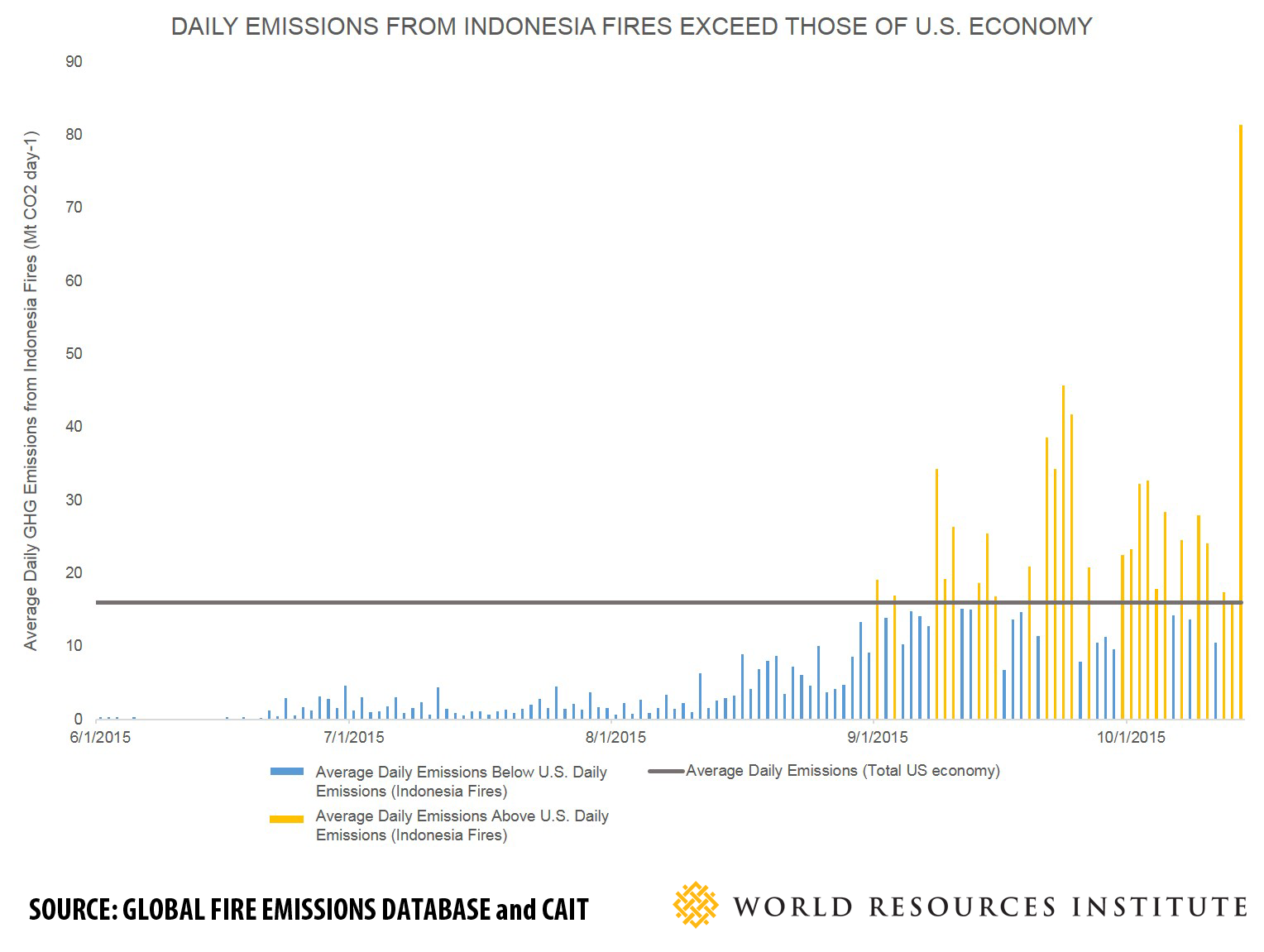
that the 2015 Indonesian fires produced more CO2e (i.e. CO2
equivalent of, in this case, CO2, CH4 and N2O) than the 2013 CO2
emissions from fossil fuel by nations such as Japan and Germany. On
26 days in August and September 2015, emissions from Indoniasian
fires exceeded the average daily emissions from all U.S. economic
activity, as shown by the WRI
imagebelow.
Methane
emissions from wildfires can sometimes be broken down relatively
quickly, especially in the tropics, due to the high levels of
hydroxyl in the atmosphere there. Conversily, methane from wildfires
at higher latitudes can persist much longer and will have strong
warming impact, especially at higher latitudes. Similarly,
CO2 emissions from wildfires in the tropics can sometimes be partly
compensated for by regrowth of vegetation after the fires. However,
regrowth can be minimal in times of drought, when forests are burned
to make way for other land uses or when peat is burned, and
especially at higher latitudes where the growth season is short and
weather conditions can be harsh. Carbon in peat lands was built up
over thousands of years and even years of regrowth cannot compensate
for this loss. A recent
studyconcludes
that there is strong correlation between fire risk for South America
and high sea surface temperatures in the Pacific Ocean and the
Atlantic Ocean. This makes the current situation very threatening. As
the image below shows, sea surface temperature anomalies were very
high on August 12, 2016.
Sea
surface temperature and anomaly. Anomalies from +1 to +2 degrees
C are red, above that they turn yellow and white

 Posts
Posts